
 Download PDF
Market Overview
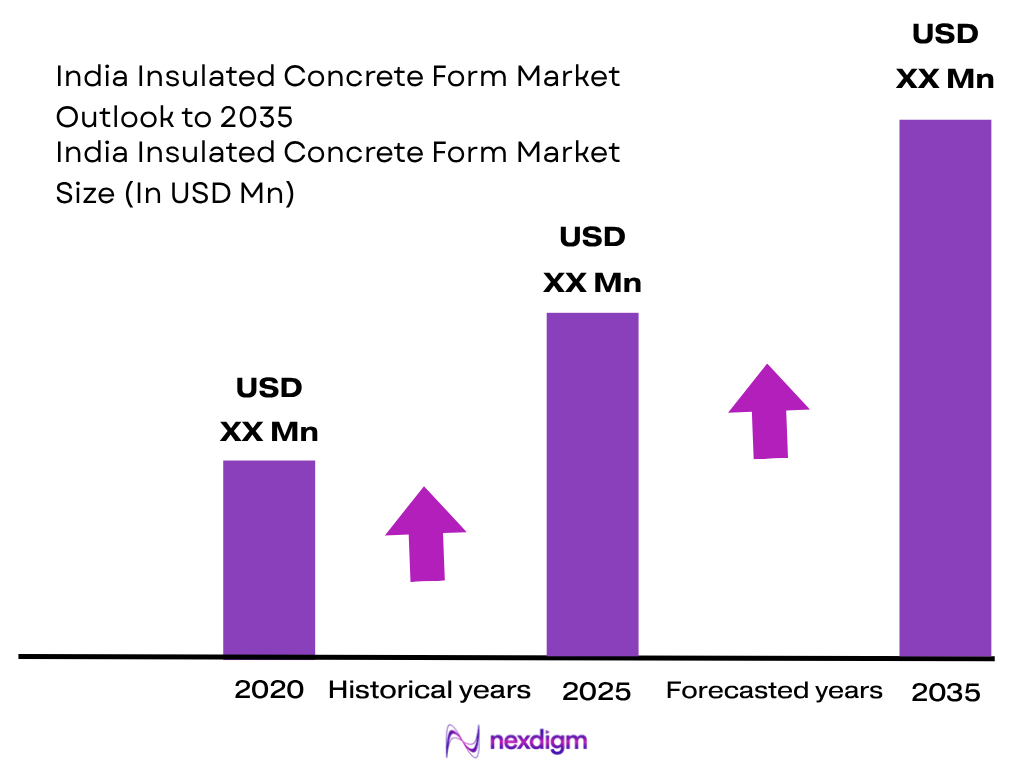
The India Insulated Concrete Form Market is valued at ~USD XX million, based on a five-year historical assessment. Demand is supported by expansion in urban housing and alternative construction technologies: PMAY-U completed housing increased from 75.31 lakh units to 85.04 lakh units, while grounded houses increased from 112.22 lakh to 114.33 lakh units. India’s GDP simultaneously increased from USD 3.50 trillion to USD 3.76 trillion, strengthening the broader construction investment environment.
Delhi-NCR, Mumbai-Pune, Bengaluru-Hyderabad, Chennai and major western and southern urban corridors represent the strongest potential ICF clusters because of concentrated residential development, premium villas, institutional projects and demand for thermally efficient construction. National PMAY-U completed housing expanded from 75.31 lakh to 85.04 lakh units, while total houses grounded increased from 112.22 lakh to 114.33 lakh. These dense construction markets also provide better access to ready-mix concrete, EPS processing, engineering services and specialized contractors.
Market Segmentation
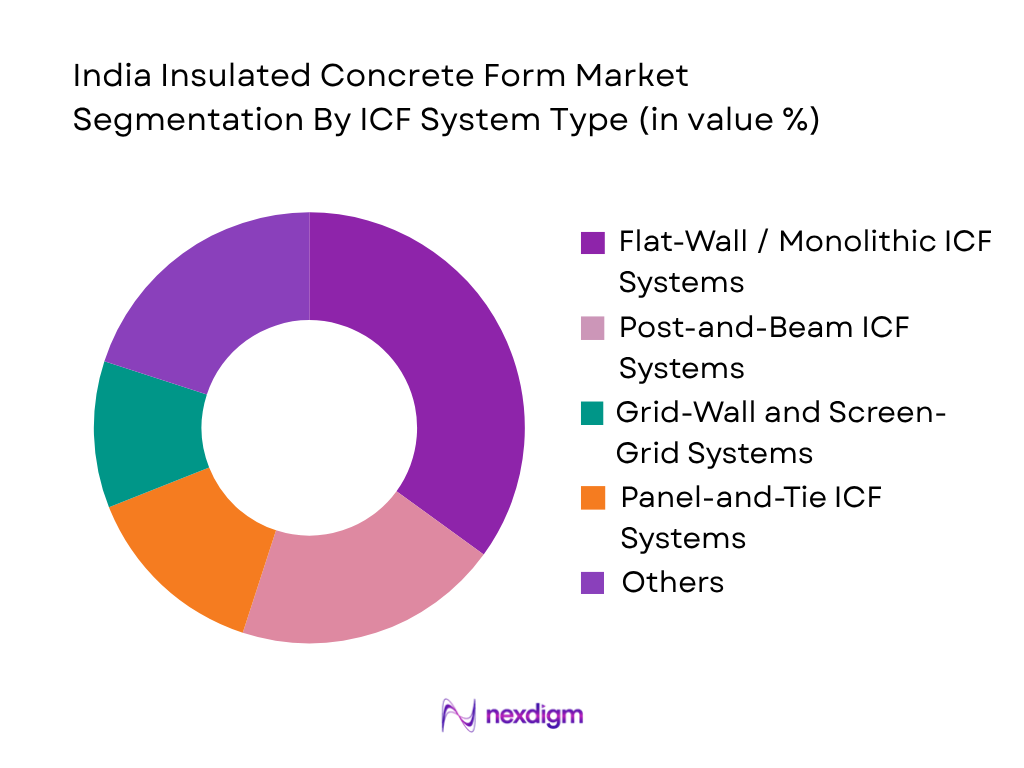
By ICF System Type
The India Insulated Concrete Form Market is segmented into flat-wall ICF systems, post-and-beam systems, grid-wall systems, screen-grid systems, panel-and-tie systems, vertical ICF systems and composite ICF systems. Flat-wall and EPS stay-in-place systems are expected to represent the dominant category because they align closely with India’s reinforced-concrete construction practices while eliminating conventional wall shuttering and adding permanent thermal insulation. Government technology documentation describes ICF construction as two EPS walls separated to create a concrete cavity, with reinforced concrete poured into the core to form a continuous load-bearing wall. The Building Materials and Technology Promotion Council has recognized stay-in-place insulated concrete formwork as an alternative to conventional brick and block masonry, increasing its relevance to mass housing and rapid construction. Systems with simple interlocking EPS forms can also reduce formwork removal activities and integrate structural concrete and insulation into a single wall assembly, making them particularly suitable for villas, low-rise residential buildings and repetitive housing projects.
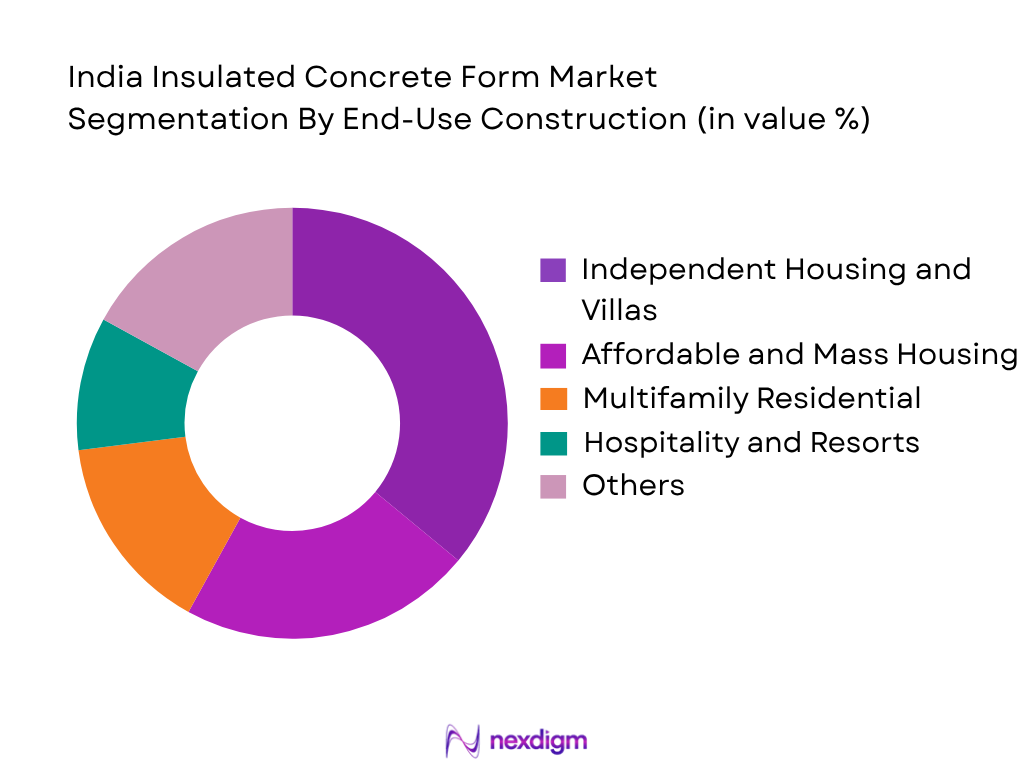
By End-Use Construction
The India Insulated Concrete Form Market is segmented into independent housing and villas, affordable and mass housing, multifamily residential buildings, hospitality, institutional buildings, commercial buildings and industrial applications. Residential construction represents the leading addressable application, supported by India’s large housing pipeline and the suitability of ICF for low-rise reinforced-concrete structures. The Ministry of Housing and Urban Affairs reported 118.64 lakh PMAY-U houses sanctioned, 114.33 lakh grounded and 85.04 lakh completed/delivered during the relevant reporting period. ICF is particularly applicable where developers require improved thermal insulation, faster wall erection, monolithic structural performance and reduced reliance on conventional brick masonry. Government technical documentation also identifies low-rise buildings as a common application for insulated concrete formwork. The combination of EPS insulation and reinforced concrete is relevant to independent homes, affordable housing, resort developments and institutional accommodation in hot, cold and high-seismic climatic zones, supporting residential construction as the principal early-adoption segment.
Competitive Landscape
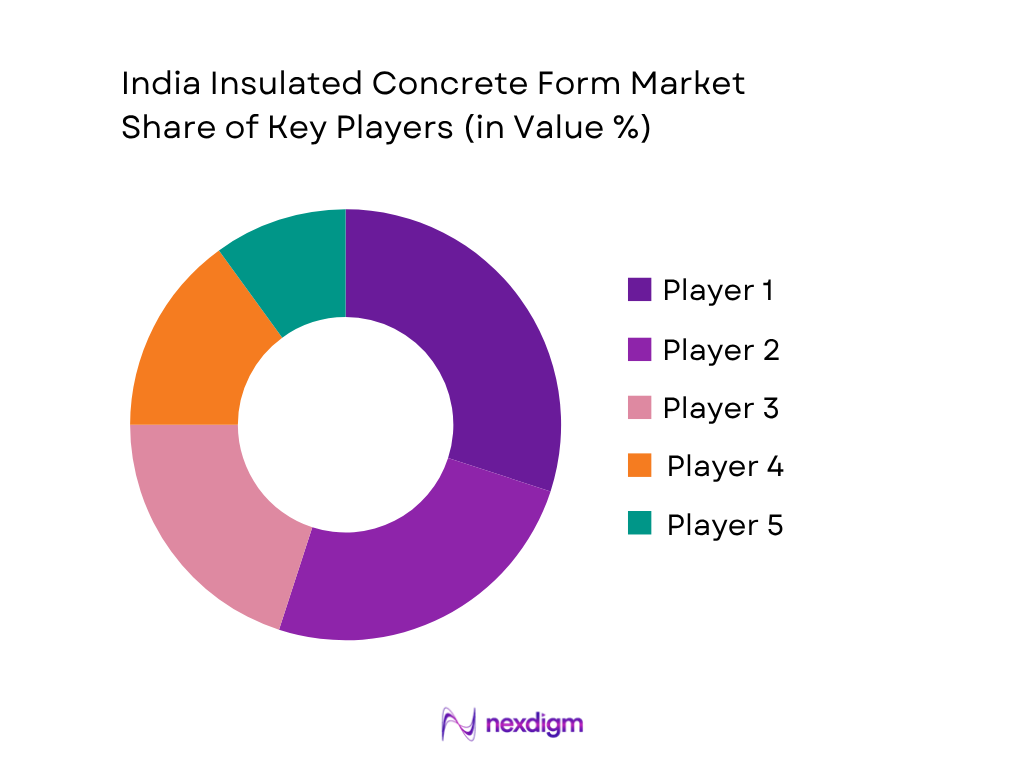
The India Insulated Concrete Form Market remains specialized and fragmented rather than concentrated around large conventional building-material companies. Domestic participants such as Reliable Building Solutions, Insubuild India and FastBloc are important because they combine ICF technology with project execution and local construction knowledge. International ICF specialists including RASTRA and Nudura provide technology benchmarks in composite forms, high-insulation wall systems, core-width flexibility and installer support. BMTPC and GHTC-India recognition of insulated stay-in-place formwork also provides an important pathway for domestic technology acceptance.
| Company | Establishment Year | Headquarters | ICF Technology | Insulating Material | Concrete Core / Structural System | Key Applications | India / Regional Position | Technical Support Capability |
| Reliable Building Solutions | 1995 | Greater Noida, Uttar Pradesh | ~ | ~ | ~ | ~ | ~ | ~ |
| Insubuild India | 2010s | India | ~ | ~ | ~ | ~ | ~ | ~ |
| FastBloc Building Systems | Not publicly disclosed | India | ~ | ~ | ~ | ~ | ~ | ~ |
| RASTRA | 1972 technology origin | International | ~ | ~ | ~ | ~ | ~ | ~ |
| Nudura | 2001 | North America | ~ | ~ | ~ | ~ | ~ | ~ |
India Insulated Concrete Form Market Analysis
Growth Drivers
Expansion of Urban and Affordable Housing Construction
India’s expanding urban housing pipeline is creating a strong demand foundation for insulated concrete form systems because ICF combines reinforced-concrete structural walls, permanent EPS insulation and stay-in-place formwork within one construction process. In 2024, PMAY-U had 1.18 crore houses sanctioned and more than 85.5 lakh houses completed and delivered, establishing a substantial pool of residential construction where industrialized building technologies can be deployed. PMAY-U 2.0 was subsequently launched to address housing requirements for an additional 1 crore urban families, further strengthening the potential project pipeline. India’s broader economic scale supports this construction activity, with 2024 GDP reaching USD 3,909.89 billion, GDP per capita reaching USD 2,694.7, and population standing at 1,450,935,791. For ICF suppliers, this housing activity is particularly relevant to affordable housing, independent homes, low-rise developments and repetitive residential projects because factory-manufactured EPS forms can replace temporary shuttering while remaining permanently around the concrete wall. Government-recognized Indian ICF configurations incorporate approximately 150 mm monolithic reinforced-concrete cores between EPS layers, providing structural and insulation functions within the same assembly. Expansion of residential construction therefore creates opportunities for ICF manufacturers to compete with conventional RCC-and-masonry construction through faster wall assembly, integrated insulation, reduced formwork handling and standardized construction processes.
Growing Adoption of Innovative Stay-in-Place Construction Technologies
Government promotion of innovative construction technologies is strengthening the environment for ICF adoption because insulated concrete forms are already recognized within India’s emerging stay-in-place formwork ecosystem. Government housing programs have shortlisted 54 proven construction technologies and classified them into 6 technology categories for application according to Indian geo-climatic requirements. Insulated concrete formwork is specifically identified as sacrificial formwork consisting of EPS layers surrounding a reinforced-concrete core, allowing the forms to remain permanently within the structure as insulation. A demonstration housing project in Bhopal has also incorporated ICF technology across 40 G+3 housing units, providing an India-specific application reference. The technology pathway has strengthened further under PMAY-U 2.0, where Affordable Housing in Partnership projects using approved innovative construction technologies can receive a Technology Innovation Grant of ₹1,000 per square metre, applicable to as much as 30 square metres per dwelling unit. India’s 2024 macroeconomic environment provides substantial construction scale, with GDP of USD 3,909.89 billion and population of 1,450,935,791. These conditions support ICF adoption because technology recognition, demonstration projects and innovation incentives can reduce specification barriers among government agencies, developers and contractors. The resulting opportunity extends beyond conventional formwork replacement toward energy-efficient, disaster-resilient and faster reinforced-concrete housing.
Market Challenges
Limited ICF-Specific Installation and Execution Ecosystem
India’s ICF market faces an important execution challenge because insulated concrete construction requires capabilities beyond those used in conventional brick masonry. Government-recognized ICF construction involves factory-produced EPS forms, reinforced-concrete placement and permanent insulation functioning together as one wall system. One recognized configuration uses 2 EPS layers separated to accommodate a nominal 150 mm reinforced-concrete core, requiring accurate block alignment, reinforcement placement, bracing and controlled concrete pouring. Government documentation on emerging technologies currently places ICF within a broader group of 6 technology categories and 54 shortlisted technologies, indicating that ICF competes for contractor familiarity and institutional attention alongside numerous alternative systems. India’s construction pipeline is enormous relative to the specialized ICF installer base: PMAY-U alone had 1.18 crore sanctioned houses and more than 85.5 lakh completed houses in 2024. PMAY-U 2.0 subsequently expanded the addressable housing program toward another 1 crore eligible urban families. India also had a population of 1,450,935,791 and GDP of USD 3,909.89 billion in 2024, reflecting the scale and geographical dispersion of construction demand. ICF suppliers consequently need trained installers, structural engineers, concrete-pouring expertise and local technical support across multiple states. Without a deeper regional execution network, manufacturers can face difficulties converting broad housing demand into ICF projects, particularly outside established metropolitan construction clusters.
Strong Competition from Established and Alternative Wall Construction Systems
The India Insulated Concrete Form Market must compete with conventional RCC-masonry construction as well as a growing range of government-recognized industrialized building technologies. India’s housing technology ecosystem includes 54 shortlisted proven technologies grouped into 6 categories, covering precast systems, prefabricated systems, stay-in-place formwork and other alternative construction methods. Within stay-in-place formwork alone, government documentation identifies at least 8 distinct technology configurations, including insulated concrete forms, EPS-based systems, galvanized-steel formwork, PVC formwork and fibre-cement-board systems. Consequently, ICF suppliers must demonstrate measurable structural, thermal and construction-productivity advantages rather than relying solely on faster erection. The competitive pressure is magnified by India’s large housing pipeline. PMAY-U had 1.18 crore sanctioned houses and more than 85.5 lakh completed and delivered houses in 2024, while PMAY-U 2.0 targets housing support for another 1 crore urban families. The country’s 2024 GDP stood at USD 3,909.89 billion, with GDP per capita of USD 2,694.7 and population of 1,450,935,791, supporting a construction ecosystem large enough for multiple competing technologies. ICF therefore faces a technology-conversion challenge: architects, structural engineers, developers and contractors must be convinced to move away from familiar RCC frames, brick masonry, AAC blocks and other established construction systems toward permanently insulated reinforced-concrete walls.
Market Opportunities
PMAY-U 2.0 Creates a Scalable Affordable-Housing Application Opportunity
India’s affordable-housing pipeline provides a significant future opportunity for ICF manufacturers because PMAY-U 2.0 creates a structured pathway for innovative construction technologies in repetitive residential development. The scheme was launched from 1 September 2024 to support 1 crore additional eligible urban beneficiaries seeking to construct, purchase or rent affordable housing. Affordable Housing in Partnership projects provide an especially relevant pathway because eligible dwellings generally have 30-45 square metres of carpet area, creating standardized residential configurations suitable for repetitive ICF wall construction. The scheme also provides a Technology Innovation Grant of ₹1,000 per square metre for AHP projects using approved innovative technologies, applicable to as much as 30 square metres per dwelling unit. Depending on location and vertical, Central assistance can reach ₹2.50 lakh per unit, while the broader program provides Central assistance of up to ₹2.50 lakh crore. These current program parameters provide a tangible opportunity for ICF suppliers without requiring assumptions about future construction volumes. India’s 2024 GDP of USD 3,909.89 billion, GDP per capita of USD 2,694.7, and population of 1,450,935,791 reinforce the long-term requirement for scalable urban housing solutions. ICF companies can capitalize through domestic EPS-form production, standardized affordable-housing designs, partnerships with AHP developers, installer training and government-approved demonstration projects.
Sustainable and Disaster-Resilient Housing Opens Higher-Performance ICF Applications
Sustainable and disaster-resilient housing represents a strong future expansion opportunity for India’s ICF market because current government construction policy increasingly prioritizes climate-responsive, energy-efficient and structurally resilient technologies. India’s Technology and Innovation Sub-Mission supports materials and construction processes designed for sustainable, faster and disaster-resilient development, while 54 globally proven technologies across 6 categories have already been shortlisted for adaptation to Indian geo-climatic conditions. ICF has direct relevance because recognized Indian systems use permanent EPS insulation surrounding a reinforced-concrete structural core, with one documented configuration incorporating a nominal 150 mm monolithic concrete core. The technology has also been demonstrated in a 40-unit G+3 housing project in Bhopal, establishing an Indian residential reference rather than relying exclusively on overseas applications. The potential application base is expanding through PMAY-U 2.0, which addresses 1 crore additional eligible urban beneficiaries, while the preceding PMAY-U program had already completed and delivered more than 85.5 lakh houses in 2024. India’s macroeconomic foundation further supports higher-performance construction: GDP stood at USD 3,909.89 billion, GDP per capita at USD 2,694.7, and population at 1,450,935,791 in 2024. These conditions create future opportunities for ICF in cyclone-prone coastal housing, seismic regions, cold-climate buildings, institutional accommodation, premium villas and energy-efficient residential developments where structural resilience and continuous insulation can be specified together.
Future Outlook
The India Insulated Concrete Form Market is projected to expand at approximately ~XX% CAGR during 2026-2035, supported by increasing demand for rapid construction, thermal-performance improvement, monolithic concrete construction and alternative building technologies. Growth is expected to remain selective initially, concentrating in premium housing, villas, institutional developments, cold-climate projects and locations where conventional masonry construction creates labor, speed or thermal-performance constraints. Government acceptance of alternative construction systems can improve future specification opportunities. GHTC-India and BMTPC documentation explicitly includes insulated concrete formwork among stay-in-place construction systems evaluated for housing applications. The technology provides permanent insulation while the reinforced-concrete core carries structural loads, creating a direct fit with India’s established RCC engineering environment.
Affordable housing provides another expansion pathway. PMAY-U 2.0 was approved to support 1 crore urban poor and middle-class families, backed by planned investment of ₹10 lakh crore and government assistance of ₹2.30 lakh crore. While ICF will compete with precast, aluminium formwork, AAC masonry and other rapid-construction systems, projects prioritizing thermal comfort and integrated insulation provide a specific opportunity for ICF suppliers.
Major Players
- Reliable Building Solutions
- Insubuild India
- FastBloc Building Systems
- RASTRA
- Amvic Building System
- Nudura
- Fox Blocks
- BuildBlock Building Systems
- Quad-Lock Building Systems
- SuperForm Products
- LiteForm Technologies
- IntegraSpec
- Faswall
- Polycrete International
- The Perfect Block
Key Target Audience
- Insulated Concrete Form Manufacturers and Technology Providers
- EPS Resin, EPS Moulding and Building-Insulation Manufacturers
- Residential, Affordable Housing and Real Estate Developers
- EPC Contractors, General Contractors and Specialized ICF Installers
- Ready-Mix Concrete, Reinforcement and Construction Material Suppliers
- Architectural, Structural Engineering and Building Design Firms
- Investments and Venture Capitalist Firms
- Government and Regulatory Bodies (Ministry of Housing and Urban Affairs, Building Materials and Technology Promotion Council, Bureau of Indian Standards, Central Public Works Department, Ministry of Power and State Urban Development Authorities)
Research Methodology
Step 1: Identification of Key Variables
The initial phase involves constructing an ecosystem map covering ICF manufacturers, EPS processors, ready-mix concrete producers, reinforcement suppliers, developers, architects, contractors, government housing agencies and installers operating in India. Desk research identifies key variables including installed ICF wall area, form consumption, system type, concrete-core configuration, insulation thickness, end-use mix, geographical demand, manufacturing capability and project-level technology acceptance.
Step 2: Market Analysis and Construction
Historical market analysis combines top-down construction indicators with bottom-up ICF supply assessment. Residential construction, government housing activity, alternative-technology adoption, regional climate requirements and construction-system substitution are evaluated alongside manufacturer projects, block volumes, installed wall areas and distributor activity. The resulting framework is used to estimate domestic ICF consumption while avoiding double counting between material supply, turnkey construction and installation revenue.
Step 3: Hypothesis Validation and Expert Consultation
Market hypotheses are validated through computer-assisted telephone interviews and direct discussions with ICF manufacturers, EPS processors, structural engineers, architects, real estate developers, contractors and installers. Interviews focus on ICF specification rates, preferred wall configurations, concrete-core thicknesses, installation productivity, labour requirements, thermal benefits, project economics, competition from masonry and alternative formwork systems, and barriers to wider adoption across different Indian regions.
Step 4: Research Synthesis and Final Output
The final stage triangulates primary research with government housing statistics, company project information, construction indicators and technology-approval documentation. Bottom-up manufacturer and installer assessments are reconciled with top-down residential and non-residential construction activity. Segment shares, competitive positioning, regional opportunities and long-term market forecasts are subsequently developed after consistency checks across wall-area consumption, block requirements, concrete-core configuration and project-level ICF adoption.

- Executive Summary
- Research Methodology (Market Definition and Scope, India Insulated Concrete Form Market Classification, ICF System Demand Assessment, EPS and Composite Insulating Form Consumption Mapping, Domestic ICF Manufacturing Capacity Assessment, Imported ICF Technology Assessment, EPS Resin and Concrete Raw Material Assessment, ICF Block Moulding and Installation Technology Mapping, Building Application-Level Demand Assessment, Residential and Non-Residential Construction Mapping, Primary Industry Interviews, Top-Down Market Sizing, Bottom-Up Company Revenue and Installation Volume Assessment, Construction Activity Analysis, Data Triangulation, Pricing Assessment, Forecasting Framework)

- Definition and Scope
- India Insulated Concrete Form Industry Evolution and Development of Energy-Efficient, Disaster-Resilient and Stay-in-Place Concrete Formwork Ecosystem
- ICF Block Manufacturing, EPS Moulding, Reinforcing Steel, Ready-Mix Concrete and Installation Industry Structure
- India Insulated Concrete Form Value Chain Analysis
- India Insulated Concrete Form Supply Chain Analysis
- EPS Resin Supplier, ICF Block Manufacturer, Concrete Producer, Reinforcement Supplier, Distributor, ICF Installer, Developer, Contractor and Building Owner Ecosystem Analysis
- ICF Construction Integration Across Foundations, External Walls, Load-Bearing Walls, Residential Buildings, Institutional Structures and Disaster-Resilient Applications

- Growth Drivers (Expansion of Affordable and Urban Housing Construction, Demand for Faster Building Systems, Growing Thermal Comfort Requirements, Cooling Energy Reduction Requirements, Expansion of Green Building Construction, Disaster-Resilient Housing Demand, Labour Productivity Improvement, Monolithic Reinforced Concrete Construction, Increasing Adoption of Alternative Construction Technologies)
- Market Challenges (Limited ICF Contractor Familiarity, Low Architect and Developer Awareness, Limited Domestic ICF Manufacturing Scale, Concrete Pour Quality-Control Requirements, ICF Bracing Complexity, Reinforcement and Services Coordination, Competition from AAC Blocks and Conventional RCC-Masonry Construction, Fragmented Installer Networks, Technology Approval and Project Specification Barriers)
- Market Opportunities (Affordable Housing Applications, Premium Energy-Efficient Villas, Seismic-Zone Housing, Cyclone-Resistant Coastal Housing, Himalayan and Cold-Climate Construction, Institutional Buildings, Hotels and Resorts, Defence Housing, Net-Zero and Low-Energy Buildings, Domestic ICF Manufacturing Localization)
- Market Trends (Stay-in-Place EPS Formwork Adoption, Monolithic Reinforced Concrete Walls, Reversible ICF Blocks, Wider Concrete Core Configurations, Integrated Rebar Holders, Graphite-Enhanced EPS, Recycled EPS Composite Forms, BIM-Compatible ICF Design, Factory-Moulded Interlocking Forms, Whole-Building Insulated Concrete Envelopes)
- Regulatory and Standards Landscape (National Building Code Requirements, BIS Structural Concrete Standards, Seismic Design Requirements, Cyclone and Wind Load Requirements, Fire Safety Requirements, Energy Conservation and Sustainable Building Code Requirements, Eco-Niwas Samhita Building Envelope Requirements, BMTPC Emerging Construction Technology Evaluation, Ministry of Housing and Urban Affairs Technology Adoption Programs)
- SWOT Analysis
- Porter’s Five Forces Analysis
- PESTLE Analysis
- Stakeholder Ecosystem
- Competition Ecosystem

- By Market Value (2020-2025)
- By ICF Form Consumption Volume (2020-2025)
- By Installed ICF Wall Area (2020-2025)
- By Domestic ICF Production Volume (2020-2025)
- By EPS Consumption in ICF Applications (2020-2025)
- By Concrete Consumption Through ICF Construction (2020-2025)
- By Residential ICF Installation Volume (2020-2025)
- By Average Selling Price (2020-2025)

- By ICF System Type (In Value %)
Flat-Wall ICF Systems
Post-and-Beam ICF Systems
Grid-Wall ICF Systems
Screen-Grid ICF Systems
Panel-and-Tie ICF Systems
Vertical ICF Systems
Composite ICF Systems
Stay-in-Place EPS Concrete Formwork Systems - By Insulating Form Material (In Value %)
Expanded Polystyrene ICF
Graphite-Enhanced Expanded Polystyrene ICF
Polyurethane-Based ICF
Cement-Bonded EPS Composite Forms
Cement-Bonded Wood-Fibre Forms
Hybrid Insulated Concrete Forms
Recycled EPS-Cement Composite Forms
Other Insulated Stay-in-Place Form Materials - By Building Application (In Value %)
External Load-Bearing Walls
Internal Structural Walls
Foundations and Basement Walls
Low-Rise Structural Shells
Multi-Storey Structural Walls
Retaining and Boundary Structures
Safe Rooms and Disaster-Resistant Structures
Insulated Concrete Floor and Roof Integration - By End-Use Construction (In Value %)
Single-Family and Independent Housing
Affordable and Mass Housing
Villas and Premium Residential Construction
Multifamily Residential Buildings
Hotels and Hospitality
Schools and Educational Buildings
Healthcare Facilities
Government and Institutional Buildings
Commercial Buildings
Industrial and Warehouse Buildings
Defence and Strategic Infrastructure - By Building Performance Requirement (In Value %)
Thermally Insulated Building Envelopes
Low Heat-Gain Construction
Energy-Efficient Residential Buildings
Earthquake-Resistant Construction
Cyclone-Resistant Construction
Flood-Resilient Construction
Fire-Resistant Construction
Acoustically Insulated Buildings
Low-Air-Infiltration Buildings
High-Performance Green Buildings

- Market Share of Major Players (By India Revenue, ICF Form Consumption Volume, Installed ICF Wall Area, ICF System Portfolio, Building Application, End-Use Construction, India Manufacturing and Distribution Footprint, Regional Project Presence)
- Cross Comparison Parameters (India ICF Revenue, ICF Block and Stay-in-Place Form Portfolio Breadth, Available Concrete Core Thickness Range, EPS Density and Thermal Insulation Configuration, India Manufacturing and Moulding Capability, Residential-Institutional-Disaster-Resilient Project Coverage, India Distributor and Installer Network Footprint, Contractor Training and Structural Design Support Capability)
- SWOT Analysis of Major Players
- Competitive Positioning Matrix
- ICF System Architecture and Product Portfolio Benchmarking
- Pricing and ICF System Category Benchmarking
- Thermal, Structural and Disaster-Resilience Performance Assessment
- Manufacturing, EPS Moulding and ICF Installation Technology Assessment
- End-Use Construction and Regional Project Exposure Assessment
- Detailed Profiles of Major Companies
Reliable Building Solutions
Insubuild India
Fast Bloc Building System
RASTRA
Amvic Building System
Nudura
Fox Blocks
BuildBlock Building Systems
Quad-Lock Building Systems
SuperForm Products
LiteForm Technologies
IntegraSpec
Faswall
Polycrete International
The Perfect Block

- Residential Developer ICF Adoption Assessment
- Affordable and Mass Housing Developer ICF Requirement Analysis
- Premium Villa and Independent Homebuilder ICF Adoption Assessment
- Multifamily Developer Insulated Concrete Construction Assessment
- Hospitality Developer ICF Requirement Analysis
- Institutional Building ICF Adoption Assessment
- Architect and Structural Engineer ICF Specification Assessment
- Government Housing Contractor ICF Procurement Analysis
- ICF Installer and Concrete Contractor Requirement Assessment
- Building Owner Energy Efficiency and Structural Resilience Assessment

- By Market Value (2026-2035)
- By ICF Form Consumption Volume (2026-2035)
- By Installed ICF Wall Area (2026-2035)
- By Domestic ICF Production Volume (2026-2035)
- By EPS Consumption in ICF Applications (2026-2035)
- By Concrete Consumption Through ICF Construction (2026-2035)
- By Residential ICF Installation Volume (2026-2035)
- By Average Selling Price (2026-2035)


 Request a Sample
 Ask for Customization
 Get a Quote
 Enquire Now