

 Download PDF
 Download PDF
Market Overview
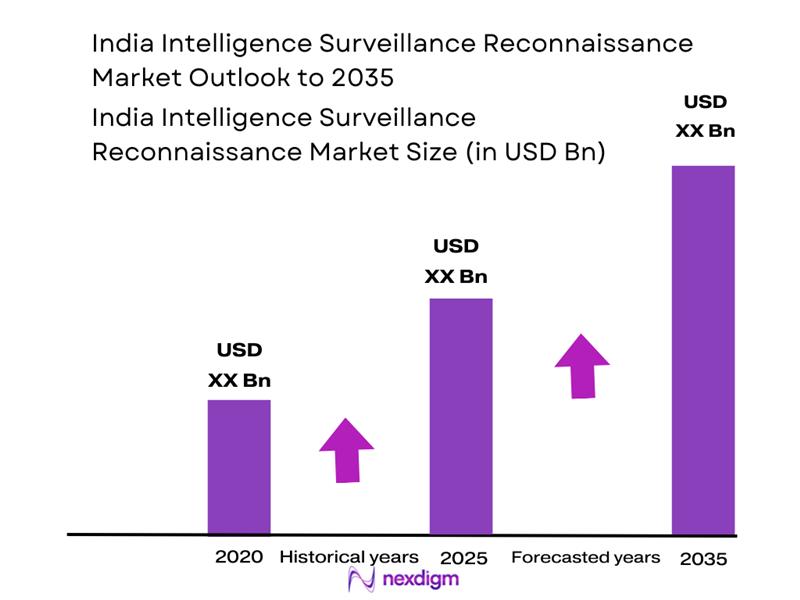
Based on a recent historical assessment, the India Intelligence Surveillance Reconnaissance market was valued at USD ~ billion, supported by officially disclosed defense capital acquisition allocations and parliamentary budget documents. The market size is driven by sustained investments in battlefield awareness, border monitoring, space-based surveillance, and network-centric warfare programs. Government-backed modernization initiatives, indigenous electronics manufacturing, and long-term ISR platform procurement have strengthened demand. Rising emphasis on persistent surveillance, data fusion, and real-time intelligence dissemination continues to reinforce spending across air, land, naval, and space domains.
Based on a recent historical assessment, New Delhi, Bengaluru, Hyderabad, and Pune dominate the India Intelligence Surveillance Reconnaissance market due to institutional concentration, industrial ecosystems, and operational command presence. New Delhi drives demand through policy formulation, procurement oversight, and intelligence agency headquarters. Bengaluru leads through aerospace engineering, avionics design, and ISR software development clusters. Hyderabad supports electronics manufacturing and missile-related surveillance integration. Pune contributes through military command infrastructure and testing facilities. National dominance is reinforced by border security priorities, maritime monitoring requirements, and expanding satellite intelligence programs.
Market Segmentation
By Product Type
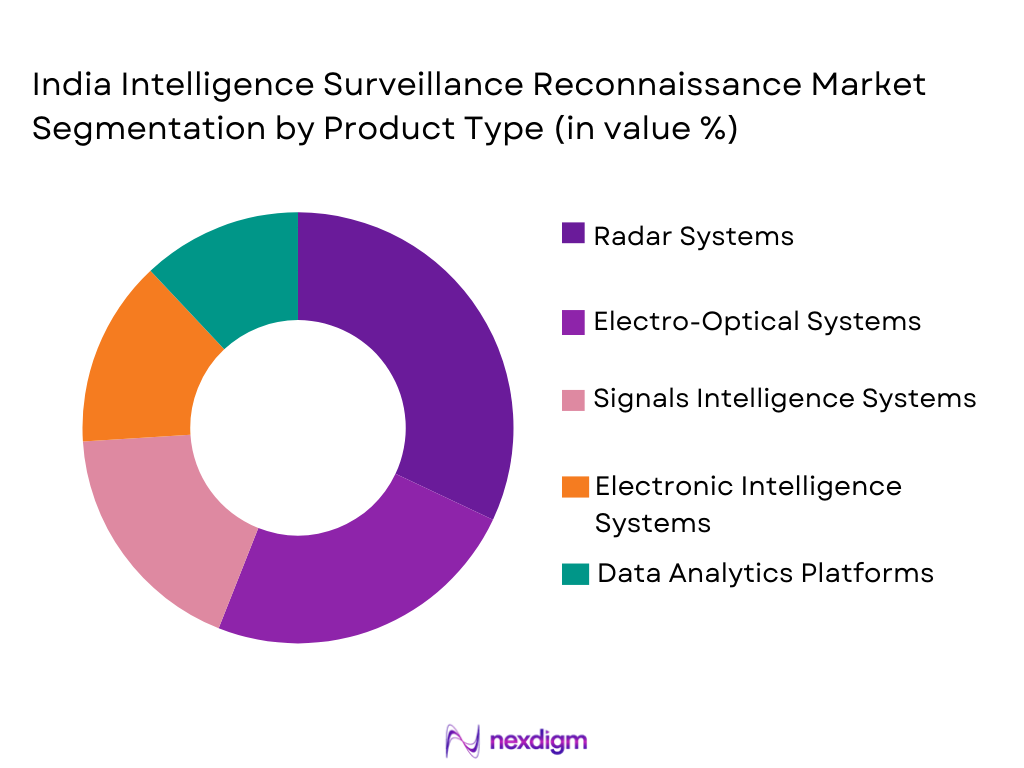
India Intelligence Surveillance Reconnaissance market is segmented by product type into electro-optical systems, radar systems, signals intelligence systems, electronic intelligence systems, and data analytics platforms. Recently, radar systems have a dominant market share due to demand patterns linked to border surveillance, maritime domain awareness, and all-weather operational requirements. Persistent monitoring needs across diverse terrains, combined with the ability to detect, track, and classify targets over long ranges, have strengthened radar adoption. Indigenous radar development programs, integration with airborne and ground platforms, and compatibility with networked command systems have further reinforced dominance. Continuous upgrades and lifecycle extensions have sustained procurement momentum.
By Platform Type
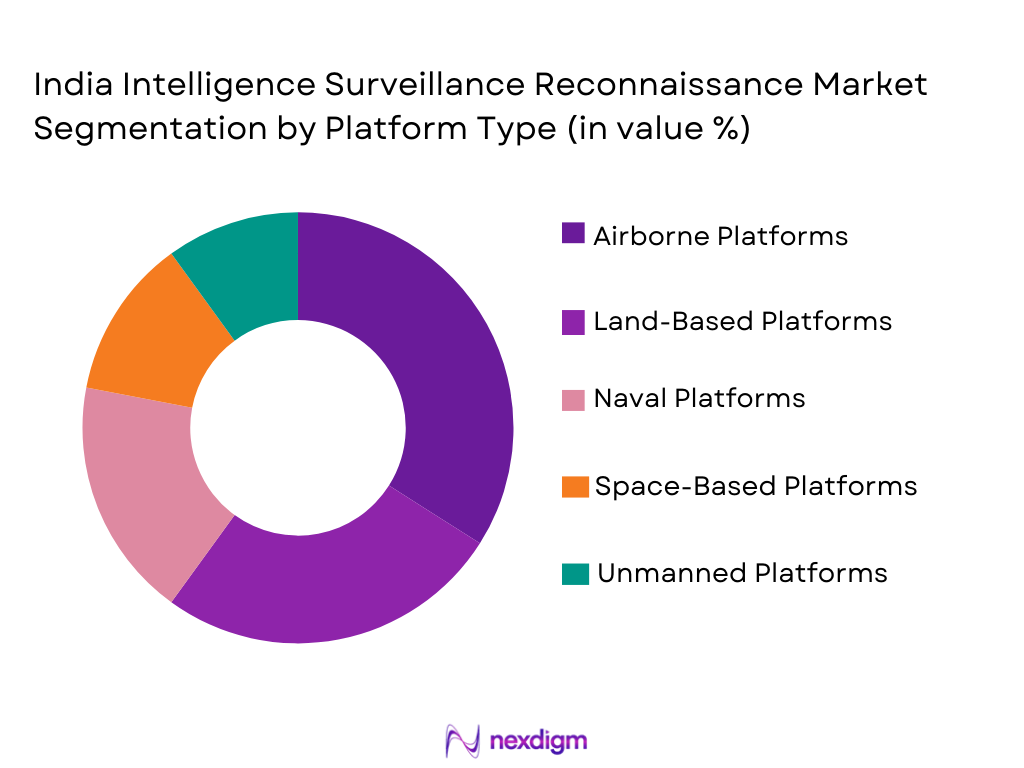
India Intelligence Surveillance Reconnaissance market is segmented by platform type into airborne, land-based, naval, space-based, and unmanned platforms. Recently, airborne platforms have a dominant market share due to demand patterns emphasizing flexibility, rapid deployment, and wide-area coverage. Airborne ISR assets support both strategic and tactical missions, offering persistent intelligence collection and real-time data relay. Integration with fighter aircraft, special mission aircraft, and helicopters has expanded operational utility. Strong domestic aerospace capabilities, combined with ongoing fleet upgrades and sensor integration programs, have sustained airborne platform dominance across multiple defense services.
Competitive Landscape
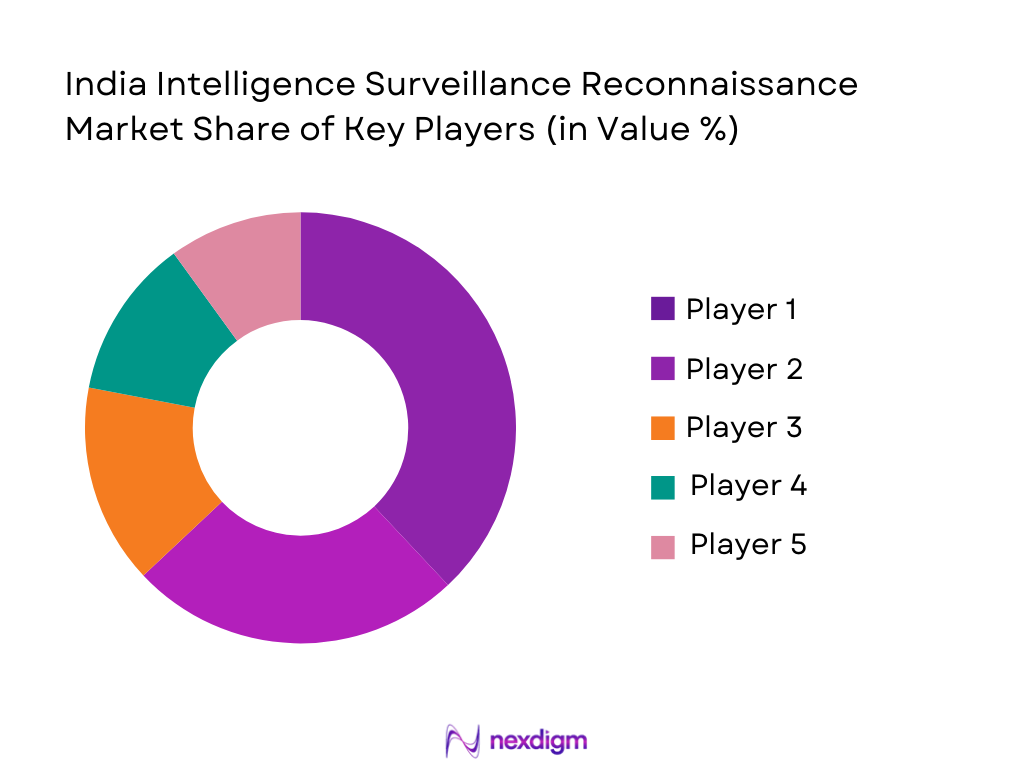
The India Intelligence Surveillance Reconnaissance market exhibits moderate consolidation, with a mix of large public sector enterprises and private defense manufacturers shaping competition. Long-term government contracts, technology partnerships, and indigenization mandates influence competitive positioning, while established players benefit from integration experience and lifecycle support capabilities.
| Company Name | Establishment Year | Headquarters | Technology Focus | Market Reach | Key Products | Revenue | Indigenous Content Level |
| Bharat Electronics Limited | 1954 | Bengaluru | ~ | ~ | ~ | ~ | ~ |
| Hindustan Aeronautics Limited | 1940 | Bengaluru | ~
|
~
|
~
|
~
|
~
|
| Tata Advanced Systems | 2010 | Hyderabad | ~
|
~
|
~
|
~
|
~
|
| Larsen and Toubro Defence | 2011 | Mumbai | ~
|
~
|
~
|
~
|
~
|
| Mahindra Defence Systems | 2015 | Mumbai | ~
|
~
|
~
|
~
|
~
|
India Intelligence Surveillance Reconnaissance Market Analysis
Growth Drivers
Border and Maritime Surveillance Modernization:
Border and Maritime Surveillance Modernization is a central growth driver for the India Intelligence Surveillance Reconnaissance market because national security priorities increasingly emphasize persistent monitoring of land borders, coastlines, and maritime approaches to address evolving threat environments. Complex terrain conditions, extended coastlines, island territories, and dense maritime traffic have created sustained demand for continuous situational awareness supported by integrated surveillance architectures. Government-backed investments in coastal surveillance networks, border monitoring grids, long-range radars, and sensor fusion centers have translated into consistent procurement activity across multiple defense and security agencies. Airborne surveillance aircraft, maritime patrol platforms, and ground-based sensor systems are being deployed to close intelligence gaps and improve response coordination. Indigenous radar development programs and domestic electronics manufacturing have strengthened supply reliability while reducing external dependency risks. Lifecycle upgrades of existing ISR assets further contribute to spending continuity by extending operational relevance and enhancing performance. Inter-agency intelligence sharing frameworks are reinforcing the need for interoperable systems capable of real-time data exchange. Maritime domain awareness initiatives, including port surveillance and shipping lane monitoring, add an additional layer of demand. Collectively, these factors embed border and maritime surveillance modernization as a structurally sustained driver of market expansion.
Network-Centric Warfare and Real-Time Intelligence Integration:
Network-Centric Warfare and Real-Time Intelligence Integration drives the India Intelligence Surveillance Reconnaissance market by reshaping operational doctrines around information dominance and synchronized decision making. Defense forces increasingly depend on ISR systems to provide timely, accurate, and fused intelligence across air, land, sea, and space domains. Integrated sensor networks enable commanders to access unified operational pictures rather than fragmented data streams. Data fusion platforms transform large volumes of sensor data into actionable intelligence under compressed timelines. Secure communication networks enhance interoperability between services and command hierarchies. Artificial intelligence applications improve target recognition, anomaly detection, and predictive threat assessment. Cloud-enabled intelligence architectures support scalable processing, storage, and dissemination requirements. Training reforms and doctrinal alignment reinforce adoption of network-centric operational concepts. Sustained modernization roadmaps ensure long-term investment continuity in integrated ISR capabilities.
Market Challenges
Integration Complexity Across Legacy and Modern ISR Platforms:
Integration Complexity Across Legacy and Modern ISR Platforms presents a persistent challenge for the India Intelligence Surveillance Reconnaissance market due to the coexistence of heterogeneous systems procured across different time periods and technological standards. Many legacy ISR assets were designed with proprietary architectures that limit seamless integration with modern digital platforms. Retrofitting advanced sensors, analytics software, and secure communication links onto older platforms requires extensive customization and validation. These integration efforts often extend project timelines and elevate program execution risks. Interoperability testing across services demands specialized expertise and infrastructure. Cybersecurity vulnerabilities may emerge when bridging legacy and modern systems, necessitating additional safeguards. Skilled systems engineering and integration talent remains limited relative to increasing technological complexity. Budgetary constraints can restrict the scope of modernization programs. As a result, integration complexity increases lifecycle costs and slows operational deployment.
Dependence on Imported Critical ISR Technologies and Components:
Dependence on Imported Critical ISR Technologies and Components constrains market resilience and strategic autonomy by exposing supply chains to external risks. Advanced sensors, specialized electronics, and select software modules often rely on foreign suppliers. Export control regulations and geopolitical considerations can disrupt procurement schedules and technology access. Limited technology transfer restricts customization for specific operational requirements. Import-related cost volatility complicates long-term budget planning. Maintenance dependencies affect system availability throughout service life. Indigenous substitutes require extended development, testing, and certification cycles. Qualification processes for domestically developed components can delay induction. Strategic autonomy objectives remain partially unmet under such dependencies. Addressing this challenge requires sustained domestic capability development.
Opportunities
Expansion of Indigenous ISR System Design and Manufacturing Capabilities:
Expansion of Indigenous ISR System Design and Manufacturing Capabilities represents a major opportunity for the India Intelligence Surveillance Reconnaissance market as national security policy increasingly prioritizes self-reliance, localized value chains, and long-term capability ownership. Government-backed defense manufacturing frameworks encourage domestic firms to move beyond component supply toward complete system design, integration, and lifecycle support. Indigenous development reduces exposure to external supply disruptions while improving program execution predictability. Locally designed ISR solutions can be optimized for specific terrain, climate, and mission profiles unique to national operational environments. Cost efficiencies emerge through reduced import dependence, localized maintenance, and shorter logistics chains. Growing confidence in domestic engineering capability strengthens procurement preference for locally developed systems. Export potential expands as partner nations seek affordable and customizable ISR platforms. Skill development initiatives enhance systems engineering depth across public and private sectors. Collectively, these dynamics position indigenous ISR manufacturing as a structurally sustainable growth opportunity.
Growth of Space-Based Surveillance and Advanced Intelligence Analytics Ecosystems:
Growth of Space-Based Surveillance and Advanced Intelligence Analytics Ecosystems offers a high-impact opportunity for the India Intelligence Surveillance Reconnaissance market as space assets become central to modern intelligence architectures. Expanding satellite constellations enable persistent earth observation, signals collection, and strategic monitoring across wide geographic areas. Space-based ISR supports early warning, force posture assessment, and long-term threat analysis. Downstream analytics platforms convert satellite data into actionable intelligence for multiple defense users. Integration of artificial intelligence accelerates image interpretation and anomaly detection. Public private collaboration enhances capacity expansion and technology infusion. Dual-use commercial participation improves economic viability of space surveillance investments. Secure data processing frameworks strengthen trust across agencies. Long-term mission requirements ensure sustained demand for space-enabled intelligence solutions.
Future Outlook
The India Intelligence Surveillance Reconnaissance market is expected to maintain steady growth over the next five years, supported by sustained defense modernization and indigenization policies. Technological advancements in sensors, analytics, and secure communications will shape procurement priorities. Regulatory support for domestic manufacturing will enhance supply resilience. Demand-side factors such as border security, maritime awareness, and space surveillance will continue to drive long-term investment momentum.
Major Players
- Bharat Electronics Limited
- Hindustan Aeronautics Limited
- Larsen and Toubro Defence
- Tata Advanced Systems
- Mahindra Defence Systems
- Alpha Design Technologies
- Data Patterns India
- Astra Microwave Products
- Paras Defence and Space Technologies
- Centum Electronics
- MTAR Technologies
- ideaForge Technology
- NewSpace India Limited
- Ananth Technologies
Key Target Audience
- Defense ministries and armed forces
- Intelligence and security agencies
- Aerospace and defense manufacturers
- System integrators and OEMs
- Investments and venture capitalist firms
- Government and regulatory bodies
- Satellite and space service providers
- Homeland security organizations
Research Methodology
Step 1: Identification of Key Variables
Key variables related to platforms, technologies, procurement channels, and end users were identified through defense publications and budget documents. Operational requirements and policy drivers were mapped. Technology maturity levels were assessed. Market boundaries were defined.
Step 2: Market Analysis and Construction
Data from official defense sources and company disclosures were analyzed. Segment-level demand patterns were structured. Competitive positioning was evaluated. Market size consistency checks were applied.
Step 3: Hypothesis Validation and Expert Consultation
Preliminary findings were validated through expert interviews and technical reviews. Assumptions were stress-tested. Policy implications were assessed. Revisions were incorporated.
Step 4: Research Synthesis and Final Output
Validated insights were synthesized into structured sections. Quantitative and qualitative findings were aligned. Consistency and compliance checks were completed. Final documentation was prepared.

- Executive Summary
- India Intelligence Surveillance Reconnaissance Market Research Methodology
(Definitions, Scope, Industry Assumptions, Market Sizing Approach, Primary & Secondary Research Framework, Data Collection & Verification Protocol, Analytic Models & Forecast Methodology, Limitations & Research Validity Checks)

- Market Definition and Scope
- Value Chain & Stakeholder Ecosystem
- Regulatory / Certification Landscape
- Sector Dynamics Affecting Demand
- Strategic Initiatives & Infrastructure Growth

- Growth Drivers
Rising defense modernization and network-centric warfare adoption
Expansion of border surveillance and maritime domain awareness initiatives
Increased reliance on unmanned and space-based reconnaissance platforms
Integration of artificial intelligence for real-time intelligence processing
Growing inter-agency intelligence sharing and joint operational frameworks - Market Challenges
High system integration complexity across legacy platforms
Dependence on imported critical subsystems and technologies
Data security and cyber vulnerability risks in ISR networks
Budget allocation constraints and long procurement cycles
Skilled workforce shortages for advanced ISR operations - Market Opportunities
Indigenous development under national defense manufacturing programs
Expansion of satellite-based and high-altitude ISR capabilities
Private sector participation in analytics and software-driven ISR solutions - Trends
Shift toward multi-domain integrated ISR architectures
Growing use of autonomous and remotely operated surveillance assets
Increased emphasis on real-time data fusion and decision support
Adoption of cloud-enabled intelligence processing environments
Enhanced focus on persistent surveillance and wide-area monitoring - Government Regulations & Defense Policy
Strengthening of indigenization and import substitution mandates
Policy support for private sector and startup participation in defense
Emphasis on secure data governance and classified information handling - SWOT Analysis
Stakeholder and Ecosystem Analysis
Porter’s Five Forces Analysis
Competition Intensity and Ecosystem Mapping

- By Market Value, 2020-2025
- By Installed Units, 2020-2025
- By Average System Price, 2020-2025
- By System Complexity Tier, 2020-2025

- By System Type (In Value%)
Signals Intelligence Systems
Imagery Intelligence Systems
Electronic Intelligence Systems
Measurement and Signature Intelligence Systems
Cyber Intelligence and Network Surveillance Systems - By Platform Type (In Value%)
Airborne ISR Platforms
Land-Based ISR Platforms
Naval ISR Platforms
Space-Based ISR Platforms
Unmanned ISR Platforms - By Fitment Type (In Value%)
New Platform Integration
Retrofit and Upgrade Installations
Portable and Deployable Systems
Fixed Infrastructure Installations
Mobile Tactical Installations - By EndUser Segment (In Value%)
Army and Ground Forces
Air Force and Aerospace Commands
Naval Forces and Coast Guard
Intelligence Agencies and Strategic Commands
Homeland Security and Border Forces - By Procurement Channel (In Value%)
Direct Government Contracts
Defense Public Sector Undertakings
Strategic Partnership Programs
Offset and Technology Transfer Agreements
Emergency and Fast-Track Procurements - By Material / Technology (in Value %)
Electro Optical and Infrared Sensors
Radar and Synthetic Aperture Radar Technologies
Signals and Electronic Intelligence Technologies
Data Fusion and Analytics Software
Artificial Intelligence Enabled Surveillance Systems

- Market structure and competitive positioning
- Market share snapshot of major players
CrossComparison Parameters [System Integration Capability, Sensor Portfolio Breadth, Indigenous Content Level, Software and Analytics Strength, Platform Compatibility, Lifecycle Support Capability, Cybersecurity Robustness, Program Management Experience, Strategic Partnerships] - SWOT Analysis of Key Players
- Pricing & Procurement Analysis
- Key Players
Bharat Electronics Limited
Hindustan Aeronautics Limited
Larsen and Toubro Defence
Tata Advanced Systems
Mahindra Defence Systems
Alpha Design Technologies
Data Patterns India
Astra Microwave Products
Paras Defence and Space Technologies
Centum Electronics
MTAR Technologies
ideaForge Technology
NewSpace India Limited
Ananth Technologies
Solar Industries Defence Systems

- Defense forces prioritizing integrated battlefield awareness
- Intelligence agencies focusing on multi-source data fusion
- Naval and air commands emphasizing persistent domain monitoring
- Homeland security users adopting rapid deployment surveillance solutions

- Forecast Market Value, 2026-2035
- Forecast Installed Units, 2026-2035
- Price Forecast by System Tier, 2026-2035
- Future Demand by Platform, 2026-2035


 Request a Sample
 Ask for Customization
 Get a Quote
 Enquire Now