

 Download PDF
Market Overview
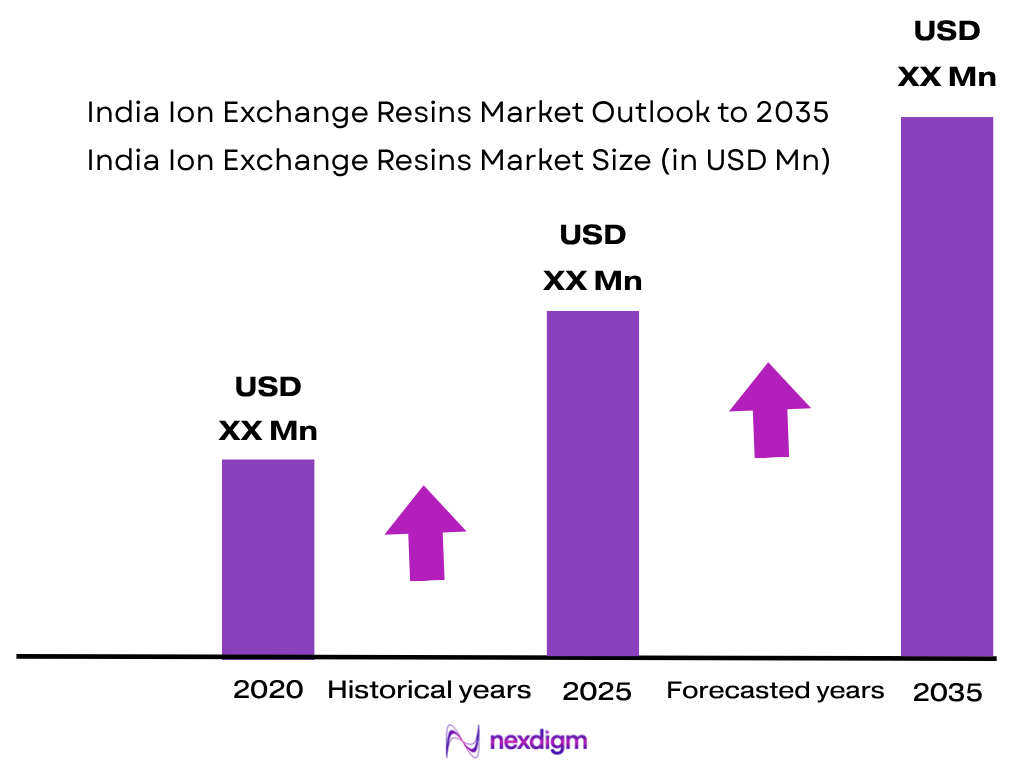
The India Ion Exchange Resins market generated ~USD 197.2 million in 2024, compared with ~USD 115.5 million in 2023, supported by demand from industrial water treatment, power generation, pharmaceuticals, chemicals, food and beverage, and electronics applications. A published India market assessment places 2024 revenue at USD 197.2 million and identifies cationic resins as the largest product segment, while another assessment reported USD 115.5 million in 2023, demonstrating substantial variation in market boundaries and methodology across published datasets.
The India Ion Exchange Resins market is concentrated around Mumbai, Pune, Ahmedabad, Vadodara, Chennai, Hyderabad, Bengaluru and Delhi-NCR, reflecting the geographic concentration of chemical, pharmaceutical, power, food-processing and industrial-water-treatment activities. Gujarat is particularly important because major resin manufacturing facilities operate in Dahej and Jhagadia, while Maharashtra hosts resin production at Paudh. Thermax reports approximately 20,000 cubic metres of resin capacity at Dahej and approximately 10,000 cubic metres each at Jhagadia and Paudh, demonstrating the importance of these industrial clusters to domestic supply.
Market Segmentation
By Resin Type
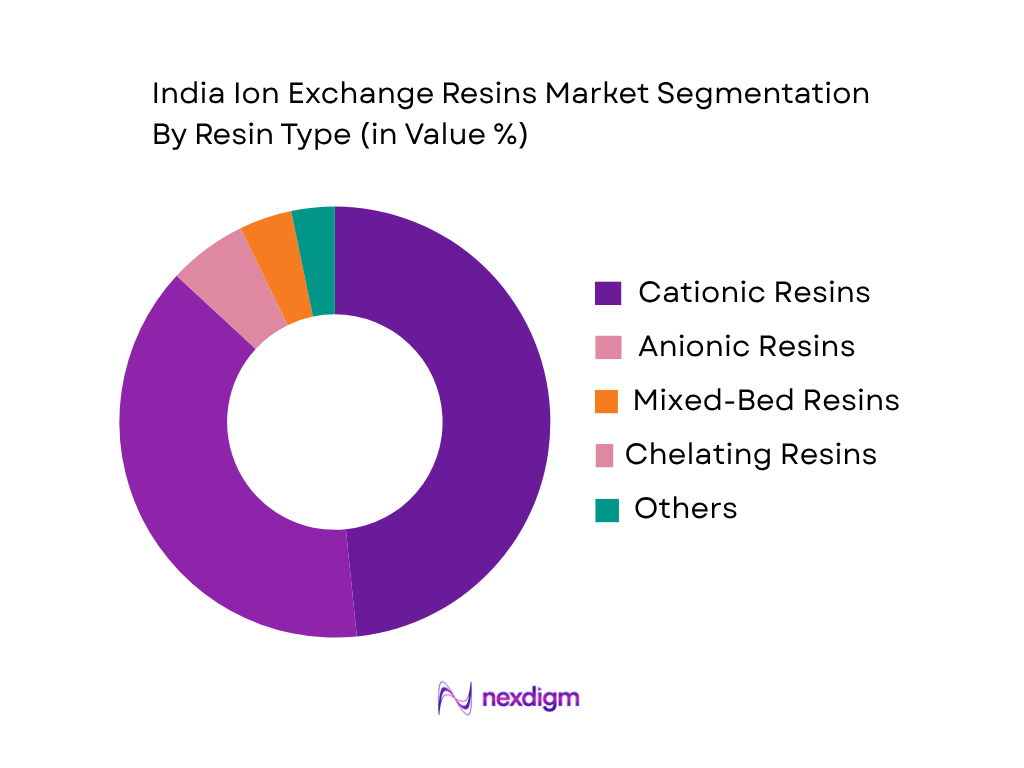
The India Ion Exchange Resins market is segmented by resin type into cationic resins, anionic resins, mixed-bed resins, chelating resins and specialty resins. Cationic resins are the dominant segment, accounting for 48.88% of India market revenue in 2024 according to published market data. (Grand View Research) Their dominance is linked to widespread use in water softening, demineralization and industrial water-treatment systems, where cation exchange is an essential stage for removing calcium, magnesium and other positively charged ions. Cationic resins are also used as the first exchange stage in conventional two-bed demineralization systems before downstream anion exchange and polishing. India’s extensive industrial water-treatment base across power, chemicals, pharmaceuticals, food processing and manufacturing therefore provides a broad recurring application base. The availability of domestic manufacturing capabilities further supports supply. Thermax, for example, manufactures Tulsion ion exchange resins at facilities in Maharashtra and Gujarat, while Ion Exchange supplies cation and anion resin ranges for water, wastewater and specialty applications.
By Application
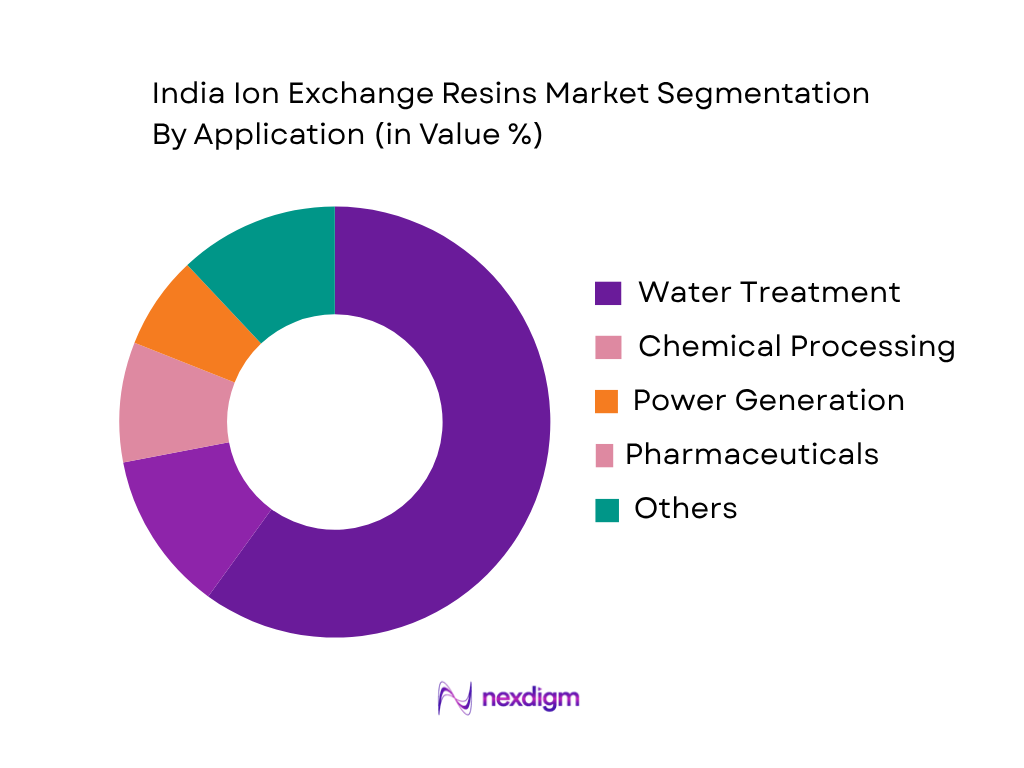
The India Ion Exchange Resins market is segmented by application into water treatment, chemical processing, power generation, pharmaceuticals, food and beverage, electronics and other specialized applications. Water treatment is the leading application segment, reflecting the central role of ion exchange in demineralization, softening, deionization and high-purity water production. Ion exchange is particularly relevant where dissolved minerals must be removed to produce process or high-purity water. Thermax describes demineralization as a technology based on ion exchange and degasification for producing mineral-free water, with applications determined by inlet water chemistry and required capacity. (Thermax) India’s industrial expansion across power, chemicals, pharmaceuticals, food processing and manufacturing creates recurring demand for treated process water and wastewater management. Pharmaceutical and electronics applications additionally require higher-purity water, creating demand for specialized resin grades. This broad application base makes water treatment the principal demand center for ion exchange resins in India.
Competitive Landscape
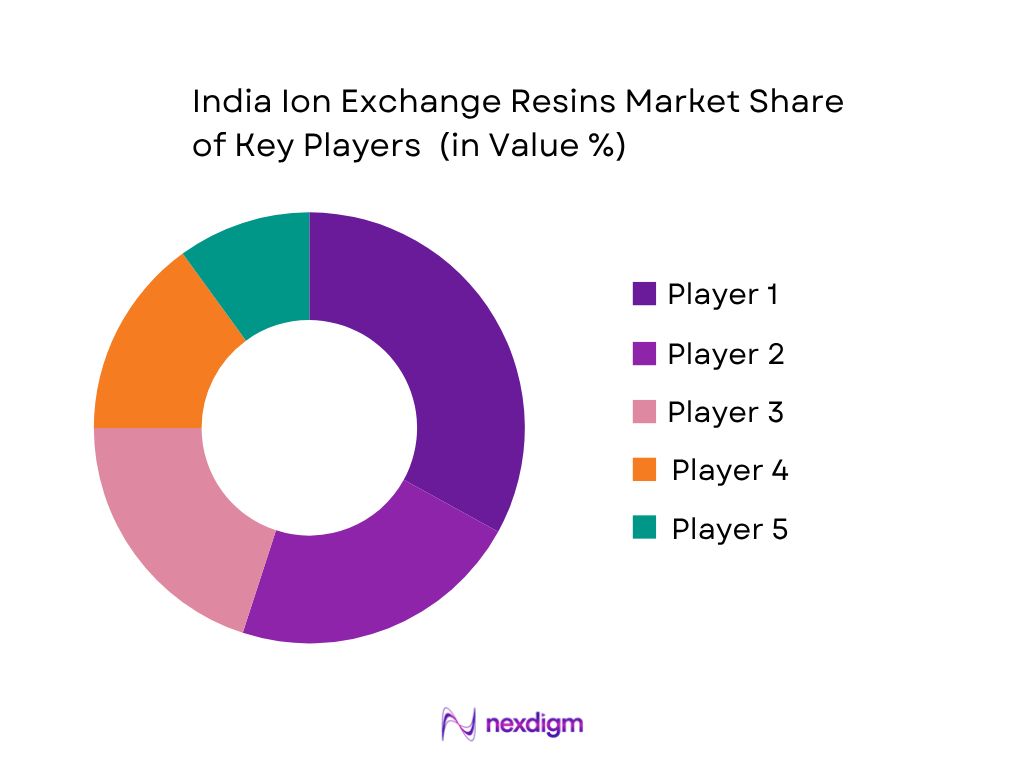
The India Ion Exchange Resins market includes established domestic manufacturers and multinational specialty-chemical companies competing across water-treatment, industrial-process, pharmaceutical and specialty-resin applications. Domestic suppliers benefit from local manufacturing, application engineering and distribution capabilities, while multinational companies compete through advanced resin chemistry, specialty grades, global technology platforms and high-purity applications. The competitive environment therefore spans both large integrated water-treatment companies and specialized resin manufacturers.
| Company | Establishment | Headquarters | Resin Brand / Portfolio | Manufacturing Presence | Key Applications | Specialty Capability | India Market Position | Technical Service |
| Ion Exchange (India) Ltd. | 1964 | Mumbai, India | ~ | ~ | ~ | ~ | ~ | ~ |
| Thermax Ltd. | 1966 | Pune, India | ~ | ~ | ~ | ~ | ~ | ~ |
| DuPont | 1802 | Wilmington, USA | ~ | ~ | ~ | ~ | ~ | ~ |
| LANXESS | 2004 | Cologne, Germany | ~ | ~ | ~ | ~ | ~ | ~ |
| Mitsubishi Chemical Group | 1933 | Tokyo, Japan | ~ | ~ | ~ | ~ | ~ | ~ |
India Ion Exchange Resins Market Analysis
Growth Drivers
Industrial Water Consumption and Expansion of Water-Intensive Manufacturing
India’s industrial expansion is directly strengthening the requirement for ion exchange-based demineralization, softening and high-purity water systems. India’s GDP reached USD 3.91 trillion in 2024, while GDP growth was 6.5, indicating continued expansion of the economic base supporting industrial water demand. Manufacturing value added reached USD 492.98 billion in 2024, according to the World Bank, providing a substantial demand base across chemicals, pharmaceuticals, food processing, metals and other water-intensive industries. The Department of Chemicals and Petrochemicals maintains dedicated production statistics for chemical and petrochemical manufacturing, reflecting the scale of process industries requiring controlled water chemistry. The requirement is particularly relevant for facilities where dissolved calcium, magnesium, silica and other ions can affect process efficiency or equipment performance. Ion exchange resins are consequently used across softening, demineralization, polishing and process-water applications. The manufacturing base also creates recurring replacement demand because resin performance depends on operating conditions, regeneration cycles and feedwater quality. India’s industrialization therefore supports demand not only for standard cation and anion resins but also for high-capacity, macroporous and application-specific grades used in increasingly sophisticated industrial water-treatment systems.
Thermal and Renewable Power Capacity and Pharmaceutical Production
India’s expanding power and pharmaceutical industries provide important application-specific demand for ion exchange resins because both sectors require reliable treated, demineralized or high-purity water. The Ministry of Power reported 462,065 MW of installed generation capacity as of December 2024, including 244,440 MW of thermal capacity, while generation during April–December reached 1,379,929.94 million units. Thermal plants require demineralized water for boiler and steam-cycle operations, creating recurring demand for cation, anion and mixed-bed resins. At the same time, India’s renewable-energy capacity reached 209.44 GW in December 2024, with 28.64 GW added during the year, expanding the overall electricity infrastructure and supporting associated water-treatment requirements in relevant generation and manufacturing facilities. The pharmaceutical sector adds another high-purity application base because manufacturing facilities require purified water and tightly controlled process-water quality. The Department of Pharmaceuticals maintains production and manufacturing-location statistics for the sector, including 37 manufacturing locations reported in its 2024 monitoring material. These combined power and pharmaceutical requirements create technically demanding applications for ion exchange resins beyond conventional municipal treatment.
Market Challenges
Dependence on Specialty Raw Materials and Imported Advanced Resin Technologies
India’s ion exchange resin industry faces a structural challenge from dependence on sophisticated polymer, functionalization and advanced water-treatment technologies. The challenge is particularly relevant for specialty grades requiring tightly controlled matrix structures, uniform bead characteristics, high exchange capacity and application-specific functional groups. India’s broader electronics and advanced-manufacturing ecosystem illustrates the continuing reliance on imported technology and components: the Economic Survey reports electronics production of ₹9.5 lakh crore and electronics imports of ₹7.3 lakh crore in FY2024. While these figures do not represent ion exchange resins specifically, they demonstrate the scale of imported advanced industrial inputs supporting technology-intensive manufacturing. The same structural issue affects specialized resin technologies when domestic suppliers require imported equipment, intermediates or technical know-how for high-purity applications. The Ministry of Electronics and Information Technology also recorded major technology partnerships in semiconductor manufacturing, including a ₹91,526 crore semiconductor fabrication project approved in 2024 and technology partnerships involving overseas companies. For ion exchange resin producers, this environment increases the importance of domestic chemistry development, local production of critical intermediates and technology transfer. Dependence on external specialty inputs can otherwise constrain development of pharmaceutical, electronics-grade, chelating and high-selectivity resin portfolios.
Resin Fouling, Chemical Regeneration and Spent Resin Disposal
Operational complexity remains a significant challenge because ion exchange resins are exposed to feedwater contaminants and require controlled regeneration to restore exchange capacity. Fouling from organic matter, suspended solids, iron, oils and other contaminants can reduce resin performance and shorten operating cycles, while regeneration generates concentrated chemical streams requiring appropriate handling. India’s wastewater infrastructure demonstrates the scale of the broader treatment challenge: CPCB data report 61,754 MLD of sewage generation against 22,963 MLD of installed sewage-treatment capacity, leaving 38,791 MLD untreated. Although these figures relate to municipal sewage rather than ion exchange resin consumption directly, they demonstrate the substantial untreated-water burden and the need for robust treatment processes upstream and downstream of specialized treatment units. Industrial users face additional requirements around wastewater minimization and reuse, increasing the importance of regeneration efficiency and spent-resin management. The treatment process can therefore involve acid, alkali or salt regeneration, depending on resin chemistry and application, while exhausted resin ultimately requires controlled disposal or replacement. These operational requirements increase technical complexity for industrial buyers and make resin selection dependent on feedwater characteristics, regeneration chemistry, operating temperature and contaminant loading.
Market Opportunities
Industrial Water Reuse and Zero Liquid Discharge Systems
Industrial water reuse and zero-liquid-discharge architectures create a significant opportunity for advanced ion exchange resin deployment because manufacturers are increasingly required to recover water, control dissolved contaminants and reduce discharge from industrial processes. CPCB data show 61,754 MLD of sewage generation and 22,963 MLD of sewage-treatment capacity, illustrating the wider national requirement for improved water treatment and reuse infrastructure. The same CPCB material identifies Maharashtra, Tamil Nadu, Uttar Pradesh, Delhi and Gujarat among the largest contributors to sewage generation, creating concentrated treatment ecosystems around major industrial and urban centers. India’s industrial base provides an additional opportunity: manufacturing value added reached USD 492.98 billion in 2024, according to the World Bank. Industrial facilities operating in chemicals, pharmaceuticals, power, food processing and metals increasingly require water-treatment systems capable of recycling process streams while maintaining suitable ionic quality. Ion exchange can be incorporated into demineralization, polishing and selective-removal stages within broader reuse and ZLD configurations. This creates demand for higher-capacity resins, fouling-resistant grades, specialty selective resins and systems designed around lower regeneration requirements. The opportunity is therefore not limited to new resin sales; it extends to replacement, performance optimization and specialized resin solutions for increasingly complex water-recovery systems.
Ultrapure Water Demand, Semiconductor Manufacturing and Domestic Resin Manufacturing
India’s emerging semiconductor and electronics manufacturing ecosystem creates a specialized opportunity for ion exchange resins because semiconductor fabrication and advanced electronics production require extremely high-quality process water with controlled ionic contamination. MeitY reported approval of a ₹91,526 crore semiconductor fabrication facility in February 2024 with planned production capacity of approximately 50,000 wafer starts per month. It also reported a ₹27,120 crore semiconductor packaging facility with planned capacity of 48 million units per day, alongside a ₹7,584 crore OSAT project with capacity of approximately 15.07 million units per day. These facilities require sophisticated water-treatment infrastructure, creating opportunities for high-purity and specialty ion exchange technologies. Domestic manufacturing is simultaneously gaining importance: MeitY reported 21 applications for Electronics Manufacturing Clusters and 10 applications for Common Facility Centres under EMC 2.0, covering 7,398 acres with proposed project costs of ₹10,231 crore. This expanding advanced-manufacturing ecosystem can support localization of specialized water-treatment components and resin supply chains. For domestic ion exchange resin manufacturers, the opportunity extends toward semiconductor-grade, high-selectivity and high-purity products, alongside partnerships with EPC companies and ultrapure-water system integrators. (MeitY)
Future Outlook
The India Ion Exchange Resins market is expected to expand as industrial water consumption, wastewater reuse and high-purity water requirements increase across major end-use industries. Demand from pharmaceuticals, power, chemicals, food processing and electronics is expected to support recurring resin replacement and new system installations. Increasing emphasis on water efficiency and industrial wastewater treatment should strengthen adoption of advanced resin technologies. Specialty, high-capacity and application-specific resin grades are expected to gain importance alongside conventional cationic and anionic products.
Major Players
- Ion Exchange (India) Limited
- Thermax Limited
- DuPont
- LANXESS
- Mitsubishi Chemical Group Corporation
- Purolite
- Ecolab
- ResinTech Inc.
- Samyang Corporation
- Resonac Holdings Corporation
- Jacobi Carbons AB
- Aldex Chemical Company
- Thermax Chemicals
- Aquanomics Systems Limited
- Resinex
Key Target Audience
- Ion exchange resin manufacturers and water-treatment solution providers
- Power generation companies and utility operators
- Pharmaceutical and biopharmaceutical manufacturers
- Chemical, petrochemical and process-industry companies
- Food, beverage and sugar-processing companies
- Investments and venture capitalist firms (Industrial water technology investors, environmental technology funds, specialty chemicals investors)
- Government and regulatory bodies (Central Pollution Control Board, Ministry of Environment, Forest and Climate Change, Ministry of Jal Shakti, Bureau of Indian Standards, Central Ground Water Authority)
- Water-treatment EPC contractors, OEMs and industrial wastewater-management companies
Research Methodology
Step 1: Identification of Key Variables
The initial phase involves constructing an India Ion Exchange Resins ecosystem map covering resin manufacturers, water-treatment OEMs, EPC contractors, industrial users, distributors and specialty-chemical suppliers. Secondary research is used to establish resin classifications, production facilities, applications, end-use industries, trade flows and technical specifications. Particular emphasis is placed on distinguishing resin revenue from broader water-treatment-system revenue.
Step 2: Market Analysis and Construction
Historical market data is compiled by combining resin sales, production capacity, application demand and end-user consumption indicators. The analysis evaluates cationic, anionic, mixed-bed and specialty resin demand across water treatment, power, pharmaceuticals, chemicals, food and beverage, electronics and other applications. Manufacturer capacity disclosures and industrial project activity are used to validate the supply-demand framework.
Step 3: Hypothesis Validation and Expert Consultation
Market hypotheses are validated through interviews with resin manufacturers, water-treatment companies, EPC contractors and industrial procurement professionals. Expert discussions focus on resin replacement cycles, operating conditions, exchange capacity, regeneration practices, qualification requirements and purchasing criteria. These inputs are used to validate the bottom-up market construction and identify differences between standard and specialty resin demand.
Step 4: Research Synthesis and Final Output
The final stage triangulates manufacturer-level information, industrial demand indicators, trade data, application-level estimates and primary research. Direct industry feedback is used to validate competitive positioning, product portfolios, manufacturing footprints and emerging applications. The final model is then subjected to consistency checks before developing the historical assessment and forecast outlook for the India Ion Exchange Resins market.

- Executive Summary
- Research Methodology (Market Definition and Resin Classification Framework, Market Sizing Methodology, Top-Down Revenue Assessment, Bottom-Up Capacity and Volume Assessment, End-Use Demand Mapping, Supply-Side Capacity Mapping, Manufacturer and Distributor Interviews, Resin Consumption Benchmarking, Production and Import-Export Validation, Data Triangulation, ASP and Product-Mix Validation, Forecasting Framework, Scenario Analysis, Assumptions and Limitations)

- Definition and Scope
- Ion Exchange Resin Industry Evolution in India
- Development of Water Treatment and Demineralization Infrastructure
- Ion Exchange Resin Manufacturing Ecosystem
- Ion Exchange Resin Value Chain Analysis

- Market Growth Drivers (Industrial Water Consumption, Expansion of Water-Intensive Manufacturing, Thermal and Renewable Power Capacity, Pharmaceutical Production, Industrial Wastewater Reuse, Municipal Water Treatment Expansion)
- Market Challenges (Dependence on Specialty Raw Materials, Imported Advanced Resin Technologies, Resin Fouling and Capacity Loss, Chemical Regeneration Requirements, Spent Resin Disposal, High-Purity Resin Qualification Requirements)
- Market Opportunities (Industrial Water Reuse, Zero Liquid Discharge Systems, Ultrapure Water Demand, Semiconductor Manufacturing, Pharmaceutical Expansion, Specialty Chelating Resins, High-Selectivity Resins, Domestic Resin Manufacturing)
- Market Trends (High-Capacity Resins, Uniform Particle Size Resins, Macroporous Resin Adoption, Specialty Chelating Resins, Mixed Bed Polishing, Counter-Current Regeneration, Resin Life Optimization, Digital Water Treatment Monitoring)
- Government Policies and Regulatory Framework (Central Pollution Control Board Requirements, Bureau of Indian Standards Water Quality Standards, Ministry of Environment Forest and Climate Change Regulations, Central Ground Water Authority Requirements, Industrial Effluent Discharge Norms, Pharmaceutical Water Standards)
- SWOT Analysis
- Porter’s Five Forces Analysis
- PESTLE Analysis

- By Market Value (2020-2025)
- By Resin Consumption Volume (2020-2025)
- By Average Selling Price (2020-2025)
- By Domestic Production Volume (2020-2025)
- By Import Volume (2020-2025)
- By Export Volume (2020-2025)

- By Resin Type (In Value %)
Strong Acid Cation Resins
Weak Acid Cation Resins
Strong Base Anion Resins
Weak Base Anion Resins
Mixed Bed Resins
Chelating Ion Exchange Resins
Adsorbent and Specialty Resins - By Matrix Type (In Value %)
Styrene-Divinylbenzene Resins
Acrylic Resins
Methacrylic Resins
Polystyrene-Based Resins
Polyacrylic-Based Resins
Specialty Polymer Matrices - By Physical Form (In Value %)
Gel-Type Resins
Macroporous Resins
Microporous Resins
Uniform Particle Size Resins
Powdered Ion Exchange Resins - By Functional Group (In Value %)
Sulfonic Acid Functionalized Resins
Carboxylic Acid Functionalized Resins
Quaternary Ammonium Functionalized Resins
Tertiary Amine Functionalized Resins
Chelating Functional Groups
Specialty Functional Groups - By Application (In Value %)
Water Demineralization and Deionization
Water Softening
Condensate Polishing
Boiler Feedwater Treatment
Ultrapure Water Generation
Wastewater Treatment and Reuse
Metal Recovery and Separation
Sugar and Food Processing
Chemical Processing - By End-Use Industry (In Value %)
Power Generation
Municipal and Industrial Water Treatment
Pharmaceuticals and Biotechnology
Food and Beverage
Chemicals and Petrochemicals
Sugar Industry
Mining and Metals

- Market Share of Major Players (By Revenue, Resin Volume, Resin Type, Application, End-Use Industry, Region, Domestic Production, Imported Resin Sales)
- Cross Comparison Parameters (Resin Portfolio Breadth, Total Ion Exchange Capacity, Specialty Resin Capability, Manufacturing Capacity, Matrix and Functional Group Range, Product Certification Coverage, Industrial Application Coverage, Technical Service and Regeneration Support)
- Pricing and Commercial Benchmarking (By Resin Type, Matrix Type, Functional Group, Grade, Application, Packaging Configuration)
- SWOT Analysis of Major Players
- Detailed Profiles of Major Companies
Ion Exchange (India) Limited
Thermax Limited
Resinex
DuPont
LANXESS
Purolite
Ecolab
Mitsubishi Chemical Group Corporation
Samyang Corporation
ResinTech Inc.
Jacobi Carbons AB|
Purolite India
Aldex Chemical Company
Thermax Onsite Energy Solutions Limited
Hebei Jincheng Resin Co., Ltd.

- Industrial Water Treatment Demand
- Power Sector Resin Consumption
- Pharmaceutical Industry Demand
- Chemical Industry Demand
- Food and Sugar Industry Demand
- Electronics and Semiconductor Demand

- By Market Value (2026-2035)
- By Resin Consumption Volume (2026-2035)
- By Average Selling Price (2026-2035)
- By Domestic Production Volume (2026-2035)
- By Import Volume (2026-2035)
- By Export Volume (2026-2035)


 Request a Sample
 Ask for Customization
 Get a Quote
 Enquire Now