
 Download PDF
Market Overview
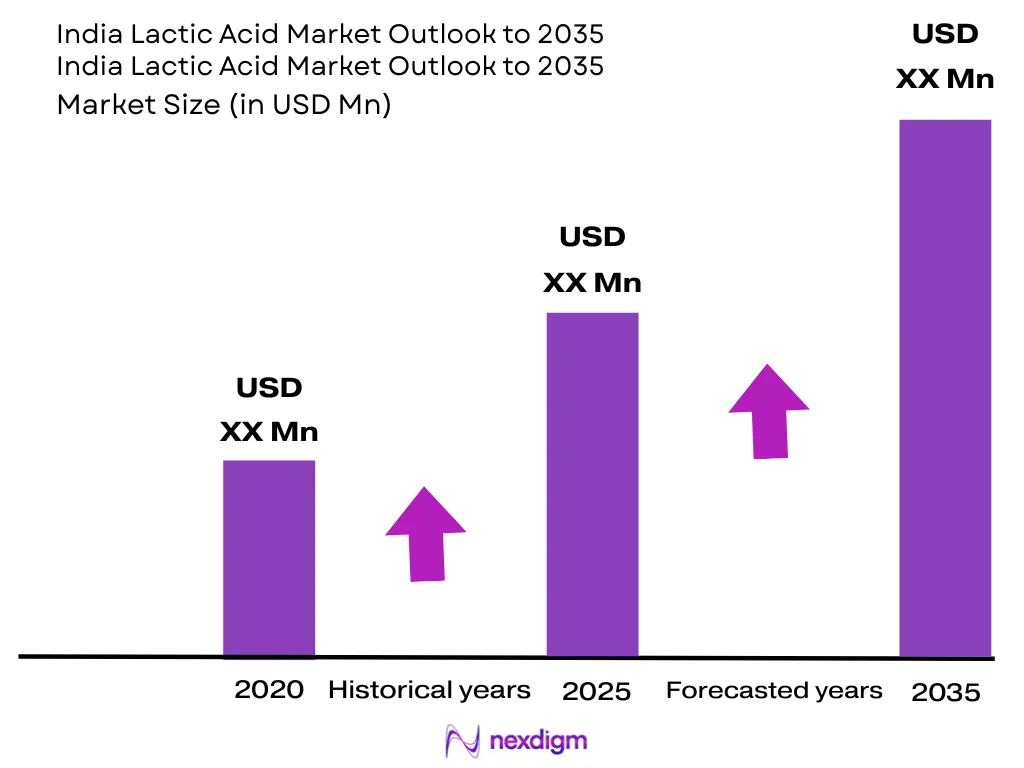
The India Lactic Acid Market was valued at USD ~ Million in 2024 and is anticipated to expand at a CAGR of ~% during 2026-2035. The market is primarily driven by rising demand for natural and organic ingredients across the food, pharmaceutical, and personal care industries, alongside the government’s growing push toward biodegradable plastics and a bio-based economy. According to industry estimates, sugarcane accounted for the largest raw material share, contributing over 41% of India’s lactic acid production in 2024, supported by the country’s position as the world’s second-largest sugarcane producer. India generates an estimated 100 million tonnes of sugarcane bagasse annually, providing an abundant and cost-effective fermentation feedstock. Rising population, urbanization, and increasing disposable income have played a central role in expanding food and beverage manufacturing capacity, while growing consumer awareness of clean-label and eco-friendly alternatives continues to support long-term demand across dairy, bakery, processed foods, skincare, and biodegradable packaging applications.
Market Segmentation
By Raw Material
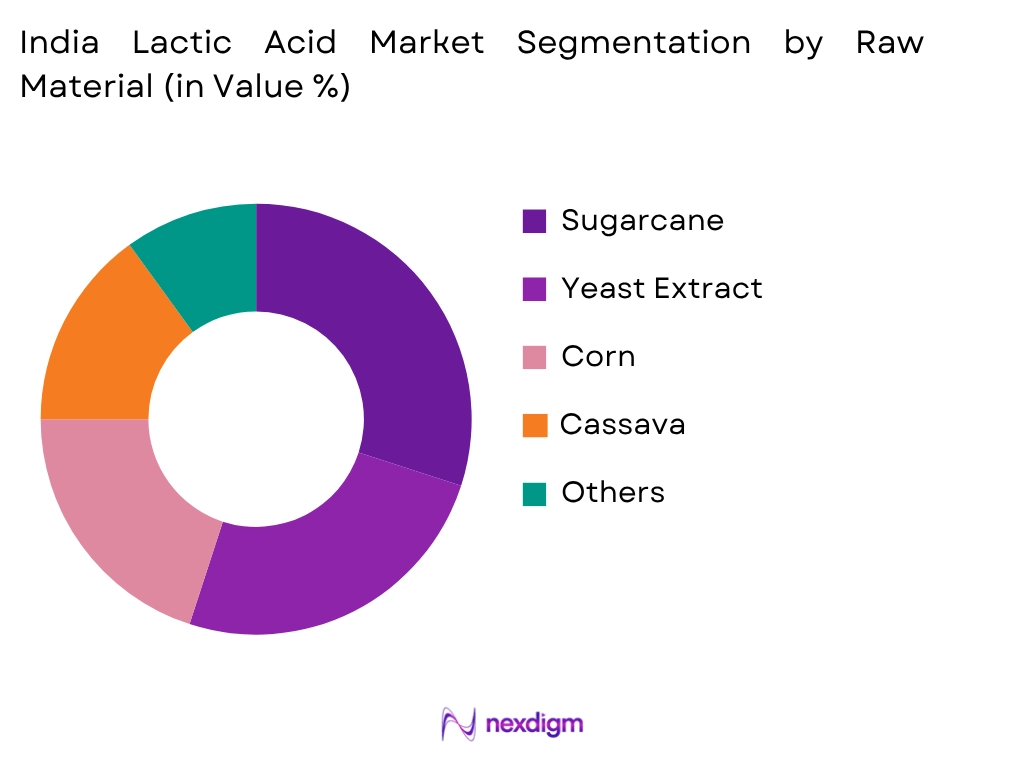
Among these, Sugarcane dominates the India Lactic Acid Market owing to its abundance, affordability, and high sugar content, making it the preferred fermentation feedstock for domestic manufacturers. India’s position as the world’s second-largest sugarcane producer, combined with an estimated 100 million tonnes of sugarcane bagasse generated annually, provides a consistent and cost-effective raw material base for lactic acid fermentation. Corn and cassava-based production remain relevant in select regions, while yeast extract is emerging as the fastest-growing raw material segment due to its use in high-purity pharmaceutical and cosmetic grade applications. Domestic sugar producers are increasingly diversifying into bio-based chemical manufacturing, exemplified by initiatives such as Balrampur Chini’s PLA brand and Praj Industries’ indigenous biopolymer demonstration plant in Pune, reflecting the growing integration between India’s sugar industry and lactic acid value chains. This raw material advantage continues to position India as a competitive manufacturing base for both domestic consumption and export-oriented bio-based chemical production.
By Application
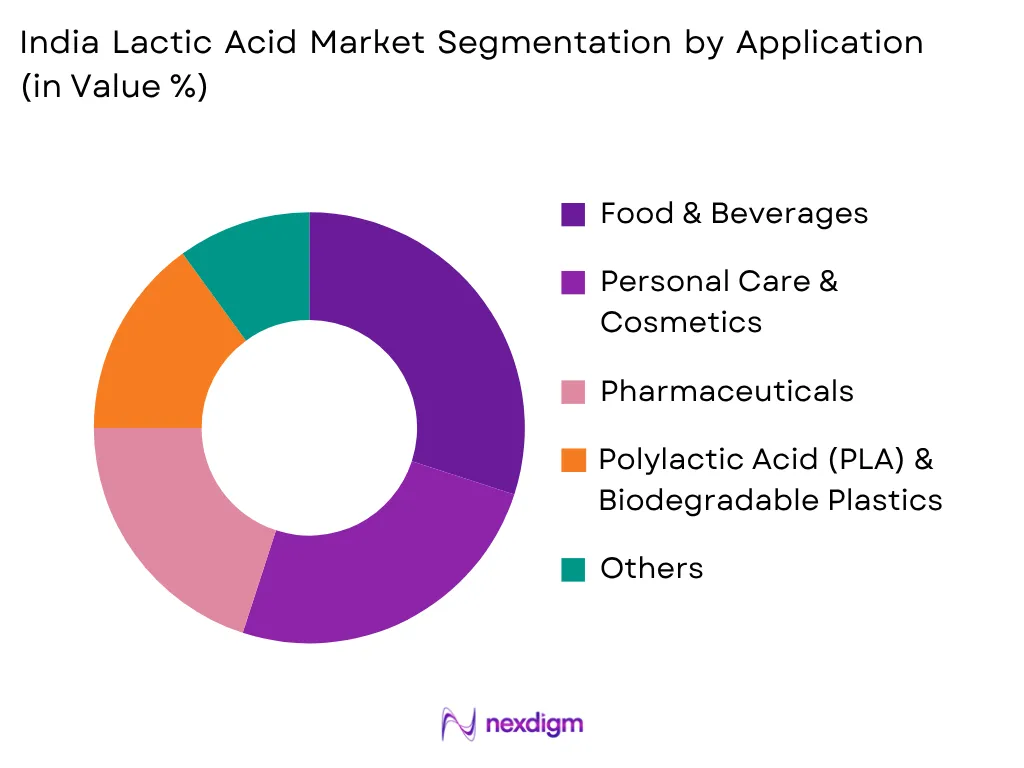
The Food & Beverages segment holds a leading share owing to the extensive use of lactic acid as a natural preservative, acidity regulator, and flavor enhancer in dairy products, bakery items, processed meats, and functional beverages. Growing consumer preference for minimally processed and clean-label foods continues to encourage manufacturers to replace synthetic preservatives with naturally derived lactic acid. At the same time, the Polylactic Acid (PLA) and biodegradable plastics segment is emerging as the fastest-growing application, propelled by India’s tightening regulations on single-use plastics and government initiatives such as the Swachh Bharat Mission and the NITI Aayog BioE3 Policy. The commissioning of India’s first indigenous PLA biopolymer demonstration plant by Praj Industries in October 2024 marked a significant milestone for domestic bioplastics manufacturing. Additionally, rising demand for lactic acid in personal care and cosmetic formulations, where it functions as an exfoliant, humectant, and pH adjuster, continues to expand the market’s application base across skincare and haircare products.
Competitive Landscape
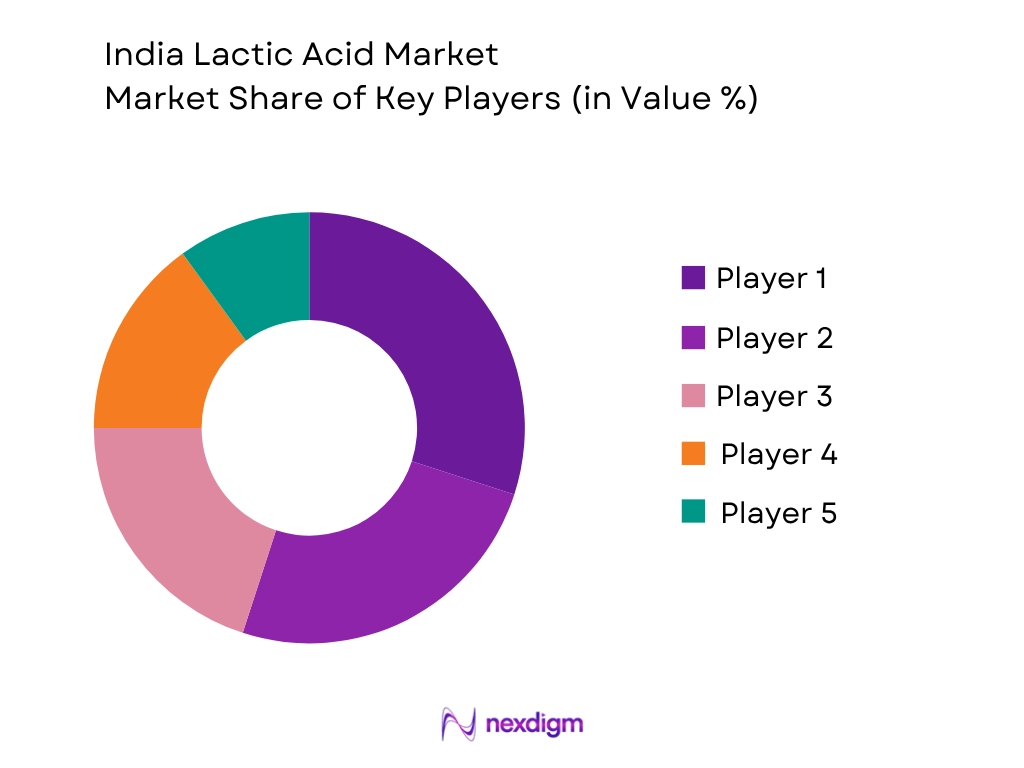
The India Lactic Acid Market is moderately fragmented, comprising domestic manufacturers with established sugarcane-based fermentation capacity alongside multinational producers supplying the market through imports and regional distribution arrangements. Competition is primarily based on production cost efficiency, purity grade capabilities, regulatory compliance, application-specific technical support, and consistency of raw material supply. Domestic players such as Godavari Biorefineries and Vaishnavi Bio Tech have built manufacturing capabilities leveraging India’s abundant sugarcane feedstock, while global producers including Corbion, NatureWorks, and Cargill maintain a strong presence through import supply chains and technical partnerships with Indian food, pharmaceutical, and bioplastics manufacturers. Companies are increasingly investing in fermentation capacity expansion, high-purity grade development, and backward integration with sugar mills to strengthen feedstock security. Government incentives under the BioE3 Policy and the push toward domestic biopolymer manufacturing are expected to encourage further capacity investments and new market entrants over the forecast period.
| Company | Establishment Year | Headquarters | Primary Product Portfolio | Lactic Acid Portfolio
|
Manufacturing Presence | Major End-Use Industries | Key Strategic Focus | Certifications & Compliance |
| Godavari Biorefineries Ltd. | 1956 | ~ | ~ | ~ | ~ | ~ | ~ | ~ |
| Corbion N.V. | 1919 | ~ | ~ | ~ | ~ | ~ | ~ | ~ |
| NatureWorks LLC | 1997 | ~ | ~ | ~ | ~ | ~ | ~ | ~ |
| Vaishnavi Bio Tech | 2005 | ~ | ~ | ~ | ~ | ~ | ~ | ~ |
| Cargill, Incorporated | 1865 | ~ | ~ | ~ | ~ | ~ | ~ | ~ |
India Lactic Acid Market Analysis
Growth Drivers
Rising Demand for Natural and Clean-Label Ingredients Across Food, Pharma, and Personal Care Industries
India’s lactic acid market is experiencing sustained growth due to increasing consumer preference for natural and organic products across the food, pharmaceutical, and personal care industries. According to industry estimates, the India lactic acid market was valued at approximately USD 123.83 million in 2024, with growth supported by rising health consciousness and growing awareness of the harmful effects of synthetic chemicals. Lactic acid’s role as a natural preservative, flavor enhancer, and pH regulator has made it a preferred ingredient in minimally processed foods, while its moisturizing and exfoliating properties continue to drive adoption in skincare and cosmetic formulations. India’s organic exports are projected to reach approximately Rs 20,000 crore by 2028, up from current levels of Rs 5,000-6,000 crore, reflecting the country’s growing focus on organic and natural product categories that rely on ingredients such as lactic acid. Additionally, India’s food safety regulator FSSAI has expanded permitted applications for L-lactic acid, including its use in infant formula and general food preservation, further widening the scope for food-grade lactic acid adoption across the domestic food processing industry.
Government Push for Biodegradable Plastics and a Bio-Based Economy
The Indian government’s sustained push toward biodegradable plastics and a bio-based economy remains a key structural driver for the lactic acid market. Lactic acid serves as the primary raw material for polylactic acid (PLA), a biodegradable polymer increasingly used as an alternative to conventional plastics in packaging, textiles, and consumer goods. The government’s restrictions on single-use plastics, combined with initiatives such as the Swachh Bharat Mission, have accelerated industry adoption of PLA-based packaging solutions. In October 2024, Praj Industries commissioned India’s first biopolymer demonstration plant using indigenous PLA technology at Jejuri, Pune, marking a significant milestone in the country’s transition toward domestic bio-based manufacturing. Furthermore, NITI Aayog’s BioE3 (Biotechnology for Economy, Environment and Employment) initiative is designed to promote biopolymers and bioeconomy development through supportive regulatory and policy frameworks, encouraging both domestic and international companies to expand fermentation-based manufacturing capacity within India. These policy measures, combined with India’s abundant sugarcane and corn feedstock availability, are expected to continue driving investment in domestic lactic acid and PLA production capacity over the forecast period.
Market Challenges
Fluctuating Raw Material Prices and Feedstock Availability
The India Lactic Acid Market remains exposed to fluctuations in the price and availability of key fermentation feedstocks such as sugarcane molasses, corn, and cassava. Since sugarcane accounts for the largest share of raw material consumption, lactic acid production costs are closely tied to sugarcane prices, which are influenced by monsoon variability, government minimum support price policies, and competing demand from the sugar and ethanol industries. Manufacturers relying on agricultural residues such as sugarcane bagasse must also contend with seasonal availability and logistical challenges associated with feedstock collection and storage. These fluctuations create pricing uncertainty for lactic acid producers, requiring companies to maintain diversified sourcing strategies, long-term supply agreements with sugar mills, and adequate feedstock inventory to ensure consistent production output. Volatility in raw material costs directly affects manufacturing margins and pricing competitiveness against imported lactic acid, particularly from lower-cost producers in China and Southeast Asia.
High Production Costs and Import Competition
Domestic lactic acid manufacturers in India face significant competition from lower-cost imports, particularly from China, which maintains substantially larger fermentation capacity and benefits from economies of scale. Indian producers often face higher production costs due to limited domestic fermentation infrastructure, higher energy costs, and comparatively smaller manufacturing scale, making it difficult to compete on price with established international suppliers such as Henan Jindan and COFCO Biochemical. Additionally, the production of high-purity pharmaceutical and cosmetic-grade lactic acid requires advanced purification and separation technologies that are not yet widely established domestically, requiring many Indian formulators to rely on imported high-purity grades. This technology gap increases dependency on international suppliers for specialized applications, while regulatory compliance requirements from bodies such as the CDSCO and FSSAI add further complexity and cost for domestic manufacturers seeking to expand into pharmaceutical and food-grade product categories. These factors collectively constrain the pace of domestic capacity expansion despite favorable feedstock availability.
Market Opportunities
Expansion of Polylactic Acid (PLA) and Biodegradable Packaging Manufacturing
India’s tightening regulations on single-use plastics and growing consumer preference for sustainable packaging present substantial opportunities for lactic acid manufacturers to expand into PLA and biodegradable plastics production. Domestic sugar producers are increasingly diversifying into bio-based chemical manufacturing, as demonstrated by Balrampur Chini Mills’ launch of its PLA brand Balrampur Bioyug in May 2025 and Praj Industries’ commissioning of India’s first indigenous PLA demonstration plant in Pune. These developments reflect a broader industry shift toward leveraging India’s abundant sugarcane feedstock for value-added bio-based chemical production rather than conventional sugar and ethanol output alone. As packaging, agriculture, and consumer goods industries increasingly adopt PLA-based materials to meet sustainability commitments and regulatory requirements, companies with integrated fermentation and polymerization capabilities are well positioned to capture growing domestic and export demand for biodegradable plastic alternatives.
Growing Investment in Fermentation-Based Domestic Manufacturing Capacity
Government initiatives such as NITI Aayog’s BioE3 Policy, combined with India’s abundant and low-cost sugarcane and agricultural residue feedstock, create significant opportunities for companies to invest in domestic fermentation-based lactic acid manufacturing capacity. With India generating an estimated 100 million tonnes of sugarcane bagasse annually, substantial untapped potential exists for converting agricultural residues into fermentation feedstock, supporting both cost efficiency and circular economy objectives. Expanding domestic manufacturing capacity would also reduce reliance on imports, particularly from China, while improving supply chain resilience for downstream food, pharmaceutical, and bioplastics manufacturers. Additionally, growing demand for high-purity lactic acid in pharmaceutical and cosmetic applications presents opportunities for companies to invest in advanced purification and separation technologies domestically, reducing dependency on imported high-purity grades. As global and domestic companies continue to recognize India’s feedstock advantages and supportive policy environment, the market is expected to see increased capital investment in new fermentation facilities and capacity expansions over the forecast period.
Future Outlook
The India Lactic Acid Market is expected to witness sustained expansion over the forecast period, supported by continued growth in the food processing, pharmaceutical, and personal care industries alongside accelerating adoption of biodegradable plastics. Government initiatives promoting a bio-based economy, combined with India’s abundant sugarcane and agricultural residue feedstock base, are expected to encourage further investment in domestic fermentation and purification capacity. Growing demand for high-purity, natural, and sustainably sourced lactic acid across food, pharmaceutical, and bioplastics applications will continue to shape the market’s long-term growth trajectory.
Major Players
- NatureWorks LLC
- Corbion N.V.
- Galactic S.A.
- Cargill, Incorporated
- COFCO Biochemical
- Henan Jindan Lactic Acid Technology Co., Ltd.
- Musashino Chemical Laboratory, Ltd.
- Godavari Biorefineries Ltd.
- Vaishnavi Bio Tech
- Zhejiang Hisun Biomaterials Co., Ltd.
- Futerro
- Danimer Scientific
- BASF SE
- Foodchem International Corporation
- Gadot Biochemical Industries Ltd.
Key Target Audience
- Lactic Acid and Polylactic Acid Manufacturers
- Food & Beverage Processing Companies
- Pharmaceutical Manufacturers
- Cosmetics and Personal Care Manufacturers
- Bioplastics and Packaging Manufacturers
- Investment and Venture Capitalist Firms
- Government and Regulatory Bodies (Food Safety and Standards Authority of India (FSSAI), Central Drugs Standard Control Organisation (CDSCO), Bureau of Indian Standards (BIS), NITI Aayog)
- Raw Material Suppliers and Sugar Mills
Research Methodology
Step 1: Identification of Key Variables
The research process begins with identifying the complete ecosystem of the India Lactic Acid Market, including raw material suppliers, fermentation and purification manufacturers, ingredient distributors, food and pharmaceutical processors, and regulatory authorities. Extensive secondary research is conducted using company annual reports, government publications, trade associations, customs statistics, industry journals, and proprietary databases to determine the variables influencing market demand, pricing, production, consumption, and technological developments.
Step 2: Market Analysis and Construction
Historical market information is collected and analyzed to estimate market size, import-export activity, application-wise demand, and pricing trends. A combination of top-down and bottom-up approaches is used to estimate market revenues and validate segment-level performance. Consumption patterns across food & beverages, pharmaceuticals, personal care, and bioplastics are evaluated to establish an accurate representation of the industry.
Step 3: Hypothesis Validation and Expert Consultation
The preliminary findings are validated through Computer-Assisted Telephone Interviews (CATIs) and structured discussions with lactic acid manufacturers, procurement managers, distributors, food technologists, regulatory experts, and senior executives operating within India’s bio-based chemicals industry. These interviews help verify market assumptions, competitive developments, technology adoption trends, pricing dynamics, and future investment opportunities while refining the overall market estimates.
Step 4: Research Synthesis and Final Output
The final stage integrates insights obtained from primary interviews with quantitative information collected through secondary sources. Data triangulation techniques are applied to reconcile differences between supply-side and demand-side estimates, ensuring robust market forecasting. The report is then reviewed through multiple quality assurance checkpoints to deliver a comprehensive analysis covering market size, segmentation, competitive landscape, future outlook, and strategic recommendations for industry stakeholders.

- Executive Summary
- Research Methodology (Market Definitions and Assumptions, Abbreviations, Market Sizing Approach, Top-Down Analysis, Bottom-Up Analysis, Demand-Side Assessment, Supply-Side Assessment, Primary Industry Interviews, Secondary Research Validation, Data Triangulation, Forecasting Framework, Limitations and Future Conclusions)

- Definition and Scope
- Market Evolution and Industry Genesis
- Timeline of Major Industry Developments
- Lactic Acid Industry Value Chain Analysis
- Supply Chain Analysis

- ;rowth Drivers (Growing Clean Label Food Demand, Rising Consumption of Processed Foods, Expansion of Biodegradable Plastics Manufacturing, Increasing Demand for Natural Preservatives, Premiumization of Personal Care Products, Growth in Bio-Based Chemical Manufacturing)
- Market Challenges (High Production Costs, Feedstock Price Volatility, Limited Domestic Fermentation Capacity, Import Competition from China, Regulatory Compliance Complexity, Technology Gap in High-Purity Manufacturing)
- Market Opportunities (Polylactic Acid Manufacturing Expansion, Fermentation Technology Investment, Agricultural Residue Valorization, Functional Food Innovation, Export-Oriented Bio-Based Chemical Manufacturing, Government Incentivized Capacity Building)
- Market Trends (Shift Toward Bio-Based Plastics, Rising Adoption in Skincare and Cosmetics, Sugarcane Bagasse Valorization, Sustainable Fermentation Sourcing, High-Purity Lactic Acid Development, Multi-Functional Ingredient Innovation)
- Government Regulations (FSSAI Food Additive Regulations, CDSCO Pharmaceutical Grade Requirements, BIS Standardization Requirements, NITI Aayog BioE3 Policy, Single-Use Plastics Regulations, Import Compliance)
- Import and Export Analysis (Trade Volume, Major Import Sources, Export Destinations, HS Code Analysis, Trade Balance)
- Raw Material Availability Analysis (Sugarcane Molasses, Sugarcane Bagasse, Corn Starch, Cassava, Whey and Dairy By-Products, Agricultural Residues)
- Technology Landscape (Fermentation Technologies, Purification and Separation Technologies, Polymerization Technologies, Enzymatic Hydrolysis, Continuous Fermentation Systems)
- Sustainability Assessment (Renewable Feedstock Utilization, Carbon Footprint Reduction, Agricultural Waste Valorization, Biodegradability, Circular Economy Integration)
- PESTLE Analysis
- SWOT Analysis
- Porter’s Five Forces Analysis
- Stakeholder Ecosystem
- Competition Ecosystem

- By Market Value (2020-2025)
- By Volume Consumption (2020-2025)
- By Average Selling Price (2020-2025)

- By Raw Material (In Value %)
Sugarcane
Corn
Cassava
Yeast Extract
Molasses
Other Crops - By Application (In Value %)
Food & Beverages
Pharmaceuticals
Personal Care & Cosmetics
Polylactic Acid (PLA) & Biodegradable Plastics
Industrial Applications
Animal Feed - By Grade (In Value %)
Food Grade
Pharmaceutical Grade
Technical/Industrial Grade
Cosmetic Grade - By End User (In Value %)
Food Processing Companies
Pharmaceutical Companies
Cosmetics & Personal Care Manufacturers
Bioplastics & Packaging Manufacturers
Animal Feed Manufacturers - By Region (In Value %)
North India
South India
West India
East India

- Market Share of Major Players (By Value, Volume, Raw Material, Application Industry, Grade)
- Cross Comparison Parameters (Product Portfolio Breadth, Purity Grade Range, Fermentation Capacity, Application Technical Support Capability, Manufacturing Capacity, Regulatory Compliance & Certifications, Customer Base, Innovation & New Product Launch Frequency)
- SWOT Analysis of Major Players
- Pricing Analysis by Product Category and Grade
- Production Capacity Analysis
- Manufacturing Footprint Analysis
- Distribution Network Analysis
- Innovation Benchmarking
- Detailed Profiles of Major Companies
NatureWorks LLC
Corbion N.V.
Galactic S.A.
Cargill, Incorporated
COFCO Biochemical
Henan Jindan Lactic Acid Technology Co., Ltd.
Musashino Chemical Laboratory, Ltd.
Godavari Biorefineries Ltd.
Vaishnavi Bio Tech
Zhejiang Hisun Biomaterials Co., Ltd.
Futerro
Danimer Scientific
BASF SE
Foodchem International Corporation
Gadot Biochemical Industries Ltd.

- Consumption Pattern Analysis (Industrial Usage, Batch Size, Product Category Penetration, Seasonal Demand, Reformulation Activity)
- Purchasing Criteria (Purity Levels, Regulatory Compliance, Cost Efficiency, Consistency of Supply, Shelf Life, Technical Support)
- Procurement and Supplier Selection Analysis
- Clean Label Adoption Assessment
- Premium vs Conventional Product Demand
- Product Attribute Preference Analysis (Purity Grade, pH Stability, Solubility, Natural Origin, Microbial Safety, Label Friendliness)
- Consumer Health & Wellness Influence on Product Development
- Pain Point Analysis
- Decision-Making Process

- By Market Value (2026-2035)
- By Volume Consumption (2026-2035)
- By Average Selling Price (2026-2035)


 Request a Sample
 Ask for Customization
 Get a Quote
 Enquire Now