
 Download PDF
Market Overview
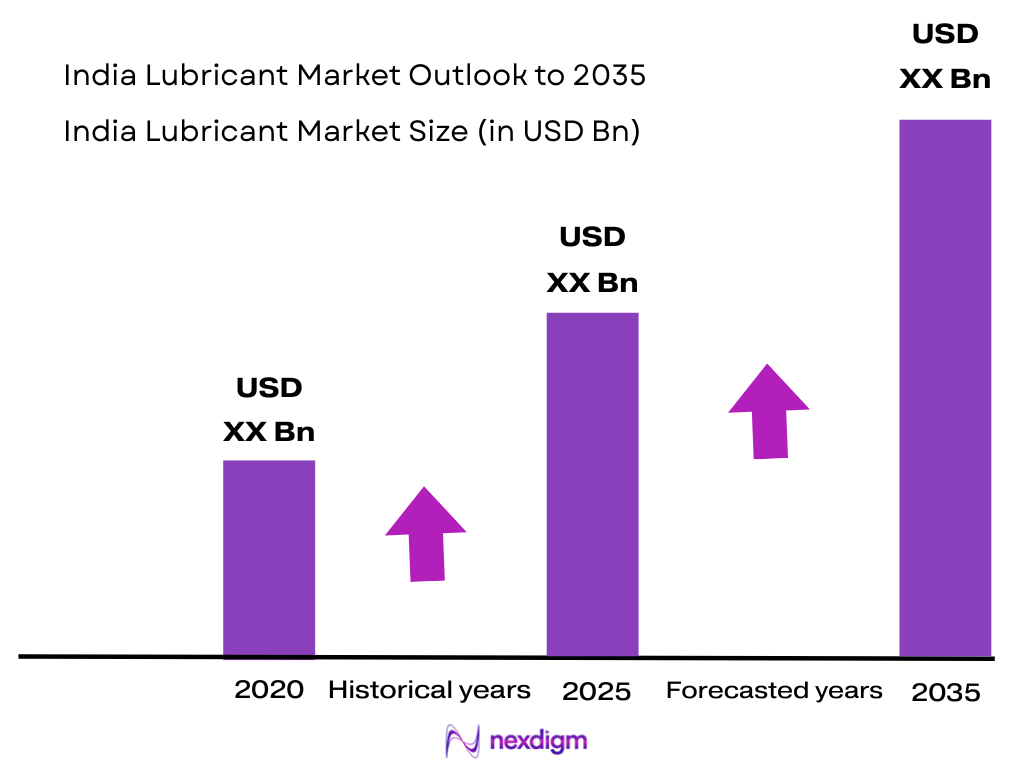
The India Lubricant Market is valued at ~USD XX billion, based on the defined market scope covering automotive, industrial, marine, process and specialty lubricants. Demand is supported by India’s expanding vehicle parc, rising commercial transportation activity, manufacturing output, construction-equipment utilization and industrial machinery base. India’s GDP expanded from approximately USD XX trillion in 2023 to USD XX trillion in 2024, while vehicle production, freight movement and industrial activity continued to support lubricant consumption across automotive and industrial applications. The market is expected to register a CAGR of ~XX% during the forecast period.
India’s lubricant demand is concentrated across major industrial, automotive and logistics centers, particularly Maharashtra, Gujarat, Tamil Nadu, Karnataka, Delhi-NCR, Uttar Pradesh and Telangana. Maharashtra benefits from automotive manufacturing, ports, engineering industries and large industrial clusters, while Gujarat combines petrochemicals, refining, chemicals, ports and manufacturing. Tamil Nadu and Karnataka have significant automobile, component, engineering and electronics ecosystems. Delhi-NCR and Uttar Pradesh are important because of their large vehicle parc, logistics corridors and commercial transportation activity, while Telangana is supported by manufacturing, pharmaceuticals and infrastructure development.
Market Segmentation
By Product Type
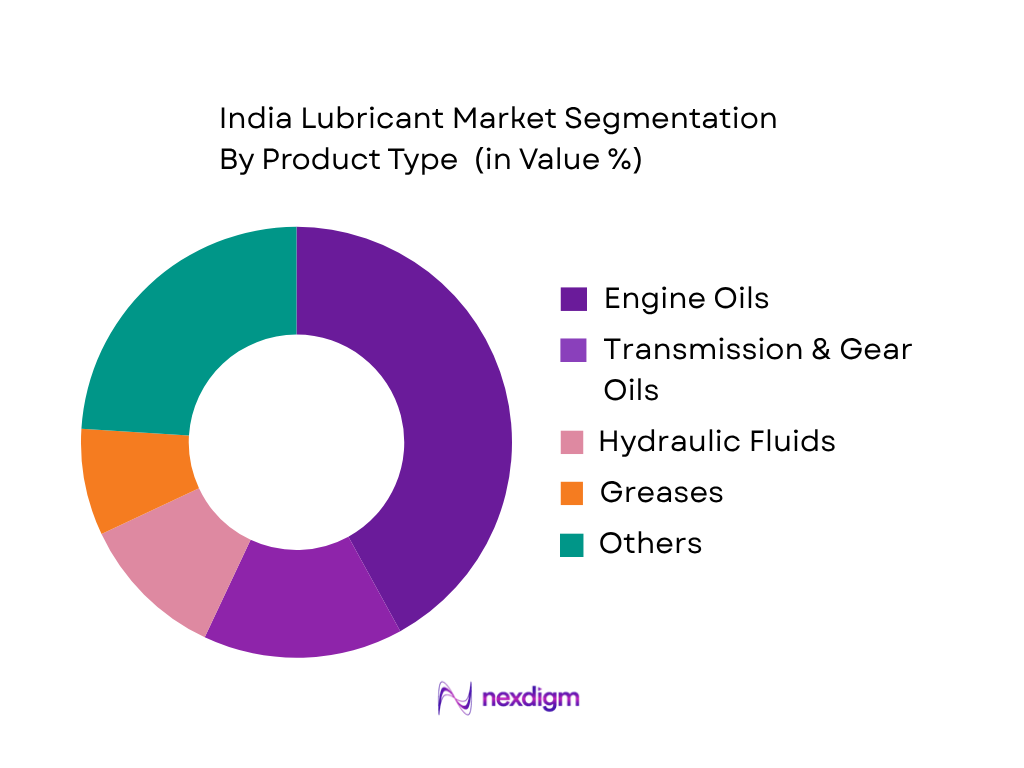
The India Lubricant Market is segmented by product type into engine oils, transmission and gear oils, hydraulic fluids, greases, metalworking fluids, process oils, turbine oils, compressor oils, transformer oils, marine lubricants and specialty lubricants. Among these, engine oils are expected to maintain the dominant position because of India’s large installed base of passenger vehicles, commercial vehicles, motorcycles and three-wheelers. High vehicle utilization, periodic lubricant replacement, aftermarket servicing and continuing demand from commercial transportation create recurring consumption. The segment also benefits from OEM-recommended lubricant specifications and the extensive workshop and retail network operated by major oil companies. Industrial lubricants remain strategically important because India’s manufacturing, power generation, construction, mining and infrastructure sectors require hydraulic fluids, gear oils, greases and turbine lubricants. Increasing equipment sophistication is simultaneously shifting demand toward synthetic and semi-synthetic formulations with longer drain intervals and improved thermal and oxidation stability.
By End-Use Industry
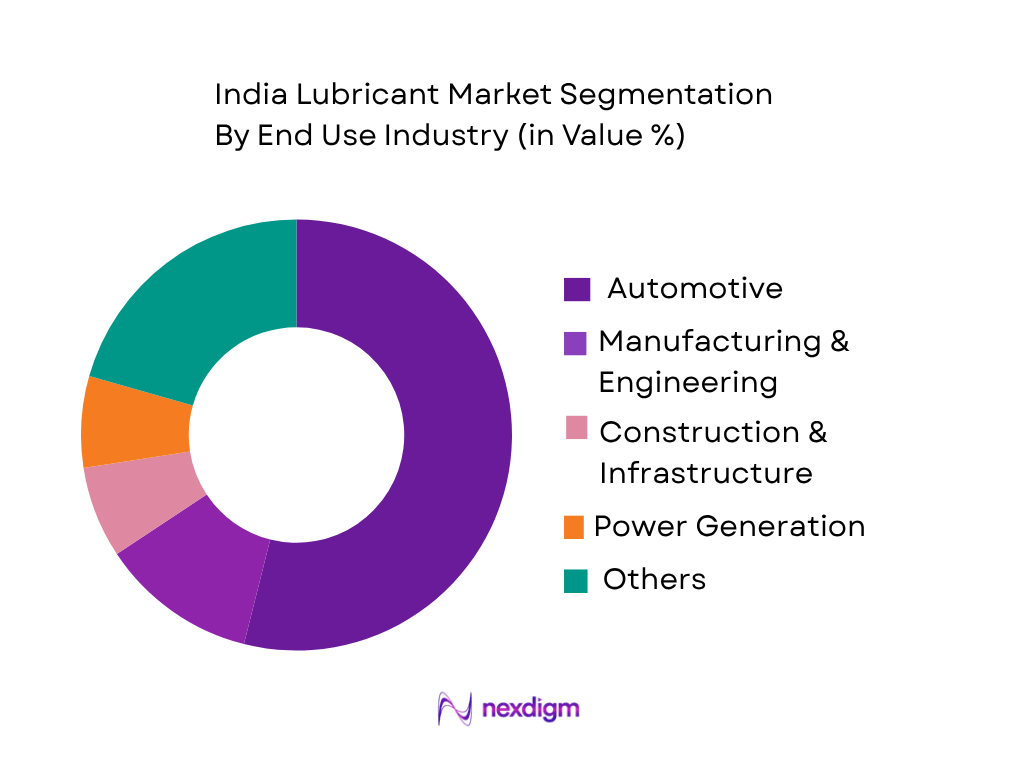
The India Lubricant Market is segmented by end-use industry into automotive, manufacturing, construction, power generation, mining and metals, oil and gas, chemicals and petrochemicals, agriculture, marine, railways and aerospace and defense. Automotive represents the dominant end-use segment because lubricants are required throughout the vehicle lifecycle, from factory fill and dealership servicing to independent workshops and aftermarket maintenance. India’s large two-wheeler population generates particularly frequent lubricant replacement requirements, while commercial vehicles consume significant volumes because of intensive utilization and long operating cycles. Passenger vehicles increasingly require technologically advanced formulations aligned with modern engine specifications, emissions systems and fuel-efficiency requirements. Industrial demand is also expanding as investments in factories, infrastructure, renewable power, logistics, construction machinery and process industries increase equipment utilization. This creates opportunities for hydraulic fluids, industrial gear oils, greases, compressor oils, turbine oils and specialty formulations. The shift toward automation and higher equipment productivity further increases the importance of lubricant reliability and condition monitoring.
Competitive Landscape
The India Lubricant Market is characterized by strong participation from integrated oil companies, global lubricant specialists and domestic manufacturers. Major competitors combine refinery or base-oil access, extensive blending infrastructure, OEM relationships, fuel-station networks, industrial distribution and aftermarket channels. The competitive environment is increasingly shifting from conventional mineral lubricants toward synthetic formulations, fuel-efficient engine oils, specialty industrial fluids, EV fluids and application-specific products. Financial strength, distribution reach, OEM approvals, formulation technology and the ability to serve both automotive and industrial customers remain important competitive differentiators.
| Company | Establishment | Headquarters | Key Financial Metric | Lubricant Portfolio | Manufacturing/Blending Capability | OEM Positioning | Distribution Reach | Technology Focus |
| Indian Oil Corporation | 1959 | New Delhi, India | ~ | ~ | ~ | ~ | ~ | ~ |
| Bharat Petroleum Corporation | 1952 | Mumbai, India | ~ | ~ | ~ | ~ | ~ | ~ |
| Hindustan Petroleum Corporation | 1974 | Mumbai, India | ~ | ~ | ~ | ~ | ~ | ~ |
| Castrol India | 1979 | Mumbai, India | ~ | ~ | ~ | ~ | ~ | ~ |
| Gulf Oil Lubricants India | 2008 | Mumbai, India | ~ | ~ | ~ | ~ | ~ | ~ |
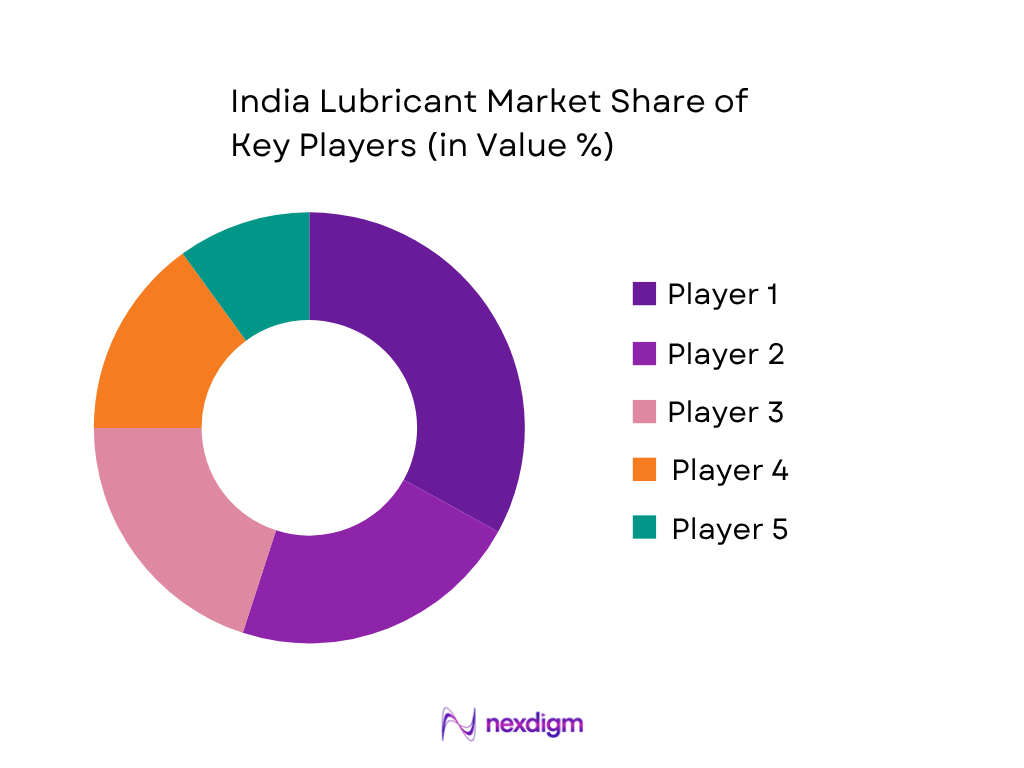
India Lubricant Market Analysis
Growth Drivers
Expansion of Vehicle Parc and Commercial Transportation Activity
The expansion of India’s vehicle base is a direct recurring-demand driver for engine oils, transmission fluids, gear oils, greases and other automotive lubricants because every internal-combustion vehicle requires periodic lubrication and maintenance. India’s automotive industry produced 3.10 crore vehicles in FY2024-25, compared with 2.84 crore vehicles in FY2023-24, according to the Society of Indian Automobile Manufacturers. Domestic sales also remained substantial, with 42,74,793 passenger vehicles, 9,51,991 commercial vehicles, 7,28,670 three-wheelers and 1,95,43,093 two-wheelers sold during calendar 2024. The two-wheeler base is particularly important for lubricant demand because motorcycles and scooters have high population penetration, intensive urban and semi-urban usage and comparatively frequent service cycles. India’s commercial-vehicle ecosystem provides another high-utilization demand pool because trucks, buses and light commercial vehicles operate for extended periods and require engine oils, transmission fluids, axle lubricants and greases. The broader macroeconomic environment also supports vehicle utilization: the World Bank reported 8.2% real GDP growth in FY2023-24, with manufacturing growth of 9.9%, while the IMF reported 6.5% real GDP growth for FY2024-25. This combination of economic activity, vehicle production and transportation demand supports continued lubricant consumption across OEM fill, dealer servicing, fleet maintenance and the independent aftermarket.
Industrial Manufacturing, Infrastructure and Equipment Expansion
Industrialization and infrastructure development are broad-based demand generators for India’s lubricant industry because manufacturing plants, construction equipment, mining machinery, power assets and material-handling systems require hydraulic fluids, industrial gear oils, compressor oils, turbine oils and greases. The World Bank reported that India’s manufacturing sector grew 9.9% in FY2023-24, while the Ministry of Heavy Industries reported that production across selected capital-goods subsectors reached ₹5,69,900 crore in FY2024-25, compared with ₹4,43,? crore in FY2023-24; earthmoving and mining machinery production alone reached ₹80,750 crore, up from ₹73,000 crore. Construction equipment demand is particularly lubricant-intensive: FY2023-24 construction-equipment sales reached 1,35,650 units, compared with 1,07,779 units previously, according to industry data cited in a SEBI filing. Infrastructure activity provides an additional equipment-utilization channel. India’s Economic Survey reported 7,63,308 km of PMGSY rural roads completed as of June 2024, while railway capital expenditure reached ₹2.62 lakh crore in FY2023-24. Power and renewable infrastructure are also creating specialized lubrication requirements: India’s renewable-energy installed capacity reached 209.44 GW in December 2024, including 48.16 GW of wind capacity. These developments expand the installed base of machines and rotating equipment requiring preventive maintenance, while greater equipment sophistication raises demand for application-specific lubricants capable of handling high loads, temperature, contamination and extended operating cycles.
Market Challenges
Base-Oil, Additive and Specialty-Feedstock Supply Dependency
India’s lubricant formulation ecosystem remains exposed to the availability and international supply chain of base oils, performance additives and specialty feedstocks, particularly for higher-performance formulations. This creates a strategic challenge because lubricant manufacturers must maintain consistent viscosity, oxidation stability, wear protection and thermal performance while managing an internationally connected raw-material chain. India’s broader petroleum system illustrates the scale of this external exposure: the Petroleum Planning & Analysis Cell maintains dedicated import-export reporting for crude oil and petroleum products, reflecting the country’s substantial dependence on international petroleum supply chains. At the same time, India’s lubricant industry is moving toward more technically demanding formulations as modern engines, industrial machinery and specialty applications require tighter performance specifications. This raises dependence on specialized additive packages rather than only conventional mineral base oils. The challenge becomes more significant for synthetic lubricants, EV fluids, high-performance industrial oils, metalworking fluids and food-grade formulations, where formulation chemistry and qualification requirements can narrow the number of technically suitable suppliers. India’s macroeconomic scale adds to the strategic importance of supply security: the IMF recorded 6.5% real GDP growth in FY2024-25, while the World Bank reported 8.2% growth in FY2023-24, indicating continued expansion of the industrial and transportation base that consumes lubricants. Consequently, disruptions affecting imported feedstocks can propagate into manufacturing schedules, formulation availability and procurement planning even when domestic blending capacity remains adequate.
Counterfeit Products, Unorganized Distribution and Changing Lubricant Consumption Patterns
The fragmented aftermarket creates a structural challenge for India’s lubricant industry because products pass through authorized distributors, independent workshops, retailers and informal channels, increasing the difficulty of protecting brands and ensuring correct product selection. This is particularly important for engine oils and other automotive lubricants, where counterfeit or improperly specified products can damage engines and undermine consumer confidence in premium formulations. The challenge is amplified by India’s enormous two-wheeler and commercial-vehicle ecosystem: SIAM recorded 1,95,43,093 two-wheeler sales and 9,51,991 commercial-vehicle sales during calendar 2024, creating millions of recurring service and lubricant-replacement transactions. At the same time, improved lubricant technology and longer service intervals can alter replacement frequency, particularly as OEMs recommend longer-drain formulations and newer vehicles use tighter lubricant specifications. Electrification introduces another structural shift: the IEA reported that India’s electric-car sales approached 100,000 units in 2024, although conventional powertrains still dominate the vehicle fleet. Lubricant manufacturers therefore face a dual requirement—protecting conventional lubricant volumes in the enormous existing vehicle parc while developing fluids for electrified drivetrains. Regulatory changes also increase compliance requirements. India’s Central Pollution Control Board’s used-oil framework requires producers to register, fulfil extended producer responsibility obligations and file annual returns, adding collection and traceability responsibilities to the value chain. These factors increase the importance of authorized distribution, product authentication, technical education and lifecycle management.
Market Opportunities
Premium Synthetic Lubricants and EV Thermal and Driveline Fluids
The transition toward higher-performance powertrains creates an opportunity for India lubricant manufacturers to shift their portfolios toward synthetic, semi-synthetic and application-specific fluids. Modern engines operate under tighter emissions, fuel-efficiency and thermal-management requirements, increasing the value of lubricants engineered for low viscosity, oxidation resistance, deposit control and extended drain performance. India’s automotive production reached 3.10 crore vehicles in FY2024-25, while domestic sales included 43.02 lakh passenger vehicles and 9.57 lakh commercial vehicles, demonstrating the scale of the installed market that can progressively migrate toward higher-specification products. Electrification adds a new technology layer rather than simply eliminating lubricant demand. The IEA reported that Indian electric-car sales approached 100,000 units in 2024, creating an emerging requirement for dedicated e-transmission fluids, thermal-management fluids, greases and other EV-compatible formulations. The opportunity extends beyond cars to electric two-wheelers, three-wheelers, buses and commercial vehicles as electrification spreads across multiple mobility categories. Manufacturers with formulation capabilities can therefore use existing lubricant distribution infrastructure while progressively introducing EV-specific products. This is supported by India’s wider technology and industrial expansion: the World Bank reported 9.9% manufacturing growth in FY2023-24, while the IMF recorded 6.5% real GDP growth in FY2024-25. The combination of expanding vehicle production, tighter technical specifications and emerging electrified powertrains provides a strong basis for premiumization and specialty-fluid development without relying solely on increases in conventional lubricant volumes.
Industrial Specialty Fluids, Renewable-Energy Lubricants and Circular Lubrication
India’s expanding industrial asset base creates significant opportunities for specialty lubricants designed around equipment-specific operating conditions rather than commodity-volume competition. Manufacturing, construction, mining, power generation and renewable energy require hydraulic fluids, industrial gear oils, turbine lubricants, compressor oils, metalworking fluids and high-performance greases. Capital-goods production across selected heavy-engineering subsectors reached ₹5,69,900 crore in FY2024-25, while earthmoving and mining machinery production reached ₹80,750 crore, indicating a substantial equipment ecosystem requiring lubrication and maintenance. Renewable energy provides another emerging application: India had 209.44 GW of installed renewable-energy capacity in December 2024, including 48.16 GW of wind capacity; by June 2026, wind capacity had reached 57,443 MW. Wind turbines require specialized gear oils, greases and maintenance fluids capable of operating under high loads and variable environmental conditions. Circularity is also becoming commercially relevant. The Central Pollution Control Board’s used-oil framework establishes extended producer responsibility requirements, including registration, EPR fulfillment through registered recyclers and annual reporting. This creates a pathway for manufacturers to develop collection, re-refining and circular-lubricant strategies alongside conventional product sales. India’s infrastructure and industrial investment environment further reinforces the opportunity: infrastructure-related ministries utilized an average of 60% of their budgeted capital expenditure between April and November 2024, according to the Economic Survey. Specialty formulations, predictive-maintenance services, renewable-energy lubricants and re-refined products can therefore expand the industry’s value proposition beyond conventional automotive oils.
Future Outlook
The India Lubricant Market is expected to experience sustained structural demand as vehicle ownership, industrialization, infrastructure investment and equipment utilization expand. Growth will increasingly depend on premiumization rather than only lubricant-volume expansion, with synthetic, low-viscosity, long-drain and application-specific formulations gaining importance. Electrification will gradually reshape automotive lubricant demand while creating new requirements for EV transmission fluids, thermal-management fluids, greases and e-mobility specialty formulations. Industrial customers are also expected to prioritize energy efficiency, equipment uptime, predictive maintenance and extended drain intervals.
Major Players
- Indian Oil Corporation Limited
- Bharat Petroleum Corporation Limited
- Hindustan Petroleum Corporation Limited
- Castrol India Limited
- Gulf Oil Lubricants India Limited
- ExxonMobil Lubricants Private Limited
- Shell India Markets Private Limited
- TotalEnergies Marketing India Private Limited
- Tide Water Oil (India) Limited
- Valvoline Cummins Private Limited
- Apar Industries Limited
- Savita Oil Technologies Limited
- Raj Petro Specialities Private Limited
- Klüber Lubrication India Private Limited
- Veedol India Limited
Key Target Audience
- Automotive OEMs and Powertrain Manufacturers
- Commercial Vehicle Fleets and Fleet Operators
- Industrial Machinery and Equipment Manufacturers
- Oil Marketing and Lubricant Distribution Companies
- Manufacturing, Engineering and Process Industries
- Investments and Venture Capitalist Firms (Private equity funds, venture capital funds, infrastructure investors and strategic investors)
- Government and Regulatory Bodies (Ministry of Petroleum and Natural Gas, Ministry of Heavy Industries, Bureau of Indian Standards, Petroleum and Explosives Safety Organisation, Central Pollution Control Board)
- Mining, Construction, Power and Infrastructure Operators
Research Methodology
Step 1: Identification of Key Variables
The initial phase establishes the India Lubricant Market ecosystem across lubricant manufacturers, base-oil suppliers, additive companies, OEMs, distributors, workshops, industrial users and regulatory authorities. Variables include lubricant production, sales volume, vehicle parc, industrial equipment utilization, OEM specifications, lubricant grades, synthetic penetration and end-use demand.
Step 2: Market Analysis and Construction
Historical market information is compiled across automotive and industrial lubricant categories, with separate assessment of engine oils, gear oils, hydraulic fluids, greases, metalworking fluids, process oils and specialty products. Bottom-up calculations incorporate lubricant volumes, channel activity, application intensity, replacement cycles and industrial equipment requirements.
Step 3: Hypothesis Validation and Expert Consultation
Market hypotheses are validated through structured discussions with lubricant manufacturers, distributors, automotive OEM representatives, industrial procurement professionals, workshops and technical specialists. Interviews focus on formulation preferences, OEM approvals, channel economics, product migration, replacement intervals and emerging EV-fluid requirements.
Step 4: Research Synthesis and Final Output
The final market model triangulates bottom-up estimates with company disclosures, production information, automotive and industrial indicators, trade data and publicly available regulatory information. Competitive benchmarking then integrates financial performance, lubricant portfolios, manufacturing footprint, OEM approvals, distribution reach and technology positioning.

- Executive Summary
- Research Methodology (Market Definition and Scope, Lubricant Classification Framework, Historical Market Reconstruction, Top-Down Market Sizing, Bottom-Up Demand Modeling, Automotive Parc Analysis, Industrial Consumption Mapping, Import-Export Validation, Primary Industry Interviews, Distributor and Channel Assessment, Data Triangulation, Forecasting Framework, Scenario Analysis, Assumptions and Limitations)

- Definition and Scope
- Evolution of the Indian Lubricant Industry
- Lubricant Industry Development Timeline
- India Lubricant Market Ecosystem
- Lubricant Value Chain Analysis
- Lubricant Supply Chain Analysis

- Growth Drivers (Expansion of Vehicle Parc, Commercial Transportation Activity, Two-Wheeler Penetration, Industrial Manufacturing Expansion, Infrastructure Development, Agricultural Mechanization, Construction Equipment Demand, Power Generation Capacity, Mining Activity, Premium Lubricant Adoption)
- Market Challenges (Base Oil Price Volatility, Dependence on Imported Specialty Base Oils and Additives, Counterfeit Lubricants, Unorganized Workshop Distribution, Drain-Interval Extension, EV Powertrain Transition, Used-Oil Collection Constraints, Product Qualification Requirements)
- Market Opportunities (Premium Synthetic Lubricants, EV Thermal and Driveline Fluids, Bio-Based Lubricants, Industrial Specialty Fluids, Re-Refined Lubricants, Wind-Turbine Lubricants, Data-Center Cooling Fluids, High-Performance Metalworking Fluids, Mining Lubricants, Food-Grade Lubricants)
- Market Trends (Long-Drain Engine Oils, Lower-Viscosity Formulations, Synthetic and Semi-Synthetic Adoption, Fuel-Efficient Lubricants, EV Fluids, OEM-Specified Lubricants, Bio-Based Formulations, Condition-Based Lubrication, Digital Oil Monitoring, Premiumization)
- Government and Regulatory Framework (Bureau of Indian Standards Requirements, Automotive Emission Standards, Used-Oil Management, Hazardous Waste Rules, Extended Producer Responsibility, Product Labelling, Environmental Compliance, Automotive OEM Specifications)
- Porter’s Five Forces Analysis
- PESTLE Analysis
- SWOT Analysis

- By Market Value (2020-2025)
- By Volume Consumption (2020-2025)
- By Average Selling Price (2020-2025)
- By Automotive Lubricant Consumption (2020-2025)
- By Industrial Lubricant Consumption (2020-2025)
- By Process Oil and Specialty Lubricant Consumption (2020-2025)
- By OEM-Fill, Aftermarket and Industrial Direct Sales (2020-2025)
- By Domestic Production and Imported Lubricants (2020-2025)
- By Organized and Unorganized Distribution (2020-2025)

- By Product Type (in value %)
Engine Oils
Transmission and Gear Oils
Hydraulic Fluids
Greases
Metalworking Fluids
Process Oils
Compressor and Refrigeration Oils
Turbine and Circulating Oils
Transformer and Electrical Oils
Marine Lubricants
Specialty and Performance Lubricants - By Base Oil Type (in value %)
Group I Base Oils
Group II Base Oils
Group III Base Oils
Polyalphaolefin-Based Lubricants
Ester-Based Lubricants
Re-Refined Base Oil Lubricants
Bio-Based Lubricants - By Automotive Application (in value %)
Passenger Car Lubricants
Commercial Vehicle Lubricants
Two-Wheeler Lubricants
Three-Wheeler Lubricants
Agricultural Machinery Lubricants
Construction Equipment Lubricants
Mining and Heavy-Duty Vehicle Lubricants
Electric Vehicle Fluids and Lubricants - By Industrial End-Use (in value %)
General Manufacturing
Power Generation
Metals and Steel
Cement and Building Materials
Mining and Mineral Processing
Food and Beverage Processing
Textile Manufacturing
Chemical and Petrochemical Processing
Oil and Gas
Marine and Port Operations
Railways and Heavy Engineering - By Distribution Channel (in value %)
OEM and Dealer Networks
Authorized Service Workshops
Independent Workshops
Lubricant Distributors and Stockists
Fuel Stations
Automotive Parts Retailers
Industrial Direct Sales
Online and E-Commerce Channels - By Vehicle Fuel and Powertrain (in value %)
Petrol Vehicles
Diesel Vehicles
CNG and LPG Vehicles
Hybrid Vehicles
Battery Electric Vehicles
Heavy-Duty Diesel Powertrains

- Market Share of Major Players (By Value, Volume, Product Type, Automotive Segment, Industrial Segment, Distribution Channel, Base Oil Type)
- Financial Performance Benchmarking (Revenue from Operations, EBITDA, Profit After Tax, EBITDA Margin, PAT Margin, Total Assets, Net Worth, Operating Cash Flow, Capital Expenditure, Dividend Payout)
- Cross Comparison Parameters
- SWOT Analysis of Major Players
- Detailed Profiles of Major Companies
Indian Oil Corporation Limited
Bharat Petroleum Corporation Limited
Hindustan Petroleum Corporation Limited
Castrol India Limited
Shell India Markets Private Limited
ExxonMobil Lubricants Private Limited
Gulf Oil Lubricants India Limited
Valvoline Cummins Private Limited
TotalEnergies Marketing India Private Limited
Tide Water Oil (India) Limited
Savita Oil Technologies Limited
Nayara Energy Limited
Petronas Lubricants India Private Limited
Apar Industries Limited
Veedol Corporation Limited

- Automotive Lubricant End-User Analysis
- Passenger Vehicle Lubricant Consumption
- Commercial Vehicle Lubricant Consumption
- Two-Wheeler Lubricant Consumption
- Agricultural Equipment Lubricant Consumption
- Construction and Mining Lubricant Consumption
- Industrial End-User Requirements

- By Market Value (2026-2035)
- By Volume Consumption (2026-2035)
- By Average Selling Price (2026-2035)
- By Automotive Lubricant Consumption (2026-2035)
- By Industrial Lubricant Consumption (2026-2035)
- By Process Oil and Specialty Lubricant Consumption (2026-2035)
- By OEM-Fill, Aftermarket and Industrial Direct Sales (2026-2035)
- By Domestic Production and Imported Lubricants (2026-2035)


 Request a Sample
 Ask for Customization
 Get a Quote
 Enquire Now