
 Download PDF
Market Overview
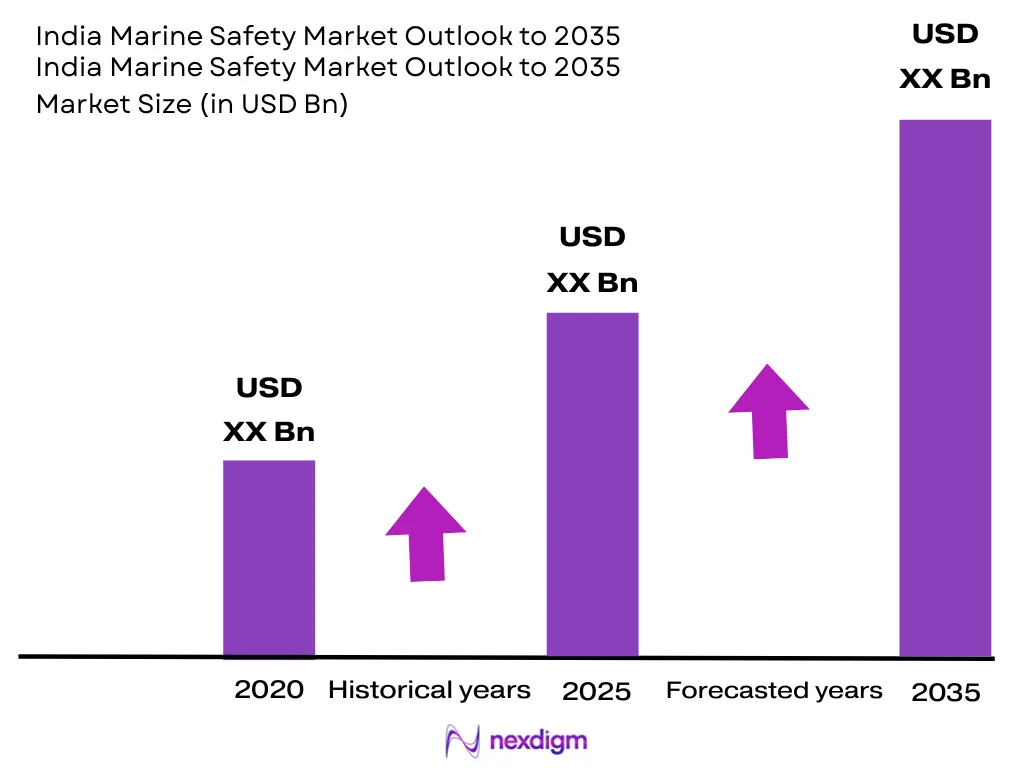
The India Marine Safety Market was valued at approximately USD ~ billion in 2024 and is projected to grow at a CAGR of ~% during the 2026–2035 forecast period. The market is driven by the expansion of India’s commercial shipping fleet, the Government of India’s ambitious maritime development programs including the Sagarmala initiative and Maritime India Vision 2030, increasingly stringent IMO and SOLAS regulatory compliance requirements, and growing safety equipment demand from the offshore oil and gas, inland waterways, and naval sectors. India is among the world’s top maritime nations, with the Directorate General of Shipping (DGS) reporting a nationally registered commercial fleet exceeding 1,500 vessels and a significantly larger number of foreign-flagged vessels managed by Indian companies, while the country operates 13 major ports and over 200 minor ports handling approximately 1.5 billion tonnes of cargo annually. According to the Ministry of Ports, Shipping and Waterways, India’s maritime sector contributes significantly to the national economy and is a priority investment area under the National Infrastructure Pipeline. The Indian Navy and Coast Guard operate extensive and modernising fleets requiring advanced safety equipment, while the country’s vast inland waterway network — being developed under the National Waterway program by the Inland Waterways Authority of India (IWAI) — is creating new and significant demand for vessel safety equipment. The marine safety market encompasses life-saving appliances, fire detection and suppression systems, navigation safety equipment, communication and distress signalling systems, personal protective equipment, marine coatings, gas detection systems, and maritime medical and crew safety services.
Market Segmentation
By Product/Service Type
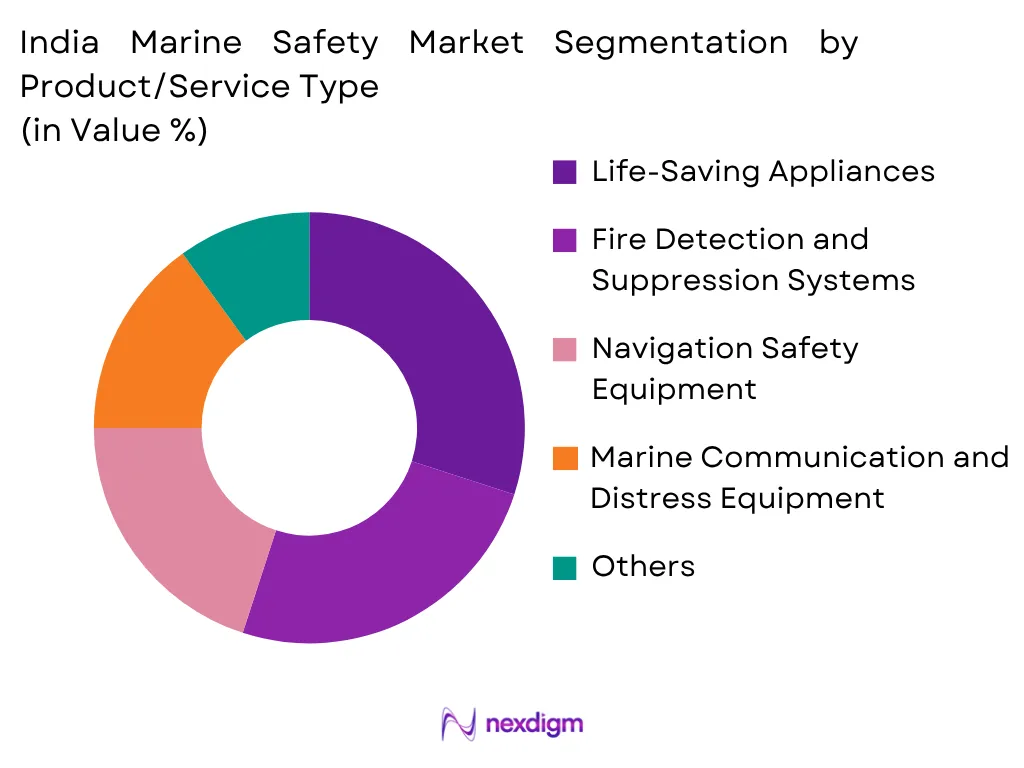
Life-saving appliances (LSA) dominate the India marine safety market by value, driven by mandatory SOLAS compliance requirements applicable to all internationally trading vessels, the Indian Merchant Shipping Act 1958, and DGS regulations governing coastal and inland vessel safety equipment. Liferafts, lifeboats, immersion suits, lifejackets, EPIRBs, SARTs, and marine pyrotechnics represent core equipment categories subject to mandatory carriage requirements, five-yearly overhaul cycles, and periodic survey inspections by recognised classification societies including Lloyd’s Register, Bureau Veritas, DNV, and the Indian Register of Shipping (IRS). Fire detection and suppression systems represent the second-largest segment, covering fixed CO2 systems, foam suppression systems, fire detection panels, and high-pressure water mist systems required across all vessel types under SOLAS Chapter II-2 and the Fire Safety Systems (FSS) Code. Navigation safety equipment, encompassing ECDIS, AIS, VDR, radar, and GMDSS communication systems, represents a high-growth segment driven by mandatory carriage requirements under SOLAS Chapter V and increasing adoption of digital navigation technology across India’s commercial and naval fleets. Marine coatings and corrosion protection represent a substantial and recurring market segment given the extensive maintenance requirements of India’s aging commercial fleet and the growing newbuilding activity at Indian shipyards including Cochin Shipyard, Mazagon Dock, and L&T Shipbuilding.
By End User
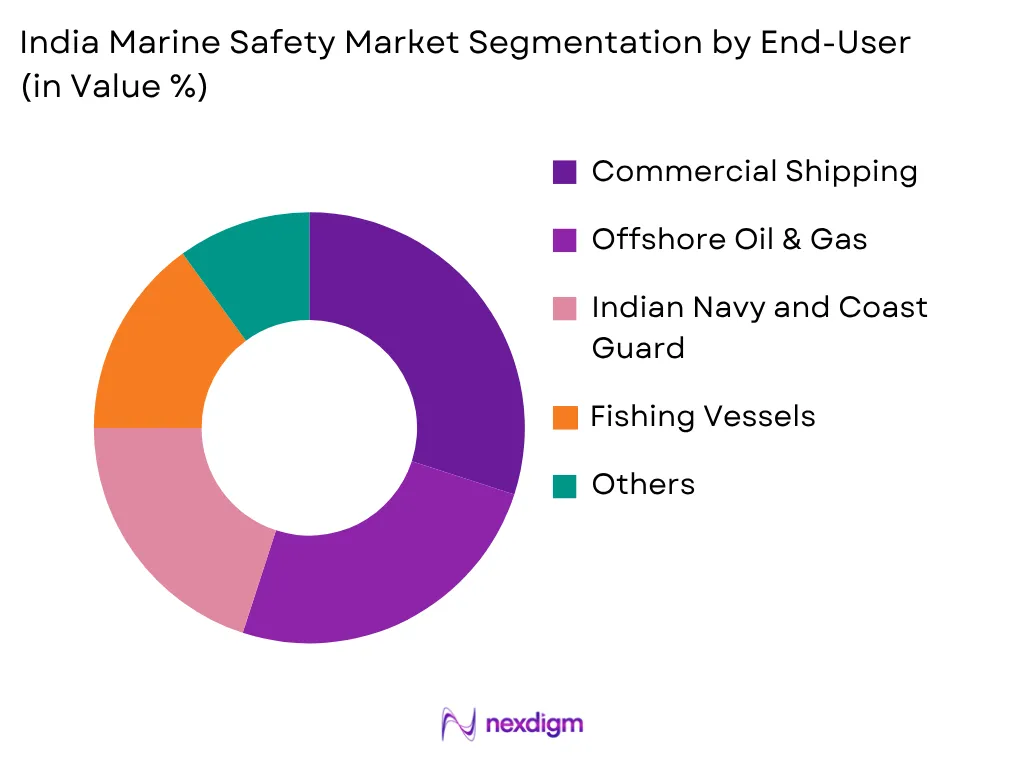
Commercial shipping represents the largest end-user segment, encompassing all internationally trading and coastal vessels registered under the Indian flag as well as foreign-flagged vessels calling at Indian ports requiring survey-compliant safety equipment. India’s commercial fleet spans bulk carriers, tankers, container ships, general cargo vessels, and offshore support vessels, each with specific mandatory safety equipment requirements governed by SOLAS, the ISM Code, and DGS circular requirements. The offshore oil and gas sector represents a high-value end-user segment given the sophisticated and specialised safety equipment required on drilling rigs, FPSOs, platform supply vessels, and other offshore installations operated by ONGC, Oil India, and international operators in Indian waters, where equipment failure consequences are particularly severe. The Indian Navy and Coast Guard represent strategically important institutional procurement segments, with fleet modernisation programs under the Indian Navy’s 30-year maritime capability perspective plan and the Coast Guard’s ongoing fleet expansion creating sustained demand for advanced safety, fire detection, and navigation safety systems. India’s large fishing vessel fleet — estimated at over 200,000 registered vessels — represents a distinctive and high-volume but cost-sensitive end-user segment requiring affordable and locally appropriate safety equipment including lifejackets, flares, and communication devices, supported through government subsidy schemes.
Competitive Landscape
The India Marine Safety Market is moderately fragmented, with multinational safety equipment manufacturers competing through authorised distributors and ship chandling networks alongside a growing base of domestic manufacturers and service providers. Global companies such as Survitec Group, Viking Life-Saving Equipment, Drager, Consilium Marine, and Furuno maintain dominant positions in high-specification IMO-certified equipment categories through established distribution partnerships and service station networks in Mumbai, Chennai, Kochi, Kolkata, and Visakhapatnam. Domestic manufacturers and service providers are increasingly competitive in segments such as marine coatings, fire suppression systems, lifejackets, and maritime training services, supported by the Make in India initiative and DGS approved domestic manufacturing programs. Price competitiveness, proximity of servicing facilities to major Indian ports, breadth of DGS and IMO certification coverage, and reliability of after-sales survey support represent the primary competitive differentiators within the Indian marine safety market.
| Company | Establishment Year | Headquarters | Primary Focus | Manufacturing/Service Facilities
|
Export Presence | Certification & Compliance | Sustainability Programs | Key Marine Safety Product/Service Portfolio |
| Drager India | 1889 | ~ | ~ | ~ | ~ | ~ | ~ | ~ |
| Survitec Group India | 1920 | ~ | ~ | ~ | ~ | ~ | ~ | ~ |
| Jotun India | 1926 | ~ | ~ | ~ | ~ | ~ | ~ | ~ |
| Consilium Marine India | 1912 | ~ | ~ | ~ | ~ | ~ | ~ | ~ |
| VIKAND Solutions India | 2010 | ~ | ~ | ~ | ~ | ~ | ~ | ~ |
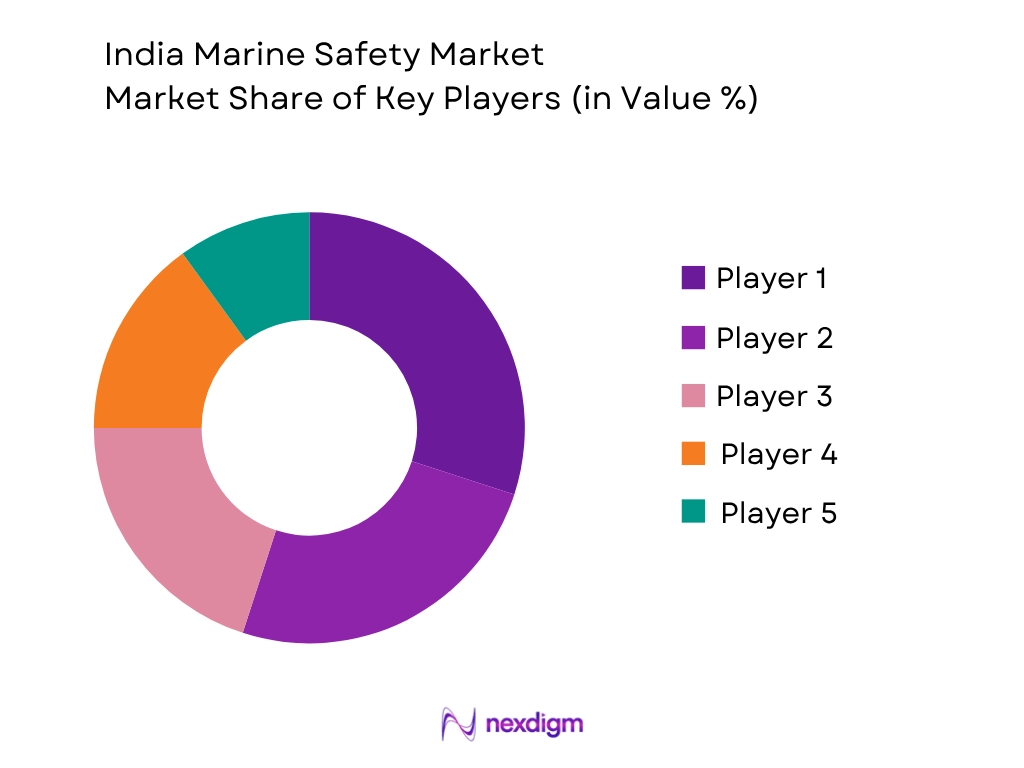
India Marine Safety Market Analysis
Growth Drivers
Government Maritime Development Programs and Expanding Commercial Fleet
The Government of India’s ambitious maritime development agenda represents the most significant structural driver of marine safety market expansion over the outlook period. The Sagarmala Programme, launched by the Ministry of Ports, Shipping and Waterways, has committed over INR 5.5 lakh crore in port-led development investment across port modernisation, coastal shipping development, port connectivity enhancement, and coastal community development, each component of which generates direct and indirect demand for marine safety equipment, port fire safety systems, and maritime training services. Maritime India Vision 2030, released by the Ministry of Ports, Shipping and Waterways, sets transformational targets for India’s maritime sector including doubling port capacity, expanding the national merchant fleet, developing cruise tourism, and establishing India as a major shipbuilding and ship recycling nation — all of which create structural demand for marine safety equipment across new vessel commissioning, port infrastructure, and maritime service development. According to the Directorate General of Shipping, India’s nationally registered fleet has grown consistently over the past decade, with particular expansion in coastal shipping and offshore support vessel categories, each requiring comprehensive SOLAS and DGS-compliant safety equipment packages. The World Bank estimated India’s GDP at approximately USD 3.9 trillion in 2024, with the IMF projecting continued robust economic growth, supporting increased trade volumes through Indian ports and sustained growth in shipping activity. India’s National Infrastructure Pipeline allocates substantial capital for port and inland waterway development through 2025, creating a sustained pipeline of maritime infrastructure investment that drives safety equipment procurement across both new installations and upgrade requirements.
IMO Regulatory Compliance and Naval and Coast Guard Fleet Modernisation
Increasingly stringent international maritime safety regulations enforced through IMO conventions — and their implementation through DGS circulars and the Merchant Shipping Act — continue to drive mandatory equipment replacement and upgrade cycles across India’s commercial and government vessel fleets. The International Maritime Organization’s ongoing work program regularly introduces new or enhanced safety equipment requirements, including amendments to SOLAS, updates to the LSA Code and FSS Code, new ECDIS carriage requirements, enhanced GMDSS modernisation under the e-Navigation framework, and updated ballast water management and pollution prevention requirements, each of which translates into compulsory procurement cycles for vessel operators. Classification societies including Lloyd’s Register, DNV, Bureau Veritas, and the Indian Register of Shipping enforce annual survey inspections, five-yearly special surveys, and periodic drydocking requirements that mandate the inspection, overhaul, or replacement of safety equipment including liferafts, immersion suits, fire extinguishers, EPIRBs, and pyrotechnics. Simultaneously, India’s Indian Navy — operating one of Asia’s largest naval fleets with approximately 150 commissioned vessels — and the Indian Coast Guard — managing a fleet of over 156 ships and 62 aircraft — represent substantial and growing institutional procurement programs for advanced safety, firefighting, damage control, and search-and-rescue equipment. The Indian Navy’s Project 75I submarine program, ongoing destroyer and frigate construction programs, and the Coast Guard’s fleet expansion along India’s 7,516-kilometre coastline collectively represent significant and sustained government procurement for specialised marine safety and survivability systems.
Market Challenges
High Import Dependency and Price Sensitivity Among Smaller Operators
The India marine safety market continues to face structural challenges arising from high import dependency for advanced and specialised safety equipment, combined with acute price sensitivity among the large number of smaller vessel operators — particularly fishing vessel owners and inland waterway operators — that constitute a significant share of the market by vessel count. According to the Directorate General of Shipping and the Bureau of Indian Standards (BIS), the majority of high-specification marine safety equipment including SOLAS-approved liferafts, immersion suits, EPIRBs, fire detection panels, and sophisticated navigation equipment is imported from established manufacturers in Europe, Japan, and the United States, given the limited domestic manufacturing capability for IMO-certified marine safety products. This import dependency exposes Indian vessel operators to currency risk on the Indian Rupee, import duty costs under India’s customs tariff structure, extended supply lead times, and after-sales servicing challenges in ports distant from major metropolitan service hubs. Simultaneously, India’s large fishing vessel fleet of over 200,000 registered craft and its growing inland waterway passenger ferry network are largely operated by small and medium-scale operators with limited capital expenditure budgets, creating persistent affordability barriers to full compliance with safety equipment requirements even where regulations mandate carriage. The price gap between internationally certified equipment meeting SOLAS and IMO standards and lower-cost locally produced or imported uncertified alternatives creates ongoing enforcement challenges for DGS and state maritime authorities.
Fragmented Distribution Infrastructure and Skilled Manpower Shortage
India’s marine safety market faces persistent operational challenges arising from fragmented ship chandling and distribution infrastructure outside the country’s major ports, alongside a significant shortage of skilled personnel qualified to install, inspect, service, and certify marine safety equipment to IMO and DGS standards. While Mumbai, Chennai, Kochi, Kolkata, and Visakhapatnam maintain relatively well-developed marine equipment distribution and servicing ecosystems, minor ports and coastal anchorages across India’s extensive coastline — as well as inland waterway terminals across National Waterways 1, 2, and 3 — frequently lack proximate access to certified safety equipment suppliers, authorised service stations, and qualified surveyors, increasing both the cost and logistical complexity of maintaining compliant safety equipment. The Directorate General of Shipping’s approved service station network, while expanding, does not yet provide comprehensive coverage across all Indian ports and anchorages, creating service gaps particularly in Gujarat’s minor port belt, Andhra Pradesh’s fishing harbour networks, and the developing inland waterway terminals. Simultaneously, the maritime industry’s demand for STCW-certified personnel trained in safety equipment operation, liferaft servicing, GMDSS operation, and firefighting systems exceeds the current output of India’s maritime training institutes, creating workforce bottlenecks that constrain service delivery capacity across the sector.
Market Opportunities
Make in India Manufacturing and Inland Waterway Safety Infrastructure
The Government of India’s Make in India initiative and the rapid development of the country’s inland waterway network under the National Waterways Act 2016 present significant and complementary long-term opportunities for India’s marine safety market. The Ministry of Ports, Shipping and Waterways has identified marine safety equipment as a priority sector for domestic manufacturing development, recognising that reducing import dependency for IMO-certified equipment would strengthen supply chain resilience, reduce costs for Indian vessel operators, and create industrial employment. DGS has progressively expanded its approved domestic manufacturer lists for lifejackets, fire extinguishers, marine pyrotechnics, and certain navigation equipment categories, creating commercial opportunities for Indian manufacturers willing to invest in IMO type approval testing and BIS certification. The Inland Waterways Authority of India (IWAI) has identified 111 waterways for development as National Waterways, with 26 waterways currently operational and carrying cargo and passenger traffic, each requiring IWAI-mandated safety equipment on operating vessels under the Inland Vessels Act 2021. The Jal Marg Vikas Project on National Waterway-1 (the Ganga) and multiple state-level ferry modernisation programs are creating procurement pipelines for lifejackets, fire extinguishers, communication equipment, and emergency signalling devices across hundreds of newly commissioned or upgraded inland vessels, representing a growing domestic demand stream for safety equipment that is accessible to Indian manufacturers at competitive price points.
Digital Safety Systems and Offshore Deep Water Safety Equipment Growth
The progressive digitalisation of maritime safety management systems and the continued expansion of India’s offshore oil and gas deep water exploration activity are creating high-value growth opportunities for advanced marine safety technology providers in the Indian market. According to the Directorate General of Hydrocarbons (DGH) and the Ministry of Petroleum and Natural Gas, India’s offshore exploration activity — spanning the Mumbai High, Krishna-Godavari basin, Cauvery basin, and emerging deep water blocks — continues to generate sustained and high-specification demand for offshore safety equipment including fire and gas detection systems, personal gas monitors, emergency shutdown systems, survival craft, and offshore-specific PPE. The government’s OALP (Open Acreage Licensing Program) and Hydrocarbon Exploration Licensing Policy (HELP) are progressively attracting international oil companies to India’s offshore blocks, increasing the number of offshore installations requiring sophisticated safety management systems. Simultaneously, the IMO’s e-Navigation strategy and the increasing adoption of ECDIS, integrated navigation bridge systems, voyage data recorders, and AIS-based vessel tracking are driving significant investment in digital navigation and safety monitoring technologies across India’s commercial fleet. IoT-enabled fire detection, connected gas monitoring systems, remote safety management platforms, and satellite-based emergency communication systems are emerging as high-growth segments as Indian ship managers and fleet operators adopt technology-enabled approaches to safety compliance management, incident prevention, and regulatory documentation.
Future Outlook
The India Marine Safety Market is expected to experience sustained expansion throughout the forecast period, supported by the Government of India’s Maritime India Vision 2030 and Sagarmala program investments, growing IMO regulatory compliance requirements, fleet expansion across commercial shipping, naval, and Coast Guard sectors, and rapidly developing inland waterway safety infrastructure. Equipment manufacturers and service providers are expected to benefit from increasing newbuilding activity at Indian shipyards, mandatory five-yearly survey cycles across the existing commercial fleet, and growing offshore oil and gas exploration safety requirements. Progressive development of domestic manufacturing capability under Make in India, supported by DGS type approval processes for Indian-made safety equipment, is expected to improve cost competitiveness and supply chain resilience over the outlook period. Digital safety technologies, IoT-enabled monitoring systems, and satellite communication-based distress signalling will represent the highest-growth product segments. Continued Coast Guard and Navy fleet modernisation will sustain institutional procurement demand for advanced safety and survivability systems through 2035.
Major Players
- Drager India
- Survitec Group India
- Jotun India
- Consilium Marine India
- VIKAND Solutions India
- Viking Life-Saving Equipment India
- Furuno India
- Wartsila India
- Kidde Fire Systems India (Carrier Global)
- Ocean Signal India
- McMurdo India
- Danfoss Marine India
- Sperry Marine India (Northrop Grumman)
- ITT Marine India
- Safetytech India
Key Target Audience
- Ship Owners and Ship Management Companies
- Shipbuilders and Shipyards
- Offshore Oil and Gas Operators
- Port and Terminal Operators
- Indian Navy and Coast Guard
- Marine Safety Equipment Distributors and Ship Chandlers
- Investments and Venture Capitalist Firms
- Government and Regulatory Bodies (Directorate General of Shipping (DGS), Ministry of Ports, Shipping and Waterways, Indian Register of Shipping (IRS), Inland Waterways Authority of India (IWAI), Indian Coast Guard)
Research Methodology
Step 1: Identification of Key Variables
The research process begins with identifying all major stakeholders across the India Marine Safety Market ecosystem, including equipment manufacturers, authorised distributors, ship chandlers, ship owners, ship management companies, classification societies, regulatory authorities, shipyards, port operators, and end-use vessel operators. Extensive desk research is conducted using DGS publications, IMO regulatory databases, trade statistics, company annual reports, maritime industry journals, fleet databases, and proprietary databases to determine the key variables influencing market demand, regulatory compliance cycles, fleet characteristics, and competitive dynamics.
Step 2: Market Analysis and Construction
Historical market information is compiled and analysed to evaluate equipment procurement volumes, fleet survey cycles, port safety investment, regulatory compliance expenditure, and demand trends across different vessel type and end-user segments. A combination of top-down and bottom-up market sizing approaches is adopted to estimate market revenues, supported by fleet-level demand modelling and supply-side distribution analysis. Data triangulation techniques are employed to ensure consistency across all market segments and sub-segments.
Step 3: Hypothesis Validation and Expert Consultation
The preliminary market estimates and analytical assumptions are validated through Computer Assisted Telephone Interviews (CATIs) and structured discussions with marine safety equipment suppliers, ship owners, fleet managers, DGS surveyors, classification society representatives, ship chandlers, port safety officers, and maritime training institute representatives. Their operational and commercial insights are utilised to verify equipment procurement trends, regulatory compliance investment levels, fleet expansion dynamics, and future market opportunities while improving the accuracy of market forecasts.
Step 4: Research Synthesis and Final Output
The final phase integrates findings from secondary research and primary interviews to prepare a comprehensive assessment of the India Marine Safety Market. Detailed analyses covering market size, segmentation, competitive landscape, regulatory framework, fleet analysis, end-user procurement patterns, and future growth prospects are developed through multiple rounds of validation. Cross-verification using both supply-side and demand-side information ensures that the final report delivers reliable, actionable, and commercially oriented market intelligence for stakeholders across India’s maritime safety ecosystem.

- Executive Summary
- Research Methodology (Market Definitions and Assumptions, Abbreviations, Market Taxonomy, Market Sizing Approach, Top-Down Analysis, Bottom-Up Analysis, Demand-Side Assessment, Supply-Side Assessment, Primary Industry Interviews, Secondary Research Validation, Data Triangulation, Forecasting Framework, Limitations and Future Conclusions)

- Definition and Scope
- Market Evolution and Industry Genesis
- Timeline of Major Industry Developments
- Marine Safety Industry Value Chain Analysis
- Supply Chain Analysis

- Growth Drivers (Expansion of India’s Commercial Shipping Fleet, Government Maritime Development Programs including Sagarmala and Maritime India Vision 2030, Stringent IMO and SOLAS Regulatory Compliance, Growth of Offshore Oil and Gas Sector, Rising Inland Waterway Development, Increasing Naval and Coast Guard Fleet Modernisation)
- Market Challenges (High Import Dependency for Advanced Marine Safety Equipment, Price Sensitivity Among Fishing Vessel and Small Operator Segments, Fragmented Ship Chandling and Distribution Infrastructure, Skilled Manpower Shortage for Installation and Servicing, Counterfeit and Non-Compliant Equipment Risks, Complex Multi-Authority Regulatory Framework)
- Market Opportunities (Make in India Initiative for Marine Safety Manufacturing, Expansion of Inland Waterway Safety Infrastructure, Sagarmala Port Modernisation-Driven Equipment Demand, Offshore Deepwater Safety Equipment Growth, Digital and IoT-Enabled Safety Monitoring Systems, STCW and MLC 2006 Compliance-Driven Training and Services)
- Market Trends (Digitalisation of Safety Management Systems, IoT-Enabled Gas and Fire Detection, ECDIS Navigation System Adoption, Autonomous Vessel Safety Technology, Crew Welfare and MLC 2006 Compliance, Eco-Friendly Marine Coating Innovation)
- Government Regulations (Directorate General of Shipping (DGS) Regulations, Merchant Shipping Act 1958, SOLAS Convention Implementation, IMO MARPOL Compliance, MLC 2006 Maritime Labour Convention, Indian Coast Guard Regulations, Inland Vessels Act 2021, Bureau of Indian Standards (BIS) Marine Equipment Certification)
- International Regulatory Framework (IMO SOLAS Chapters, LSA Code, FSS Code, STCW Convention, MLC 2006, MARPOL Annexes, ISM Code, ISPS Code)
- Fleet Analysis (India-Registered Commercial Fleet Size, Fleet Age Profile, Vessel Type Distribution, Scrapping and Newbuilding Activity, Coastal Shipping Fleet)
- Port Infrastructure Analysis (Major Port Trust Expansion, Sagarmala Projects, Port Safety Requirements, Terminal Operator Safety Mandates)
- Offshore Sector Analysis (ONGC, Oil India Offshore Safety Requirements, Deep Water Exploration Safety, OSV Fleet Safety Demand)
- Inland Waterway Analysis (National Waterway Development, IWAI Safety Requirements, Ferry and Passenger Vessel Safety)
- SWOT Analysis
- Porter’s Five Forces Analysis
- PESTLE Analysis
- Stakeholder Ecosystem
- Competition Ecosystem

- By Market Value (2020-2025)
- By Volume (2020-2025)
- By Average Selling Price (2020-2025)

- By Product/Service Type (In Value %)
Life-Saving Appliances (LSA)
Fire Detection and Suppression Systems
Navigation Safety Equipment
Marine Communication and Distress Equipment
Personal Protective Equipment (PPE)
Marine Coatings and Corrosion Protection
Gas Detection and Monitoring Systems
Maritime Medical and Crew Safety Services - By Life-Saving Appliance Type (In Value %)
Liferafts and Lifeboats
Immersion Suits and Lifejackets
EPIRBs and SARTs
Marine Flares and Pyrotechnics
Rescue Boats
Survival Craft Equipment
- By End User (In Value %)
Commercial Shipping
Offshore Oil & Gas
Indian Navy and Coast Guard
Fishing Vessels
Passenger Ferries and Cruise
Inland Waterways
Port and Terminal Operators - By Vessel Type (In Value %)
Bulk Carriers
Tankers
Container Ships
Offshore Support Vessels
Passenger and Ferry Vessels
Fishing Vessels
Naval and Coast Guard Vessels - By Region (In Value %)
West Coast (Mumbai, JNPT, Mundra, Kandla)
East Coast (Kolkata, Visakhapatnam, Chennai)
South Coast (Kochi, Tuticorin, Mangalore)
Andaman & Nicobar and Island Territories

- Market Share Analysis (By Value, Volume, Product Category, End User Segment, Regional Presence)
- Cross Comparison Parameters (LSA Product Portfolio, Fire Safety Portfolio, Navigation Equipment Range, Service Station Network, IMO/SOLAS Certification Coverage, India Distribution Network, After-Sales Service Capability, Make in India Manufacturing Investment)
- SWOT Analysis of Major Players
- Pricing Analysis (By Equipment Type, Vessel Class, Compliance Standard, New vs Replacement Market)
- Detailed Profiles of Major Companies
Drager India
Survitec Group India
Jotun India
Consilium Marine India
VIKAND Solutions India
Viking Life-Saving Equipment India
Furuno India
Wartsila India
Kidde Fire Systems India (Carrier Global)
Ocean Signal India
McMurdo India
Danfoss Marine India
Sperry Marine India (Northrop Grumman)
ITT Marine India
Safetytech India

- Procurement Pattern Analysis (Equipment Specification, Approval Requirements, Inspection Cycles, Servicing Contracts)
- Purchasing Criteria Assessment (IMO/SOLAS Compliance, Price, After-Sales Service, Certification, Availability)
- Equipment Lifecycle and Survey Analysis (Annual Survey Requirements, 5-Year Overhaul Cycles, Hydrostatic Release Unit Replacement, Pyrotechnic Expiry)
- Operator Safety Management Analysis (ISM Code Compliance, Safety Management Systems, Crew Training Requirements)
- Decision-Making Framework (Ship Owner, Ship Manager, Fleet Safety Officer, Purchasing Department, Class Society Surveyor)

- By Market Value (2026-2035)
- By Volume (2026-2035)
- By Average Selling Price (2026-2035)


 Request a Sample
 Ask for Customization
 Get a Quote
 Enquire Now