

 Download PDF
Market Overview
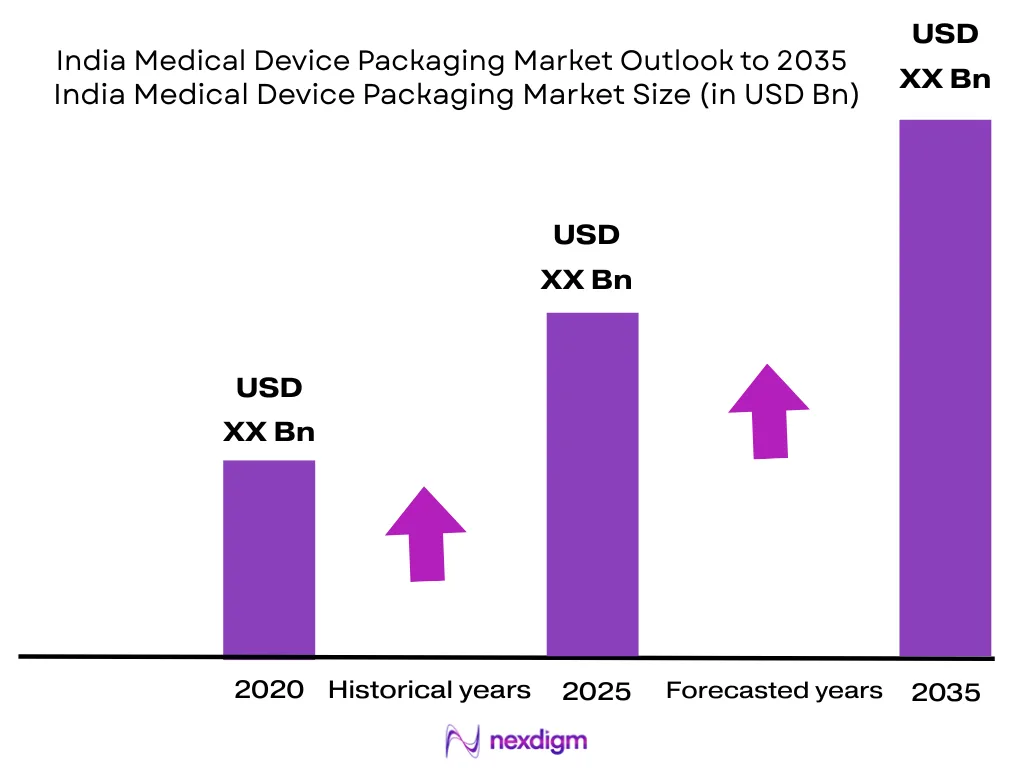
The India medical device packaging market is valued at approximately USD ~ billion, compared with USD ~ billion in the preceding annual period. The value is a placeholder because no audited public source isolates national medical-device-packaging revenue. Demand is supported by a medical-device sector of approximately USD 14 billion, exports of USD 4.1 billion, and continuing production of diagnostic, surgical, cardiovascular, implantable and single-use devices requiring validated sterile barriers and transit protection.Gujarat, Maharashtra, Telangana, Andhra Pradesh, Tamil Nadu and Karnataka dominate India’s medical device packaging activity because they combine device plants, polymer conversion, cleanroom operations, sterilisation facilities, ports and healthcare clusters. Government-supported parks strengthen this concentration: 194 manufacturers had received land across three parks covering 298.58 acres, while 34 units had begun plant construction. These clusters reduce lead times for pouch conversion, thermoforming, device assembly, testing and commercial-scale packaging qualification.
Market Segmentation
By Packaging Format
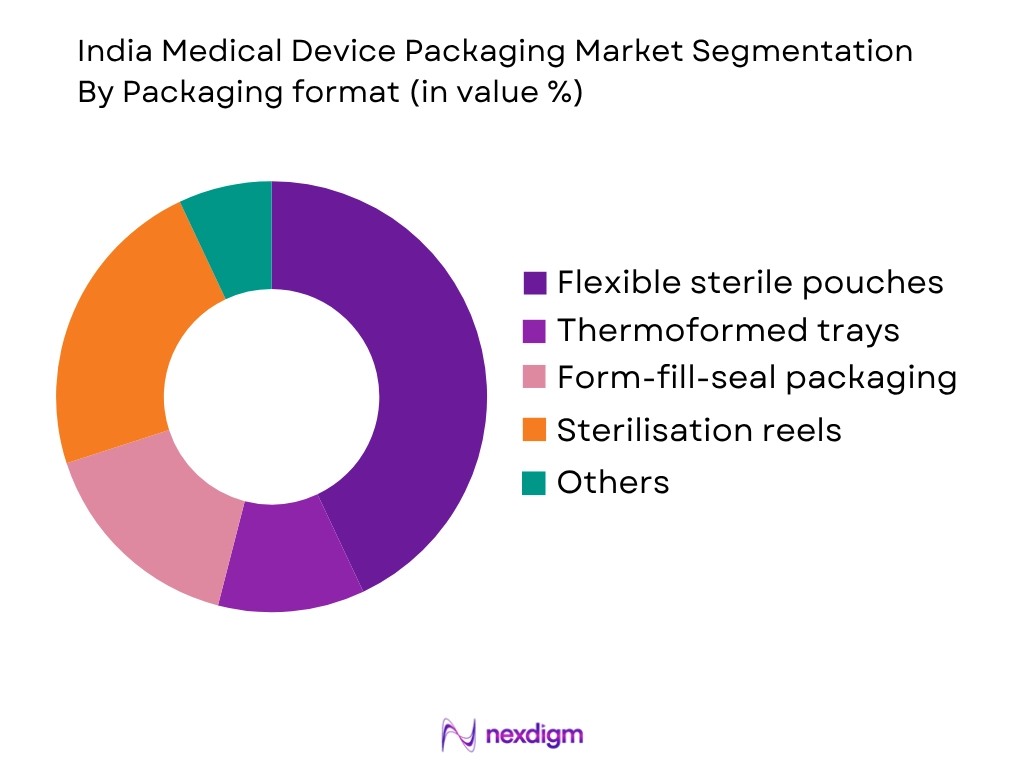
The India medical device packaging market is segmented into flexible sterile pouches, sterilisation reels, thermoformed trays, form-fill-seal packs, header bags, blister packs, rigid containers and other protective systems. Flexible sterile pouches hold the dominant position because they can package wound-care products, syringes, catheters, surgical accessories, diagnostic consumables and dental devices with comparatively low material use. Paper–film and spun-bonded-polyolefin structures allow microbial protection, product visibility and controlled peel opening. Sterilisation reels are widely used by hospitals and high-volume disposable-device producers because users can cut and seal the required length. Thermoformed trays remain essential for implants, instruments and sharp or fragile products requiring immobilisation. Form-fill-seal packaging suits high-volume standardized consumables because forming, filling and sealing can be integrated. The distribution below is a report placeholder pending interviews with converters, medical-device manufacturers and sterilisation providers. Amcor identifies pouches, thermoformed structures and form-fill-seal systems as principal formats for medical-device protection and sterile presentation.
By Packaging Material
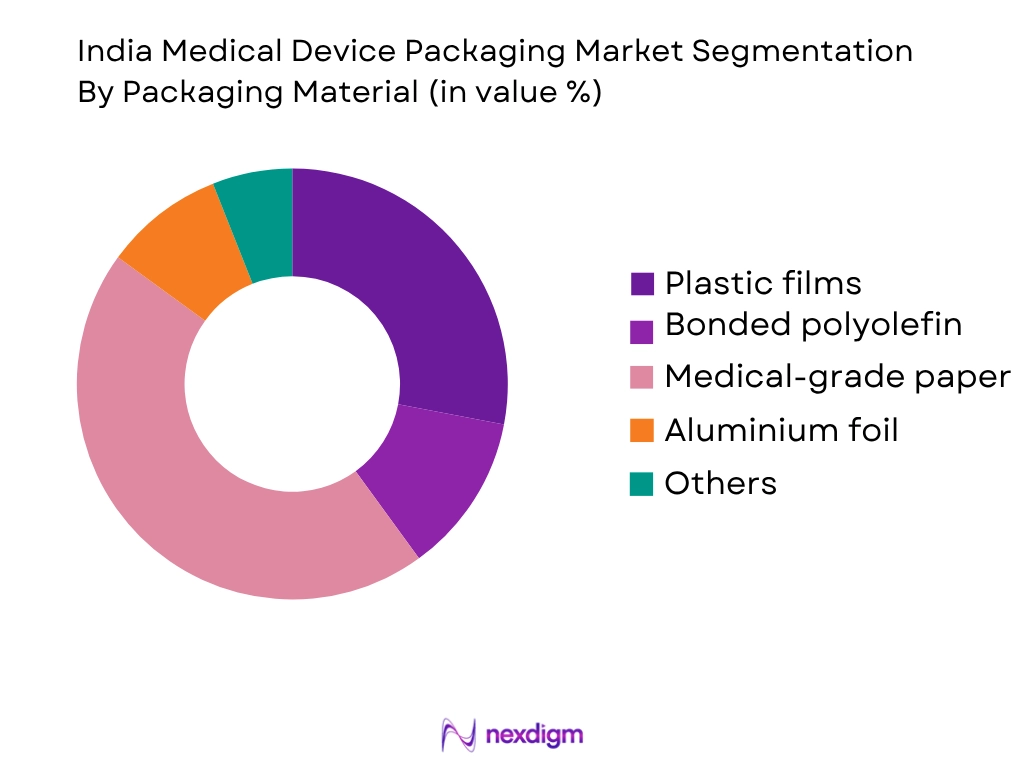
The India medical device packaging market is segmented into medical-grade paper, plastic films and thermoforming sheets, spun-bonded polyolefin, medical-grade paperboard, aluminium laminates and other specialty substrates. Medical-grade paper and paper–film combinations hold the leading position because India has a large base of cost-sensitive single-use devices, hospital sterilisation products and disposable consumables. Medical paper provides breathability for ethylene oxide or steam-compatible applications and can be converted into pouches and reels at scale. Plastic films and sheets remain critical for transparent pouch webs, rigid trays and form-fill-seal systems requiring puncture resistance, sealability and moisture protection. Spun-bonded polyolefin is preferred for higher-performance sterile barriers because it is lightweight, durable, breathable and resistant to bacterial penetration and aging. Aluminium laminates are used where stronger moisture, oxygen or light protection is needed. Material choice is ultimately determined by sterilisation exposure, device geometry, shelf-life requirements and cost sensitivity. DuPont identifies Tyvek as a durable, breathable nonwoven resistant to abrasion, water and bacterial penetration.
Competitive Landscape
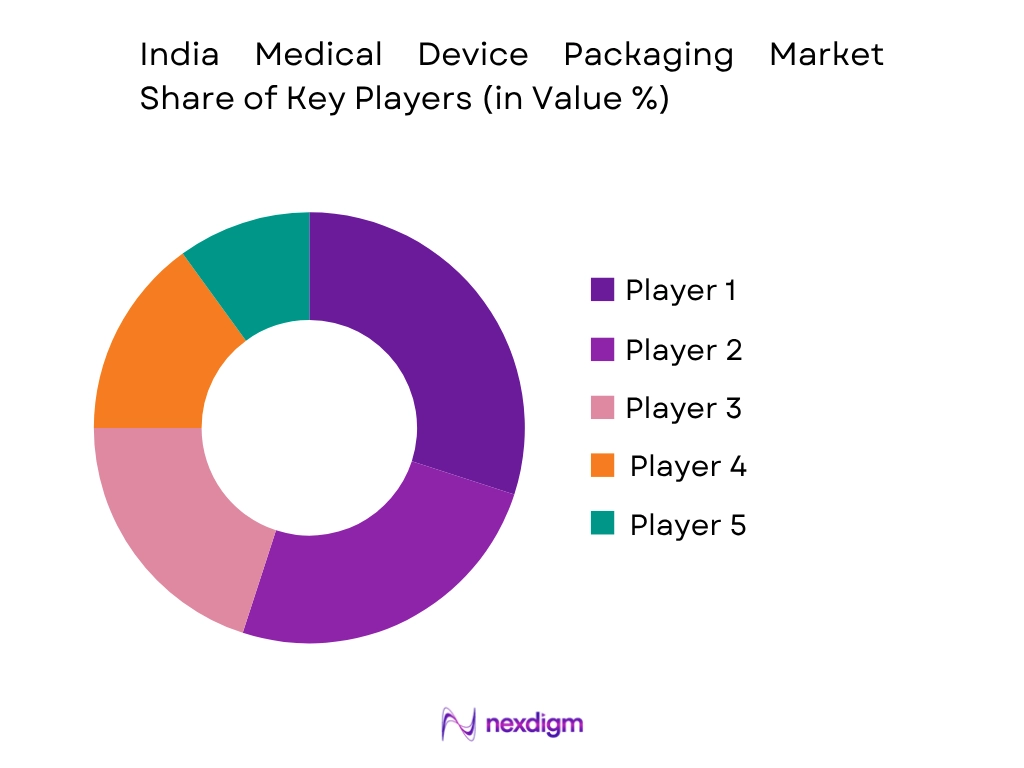
The India medical device packaging market includes domestic integrated converters, medical-pouch specialists, multinational material suppliers and global healthcare-packaging companies. UFlex has a strong local flexible-packaging and polymer-science base, while Amcor brings medical-device pouch, forming-film and lidding expertise. DuPont supplies high-performance sterile-barrier material, and TekniPlex and West Pharmaceutical Services participate in healthcare polymers, components and drug-delivery packaging. Competition is shaped by cleanroom capability, sterilisation compatibility, CDSCO documentation, short-run customization, material traceability and export-market validation.
| Company | Establishment year | Headquarters | Core formats | Material capability | Sterilisation compatibility | Validation support | India relevance | Sustainability capability |
| UFlex Limited | 1985 | Noida, India | ~ | ~ | ~ | ~ | ~ | ~ |
| Amcor | 1860 | Zurich, Switzerland | ~ | ~ | ~ | ~ | ~ | ~ |
| DuPont | 1802 | Wilmington, United States | ~ | ~ | ~ | ~ | ~ | ~ |
| TekniPlex Healthcare | 1967 | Wayne, United States | ~ | ~ | ~ | ~ | ~ | ~ |
| West Pharmaceutical Services | 1923 | Exton, United States | ~ | ~ | ~ | ~ | ~ | ~ |
India Medical Device Packaging Market Analysis
Growth Drivers
Domestic Medical-Device Manufacturing Expansion
India’s expansion of domestic medical-device production is increasing demand for sterile pouches, sterilisation reels, thermoformed trays, medical-grade lidding, protective inserts and validated transit packaging. The Production Linked Incentive Scheme for medical devices has a budgetary outlay of INR 3,420 crore. As of September 2025, 22 greenfield projects had been commissioned and production had started for 55 medical-device products, including heart valves, stents, dialysers, MRI equipment and ultrasound systems. Cumulative eligible sales reached INR 12,344.37 crore, including export sales of INR 5,869.36 crore. These production lines require packaging systems that maintain sterility, prevent device movement and support domestic and export labelling. India’s economic base reinforces this industrial activity: the World Bank recorded GDP of approximately USD 3.96 trillion and GDP per capita of USD 2,702.5 in 2025, while the IMF reported real output growth of 6.5 units per 100 units during the preceding fiscal period. Higher-value domestic devices generate more packaging-engineering work than imported finished products because pouch sealing, tray development, sterilisation coordination and package validation are completed closer to local manufacturing sites. Growth is therefore extending beyond packaging volume into cleanroom conversion, precision tooling, integrity testing and controlled documentation.
Medical-Device Parks and Regulatory Packaging Requirements
Government-supported medical-device parks and CDSCO packaging controls are creating an organized demand base for qualified medical packaging. As of September 2025, 194 manufacturers had received land across 3 medical-device parks covering 298.58 acres, and 34 units had commenced plant construction. The scheme provides common infrastructure such as testing facilities, tool rooms, warehouses and sterilisation support, allowing packaging converters to locate near device manufacturers and shorten validation cycles. The Medical Devices Rules require production dossiers to describe manufacturing, assembly, testing, labelling, packaging and storage controls. Device documentation also identifies construction material, shelf life and whether the product is sterile or non-sterile. CDSCO clarified in 2025 that non-sterile devices intended for sterilisation before use must be packed and labelled to state their non-sterile condition clearly. These requirements increase demand for controlled artwork, medical-grade substrates, sterilisation indicators, traceable lot coding and validated seal processes. India’s 3,287,263-square-kilometre territory also makes distribution durability important because finished devices move between manufacturing clusters, government procurement warehouses, hospitals and export ports. Packaging suppliers positioned within device parks can combine pouch or tray conversion with testing, sterilisation and warehousing, improving coordination for Class B, Class C and Class D products.
Market Challenges
Medical-Grade Material Dependence and Capital-Intensive Qualification
India’s medical-device packaging sector faces high entry requirements because sterile packaging cannot be introduced solely through conventional printing or film-conversion capacity. Suppliers require classified cleanrooms, calibrated sealing machines, precision thermoforming tools, environmental monitoring, package-integrity equipment and documented quality systems. Each new packaging combination may require installation qualification, operational qualification and performance qualification, followed by aging, sterilisation and distribution testing. Specialty materials such as spun-bonded polyolefin, coated medical paper, PETG forming sheet and validated sealant films can remain dependent on imported or limited-source supply. Replacing a qualified substrate may require a new technical assessment rather than a simple purchasing substitution. This challenge operates within a sector receiving substantial industrial investment: the medical-device PLI programme has INR 3,420 crore allocated and had generated INR 12,344.37 crore in eligible sales by September 2025. However, these volumes are spread across devices with different geometries, sterilisation methods and package configurations, limiting standardisation. India’s GDP reached approximately USD 3.96 trillion in 2025, but medical-packaging investment must still be supported by long-term customer commitments because cleanroom capacity and tooling may be installed before commercial device volumes stabilise. Smaller device manufacturers needing clinical batches or customized packs can therefore struggle to absorb validation and equipment requirements.
Validation Complexity and Shortage of Specialized Technical Capability
Medical-device packaging development requires a narrower skills base than general packaging manufacturing. Engineers must evaluate device weight, sharp edges, microbial barriers, sterilisation exposure, peel behaviour, particulate generation and transport hazards before approving a package. India’s PLI-supported production base had introduced 55 products through 22 commissioned greenfield projects by September 2025, while a separate 2025 government update reported 21 projects manufacturing 54 unique devices. These include heart valves, stents, dialyser machines and advanced diagnostic systems that require materially different sterile-barrier configurations. CDSCO’s 2024 guidance for in-vitro diagnostic devices requires scientific information supporting shelf life, in-use stability and shipping studies, adding technical work for packaging and quality teams. The challenge extends to operators and laboratory personnel: sealers must be controlled within validated parameters, while technicians must interpret seal-strength, leak, aging and distribution-test results. India’s manufacturing ecosystem contains many small firms, and the IMF has noted that manufacturing is dominated by smaller enterprises with lower productivity, restricting access to advanced validation capability in parts of the supply chain. Technical resources are also concentrated around Gujarat, Maharashtra, Telangana, Tamil Nadu and Karnataka, while device customers and hospitals operate nationwide. Limited availability of experienced sterile-barrier engineers can consequently delay material qualification, failure investigation, customer approval and commercial scale-up.
Market Opportunities
Automation, Digital Traceability and Package-Integrity Testing
Automation represents a major opportunity because India’s growing medical-device production base requires higher process consistency without proportionate increases in manual inspection. As of September 2025, PLI-supported projects had generated cumulative eligible sales of INR 12,344.37 crore, including INR 5,869.36 crore in exports. Export-oriented products require reproducible sealing, detailed production records and reliable evidence that packaging remains intact during transportation. Connected sealing machines can record temperature, pressure, dwell time and line speed for every batch, while machine-vision systems can detect channels, wrinkles, contamination and incomplete seals. Vacuum-decay, pressure-decay and high-voltage leak-detection systems can identify integrity failures without destroying all tested packs. Digital batch records can link device lots, packaging-material batches, sterilisation runs and inspection outcomes, supporting CDSCO compliance and customer audits. India’s technology environment provides a favourable adoption base: the IMF reported that nearly 60 companies out of every 100 assessed had actively deployed artificial intelligence, with adoption concentrated in services including healthcare, logistics and retail. Although this is broader than packaging, it indicates strong digital capability that can be transferred into smart manufacturing. Automation suppliers can therefore address cleanroom pouching, tray sealing, robotic loading, digital printing, electronic line clearance and predictive maintenance.
Cluster-Based Contract Packaging and Export-Compliant Platforms
The expansion of medical-device parks creates an opportunity for regional contract packaging, sterilisation and validation hubs. By September 2025, 194 manufacturers had been allotted 298.58 acres across 3 parks, while 34 plants had entered construction. These clusters allow specialist providers to serve multiple manufacturers from shared cleanrooms, testing laboratories, warehouses and sterilisation facilities rather than requiring every device company to build standalone infrastructure. Contract providers can offer pouch conversion, sterilisation reels, thermoformed trays, device assembly, labelling, accelerated aging, distribution testing and release documentation. This model is particularly relevant to small and medium manufacturers producing lower-volume orthopedic, diagnostic, dental or surgical devices. International collaboration can add qualified materials, automated sealing systems and testing expertise, while Indian partners provide customer access, CDSCO knowledge and lower-volume customization. Current export performance supports future demand: PLI-supported medical-device export sales reached INR 5,869.36 crore by September 2025, showing an existing need for packaging suitable for regulated foreign markets. India’s macroeconomic scale also supports investment, with GDP at approximately USD 3.96 trillion and growth of 7.6 units per 100 units in the latest World Bank observation. Cluster-based suppliers can develop standardized sterile-barrier platforms with destination-specific labels, importer details and symbols, reducing qualification duplication and supporting faster entry into the United States, Europe, the United Kingdom, the Middle East and Africa.
Future Outlook
The India medical device packaging market is forecast to expand at approximately ~% CAGR during the forecast period. The rate is a placeholder because no authoritative public forecast isolates this packaging category. Growth will be supported by domestic device manufacturing, medical-device parks, export-oriented production, hospital expansion, diagnostic demand and increasing use of single-use surgical and home-care products. The PLI programme for medical devices has a financial outlay of INR 3,420 crore and supports selected manufacturers in targeted device categories. A government update reported 26 approved applicants covering 138 products, creating additional demand for sterile pouches, trays, reels, labels and transit systems as production facilities move from qualification into commercial output. Medical-device parks will influence where packaging capacity is added. Common infrastructure can include testing laboratories, sterilisation services, tool rooms, warehousing and plastic-processing capabilities. By late 2025, 194 manufacturers had been allotted land and 34 units had begun construction across three parks. Packaging converters located close to these facilities can reduce transport of empty trays and pouches, accelerate line trials and provide technical support during product validation. Flexible pouches and sterilisation reels will remain central because India produces substantial volumes of syringes, dressings, catheters, disposables and hospital consumables. Thermoformed trays will gain relevance in orthopedic, cardiovascular, ophthalmic and minimally invasive devices, particularly as domestic manufacturers move into higher-value technologies. Export-oriented products will require packages capable of satisfying customer specifications and standards used in the United States, European Union, United Kingdom and other regulated destinations.
Major Players
- Amcor
- UFlex Limited
- Huhtamaki India
- Winpak Control Group
- Vishakha Polyfab
- Terramica
- Steril Medipac
- SGH Healthcaring
- Constantia Flexibles
- TekniPlex Healthcare
- DuPont
- Klöckner Pentaplast
- Berry Global
- West Pharmaceutical Services
- Oliver Healthcare Packaging
Key Target Audience
- Medical device packaging manufacturers and sterile-barrier converters
- Medical device and in-vitro diagnostic manufacturers
- Contract development and manufacturing organisations
- Contract packaging and sterilisation service providers
- Medical-grade paper, polymer and barrier-material suppliers
- Packaging machinery, inspection and integrity-testing equipment providers
- Investments and venture capitalist firms
- Government and regulatory bodies
Research Methodology
Step 1: Identification of Key Variables
The first phase constructs an ecosystem map covering medical-device manufacturers, packaging converters, substrate suppliers, sterilisation providers, testing laboratories and government-supported device parks. Critical variables include device output, packaging units per device, sterile-barrier format, substrate consumption, cleanroom capacity, sterilisation method, import dependence and average packaging realization. Primary sterile barriers are separated from protective, secondary and tertiary packaging.
Step 2: Market Analysis and Construction
Historical demand is assessed using domestic medical-device output, imports, exports, converter revenues, substrate consumption and installed packaging capacity. A top-down model converts device-category production into packaging-unit requirements. A bottom-up model aggregates pouch, reel, tray, lidding, rollstock and contract-packaging revenues before reconciliation through material-weight, conversion-yield and average-unit-value checks.
Step 3: Hypothesis Validation and Expert Consultation
Market hypotheses are validated through computer-assisted telephone interviews with device manufacturers, packaging engineers, converters, sterilisation companies and laboratory-service providers. Interviews assess format penetration, line utilisation, qualification periods, material sourcing, package failures and outsourcing. Responses are classified by device risk class, packaging format, sterilisation method, customer scale and domestic-versus-export production.
Step 4: Research Synthesis and Final Output
The final phase integrates CDSCO rules, government scheme information, trade data, company disclosures and primary interviews. Market size is triangulated across packaging revenue, unit shipments, device output and material consumption. Forecast assumptions incorporate PLI-supported capacity, medical-device parks, export activity, contract packaging, sustainability and import substitution. Competitive positioning is validated against cleanroom capability, technical services and customer qualifications.

- Executive Summary
- Research Methodology (Market Definitions and Assumptions, Medical Device Packaging Taxonomy, Abbreviations, Market Sizing Approach, Top-Down Device Shipment Analysis, Bottom-Up Converter Revenue Aggregation, Packaging Units per Device Assessment, Demand-Side Evaluation, Supply-Side Capacity Mapping, Import–Export Reconciliation, Primary Industry Interviews, Data Triangulation, Forecasting Framework, Scenario Analysis, Limitations and Future Conclusions)

- Definition and Scope
- Market Evolution and Industry Genesis
- Timeline of Major Industry Developments
- Medical Device Packaging Business Cycle
- Packaging Demand Linkage with Domestic Medical Device Production
- Medical Device Classification and Packaging Requirement Mapping

- Growth Drivers (Expansion of Domestic Medical Device Manufacturing, Production-Linked Incentive Support, Medical Device Park Development, Growth of Single-Use Medical Consumables, Increasing Surgical and Diagnostic Activity, Expansion of Hospital Infrastructure, Import Substitution and Rising Medical Device Exports)
- Market Challenges (Medical-Grade Material Import Dependence, Fragmented Converter Base, Sterilisation Capacity Constraints, Long Packaging Qualification Cycles, Price-Sensitive Device Procurement, Packaging Seal Failure Risk, Skilled Validation Workforce Shortages and Sustainability–Sterility Trade-Offs)
- Market Opportunities (Domestic Sterile Barrier Material Production, Medical Device Park Packaging Units, Recyclable Healthcare Packaging, PVC-Free Device Packaging, Custom Implant Trays, Contract Packaging Expansion, Automated Package Integrity Testing and Export-Compliant Packaging Platforms)
- Market Trends (Medical Paper–Film Pouches, Thermoformed Tray Optimisation, Double Sterile Barrier Systems, Digital Package Prototyping, Automated Seal Inspection, Cleanroom Packaging Outsourcing, Medical Device Kit Assembly, Localised Packaging Material Qualification and Packaging Sustainability Scorecards)
- SWOT Analysis
- Porter’s Five Forces Analysis
- PESTLE Analysis

- By Market Value (2020-2025)
- By Packaging Units (2020-2025)
- By Medical-Grade Material Consumption (2020-2025)

- By Packaging Format (In Value %)
Flexible Sterile Pouches
Thermoformed Trays
Header Bags
Form-Fill-Seal Packs
Four-Side-Seal Packs
Blister Packs
Clamshell Packaging - By Packaging Material (In Value %)
Medical-Grade Paper
Spun-Bonded Polyolefin and Tyvek
Polyethylene Films
Polypropylene Films
Polyethylene Terephthalate Films and Sheets
PETG Thermoforming Materials - By End-User Organisation (In Value %)
Large Domestic Medical Device Manufacturers
Multinational Medical Device Subsidiaries
Micro, Small and Medium Medical Technology Enterprises
Contract Development and Manufacturing Organisations
Original Equipment Manufacturers - By Geographic Market (In Value %)
North India
West India
South India
East India
Central India

- Market Share of Major Players
- Cross Comparison Parameters (Sterile Barrier Product Portfolio, Medical-Grade Material Expertise, India Cleanroom Manufacturing Footprint, Sterilisation Compatibility Coverage, Packaging Validation and Testing Capability, Domestic Medical Device Customer Coverage, Custom Tooling and Prototyping Capability, Sustainable Healthcare Packaging Portfolio)
- SWOT Analysis of Major Players
- Detailed Profiles of Major Companies
Amcor
UFlex Limited
Huhtamaki India
Winpak Control Group
Vishakha Polyfab
Terramica
Steril Medipac
SGH Healthcaring
Constantia Flexibles
TekniPlex Healthcare
DuPont
Klöckner Pentaplast
Berry Global
West Pharmaceutical Services
Oliver Healthcare Packaging

- Packaging Demand and Utilisation Assessment
- Medical Device Manufacturer Procurement Criteria
- Packaging Supplier Qualification Process
- Packaging Engineer Decision-Making Process
- Regulatory and Quality Team Requirements
- Large Domestic Medical Device Manufacturer Analysis

- By Market Value (2026-2035)
- By Packaging Units (2026-2035)
- By Medical-Grade Material Consumption (2026-2035)


 Request a Sample
 Ask for Customization
 Get a Quote
 Enquire Now