
 Download PDF
Market Overview
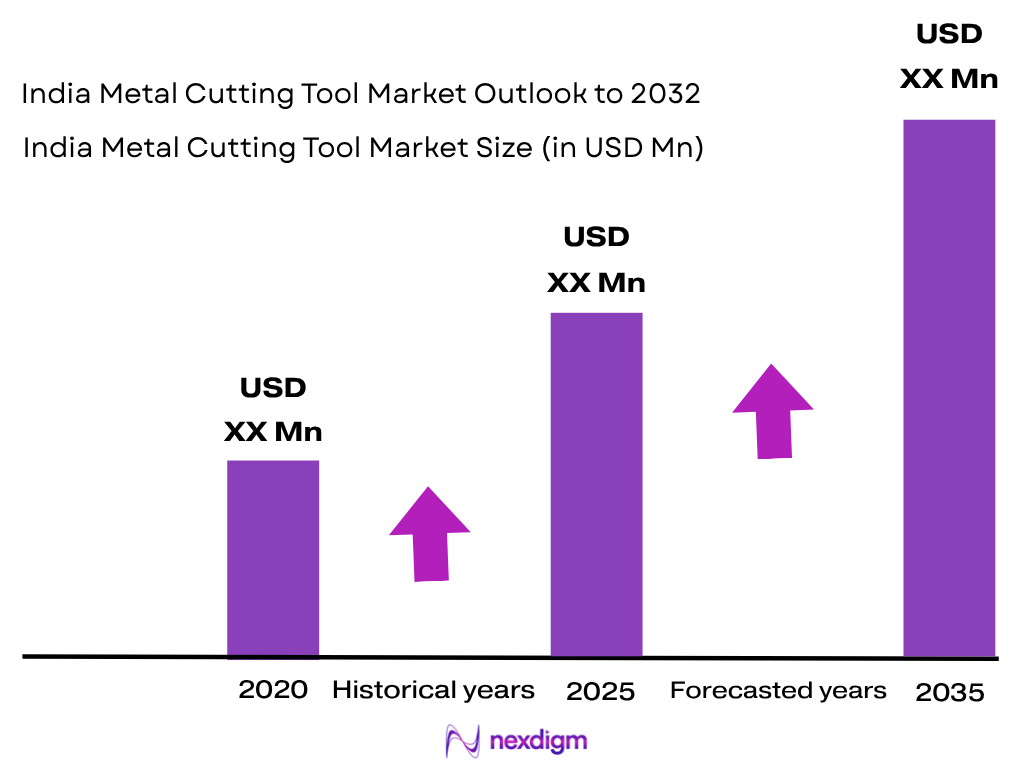
The India Metal Cutting Tool Market is valued at ~USD ~ billion in 2024 and is projected to expand at a ~% CAGR during 2026-2035. Demand is closely linked with the expansion of precision manufacturing, CNC machining, automotive production, aerospace components, industrial machinery and engineering applications. India’s machine-tool consumption reached ₹27,265 crore in FY2023-24, while production reached ₹13,571 crore, demonstrating the expanding equipment base requiring cutting tools. IMTMA subsequently estimated machine-tool consumption at ₹31,781 crore in FY2024-25, supporting continued tooling demand.
India Metal Cutting Tool demand is concentrated around major manufacturing clusters including Maharashtra, Tamil Nadu, Gujarat, Karnataka and Haryana, where automotive, engineering, aerospace, machinery and industrial-component manufacturing create recurring requirements for turning, milling, drilling, boring and finishing tools. Automotive manufacturing is a particularly important demand generator: India produced 5.061 million passenger vehicles, 1.033 million commercial vehicles, 1.050 million three-wheelers and 23.884 million two-wheelers in FY2024-25. These production volumes support extensive machining requirements across OEM and component supply chains.
Market Segmentation
By Tool Type
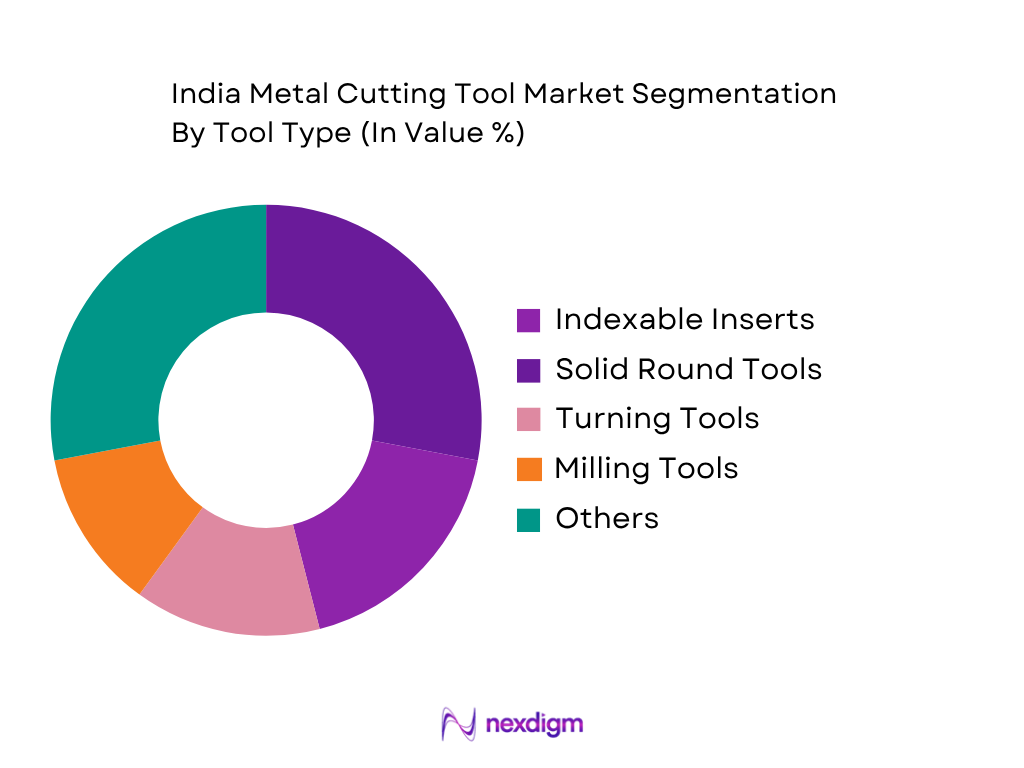
India Metal Cutting Tool Market is segmented by tool type into indexable inserts, solid round tools, turning tools, milling tools, drilling tools, reaming tools, boring tools, threading tools, grooving and parting tools, sawing tools, gear-cutting tools and special/custom cutting tools. Indexable cutting tools are expected to represent the dominant segment, supported by their suitability for high-volume machining, replaceable cutting edges, reduced machine downtime and flexibility across turning, milling and grooving applications. Their adoption is reinforced by India’s increasing CNC-machine deployment and the growing need for repeatable machining performance. Sandvik notes that cutting tools are a relatively small component of overall manufacturing cost but have a significant influence on productivity and quality, making tooling performance strategically important for manufacturers.
By Tool Material
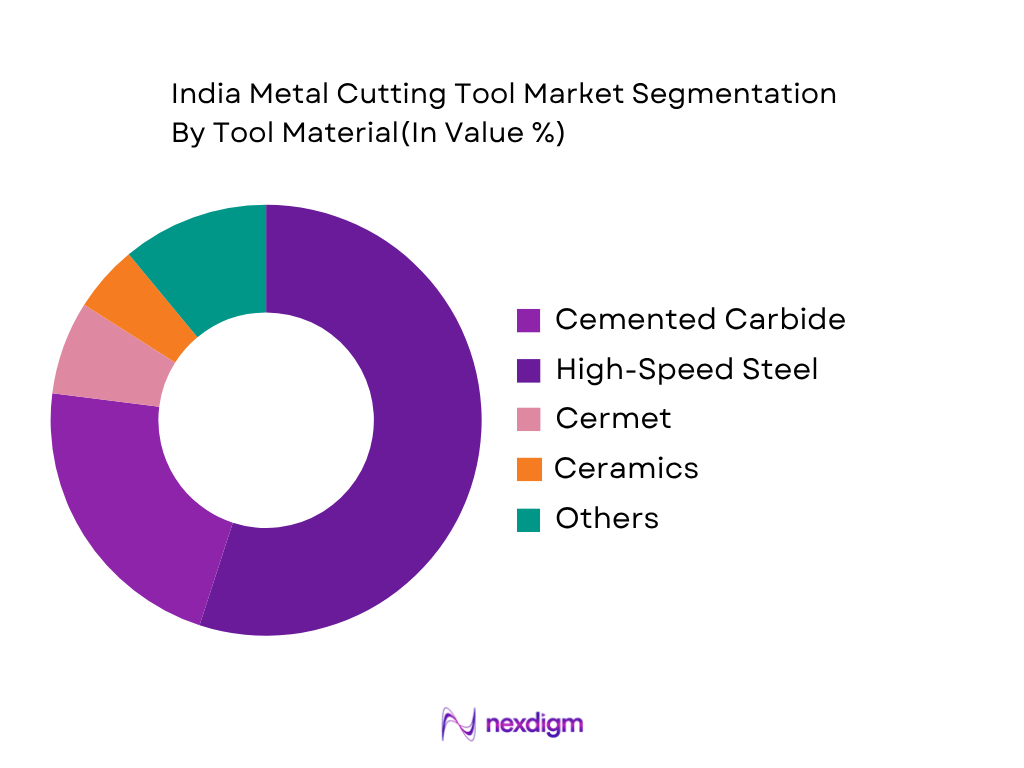
India Metal Cutting Tool Market is segmented by tool material into cemented carbide, high-speed steel, cermet, ceramics, cubic boron nitride, polycrystalline diamond and other advanced materials. Cemented carbide is expected to remain the dominant material category because it combines hardness, wear resistance, thermal performance and productivity across a broad range of industrial machining operations. Carbide tooling is particularly relevant to automotive and general-engineering applications where manufacturers require consistent tool life and higher cutting speeds. Kennametal India reported growth across its hard-metal product portfolio and serves automotive, general engineering, aerospace, mining, construction and MSME customers, demonstrating the breadth of carbide and hard-metal applications within India’s industrial base.
Competitive Landscape
The India Metal Cutting Tool Market is characterized by established global tooling groups, specialized Indian manufacturers and international brands operating through domestic subsidiaries, distributors and application-engineering networks. Major participants compete through carbide grades, indexable insert geometries, coatings, tool-life performance, application engineering, customized tooling and availability. Companies such as Kennametal, Sandvik, ISCAR, Mitsubishi Materials, Seco Tools, Walter, Kyocera, Tungaloy, CERATIZIT and Guhring address demanding automotive, aerospace, general-engineering and precision-machining applications. Sandvik identifies IMC Group and Kennametal among major premium-market competitors, while the mid-market includes brands associated with Mitsubishi, TaeguTec and WIDIA.
| Company | Establishment Year | Headquarters | Key Tool Portfolio | Material Expertise | Coating Capability |
| Sandvik | 1862 | Stockholm, Sweden | ~ | ~ | ~ |
| Kennametal | 1938 | Pittsburgh, USA | ~ | ~ | ~ |
| ISCAR | 1952 | Tefen, Israel | ~ | ~ | ~ |
| Mitsubishi Materials | 1871 | Tokyo, Japan | ~ | ~ | ~ |
| CERATIZIT | 1921 | Mamer, Luxembourg | ~ | ~ | ~ |
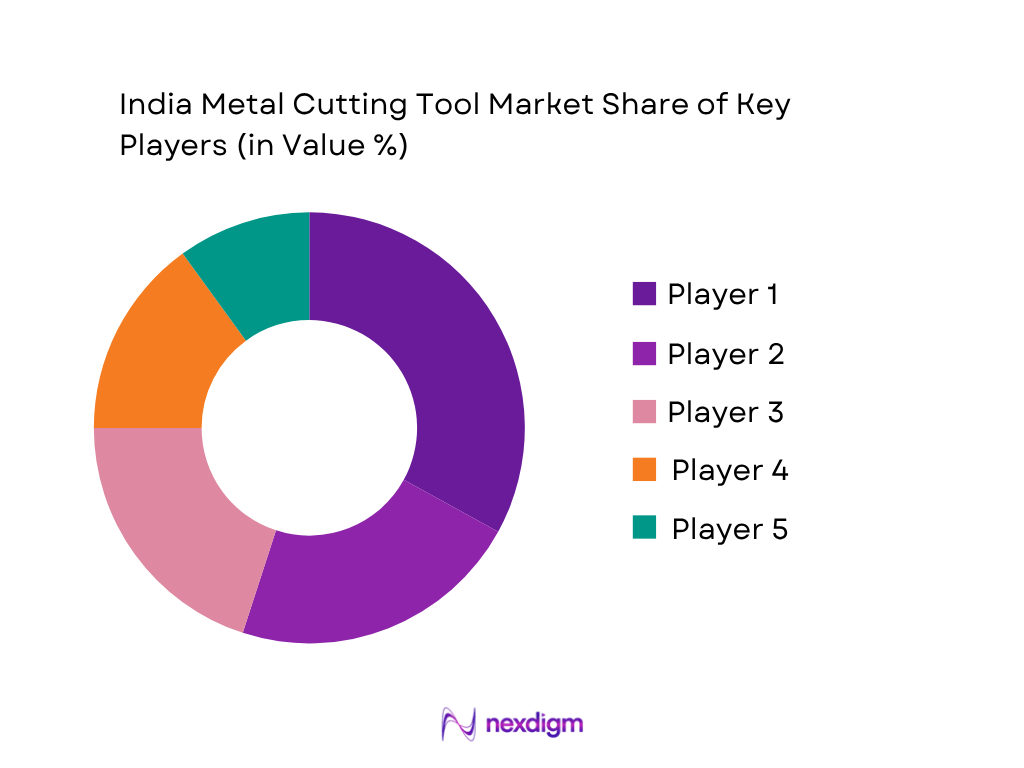
India Metal Cutting Tool Market Analysis
Growth Drivers
CNC Adoption and Manufacturing Expansion
The adoption of CNC machine tools, automotive manufacturing, industrial automation and precision engineering is strengthening demand for metal cutting tools in India. The Indian machine tool industry recorded production of ₹14,566 crore and consumption of ₹31,781 crore in FY2024-25, according to the Indian Machine Tool Manufacturers’ Association. India ranked 9th globally in machine-tool production and 4th in consumption during 2024, indicating a substantial domestic machining base. Automotive manufacturing remains a key application area because machining operations across engines, transmissions, chassis, braking systems and precision components require turning, milling, drilling, boring and threading tools. The wider manufacturing ecosystem is also being supported by localization initiatives. PLI schemes across 14 sectors had attracted more than ₹2.16 lakh crore in cumulative investment and generated more than ₹20.41 lakh crore in cumulative production or sales by December 2025. Electronics manufacturing reached approximately ₹11.3 lakh crore in FY2024-25, while electronics exports reached approximately ₹3.3 lakh crore, creating additional demand for precision manufacturing equipment and tooling. These developments support greater use of carbide inserts, drills, milling cutters, reamers and application-specific tools. The expanding installed base of CNC equipment also creates recurring replacement demand as manufacturers seek higher productivity, dimensional consistency and reliable machining performance.
Automotive, Defence and Precision Manufacturing
Automotive, aerospace, defence and precision-engineering production is increasing the requirement for advanced cutting tools capable of machining complex geometries and difficult materials. India’s defence production reached ₹1,50,590 crore in FY2024-25, compared with ₹1,27,434 crore in FY2023-24, according to the Ministry of Defence. Defence exports also reached ₹23,622 crore in FY2024-25, creating opportunities for suppliers of precision carbide, ceramic, CBN, PCD and coated tooling. The defence manufacturing ecosystem included approximately 16,000 MSMEs, expanding the number of potential machining customers. Electronics manufacturing provides another important demand base, with production reaching ₹11.3 lakh crore in FY2024-25 and exports reaching approximately ₹3.3 lakh crore. These industries require tight dimensional tolerances, repeatable surface finishes and controlled tool performance. Increasing production complexity is therefore shifting demand toward advanced geometries, PVD-coated tools and application-specific cutting solutions. The machine-tool ecosystem reinforces this opportunity: domestic machine-tool consumption reached ₹31,781 crore in FY2024-25, while imports reached ₹18,686 crore, according to IMTMA. This indicates significant investment in production machinery that subsequently requires cutting tools and tooling accessories. Expansion across automotive, defence and electronics manufacturing is consequently supporting both initial tooling requirements and recurring replacement demand.
Market Challenges
Imported Materials and Advanced Tooling Requirements
Dependence on advanced tooling materials, tungsten carbide availability, coating technologies and specialized manufacturing capabilities remains a challenge for the India Metal Cutting Tool Market. Premium cutting applications increasingly require cemented carbide, CBN, PCD, ceramics and sophisticated coating systems that demand specialized production and quality-control capabilities. The broader machine-tool industry illustrates the technology gap: domestic machine-tool production reached ₹14,566 crore in FY2024-25, while consumption reached ₹31,781 crore and imports reached ₹18,686 crore. Although these figures concern machine tools rather than cutting tools, they demonstrate the broader dependence of India’s manufacturing ecosystem on imported advanced production technologies. Customers are also increasingly demanding predictable tool life, dimensional consistency and application-specific performance. These requirements increase R&D and engineering costs for tooling manufacturers. Smaller machining companies may continue to prioritize immediate availability and acquisition cost, creating competition between premium products and lower-cost alternatives. Tool manufacturers must therefore balance advanced material development with competitive manufacturing economics. Precision grinding, coating compatibility, tool inspection and application testing add further technical requirements. The growth of sophisticated automotive, aerospace, defence and electronics machining increases the importance of these capabilities. Consequently, suppliers without access to advanced materials, coating facilities, application engineers and reliable supply networks can face difficulty serving high-precision customers.
Tool Life, Compatibility and Skilled Engineering Constraints
Variability in tool life, machine compatibility, precision grinding requirements and shortages of specialized tooling expertise create operational challenges across India’s machining ecosystem. Cutting performance depends on workpiece material, machine rigidity, spindle characteristics, cutting speed, feed rate, coolant conditions and tool geometry, making standardized products unsuitable for some high-precision applications. India’s expanding manufacturing base increases this complexity. Automotive, defence and electronics manufacturers operate different machining processes and therefore require different carbide grades, geometries, coatings and tool configurations. Defence production reached ₹1,50,590 crore in FY2024-25, while electronics production reached ₹11.3 lakh crore, demonstrating the scale of sectors requiring increasingly sophisticated manufacturing processes. The machine-tool industry also recorded ₹31,781 crore in domestic consumption during FY2024-25, creating a large installed base requiring compatible tooling. Small and medium machining companies can face additional constraints because they may lack dedicated tooling engineers, automated tool presetting systems and sophisticated tool-condition monitoring capabilities. Counterfeit or low-quality products can further complicate purchasing decisions by producing inconsistent tool-life results. As manufacturers adopt more CNC and automated production equipment, tooling suppliers increasingly need to provide technical application support rather than simply supplying consumables. Tool selection, cutting-parameter optimization, regrinding and tool inspection are therefore becoming important competitive requirements. This raises the technical burden on manufacturers and distributors while creating differentiation opportunities for suppliers capable of providing engineering-led tooling solutions.
Market Opportunities
Localization and High-Performance Tool Manufacturing
The expansion of domestic manufacturing provides opportunities for localized production of high-performance carbide tools, advanced PVD-coated tools and customized cutting solutions. PLI schemes across 14 sectors had attracted cumulative investment exceeding ₹2.16 lakh crore and generated cumulative production or sales exceeding ₹20.41 lakh crore by December 2025. The schemes also generated more than ₹8.3 lakh crore in exports, demonstrating the scale of manufacturing activity available to domestic suppliers. Electronics and automotive components are particularly relevant: PLI-supported electronics companies generated incremental production of approximately ₹2,45,375 crore, while automobile and auto-component companies generated approximately ₹13,126 crore of incremental production during the period reported by the government. These production activities require machining equipment and associated cutting tools. Defence manufacturing provides another high-value opportunity, with defence production reaching ₹1,50,590 crore in FY2024-25 and exports reaching ₹23,622 crore. Such applications are suited to premium carbide, coated, CBN and PCD tools where dimensional accuracy and tool performance are critical. Tool manufacturers can use this industrial expansion to increase domestic production, develop specialized grades and reduce dependence on imported premium tooling. Opportunities also exist in customized tool design, application engineering and localized technical support for automotive, aerospace, defence, electronics and industrial machinery customers.
EV, Aerospace and Smart Tooling
Electric-vehicle component machining, aerospace and defence manufacturing, automated tool management and Industry 4.0-compatible tooling create opportunities for higher-value products and integrated machining solutions. India’s defence exports reached ₹23,622 crore in FY2024-25, while defence production reached ₹1,50,590 crore, supporting demand for precision components and advanced machining. Electronics manufacturing reached ₹11.3 lakh crore in FY2024-25, with exports of approximately ₹3.3 lakh crore, creating another precision-manufacturing ecosystem. Government-supported manufacturing programs also generated more than ₹20.41 lakh crore in cumulative production or sales across 14 sectors by December 2025. These conditions support opportunities for advanced carbide grades, PVD coatings, customized cutting geometries and digitally managed tooling systems. Smart tool monitoring can help manufacturers track tool condition and reduce unexpected tool failures, while digital tool presetting can improve consistency in automated CNC production. Automated tool management can also support inventory control and tool availability across large manufacturing facilities. EV component production adds opportunities around motor housings, shafts, gears, battery-related components and lightweight structures requiring specialized machining strategies. Aerospace and defence applications can require advanced materials and complex geometries, creating demand for high-performance tooling rather than commodity products. Suppliers can therefore move beyond individual cutting-tool sales toward integrated services combining tool selection, digital monitoring, presetting, regrinding and application engineering. This creates opportunities for localized premium-tool manufacturers to serve India’s growing manufacturing base while developing capabilities for export-oriented production.
Future Outlook
The India Metal Cutting Tool Market is expected to benefit from the continued expansion of precision manufacturing, CNC machining, automotive component production, aerospace and defence manufacturing, industrial machinery and localized production. Rising machining complexity is likely to encourage adoption of higher-performance carbide grades, advanced coatings, multi-axis-compatible tools and customized geometries. India’s machine-tool consumption reached ₹31,781 crore in FY2024-25, while automotive production remained substantial across passenger vehicles, commercial vehicles, three-wheelers and two-wheelers. These developments create a broad installed base requiring replacement tooling, productivity improvements and application-specific machining solutions.
Major Players
- Sandvik / Dormer Pramet
- Kennametal India
- Mitsubishi Materials
- Kyocera Precision Tools India
- Seco Tools
- Walter Tools India
- ISCAR India
- Tungaloy India
- CERATIZIT India
- Guhring India
- OSG India
- MAPAL India
- Sumitomo Electric Hardmetal India
- LMT Tools India
- Addison & Co.
Key Target Audience
- Automotive and Auto Component Manufacturers
- Aerospace and Defence Component Manufacturers
- Industrial Machinery and Equipment Manufacturers
- CNC Machine Tool Manufacturers
- Metal Cutting Tool Manufacturers and Distributors
- Investments and Venture Capitalist Firms
- Government and Regulatory Bodies (Ministry of Heavy Industries, Department for Promotion of Industry and Internal Trade, Ministry of Commerce and Industry)
- Large CNC Machine Shops and Precision Engineering Manufacturers
Research Methodology
Step 1: Identification of Key Variables
The initial phase involves constructing an ecosystem map covering cutting-tool manufacturers, carbide and tool-material suppliers, coating providers, machine-tool manufacturers, distributors and end-use machining industries. The assessment identifies tool categories, machining operations, material technologies, application requirements, production capacity, imports, exports and replacement-tool demand influencing the India Metal Cutting Tool Market.
Step 2: Market Analysis and Construction
Historical market information is compiled through industry data, company disclosures, government statistics, trade information and machine-tool industry datasets. The analysis evaluates production activity, machine-tool consumption, industrial output, automotive manufacturing, aerospace activity and machining requirements to establish the underlying demand environment for metal cutting tools.
Step 3: Hypothesis Validation and Expert Consultation
Market hypotheses are evaluated against company disclosures, industry association information and operational evidence from tooling and machining participants. Application-level assessment considers tool selection, tool life, machining speed, coating requirements, CNC compatibility, replacement cycles and technical-support requirements across automotive, aerospace, general engineering and industrial machinery applications.
Step 4: Research Synthesis and Final Output
The final stage integrates top-down industry indicators with bottom-up analysis of tool categories, material types, machining operations and end-use industries. Company-level information is used to validate competitive positioning, product portfolios, manufacturing capabilities, distribution networks and application-engineering strengths before consolidating the final India Metal Cutting Tool Market assessment.

- Executive Summary
- Research Methodology (Market Definitions and Assumptions, Abbreviations, Market Sizing Approach, Top-Down Analysis, Bottom-Up Analysis, Demand-Side Assessment, Supply-Side Assessment, Primary Industry Interviews, Metal Cutting Tool Consumption Assessment, Production and Import-Export Analysis, Tool Application Mapping, Data Triangulation, Forecasting Framework, Limitations and Future Conclusions)

- Definition and Scope
- India Metal Cutting Tool Industry Evolution and Development of High-Speed Steel Cutting Tools, Cemented Carbide Tools, Indexable Inserts, Solid Carbide Tools, Coated Cutting Tools, Precision Cutting Tools, CNC-Compatible Tooling, High-Performance Machining Solutions, Advanced Tool Geometries, Automated Tool Management, Digital Tool Monitoring and Industry 4.0-Enabled Cutting Solutions
- Metal Cutting Tool Value Chain Analysis
- Metal Cutting Tool Supply Chain Analysis
- Tool Steel Suppliers, Tungsten Carbide Suppliers, Cobalt and Binder Suppliers, Tool Coating Material Suppliers, Cutting Tool Manufacturers, Indexable Insert Manufacturers, Solid Carbide Tool Manufacturers, Tool Grinding Companies, PVD and CVD Coating Providers, Toolholding System Suppliers, CNC Machine Tool Manufacturers, Tooling Distributors, Industrial Dealers, Machine Shops, OEMs, Tier-1 Suppliers, Tier-2 Suppliers and End-Use Manufacturers

- Growth Drivers (CNC Machine Tool Adoption, Automotive and Auto Component Manufacturing, Aerospace and Defence Component Production, Industrial Automation, Precision Engineering Demand, Manufacturing Localization, Increasing Machining Complexity, Replacement of Conventional Tools, Higher Machining Productivity Requirements, Industry 4.0 Adoption, Expansion of Manufacturing Clusters, Demand for High-Performance Tooling)
- Market Challenges (Dependence on Imported Advanced Tooling Materials, Tungsten Carbide Supply Exposure, Advanced Tool Coating Requirements, High R&D Requirements, Skilled Tooling Engineer Shortage, Low-Cost Tool Competition, Tool Life Variability, Counterfeit Cutting Tools, Machine-Tool Compatibility Requirements, Small-Batch Production Constraints, Precision Grinding Requirements, Raw Material Supply Volatility)
- Market Opportunities (Make in India Tool Manufacturing, Aerospace and Defence Tooling, Electric Vehicle Component Machining, High-Performance Carbide Tools, Advanced PVD-Coated Tools, Customized Cutting Solutions, Automated Tool Management, Smart Tool Monitoring, Digital Tool Presetting, Industry 4.0-Compatible Tooling, Export-Oriented Tool Manufacturing, Localized Premium Tool Production)
- Market Trends (CNC-Compatible Tooling, High-Speed Machining, Dry and Minimum Quantity Lubrication Machining, Advanced Carbide Grades, Multi-Layer Tool Coatings, Modular Tooling Systems, Digital Tool Management, Automated Tool Presetting, AI-Assisted Machining Optimization, High-Precision Micro-Machining, Sustainable Tooling, Advanced Cutting Geometries)
- Government Regulations and Industrial Policies (Make in India, Production Linked Incentive Schemes, Capital Goods Competitiveness Programs, BIS Standards, Quality Control Requirements, Import Duties on Tooling Components, Industrial Corridor Development, Defence Manufacturing Localization, Aerospace Manufacturing Standards, Environmental Regulations, Occupational Safety Requirements, Export Control Requirements)
- SWOT Analysis
- Porter’s Five Forces Analysis
- PESTLE Analysis
- Stakeholder Ecosystem
- Technology Ecosystem
- Manufacturing Ecosystem

- By Market Value (2020-2025)
- By Tool Consumption Volume (2020-2025)
- By Tool Production Volume (2020-2025)
- By Tool Import Volume (2020-2025)
- By Tool Export Volume (2020-2025)
- By Indexable Insert Consumption Volume (2020-2025)
- By Solid Round Tool Consumption Volume (2020-2025)
- By Carbide Tool Consumption Volume (2020-2025)
- By High-Speed Steel Tool Consumption Volume (2020-2025)
- By CNC Machining Tool Consumption (2020-2025)

- By Tool Type (In Value %)
Indexable Inserts
Solid Round Tools
Turning Tools
Milling Tools
Drilling Tools
Reaming Tools
Boring Tools
Threading Tools
Grooving and Parting Tools
Sawing Tools
Gear Cutting Tools
Special and Custom Cutting Tools - By Tool Material (In Value %)
Cemented Carbide
High-Speed Steel
Cermet
Ceramics
Cubic Boron Nitride
Polycrystalline Diamond
Diamond
Other Advanced Tool Materials - By Tool Configuration (In Value %)
Indexable Cutting Tools
Solid Cutting Tools
Brazed Cutting Tools
Replaceable-Head Tools
Modular Cutting Tools
Custom Engineered Tools - By Coating Type (In Value %)
Uncoated Tools
TiN-Coated Tools
TiCN-Coated Tools
TiAlN-Coated Tools
AlTiN-Coated Tools
AlCrN-Coated Tools
Diamond-Coated Tools
Multilayer PVD and CVD Coatings - By Machining Operation (In Value %)
Turning
Milling
Drilling
Boring
Threading
Reaming
Grooving
Parting
Gear Machining
Finishing and High-Precision Machining - By Machine Tool Type (In Value %)
CNC Turning Centers
CNC Machining Centers
CNC Milling Machines
CNC Drilling Machines
Swiss-Type CNC Machines
Multi-Axis Machining Centers
Gear Cutting Machines
Conventional Machine Tools
Special-Purpose Machines - By End-Use Industry (In Value %)
Automotive and Auto Components
Aerospace and Defence
General Engineering
Industrial Machinery
Power and Energy Equipment
Railways and Transportation Equipment
Oil and Gas Equipment
Medical and Precision Engineering
Electronics and Electrical Equipment
Construction Equipment
Agricultural Machinery
Die and Mould Manufacturing - By Region (In Value %)
Maharashtra
Tamil Nadu
Gujarat
Karnataka
Haryana
Uttar Pradesh
Telangana
Andhra Pradesh
Punjab
Rest of India

- Market Share of Major Players (By India Revenue, Tool Category, Tool Material, Machining Operation, End-Use Industry, Customer Segment, Distribution Channel, Domestic Manufacturing Presence, Import Dependency, Product Portfolio, Tool Coating Capability, Application Engineering Capability, Distribution Reach, Technical Service Capability)
- Cross Comparison Parameters (Product Portfolio Breadth, Carbide Grade and Insert Portfolio, Tool Coating Technology, Tool Life and Machining Performance, CNC and Multi-Axis Compatibility, Custom Tool Design Capability, Domestic Manufacturing Capacity, Application Engineering and Technical Support)
- SWOT Analysis of Major Players
- Detailed Profiles of Major Companies
Sandvik / Dormer Pramet
Kennametal India
Mitsubishi Materials
Kyocera Precision Tools India
Seco Tools
Walter Tools India
ISCAR India
Tungaloy India
CERATIZIT India
Guhring India
OSG India
MAPAL India
Sumitomo Electric Hardmetal India
LMT Tools India
Addison & Co.

- CNC Machine Shop Demand Assessment
- OEM Tooling Requirement Analysis
- Tier-1 and Tier-2 Supplier Tool Consumption Assessment
- Automotive Component Machining Requirement Analysis
- Aerospace and Defence Precision Tooling Assessment
- General Engineering Tool Consumption Analysis
- Tool Replacement and Regrinding Requirement Analysis
- Tool Life and Productivity Requirement Assessment
- High-Precision Machining Requirement Analysis

- By Market Value (2026-2032)
- By Tool Consumption Volume (2026-2032)
- By Tool Production Volume (2026-2032)
- By Tool Import Volume (2026-2032)
- By Tool Export Volume (2026-2032)
- By Indexable Insert Consumption Volume (2026-2032)
- By Solid Round Tool Consumption Volume (2026-2032)
- By Carbide Tool Consumption Volume (2026-2032)
- By High-Speed Steel Tool Consumption Volume (2026-2032)
- By CNC Machining Tool Consumption (2026-2032)


 Request a Sample
 Ask for Customization
 Get a Quote
 Enquire Now
