
 Download PDF
Market Overview
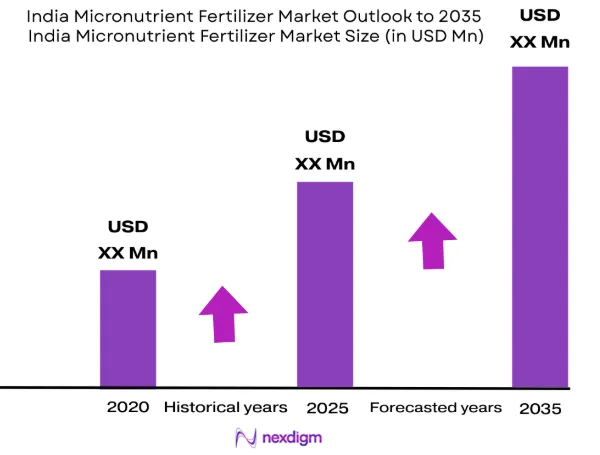
The India Micronutrient Fertilizer Market was valued at approximately USD ~ million in 2024, supported by rising adoption of balanced fertilization practices, increasing micronutrient deficiencies across agricultural soils, and expansion of horticultural cultivation. The market is expected to grow at a CAGR of 8.7% during 2026–2035, driven by government support for soil health management, increasing awareness among farmers regarding nutrient-use efficiency, and rising demand for specialty crop nutrition products.
Market Segmentation
By Nutrient Type
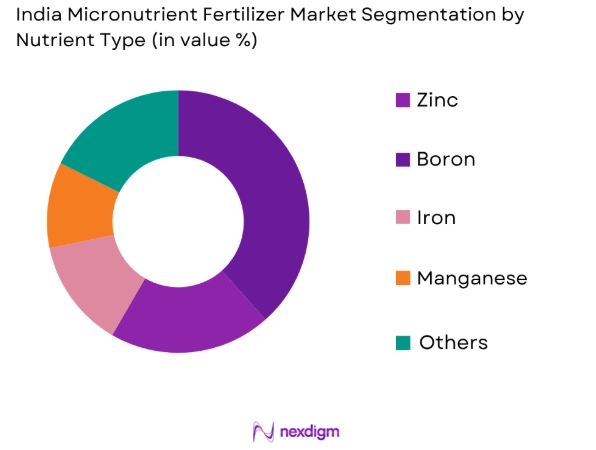
India Micronutrient Fertilizer Market is segmented by micronutrient type into zinc fertilizers, boron fertilizers, iron fertilizers, manganese fertilizers, and others. Recently, zinc fertilizers hold the dominant market share due to the widespread zinc deficiency observed across Indian agricultural soils. Studies conducted under the Soil Health Card program indicate that zinc deficiency is among the most prevalent micronutrient deficiencies affecting crop productivity in several states. Major crops such as rice, wheat, maize, sugarcane, and cotton respond significantly to zinc application, leading to higher adoption among farmers. Zinc sulphate remains the most commonly used formulation due to its affordability and proven agronomic benefits. Government initiatives promoting balanced fertilization and nutrient management further contribute to the dominance of zinc fertilizers. The increasing focus on improving crop yields, nutrient-use efficiency, and soil fertility continues to support strong demand for zinc-based products across India’s agricultural sector.
By Crop Type
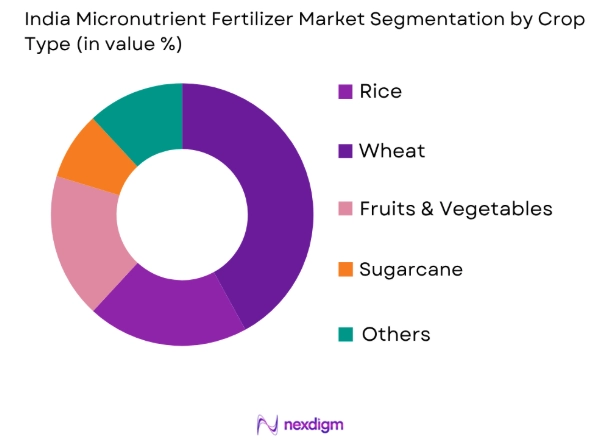
India Micronutrient Fertilizer Market is segmented by crop type into rice, wheat, fruits and vegetables, sugarcane, and others. Recently, rice has emerged as the dominant segment due to its extensive cultivation area and high nutrient requirements. India remains one of the world’s largest rice producers, cultivating more than 45 million hectares annually. Continuous rice cultivation often leads to depletion of micronutrients such as zinc, iron, and boron, increasing reliance on specialized fertilizers. Government procurement programs and food security initiatives encourage farmers to maximize rice productivity, further driving micronutrient application rates. Zinc fertilizers are particularly important in rice cultivation because zinc deficiency directly impacts plant growth and grain yield. The combination of large cultivation area, intensive fertilizer use, and increasing awareness of nutrient management practices has enabled rice cultivation to maintain its leading position in micronutrient fertilizer consumption across the country.
Competitive Landscape
The India Micronutrient Fertilizer Market is moderately consolidated with the presence of established fertilizer manufacturers, cooperative organizations, specialty nutrient producers, and multinational crop nutrition companies. Leading players focus on expanding distribution networks, introducing crop-specific nutrient solutions, investing in micronutrient manufacturing facilities, and strengthening dealer engagement programs. Increasing emphasis on soil health management and precision agriculture is encouraging companies to diversify their micronutrient portfolios and develop customized nutrient formulations.
| Company | Establishment Year | Headquarters | Zinc Portfolio | Boron Portfolio | Distribution Strength | Manufacturing Presence | Crop-Specific Solutions | Dealer Network |
| Coromandel International | 1961 | ~ | ~ | ~ | ~ | ~ | ~ | ~ |
| IFFCO | 1967 | ~ | ~ | ~ | ~ | ~ | ~ | ~ |
| GSFC | 1962 | ~ | ~ | ~ | ~ | ~ | ~ | ~ |
| Aries Agro | 1969 | ~ | ~ | ~ | ~ | ~ | ~ | ~ |
| Deepak Fertilisers | 1979 | ~ | ~ | ~ | ~ | ~ | ~ | ~ |
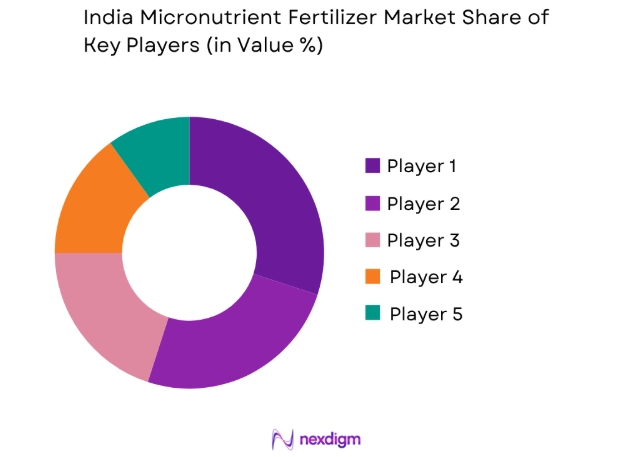
India Micronutrient Fertilizer Market Analysis
Growth Drivers
Rising Soil Micronutrient Deficiency Across Agricultural Land
India’s micronutrient fertilizer market is being significantly driven by the increasing prevalence of micronutrient deficiencies in agricultural soils. According to the Indian Council of Agricultural Research (ICAR) and the Ministry of Agriculture, soil testing under the Soil Health Card Scheme has identified widespread deficiencies of zinc, boron, iron, manganese, and copper across major farming regions. More than 230 million Soil Health Cards have been distributed, covering over 140 million hectares of cultivated land. Data from the Soil Health Management Program indicates that zinc deficiency affects approximately 36 million hectares of agricultural land, while boron deficiency is prominent across several states including Karnataka, Maharashtra, and Tamil Nadu. India’s gross cropped area exceeds 198 million hectares, creating a large requirement for nutrient replenishment. The World Bank reports that agriculture contributes around USD 500 billion to India’s economy, emphasizing the importance of maintaining soil productivity. Foodgrain production crossed 330 million metric tons, while horticulture output exceeded 355 million metric tons, both requiring balanced nutrient management for yield sustainability. Continuous cultivation and intensive fertilizer application have accelerated micronutrient depletion, increasing dependence on zinc sulphate, boron, iron chelates, and other micronutrient products. The growing recognition of soil fertility management among farmers and policymakers continues to support higher adoption of micronutrient fertilizers across cereal, oilseed, horticulture, and plantation crops.
Expansion of High-Value Horticulture and Commercial Crops
The expansion of horticulture and commercial crop cultivation is a major growth driver for the India micronutrient fertilizer market. According to the Ministry of Agriculture and Farmers Welfare, horticulture production exceeded 355 million metric tons, surpassing foodgrain production in several regions. India cultivates fruits and vegetables across more than 29 million hectares, while commercial crops such as cotton, sugarcane, tea, coffee, and spices occupy substantial acreage. These crops require balanced micronutrient application because deficiencies directly affect yield quality, fruit size, sugar content, and export standards. India exported agricultural products worth over USD 48 billion, highlighting the importance of maintaining crop quality through advanced nutrient management. The country remains the world’s largest producer of milk, spices, and several fruits, increasing pressure on farmers to maximize productivity per hectare. The IMF estimates India’s GDP exceeded USD 3.9 trillion, supported partly by the agricultural value chain and agro-processing sector. Increasing cultivation of export-oriented grapes, pomegranates, bananas, mangoes, and vegetables has boosted demand for boron, zinc, iron, and manganese fertilizers. Rising adoption of fertigation systems, protected cultivation, and precision farming techniques across states such as Maharashtra, Karnataka, Andhra Pradesh, and Gujarat further accelerates the use of specialized micronutrient formulations to improve nutrient-use efficiency and crop profitability.
Market Challenges
Dependence on Imported Raw Materials and Supply Volatility
One of the major challenges facing the India micronutrient fertilizer market is dependence on imported raw materials used in manufacturing zinc, boron, copper, molybdenum, and chelated micronutrient products. According to the Ministry of Commerce and Industry, India imports substantial quantities of fertilizer inputs and specialty nutrient raw materials due to limited domestic reserves of several micronutrient minerals. Total merchandise imports exceeded USD 675 billion, reflecting the country’s exposure to international commodity supply chains. India’s fertilizer sector also relies on imported minerals and intermediate products from countries including China, Chile, Peru, South Africa, and Australia. The World Bank reported global commodity price volatility continuing through recent years due to geopolitical disruptions and logistics constraints. Port congestion, shipping delays, and fluctuations in mineral availability affect the consistent supply of micronutrient fertilizer ingredients. India’s agricultural sector supports livelihoods for more than 100 million farming households, making uninterrupted fertilizer availability critical for crop productivity. Any disruption in the raw material supply chain can affect manufacturing schedules and regional product distribution. This dependence creates operational challenges for domestic producers and distributors, particularly during peak agricultural seasons when demand for micronutrient fertilizers increases across cereal, horticulture, and plantation crop segments.
Limited Farmer Awareness and Uneven Adoption Rates
Despite significant government initiatives, limited awareness regarding micronutrient deficiencies remains a major challenge for market expansion. India has over 146 million operational landholdings, with average farm sizes remaining relatively small according to the Agriculture Census. Many farmers continue to prioritize primary nutrients such as nitrogen, phosphorus, and potassium while underutilizing micronutrient products. Although more than 230 million Soil Health Cards have been issued, adoption of soil-test-based nutrient recommendations varies considerably across states and districts. The Ministry of Agriculture reports that agriculture occupies approximately 140 million hectares of net sown area, but access to extension services and agronomic guidance remains uneven. Smallholder farmers often rely on traditional fertilization practices and may not recognize symptoms of zinc, boron, or iron deficiency until crop losses become visible. India’s rural population exceeds 900 million people, creating logistical challenges for disseminating nutrient management education at scale. In several regions, dealer recommendations continue to influence fertilizer purchasing decisions more strongly than scientific soil analysis. This knowledge gap slows penetration of specialty micronutrient products, particularly in rain-fed agricultural areas. Enhancing farmer training, digital advisory platforms, and extension services remains critical to improving micronutrient fertilizer adoption and maximizing crop productivity.
Market Opportunities
Growth of Precision Agriculture and Digital Farming Technologies
The increasing adoption of precision agriculture technologies presents a significant opportunity for the India micronutrient fertilizer market. According to the Ministry of Agriculture, digital agriculture initiatives are expanding through satellite monitoring, drone deployment, GIS-based soil mapping, and farm advisory platforms. India possesses more than 198 million hectares of gross cropped area, creating substantial demand for data-driven nutrient management solutions. The country’s digital ecosystem includes over 950 million internet subscribers and more than 1.1 billion mobile connections, enabling wider dissemination of precision farming tools. Drones are increasingly being used for nutrient application, crop monitoring, and deficiency detection across large agricultural areas. The government’s Digital Agriculture Mission is promoting integration of farm databases, weather information, and soil health records to improve input efficiency. Precision farming techniques help identify micronutrient deficiencies at field level, enabling targeted application of zinc, boron, iron, and manganese fertilizers. India’s foodgrain output exceeding 330 million metric tons demonstrates the scale of agricultural production requiring optimized nutrient management. As farmers seek higher productivity and resource efficiency, precision agriculture technologies are expected to increase demand for customized micronutrient formulations, water-soluble products, and crop-specific nutrient solutions across major agricultural regions.
Expansion of Government Soil Health and Sustainable Agriculture Programs
Government-led soil health and sustainable agriculture initiatives create substantial opportunities for micronutrient fertilizer manufacturers. The Soil Health Card Scheme has generated one of the world’s largest soil databases, with more than 230 million cards issued to farmers across the country. India cultivates over 140 million hectares of net sown area, requiring continuous nutrient replenishment to maintain soil productivity. The National Mission for Sustainable Agriculture and related programs promote balanced fertilization, integrated nutrient management, and resource-efficient farming practices. Foodgrain production exceeding 330 million metric tons and horticulture output surpassing 355 million metric tons underscore the need for improved nutrient-use efficiency. According to the Ministry of Agriculture, increasing focus is being placed on restoring soil fertility and correcting micronutrient deficiencies identified through extensive soil testing programs. India’s agricultural exports exceeding USD 48 billion also encourage adoption of quality-enhancing nutrient management practices to meet international standards. As governments continue investing in soil diagnostics, farmer training, and nutrient stewardship programs, demand for zinc, boron, iron, manganese, and multi-micronutrient fertilizers is expected to strengthen. These initiatives create favorable conditions for manufacturers to expand product penetration across both commercial farming operations and smallholder agricultural communities.
Future Outlook
The India Micronutrient Fertilizer Market is expected to witness sustained growth over the coming decade due to increasing soil nutrient depletion, rising demand for high-value crops, and stronger adoption of precision farming technologies. Government programs promoting balanced fertilization and nutrient stewardship are expected to improve micronutrient usage rates across key agricultural regions. The market is also likely to benefit from the growing popularity of fertigation, protected cultivation, and specialty crop nutrition solutions. Product innovation in chelated formulations and customized micronutrient blends will remain a key growth avenue for industry participants.
Major Players
- Coromandel International Limited
- Indian Farmers Fertiliser Cooperative Limited (IFFCO)
- Gujarat State Fertilizers & Chemicals Ltd. (GSFC)
- Deepak Fertilisers & Petrochemicals Corporation Ltd.
- Aries Agro Limited
- Rashtriya Chemicals and Fertilizers Ltd. (RCF)
- National Fertilizers Limited (NFL)
- Paradeep Phosphates Limited
- Tata Chemicals Limited
- Zuari FarmHub Limited
- Krishna Phoschem Limited
- Nagarjuna Fertilizers and Chemicals Ltd.
- Yara India Private Limited
- BASF India Limited
- Chambal Fertilisers and Chemicals Ltd.
Key Target Audience
- Micronutrient Fertilizer Manufacturers
- Specialty Crop Nutrition Companies
- Fertilizer Distributors and Agro-Dealers
- Agricultural Cooperatives
- Precision Agriculture Technology Providers
- Investments and Venture Capitalist Firms
- Government and Regulatory Bodies
- Commercial Farming Enterprises and Plantation Operators
Research Methodology
Step 1: Identification of Key Variables
The initial phase involves constructing an ecosystem map encompassing all major stakeholders within the India Micronutrient Fertilizer Market. Extensive secondary research is conducted using agricultural databases, government publications, fertilizer industry reports, and trade statistics. The objective is to identify critical variables influencing market demand, supply, pricing, and adoption.
Step 2: Market Analysis and Construction
Historical market performance is analyzed through fertilizer consumption trends, micronutrient usage patterns, crop acreage, and regional demand assessment. Market sizing is performed using both top-down and bottom-up approaches while evaluating production capacity, imports, exports, and distributor networks.
Step 3: Hypothesis Validation and Expert Consultation
Market assumptions are validated through interviews with fertilizer manufacturers, distributors, agronomists, agricultural input retailers, and industry experts. These consultations provide operational insights regarding product demand, farmer behavior, regional consumption trends, and competitive dynamics.
Step 4: Research Synthesis and Final Output
The final stage integrates primary and secondary findings to develop a comprehensive view of the market. Data triangulation techniques are used to verify market estimates, segmentation shares, and future growth prospects, ensuring accuracy and consistency across all research outputs.

- Executive Summary
- Research Methodology (Market Definitions and Assumptions, Abbreviations, Market Sizing Approach, Bottom-Up Analysis, Top-Down Validation, Primary Interviews with Manufacturers and Distributors, Demand-Side Assessment, Supply-Side Assessment, Data Triangulation, Limitations and Future Conclusions)

- Definition and Scope
- Market Evolution and Industry Genesis
- Timeline of Micronutrient Fertilizer Development in India
- Agricultural Input Ecosystem
- Supply Chain and Value Chain Analysis

- Growth Drivers (Soil Micronutrient Deficiency Expansion, Rising Crop Yield Requirements, Government Balanced Fertilization Programs, Precision Agriculture Adoption, Growth in High-Value Horticulture Cultivation)
- Market Challenges (Farmer Awareness Gaps, Counterfeit Micronutrient Products, Raw Material Import Dependence, Price Sensitivity Among Small Farmers, Regional Demand Imbalances)
- Market Opportunities (Chelated Micronutrient Expansion, Specialty Crop Nutrition Solutions, Precision Farming Technologies, Fertigation Growth, Multi-Micronutrient Blend Development)
- Market Trends (Liquid Micronutrient Adoption, Customized Crop Nutrition Programs, Digital Agriculture Platforms, Nano Fertilizer Integration, Sustainable Nutrient Management Practices)
- Government Regulations (Fertilizer Control Order Compliance, Integrated Nutrient Management Policies, PM-PRANAM Scheme Impact, Nutrient-Based Subsidy Framework, State-Level Registration Requirements)
- SWOT Analysis
- Stakeholder Ecosystem
- PESTLE Analysis
- Porter’s Five Forces Analysis
- Competition Ecosystem

- By Market Value (2020-2025)
- By Volume Consumption (2020-2025)
- By Average Selling Price (2020-2025

- By Nutrient Type (In Value %)
Zinc Fertilizers
Boron Fertilizers
Iron Fertilizers
Manganese Fertilizers
Copper Fertilizers
Molybdenum Fertilizers
Multi-Micronutrient Fertilizers
Others - By Crop Type (In Value %)
Rice
Wheat
Maize
Sugarcane
Fruits & Vegetables
Cotton
Oilseeds
Pulses
Others - By Form Type (In Value %)
Granular
Liquid
Chelated
Powder/Crystalline - By Application Method (In Value %)
Soil Application
Foliar Application
Fertigation
Seed Treatment - By Distribution Channel (In Value %)
Fertilizer Dealers/Retailers
Cooperatives
Direct Company Sales
Agri Input E-Commerce Platforms

- Market Share of Major Players (Market Share by Value, Volume, Micronutrient Portfolio, State Presence, Distribution Reach, Crop Coverage)
- Cross Comparison Parameters (Product Portfolio Strength, Micronutrient Manufacturing Capacity, Zinc Fertilizer Portfolio, Chelated Product Presence, Distribution Network Reach, Dealer and Retailer Coverage, State Registration Footprint, Crop-Specific Nutrient Solutions)
- SWOT Analysis of Major Players
- Pricing Analysis Basis SKUs (Zinc Sulphate Monohydrate, Zinc Sulphate Heptahydrate, Borax, Solubor, Ferrous Sulphate, Chelated Iron, Copper Sulphate, Manganese Sulphate, Molybdenum Fertilizers, Multi-Micronutrient Mixtures)
- Detailed Profiles of Major Companies
Coromandel International Limited
Indian Farmers Fertiliser Cooperative Limited (IFFCO)
Paradeep Phosphates Limited
Zuari FarmHub Limited
Deepak Fertilisers & Petrochemicals Corporation Ltd.
Aries Agro Limited
Chambal Fertilisers and Chemicals Ltd.
Rashtriya Chemicals and Fertilizers Ltd. (RCF)
Gujarat State Fertilizers & Chemicals Ltd. (GSFC)
National Fertilizers Limited (NFL)
Tata Chemicals Limited
Krishna Phoschem Limited
Nagarjuna Fertilizers and Chemicals Ltd.
Yara India Private Limited
BASF India Limited

- Crop Nutrition Demand Assessment
- Farm Size-Based Consumption Analysis
- Purchasing Power and Fertilizer Spending Patterns
- Micronutrient Usage Intensity by Crop
- Farmer Pain Points and Adoption Barriers
- Decision-Making Framework for Product Selection
- Brand Awareness and Loyalty Assessment

- By Market Value (2026-2035)
- By Volume Consumption (2026-2035)
- By Average Selling Price (2026-2035)


 Request a Sample
 Ask for Customization
 Get a Quote
 Enquire Now