
 Download PDF
Market Overview
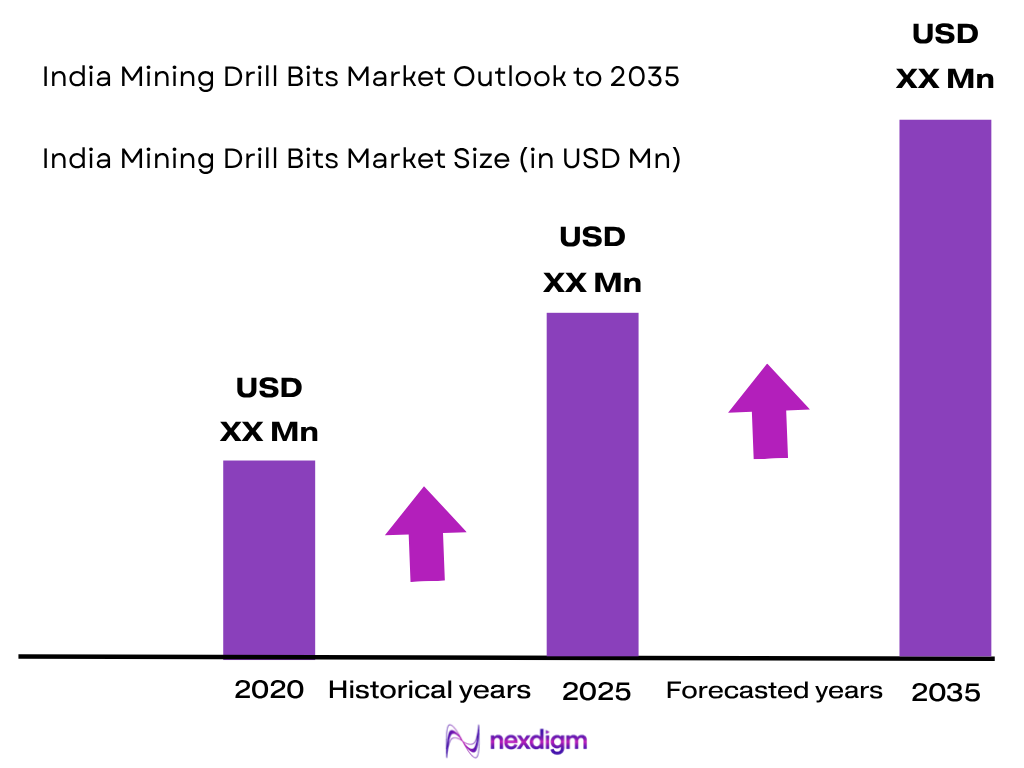
The India Mining Drill Bits Market is supported by the scale and intensity of domestic mining activity, particularly coal, iron ore, limestone and mineral exploration. Official coal statistics show that India produced 997.83 million tonnes of coal in FY2023-24, while production increased to 1,047.523 million tonnes in FY2024-25. Coal India alone produced 773.81 million tonnes in FY2023-24 and 781.056 million tonnes in FY2024-25. These production volumes translate into recurring drilling requirements for blast-hole, rotary, DTH and exploration applications, creating a substantial downstream requirement for drill bits.
The India Mining Drill Bits Market is concentrated around mineral-producing states including Odisha, Chhattisgarh, Jharkhand, Rajasthan, Karnataka and Madhya Pradesh, where coal, iron ore, limestone and base-metal extraction generate recurring drilling requirements. Coal India’s major production growth areas include the North Karanpura, Korba, IB and Talcher coalfields, while captive and commercial coal mines increased production from 147.12 million tonnes to 190.95 million tonnes across the latest reported fiscal periods. Mineral exploration is also expanding: GSI undertook 438 exploration projects, including 195 critical-mineral projects, during the latest reported field season.
Market Segmentation
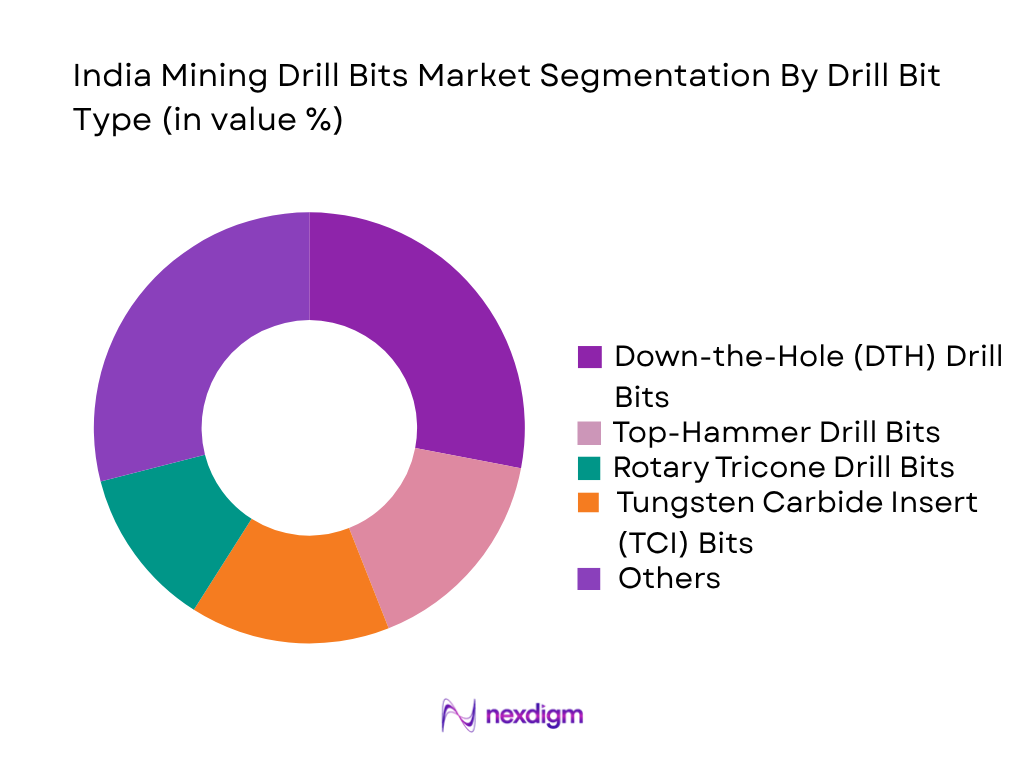
By Drill Bit Type
The India Mining Drill Bits Market is segmented by drill bit type into Down-the-Hole (DTH) drill bits, top-hammer drill bits, rotary tricone drill bits, tungsten carbide insert (TCI) bits, milled-tooth drill bits, polycrystalline diamond compact (PDC) bits, diamond core bits, drag bits, button bits and specialty mining drill bits. DTH drill bits are positioned as the leading sub-segment because Indian open-pit mines, quarrying operations and drilling contractors require dependable penetration across hard and abrasive rock formations. The importance of blast-hole drilling is reinforced by the scale of coal and mineral extraction, with India producing 1,047.523 million tonnes of coal in FY2024-25 and captive/commercial mines producing 190.95 million tonnes. DTH systems are particularly relevant where drilling accuracy, hole depth and penetration consistency influence blasting performance. Continued mineral exploration also expands demand for specialized drilling tools. GSI conducted 438 exploration projects during the latest field season, while MECL increased exploratory drilling activity, supporting demand for exploration-oriented drill bits alongside production drilling tools.
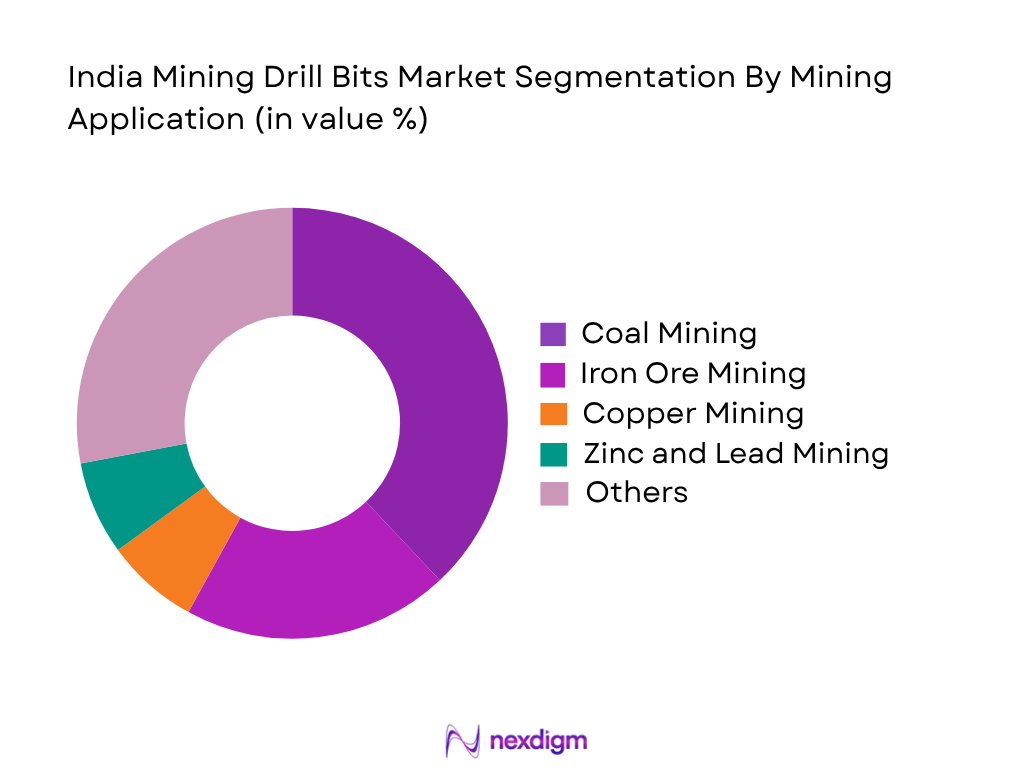
By Mining Application
The India Mining Drill Bits Market is segmented by mining application into coal mining, iron ore mining, copper mining, zinc and lead mining, limestone mining and quarrying, bauxite mining, manganese mining, gold mining, diamond mining and other mineral mining. Coal mining represents a leading demand application because of India’s exceptionally large production base and extensive use of drilling and blasting in opencast operations. Official statistics place national coal production at 997.83 million tonnes in FY2023-24 and 1,047.523 million tonnes in FY2024-25, while Coal India contributed 781.056 million tonnes in FY2024-25. Captive and commercial mines additionally reached 190.95 million tonnes, increasing the number of operating mining sites requiring drilling consumables. The expansion of critical-mineral exploration provides another demand channel: GSI undertook 195 critical-mineral exploration projects within its 438-project field-season program. This creates requirements for both production drill bits and specialized core-drilling products used during geological investigation.
Competitive Landscape
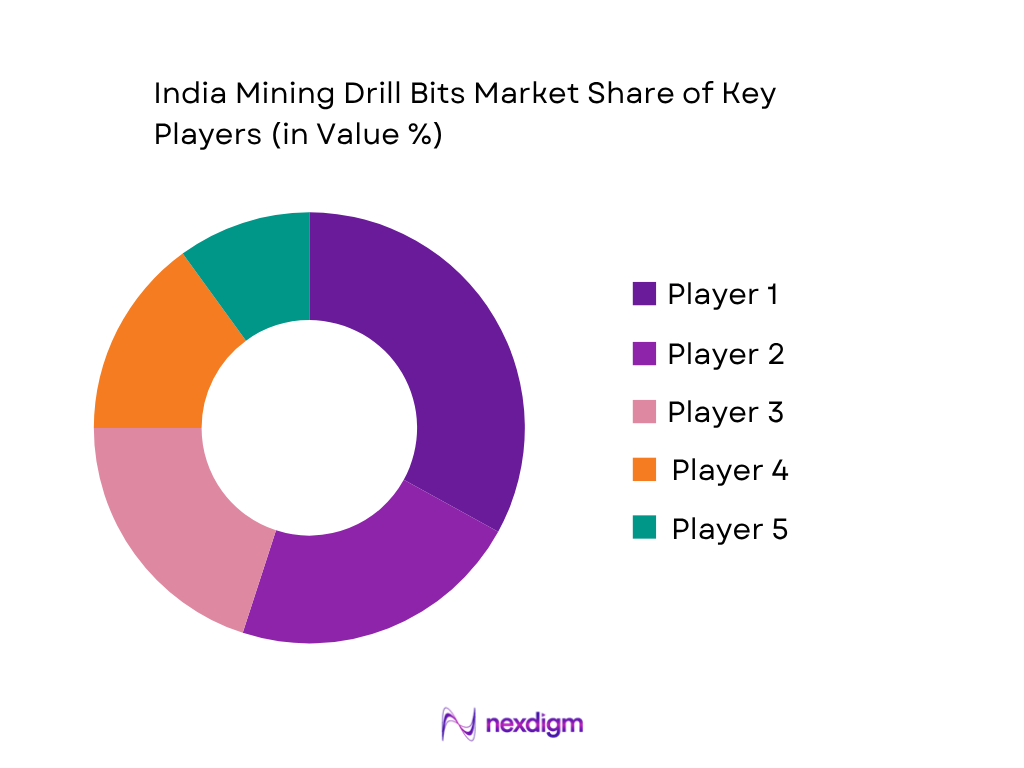
The India Mining Drill Bits Market comprises international mining-technology companies, specialized drilling-tool manufacturers and Indian equipment suppliers serving coal producers, mineral exploration organizations, quarrying companies and drilling contractors. Competition is shaped by product durability, penetration performance, compatibility with drilling equipment, cutting-structure technology, bit life, technical support and distribution coverage. The scale of Indian mining activity provides an extensive installed base: captive and commercial coal production reached 190.95 million tonnes, while GSI’s exploration program covered 438 projects, creating demand across both production and exploration drilling.
| Company | Establishment Year | Headquarters | DTH Technology | Rotary Bit Portfolio | PDC Technology | Diamond Drilling | Mining Applications | India Service Coverage | Product Customization |
| Sandvik Mining and Rock Solutions | 1862 | Stockholm, Sweden | ~ | ~ | ~ | ~ | ~ | ~ | ~ |
| Epiroc | 2018 | Stockholm, Sweden | ~ | ~ | ~ | ~ | ~ | ~ | ~ |
| Boart Longyear | 1890 | Salt Lake City, USA | ~ | ~ | ~ | ~ | ~ | ~ | ~ |
| Mincon Group | 1977 | Shannon, Ireland | ~ | ~ | ~ | ~ | ~ | ~ | ~ |
| Revathi Equipment India | 1977 | Coimbatore, India | ~ | ~ | ~ | ~ | ~ | ~ | ~ |
India Mining Drill Bits Market Analysis
Growth Drivers
Expansion of Coal Mining and Blast-Hole Drilling
The India Mining Drill Bits Market is supported by the continued expansion of domestic coal production, which directly sustains requirements for blast-hole, rotary and Down-the-Hole (DTH) drilling equipment and consumables. According to the Ministry of Coal, India produced 997.83 million tonnes of coal in FY2023-24, while production reached 1,047.523 million tonnes in FY2024-25, creating a large recurring requirement for drilling across opencast and underground mining operations. Coal India Limited produced 773.81 million tonnes in FY2023-24 and 781.056 million tonnes in FY2024-25, while captive and commercial coal mines increased production from 147.12 million tonnes to 190.95 million tonnes over the same period. The Ministry of Coal also reported 200.23 million tonnes of production from captive, commercial and other mines in FY2025-26, demonstrating continued operating activity. These production levels sustain recurring replacement requirements for DTH buttons, tungsten-carbide inserts, rotary bits and other drilling tools used under varying geological conditions. The expansion of production capacity also increases drilling requirements during mine development, bench preparation, overburden removal and blast-hole formation. Consequently, mining operators and drilling contractors require drill bits capable of maintaining penetration rates and hole accuracy across extended operating cycles. This creates sustained demand for durable cutting structures, application-specific geometries and high-performance drilling consumables across India’s major coal-producing regions.
Expansion of Mineral Exploration and Critical-Mineral Drilling
Increasing geological exploration is strengthening the requirement for specialized mining drill bits in India, particularly diamond core bits, reverse-circulation tools, DTH products and other exploration-oriented drilling systems. The Ministry of Mines reported that the Geological Survey of India undertook 438 exploration projects during field season 2024-25, including 195 critical-mineral projects, compared with 360 projects and 127 critical-mineral projects during field season 2023-24. The subsequent field season included 450 exploration projects, of which 227 projects focused on critical minerals. The National Mineral Exploration Trust also approved 146 exploration and procurement projects worth ₹712 crore between January 2024 and January 2025. These activities increase drilling requirements across greenfield mineral targets, resource-definition programs and geological investigations. Critical-mineral exploration is particularly relevant because drilling may involve hard-rock formations, variable depths, fractured zones and stringent core-recovery requirements. This supports demand for diamond-impregnated bits, PDC products, DTH bits and specialized core-drilling tools. The broader exploration pipeline also creates opportunities for manufacturers to develop drill bits matched to specific geological formations and drilling methods. As exploration programs expand across different Indian mineral belts, suppliers need to provide products that balance penetration performance, durability, core recovery and hole stability, strengthening the role of specialized drilling technologies within India’s mining equipment ecosystem.
Market Challenges
High Drill-Bit Wear in Hard and Abrasive Geological Formations
The India Mining Drill Bits Market faces operational challenges because Indian mining and exploration activities cover highly diverse geological conditions, including hard-rock, abrasive and fractured formations. Drill-bit performance can vary substantially according to rock hardness, abrasiveness, fracture intensity, drilling depth and flushing conditions, increasing the importance of application-specific cutting structures. The scale of coal and mineral operations magnifies this challenge: India produced 1,047.523 million tonnes of coal in FY2024-25, while Odisha produced 269.363 million tonnes, Jharkhand 206.192 million tonnes, Chhattisgarh 204.953 million tonnes and Madhya Pradesh 167.571 million tonnes, according to the Ministry of Coal. These geographically dispersed operations expose drill-bit manufacturers to different drilling environments, rock conditions and equipment configurations. Exploration activity adds another layer of complexity, with GSI undertaking 438 exploration projects and 195 critical-mineral projects during field season 2024-25, according to the Ministry of Mines. Under these conditions, premature wear, broken carbide buttons, gauge loss and reduced penetration can increase replacement frequency and affect drilling schedules. Manufacturers therefore need to engineer cutting structures, bit bodies and flushing arrangements according to specific formations rather than relying on standardized designs. Drill-bit selection must also account for rig power, rotation speed, impact energy, hole diameter and drilling method, making technical application support an important requirement for mining customers.
Dependence on Specialized Materials and Technical Manufacturing Capabilities
The India Mining Drill Bits Market faces supply-chain and manufacturing challenges associated with specialized materials such as tungsten carbide, synthetic diamond, PDC cutters, alloy steel and precision-engineered components. Drill bits used in mining require carefully controlled material properties because cutting structures must withstand impact, abrasion, heat and repeated mechanical loading. The challenge becomes more significant as Indian mining expands toward harder formations and technically demanding exploration programs. The Ministry of Mines reported 438 GSI exploration projects during field season 2024-25, including 195 critical-mineral projects, while the subsequent field season increased activity to 450 projects, including 227 critical-mineral projects. Such exploration requires specialized products across core drilling, DTH and other drilling techniques. At the production level, India’s coal output reached 1,047.523 million tonnes in FY2024-25, demonstrating the scale of downstream drilling activity. Manufacturers must maintain consistent metallurgy, carbide geometry, cutter quality and dimensional tolerances while supporting different drilling-rig configurations. Technical expertise is also required for bit selection, failure analysis and performance optimization. In addition, maintaining reliable supplies of specialized components is important because interruptions can affect drilling schedules and equipment utilization. The increasing technical diversity of drilling applications therefore places greater emphasis on localized engineering capabilities, quality control, component availability and after-sales technical support throughout the Indian mining drill-bit supply chain.
Market Opportunities
Development of Advanced Drill Bits for Critical-Mineral Exploration
The India Mining Drill Bits Market has an opportunity to expand through specialized products designed for critical-mineral exploration, geological investigation and resource-definition drilling. Current exploration activity provides a measurable foundation for this opportunity. The Ministry of Mines reported 438 GSI exploration projects during field season 2024-25, including 195 projects focused on critical minerals. Activity increased further in the following field season to 450 projects, including 227 critical-mineral projects. The National Mineral Exploration Trust also approved 146 exploration and procurement projects worth ₹712 crore between January 2024 and January 2025. These programs require drilling tools capable of maintaining penetration, core recovery and hole integrity under varying rock conditions. The opportunity extends across diamond core bits, impregnated bits, PDC technologies, specialized carbide products and application-specific DTH tools. Suppliers can develop products optimized for different mineral formations, drilling depths and equipment configurations encountered across Indian exploration regions. Increasing attention to critical minerals also creates demand beyond conventional coal and iron-ore applications, allowing manufacturers to diversify into lithium-bearing formations, rare-earth exploration, graphite, copper and other strategically important mineral targets. Advanced bit designs incorporating improved diamond distribution, optimized carbide grades, enhanced gauge protection and specialized hydraulic configurations can further address demanding exploration conditions. This creates scope for suppliers to build differentiated products around geological performance rather than competing only on conventional drilling-tool specifications.
Localization of Mining Drill-Bit Manufacturing and Advanced Drilling Technologies
The India Mining Drill Bits Market presents opportunities for localized production of advanced drilling tools as domestic mining and exploration activity creates a recurring requirement for replacement and application-specific products. India’s coal production reached 1,047.523 million tonnes in FY2024-25, while captive and commercial coal mines produced 190.95 million tonnes, according to the Ministry of Coal. In addition, GSI undertook 438 exploration projects during field season 2024-25, demonstrating demand across both production and exploration drilling. The opportunity is therefore not limited to conventional drill bits; manufacturers can develop localized PDC cutters, tungsten-carbide button configurations, diamond core bits, hybrid cutting structures and specialized DTH products. Domestic manufacturing can support faster customization according to Indian geological conditions and mine-specific drilling requirements while reducing dependence on imported specialized components. Increasing deployment of automated drilling, digital drill monitoring and performance analytics provides an additional technology pathway, allowing suppliers to combine physical drill-bit products with data-driven bit selection and wear monitoring. The continuing expansion of domestic mining and exploration provides manufacturers with a broad application base for developing locally engineered drilling solutions. Local engineering can also improve responsiveness for replacement requirements, technical troubleshooting and product modification. These capabilities can strengthen India’s mining-equipment supply ecosystem while creating opportunities for manufacturers to serve coal, iron ore, critical minerals, quarrying and exploration applications with locally optimized drilling technologies.
Future Outlook
The India Mining Drill Bits Market is expected to experience continued demand as domestic mineral production, mechanized mining, exploration activity and development of critical mineral resources support drilling requirements. Coal production has already exceeded 1 billion tonnes, while captive and commercial mining continues to expand. Mineral exploration is also becoming more technology-intensive, with 438 GSI projects undertaken in the latest reported field season and 227 critical-mineral projects included in the subsequent field-season program. The market outlook is therefore increasingly linked to drilling productivity, longer bit life, advanced cutting structures, automated drilling and application-specific bit design.
Major Players
- Sandvik Mining and Rock Solutions India Pvt. Ltd.
- Epiroc Mining India Pvt. Ltd.
- Boart Longyear India Pvt. Ltd.
- Komatsu Mining Corp.
- Caterpillar India Pvt. Ltd.
- Furukawa Rock Drill Co., Ltd.
- Mincon Group plc
- Robit Plc
- Rockmore International
- Mitsubishi Materials Corporation
- Numa
- Center Rock Inc.
- Volgaburmash
- PCI Limited
- Revathi Equipment India Limited
Key Target Audience
- Mining Equipment Manufacturers and Drill-Rig OEMs
- Coal Mining Companies and Mine Operators
- Iron Ore, Base Metal and Critical Mineral Producers
- Mineral Exploration and Geological Drilling Contractors
- Investments and Venture Capitalist Firms (Mining Technology, Industrial Equipment and Advanced Materials Investors)
- Government and Regulatory Bodies (Ministry of Mines, Ministry of Coal, Directorate General of Mines Safety)
- Quarrying and Construction Materials Producers
- Drilling Equipment Distributors and Industrial Tooling Suppliers
Research Methodology
Step 1: Identification of Key Variables
The initial phase involves mapping the India Mining Drill Bits Market ecosystem across drill-bit manufacturers, drilling-rig OEMs, mining companies, exploration contractors, distributors and raw-material suppliers. Variables include bit type, drilling method, hole diameter, cutting structure, application, bit life, penetration performance and replacement frequency. Official mining production and exploration datasets are incorporated to establish the underlying demand environment.
Step 2: Market Analysis and Construction
Historical market information is compiled using a combination of supply-side production assessments and demand-side mining activity. Coal production, captive and commercial mining output, exploration drilling and mineral-development activity are evaluated to determine the consumption potential for DTH, rotary, top-hammer and core-drilling bits. Government datasets provide the principal validation layer for mining activity and exploration intensity.
Step 3: Hypothesis Validation and Expert Consultation
Market hypotheses are validated through discussions with mining-equipment manufacturers, drilling contractors, mine procurement teams and technical specialists. Interviews focus on bit replacement cycles, drilling conditions, geological hardness, preferred cutting structures, equipment compatibility and performance requirements. Operational feedback is used to validate demand patterns across coal, iron ore, quarrying and mineral-exploration applications.
Step 4: Research Synthesis and Final Output
The final stage triangulates manufacturer information, mining-production statistics, exploration activity and application-level demand indicators. Government information on coal production and mineral exploration is reconciled with industry-level assessments to validate the market model. The resulting framework provides a structured assessment of product categories, end-use applications, competitive positioning and future demand drivers.

- Executive Summary
- Research Methodology (Market Definition and Scope, India Mining Drill Bits Market Classification, Mining Drill Bit Technology Mapping, Rotary Drill Bit Assessment, Tricone Drill Bit Evaluation, Tungsten Carbide Insert (TCI) Bit Analysis, Milled-Tooth Bit Assessment, Down-the-Hole (DTH) Bit Evaluation, Top-Hammer Bit Analysis, Polycrystalline Diamond Compact (PDC) Bit Assessment, Diamond Core Bit Evaluation, Drag Bit Assessment, Drill Bit Material and Cutter Technology Mapping, Tungsten Carbide Grade Evaluation, Polycrystalline Diamond Cutter Assessment, Bit Body Material Analysis, Hardfacing Technology Evaluation, Bearing and Seal Technology Assessment, Bit Gauge Protection Analysis, Flushing Technology Evaluation)

- Definition and Scope
- India Mining Drill Bits Industry Evolution and Development of Mechanized Mining, Open-Pit Coal Mining Expansion, Blast-Hole Drilling Adoption, DTH Drilling Development, Rotary Drilling Technology Adoption, Underground Mining Mechanization, Mineral Exploration Intensification, Iron Ore Mine Development, Copper and Base Metal Exploration, Limestone Quarrying Expansion, High-Performance Carbide Bit Adoption, PDC Technology Introduction, Automated Drilling Systems, Digital Drill Monitoring, Remote Drilling Technologies and Advanced Mining Equipment Deployment
- Mining Drill Bits Value Chain Analysis
- Mining Drill Bits Supply Chain Analysis
- Tungsten Carbide Suppliers, Synthetic Diamond and PDC Cutter Manufacturers, Steel and Alloy Suppliers, Drill Bit Component Manufacturers, Bit Design and Engineering Companies, Drill Bit Manufacturers, DTH Bit Manufacturers, Tricone Bit Manufacturers, PDC Bit Manufacturers, Diamond Core Bit Manufacturers

- Growth Drivers (Expansion of Coal Production, Growth of Iron Ore Mining, Increasing Open-Pit Mining Activity, Expansion of Mineral Exploration, Mechanization of Mining Operations, Rising Blast-Hole Drilling Requirements, Growth of Quarrying Activity, Increasing Adoption of DTH Drilling, Demand for Higher Drilling Productivity, Development of Critical Mineral Resources)
- Market Challenges (High Wear Rates in Abrasive Formations, Tungsten Carbide Raw Material Dependency, Drill Bit Replacement Requirements, Geological Variability Across Mining Regions, Equipment Compatibility Constraints, Skilled Drilling Operator Requirements, Bit Performance Variability Across Rock Formations, Supply Chain Dependency for Specialized Components, Counterfeit and Low-Quality Drill Bit Availability, Mine-Level Procurement Cost Pressure)
- Market Opportunities (Expansion of Critical Mineral Exploration, Advanced PDC and Hybrid Bit Adoption, High-Performance DTH Bit Development, Digital Bit Performance Monitoring, Automated Drilling Systems, Development of Longer-Life Cutting Structures, Expansion of Underground Mining Applications, Advanced Diamond Core Drilling Technologies, Customized Bits for Indian Geological Formations, Localized Drill Bit Manufacturing and Component Production)
- Market Trends (Increasing DTH Technology Adoption, Growth of Rotary Blast-Hole Drilling, Higher Tungsten Carbide Content in Cutting Structures, Development of Advanced PDC Cutters, Increasing Demand for Longer Bit Life, Digital Drill Performance Monitoring, Automated Bit Selection, Predictive Wear Monitoring, Customized Bit Geometry, Increasing Focus on Drilling Productivity and Hole Accuracy)
- Government Regulations and Standards (Mines and Minerals Development and Regulation Framework, Ministry of Mines Mineral Exploration Policies, Ministry of Coal Mining Policies, Directorate General of Mines Safety Requirements, Mineral Conservation and Development Rules, Mineral Auction Framework, Environmental Clearance Requirements, Mine Safety Regulations, Explosives and Blasting Regulations, Bureau of Indian Standards Requirements for Mining Equipment)
- SWOT Analysis
- Porter’s Five Forces Analysis
- PESTLE Analysis
- Stakeholder Ecosystem
- Competition Ecosystem

- By Market Value (2020-2025)
- By Drill Bit Consumption Volume (2020-2025)
- By Average Selling Price (2020-2025)
- By Rotary Drill Bit Consumption Volume (2020-2025)
- By DTH Drill Bit Consumption Volume (2020-2025)
- By Top-Hammer Drill Bit Consumption Volume (2020-2025)
- By Tricone Drill Bit Consumption Volume (2020-2025)
- By PDC Drill Bit Consumption Volume (2020-2025)
- By Diamond Core Bit Consumption Volume (2020-2025)
- By Mining Blast-Hole Drill Bit Consumption Volume (2020-2025)
- By Mineral Exploration Drill Bit Consumption Volume (2020-2025)

- By Drill Bit Type (In Value %)
Down-the-Hole (DTH) Drill Bits
Top-Hammer Drill Bits
Rotary Tricone Drill Bits
Tungsten Carbide Insert (TCI) Bits
Milled-Tooth Drill Bits
Polycrystalline Diamond Compact (PDC) Bits
Diamond Core Bits
Drag Bits
Button Bits
Specialty Mining Drill Bits - By Drilling Method (In Value %)
Rotary Drilling
Down-the-Hole Drilling
Top-Hammer Percussion Drilling
Rotary-Percussion Drilling
Core Drilling
Reverse Circulation Drilling
Blast-Hole Drilling
Exploration Drilling - By Mining Application (In Value %)
Coal Mining
Iron Ore Mining
Copper Mining
Zinc and Lead Mining
Limestone Mining and Quarrying
Bauxite Mining
Manganese Mining
Gold Mining
Diamond Mining
Other Mineral Mining - By Bit Material and Cutting Structure (In Value %)
Tungsten Carbide Button Bits
Tungsten Carbide Insert Bits
Polycrystalline Diamond Compact Cutters
Natural Diamond Impregnated Bits
Synthetic Diamond Impregnated Bits
Steel-Tooth Cutting Structures
Carbide-Hardfaced Cutting Structures
Hybrid Cutting Structures - By Hole Diameter (In Value %)
Below 3 Inches
3–6 Inches
6–8 Inches
8–12 Inches
12–18 Inches
Above 18 Inches - By End-User Type (In Value %)
Coal Mining Companies
Iron Ore Mining Companies
Base Metal Mining Companies
Mineral Exploration Companies
Quarrying Companies
Drilling Contractors
Mining Equipment Contractors
Government-Owned Mining Enterprises
Private Mining Operators
Construction and Infrastructure Mining Contractors - By Region (In Value %)
Odisha
Jharkhand
Chhattisgarh
Madhya Pradesh
Rajasthan
Maharashtra
Karnataka
Goa
Andhra Pradesh
Telangana
Other Indian Regions

- Market Share of Major Players (By India Revenue, Drill Bit Product Portfolio, DTH Bit Capability, Rotary Bit Capability, Tricone Product Coverage, PDC Technology Coverage, Diamond Core Bit Portfolio, Tungsten Carbide Technology, Cutting Structure Coverage, Mining Application Coverage, Production Capacity, Drill Bit Life Performance, Distribution Network, After-Sales Service Coverage, Regional Presence)
- Cross Comparison Parameters (Drill Bit Product Portfolio Breadth, DTH Bit Manufacturing Capability, Rotary Tricone Technology Coverage, PDC Cutter Technology Capability, Diamond Core Bit Expertise, Tungsten Carbide Cutting Structure Coverage, Mining Application Coverage, India Distribution and Service Network Reach)
- SWOT Analysis of Major Players
- Competitive Positioning Matrix
- Mining Drill Bit Technology and Application Benchmarking
- DTH and Top-Hammer Drill Bit Performance Assessment
- Rotary Tricone and TCI Bit Technology Assessment
- PDC and Advanced Fixed-Cutter Drill Bit Assessment
- Diamond Core Drilling and Mineral Exploration Technology Assessment
- Drill Bit Wear, Life and Rate of Penetration Benchmarking
- Blast-Hole Drilling Productivity and Hole-Quality Assessment
- Coal, Iron Ore and Critical Mineral Drilling Application Assessment
- Detailed Profiles of Major Companies
Sandvik Mining and Rock Solutions India Pvt. Ltd.
Epiroc Mining India Pvt. Ltd.
Boart Longyear India Pvt. Ltd.
Komatsu Mining Corp.
Caterpillar India Pvt. Ltd.
Furukawa Rock Drill Co., Ltd.
Mincon Group plc
Robit Plc
Rockmore International
Mitsubishi Materials Corporation
Numa
Center Rock Inc.
Volgaburmash
PCI Limited
Revathi Equipment India Limited

- Coal Mine Drill Bit Procurement Assessment
- Iron Ore Mine Drilling Requirement Analysis
- Mineral Exploration Drill Bit Demand Assessment
- Underground Mining Drilling Requirement Analysis
- Open-Pit Mining Blast-Hole Requirement Assessment
- Quarrying Drill Bit Procurement Analysis
- Drilling Contractor Tooling Requirement Assessment
- DTH Drilling Contractor Demand Analysis
- Rotary Drill Bit Procurement Preference Assessment
- PDC Drill Bit Technology Adoption Assessment
- Diamond Core Bit Procurement Assessment
- Drill Bit Replacement Cycle Analysis
- Bit Wear and Failure Assessment
- Rate of Penetration and Bit Life Requirement Analysis
- Cost-Per-Metre and Drilling Productivity Assessment

- By Market Value (2026-2035)
- By Drill Bit Consumption Volume (2026-2035)
- By Average Selling Price (2026-2035)
- By Rotary Drill Bit Consumption Volume (2026-2035)
- By DTH Drill Bit Consumption Volume (2026-2035)
- By Top-Hammer Drill Bit Consumption Volume (2026-2035)
- By Tricone Drill Bit Consumption Volume (2026-2035)
- By PDC Drill Bit Consumption Volume (2026-2035)
- By Diamond Core Bit Consumption Volume (2026-2035)
- By Mining Blast-Hole Drill Bit Consumption Volume (2026-2035)
- By Mineral Exploration Drill Bit Consumption Volume (2026-2035)


 Request a Sample
 Ask for Customization
 Get a Quote
 Enquire Now