

 Download PDF
Market Overview
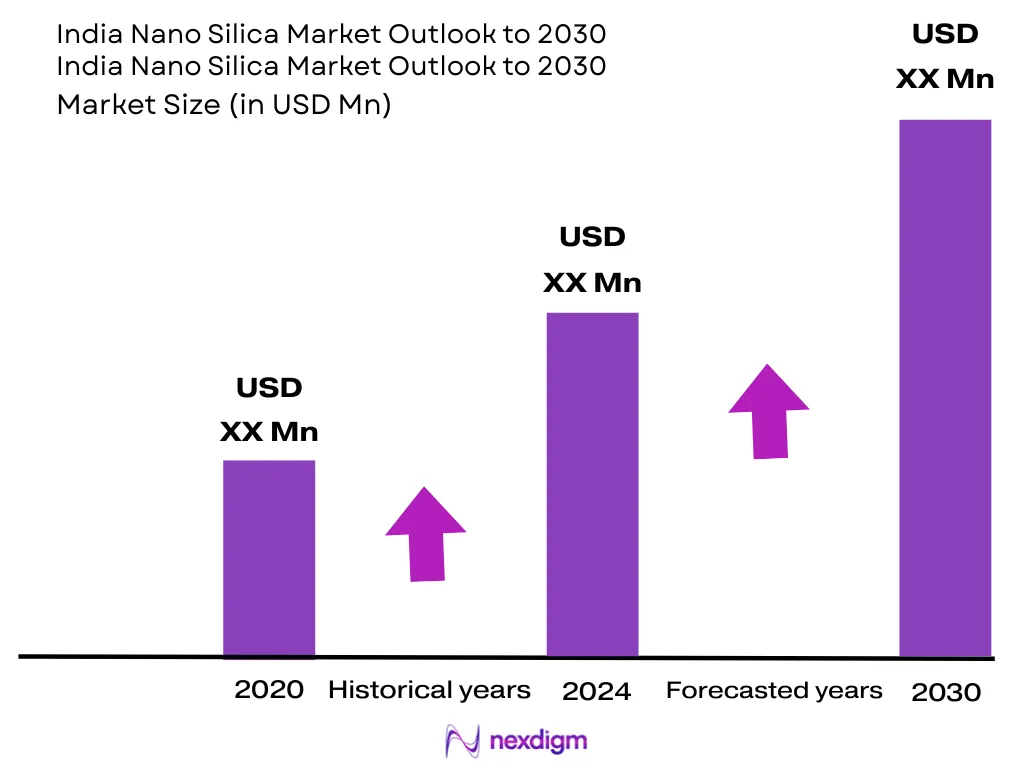
The India Nano Silica Market reached approximately USD ~ Million in 2024, supported by growing demand from the rubber, construction, specialty chemicals, and electronics sectors. According to the Ministry of Commerce and Industry, India’s chemicals and petrochemicals industry exceeded USD 220 Billion, while domestic tire production surpassed 220 million units, creating substantial demand for reinforcing fillers such as nano silica. Additionally, India’s construction sector generated over USD 700 Billion in economic activity, increasing the adoption of nano silica-enhanced concrete, coatings, and cementitious materials. The market is further driven by investments in advanced manufacturing, energy storage technologies, and nanotechnology research programs.
Market Segmentation
By Product Type
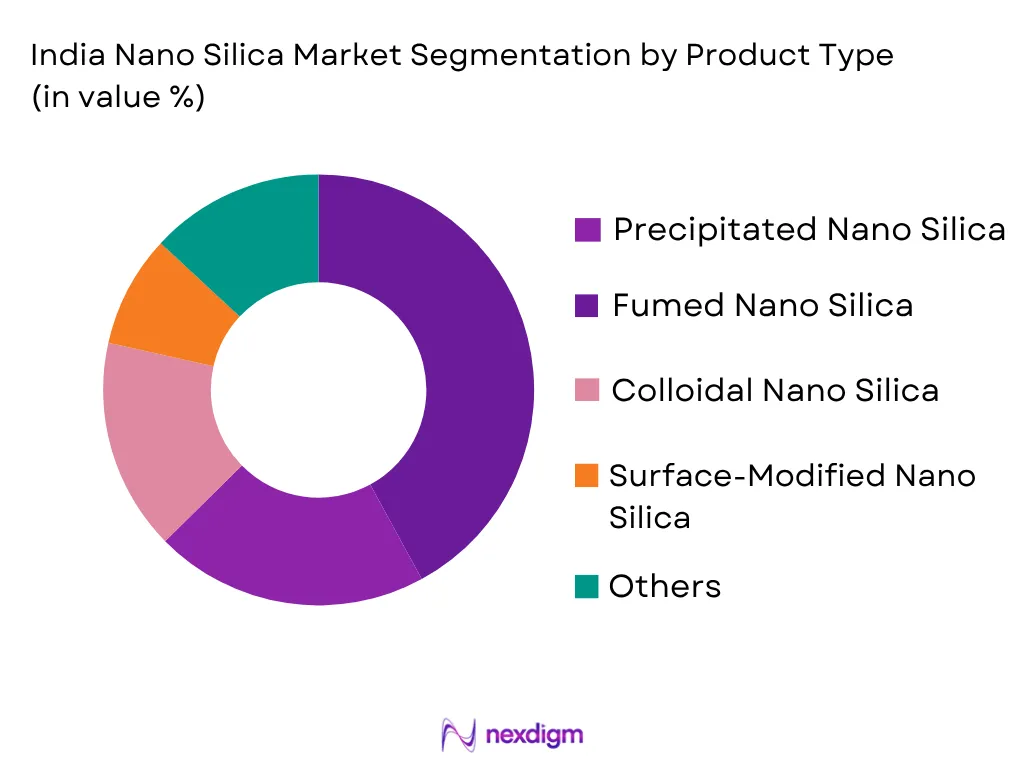
The India Nano Silica Market is segmented into precipitated nano silica, fumed nano silica, colloidal nano silica, mesoporous nano silica, and surface-modified nano silica. Recently, precipitated nano silica has maintained the dominant market share due to its extensive usage in tire manufacturing, industrial rubber products, footwear compounds, and polymer reinforcement applications. The segment benefits from its cost-effectiveness compared to other nano silica grades while delivering superior abrasion resistance, tensile strength enhancement, and rolling resistance reduction. The growing shift toward green tires and fuel-efficient automotive components has further strengthened demand. Domestic manufacturers increasingly prefer precipitated nano silica because of easier scalability, broader availability of raw materials, and compatibility with large-volume industrial applications, making it the preferred choice across multiple end-user industries.
By Application
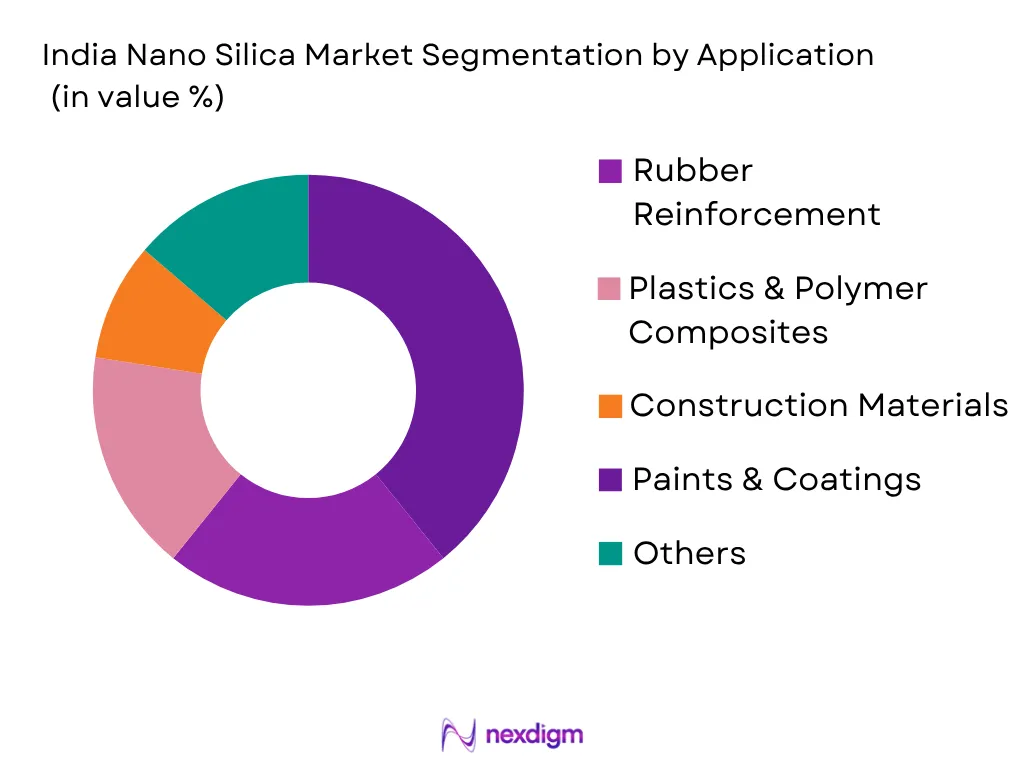
The India Nano Silica Market is segmented into rubber reinforcement, plastics & polymer composites, construction materials, paints & coatings, electronics & semiconductors, energy storage, and healthcare applications. Recently, rubber reinforcement has emerged as the leading application segment due to widespread adoption within tire manufacturing and industrial rubber products. Nano silica significantly improves rolling resistance, wet traction, abrasion resistance, and durability of tires, making it essential for high-performance and environmentally sustainable tire production. The expansion of automotive manufacturing and rising demand for electric vehicles have further accelerated adoption. Additionally, stringent fuel-efficiency requirements and increasing consumer preference for long-lasting tires have encouraged manufacturers to incorporate advanced reinforcing materials, strengthening the dominance of this segment within the Indian nano silica market.
Competitive Landscape
The India Nano Silica Market is moderately consolidated and characterized by the presence of both domestic manufacturers and international specialty chemical companies. Major participants compete through technological innovation, product customization, surface modification capabilities, production capacity expansion, and strategic collaborations with automotive, construction, and electronics manufacturers. Companies with strong R&D capabilities and advanced particle engineering technologies possess a significant competitive advantage due to increasing demand for application-specific nano silica grades.
| Company | Establishment Year | Headquarters | Product Portfolio | Nano Silica Grades | Surface Modification Capability | Key End-Use Industries | Manufacturing Presence | R&D Focus |
| Tata Chemicals Limited | 1939 | ~ | ~ | ~ | ~ | ~ | ~ | ~ |
| Madhu Silica Pvt. Ltd. | 1980 | ~ | ~ | ~ | ~ | ~ | ~ | ~ |
| Gujarat Credo Mineral Industries Ltd. | 1991 | ~ | ~ | ~ | ~ | ~ | ~ | ~ |
| Evonik Industries AG | 2007 | ~ | ~ | ~ | ~ | ~ | ~ | ~ |
| Cabot Corporation | 1882 | ~ | ~ | ~ | ~ | ~ | ~ | ~ |

India Nano Silica Market Analysis
Growth Drivers
Rising Demand from Tire and Rubber Manufacturing
India’s tire and rubber manufacturing sector remains one of the most significant demand generators for nano silica due to its application as a reinforcing filler that enhances rolling resistance, abrasion resistance, wet grip performance, and fuel efficiency. The Indian tire industry recorded a turnover of approximately INR 91,000 crore in FY2024, supported by 37 manufacturing plants operated by major tire producers across the country. Tire exports reached INR 25,051 crore, reflecting the growing scale of domestic production and international demand. The industry has also witnessed cumulative capacity creation investments exceeding INR 43,000 crore in recent years. As tire manufacturers increasingly focus on premium and green tire technologies, demand for advanced silica materials has strengthened significantly. Nano silica improves durability, energy efficiency, and overall tire performance, making it an essential component in modern tire formulations. Additionally, India’s expanding automotive manufacturing ecosystem, growing replacement tire demand, and increasing production of commercial and passenger vehicles continue to create favorable conditions for nano silica consumption. The localization of specialty chemicals and rising adoption of high-performance elastomers further support long-term demand growth across the tire and rubber value chain.
Expansion of Infrastructure and Advanced Construction Activities
The rapid expansion of infrastructure and construction activities in India is accelerating the adoption of nano silica in concrete admixtures, specialty cement formulations, protective coatings, and advanced construction chemicals. Government capital expenditure has nearly tripled compared to FY2020 levels, while infrastructure investment in roads reached approximately INR 3.01 lakh crore during FY2024. The Indian Railways network spans more than 68,500 route kilometers, supported by capital expenditure of approximately INR 2.62 lakh crore. Furthermore, annual infrastructure spending allocations exceed INR 11 trillion, highlighting the scale of ongoing infrastructure development. Nano silica is increasingly incorporated into construction materials because it enhances compressive strength, durability, crack resistance, permeability control, and service life of concrete structures. The development of highways, industrial corridors, logistics parks, metro rail systems, airports, and smart city projects is creating substantial demand for high-performance construction materials. As developers and contractors prioritize sustainable and long-life infrastructure assets, nano-engineered additives such as nano silica are becoming increasingly important in delivering enhanced structural performance and lifecycle efficiency.
Market Challenges
Dependence on Imported High-Purity Nano Silica Technologies
Despite India’s growing specialty chemicals sector, the nano silica industry continues to depend on imported technologies, advanced processing equipment, specialty grades, and sophisticated surface modification solutions. High-performance applications such as semiconductors, electronics, batteries, biomedical devices, and advanced coatings require stringent purity standards, controlled particle size distribution, and specialized manufacturing capabilities. India’s manufacturing ecosystem is expanding rapidly, supported by infrastructure expenditure exceeding INR 11 trillion annually and increasing investments in advanced manufacturing sectors. However, domestic production of ultra-high-purity nano silica remains limited compared to demand from emerging industries. This creates a reliance on imported technologies and premium-grade products for critical applications. The challenge is particularly relevant for manufacturers serving electronics, energy storage, and precision engineering sectors where product consistency is essential. Longer procurement cycles, technology licensing requirements, and dependence on foreign expertise can impact operational flexibility and slow the commercialization of next-generation nano silica applications. Strengthening indigenous research capabilities and advanced material processing infrastructure remains a key requirement for reducing this dependency.
High Energy Intensity and Manufacturing Complexity
Nano silica production is a technologically intensive process requiring specialized equipment, controlled processing environments, advanced particle engineering, and significant energy consumption. Manufacturing consistency is critical because even minor variations in particle morphology, surface area, purity, or dispersion characteristics can significantly influence end-product performance. India’s industrial sector continues to experience varying levels of infrastructure and manufacturing activity. Core infrastructure industries account for approximately 40% of the country’s industrial production, while steel production increased by 7.2 units for every 100 units produced in the corresponding period of the previous year, and cement production expanded by approximately 13 units for every 100 units produced previously, reflecting strong industrial activity. As industrial demand increases, competition for energy resources and production inputs also intensifies. Nano silica manufacturers must simultaneously meet stringent quality requirements, environmental compliance standards, and customer-specific performance specifications. The complexity associated with maintaining uniform particle characteristics, scaling production efficiently, and ensuring sustainable manufacturing practices creates significant operational challenges for market participants. These factors continue to influence the pace of capacity expansion and technological advancement within the industry.
Market Opportunities
Growth of Electric Vehicle and Advanced Battery Manufacturing Ecosystem
India’s expanding electric mobility and battery manufacturing ecosystem presents a significant growth opportunity for nano silica producers. Nano silica is increasingly utilized in battery separators, electrode materials, insulation systems, thermal management solutions, and lightweight composite components used in electric vehicles. Public investment in infrastructure and industrial development continues to exceed INR 11 trillion annually, supporting the creation of advanced manufacturing capabilities across the country. Additionally, approved renewable energy projects include 50 solar park developments with a combined capacity of 37.5 GW, while planned investments in the petrochemical sector are expected to exceed INR 7.2 trillion. These developments indicate strong momentum across sectors that consume advanced materials and specialty chemicals. As battery manufacturing facilities, energy storage projects, and EV component production continue to expand, demand for high-performance nano silica grades is expected to strengthen. The material’s ability to enhance thermal stability, insulation performance, mechanical strength, and durability makes it increasingly valuable in next-generation battery technologies and electric mobility applications. This creates substantial opportunities for both domestic producers and technology-focused nano silica manufacturers.
Increasing Adoption of Sustainable Nano Silica from Agricultural Waste Streams
The growing adoption of sustainable nano silica production from agricultural waste such as rice husk ash represents a major opportunity for the Indian nano materials industry. India remains one of the world’s largest rice-producing countries, generating substantial quantities of rice husk that can be converted into high-purity silica through advanced extraction technologies. Simultaneously, infrastructure spending continues to exceed INR 11 trillion, while investments in road infrastructure alone reached approximately INR 3.01 lakh crore, increasing demand for environmentally sustainable construction materials and specialty chemicals. Bio-derived nano silica supports circular economy objectives by converting agricultural waste into high-value industrial products. It also offers advantages such as reduced environmental impact, improved resource efficiency, and compatibility with sustainability-focused procurement practices. Industries including construction chemicals, polymer composites, coatings, rubber products, and specialty materials are increasingly seeking environmentally responsible raw materials to support their sustainability commitments. As environmental regulations and ESG-focused investment strategies become more prominent, sustainable nano silica production creates a compelling growth avenue for manufacturers seeking differentiation while meeting the rising demand for advanced and environmentally responsible material solutions.
Future Outlook
The India Nano Silica Market is expected to witness substantial expansion over the forecast period owing to increasing adoption of nanotechnology across industrial manufacturing. Government initiatives supporting advanced materials production, rapid growth in electric vehicle manufacturing, and rising investments in specialty chemicals are expected to drive market demand. Construction modernization projects, sustainable infrastructure development, and the emergence of high-performance composites will further strengthen consumption. Additionally, advancements in surface functionalization technologies and growing utilization of nano silica in energy storage and electronics applications are likely to create new growth avenues. Domestic production capacity expansions and increasing localization efforts are anticipated to reduce import dependency and enhance market competitiveness.
Major Players
- Tata Chemicals Limited
- Madhu Silica Pvt. Ltd.
- Gujarat Credo Mineral Industries Ltd.
- Evonik Industries AG
- Cabot Corporation
- Wacker Chemie AG
- Solvay SA
- Nouryon
- Tokuyama Corporation
- Denka Company Limited
- Fuso Chemical Co., Ltd.
- OCI Company Ltd.
- Merck KGaA
- Akzo Nobel N.V.
- NanoPore Incorporated
Key Target Audience
- Nano Silica Manufacturers
- Tire and Rubber Product Manufacturers
- Specialty Chemical Producers
- Paints and Coatings Manufacturers
- Electronics and Semiconductor Companies
- Energy Storage and Battery Manufacturers
- Investments and Venture Capitalist Firms
- Government and Regulatory Bodies (Ministry of Chemicals and Fertilizers, Department of Science and Technology, Bureau of Indian Standards, Ministry of Environment Forest and Climate Change)
Research Methodology
Step 1: Identification of Key Variables
The initial phase involves constructing an ecosystem map encompassing all major stakeholders within the India Nano Silica Market. This process includes extensive secondary research through industry publications, company annual reports, government databases, patent repositories, and nanotechnology journals. The objective is to identify critical variables influencing supply, demand, pricing, production capacity, and technology adoption.
Step 2: Market Analysis and Construction
Historical market data is compiled and analyzed to assess production trends, consumption patterns, import-export dynamics, and revenue generation across major applications. Market sizing is developed using a combination of bottom-up and top-down approaches, considering demand from tire manufacturing, construction materials, specialty chemicals, and electronics industries.
Step 3: Hypothesis Validation and Expert Consultation
Market assumptions and preliminary estimates are validated through structured interviews with nano silica manufacturers, raw material suppliers, distributors, technology providers, and end-user industries. These consultations provide operational insights regarding capacity utilization, procurement trends, product innovations, and future investment strategies, ensuring robust validation of market findings.
Step 4: Research Synthesis and Final Output
The final stage integrates primary and secondary findings through data triangulation and statistical modeling. Direct engagement with manufacturers, industry associations, and technology experts helps validate segmentation, competitive positioning, and forecast assumptions. The resulting analysis provides a comprehensive and reliable assessment of the India Nano Silica Market.

- Executive Summary
- Research Methodology (Market Definitions and Assumptions, Abbreviations, Market Sizing Framework, Top-Down Analysis, Bottom-Up Analysis, Demand-Side Assessment, Supply-Side Assessment, Primary Industry Interviews, Distributor & OEM Validation, Trade Flow Analysis, Data Triangulation, Forecasting Framework, Limitations and Future Conclusions)

- Definition and Scope
- Industry Evolution and Market Genesis
- Timeline of Major Industry Developments
- Nano Silica Industry Life Cycle Analysis
- Nano Silica Manufacturing Process Overview

- Growth Drivers (Rising Demand for High-Performance Rubber Reinforcement, Green Tire Manufacturing Expansion, Growth in EV Production, Increasing Use of Nano-Modified Concrete, Expansion of Advanced Polymer Composites, Rising Electronics Manufacturing Activities, Growth in Specialty Coatings Demand, Increasing R&D Investments in Nanomaterials)
- Market Challenges (High Production and Processing Costs, Limited Commercial-Scale Domestic Manufacturing, Particle Dispersion and Agglomeration Challenges, Stringent Nanomaterial Handling Requirements, Dependence on Imported High-Purity Grades, Lack of Standardized Regulatory Frameworks, Limited End-User Awareness, Technology Commercialization Barriers)
- Market Opportunities (EV Battery Material Applications, Semiconductor Manufacturing Growth, Sustainable Nano Silica Production from Rice Husk Ash, Smart Infrastructure Development, Biomedical and Drug Delivery Applications, High-Performance Adhesives & Sealants, Water Treatment Technologies, Export Opportunities to Asia-Pacific and Middle East Markets)
- Market Trends (Surface Functionalized Nano Silica Development, Hydrophobic Nano Silica Adoption, Nano Silica Integration in Green Tires, High Dispersion Nano Silica Technologies, Hybrid Nanocomposite Formulations, Sustainable Silica Extraction Technologies, Customized Particle Engineering Solutions, Advanced Coating and Barrier Material Applications)
- Government Regulations (BIS Quality Standards Compliance, Environmental Protection Regulations, Hazardous Chemical Handling Standards, Occupational Safety Guidelines for Nanomaterials, Import-Export Compliance Framework, Chemical Storage and Transportation Regulations, Industrial Emission Standards, Advanced Materials Manufacturing Policies)
- PESTLE Analysis
- SWOT Analysis
- Porter’s Five Forces Analysis
- Stakeholder Ecosystem
- Competition Ecosystem

- By Market Value (2019-2024)
- By Volume Consumption (2019-2024)
- By Average Selling Price (2019-2024)

- By Product Type (In Value %)
Precipitated Nano Silica
Fumed Nano Silica
Colloidal Nano Silica
Mesoporous Nano Silica
Silica Aerogel Nanoparticles
Surface Modified Nano Silica
Hydrophilic Nano Silica
Hydrophobic Nano Silica - By Coating Technology (In Value %)
Polymer-Coated Fertilizers
Sulfur-Coated Fertilizers
Polymer-Sulfur Coated Fertilizers
Resin-Coated Fertilizers
Bio-Based Coated Fertilizers
Nano-Coated Nano Silicas - By Distribution Model (In Value %)
Direct Sales
Industrial Distributors
Chemical Traders
Online B2B Platforms - By Region (In Value %)
North India
South India
West India
East India
Central India - By Application (In Value %)
Rubber Reinforcement
Plastics & Polymer Composites
Paints & Coatings
Adhesives & Sealants
Construction Materials & Concrete Admixtures
Electronics & Semiconductors
Battery Materials & Energy Storage
Healthcare & Biomedical Applications
Agriculture & Agrochemicals
Personal Care & Cosmetics
Textiles & Functional Fabrics
Water Treatment Applications

- Market Share of Major Players (By Value, Volume, Production Capacity, Application Segment)
- Cross Comparison Parameters Nano Silica Production Capacity, Average Particle Size Portfolio, Specific Surface Area Range, Surface Modification Capabilities, Nano Silica Purity Levels, Application Industry Coverage, Domestic Distribution Reach, R&D and Patent Portfolio Strength)
- SWOT Analysis of Major Players
- Pricing Analysis by Product Grade and Particle Size
- Detailed Profiles of Major Companies
Tata Chemicals Limited
Gujarat Credo Mineral Industries Ltd.
Madhu Silica Pvt. Ltd.
Solvay SA
Evonik Industries AG
Wacker Chemie AG
Cabot Corporation
Nouryon
Tokuyama Corporation
Fuso Chemical Co., Ltd.
OCI Company Ltd.
Merck KGaA
Akzo Nobel N.V.
NanoPore Incorporated
Denka Company Limited

- Consumption Pattern Analysis (Consumption Volume per Industry, Loading Ratio, Replacement Trends, Adoption Rates, Utilization Intensity)
- Procurement and Sourcing Analysis (Supplier Preference, Procurement Frequency, Contract Duration, Vendor Consolidation, Supplier Switching Behavior)
- Application Performance Assessment (Tensile Strength Improvement, Abrasion Resistance, Thermal Stability, Barrier Properties, Durability Enhancement)
- Customer Pain Point Analysis (Cost Pressure, Dispersion Issues, Quality Consistency, Supply Reliability, Technical Support Requirements)
- Product Attribute Preference Analysis (Particle Size, Surface Area, Purity, Dispersion Stability, Hydrophobicity)

- By Market Value (2025-2030)
- By Volume Consumption (2025-2030)
- By Average Selling Price (2025-2030)


 Request a Sample
 Ask for Customization
 Get a Quote
 Enquire Now