
 Download PDF
 Download PDF
Market Overview
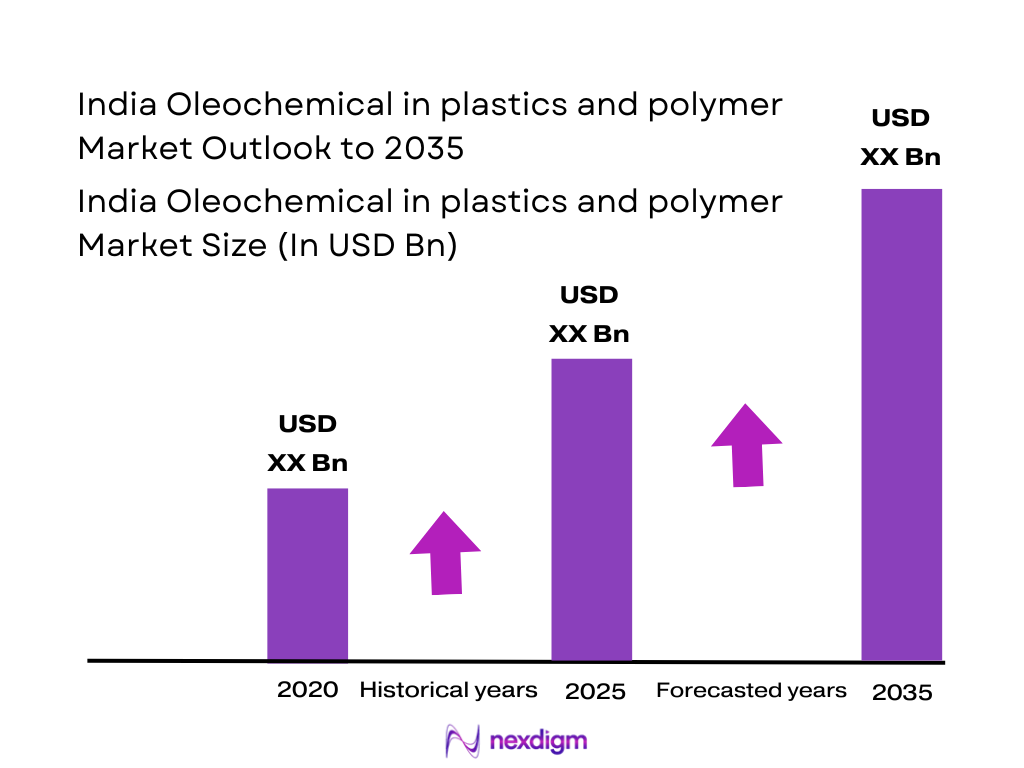
The India Oleochemical in plastics and polymer market outlook to 2035 market current size stands at around USD ~ million, reflecting established adoption of bio-based additives across polymer compounding, PVC processing, and specialty resin formulations. Demand is supported by domestic availability of fatty acids, glycerine derivatives, and esters for use as plasticizers, lubricants, and stabilizers. The market benefits from localized formulation capabilities, growing technical acceptance of non-phthalate alternatives, and rising integration of renewable feedstocks into polymer processing value chains across industrial clusters.
Western India, particularly Maharashtra and Gujarat, anchors formulation capacity due to petrochemical clusters, port access, and dense polymer processing infrastructure. Southern India shows strong demand from automotive and electrical manufacturing ecosystems supported by logistics corridors and skilled technical labor. Northern India concentrates downstream PVC and packaging processors near consumption centers. Policy emphasis on bio-based inputs, tightening standards for phthalates, and expanding recycling ecosystems reinforce regional specialization, supplier networks, and collaborative development between oleochemical producers and compounders.
Market Segmentation
By Product Type
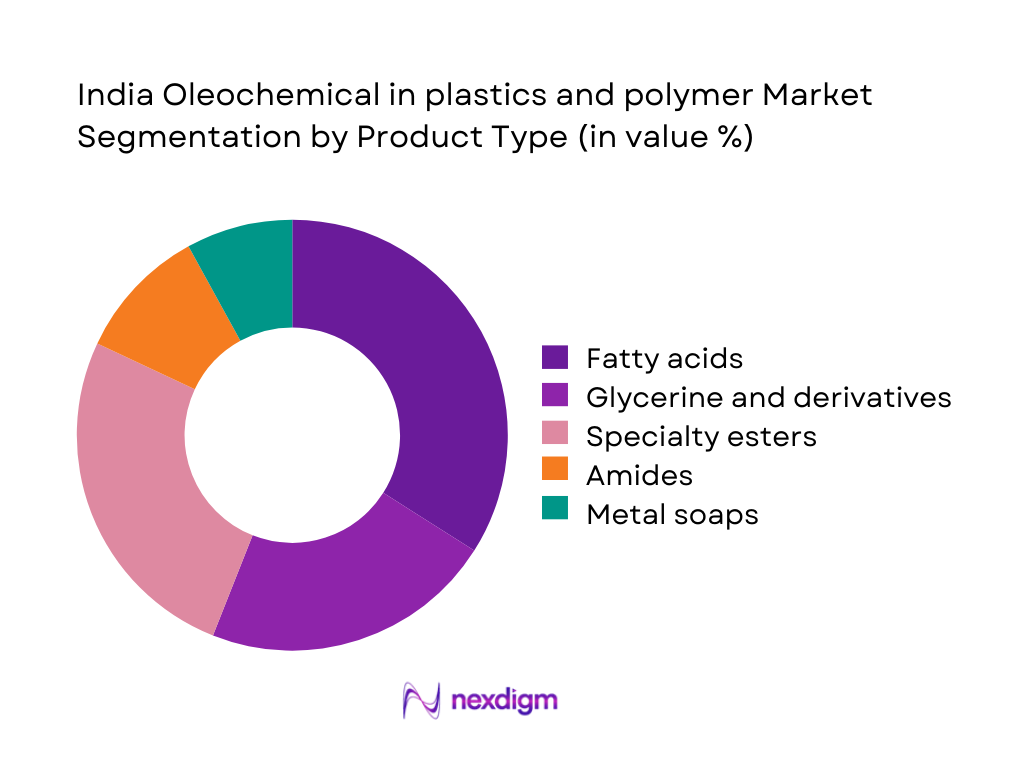
Fatty acids, glycerine derivatives, and specialty esters dominate due to broad applicability across PVC plasticization, polymer lubrication, and processing aids. Amides and metal soaps maintain relevance in high-temperature processing environments and specialty elastomer formulations. Product dominance reflects feedstock accessibility, compatibility with existing compounding lines, and performance consistency under Indian processing conditions. Local producers focus on scalable derivatives that integrate with polyolefins and PVC, while niche esters are increasingly used in medical-grade and food-contact polymers. Product mix evolution is driven by regulatory preference for non-phthalate additives and demand for renewable inputs in packaging and consumer goods polymers.
By Application
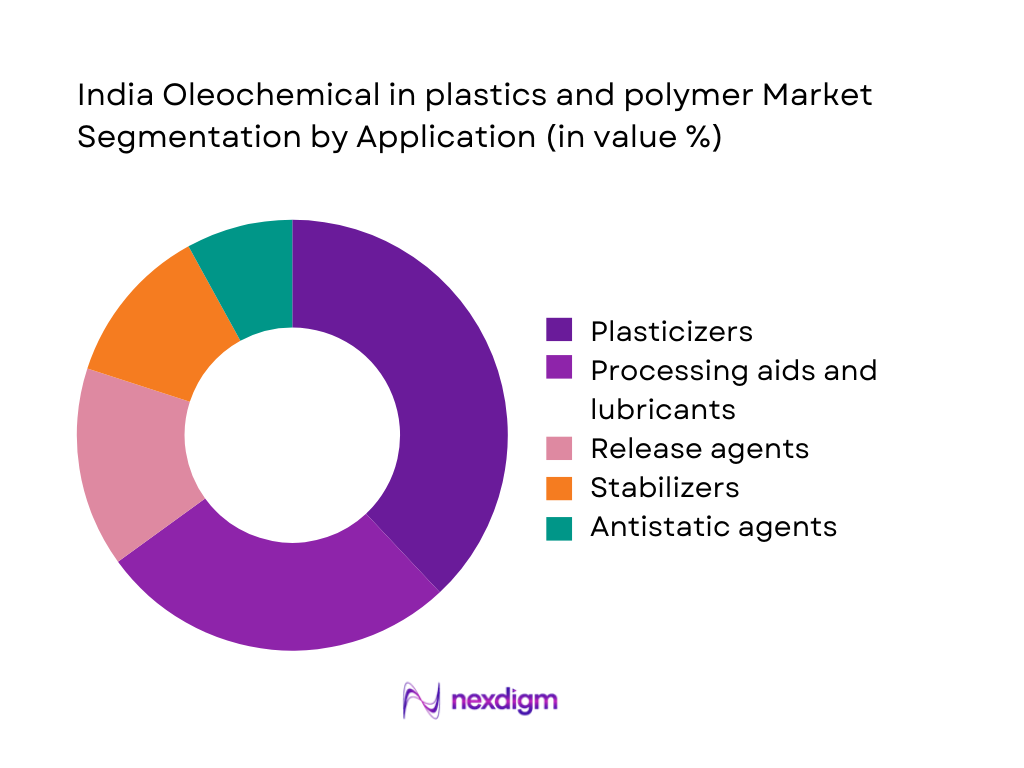
Plasticizers and processing aids account for the largest share, supported by PVC growth in cables, pipes, and flexible films. Lubricants and release agents maintain steady adoption in extrusion and injection molding operations where cycle time reduction is prioritized. Stabilizers and antistatic agents show rising uptake in packaging and electronics housings driven by compliance with material safety norms. Application dominance reflects the compatibility of oleochemicals with existing polymer formulations and growing preference for renewable additives in consumer-facing products, particularly in packaging and appliances requiring food-contact or low-toxicity certifications.
Competitive Landscape
The competitive environment is characterized by vertically integrated feedstock sourcing, regional formulation hubs near polymer clusters, and application-specific technical support for processors. Differentiation centers on formulation depth, regulatory readiness for non-phthalate and food-contact standards, and service capability to customize additives for recycled and specialty polymers.
| Company Name | Establishment Year | Headquarters | Formulation Depth | Distribution Reach | Regulatory Readiness | Service Capability | Channel Strength | Pricing Flexibility |
| Godrej Industries Limited | 1897 | Mumbai | ~ | ~ | ~ | ~ | ~ | ~ |
| VVF Limited | 1970 | Mumbai | ~ | ~ | ~ | ~ | ~ | ~ |
| Emery Oleochemicals India | 1840 | Mumbai | ~ | ~ | ~ | ~ | ~ | ~ |
| 3F Industries Limited | 1962 | Hyderabad | ~ | ~ | ~ | ~ | ~ | ~ |
| KLK OLEO India | 1909 | Mumbai | ~ | ~ | ~ | ~ | ~ | ~ |
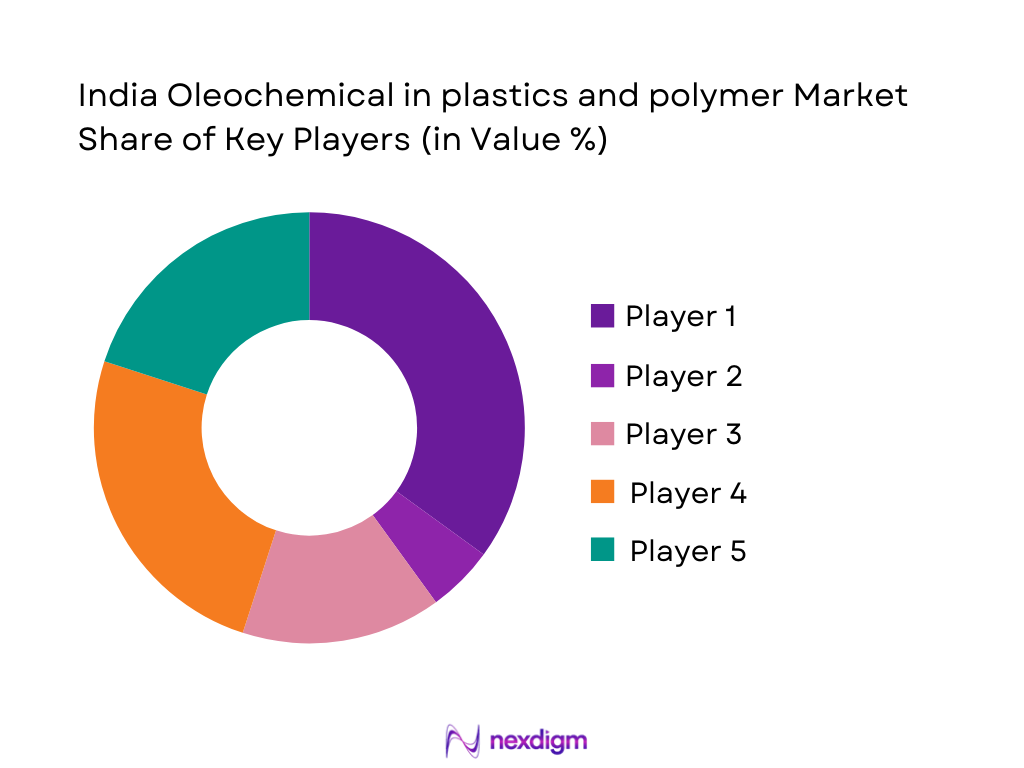
India Oleochemical in plastics and polymer market outlook to 2035 Market Analysis
Growth Drivers
Rising use of bio-based additives in polymer compounding
Indian polymer processors increased pilot adoption of bio-based additives during 2024 and 2025 following safety advisories and material compatibility guidance issued by domestic standards bodies. In 2024, more than 100 polymer processing units across major industrial belts initiated limited substitution trials for renewable lubricants and plasticizers in PVC and polyolefins. The number of notified plastic processing clusters supported by state industrial development agencies exceeded 30 in 2025, strengthening access to testing facilities and formulation support. Expansion of dedicated chemical parks in western and southern India improved availability of common utilities and logistics access for specialty additive validation.
Regulatory push to replace phthalate plasticizers in PVC
During 2024 and 2025, regulatory scrutiny of phthalate use in food-contact and medical-grade PVC increased following updated material safety guidance. Over 250 PVC processing lines initiated qualification of non-phthalate plasticizers for cables, tubing, and packaging films. Accreditation of polymer testing laboratories under national quality frameworks crossed 60 facilities by 2025, enabling higher throughput for migration and compliance testing. Port and customs authorities intensified inspection of flexible PVC imports for conformity to safety standards, accelerating substitution toward oleochemical-based plasticizers in regulated end-use segments.
Challenges
Feedstock price volatility linked to palm oil markets
Volatility in palm-derived feedstock availability during 2024 and 2025 disrupted procurement planning for oleochemical formulators supplying polymer additives. Import throughput at major western ports experienced congestion episodes during peak agricultural export cycles, increasing lead times for fatty acid and ester shipments. Storage utilization at coastal chemical tank farms exceeded 85 during peak months in 2025, limiting buffer inventory capacity for additive manufacturers. Seasonal logistics disruptions along western freight corridors further constrained inbound feedstock movement, exposing polymer additive producers to upstream supply instability and short-term formulation planning risks.
Quality consistency issues across small-scale oleochemical producers
Quality audits conducted across 2024 identified recurring non-conformance among small-scale oleochemical units supplying polymer-grade additives. Several audited facilities failed batch-to-batch consistency checks for acid value and ester purity thresholds required in polymer compounding. Regional laboratory capacity expanded to more than 60 accredited facilities by 2025, yet turnaround times for corrective testing remained extended, delaying revalidation cycles. Polymer processors reported repeated lot rejections from smaller suppliers during 2024, highlighting structural challenges in standardization, process control, and certification readiness across fragmented production clusters.
Opportunities
Development of bio-based plasticizers for medical and food-contact PVC
Regulatory clearance pathways for food-contact polymer additives expanded during 2024 and 2025, supporting faster evaluation of bio-based plasticizers. The number of product dossiers submitted for food-contact polymer approval exceeded 40 in 2024, reflecting growing industry interest in compliant formulations. Medical device manufacturing zones across multiple states increased procurement of compliant PVC compounds for tubing and disposable components. Expansion of accredited testing capacity improved migration and toxicity assessment turnaround, enabling polymer processors to shorten validation cycles for bio-based plasticizers in regulated healthcare and packaging applications.
Localization of specialty ester production for polymer additives
During 2024 and 2025, multiple specialty chemical projects received industrial approvals within designated chemical parks to localize ester production for polymer additives. New esterification lines were commissioned in western and southern industrial corridors, supported by shared utilities and effluent treatment infrastructure. Skill development programs under national chemical manufacturing initiatives trained more than 1,000 technicians in ester synthesis and quality control by 2025. Local equipment commissioning reduced reliance on imported specialty esters and enabled faster customization of polymer additive formulations for domestic compounders.
Future Outlook
The market outlook through 2035 reflects steady regulatory reinforcement for non-phthalate additives, deeper integration of renewable inputs in polymer compounding, and increasing collaboration between oleochemical producers and processors. Regional manufacturing corridors are expected to strengthen application development. Recycling-driven formulations will influence additive demand. Policy alignment with material safety standards and expanding testing infrastructure will shape commercialization pathways.
Major Players
- Godrej Industries Limited
- VVF Limited
- Emery Oleochemicals India
- 3F Industries Limited
- KLK OLEO India
- Wilmar International India
- IOI Oleochemicals India
- Twin Rivers Technologies India
- Aarti Industries Limited
- Patanjali Natural Oleochemicals
- BASF India
- Clariant Chemicals India
- Evonik India
- Croda India
- Arkema India
Key Target Audience
- Polymer compounders and masterbatch manufacturers
- PVC processors and flexible packaging converters
- Automotive component manufacturers
- Consumer goods and appliance manufacturers
- Recycling and reprocessing facilities
- Investments and venture capital firms
- Ministry of Chemicals and Fertilizers, Government of India
- Central Pollution Control Board
Research Methodology
Step 1: Identification of Key Variables
Core variables covered product purity thresholds, regulatory compliance parameters, application performance criteria, and supply chain reliability. Feedstock sourcing patterns and polymer compatibility benchmarks were mapped. Regional processing density and logistics accessibility were profiled. Policy directives affecting additive selection were identified.
Step 2: Market Analysis and Construction
Application-level demand drivers were aligned with processing technologies and regulatory frameworks. Regional infrastructure readiness and testing capacity were assessed. Supply-side capabilities were mapped across formulation depth and distribution reach. Scenario constructs were built around regulatory tightening and recycling-driven formulation needs.
Step 3: Hypothesis Validation and Expert Consultation
Technical practitioners from compounding facilities, regulatory laboratories, and polymer processors validated application feasibility assumptions. Compliance officers reviewed material safety implications. Logistics operators provided operational constraints. Feedback loops refined adoption pathways across regulated PVC and packaging use cases.
Step 4: Research Synthesis and Final Output
Insights were synthesized across demand drivers, operational constraints, and regulatory readiness. Cross-functional validation ensured internal consistency. Application scenarios were stress-tested against infrastructure maturity. Final outputs aligned opportunity pathways with institutional and ecosystem indicators.

- Executive Summary
- Research Methodology (Market Definitions and oleochemical derivative classification for polymer applications, Primary interviews with compounders and polymer processors across India, Price tracking of fatty acid esters and glycerine derivatives used in plastics, Plant capacity and feedstock sourcing assessment for domestic oleochemical producers, Analysis of BIS standards and plastic additive regulations, Import–export data triangulation for palm-based derivatives)

- Definition and Scope
- Market evolution
- Usage pathways in polymer compounding
- Ecosystem structure
- Supply chain and channel structure
- Regulatory environment

- Growth Drivers
Rising use of bio-based additives in polymer compounding
Regulatory push to replace phthalate plasticizers in PVC
Growth of flexible packaging and FMCG plastics demand
Automotive lightweighting driving specialty polymer additives
Capacity expansions in domestic oleochemical manufacturing
Import substitution initiatives for specialty additives - Challenges
Feedstock price volatility linked to palm oil markets
Quality consistency issues across small-scale oleochemical producers
Limited domestic availability of high-purity specialty esters
Cost competitiveness versus petrochemical additives
Regulatory uncertainty on biodegradable additive standards
Dependence on imports for advanced formulations - Opportunities
Development of bio-based plasticizers for medical and food-contact PVC
Localization of specialty ester production for polymer additives
Partnerships between polymer compounders and oleochemical producers
Growth in biodegradable and compostable polymer additives
Export opportunities to Southeast Asia and Middle East
Customization of additives for recycled plastic processing - Trends
Shift toward non-phthalate and bio-based plasticizers
Increasing use of glycerine derivatives in polymer processing aids
Rising adoption of oleochemical lubricants in film extrusion
Integration of oleochemicals in recycled polymer compatibilizers
Capacity debottlenecking in palm-based derivative plants
Formulation of multifunctional green additives - Government Regulations
- SWOT Analysis
- Stakeholder and Ecosystem Analysis
- Porter’s Five Forces Analysis
- Competition Intensity and Ecosystem Mapping

- By Value, 2020–2025
- By Volume, 2020–2025
- By Revenue Base, 2020–2025
- By Average Selling Price, 2020–2025

- By Product Type (in Value %)
Fatty acids
Fatty alcohols
Glycerine and glycerol derivatives
Methyl esters and bio-esters
Amides and metal soaps - By Application in Plastics and Polymers (in Value %)
Plasticizers
Lubricants and processing aids
Stabilizers
Release agents and slip additives
Antistatic agents - By Polymer Type (in Value %)
Polyvinyl chloride
Polyolefins
Engineering plastics
Bioplastics and biodegradable polymers
Rubber and elastomers - By End-use Industry (in Value %)
Packaging
Automotive and transportation
Construction and infrastructure
Consumer goods and appliances
Electrical and electronics - By Source Feedstock (in Value %)
Palm-based derivatives
Coconut-based derivatives
Soy and other vegetable oil derivatives
Animal fat-based derivatives - By Region Type (in Value %)
Western
Southern
Northern
Eastern
Central

- Market structure and competitive positioning
Market share snapshot of major players - Cross Comparison Parameters (product purity levels, portfolio breadth in polymer additives, domestic manufacturing footprint, feedstock sourcing integration, pricing competitiveness, regulatory compliance capability, technical support to compounders, export orientation, formulation customization capability, scale of esterification capacity, supply reliability and lead times, quality consistency and batch traceability, application-specific certifications for PVC and food-contact polymers, R&D depth in bio-based plasticizers, backward integration into fatty acids and glycerine, regional warehousing and logistics reach)
- SWOT Analysis of Key Players
- Pricing and Commercial Model Benchmarking
- Detailed Profiles of Major Companies
Godrej Industries Limited
VVF Limited
Emery Oleochemicals India
3F Industries Limited
Aarti Industries Limited
KLK OLEO India
Wilmar International India
IOI Oleochemicals India
Patanjali Natural Oleochemicals
Twin Rivers Technologies India
BASF India
Clariant Chemicals India
Evonik India
Croda India
Arkema India

- Demand and utilization drivers
- Procurement and tender dynamics
- Buying criteria and vendor selection
- Budget allocation and financing preferences
- Implementation barriers and risk factors
- Post-purchase service expectations

- By Value, 2026–2035
- By Volume, 2026–2035
- By Revenue Base, 2026–2035
- By Average Selling Price, 2026–2035


 Request a Sample
 Ask for Customization
 Get a Quote
 Enquire Now