
 Download PDF
Market Overview
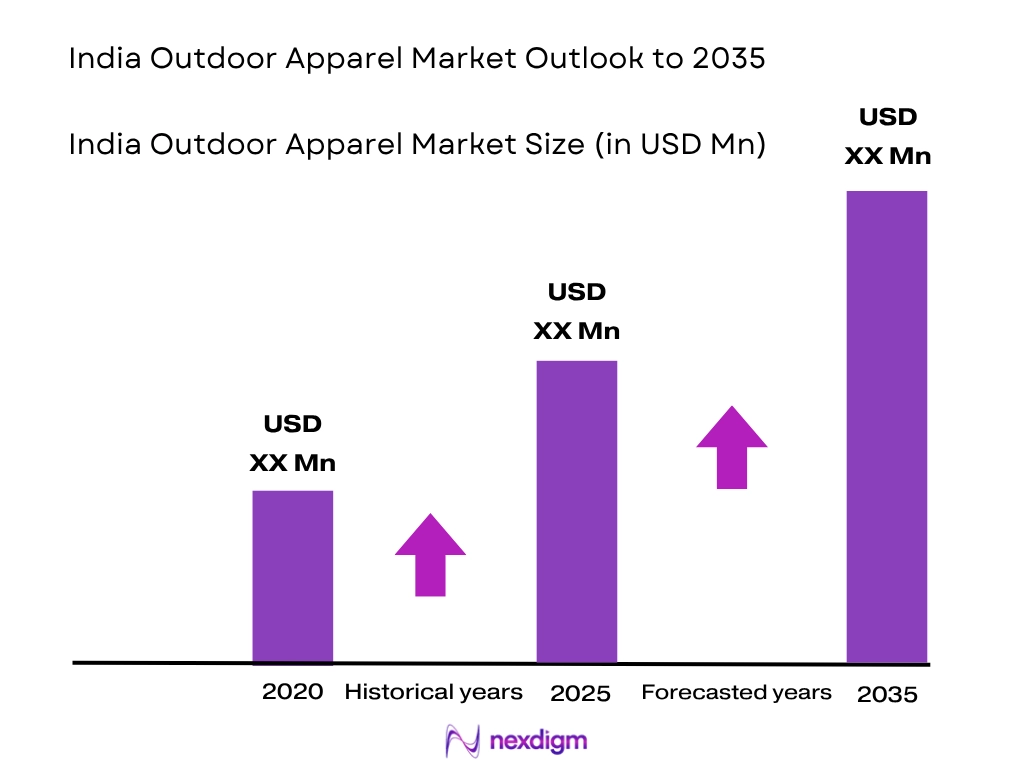
The India Outdoor Apparel market is valued at USD ~ million based on a Nexdigm five‑year historical analysis, reflecting expansion from USD ~ million in 2024 according to industry research. This scale is driven primarily by expanding adventure tourism and trekking activity across Himalayan and hill regions, growing fitness awareness among urban consumers, and increasing demand for performance and weather‑adaptive outdoor clothing that offers thermal insulation, durability, and multifunctional use in varied climatic conditions.
Within the India Outdoor Apparel market, North Indian metros and hill regions such as Delhi NCR, Chandigarh, Shimla, Uttarakhand, and Jammu & Kashmir dominate demand due to strong trekking and winter tourism activities alongside higher disposable incomes. Western and Southern metros like Mumbai, Pune, Bangalore, and Chennai also significantly contribute through a growing lifestyle segment and online adoption. These regions benefit from better retail infrastructure, higher outdoor participation, and elevated brand awareness compared to other parts of the country.
Market Segmentation
By Product Type
By product type, Jackets & Hoodies lead the India Outdoor Apparel market, driven by robust demand for insulated, wind‑resistant, and weather‑adaptive outerwear essential for trekking, camping, and cold‑climate tourism. Consumers increasingly seek durable outer layers that combine thermal insulation with lightweight construction, making this sub‑segment essential for high‑altitude and winter landscapes. Brands emphasize high‑performance fabrics, water resistance, and ergonomic design, which further reinforce consumer preference. The continued growth in adventure travel and weekend excursions into hilly regions has consolidated the appeal and revenue share of jackets and hoodies relative to other categories. 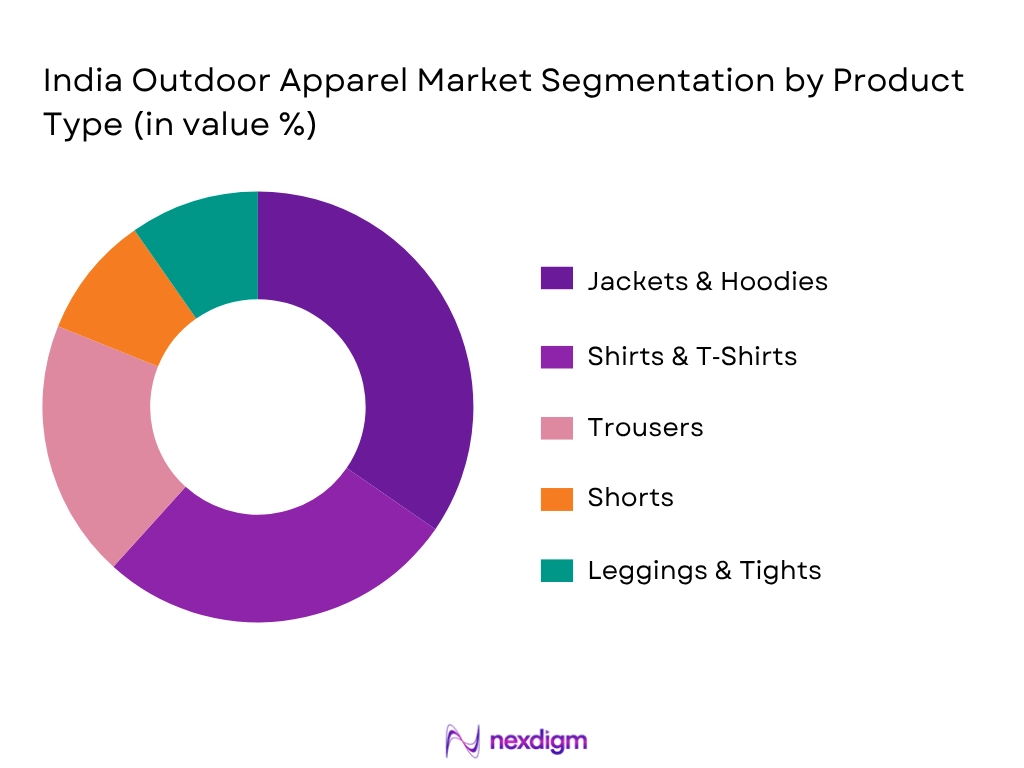
By Distribution Channel
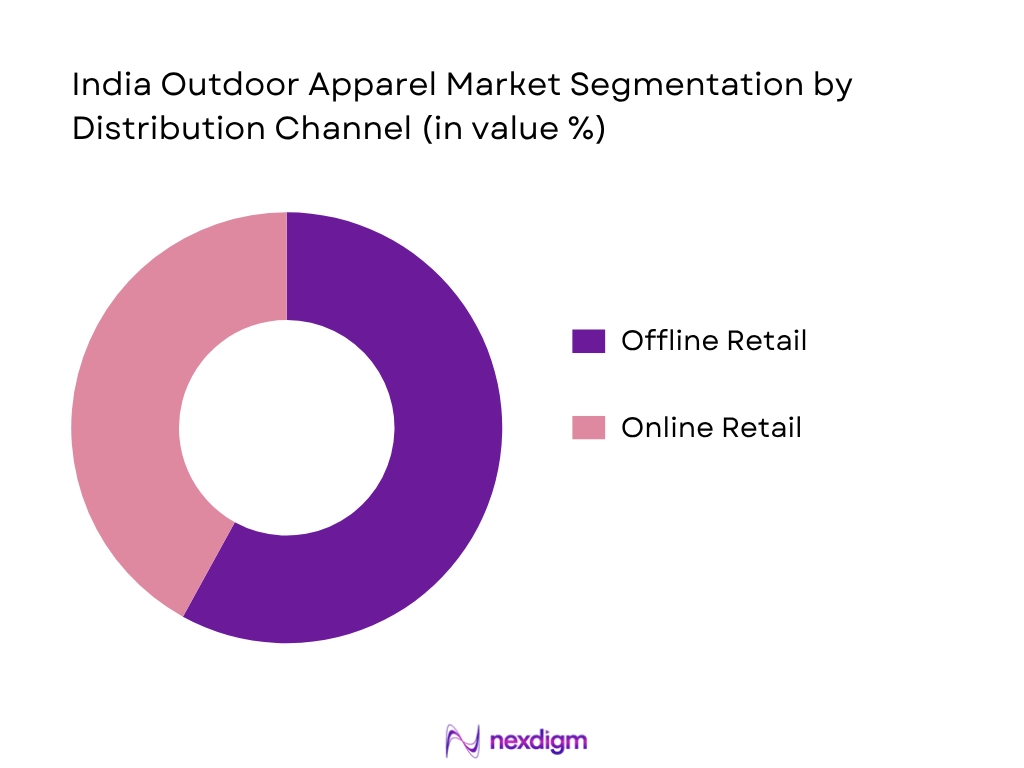
In distribution channels, Offline Retail remains dominant due to consumers’ strong preference for in‑person evaluation of fabric quality, fit, and functionality before purchase. Specialty outdoor stores and branded outlets are particularly valued for showcasing product features such as insulation levels, breathability, and protective capabilities, which often require tactile assessment. Additionally, established retail footprints in metropolitan centres further cement offline dominance, especially for premium and technical apparel bought for trekking and specialized outdoor use. Nevertheless, online retail is rapidly scaling up, propelled by increased smartphone penetration, digital marketing, and competitive pricing.
Competitive Landscape
The competitive landscape of the India Outdoor Apparel market is moderately fragmented, with a mix of established global players and strong domestic brands. Competition centres on product performance, fabric technology, pricing strategies, distribution reach (both online and offline), and brand recognition. International brands often lead in premium and technical segments, while Indian players leverage localized designs and value pricing for broader market reach.
| Company | Establishment Year | Headquarters | Retail Footprint | E‑Commerce Strategy | ASP Positioning | Product Technology | Distribution Reach |
| Decathlon India | 2003 | India | ~ | ~ | ~ | ~ | ~ |
| Wildcraft India | 1998 | India | ~ | ~ | ~ | ~ | ~ |
| The North Face India | 1968 (parent) | USA/India ops | ~ | ~ | ~ | ~ | ~ |
| Columbia Sportswear India | 1938 | USA/India ops | ~ | ~ | ~ | ~ | ~ |
| Adidas Outdoor Range | 1949 (parent) | Germany/India ops | ~ | ~ | ~ | ~ | ~ |
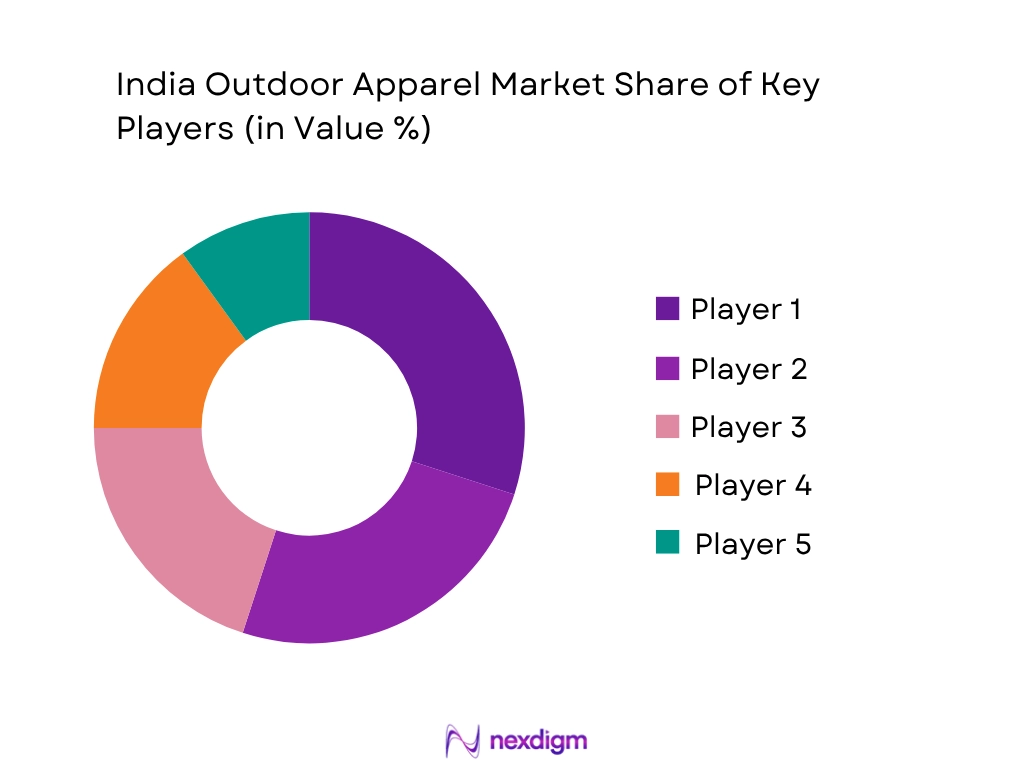
India Outdoor Apparel Market Analysis
Growth Drivers
Adventure Participation
India’s rising adventure tourism and recreational travel have created a strong foundation for demand in outdoor apparel. According to the Ministry of Tourism’s Annual India Tourism Data Compendium, total domestic tourist visits reached 2,948.19 million in 2024, an increase over previous years, reflecting robust travel behavior among Indian consumers. Domestic tourism consistently represents over 90% of all tourism activity, underscoring deep engagement with travel and outdoor experiences. Adventure tourism specifically attracted 10 million domestic participants in trekking, hiking, and nature‑based travel, with Himachal Pradesh and Uttarakhand leading these activities in recent years. Increased participation in outdoor travel directly motivates consumers to seek performance‑oriented clothing that meets rugged terrain, weather variability, and functional requirements such as breathability and weather resistance. High domestic visitor numbers also correlate with increased spending on outdoor gear and apparel suitable for travel experiences ranging from mountain treks to eco‑tourism circuits. Adventure and exploratory travel strengthens the ecosystem for outdoor apparel purchases, particularly in Northern and hill regions where tourism infrastructure continues to expand, creating sustained market stimulation.
Performance Fabrics
The adoption of performance textile technologies is propelling the functional segment of the India Outdoor Apparel market. India’s broader retail and apparel ecosystem is positioned within the Rs. 82 lakh crore retail market in 2024, which encompasses performance and lifestyle categories that benefit from engineered fabrics and advanced manufacturing techniques. With organized retail capturing a growing share of consumer electronic and apparel spending, there is a higher penetration of clothing incorporating moisture‑wicking, quick‑dry, and thermal regulation fabrics. Growth in internet penetration and online retail has also facilitated access to global brands that emphasize fabric performance standards. Urban consumers increasingly demand apparel that combines comfort with adaptive performance a trend evident in rising sales of technical t‑shirts, rugged trousers, and weather‑resistant outer layers. Performance fabrics address functional needs for trekking, camping, trail running, and high‑activity pursuits, aligning consumer expectations with apparel technologies that offer genuine utility in diverse climatic conditions across India. Improvements in domestic textile capabilities further enhance access to high‑performance materials, fostering a competitive market environment where consumers increasingly prioritize product functionality backed by fabric science.
Market Challenges
Raw Material Volatility
Volatility in raw material costs and availability exerts significant pressure on outdoor apparel manufacturing economics in India. The wider Indian textile sector, a core upstream segment for apparel, is influenced by global feedstock prices for polyester, nylon, and technical fibers. While India’s textile market valued at an estimated USD 147 billion in 2024‑25, encompasses apparel, technical textiles, and home textiles, raw input costs remain influenced by international commodity pricing and currency fluctuations. In 2024, Indian textile and apparel exports were recorded at USD 37 billion, underscoring a strong export orientation that can intensify raw material demand and price sensitivity. Dependence on imported advanced technical yarns and laminates for performance outdoor wear exposes manufacturers to exchange‑rate pressures and shifting global supply dynamics. Supply chain costs related to specialized performance materials can disproportionately affect pricing strategies, especially for functional outerwear and insulated products. Labile material costs can also compress margins for domestic brands competing with international players who may hedge raw material contracts more effectively. Given the interconnected nature of global textile feedstocks and domestic manufacturing, raw fiber price volatility presents a sustained operational risk, complicating forecasting and product planning for outdoor apparel brands targeting diverse climatic applications from Himalayan to coastal outdoor environments.
Supply Chain Disruptions
Supply chain disruptions continue to challenge the India Outdoor Apparel market’s ability to deliver consistently across channels. Broader supply chain constraints impact the availability of technical textiles and finished goods, particularly when manufacturing inputs depend on cross‑border logistics. Despite growth in organized retail, supply chain bottlenecks such as port congestion, erratic freight costs, and regional transport limitations can delay product flows, especially for international brands sourcing advanced materials or finished apparel from global facilities. India’s expanding travel and tourism sector, with 20.57 million international tourist arrivals and 2,948.19 million domestic visits in 2024, suggests sustained outdoor activity, but logistical disruptions could limit timely product availability in peak seasons. Retail infrastructure enhancements including expansion of mall space and omni‑channel retail formats have increased demand for reliable logistics, but capacity constraints persist in Tier‑II and Tier‑III markets where warehousing and transport networks are still developing. Furthermore, the rapid growth of e‑commerce and direct‑to‑consumer channels depends on efficient logistics to maintain consumer satisfaction, timely delivery, and return handling. Delays in supply chain processes can negatively affect inventory levels, seasonally relevant product launches, and overall consumer experience, presenting a tangible challenge to brands attempting to scale across India’s geographically diverse market.
Opportunities
Sustainable & Circular Lines
Sustainability presents a compelling opportunity to differentiate and expand the India Outdoor Apparel market. Indian consumers are increasingly attuned to environmental considerations, aligning with global trends in circular fashion and eco‑friendly material adoption. Retail data indicates organized retail and tech‑enabled apparel segments are capturing consumer attention, with India’s retail economy reaching Rs. 82 lakh crore in 2024, offering brands a platform to introduce sustainable offerings within this larger framework. Performance apparel incorporating recycled materials, low‑impact dyes, and biodegradable components can appeal to both environmentally conscious consumers and adventure travelers seeking gear that aligns with environmental ethics. The Indian government’s policy emphasis on sustainable development and eco‑tourism circuits further reinforces market receptivity to sustainable outdoor apparel solutions, particularly in regions such as Western Ghats and Himalayan eco‑zones where environmental impact mitigation is critical. Moreover, luxury and premium segments often early adopters of sustainable innovations can drive consumer perception shifts that later diffuse to mid‑market tiers. Circular product lines that emphasize repairability, product lifecycle information, and take‑back programs also support long‑term consumer engagement and repeat purchase behavior. By harnessing sustainability narratives backed by verifiable material credentials, outdoor apparel brands can tap into a growth path that resonates with a younger, environmentally motivated consumer base while differentiating themselves in a competitive retail environment.
Direct‑to‑Consumer Expansion
The expansion of direct‑to‑consumer (D2C) channels represents a strategic growth opportunity for the India Outdoor Apparel market, leveraging rising digital adoption and retail consumption patterns. India’s e‑commerce ecosystem is robust, with approximately 270 million online shoppers as of 2024, and e‑commerce revenue in India’s retail sector reaching Rs. 10,71,125 crore (USD 125 billion). E‑commerce facilitates broader reach for outdoor apparel brands beyond traditional physical stores, particularly in Tier‑II and Tier‑III cities where brick‑and‑mortar retail penetration is comparatively lower. D2C channels enable brands to gather direct consumer insights, personalize offerings, and manage inventory more efficiently while maintaining pricing control. Enhanced mobile internet access and payment infrastructure have bolstered online purchasing, enabling hyper‑personalized marketing and rapid scaling opportunities for performance apparel brands. Direct engagement with consumers through brand sites, social platforms, and mobile apps also supports stronger loyalty programs and repeat purchase incentives. Increased digital literacy among younger cohorts, combined with affordable logistics solutions, allows outdoor apparel brands to build meaningful consumer relationships that transcend traditional retail boundaries. With India’s organized retail and fashion sectors rapidly evolving, the D2C route offers a measurable path for outdoor apparel firms to cultivate niche markets, control brand narratives, and accelerate adoption of new product lines.
Future Outlook
Over the medium to long term, the India Outdoor Apparel market is expected to maintain steady growth propelled by continued expansion of outdoor recreational activities, heightened fitness awareness, and a younger population with increasing discretionary spending. The rising influence of e‑commerce, mobile commerce adoption, and omni‑channel retail experiences will further democratize access to performance apparel beyond traditional hubs. Consumer preference for sustainable and multifunctional products, alongside innovations in weather‑adaptive fabrics, will shape product roadmaps. Moreover, expansion into Tier‑II and Tier‑III cities through localized retail and digital fulfilment will unlock new demand pools. Brands that successfully integrate performance functionality with eco‑friendly materials, and provide seamless purchase and return experiences through digital platforms, will capture disproportionate market growth. Strategic partnerships with adventure tourism operators and fitness communities will further enhance visibility and customer loyalty.
Major Players
- Decathlon India
- Wildcraft India
- The North Face India
- Columbia Sportswear India
- Adidas Outdoor Range
- Nike Outdoor Segment (India)
- Puma Outdoor Range (India)
- Reebok Outdoor (India)
- Quechua (Decathlon Brand)
- Mont‑Bell India
- Arcteryx India
- Patagonia India (limited)
- Trespass (India)
- RaidLight India
- Forclaz
Key Target Audience
- Outdoor & Adventure Retailers (Apparel Buyers & Category Managers)
- Sportswear & Active Lifestyle Brands (Product & Strategy Teams)
- Investments & Venture Capitalist Firms (Apparel & Consumer Goods)
- Government and Regulatory Bodies (Ministry of Tourism, Ministry of Textiles)
- Apparel Supply Chain & Logistics Partners (Retail Distribution Directors)
- Financial Institutions & Equity Analysts (Retail & Apparel Focus)
- E‑commerce Platforms & Digital Marketplace Strategists
- Outdoor Tourism Operators & Experience Curators
Research Methodology
Step 1: Identification of Key Variables
The initial phase involved constructing a comprehensive map of the India Outdoor Apparel ecosystem, including apparel categories, consumer segments, and distribution channels. This step used extensive desk research from databases, industry publications, and verified market reports to define critical drivers and constraints.
Step 2: Market Analysis and Construction
Historical data on revenues, unit sales, channel performance, and product pricing were compiled and analyzed to establish baseline metrics. Market segmentation insights and competitive dynamics were integrated to derive a robust view of segment value, growth trajectory, and demand drivers.
Step 3: Hypothesis Validation and Expert Consultation
Hypotheses regarding market growth patterns and consumer preferences were validated through consultations with industry practitioners, retailer insights, and product category experts. Feedback helped refine segment assumptions and credibility of forecasts.
Step 4: Research Synthesis and Final Output
Final data synthesis incorporated primary and secondary sources, validation loops, and triangulation to produce accurate size estimates and forecasts. Direct engagement with industry stakeholders ensured coherence between bottom‑up findings and macro growth indicators.

- Executive Summary
- Research Methodology (Market Definitions and Assumptions, Abbreviations and Terminology, Sizing Approach, Data Sources and Triangulation Logic, Primary Research Framework (Retailer, Distributor, Consumer, Brand Perspectives), Limitations, Bias Controls, and Confidence Intervals, Forecasting Models and Validation Techniques)

- Definition and Scope of ‘Outdoor Apparel’
- Market Genesis and Evolution in India
- Country Outdoor Participation & Lifestyle Trends
- Apparel Life Cycle: Wear Categories
- Outdoor Use Cases: Trekking, Mountaineering, Adventure Travel, Everyday Outdoor
- Supply Chain Dynamics

- Growth Drivers (Adventure Participation, Performance Fabrics, Premiumization, Omni-Channel Expansion, Sustainable Materials, Seasonal Demand, Health & Fitness Trends)
- Market Challenges (Raw Material Volatility, Supply Chain Disruptions, Channel Cannibalization, Counterfeit Products, Price Sensitivity, Inventory Management, Retail Infrastructure Gaps)
- Opportunities (Sustainable & Circular Lines, Direct-to-Consumer Expansion, Rental & Resale, Customization, Wearable Apparel, Private Label Partnerships, Tier-II & III Growth, Eco-Fabric Innovation)
- Emerging Trends (Smart Fabrics, Influencer Marketing, Seasonal Capsules, Sustainable Packaging, Hybrid Urban-Outdoor Apparel, Activity-Based Personalization, Localized Design, Event Collaborations)
- Regulatory Environment (BIS Compliance, Import Tariffs, Environmental & Labor Standards, OEKO-TEX/GOTS Certification, Advertising Verification, Packaging Guidelines, Safety Standards, EPR Compliance)
- Porter’s Five Forces Analysis (New Entrants, Supplier Power, Buyer Power, Substitutes, Competitive Rivalry)
- SWOT Analysis (Market Level) (Strengths: Outdoor Culture & Brand Equity; Weaknesses: Price Sensitivity & Limited Tech Manufacturing; Opportunities: Sustainability & D2C Channels, Tier-II & III Expansion; Threats: Supply Chain Risk & Competitive Saturation)
- Value Chain & Supply Chain Analysis (Raw Materials – Polyester, Nylon, Wool, Technical Laminates, Recycled Fabrics; Domestic vs Imported Production; Production Capacity; Logistics & Distribution; Retail & E-Commerce Channels; Quality Testing; Returns & Reverse Logistics)

- By Value (2020-2025)
- By Volume (2020-2025)
- By Average Selling Price (2020-2025)
- By Retail Channel Sales Contribution (2020-2025)
- By Online vs Offline Sales Mix (2020-2025)

- By Product Category (In Value%)
Technical Jackets & Shells
Fleece & Insulation Wear
Outdoor Trousers & Shorts
Performance Tees & Base Layers
Outdoor Footwear & Accessories - By Fabric / Material Type (In Value%)
Synthetic (Polyester, Nylon, Elastane)
Natural (Merino Wool, Cotton Outdoor Blends)
Hybrid / Technical Knit Fabrics
Recycled / Sustainable Materials - By Consumer Gender & Age Cohorts (In Value%)
Men
Women
Youth / Teens
Kids Outdoor Apparel - By Distribution Channel (In Value%)
Exclusive Brand Stores
Multi‑Brand Sports & Lifestyle Stores
E‑Commerce & D2C Platforms
Modern Trade (Sportswear Sections)
Traditional Apparel Outlets - By Price Tier (In Value%)
Premium (> ₹10,000)
Mid‑Market (₹4,000–₹10,000)
Value / Economy (< ₹4,000) - By End‑Use Application (In Value%)
High‑Performance Outdoor Activities
Casual / Daily Outdoor Lifestyle
Travel & Leisure Outdoor Wear
Institutional / Team Apparel

- Market Share Analysis (By Value, By Volume, By Key Segments, Premium vs Mid-Market Share)
- Cross‑Comparison Parameters (Brand Portfolio Breadth (Technical vs Casual), Retail Footprint Density (Exclusive + Multi‑Brand Stores), E‑Commerce Penetration & D2C Revenue Mix, Average Selling Price Bands by Segment, SKU Depth & Seasonal Launch Cycles, Material Technology Adoption Index, Distribution Coverage Ratio (Urban vs Semi‑Urban), Consumer NPS)
Channel Performance (Offline vs Online Revenue Mix, Flagship vs Multi-Brand Store Sales, Regional Channel Strength, Tier-II & III Penetration) - Pricing & Positioning (SKU-Level Pricing, Segment-Based Price Positioning, Promotions & Discounts, Value vs Premium Strategy)
- SWOT Analysis of Major Players (Strengths: Brand Equity & Technical Innovation; Weaknesses: High ASP & Limited Local Manufacturing; Opportunities: D2C, Sustainable Lines; Threats: Competitive Saturation & Supply Chain Risks)
- Recent Developments & Strategic Initiatives (Product Launches, Market Expansion, Collaborations & Partnerships, Omnichannel Integration, Sustainability Initiatives)
- Detailed Company Profiles
Decathlon India
Wildcraft India
The North Face India
Quechua (Decathlon Brand)
Columbia Sportswear India
Nike Outdoor Segment (India)
Adidas Outdoor Segment (India)
Puma Outdoor Range (India)
Reebok Outdoor (India)
Mont‑Bell India
Arcteryx India
RaidLight India
Forclaz (Decathlon Sub‑Brand)
Trespass (India)
Quechua Trekking (Specialist Retail)

- Demographics & Cohorts (Men, Women, Youth, Kids; Tier-I, II, III Cities; Income & Lifestyle Segments)
- Buying Motivations (Performance Needs, Fashion & Style, Brand Trust, Sustainability, Comfort & Climate Adaptation)
- Purchase Patterns (Frequency by Category, Seasonal Peaks, Occasion-Based Buying, Online vs Offline Split, Basket Composition & Cross-Sell)
- Brand Loyalty & Retention (Repeat Purchase Rates, Brand Switching Tendencies, Loyalty Program Engagement, NPS & Advocacy)
- Price Sensitivity & Willingness-to-Pay (ASP Tolerance, Premium vs Mid-Market Preference, Discount & Promotional Impact)
- Digital & Social Influence (E-commerce Engagement, Social Media Impact, Influencer & Community Recommendations, App & Website Interactions)
- Regional & Climate-Driven Preferences (North vs South vs East vs West, Terrain-Specific Apparel Needs, Weather & Seasonal Adaptations)
- Consumer Pain Points (Limited Availability in Tier-II/III, Size & Fit Challenges, Product Information Gaps, Return & Exchange Experience, Counterfeit Concerns)
- Decision-Making Process (Research Channels, Peer Recommendations, Retailer/Brand Consultation, Feature vs Price Evaluation, Omni-Channel Purchase Journey)

- By Value (2026-2035)
- By Volume (2026-2035)
- By ASP (2026-2035)
- By Segment & Channel (2026-2035)
- By Top Regions & Cities (2026-2035)


 Request a Sample
 Ask for Customization
 Get a Quote
 Enquire Now