
 Download PDF
Market Overview
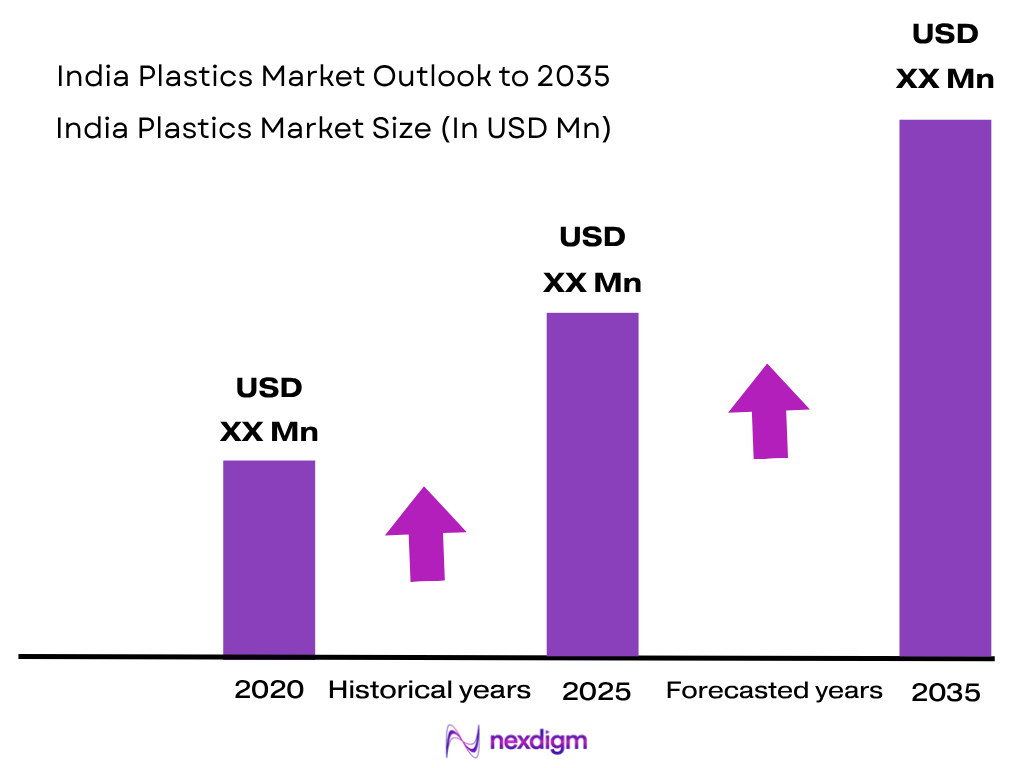
The India Plastics Market is estimated at USD ~XX billion in 2024, with the report forecast indicating a ~XX% CAGR during 2026–2035. The market is supported by broad polymer consumption across packaging, construction, automotive, electrical and electronics, healthcare, agriculture and consumer products. Government industry statistics show that India had 52.29 million tonnes of installed petrochemical capacity and 42.16 million tonnes of petrochemical production in the latest reported production cycle, highlighting the scale of the domestic polymer ecosystem.
The India Plastics Market is concentrated around major industrial and petrochemical clusters in Gujarat, Maharashtra, Tamil Nadu, Uttar Pradesh and Karnataka, supported by polymer manufacturing, conversion capacity, ports, automotive production and consumer-goods industries. Government industrial data identifies Gujarat, Maharashtra and Tamil Nadu among the leading manufacturing states by output, while major petrochemical facilities and plastics-processing clusters strengthen regional supply availability. Plastic products also have an extensive export footprint, with Indian plastics exports reaching USD 12.5 billion in the latest fiscal year reported by DGCIS-based industry data.
Market Segmentation
By Polymer Type
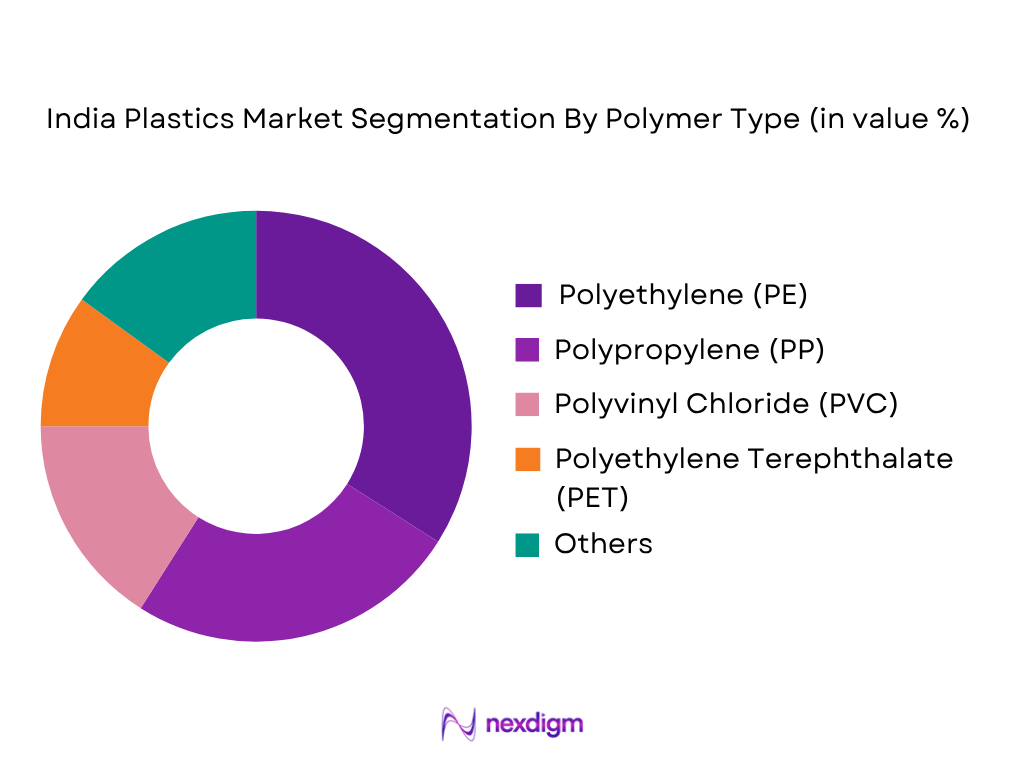
The India Plastics Market is segmented by polymer type into polyethylene, polypropylene, polyvinyl chloride, polyethylene terephthalate, polystyrene, ABS and styrenic polymers, polyurethane, engineering plastics, specialty polymers and recycled polymers. Polyethylene and polypropylene represent the leading working segment because of their extensive use across flexible packaging, rigid containers, household products, automotive components, industrial products, pipes and consumer applications. Their processing versatility allows converters to manufacture films, injection-moulded products, blow-moulded containers and other high-volume applications. Polyolefins are also supported by India’s large packaging and consumer-goods ecosystem, while domestic petrochemical producers provide an established supply base. Government data confirms the considerable scale of India’s petrochemical production infrastructure, with total petrochemical production recorded at 42.16 million tonnes in the latest reported cycle. The continued development of domestic polymer capacity, combined with demand from packaging, infrastructure and manufacturing, reinforces polyolefins as a central component of the Indian plastics value chain.
By Application
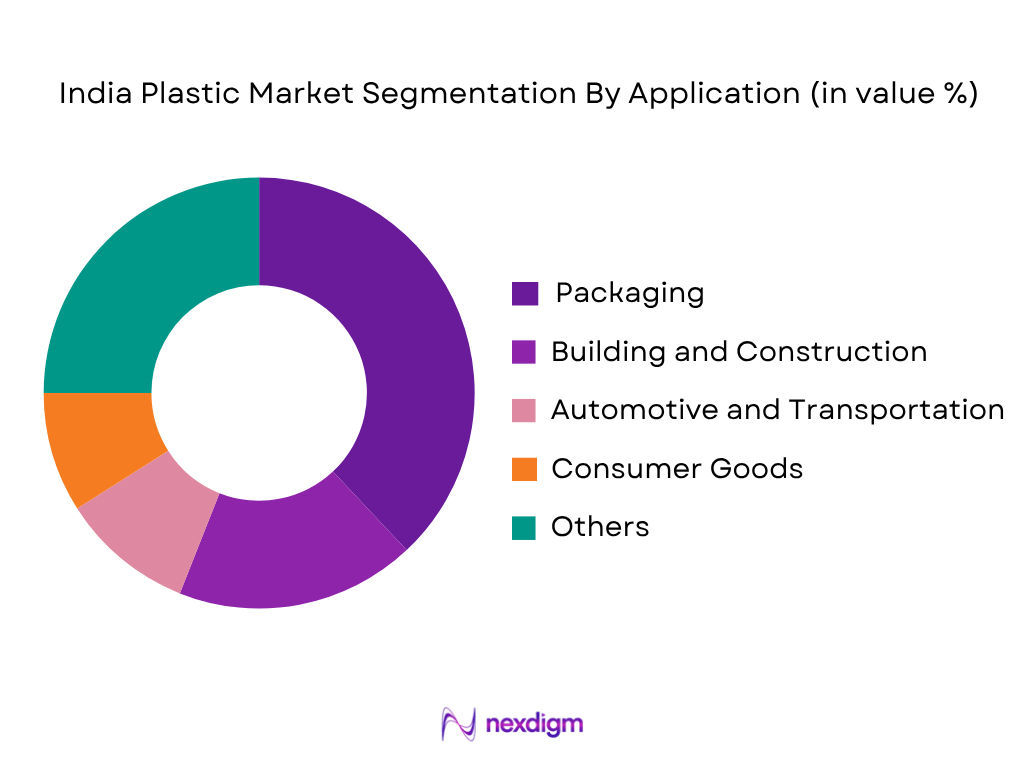
The India Plastics Market is segmented by application into packaging, building and construction, automotive and transportation, electrical and electronics, healthcare and medical, agriculture, consumer goods, industrial applications and textiles. Packaging is the leading application segment because plastics provide lightweight, barrier, sealing, durability and design advantages across food, beverages, personal care, pharmaceuticals and household products. The application is reinforced by India’s large FMCG and food-processing ecosystem, while flexible films, rigid containers, bottles, closures and multilayer structures create demand for multiple polymer families. Plastics also remain important in infrastructure through pipes, fittings, insulation and construction products. The broader manufacturing base provides another demand channel: government industrial data records 260,061 factories and more than 46.24 million persons engaged across the covered manufacturing sector, supporting extensive downstream consumption of polymer components and products.
Competitive Landscape
The India Plastics Market contains integrated petrochemical producers, polymer manufacturers, plastics processors, packaging companies, pipe manufacturers, automotive-component suppliers and recycling businesses. Large integrated producers such as Reliance Industries, Indian Oil and GAIL participate upstream, while companies including Supreme Industries, Finolex Industries, Astral, Prince Pipes and Nilkamal have stronger downstream exposure. The competitive structure is therefore differentiated by polymer availability, processing capacity, application specialization, geographic footprint, integration with petrochemical feedstocks and ability to address recycled-material requirements. The Department of Chemicals and Petrochemicals reported 52.29 million tonnes of installed petrochemical capacity, demonstrating the substantial upstream industrial base supporting the downstream plastics ecosystem.
| Company | Established | Headquarters | Polymer / Product Focus | Processing Exposure | Key End-Use Markets | Recycling / Circularity | Geographic Strength |
| Reliance Industries | 1973 | Mumbai, India | ~ | ~ | ~ | ~ | ~ |
| Indian Oil Corporation | 1959 | New Delhi, India | ~ | ~ | ~ | ~ | ~ |
| GAIL (India) | 1984 | New Delhi, India | ~ | ~ | ~ | ~ | ~ |
| Supreme Industries | 1942 | Mumbai, India | ~ | ~ | ~ | ~ | ~ |
| Finolex Industries | 1981 | Pune, India | ~ | ~ | ~ | ~ | ~ |
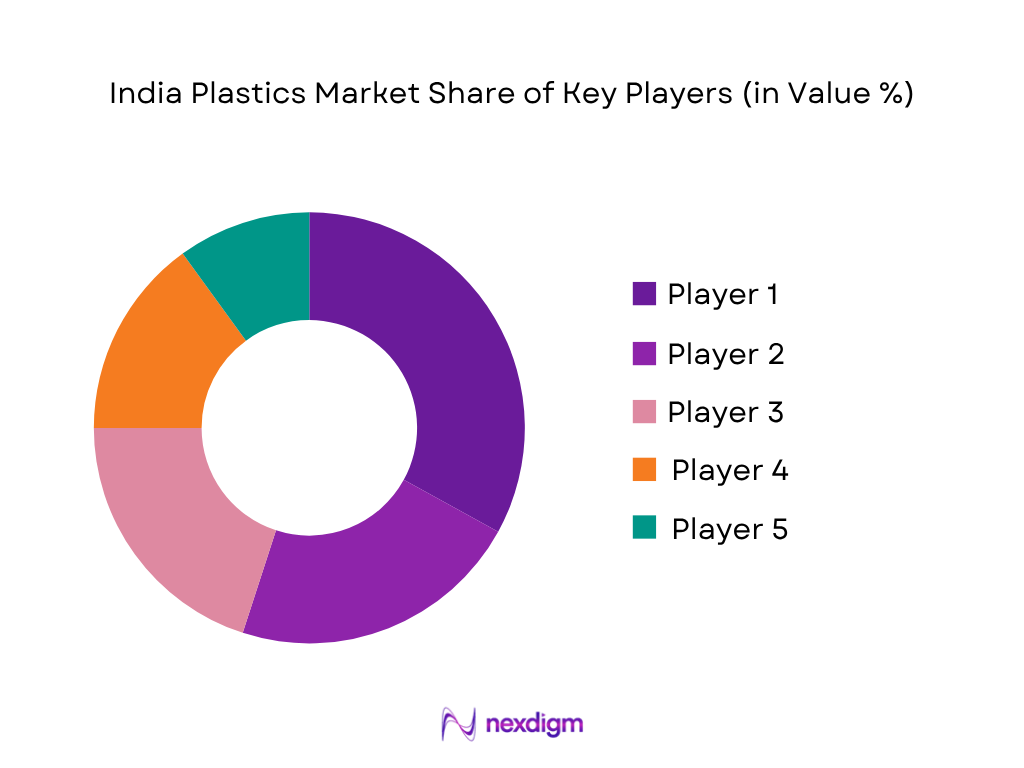
India Plastics Market Analysis
Growth Drivers
Packaging Consumption Expansion
Packaging remains a major structural demand driver for the UK plastics market because plastics are embedded across food, beverage, household, pharmaceutical and industrial packaging formats. Defra reported 2.265 million tonnes of plastic packaging waste arising in the UK in 2024, with 1.154 million tonnes recycled, demonstrating the substantial volume of plastic moving through the packaging economy. The Office for National Statistics reported UK population of 69.281 million in mid-2024, compared with 68.526 million in mid-2023, expanding the underlying consumer base for packaged products. UK manufacturers recorded total product sales of £452.2 billion in 2024, according to ONS, providing a broad industrial and consumer base for plastic packaging demand. Food manufacturing remained the largest manufacturing division, with £95.0 billion of product sales in 2024, reinforcing the importance of packaging-intensive applications. In addition, HMRC recorded 3.138 million tonnes of plastic packaging declared under Plastic Packaging Tax in 2024-25, showing the scale of packaging entering the regulated market. These indicators support continued demand for films, containers, bottles, trays, closures and protective packaging while simultaneously increasing requirements for recyclable and recycled-content plastics.
Construction and Infrastructure Development
Construction activity supports UK plastics demand through the use of PVC pipes, insulation systems, roofing membranes, cable protection, flooring, windows, profiles and other polymer-based building components. ONS reported that construction new work in Great Britain reached £140.684 billion in 2024, while new infrastructure construction was valued at £33.9 billion. Public-sector new construction work increased by £2.592 billion during the year, indicating continued infrastructure-related activity relevant to polymer-intensive applications. ONS also recorded £33.9 billion of new infrastructure construction, with roads and railways together accounting for 52.2% of new infrastructure work, supporting requirements for drainage, cabling, insulation and protective materials. The UK population reached 69.281 million in mid-2024, creating continued requirements for residential, commercial and public infrastructure. The broader manufacturing sector generated £452.2 billion in product sales in 2024, indicating a substantial industrial ecosystem requiring plastics for machinery components, electrical systems and construction-related products. These conditions support demand for durable polymer materials, particularly where plastics provide corrosion resistance, low weight, weather resistance and installation efficiency. Sources: Office for National Statistics; Department for Business and Trade; Infrastructure and Projects Authority.
Market Challenges
Virgin Polymer Feedstock Volatility
The UK plastics market remains exposed to fluctuations in petrochemical feedstocks because virgin polyethylene, polypropylene, PVC, PET and engineering polymers depend substantially on hydrocarbon-derived raw materials. This exposure creates uncertainty for processors when energy, oil, gas and chemical-input conditions change. The International Monetary Fund reported UK real GDP growth of 1.1% in 2024, reflecting a relatively modest macroeconomic expansion and a demand environment in which manufacturers remained sensitive to input-cost pressures. ONS recorded total UK manufacturers’ product sales of £452.2 billion in 2024, down from £466.7 billion in 2023, illustrating the broader pressure affecting manufacturing activity. Energy-intensive plastics processing adds another vulnerability because extrusion, injection moulding, blow moulding, thermoforming and polymer compounding require continuous electricity and thermal energy. The UK Government’s Plastic Packaging Tax increased to £217.85 per tonne from April 2024 and reached £228.82 per tonne from April 2026, increasing the commercial importance of recycled content and material efficiency. HMRC recorded 3.138 million tonnes of plastic packaging declared in 2024-25, illustrating the scale of material exposed to the regulatory framework. Consequently, polymer producers and converters face simultaneous feedstock, energy, trade and regulatory pressures.
Plastic Waste Collection Constraints
Plastic waste collection and recycling remain major challenges because the UK generates large volumes of plastic packaging while collection systems, material sorting and recycling capacity vary across locations and polymer types. Defra reported 2.265 million tonnes of plastic packaging waste arising in 2024 and 1.154 million tonnes recycled, leaving more than 1.1 million tonnes outside reported recycling under the relevant methodology. The government also reported 109,671 tonnes of waste associated with illegitimate evidence disrupted through packaging compliance interventions in 2024, illustrating the complexity of maintaining reliable recycling documentation and material traceability. Packaging EPR data recorded 1.388 million tonnes of obligated plastic packaging placed on the UK market in 2024, demonstrating the scale of material that requires collection and treatment. The UK population reached 69.281 million in mid-2024, increasing the underlying volume of household consumption and post-consumer material flows. From 2025, packaging Extended Producer Responsibility introduced additional producer obligations, requiring stronger data management and accountability. These conditions create operational challenges for plastics manufacturers seeking consistent recycled feedstock, particularly where collection, sorting and reprocessing systems cannot reliably deliver polymer-specific quality.
Market Opportunities
Advanced Mechanical Recycling
Advanced mechanical recycling represents an important opportunity for the UK plastics market because substantial quantities of plastic packaging already enter the domestic waste stream, creating a feedstock base for higher-value recycled polymers. Defra recorded 2.265 million tonnes of plastic packaging waste arising in 2024, of which 1.154 million tonnes was recycled. Packaging EPR data separately recorded 1.388 million tonnes of obligated plastic packaging placed on the UK market, highlighting a sizeable stream that can potentially be captured through improved collection, sorting and reprocessing. HMRC’s Plastic Packaging Tax framework provides a direct commercial incentive for manufacturers and importers to incorporate recycled content, with packaging containing at least 30% recycled plastic outside the tax charge. The tax rate was £217.85 per tonne from April 2024 and increased to £228.82 per tonne from April 2026. The UK population of 69.281 million in mid-2024 also supports a substantial continuing supply of post-consumer packaging waste. These conditions create opportunities for advanced sorting, washing, filtration, compatibilisation, deodorisation and polymer purification technologies. Companies able to deliver consistent recycled polyethylene, polypropylene and PET quality can increasingly support packaging converters seeking reliable circular feedstock and compliance with evolving UK packaging requirements.
Chemical Recycling and Circular Polymers
Chemical recycling and circular polymer technologies offer an opportunity to address plastic streams that are difficult to process through conventional mechanical recycling, particularly mixed, contaminated or multilayer materials. Defra recorded 2.265 million tonnes of plastic packaging waste arising in the UK in 2024, demonstrating the scale of the feedstock challenge and the potential resource available for alternative treatment technologies. Of this amount, 1.154 million tonnes was recycled, leaving substantial material requiring improved recovery pathways. Packaging EPR records show 1.388 million tonnes of obligated plastic packaging placed on the UK market in 2024, strengthening the need for traceable recovery systems and circular material supply. HMRC’s Plastic Packaging Tax requires manufacturers and importers to address recycled content, with the applicable threshold set at 30% recycled plastic. The tax rate reached £228.82 per tonne from April 2026, increasing the commercial relevance of recycled and circular polymer solutions. The UK Government’s packaging reforms also increase requirements for producer accountability and material reporting. These developments create opportunities for pyrolysis, depolymerisation, solvent-based recovery, mass-balance polymers and closed-loop supply agreements, particularly where they can produce consistent feedstock suitable for demanding food, automotive, healthcare and industrial applications.
Future Outlook
Over the next decade, the India Plastics Market is expected to benefit from increasing manufacturing activity, packaging conversion, infrastructure development, automotive production and healthcare applications. The market is also likely to undergo a structural transition toward recycled polymers, mono-material packaging, lightweight components and higher-performance engineering plastics. Domestic petrochemical capacity provides an important foundation, while regulatory requirements around plastic waste and recycled content are expected to increase the strategic importance of collection, sorting and recycling capabilities. The resulting opportunity will extend beyond virgin polymer production toward integrated circular-material ecosystems.
Major Players
- Reliance Industries Limited
- Indian Oil Corporation Limited
- GAIL (India) Limited
- Haldia Petrochemicals Limited
- Supreme Industries Limited
- Finolex Industries Limited
- Supreme Petrochem Limited
- Astral Limited
- Prince Pipes and Fittings Limited
- Time Technoplast Limited
- Nilkamal Limited
- Jain Irrigation Systems Limited
- Uflex Limited
- Motherson Group
- DCM Shriram Limited
Key Target Audience
- Polymer and Petrochemical Manufacturers
- Plastic Packaging and Conversion Companies
- Automotive Component and Polymer Manufacturers
- Construction Materials and Plastic Piping Companies
- Electrical, Electronics and Engineering Plastics Manufacturers
- Investments and Venture Capitalist Firms
- Government and Regulatory Bodies (Ministry of Chemicals and Fertilizers, Department of Chemicals and Petrochemicals, Central Pollution Control Board, Ministry of Environment, Forest and Climate Change)
- Plastic Waste Management and Recycling Companies
Research Methodology
Step 1: Identification of Key Variables
The initial phase involves constructing an India Plastics Market ecosystem map covering petrochemical producers, polymer manufacturers, compounders, converters, distributors, end-use industries and recycling companies. Secondary industry information is assessed alongside official production, capacity, trade, waste-management and regulatory datasets to identify variables affecting polymer demand, conversion activity and circular-material adoption.
Step 2: Market Analysis and Construction
Historical market information is compiled across polymer categories, applications, processing technologies and downstream industries. The analysis reconciles domestic polymer production, imports, exports, apparent consumption and plastics-processing activity to construct a consistent market framework. Particular attention is given to PE, PP, PVC, PET and engineering plastics because of their importance across major Indian end-use industries.
Step 3: Hypothesis Validation and Expert Consultation
Market hypotheses are validated through structured discussions with polymer manufacturers, plastics processors, packaging converters, automotive-component suppliers, pipe manufacturers and recycling operators. Interviews are used to examine capacity utilization, application demand, technology adoption, material substitution, recycled-resin procurement and regulatory implementation, while avoiding reliance on unsupported assumptions.
Step 4: Research Synthesis and Final Output
The final stage triangulates bottom-up company and application assessments against top-down petrochemical and industrial indicators. Production, trade, processing and end-use datasets are reconciled to identify inconsistencies and refine market estimates. The resulting analysis is structured around polymer type, application, regional manufacturing clusters, competitive positioning and future circular-economy opportunities.

- Executive Summary
- Research Methodology (Market Definitions and Assumptions, Polymer Classification Framework, Plastics Industry Boundary Definition, Market Sizing Approach, Top-Down Analysis, Bottom-Up Analysis, Resin Consumption Assessment, Domestic Production Assessment, Import-Export Reconciliation, Demand-Side Assessment, Supply-Side Assessment, Primary Industry Interviews, Capacity Mapping, Data Triangulation, Forecasting Framework, Limitations and Future Conclusions)

- Definition and Scope
- India Plastics Industry Evolution
- India Plastics Value Chain Analysis
- India Plastics Supply Chain Analysis
- Polymer Production and Conversion Ecosystem Analysis
- Plastics Processing Technology Assessment
- Domestic Polymer Capacity and Production Infrastructure Assessment

- Growth Drivers (Packaging Consumption Expansion, Construction and Infrastructure Development, Automotive Lightweighting, Healthcare and Medical Product Demand, Electrical and Electronics Manufacturing, Food and Beverage Packaging Expansion, Domestic Polymer Consumption Growth, Industrial Manufacturing Expansion)
- Market Challenges (Virgin Polymer Feedstock Volatility, Dependence on Petrochemical Feedstocks, Plastic Waste Collection Constraints, Recycling Infrastructure Gaps, Recycled Resin Quality Variability, Energy-Intensive Processing, Informal Recycling Fragmentation, Compliance and Extended Producer Responsibility Requirements)
- Market Opportunities (Advanced Mechanical Recycling, Chemical Recycling and Circular Polymers, Post-Consumer Recycled Resin Development, Bio-Based Polymer Applications, Sustainable Flexible Packaging, Lightweight Automotive Components, High-Performance Engineering Plastics, Domestic Recycling Infrastructure, Circular Polymer Supply Agreements)
- Market Trends (Recycled Content Integration, Lightweight Polymer Adoption, Mono-Material Packaging Development, Bio-Based Polymer Development, Advanced Recycling Technologies, Engineering Plastics Substitution, Sustainable Packaging Conversion, Digitalized Plastics Processing, Polymer Compounding Innovation)
- Government Regulations and Standards (Plastic Waste Management Rules, Extended Producer Responsibility Framework, Plastic Packaging Recycling Targets, Single-Use Plastic Restrictions, Recycled Content Requirements, Central Pollution Control Board Compliance, Bureau of Indian Standards Requirements, Plastic Waste Reporting and Traceability)
- SWOT Analysis
- Porter’s Five Forces Analysis
- PESTLE Analysis
- Stakeholder Ecosystem

- By Market Value (2020-2025)
- By Plastics Processing Volume (2020-2025)
- By Virgin Resin Consumption Volume (2020-2025)
- By Polymer Import Volume (2020-2025)
- By Polymer Export Volume (2020-2025)

- By Polymer Type (In Value %)
Polyethylene (PE)
Polypropylene (PP)
Polyvinyl Chloride (PVC)
Polyethylene Terephthalate (PET)
Polystyrene (PS)
ABS and Styrenic Polymers
Polyurethane (PU)
Engineering Plastics
Specialty and High-Performance Polymers
Recycled Polymers - By Product Form (In Value %)
Plastic Films and Sheets
Rigid Plastic Containers
Plastic Pipes and Fittings
Plastic Profiles and Extruded Products
Plastic Bottles and Closures
Plastic Moulded Components
Plastic Packaging Products
Plastic Household Products
Plastic Industrial Products
Plastic Sheets, Laminates and Composites - By Application (In Value %)
Packaging
Building and Construction
Automotive and Transportation
Electrical and Electronics
Healthcare and Medical
Consumer Goods
Agriculture and Irrigation
Industrial Machinery and Equipment
Textiles and Synthetic Fibers
Infrastructure and Utility Applications - By Processing Technology (In Value %)
Injection Molding
Extrusion
Blow Molding
Thermoforming
Rotational Molding
Compression Molding
Film and Sheet Extrusion
Compounding and Masterbatch Processing
Recycling and Pelletization
Additive and Advanced Manufacturing - By Sales Channel (In Value %)
Direct Polymer Manufacturer Sales
Distributors and Polymer Stockists
Plastic Processing Companies
Industrial Component Suppliers
Packaging Converters
Automotive Tier Suppliers
Construction Material Distributors
Online B2B Polymer Platforms - By Region (In Value %)
Western India
Maharashtra
Gujarat
Northern India
Delhi NCR
Uttar Pradesh
Haryana
Southern India
Tamil Nadu
Karnataka
Telangana
Andhra Pradesh
Eastern India
West Bengal
Odisha
Central India
Madhya Pradesh
Rajasthan

- Market Share of Major Players (By Polymer Type, Product Category, Processing Technology, End-Use Industry, Production Capacity, Geographic Presence, Domestic Sales, Export Presence)
- Cross Comparison Parameters (Polymer Portfolio Breadth, Annual Polymer Production and Processing Capacity, Plastics Processing Technology Capability, Product and SKU Portfolio Breadth, Domestic Manufacturing Footprint, Recycling and Circular Polymer Capability, End-Use Industry Coverage, Distribution and Polymer Supply Network)
- SWOT Analysis of Major Players
- Detailed Profiles of Major Companies
Reliance Industries
Indian Oil Corporation
GAIL (India)
The Supreme Industries
Finolex Industries
Astral
Supreme Petrochem
Jain Irrigation Systems
Prince Pipes and Fittings
Time Technoplast
Nilkamal
Motherson
Uflex
Finolex Cables
DCM Shriram

- End-Use Industry Demand Assessment
- Packaging Industry Polymer Consumption Analysis
- Construction Industry Plastics Consumption Analysis
- Automotive Plastics Demand Assessment
- Electrical and Electronics Plastics Demand Assessment
- Healthcare and Medical Plastics Demand Assessment
- Agricultural Plastics Consumption Analysis
- Consumer Goods Plastics Demand Assessment
- Industrial Plastics Consumption Analysis

- By Market Value (2026-2035)
- By Plastics Processing Volume (2026-2035)
- By Virgin Resin Consumption Volume (2026-2035)
- By Polymer Import Volume (2026-2035)
- By Polymer Export Volume (2026-2035)


 Request a Sample
 Ask for Customization
 Get a Quote
 Enquire Now