

 Download PDF
Market Overview
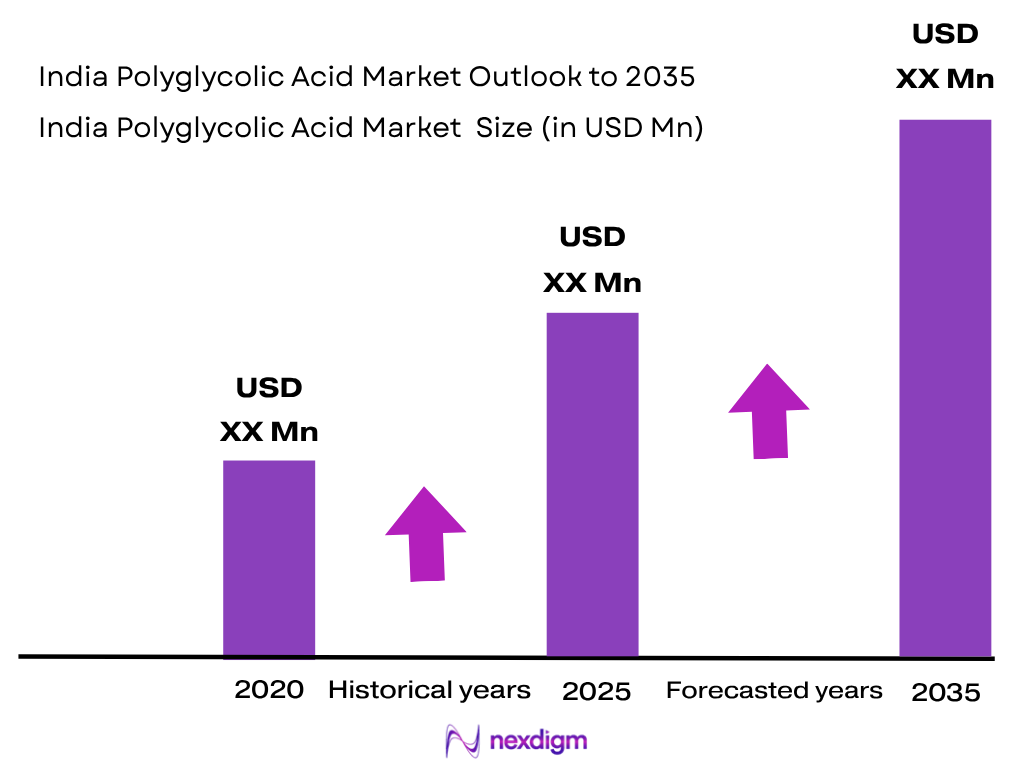
The India Polyglycolic Acid Market is primarily driven by the expanding use of PGA in synthetic absorbable surgical sutures, where predictable absorption, tensile-strength retention, handling characteristics and relatively low tissue reaction support adoption. PGA is also being evaluated across biodegradable packaging, drug delivery, tissue engineering and specialty industrial applications. India’s expanding healthcare infrastructure and medical-device manufacturing ecosystem provide an important demand base, while increasing interest in biodegradable and high-performance polymers creates additional application opportunities. Domestic suppliers already offer PGA-based sutures, demonstrating established downstream conversion capability.
The Indian PGA ecosystem is particularly concentrated around Bengaluru, Ahmedabad, Mumbai, Gurugram and other established medical-device manufacturing clusters, reflecting the concentration of surgical-suture manufacturers, medical consumables suppliers and distributors. Bengaluru has a particularly visible PGA-suture manufacturing ecosystem, with companies such as Futura Surgicare, Relyon Sutures and Sutu India represented in the market. The presence of Peenya and other established medical-device clusters supports access to skilled manufacturing, hospitals, distributors and export channels.
Market Segmentation
By Grade
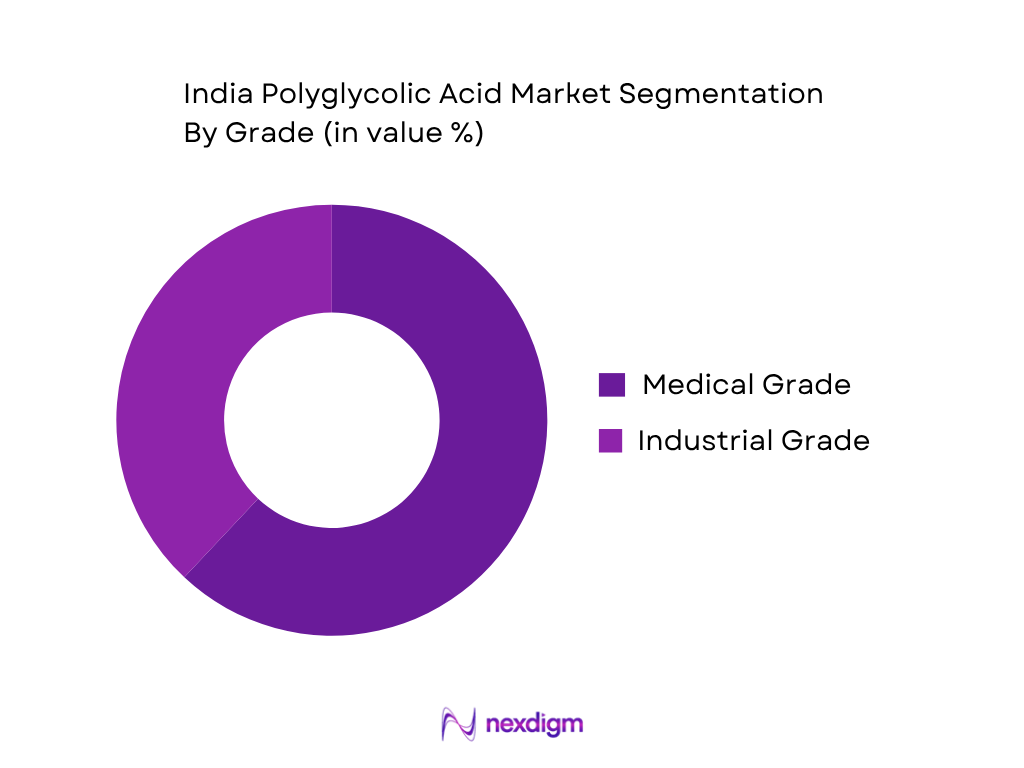
The India Polyglycolic Acid Market is segmented into medical grade, suture grade, oilfield grade, packaging grade, industrial grade and high-performance grade. Medical and suture grades are expected to represent the dominant portion of demand, supported by the established commercial use of PGA in synthetic absorbable surgical sutures. PGA’s combination of biodegradability, tensile strength and predictable absorption makes it suitable for wound closure applications requiring temporary mechanical support. Indian manufacturers already supply PGA sutures for general, ophthalmic, orthopaedic and gastrointestinal procedures, indicating an established downstream application base. The medical segment also benefits from India’s expanding hospital infrastructure, increasing surgical capacity and development of domestic medical-device manufacturing. Beyond conventional sutures, PGA’s characteristics support opportunities in bioabsorbable implants, tissue engineering and controlled drug delivery. The qualification requirements for medical-grade polymers are stringent, however, making regulatory documentation, biocompatibility, sterilization compatibility, material consistency and degradation performance important competitive differentiators.
By Application
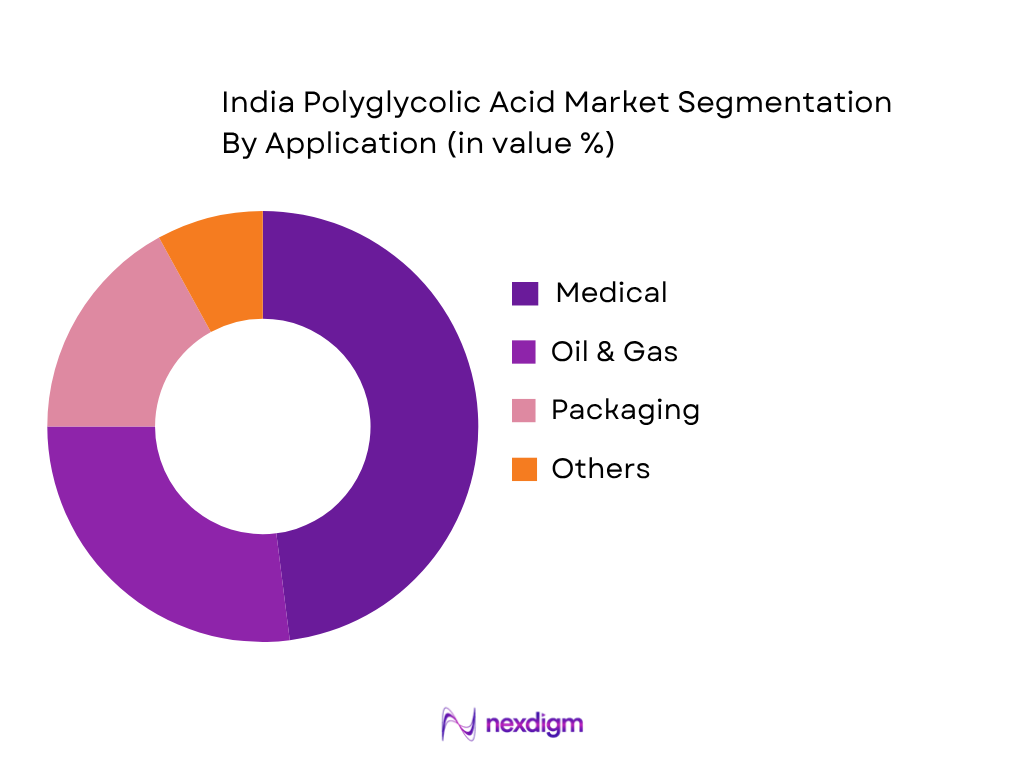
The India Polyglycolic Acid Market is segmented into medical and healthcare, oil and gas, packaging, drug delivery, tissue engineering, filtration, industrial applications and other specialty applications. Medical and healthcare applications are positioned as the leading application segment, primarily because PGA has a long-established role in absorbable surgical sutures. Indian market participants manufacture PGA sutures in different sizes, configurations and coating systems, while PGA-based products are used across general surgery and specialist procedures. (Tradeindia) The material’s controlled hydrolytic degradation also creates opportunities beyond wound closure, including bioabsorbable implants and drug-delivery systems. Oil and gas represents another technically differentiated application area because degradable polymer components can be used in temporary downhole operations. Packaging represents an emerging opportunity associated with PGA’s barrier characteristics and biodegradable-polymer positioning. Consequently, the application landscape combines an established medical revenue base with emerging high-value specialty applications that could broaden PGA consumption in India.
Competitive Landscape
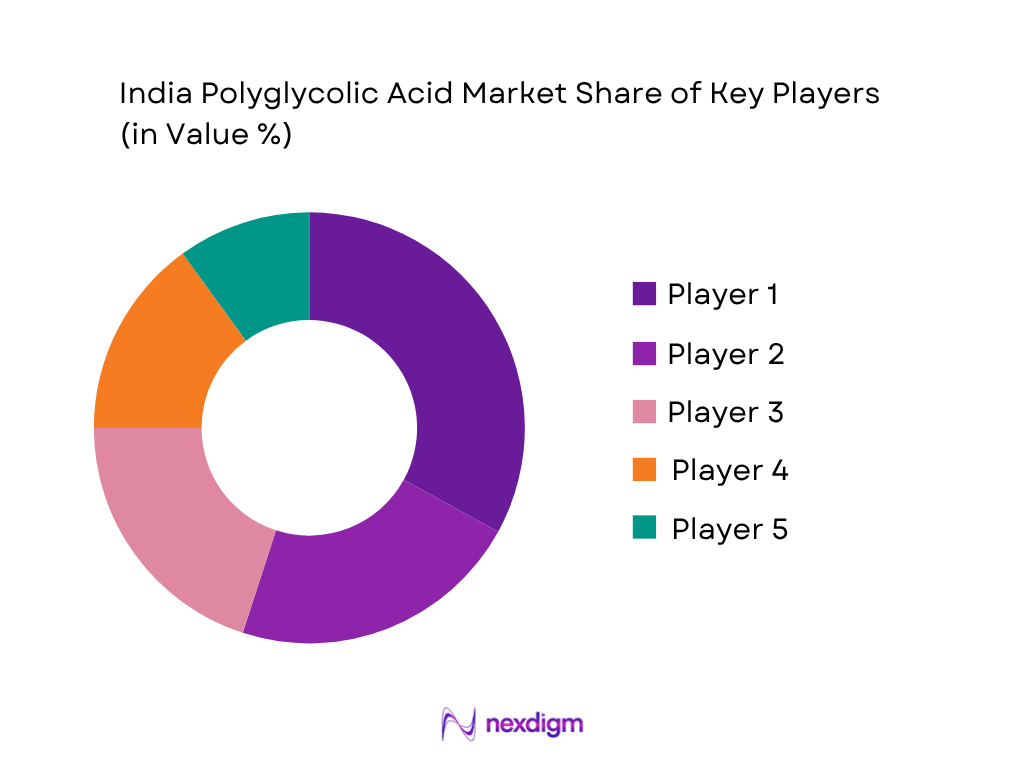
The India Polyglycolic Acid Market has a fragmented downstream competitive structure, with Indian manufacturers particularly visible in the absorbable-suture segment. Futura Surgicare, Healthium/Sutures India, Relyon Sutures, Unisur Lifecare, Neu Micromed and other domestic manufacturers participate in PGA-suture production or distribution, while international medical-device companies such as Ethicon and B. Braun compete through broader absorbable-suture portfolios. The competitive environment is therefore influenced by product quality, regulatory approvals, manufacturing capabilities, surgeon acceptance, hospital procurement relationships and distribution reach.
| Company | Establishment | Headquarters / India Base | PGA Product Focus | Medical Application Coverage | Manufacturing Capability | Distribution Reach | Key Competitive Parameter |
| Futura Surgicare | 1994 | Bengaluru, Karnataka | ~ | ~ | ~ | ~ | ~ |
| Healthium Medtech / Sutures India | 1992 | Bengaluru, Karnataka | ~ | ~ | ~ | ~ | ~ |
| Relyon Sutures | 1984 | Bengaluru, Karnataka | ~ | ~ | ~ | ~ | ~ |
| Unisur Lifecare | 2012 | Bengaluru, Karnataka | ~ | ~ | ~ | ~ | ~ |
| Ethicon / Johnson & Johnson MedTech | 1886 | India operations | ~ | ~ | ~ | ~ | ~ |
India Polyglycolic Acid Market Analysis
Growth Drivers
Expansion of Absorbable Surgical Procedures
India’s demand for polyglycolic acid (PGA) is supported by the expanding scale of healthcare activity, particularly surgical and medical-device manufacturing. The IMF reported India’s real GDP growth at 8.2 in 2023/24, indicating strong underlying economic activity and investment capacity across healthcare-related sectors. World Bank WITS data show India exported pharmaceutical products worth USD 23,049,048.34 thousand in 2024, demonstrating the scale of the country’s healthcare manufacturing and export ecosystem. India also exported medical and surgical instruments worth USD 1,417,308.03 thousand in 2024. PGA is particularly relevant to this ecosystem because its established medical use includes absorbable sutures and other bioabsorbable applications where controlled hydrolytic degradation is required. The scale of medical-device trade provides a tangible industrial base for manufacturers developing higher-value polymer-based components. In addition, India’s gross investment reached 33.3 in the IMF’s 2023/24 macroeconomic framework, supporting continued capacity creation across manufacturing-intensive sectors. These conditions strengthen the commercial environment for domestic PGA processing, medical-grade polymer qualification, and conversion into absorbable surgical products. The combination of healthcare manufacturing capability, medical-device exports, and sustained investment creates a structural demand pathway for PGA-based surgical materials.
Growth of Medical Device Manufacturing
The expansion of India’s medical-device ecosystem is creating additional downstream demand potential for high-performance biodegradable polymers such as PGA. World Bank WITS records show that India exported medical instruments and appliances classified under HS 9018 at USD 1,417,308.03 thousand in 2024, while exports of medical diagnostic instruments under HS 902780 reached USD 46,279.32 thousand. India also exported 671,178,000 units under HS 901890, indicating substantial manufacturing and international distribution activity across medical-device categories. On the import side, medical diagnostic instruments under HS 902780 reached USD 439,543.57 thousand and 29,501,200 items, showing that the domestic market is simultaneously integrating sophisticated medical technologies from international suppliers. PGA can participate in this expanding ecosystem through absorbable sutures, bioabsorbable fixation components, tissue-engineering structures, and other temporary medical devices. The IMF’s 2024/25 framework also recorded gross investment at 33.6 of GDP, reinforcing the broader investment environment for production capacity and industrial modernization. As Indian manufacturers move toward more sophisticated medical products, the technical requirements for controlled degradation, biocompatibility, sterilization compatibility, and predictable mechanical performance become increasingly relevant. This supports opportunities for PGA suppliers capable of meeting medical-grade specifications and qualification requirements.
Market Challenges
High Polymerization Complexity
PGA manufacturing presents technical challenges because polymerization and subsequent processing require tightly controlled molecular weight, moisture exposure, thermal history, and degradation characteristics. These requirements become more significant when material is intended for medical applications, where consistency and reproducibility are critical. India’s dependence on sophisticated imported medical technologies illustrates the broader capability gap that can affect specialized polymer manufacturing. World Bank WITS records show India imported medical diagnostic instruments worth USD 439,543.57 thousand and 29,501,200 items in 2024, including substantial imports from the United States, China, Singapore, Germany, and Japan. This demonstrates the scale of international technology integration required within India’s healthcare ecosystem. At the macroeconomic level, IMF data indicate that India’s private corporate investment growth had moderated from 21 in 2022/23 to 13 in 2023/24, highlighting the importance of efficient capital allocation when establishing specialized production infrastructure. For PGA producers, polymerization equipment, controlled-atmosphere handling, purification, molecular-weight management, and specialized quality-control systems can therefore represent significant operational complexity. The challenge is particularly pronounced where domestic manufacturers lack established expertise in medical-grade biodegradable polymers. Building reliable domestic capability requires process engineering, specialist personnel, analytical testing, and stringent batch-to-batch controls before PGA can be consistently supplied to regulated medical-device applications.
Medical Qualification Requirements
Medical qualification requirements represent a substantial challenge for PGA manufacturers because materials intended for absorbable surgical products must demonstrate consistent biological, mechanical, chemical, and degradation characteristics. India’s medical-device ecosystem is increasingly connected to international supply chains, creating higher expectations for product consistency and documentation. World Bank WITS reports that India exported medical instruments and appliances worth USD 459,874.35 thousand under HS 901890 in 2024, covering 671,178,000 items, while medical test-kit exports under HS 382200 reached USD 145,217.74 thousand and 3,637,630 kilograms. Such trade volumes illustrate the operational scale at which manufacturers must maintain reliable quality systems. PGA suppliers entering medical applications therefore face requirements extending beyond polymer synthesis, including characterization of molecular weight, residual monomer levels, moisture content, thermal properties, sterility compatibility, and hydrolytic degradation behavior. The challenge is compounded by the need to qualify material with downstream medical-device manufacturers before commercial adoption. India’s IMF-reported consumer-price growth of 4.8 in 2024/25 also indicates an operating environment where manufacturers must balance technical qualification expenditure with broader production economics. Consequently, companies lacking established medical-grade polymer validation capabilities may face longer commercialization cycles and greater technical risk than suppliers already experienced in regulated bioabsorbable materials.
Market Opportunities
Advanced Bioabsorbable Medical Devices
The development of advanced bioabsorbable medical devices represents a significant opportunity for PGA because the polymer can provide temporary mechanical support before gradually degrading through hydrolysis. India’s expanding medical-device manufacturing base provides a practical downstream platform for applications extending beyond conventional sutures. World Bank WITS records USD 1,417,308.03 thousand in Indian exports of medical, surgical, dental, and veterinary instruments under HS 9018 during 2024, while exports of medical instruments and appliances under HS 901890 reached USD 459,874.35 thousand. India also exported 671,178,000 units under HS 901890, demonstrating substantial manufacturing and supply-chain activity in medical products. This ecosystem creates opportunities for PGA-based absorbable fixation devices, temporary scaffolds, specialized surgical components, and tissue-repair products requiring predictable degradation. The opportunity is strengthened by India’s broader investment environment: IMF data place gross investment at 33.6 of GDP for 2024/25, while real GDP growth was projected at 6.5. These indicators support continued industrial capacity development and technology adoption. Domestic PGA suppliers can potentially capture additional value by moving beyond resin production toward medical-grade compounds, precision-processed components, and application-specific biomaterials. Such integration would allow manufacturers to participate directly in higher-value medical-device development while reducing dependence on imported specialized polymer inputs.
Domestic PGA Material Development
Domestic development of PGA materials provides an opportunity to strengthen India’s specialized polymer capabilities and reduce reliance on internationally sourced high-performance medical materials. World Bank trade data demonstrate that India’s healthcare manufacturing ecosystem already operates at considerable scale: pharmaceutical-product exports reached USD 23,049,048.34 thousand in 2024, while medical and surgical instrument exports under HS 9018 reached USD 1,417,308.03 thousand. At the same time, India imported USD 439,543.57 thousand of medical diagnostic instruments under HS 902780, indicating continued integration with global technology supply chains. This combination creates an opportunity for domestic polymer producers to develop PGA grades tailored to Indian medical-device requirements, including controlled molecular weight, predictable degradation, sterilization compatibility, and processing stability. The opportunity is not restricted to sutures; domestic material development can support tissue-engineering scaffolds, drug-delivery systems, absorbable fixation products, specialty filtration media, and degradable industrial components. IMF data show gross investment at 33.6 of GDP in 2024/25, providing a supportive macroeconomic environment for industrial capacity development. Establishing domestic PGA expertise could also enable collaboration between polymer producers and medical-device manufacturers, improving application-specific formulation and processing capabilities. Building this supply base would allow Indian companies to progress from importing specialized materials toward developing and supplying domestically engineered biodegradable polymer grades.
Future Outlook
The India Polyglycolic Acid Market is expected to move from a predominantly absorbable-suture-led market toward a broader specialty bioabsorbable-polymer ecosystem. Medical-grade PGA should remain central as domestic medical-device manufacturing develops, while drug delivery, tissue engineering and bioabsorbable devices provide higher-value application opportunities. Packaging and oil & gas applications can diversify demand beyond healthcare. The competitive environment is also expected to increasingly emphasize material engineering, degradation control, regulatory qualification, product customization and domestic manufacturing capabilities.
Growth opportunities are likely to be strongest where PGA’s technical characteristics solve application-specific requirements rather than where it competes solely on conventional polymer economics. In medical applications, manufacturers can expand from standard sutures into specialized configurations, bioabsorbable implants and advanced wound-closure technologies. In industrial applications, controlled degradation can create opportunities for temporary components and specialty materials. The development of domestic processing capabilities could also reduce dependence on imported specialty materials and strengthen India’s position as a regional manufacturing base.
Major Players
- Futura Surgicare Pvt. Ltd.
- Healthium Medtech Private Limited / Sutures India
- Relyon Sutures
- Unisur Lifecare Pvt. Ltd.
- Neu Micromed International Pvt. Ltd.
- Peter Surgical India Pvt. Ltd.
- Sutu India Private Limited
- Suture Planet
- Universal Sutures
- Dolphin Sutures / Medical & Surgical Solutions
- Bentley Healthcare Pvt. Ltd.
- MCO Hospital Aids Pvt. Ltd.
- Aurolab
- Johnson & Johnson MedTech / Ethicon
- B. Braun India
Key Target Audience
- Medical-device and absorbable-suture manufacturers
- Specialty polymer and biodegradable-material manufacturers
- Pharmaceutical and drug-delivery companies
- Healthcare and surgical-device procurement organizations
- Oil & gas service and downhole-technology companies
- Packaging and high-barrier polymer converters
- Investments and venture capitalist firms
- Government and regulatory bodies (Central Drugs Standard Control Organisation, Department of Pharmaceuticals, Ministry of Chemicals and Fertilizers)
Research Methodology
Step 1: Identification of Key Variables
The research begins with construction of an India-specific PGA ecosystem covering glycolide and polymer inputs, PGA resin producers, suture manufacturers, medical-device companies, packaging converters, oil & gas users and distributors. Key variables include material grade, form, processing technology, application, production capability, imports, regulatory requirements and end-user demand. The assessment separates primary PGA consumption from downstream products incorporating PGA.
Step 2: Market Analysis and Construction
Historical market information is compiled across PGA resin, fiber, film, suture and medical-device applications. The analysis evaluates domestic production, imports, downstream conversion, application penetration and end-user demand. A bottom-up model is constructed from application-level consumption and company-level operating indicators, while a top-down assessment provides a market-level validation framework.
Step 3: Hypothesis Validation and Expert Consultation
Market hypotheses are validated through discussions with polymer producers, medical-device manufacturers, suture companies, hospital procurement professionals, distributors and application specialists. Interviews focus on PGA grade selection, material qualification, procurement patterns, regulatory barriers, manufacturing economics, substitution threats and technology adoption. These inputs are used to validate the segmentation structure and identify application-specific demand drivers.
Step 4: Research Synthesis and Final Output
The final analysis integrates secondary research, company information, trade data, regulatory documentation and expert inputs into a unified India PGA market model. Bottom-up application estimates are reconciled against supply-side indicators and import activity. The resulting framework provides market sizing, segmentation, competitive positioning, application opportunities and strategic recommendations for participants across the PGA value chain.

- Executive Summary
- Research Methodology (Market Definitions and Assumptions, PGA Market Boundary, Material/Form Classification, Application Mapping, Market Sizing Methodology, Top-Down Market Reconstruction, Bottom-Up Market Reconstruction, Demand-Side Assessment, Supply-Side Assessment, Primary Industry Interviews, Secondary Data Validation, Import–Export Cross-Checks, Application-Level Triangulation, Forecasting Framework, Scenario Analysis, Data Limitations)

- Definition and Scope
- Polyglycolic Acid Material Characteristics and Commercial Specifications
- India PGA Industry Evolution and Technology Development
- India PGA Ecosystem and Stakeholder Mapping
- Domestic Manufacturing Versus Import Dependency
- PGA Production and Conversion Infrastructure
- PGA Grade and Specification Landscape

- Growth Drivers (Expansion of Absorbable Surgical Procedures, Growth of Medical Device Manufacturing, Demand for Synthetic Absorbable Sutures, Development of Bioabsorbable Devices, Demand for High-Performance Biodegradable Materials)
- Market Challenges (High Polymerization Complexity, Glycolide Feedstock Availability, Moisture Sensitivity, Hydrolytic Degradation During Processing, Limited Specialist Manufacturing Base, Medical Qualification Requirements, Regulatory Complexity, Competition From Alternative Resorbable Polymers)
- Market Opportunities (Advanced Bioabsorbable Medical Devices, Domestic PGA Material Development, Tissue Engineering Applications, Drug Delivery Systems, High-Barrier Packaging, Degradable Industrial Components, Specialty Filtration, PGA-Based Composites)
- Market Trends (Bioabsorbable Medical Material Development, Domestic Medical Device Manufacturing, PGA Copolymer Innovation, Controlled Degradation, Medical Device Miniaturization, High-Barrier Material Development, Sustainable Polymer Substitution)
- Government and Regulatory Framework (CDSCO Requirements, Medical Device Rules, Import Licensing, Manufacturing Licensing, Quality Management Systems, Biocompatibility Testing, Sterilization Requirements, Post-Market Surveillance)
- SWOT Analysis
- Porter’s Five Forces Analysis
- PESTLE Analysis

- By Market Value (2020-2025)
- By Volume Consumption (2020-2025)
- By Domestic Production Volume (2020-2025)
- By Import Volume (2020-2025)
- By Export Volume (2020-2025)
- By Resin Consumption (2020-2025)
- By Fiber Consumption (2020-2025)

- By Form (In Value %)
PGA Resins
PGA Fibers
PGA Films
PGA Sheets
PGA Rods
PGA Composites
PGA-Based Medical Components
Other PGA Forms - By End-Use Industry (In Value %)
Medical and Healthcare
Oil & Gas
Packaging
Filtration
Agriculture
Industrial Manufacturing
Civil Engineering
Other Specialty Applications - By Medical Application (In Value %)
Absorbable Surgical Sutures
Dental Sutures
Ophthalmic Sutures
Orthopaedic Applications
Tissue Reinforcement Materials
Bioabsorbable Implants
Drug Delivery Systems
Tissue Engineering Scaffolds
Other Medical Applications - By Processing Technology (In Value %)
Ring-Opening Polymerization
Melt Polymerization
Solid-State Polymerization
Extrusion
Fiber Spinning
Film Extrusion
Injection Molding
Compression Molding
Composite Processing - By Grade (In Value %)
Medical Grade
Suture Grade
Oilfield Grade
Packaging Grade
Industrial Grade
High-Performance Grade
Biodegradable Grade

- Market Share of Major Players (By Value, Volume, Form, Grade, Medical Application, Industrial Application)
- Cross Comparison Parameters (PGA Product Portfolio Breadth, Medical-Grade Manufacturing Capability, Suture Portfolio Breadth, PGA Processing Technology, Application Portfolio Coverage, Manufacturing and Conversion Capacity, Regulatory and Certification Capability, R&D and Product Innovation Capability)
- SWOT Analysis of Major Players
- Detailed Profiles of Major Companies
Futura Surgicare Pvt. Ltd. / Dolphin Sutures
Healthium Medtech Private Limited
Unisur Lifecare Pvt. Ltd.
Suture Planet
Microfine Surgical Devices
Peter Surgical India Pvt. Ltd.
Relyon Sutures
Sutu India Private Limited
Neu Micromed International Pvt. Ltd.
Alpha Therapeutics Pvt. Ltd.
Ideal Sutures Enterprises
Lotus Surgicals Pvt. Ltd.
Quraxia Pharmaceuticals Pvt. Ltd.
Johnson & Johnson MedTech / Ethicon
B. Braun India

- Medical End-User Assessment
- Hospital Procurement Behaviour
- PGA Product Attribute Preferences
- Medical Device Manufacturer Requirements
- Industrial End-User Requirements
- End-User Switching Analysis

- By Market Value (2026-2035)
- By Volume Consumption (2026-2035)
- By Domestic Production Volume (2026-2035)
- By Import Volume (2026-2035)
- By Export Volume (2026-2035)
- By Resin Consumption (2026-2035)
- By Fiber Consumption (2026-2035)


 Request a Sample
 Ask for Customization
 Get a Quote
 Enquire Now