
 Download PDF
Market Overview
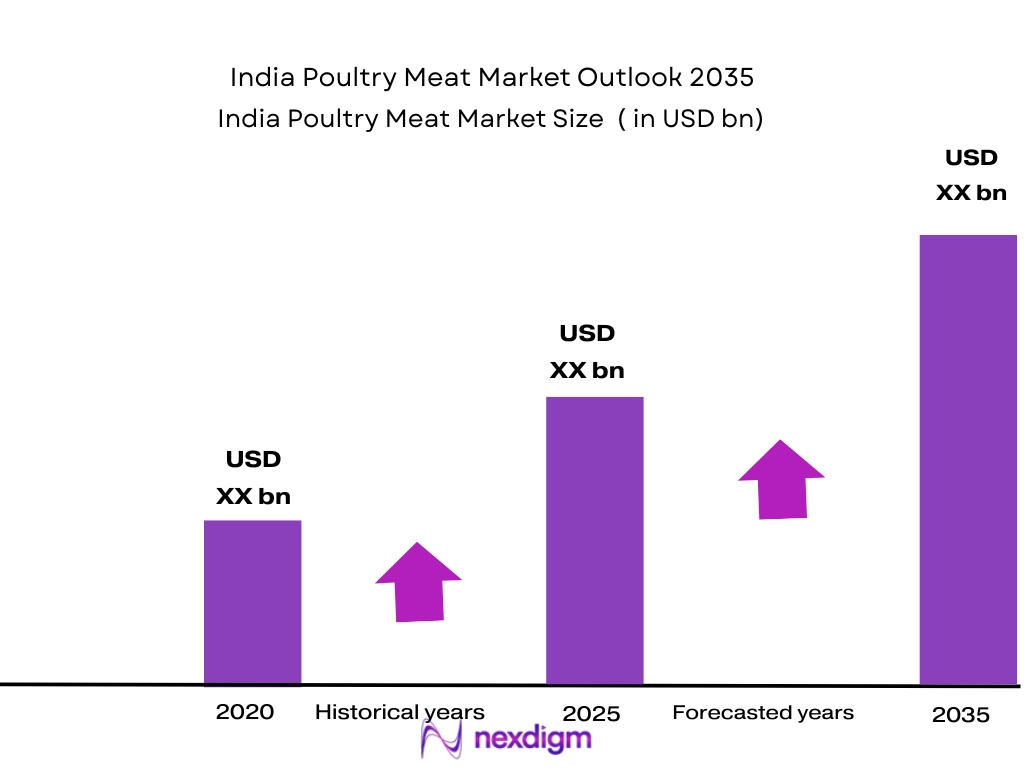
The India Poultry Meat Market is valued at approximately USD ~ billion, supported by steady protein demand, urban foodservice growth, and gradual formalization of chilled and frozen meat supply. India’s total meat production has moved from 10.25 million tonnes to 10.50 million tonnes across the latest reporting cycle, while poultry meat alone contributes about 5.18 million tonnes. The market is forecasted to grow at a CAGR of around 3.48% during 2024–2030.
The market is concentrated around West Bengal, Uttar Pradesh, Maharashtra, Andhra Pradesh, Telangana, Tamil Nadu, Karnataka, and Haryana because these regions combine large poultry farming clusters, feed access, hatchery infrastructure, meat-consuming populations, and strong wholesale networks. Southern states are especially important because integrated poultry operations are located near maize and soybean belts, reducing feed logistics costs. Major urban demand centres such as Delhi-NCR, Mumbai, Bengaluru, Hyderabad, Chennai, Pune, and Kolkata dominate branded poultry consumption.
Market Segmentation
By Product Form
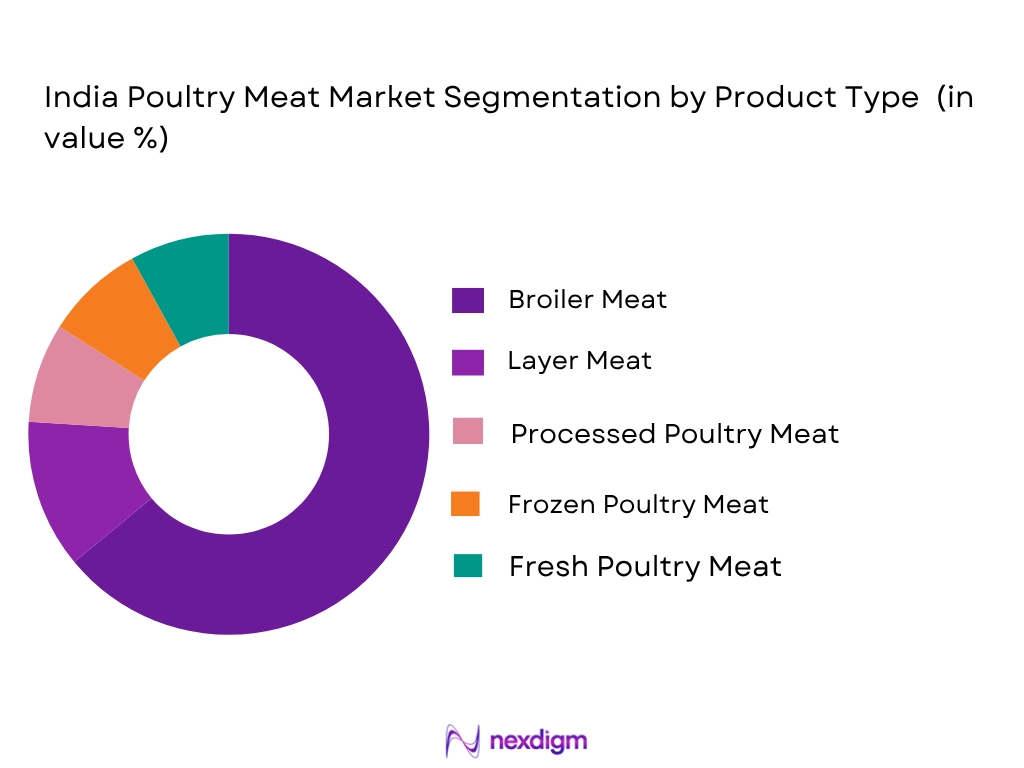
India Poultry Meat Market is segmented by product form into chilled/frozen poultry meat, fresh poultry meat, processed poultry meat, and canned poultry meat. Chilled and frozen poultry meat has a dominant market share in India under the product form segmentation, due to its rising acceptance among institutional buyers, quick service restaurants, online meat delivery platforms, and organized retail chains. The segment benefits from better shelf life, standardized cuts, cold-chain logistics, and improved hygiene perception compared with traditional loose poultry sold through wet markets. Foodservice chains prefer chilled and frozen products because they require consistent sizing, portion control, traceability, and reliable bulk supply. Urban households are also shifting toward branded chilled packs as consumers become more concerned about food safety, antibiotic residue, and product freshness. Growth of meat delivery platforms, modern retail counters, and frozen food brands has further strengthened the segment’s dominance.
By Distribution Channel
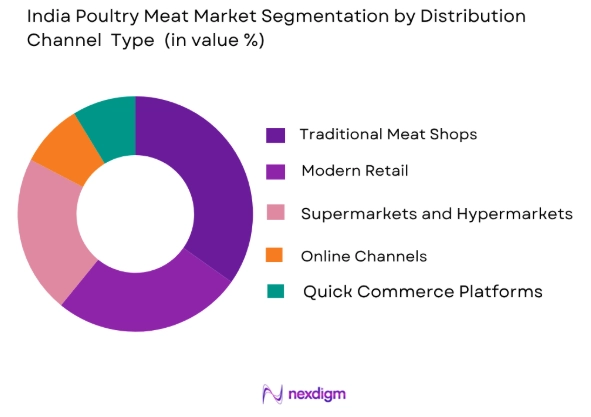
India’s poultry meat market is expected to become more diversified across distribution channels, although traditional meat shops will continue to hold a major share due to strong consumer familiarity and local accessibility. Modern retail formats, including supermarkets and hypermarkets, are likely to gain traction as consumers increasingly prefer hygienic, packaged, and branded poultry products. Online channels will expand with rising internet use, digital payments, and demand for doorstep delivery. Quick commerce platforms are also expected to grow rapidly in urban markets by offering fresh chicken, standardized cuts, and ready-to-cook products with faster delivery and greater convenience.
Competitive Landscape
The India Poultry Meat Market remains fragmented but is increasingly influenced by integrated poultry companies, branded meat processors, frozen food companies, and online meat delivery platforms. Large players such as Suguna Foods, Venky’s, Godrej Tyson Foods, Skylark Hatcheries, and Sneha Farms have stronger control over breeder farms, hatcheries, feed mills, contract farming, processing, and distribution. Digital-first players such as Licious, FreshToHome, TenderCuts, Zappfresh, and Meatigo are reshaping urban retail through direct sourcing, chilled delivery, and premium cuts.
| Company | Establishment Year | Headquarters | Product Focus | Business Model | Distribution Strength | Processing Capability | Key Customer Base | Strategic Positioning |
| Suguna Foods | 1984 | Coimbatore, Tamil Nadu | ~ | ~ | ~ | ~ | ~ | ~ |
| Venkateshwara Hatcheries / Venky’s | 1971 | Pune, Maharashtra | ~ | ~ | ~ | ~ | ~ | ~ |
| Godrej Tyson Foods | 2008 | Mumbai, Maharashtra | ~ | ~ | ~ | ~ | ~ | ~ |
| Skylark Hatcheries | 1985 | Haryana | ~ | ~ | ~ | ~ | ~ | ~ |
| Sneha Farms | 1982 | Hyderabad, Telangana | ~ | ~ | ~ | ~ | ~ | ~ |
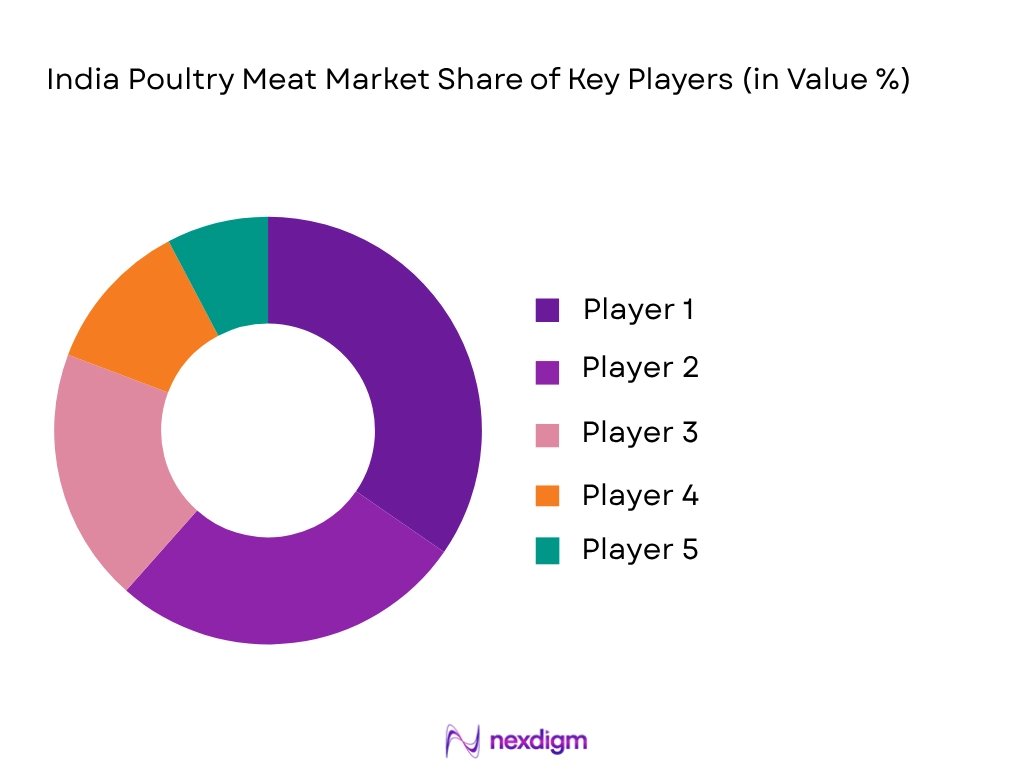
India Poultry Meat Market Analysis
Growth Drivers
Rising Animal Protein Consumption
India’s poultry meat market is gaining momentum as consumers increasingly include animal protein in their diets. Chicken is widely preferred because it is affordable, versatile, and generally accepted across many regions compared with other meats. Growing health awareness has also supported demand, as poultry is often viewed as a leaner protein source. Urban consumers, younger populations, and working professionals are driving higher consumption through home cooking, restaurants, and food delivery platforms. Rising disposable incomes are further enabling households to buy poultry more frequently. As middle-class families shift from carbohydrate-heavy diets to more protein-rich meals, chicken is becoming a regular part of weekly food consumption. This steady change in eating habits is a key driver of long-term poultry meat demand.
Growth of QSRs, Food Delivery, and Processed Meat
The expansion of quick service restaurants, cloud kitchens, and online food delivery platforms has significantly increased poultry meat consumption in India. Chicken-based products such as burgers, wraps, fried chicken, kebabs, nuggets, and ready-to-cook items are popular among urban consumers because they offer convenience and consistent taste. Busy lifestyles and rising participation of women in the workforce have also increased demand for processed and ready-to-cook poultry products. Organized brands are investing in hygienic packaging, cold storage, and value-added products to attract quality-conscious consumers. Food delivery apps have made chicken meals more accessible across cities, while QSR chains continue to expand into smaller towns. This convenience-led demand is strengthening the poultry meat market.
Market Challenges
Feed Price Volatility and Disease Outbreaks
One of the major challenges for India’s poultry meat market is volatility in feed prices. Poultry feed depends heavily on maize, soybean meal, and other agricultural inputs, whose prices fluctuate due to weather conditions, crop output, global commodity trends, and supply disruptions. Since feed forms a major portion of production costs, sudden price increases can reduce farmer margins and increase retail chicken prices. Disease outbreaks such as avian influenza also create serious risks for the industry. Even localized outbreaks can disrupt supply, reduce consumer confidence, and lead to temporary restrictions on movement or sales. Small and medium poultry farmers often lack advanced biosecurity systems, making disease prevention difficult and increasing operational uncertainty.
Fragmented Supply Chain and Consumption Barriers
India’s poultry meat supply chain remains highly fragmented, with many small-scale farms, local traders, wet markets, and informal retailers. Limited cold chain infrastructure creates quality, hygiene, and wastage concerns, especially in regions with weak logistics networks. Maintaining consistent temperature control from farm to retail is difficult, which affects product safety and shelf life. Religious, cultural, and regional food preferences also influence poultry demand, as meat consumption varies widely across states and communities. In addition, competition from eggs, fish, pulses, dairy, and plant-based proteins can limit growth in certain consumer segments. Regulatory compliance and food safety standards are becoming stricter, requiring investment in processing, packaging, traceability, and hygiene, which can be challenging for smaller players.
Opportunities
Organized and Branded Poultry Retail Expansion
The shift from traditional wet markets to organized and branded poultry retail presents a strong growth opportunity in India. Consumers are becoming more concerned about hygiene, freshness, traceability, and product quality, especially in urban areas. Branded poultry players can benefit by offering cleaned, packed, portioned, and certified meat through supermarkets, exclusive outlets, and modern trade channels. Organized retail also allows companies to provide consistent pricing, better packaging, and value-added products such as marinated chicken, sausages, nuggets, and ready-to-cook cuts. As consumer trust becomes more important, companies that invest in quality assurance, cold chain logistics, and transparent sourcing can gain a competitive advantage. This transition can gradually formalize the poultry meat market.
Growth of Online Meat Delivery Platforms
Online meat delivery platforms offer a major opportunity for the poultry meat market by improving convenience, accessibility, and product variety. Urban consumers increasingly prefer ordering fresh or ready-to-cook chicken through mobile apps due to time constraints and concerns about hygiene in traditional markets. These platforms can offer doorstep delivery, standardized cuts, subscription models, and premium products such as antibiotic-free or free-range chicken. Digital channels also help companies build direct relationships with consumers, collect demand data, and manage inventory more efficiently. As internet penetration, digital payments, and quick commerce expand beyond metro cities, online poultry meat sales are likely to grow further. This creates opportunities for both established brands and regional players.
Future Outlook
Over the next five years, the India Poultry Meat Market is expected to grow steadily, driven by rising protein consumption, rapid foodservice expansion, and growing penetration of branded meat retail. The market will continue shifting from live-bird and wet-market formats toward hygienic chilled, frozen, and ready-to-cook formats. Cold-chain investments, quick-commerce delivery, and food safety awareness will support organized players. Demand from QSR chains, cloud kitchens, caterers, and online platforms will remain central to market growth.
Major Players
- Suguna Foods
- Venkateshwara Hatcheries / Venky’s India
- Godrej Tyson Foods
- Skylark Hatcheries
- Sneha Farms
- IB Group
- Srinivasa Farms
- RM Group
- Licious
- FreshToHome
- Zappfresh
- TenderCuts
- Meatigo
- ITC Master Chef
- Shanthi Feeds
Key Target Audience
- Poultry meat producers and integrated poultry companies
- Meat processing and frozen food companies
- Online meat delivery and quick-commerce platforms
- Supermarkets, hypermarkets, and organized retail chains
- Hotels, restaurants, cafés, QSRs, and cloud kitchens
- Feed manufacturers and poultry input suppliers
- Investments and venture capitalist firms
- Government and regulatory bodies
Research Methodology
Step 1: Identification of Key Variables
The initial phase involves constructing an ecosystem map covering major stakeholders in the India Poultry Meat Market. This includes poultry farms, hatcheries, feed suppliers, processors, wholesalers, wet-market retailers, modern trade operators, foodservice buyers, and online meat platforms. The objective is to identify variables influencing supply, pricing, demand, and channel movement.
Step 2: Market Analysis and Construction
In this phase, historical market performance is assessed through production data, consumption patterns, pricing indicators, distribution formats, and organized versus unorganized channel structures. The analysis examines poultry meat value, volume movement, product form split, and demand from households, foodservice, and institutional buyers. This helps construct a reliable market model.
Step 3: Hypothesis Validation and Expert Consultation
Market hypotheses are validated through interactions with poultry processors, feed companies, distributors, cold-chain operators, foodservice procurement teams, and online meat retail executives. These discussions provide operational insights into pricing, margins, demand seasonality, disease risk, product mix, and channel-level supply constraints. The inputs help refine market estimates and segment assumptions.
Step 4: Research Synthesis and Final Output
The final stage involves synthesizing desk research, industry interviews, company mapping, and demand-side assessment into a structured market report. The output includes market size, growth outlook, segmentation, competitive landscape, target audience, and strategic implications. The final analysis is cross-verified to ensure consistency across supply-side and demand-side indicators.

- Executive Summary
- Research Methodology (Market Definitions and Assumptions, Abbreviations, Market Sizing Approach, Consolidated Research Approach, Understanding Market Potential Through In-Depth Industry Interviews, Primary Rsearch Approach, Limitations and Future Conclusions)

- Definition and Scope
- Market Dynamics Overview
- Market Genesis
- Major Players and Market Timeline
- Business Cycle and Trends
- Supply Chain and Value Chain Analysis

- Growth Drivers
Rising Consumption of Animal Protein
Increasing Urbanization and Changing Food Habits
Growth of Quick Service Restaurants and Food Delivery Platforms
Expansion of Organized Poultry Farming
Rising Demand for Processed and Ready-to-Cook Meat Products
Increasing Disposable Income and Middle-Class Population - Market Challenges
Price Volatility in Poultry Feed
Disease Outbreaks and Biosecurity Concerns
Fragmented Supply Chain and Cold Chain Limitations
Religious and Cultural Consumption Preferences
Regulatory Compliance and Food Safety Standards
Competition from Other Protein Sources - Opportunities
Expansion of Organized and Branded Poultry Meat Retail
Growth of Online Meat Delivery Platforms
Rising Demand for Antibiotic-Free and Organic Poultry Meat
Increasing Demand from HoReCa and QSR Channels
Investment in Cold Chain and Meat Processing Infrastructure
Export Potential for Processed Poultry Products - Key Trends
Shift Toward Branded and Hygienically Packaged Poultry Meat
Growing Preference for Fresh and Chilled Poultry Products
Rising Adoption of Processed and Value-Added Poultry Products
Expansion of Online and Quick Commerce Meat Delivery
Increasing Focus on Traceability and Food Safety
Growth of Integrated Poultry Farming Models - Government Regulations
- SWOT Analysis
- Porter’s Five Forces

- By Value, 2020–2025
- By Volume, 2020–2025
- By Average Price, 2020–2025

- By Product Type (In Value %)
Broiler Meat
Layer Meat
Processed Poultry Meat
Frozen Poultry Meat
Fresh Poultry Meat - By Bird Type (In Value %)
Chicken
Duck
Turkey
Quail
Others - By Product Form (In Value %)
Fresh/Chilled Poultry Meat
Frozen Poultry Meat
Processed Poultry Meat
Ready-to-Cook Poultry Products
Ready-to-Eat Poultry Products - By Processing Type (In Value %)
Raw Poultry Meat
Marinated Poultry Meat
Sausages and Nuggets
Smoked Poultry Meat
Canned Poultry Meat
Others - By Distribution Channel (In Value %)
Traditional Meat Shops
Modern Retail
Supermarkets and Hypermarkets
Online Channels
Quick Commerce Platforms - By End User (In Value %)
Households
Hotels and Restaurants
Cafés and Quick Service Restaurants
Catering Services
Food Processing Companies
Institutional Buyers - By Region (In Value %)
North India
South India
East India
West India
Central India
Northeast India

- Market Share of Major Players by Value/Volume
- Market Share of Major Players by Product Type
- Cross Comparison Parameters ( Company Overview, Business Strategies, Recent Developments, Strength, Weakness, Organizational Structure, Revenues, Revenues by Product Type, Number of Touchpoints, Distribution Channels, Number of Dealers and Distributors, Margins, Production Plant, Capacity, Unique Value Offering, Others)
- SWOT Analysis of Major Players
- Pricing Analysis Based on Product Categories for Major Players
- Detailed Profiles of Major Companies
Suguna Foods
Venky’s India Limited
Godrej Tyson Foods Limited
Skylark Foods
IB Group
Srinivasa Farms
RM Group
Sneha Farms
Licious
FreshToHome
Zappfresh
Meatigo
TenderCuts
Doux Group India
Tyson Foods India

- Market Demand and Utilization
- Purchasing Power and Budget Allocations
- Regulatory and Compliance Requirements
- Needs, Desires, and Pain Point Analysis
- Decision-Making Process

- By Value, 2026–2035
- By Volume, 2026–2035
- By Average Price, 2026–2035


 Request a Sample
 Ask for Customization
 Get a Quote
 Enquire Now