
 Download PDF
Market Overview
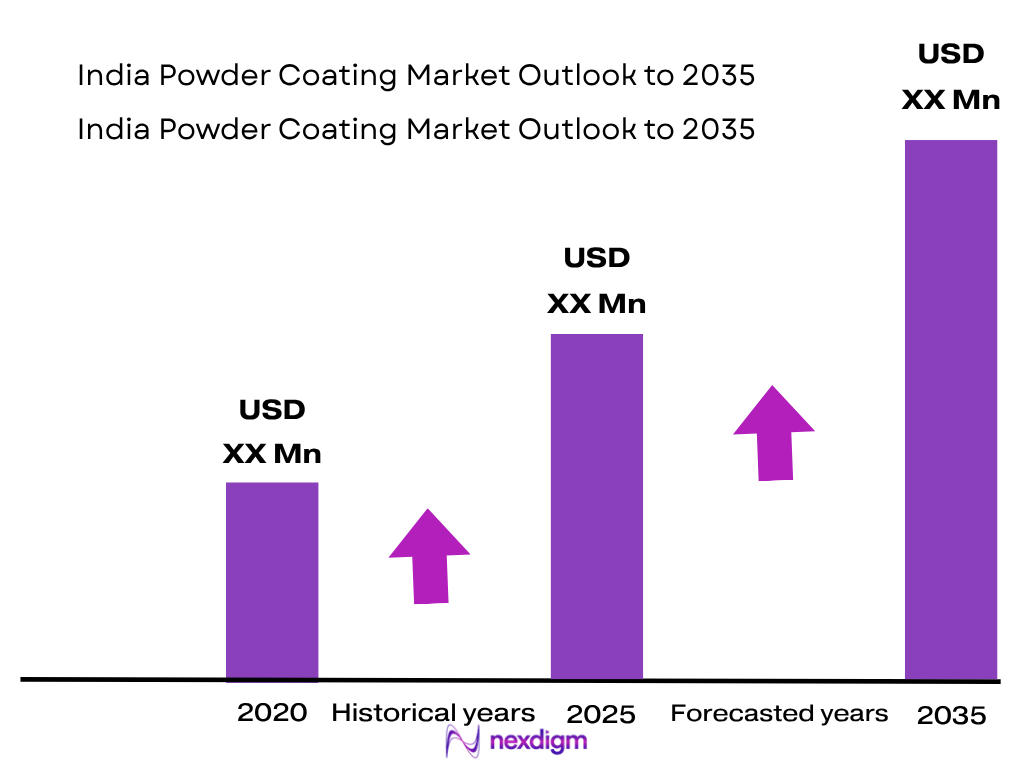
The India Powder Coating Market is valued at approximately USD ~ million, with demand supported by automotive components, white goods, architectural aluminum, electrical equipment and general industrial fabrication. Factory-sector output increased from roughly ₹142.7 trillion to ₹151.0 trillion, while factory-sector GVA rose from about ₹21.97 trillion to ₹24.58 trillion across the latest two ASI periods. Basic metals, motor vehicles and chemicals rank among India’s largest factory-sector value-added industries, directly supporting powder-coating consumption.
Maharashtra, Gujarat, Tamil Nadu, Karnataka, Uttar Pradesh, Haryana and the Delhi NCR industrial belt dominate powder-coating demand because they combine automotive, electrical equipment, fabricated metals, appliances and engineering manufacturing. Tamil Nadu, Gujarat, Maharashtra, Uttar Pradesh and Karnataka rank among the leading states for factory employment, while India’s factory sector engaged more than 18 million persons. These regions also host dense OEM, Tier-1 supplier and job-coating ecosystems requiring polyester, hybrid, epoxy and specialty powder finishes.
Market Segmentation
By Resin Chemistry
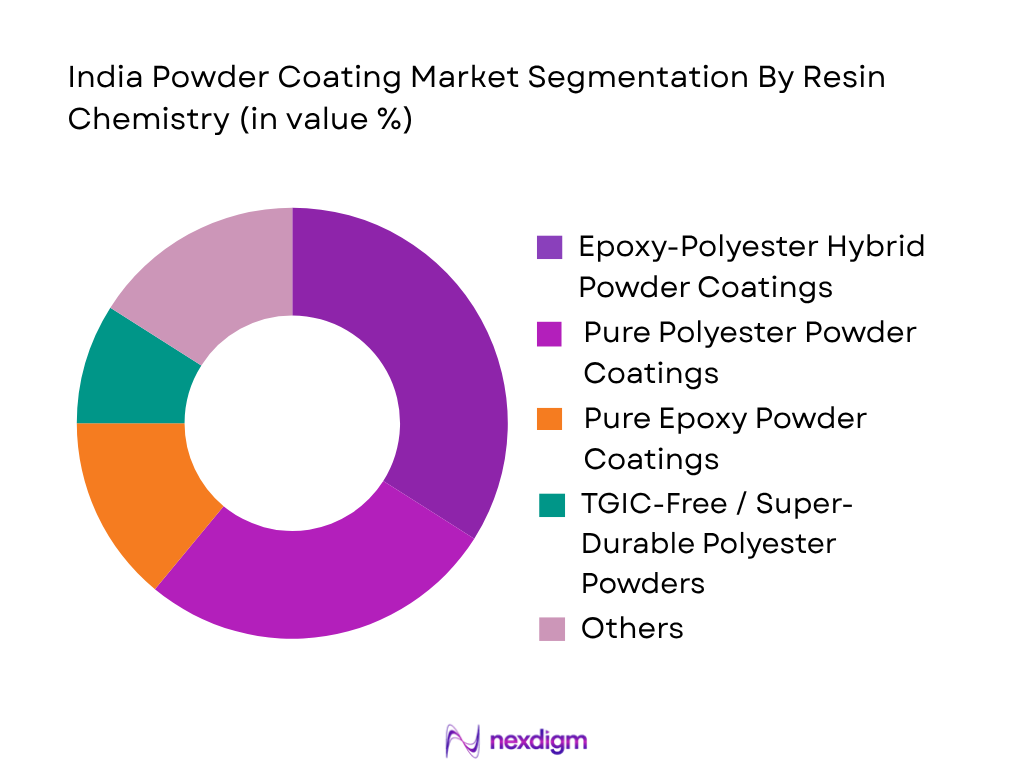
The India Powder Coating Market is segmented into epoxy-polyester hybrid, pure polyester, TGIC polyester, TGIC-free polyester, pure epoxy, polyurethane, acrylic, fluoropolymer and thermoplastic systems. Epoxy-polyester hybrid powder coatings hold the dominant position because Indian demand remains heavily concentrated in indoor industrial, appliance, electrical and furniture applications where appearance, mechanical strength and processing flexibility are important. Hybrids combine epoxy adhesion and corrosion performance with polyester-derived appearance characteristics, making them suitable for control panels, furniture, machinery housings and indoor appliance components. Pure polyester systems are increasingly important for external applications requiring better UV durability, particularly architectural aluminum, ACE equipment and automotive components. Kansai Nerolac’s Indian powder portfolio includes dedicated epoxy-polyester, epoxy and pure polyester series, while Asian Paints PPG markets the same core chemistries for industrial end users. This broad supplier support, combined with the large installed base of conventional powder lines, reinforces hybrid chemistry’s leading position while super-durable polyester and low-bake systems gain importance in higher-performance outdoor applications.
By End-Use Industry
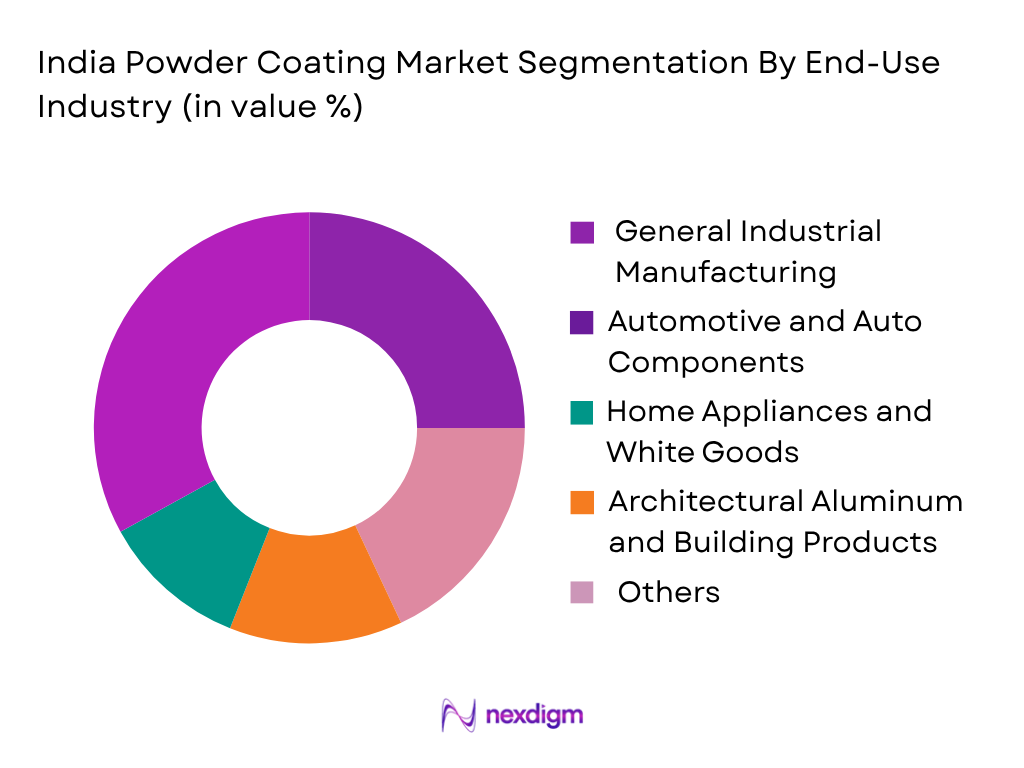
The India Powder Coating Market is segmented into general industrial manufacturing, automotive and auto components, two-wheelers, appliances, consumer electricals, architectural aluminum, furniture, ACE equipment, heavy electricals, control panels, HVAC, pipelines and renewable-energy equipment. General industrial manufacturing dominates end-use demand because powder coatings are widely applied to fabricated steel components, storage systems, lighting, machinery housings, telecom enclosures, distribution boxes and miscellaneous engineered products. The Annual Survey of Industries identifies basic metals, motor vehicles, chemicals and machinery among the leading contributors to factory-sector value added, confirming the breadth of metal-intensive manufacturing that supports powder consumption. Asian Paints PPG specifically lists telecommunications, lighting, machinery, UPS systems, IT servers, fences and distribution boxes under general industrial powder applications. Automotive and appliance demand remains strategically important because those sectors increasingly require corrosion resistance, thinner film builds, appearance consistency and energy-efficient curing, supporting higher-value powder formulations and technical-service intensity.
Competitive Landscape
The India Powder Coating Market combines large domestic coatings groups, multinational technology providers and specialized Indian powder manufacturers. Asian Paints PPG, AkzoNobel Interpon, Berger Paints, Kansai Nerolac and Jotun compete across industrial, automotive, architectural and functional powder applications. Competition is shifting from standard colors and price toward curing efficiency, specialty performance, custom formulation, application support, architectural warranties and supply responsiveness. Berger maintains powder inventory through more than 30 depots, while Asian Paints PPG offers dedicated industrial, architectural and specialty powder platforms.
| Company | Establishment Year | Headquarters | Resin Chemistry Breadth | Core Powder Applications | India Manufacturing / Supply | Functional Powder Capability | Architectural Capability | Technical Support |
| Asian Paints PPG Pvt. Ltd. | 2012 | Mumbai, India | ~ | ~ | ~ | ~ | ~ | ~ |
| AkzoNobel – Interpon | 1994 | Amsterdam, Netherlands | ~ | ~ | ~ | ~ | ~ | ~ |
| Berger Paints India Limited | 1923 | Kolkata, India | ~ | ~ | ~ | ~ | ~ | ~ |
| Kansai Nerolac Paints Limited | 1920 | Mumbai, India | ~ | ~ | ~ | ~ | ~ | ~ |
| Jotun India Pvt. Ltd. | 1926 | Sandefjord, Norway | ~ | ~ | ~ | ~ | ~ | ~ |
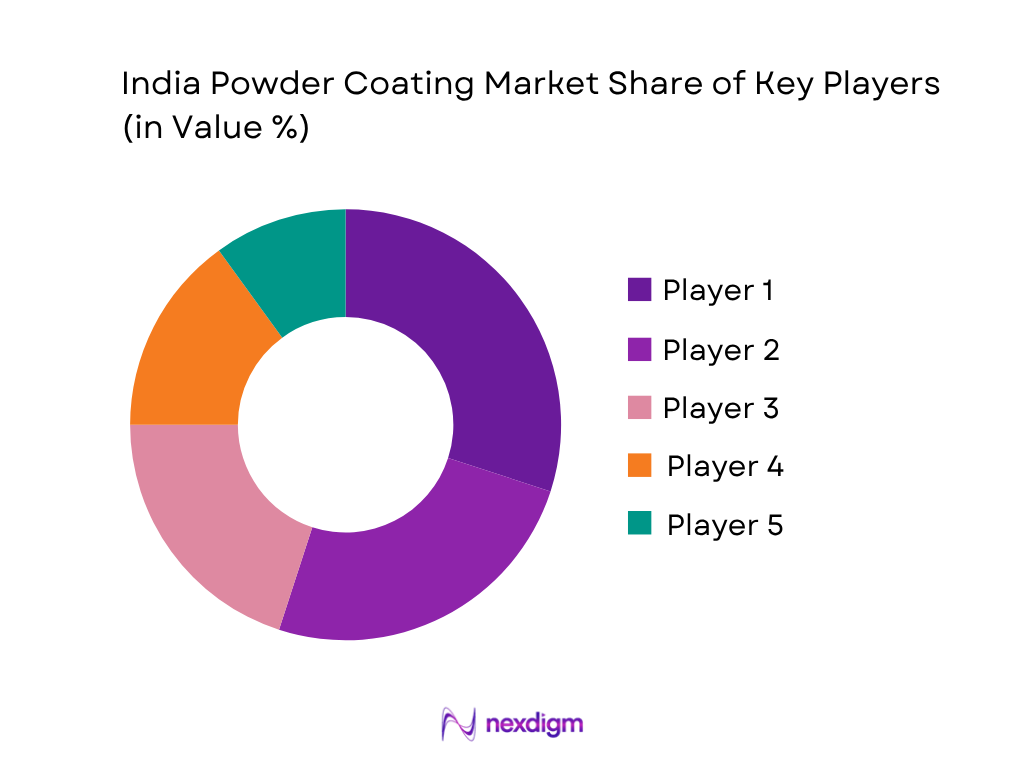
India Powder Coating Market Analysis
Growth Drivers
Expansion of Automotive and Auto-Component Manufacturing
India’s automotive manufacturing base is a major demand driver for powder coatings used on wheels, chassis parts, suspension assemblies, motorcycle frames, brake components, seat structures, battery enclosures and under-hood components. The Society of Indian Automobile Manufacturers recorded total vehicle production of 31,036,476 units in 2024-25, compared with 28,439,036 units in 2023-24. Two-wheeler production alone reached 23,883,857 units, passenger vehicles reached 5,061,164 units, commercial vehicles totaled 1,034,947 units, and three-wheelers reached 1,050,020 units. This volume provides a substantial recurring substrate base for polyester, epoxy-polyester hybrid, corrosion-resistant and heat-resistant powder systems. India’s broader macroeconomic capacity reinforces this manufacturing platform: World Bank data place nominal GDP at USD 3.761 trillion in 2024, compared with USD 3.501 trillion in 2023. Vehicle manufacturers and Tier-1 suppliers increasingly require consistent film thickness, corrosion protection and high-throughput coating processes, creating demand not only for standard powders but also for low-bake formulations, bonded metallic finishes and application-specific systems. The continuing expansion of vehicle production therefore supports higher powder consumption across captive OEM lines and specialist component coaters.
White Goods, Electrical Equipment and Industrial Manufacturing Expansion
India’s growing white-goods and electrical-equipment manufacturing ecosystem provides another significant growth driver for powder coatings used on air-conditioner components, electrical cabinets, control panels, appliance housings, fans, lighting systems and fabricated enclosures. The Ministry of Commerce and Industry reported 38 applications under the third round of the Production Linked Incentive Scheme for White Goods in 2024, with committed investment of ₹4,121 crore. Of these, 30 new applicants committed ₹2,836 crore, while existing beneficiaries proposed an additional ₹1,285 crore. In 2025, 24 companies were selected with committed investment of ₹3,516 crore, including 15 air-conditioner component manufacturers investing ₹3,260 crore and 9 LED companies investing ₹256 crore. Manufacturing momentum is also visible in official industrial-production data: the electrical-equipment production index reached 126.2 in the 2024 series, while computer, electronic and optical products recorded 123.8. World Bank data place India’s nominal GDP at USD 3.761 trillion in 2024. These investments expand metal fabrication, enclosure manufacturing and appliance-component output, supporting powder-coating demand across automated OEM lines and regional job coaters.
Market Challenges
Energy-Intensive Thermal Curing Requirements
Thermal curing remains a significant operational challenge for the India Powder Coating Market because conventional thermoset powders require substrates to reach specified metal temperatures and remain within defined cure windows. This creates substantial energy requirements for batch ovens and continuous conveyor lines, particularly when coating thick steel fabrications, agricultural equipment, electrical enclosures and heavy automotive components. Central Electricity Authority data show industrial electricity consumption of 640,626 GWh in 2023-24, increasing to 655,562 GWh in 2024-25, illustrating the scale of power consumed across India’s industrial economy. Powder-coating plants form part of this energy-intensive manufacturing structure because pretreatment, drying, compressed-air systems, powder booths and curing ovens all contribute to facility energy loads. The challenge is amplified for small and medium job coaters operating older gas-fired or electric ovens with limited thermal efficiency and inconsistent loading. India’s economic scale further raises the importance of finishing productivity, with World Bank data placing nominal GDP at USD 3.761 trillion in 2024 and constant-price GDP at approximately USD 3.434 trillion. These conditions increase the commercial relevance of low-bake powders, fast-cure systems, infrared-assisted curing and improved oven utilization as manufacturers seek higher line throughput without proportionately increasing energy requirements.
Complex Substrate Mix and Coating-Line Process Control
India’s powder-coating industry serves a highly diverse manufacturing base, creating technical challenges around pretreatment consistency, grounding, film build, curing and formulation qualification. Official industrial-production data illustrate this diversity: fabricated metal products recorded an index reading of 100.3 in the 2024 series, electrical equipment reached 126.2, and computer, electronic and optical products recorded 123.8. Meanwhile, vehicle manufacturing reached 31,036,476 units in 2024-25, covering passenger vehicles, commercial vehicles, three-wheelers and two-wheelers with different substrates and coating specifications. Such application diversity means one powder system cannot satisfy every requirement. Mild steel may require phosphate or nano-ceramic pretreatment, aluminum demands different surface preparation, and electrical components may require dielectric performance beyond decorative protection. Variations in degreasing, rinse-water quality, grounding, powder reclaim ratios and oven temperature can produce adhesion failures, color variation, orange peel or insufficient corrosion resistance even when the powder formulation itself is compliant. India’s nominal GDP reached USD 3.761 trillion in 2024, reflecting the scale of the industrial economy requiring standardized finishing performance. The challenge is therefore increasingly centered on process control and technical service, particularly among regional job coaters serving multiple OEM specifications.
Market Opportunities
Low-Bake and Fast-Cure Powder Coating Technologies
Low-temperature and fast-curing powders represent a strong future opportunity because India already has a large industrial energy and manufacturing base where reduced oven temperatures can improve line productivity and widen the range of components suitable for powder coating. Industrial electricity consumption reached 655,562 GWh in 2024-25, compared with 640,626 GWh in 2023-24, demonstrating the scale of energy demand across manufacturing facilities. At the same time, vehicle production reached 31,036,476 units in 2024-25, while electrical-equipment industrial production recorded an index value of 126.2 in official 2024 data. These current conditions provide a substantial installed base of metal components and coating lines where lower curing temperatures or shorter dwell times could reduce oven loading and increase throughput. Low-bake technology is particularly relevant for thick fabricated parts that require extended heating before reaching conventional cure temperatures, while fast-cure formulations can improve productivity on high-volume appliance, automotive and electrical-component lines. World Bank data place India’s nominal GDP at USD 3.761 trillion in 2024, supporting continued industrial modernization. Suppliers that can combine lower cure requirements with corrosion resistance, appearance consistency and stable powder recovery have an opportunity to replace conventional formulations across OEM and job-coating operations.
White Goods, EV Components and Functional Powder Applications
India’s expanding appliance, electrical and mobility manufacturing base creates future opportunities for functional powder coatings designed for dielectric insulation, corrosion protection, heat resistance and specialized component finishing. The government’s white-goods PLI program had 84 participating companies after the 2025 selections, with cumulative committed investment of ₹10,478 crore and planned production of ₹172,663 crore during the scheme period. The third selection round alone included 15 air-conditioner component manufacturers committing ₹3,260 crore. Automotive production simultaneously reached 31,036,476 vehicles in 2024-25, including 5,061,164 passenger vehicles and 23,883,857 two-wheelers, creating a substantial present-day base of frames, motors, electrical housings, suspension parts and other powder-coatable components. Electrical-equipment industrial production recorded an index of 126.2 in official 2024 data, further supporting demand for powder-coated panels, cabinets, busbar systems and control equipment. India’s nominal GDP stood at USD 3.761 trillion in 2024, providing the macroeconomic base for continued industrial investment. These existing manufacturing volumes create future scope for dielectric powders, high-temperature coatings, antimicrobial finishes, super-durable polyesters and corrosion-resistant systems that provide functional performance beyond conventional color and appearance.
Future Outlook
The India Powder Coating Market is forecast to expand at approximately ~X.X% CAGR during 2026–2035, with the final rate retained as a placeholder for the proprietary market model. Future growth is expected to shift progressively toward low-bake, fast-cure, super-durable architectural, dielectric and corrosion-protection powders as Indian OEMs modernize coating lines and improve finishing productivity. Automotive and auto-component manufacturing should remain an important growth platform because powder coatings already serve motorcycle frames, chassis components, brake parts, filter housings, suspension systems and wheels. Kansai Nerolac identifies applications spanning two-wheelers and four-wheelers, while Asian Paints PPG supplies powder coatings for chassis, engine blocks, coil springs and suspension components.
White-goods manufacturing is another high-potential application. In 2024, 38 companies applied under the third round of India’s white-goods PLI scheme with committed investment of ₹4,121 crore, including 30 new applicants proposing ₹2,836 crore of investment in air-conditioner and LED component manufacturing. This manufacturing expansion creates coating opportunities in sheet-metal panels, compressors, motors, heat-exchanger components and electrical housings.
Major Players
- Asian Paints PPG Pvt. Ltd.
- AkzoNobel Powder Coatings India – Interpon
- Berger Paints India Limited
- Kansai Nerolac Paints Limited
- Jotun India Pvt. Ltd.
- Axalta Coating Systems India Pvt. Ltd.
- TIGER Coatings & Inks India Pvt. Ltd.
- Rapid Engineering Co. Pvt. Ltd. – Rapidcoat
- Maharani Innovative Paints Pvt. Ltd.
- Haryana Coating Pvt. Ltd. – Tuff Coat
- Nivera Paints India Pvt. Ltd.
- Premium Powder Mfg. Co.
- Maestro Coats LLP
- Prism Colour Coats
- Neat Koat Speciality Inc.
Key Target Audience
- Powder Coating Manufacturers
- Powder Coating Resin, Pigment and Additive Suppliers
- Job Coaters and Surface Finishing Companies
- Automotive, Appliance, Architectural and Electrical OEMs
- Powder Application Equipment and Finishing Line Manufacturers
- Industrial Coatings Distributors and Regional Stockists
- Investments and Venture Capitalist Firms
- Government and Regulatory Bodies (Central Pollution Control Board, Ministry of Environment Forest and Climate Change, Department for Promotion of Industry and Internal Trade, Ministry of Heavy Industries, Bureau of Indian Standards)
Research Methodology
Step 1: Identification of Key Variables
The initial research stage creates an ecosystem map of powder manufacturers, resin and pigment producers, distributors, job coaters, pretreatment suppliers, equipment manufacturers and OEM finishers. Key variables include resin chemistry, powder consumption, cure temperature, film thickness, transfer efficiency, reclaim practices, manufacturing footprint and end-use application intensity.
Step 2: Market Analysis and Construction
Historical market demand is developed through top-down and bottom-up modeling. Top-down analysis evaluates automotive manufacturing, white goods, electrical equipment, architectural aluminum and general industrial output, while bottom-up analysis assesses powder manufacturer revenues, job-coater throughput, distribution volumes and OEM captive finishing consumption. Organized and regional supplier volumes are analyzed separately.
Step 3: Hypothesis Validation and Expert Consultation
Market hypotheses are validated through CATI and structured discussions with powder formulators, distributors, application-equipment suppliers, job coaters and OEM procurement teams. Interviews test assumptions around resin preference, color-change frequency, powder recovery, line utilization, cure constraints, supplier qualification and custom-formulation requirements. Feedback is used to reconcile supply-side and demand-side market estimates.
Step 4: Research Synthesis and Final Output
The final stage triangulates government manufacturing statistics, supplier information, primary interviews and coating-line benchmarks. Powder demand is cross-checked against coated surface area, film build, reclaim rate and OEM production intensity. Forecast scenarios incorporate manufacturing expansion, white-goods localization, EV production, architectural demand, low-bake technology adoption and liquid-to-powder conversion.

- Executive Summary
- Research Methodology (Market Definition and Scope, India Powder Coating Taxonomy, Thermoset and Thermoplastic Powder Classification, Resin Chemistry Mapping, Functional and Decorative Powder Classification, Substrate Mapping, Surface Pretreatment Assessment, Electrostatic Application Technology Assessment, Cure Technology Assessment, Film Thickness Assessment, Powder Recovery and Reclaim Assessment, Market Sizing Framework)

- Definition and Scope
- India Powder Coating Industry Evolution and Technology Development
- Powder Coating Manufacturing and Formulation Process
- Powder Coating Value Chain Analysis
- India Powder Coating Supply Chain Analysis
- Resin, Pigment, Additive and Filler Ecosystem Analysis
- India Powder Coating Import Dependency and Localization Assessment
- OEM Powder Coating Application Architecture and Job-Coater Solution Framework

- Growth Drivers (Expansion of Automotive and Auto Component Manufacturing, White Goods and Consumer Electrical Production, Infrastructure and Architectural Aluminum Demand, Agricultural and Construction Equipment Manufacturing, Electrical Equipment Expansion, Liquid-to-Powder Conversion, VOC Reduction Requirements, High Powder Recovery and Material Utilization)
- Market Challenges (Polyester and Epoxy Resin Volatility, Energy-Intensive Cure Requirements, Fragmented Job-Coater Ecosystem, Pretreatment Quality Variation, Powder Recovery Discipline, Color Change Downtime, Price Competition from Regional Manufacturers, Skilled Finishing Workforce Constraints)
- Market Opportunities (Low-Bake and Fast-Cure Powders, EV Battery and Electrical Insulation Powders, Super-Durable Architectural Coatings, Fusion-Bonded Epoxy for Pipelines and Rebar, Antimicrobial Powder Coatings, Powder-on-MDF Applications, Automated Powder Application Systems, Liquid-to-Powder Line Conversion)
- Market Trends (TGIC-Free Polyester Adoption, Low-Bake Fast-Cure Systems, Super-Durable Architectural Powders, Bonded Metallic Finishes, Functional Powder Coatings, Robotic Application, Dense-Phase Powder Delivery, OEM-Specific Custom Formulation)
- Regulatory and Standards Landscape (Central Pollution Control Board Industrial Emission Requirements, Air Prevention and Control of Pollution Act Requirements, Environment Protection Rules, State Pollution Control Board Consent Requirements, Hazardous and Other Wastes Management Requirements, Occupational Safety and Health Requirements, Bureau of Indian Standards Requirements, ASTM and ISO Powder Coating Test Methods)
- SWOT Analysis
- Porter’s Five Forces Analysis
- PESTLE Analysis
- Stakeholder Ecosystem
- Competition Ecosystem

- By Market Value (2020-2025)
- By Powder Coating Consumption Volume (2020-2025)
- By Coated Surface Area (2020-2025)
- By Domestic Production Volume (2020-2025)
- By Import Volume (2020-2025)
- By Export Volume (2020-2025)
- By Average Selling Price (2020-2025)
- By Thermoset Powder Consumption (2020-2025)
- By Thermoplastic Powder Consumption (2020-2025)

- By Resin Chemistry (In Value %)
Epoxy-Polyester Hybrid Powder Coatings
Pure Polyester Powder Coatings
TGIC Polyester Powder Coatings
TGIC-Free Polyester Powder Coatings
Super-Durable Polyester Powder Coatings
Pure Epoxy Powder Coatings
Polyurethane Powder Coatings
Acrylic Powder Coatings
Fluoropolymer Powder Coatings
Silicone Polyester Powder Coatings
Nylon Powder Coatings
Polyethylene Powder Coatings
Other Specialty Thermoplastic Powders - By Coating Technology (In Value %)
Thermosetting Powder Coatings
Thermoplastic Powder Coatings
Low-Temperature Cure Powder Coatings
Low-Bake Fast-Cure Powder Coatings
Ultra-Low-Bake Powder Coatings
UV-Curable Powder Coatings
Thin-Film Powder Coatings
High-Temperature Resistant Powder Coatings - By Functional Performance (In Value %)
Decorative Powder Coatings
Corrosion-Resistant Powder Coatings
Super-Durable Architectural Powders
High-Temperature Powder Coatings
Heat-Reflective Powder Coatings
Electrical Insulation and Dielectric Powders
Antimicrobial Powder Coatings
Anti-Graffiti Powder Coatings
Scratch-Resistant Powder Coatings
Chemical-Resistant Powder Coatings
Fire-Retardant Powder Coatings
Fusion-Bonded Epoxy Powders
Rebar Powder Coatings
Zinc-Rich and Zinc-Free Powder Primers - By End-Use Industry (In Value %)
General Industrial Manufacturing
Automotive and Auto Components
Two-Wheelers and Three-Wheelers
Commercial Vehicles
Electric Vehicles and EV Components
Home Appliances and White Goods
Fans and Consumer Electricals
Architectural Aluminum and Building Products
Furniture and Office Equipment
Agricultural and Construction Equipment
Heavy Electrical Equipment
Switchgear and Control Panels
HVAC and Refrigeration Equipment
Metal Fabrication
Pipes and Pipelines
Rebar and Construction Steel
Oil and Gas Equipment
Solar and Renewable Energy Equipment - By Distribution Channel (In Value %)
Direct Powder Manufacturer-to-OEM Sales
Direct Manufacturer-to-Job Coater Sales
Authorized Powder Coating Distributors
Industrial Paint and Coating Distributors
Regional Stocking Depots
Dealer and Reseller Networks
Equipment and Powder Bundled Distribution
Online B2B Industrial Platforms
Custom Color and Small-Batch Channels - By Region (In Value %)
North India
Delhi NCR
Haryana
Punjab
Uttar Pradesh
Rajasthan
West India
Maharashtra

- Market Share of Major Players (By Revenue, Volume, Resin Chemistry, Powder Technology, End-Use Industry, Application Type, Market Type, Distribution Channel)
- Cross Comparison Parameters (Resin Chemistry and Powder Technology Breadth, India Powder Manufacturing and Extrusion Capacity, Low-Bake and Fast-Cure Technology Capability, Architectural Super-Durable and Hyper-Durable Portfolio Strength, Functional and High-Performance Powder Capability, Custom Color Matching and Small-Batch Formulation Flexibility, Pan-India Distribution and Technical Application Support, Sustainable and TGIC-Free Low-Energy Powder Portfolio)
- SWOT Analysis of Major Players
- Competitive Positioning Matrix
- Product and Technology Portfolio Benchmarking
- Pricing and Distribution Network Benchmarking
- Market Entry Strategy Assessment
- Detailed Profiles of Major Companies
Asian Paints PPG Pvt. Ltd.
AkzoNobel Powder Coatings India – Interpon
Berger Paints India Limited
Kansai Nerolac Paints Limited
Jotun India Pvt. Ltd.
Axalta Coating Systems India Pvt. Ltd.
TIGER Coatings & Inks India Pvt. Ltd.
Rapid Engineering Co. Pvt. Ltd. – Rapidcoat
Maharani Innovative Paints Pvt. Ltd.
Haryana Coating Pvt. Ltd. – Tuff Coat
Nivera Paints India Pvt. Ltd.
Premium Powder Mfg. Co.
Maestro Coats LLP
Prism Colour Coats
Neat Koat Speciality Inc.

- Buyer Segmentation
- OEM Procurement Behaviour
- Supplier Selection Criteria
- Buyer Pain Points
- Technology Adoption Assessment
- Replacement and Repurchase Behaviour

- By Market Value (2026-2035)
- By Powder Coating Consumption Volume (2026-2035)
- By Coated Surface Area (2026-2035)
- By Domestic Production Volume (2026-2035)
- By Import Volume (2026-2035)
- By Export Volume (2026-2035)
- By Average Selling Price (2026-2035)
- By Thermoset Powder Consumption (2026-2035)
- By Thermoplastic Powder Consumption (2026-2035)


 Request a Sample
 Ask for Customization
 Get a Quote
 Enquire Now