
 Download PDF
Market Overview
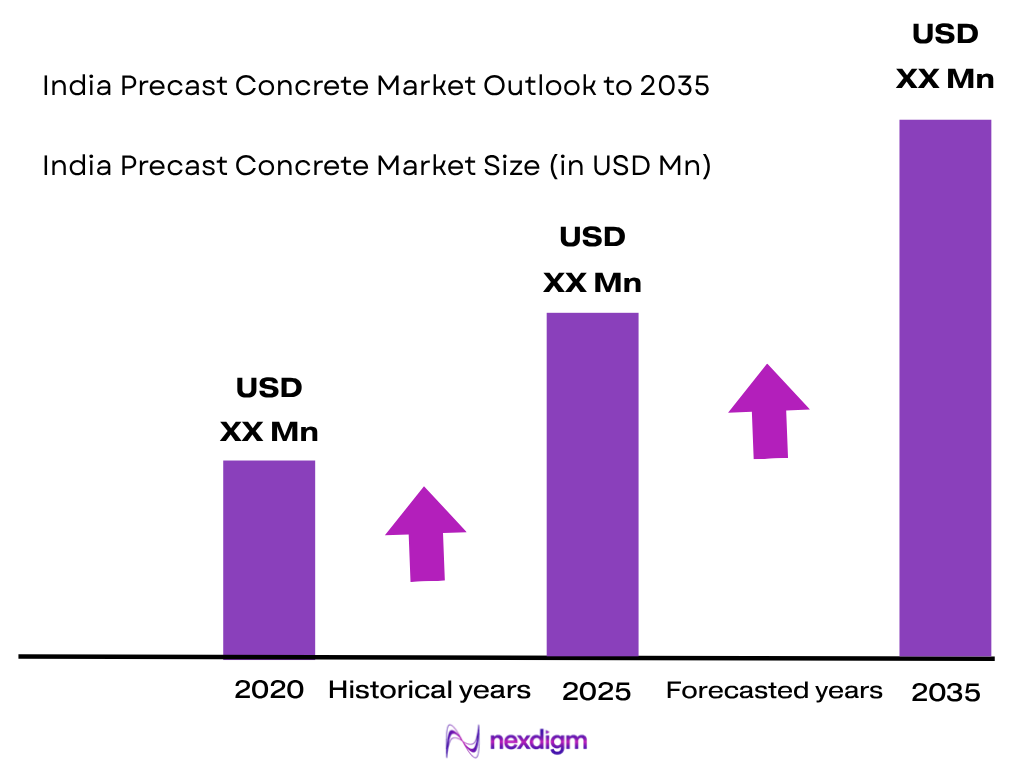
The India Precast Concrete Market was valued at USD 6.69 billion in the latest published 2024 estimate. The market is supported by increasing urbanization, large-scale residential development, infrastructure construction and the requirement for faster project execution. Precast concrete enables factory-controlled production, standardized quality and faster on-site assembly, making it relevant to housing, commercial buildings, transportation infrastructure and industrial construction. Published industry analysis identifies beams, slabs and columns as the leading product category, while infrastructure is the leading end-use segment.
India’s precast concrete demand is concentrated around major construction and infrastructure centres where residential, commercial, industrial, metro, highway and airport projects create recurring requirements for standardized concrete components. Maharashtra, Gujarat and Tamil Nadu are particularly important markets because of their large infrastructure and industrial project pipelines. Metropolitan regions such as Mumbai, Pune, Chennai, Bengaluru, Hyderabad and Delhi NCR also support adoption through high-rise construction and large housing developments. Government-backed housing and infrastructure programs further support the use of industrialized construction technologies, including precast structural systems.
Market Segmentation
By Product Type
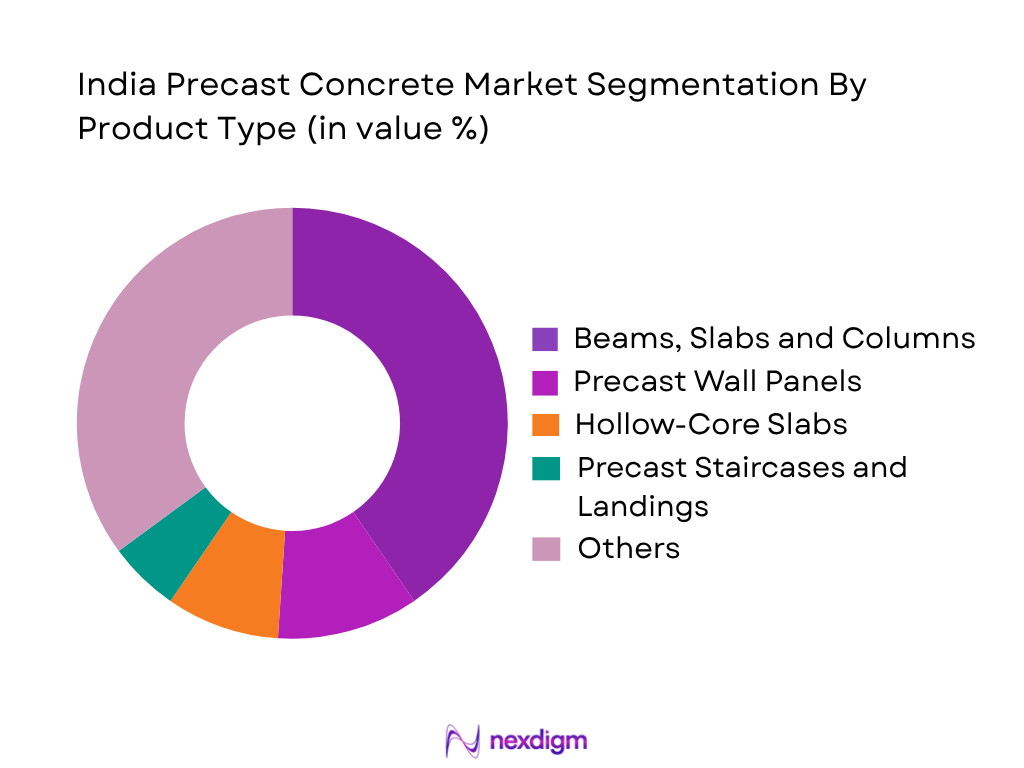
The India Precast Concrete Market is segmented by product type into beams, slabs and columns, precast wall panels, hollow-core slabs, precast staircases and landings, precast roof and floor systems, road barriers and dividers, box culverts and drainage products, railway sleepers, metro and viaduct segments, bridge girders and deck components, precast pipes and utility products, 3D precast modules and modular units, and architectural precast components. Beams, slabs and columns represent the leading sub-segment in the published market framework because these components have broad applicability across residential, commercial, industrial and infrastructure construction. Their standardized geometry makes them suitable for factory production and repetitive installation, supporting faster construction and consistent quality. Published market analysis places this category at 38.56% of 2024 market revenue. Demand is further supported by high-rise housing, warehouses, commercial buildings and infrastructure projects where repetitive structural components can reduce on-site construction requirements. Hollow-core slabs and precast wall systems are also gaining relevance as developers seek faster construction and lower site labour requirements.
By End-Use Industry
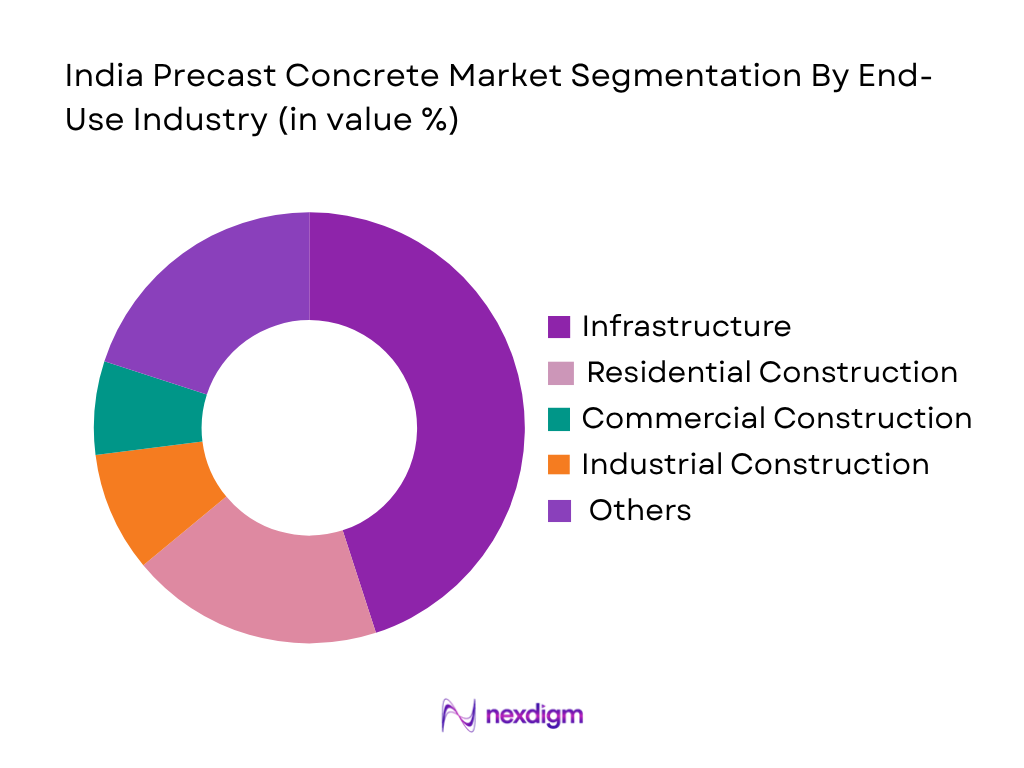
The India Precast Concrete Market is segmented by end-use industry into infrastructure, residential construction, commercial construction, industrial construction, institutional construction, transportation infrastructure, railways and metro infrastructure, roads and highways, water and wastewater infrastructure, power and utility infrastructure, warehousing and logistics, data centres, and hospitality and tourism infrastructure. Infrastructure represents the leading end-use category because precast concrete is extensively used in highways, bridges, metro systems, railway infrastructure, drainage structures, utility installations and other large-scale civil-engineering projects. Published market analysis identifies infrastructure as accounting for 44.9% of 2024 market revenue. Precast products are particularly relevant to infrastructure because repetitive components can be manufactured under controlled factory conditions and transported to construction sites for rapid installation. Metro segments, bridge components, road barriers, culverts and drainage products also benefit from standardized production. Residential and commercial construction provide another significant demand base, particularly in metropolitan areas where developers require faster project completion
Competitive Landscape
The India Precast Concrete Market includes large engineering and construction companies, specialized precast manufacturers, building-technology providers and cement-sector companies with integrated construction capabilities. The competitive environment includes companies such as Larsen & Toubro Construction, B.G. Shirke Construction Technology, Godrej Construction, SOBHA, PSP Projects, Magicrete, Fuji Silvertech Concrete, UltraTech Cement and Toyota Forms. Competition is shaped by manufacturing capacity, product breadth, project execution capabilities, geographic coverage, automation, engineering expertise and the ability to deliver large infrastructure and building projects. Published industry sources identify several of these companies among the principal participants in India’s precast concrete ecosystem.
| Company | Establishment Year | Headquarters | Precast Capability | Key Product Focus | Infrastructure Exposure | Building Construction Exposure | Manufacturing Capability | Geographic Reach |
| Larsen & Toubro Construction | 1938 | Mumbai, India | ~ | ~ | ~ | ~ | ~ | ~ |
| B.G. Shirke Construction Technology | 1971 | Pune, India | ~ | ~ | ~ | ~ | ~ | ~ |
| Godrej Construction | 1897 | Mumbai, India | ~ | ~ | ~ | ~ | ~ | ~ |
| SOBHA Limited | 1995 | Bengaluru, India | ~ | ~ | ~ | ~ | ~ | ~ |
| Fuji Silvertech Concrete | 2010 | Ahmedabad, India | ~ | ~ | ~ | ~ | ~ | ~ |
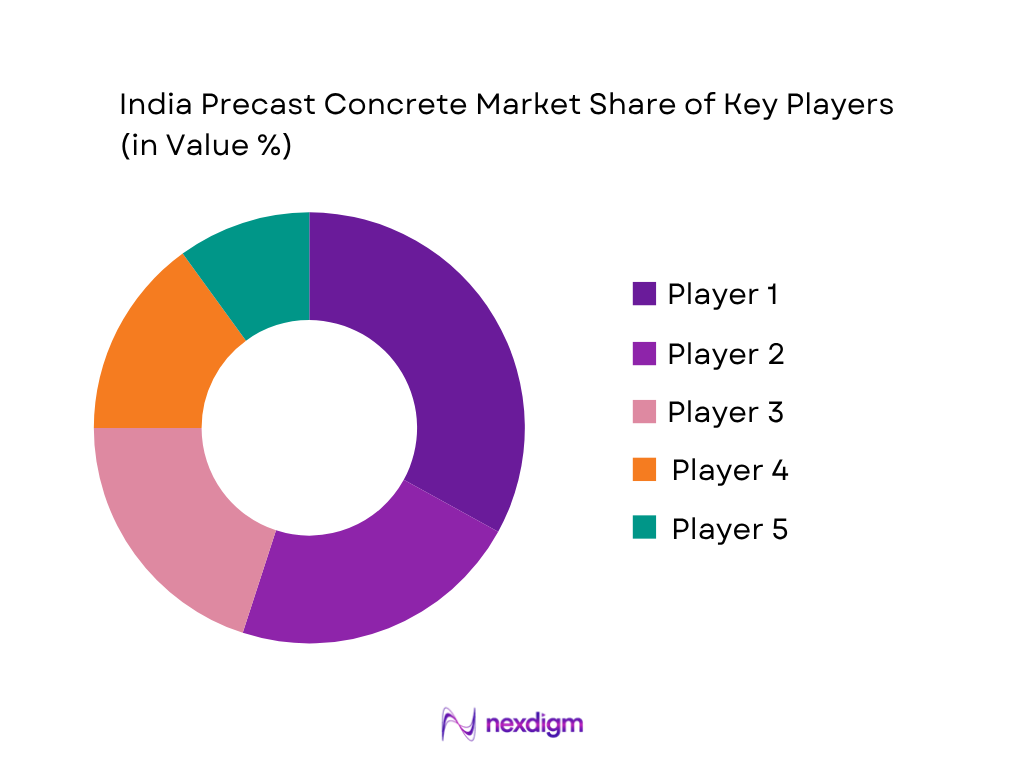
India Precast Concrete Market Analysis
Growth Drivers
Infrastructure-led construction investment
The India Precast Concrete Market is supported by sustained infrastructure investment, which directly expands demand for standardized structural and civil-engineering components. The IMF reported gross investment at 33.6% of GDP for FY2024-25, while bank credit to the private sector recorded 13.0 growth during the same period, indicating continued financing capacity for construction-linked activity. The Government of India also maintained a strong capital-expenditure orientation, with Union government capital expenditure reaching ₹9.5 lakh crore in FY2023-24 and state capital spending reaching ₹9.6 lakh crore on a budget-estimate basis. Infrastructure spending is particularly relevant to precast concrete because bridges, metro systems, rail infrastructure, roads, drainage networks and industrial facilities require repeatable components that can be manufactured away from the construction site. The national highway network reached 146,145 km, while four-lane-and-above highways reached 48,422 km, creating a substantial infrastructure base requiring continued construction and upgrading. These conditions support demand for precast beams, slabs, columns, barriers, pipes, culverts and other components. The World Bank also records industry, including construction, as a major component of India’s economic output, reinforcing the importance of construction activity to industrial demand.
Expansion of construction output and industrialized building methods
The India Precast Concrete Market is gaining support from the expansion of construction output and increasing emphasis on productivity within large-scale building projects. India’s construction output at constant prices increased from ₹70,44,362 crore in FY2023-24 to ₹75,47,815 crore in FY2024-25, while construction gross value added increased from ₹23,18,266 crore to ₹24,87,430 crore, according to the latest national accounts estimates. Gross capital formation within construction remained substantial at ₹6,91,885 crore in FY2024-25, demonstrating continued investment in productive construction capacity. These conditions create opportunities for precast concrete because factory-produced components can standardize dimensions, improve production scheduling and reduce dependence on prolonged on-site fabrication. The World Bank’s macroeconomic database also identifies industry, including construction, as a major contributor to India’s economic structure, while its data indicate continued urban population growth of 2.2 annual units in the latest reported period. Increasing urban construction density makes construction speed increasingly important for developers and contractors. Precast solutions are therefore relevant to residential towers, warehouses, industrial facilities, commercial buildings, transport structures and public infrastructure where repetitive structural elements can be manufactured in controlled environments and installed through coordinated construction schedules.
Market Challenges
Transportation and logistics constraints for heavy precast components
The India Precast Concrete Market faces logistical constraints because large and heavy components must be transported from manufacturing facilities to project sites, often across substantial distances. India’s national highway network stood at 146,145 km, while the network of four-lane-and-above highways reached 48,422 km, demonstrating the scale of the country’s road infrastructure but also highlighting the geographic distances involved in nationwide construction activity. The Economic Survey reported that net bank credit flow to infrastructure sectors between March 2023 and March 2024 was around ₹79,000 crore, while infrastructure-sector credit growth reached 6.5 in FY2024, reflecting continued but selective financing conditions. Precast manufacturers therefore need efficient plant locations, specialized transport arrangements, lifting equipment and coordinated delivery schedules. Large beams, columns, wall panels and other structural elements can face route restrictions, handling requirements and site-access limitations that do not affect conventional in-situ concrete to the same degree. These logistical requirements can become particularly significant for projects located far from manufacturing clusters. The challenge is market-specific because transportation efficiency directly influences the feasibility of using factory-produced concrete components. Expansion of roads and freight infrastructure can gradually improve accessibility, but manufacturers still need regional production networks and project-specific logistics planning to manage movement, storage and installation requirements.
Dependence on project coordination, skilled installation and capital-intensive production
The India Precast Concrete Market faces operational challenges because successful deployment requires close coordination between design, manufacturing, transportation, lifting and installation activities. The IMF reported gross investment at 33.6% of GDP for FY2024-25 and private-sector bank credit growth at 13.0, demonstrating the scale of investment activity but also the importance of efficient capital deployment. Precast manufacturing requires dedicated production facilities, moulds, reinforcement systems, curing infrastructure, quality-control processes and specialized lifting equipment. The economic challenge becomes more pronounced when projects have changing designs, irregular component requirements or delays between manufacturing and site readiness. India’s construction sector recorded gross capital formation of ₹6,91,885 crore in FY2024-25, illustrating the substantial capital base involved across construction activities. For precast suppliers, manufacturing components before the installation site is ready can create inventory and storage requirements, while changes in project specifications can result in additional fabrication work. Installation also requires coordinated cranes, transport vehicles and trained crews capable of positioning and connecting large structural elements safely. These factors make project scheduling, engineering coordination and production planning critical to maintaining the economic advantages of precast construction.
Market Opportunities
Infrastructure modernization and transportation construction
The India Precast Concrete Market has opportunities from continued modernization of roads, railways, urban transportation and related infrastructure. India’s national highway network reached 146,145 km, while the length of four-lane-and-above national highways reached 48,422 km and operational high-speed highway corridors reached about 2,138 km. Indian Railways had more than 68,584 route km and capital expenditure of ₹2.62 lakh crore in FY2023-24, with spending directed toward new lines, gauge conversion and doubling. These infrastructure programs create applications for precast sleepers, drainage structures, bridge components, boundary systems, retaining elements, utility structures, station components and other standardized concrete products. The Economic Survey also reported ₹9.5 lakh crore of Union government capital expenditure in FY2023-24 and ₹9.6 lakh crore of combined state capital spending on a budget-estimate basis. This investment environment provides a broad project base for manufacturers capable of supplying standardized components at scale. The opportunity is particularly relevant where construction programs involve repetitive designs and large quantities, because factory production can support consistent dimensional quality and coordinated installation. Continued infrastructure development therefore provides precast manufacturers with opportunities to expand beyond conventional building components into transportation, utilities, rail, road and public-infrastructure applications.
Urban construction and modular building adoption
The India Precast Concrete Market has opportunities from urban development and the increasing application of industrialized construction methods in high-density projects. World Bank data show India’s urban population growth at 2.2 annual units in the latest reported period, while electric power consumption reached 841.1 kWh per capita in the corresponding data series, reflecting the continuing expansion of urban economic activity and infrastructure requirements. India’s construction output reached ₹75,47,815 crore at constant prices in FY2024-25, while construction gross value added reached ₹24,87,430 crore. This scale of construction creates opportunities for precast manufacturers supplying residential towers, commercial buildings, warehouses, data centres, industrial facilities, schools and public buildings. Precast walls, floor slabs, staircases, columns, beams and façade components can support repetitive building designs and help coordinate construction across large developments. The opportunity is strengthened where developers seek predictable production schedules and standardized quality across multiple buildings within a project. India’s strong investment environment, with gross investment recorded at 33.6 of GDP by the IMF for FY2024-25, provides a supportive macroeconomic backdrop for continued construction activity. As urban projects become larger and more standardized, manufacturers with engineering, fabrication, transport and installation capabilities can participate across multiple stages of the building process.
Future Outlook
Over the next decade, the India Precast Concrete Market is expected to benefit from increasing adoption of industrialized construction, infrastructure development, urban housing and modular construction techniques. Demand is likely to extend across structural building components, transportation infrastructure, metro systems, highways, industrial buildings and mass housing. Automation, standardized mould systems, digital design and factory-controlled production can improve manufacturing consistency and support larger project volumes. The increasing requirement for faster construction can further encourage developers and contractors to use precast systems where repetitive components and controlled installation conditions are suitable.
The market is also positioned to benefit from technological developments in prestressed concrete, high-performance concrete, automated production lines and digital coordination through BIM. Specialist applications such as data centres, logistics facilities, industrial buildings and large residential developments can create additional demand for engineered precast components. The increasing use of prefabricated construction can also expand opportunities for modular wall, floor, staircase and structural systems. Infrastructure applications remain particularly important because precast technology is compatible with repetitive components required in highways, bridges, railways, metros, drainage and utility projects.
Major Players
- Larsen & Toubro Construction
- B.G. Shirke Construction Technology
- Godrej Construction
- SOBHA Limited
- PSP Projects Limited
- Precast India Infrastructures Pvt. Ltd.
- VME Precast Pvt. Ltd.
- Hindustan Prefab Limited
- Magicrete Building Solutions Pvt. Ltd.
- Fuji Silvertech Concrete Pvt. Ltd.
- AACP Infrastructure Systems Pvt. Ltd.
- Schwing Stetter India
- UltraTech Cement Limited
- Toyota Forms India Pvt. Ltd.
- Vollert India Pvt. Ltd.
Key Target Audience
- Real Estate Developers and Large Residential Developers
- Infrastructure Developers and EPC Contractors
- Precast Concrete Manufacturers and Construction Technology Providers
- Cement, Aggregates, Reinforcement Steel and Construction Material Companies
- Investments and Venture Capitalist Firms
- Government and Regulatory Bodies (Ministry of Housing and Urban Affairs, Ministry of Road Transport and Highways, Ministry of Railways, National Highways Authority of India)
- Metro Rail Corporations and Transportation Infrastructure Authorities
- Industrial, Logistics, Data Centre and Warehousing Developers
Research Methodology
Step 1: Identification of Key Variables
The initial phase involves constructing an ecosystem map encompassing precast manufacturers, construction companies, infrastructure developers, material suppliers, equipment providers and government infrastructure agencies. Secondary research is used to identify production capacities, product categories, project pipelines and major demand centres. The analysis establishes the variables required to measure product-level and end-use demand.
Step 2: Market Analysis and Construction
Historical market information is compiled across structural precast, architectural precast, transportation products, utility products and modular systems. Demand is assessed across residential, commercial, industrial and infrastructure applications. Production capacity, project activity, construction investment and product utilization are evaluated to establish the market structure and determine the contribution of individual segments.
Step 3: Hypothesis Validation and Expert Consultation
Market hypotheses are developed from secondary research and subsequently evaluated through interviews with precast manufacturers, EPC contractors, developers, infrastructure companies and construction specialists. Discussions focus on production utilization, project specifications, procurement patterns, technology adoption and capacity expansion. These inputs are used to validate assumptions and identify differences between nominal capacity and active market demand.
Step 4: Research Synthesis and Final Output
The final phase integrates supply-side and demand-side findings through top-down and bottom-up calculations. Company-level information, project pipelines, product volumes, end-use requirements and regional construction activity are triangulated to produce the final market assessment. The resulting framework provides estimates by product, end use, application and geography and establishes the basis for the long-term forecast.

- Executive Summary
- Research Methodology (Market Definitions and Assumptions, India Precast Concrete Market Classification, Precast Product Mapping, Structural Precast Assessment, Architectural Precast Assessment, Prestressed Concrete Assessment, Reinforced Precast Assessment, Modular Precast Assessment, Hollow-Core Slab Assessment, Precast Beam and Column Assessment, Precast Wall Panel Assessment, Precast Staircase Assessment, Precast Road Barrier Assessment, Precast Drainage Product Assessment, Box Culvert Assessment, Railway Sleeper Assessment, Metro Segment Assessment, Bridge Girder Assessment, Utility Precast Assessment, Precast Manufacturing Capacity Assessment, Factory Automation Assessment, Mould and Formwork Assessment, Steam-Curing Assessment, Concrete Mix Design Assessment, Reinforcement and Prestressing Assessment, Quality Certification Assessment, Transportation and Erection Assessment, Construction Project Pipeline Assessment, Supply-Side Assessment, Demand-Side Assessment, Top-Down Market Sizing, Bottom-Up Market Sizing, Primary Industry Interviews, Infrastructure Pipeline Assessment, Data Triangulation, Forecasting Framework)

- Definition and Scope
- India Precast Concrete Industry Evolution and Development of Structural Precast Components, Prestressed Concrete Systems, Precast Building Panels, Hollow-Core Slabs, Precast Beams and Columns, Precast Staircases, Modular Precast Construction, Precast Housing Systems, Road Barriers, Box Culverts, Drainage Products, Railway Sleepers, Metro Viaduct Segments, Bridge Girders, Utility Precast Products, Architectural Precast, Industrialized Construction Systems, Automated Precast Manufacturing, Digital Precast Design and Sustainable Precast Concrete Technologies
- Precast Concrete Value Chain Analysis
- Precast Concrete Supply Chain Analysis
- Cement and Ready-Mix Concrete Suppliers, Aggregates Suppliers, Admixture Suppliers, Reinforcement Steel Suppliers, Prestressing Strand Suppliers, Precast Mould and Formwork Manufacturers, Precast Machinery Suppliers, Concrete Batching Equipment Suppliers, Automated Production System Providers, Precast Concrete Manufacturers, Precast Fabrication Plants, Testing and Quality-Control Laboratories, Heavy Transport Providers, Crane and Erection Contractors, EPC Contractors, Real Estate Developers, Infrastructure Developers, Government Infrastructure Agencies, Building Contractors, Railway and Metro Contractors

- Growth Drivers (National Highway and Expressway Development, Metro Rail Expansion, Urban Housing Development, Infrastructure Investment, Industrial and Logistics Construction, Data Centre Development, Faster Construction Requirements, Skilled Labour Constraints, Quality Standardization, Off-Site Construction Adoption, Government Precast Procurement Requirements, Modular Construction Adoption)
- Market Challenges (High Initial Plant Investment, Heavy Transportation Requirements, Limited Plant-to-Site Economic Radius, Skilled Precast Erection Requirements, Mould and Formwork Costs, Project-Specific Engineering Requirements, Fragmented Construction Practices, Site Access Constraints, Crane and Heavy-Lifting Requirements, Quality-Control Requirements, Raw Material Volatility, Limited Standardization Across Projects)
- Market Opportunities (Mass Housing Precast Systems, Metro and Railway Precast Components, Highway and Bridge Precast Products, Data Centre Construction, Industrial and Logistics Facilities, Modular Precast Buildings, Automated Precast Manufacturing, High-Performance Concrete Components)
- Market Trends (Industrialized Construction, Modular Precast Adoption, Automated Production Lines, Digital Precast Design, BIM-Based Precast Coordination, High-Strength Concrete, Prestressed Precast Systems, Lightweight Precast Components, Factory-Controlled Quality, Mechanized Erection, Sustainable Concrete Mixes)
- Government Regulations and Standards (National Highway Pre-cast Concrete Policy, Bureau of Indian Standards Requirements, IS 456 Concrete Requirements, IS 1343 Prestressed Concrete Requirements, IS 15916 Building Prefabrication Requirements, IS 16172 Precast Concrete Requirements, Quality Council of India Certification, RDSO Requirements for Railway Precast Components)
- SWOT Analysis
- Porter’s Five Forces Analysis
- PESTLE Analysis
- Stakeholder Ecosystem
- Precast Construction and Infrastructure Project Ecosystem

- By Market Value (2020-2025)
- By Precast Concrete Production Volume (2020-2025)
- By Precast Concrete Installation Volume (2020-2025)
- By Structural Precast Production Volume (2020-2025)
- By Architectural Precast Production Volume (2020-2025)
- By Prestressed Precast Production Volume (2020-2025)
- By Precast Building Component Production Volume (2020-2025)
- By Infrastructure Precast Production Volume (2020-2025)

- By Product Type (In Value %)
Beams, Slabs and Columns
Precast Wall Panels
Hollow-Core Slabs
Precast Staircases and Landings
Precast Roof and Floor Systems
Road Barriers and Dividers
Box Culverts, Manholes and Drainage Products
Railway Sleepers
Metro and Viaduct Segments
Bridge Girders and Deck Components
Precast Pipes and Utility Products
3D Precast Modules and Modular Units
Architectural Precast Components
Other Precast Concrete Products - By End-Use Industry (In Value %)
Infrastructure
Residential Construction
Commercial Construction
Industrial Construction
Institutional Construction
Transportation Infrastructure
Railways and Metro Infrastructure
Roads and Highways
Water and Wastewater Infrastructure
Power and Utility Infrastructure
Warehousing and Logistics
Data Centres
Hospitality and Tourism Infrastructure - By Application (In Value %)
Building Structures
Mass Housing
High-Rise Residential Construction
Commercial Buildings
Industrial Buildings and Warehouses
Metro Viaducts
Railway Infrastructure
Bridges and Flyovers
Road Infrastructure
Highways and Expressways
Drainage and Sewerage Systems
Water Infrastructure
Boundary Walls and Noise Barriers
Utility and Infrastructure Components - By Construction Technology (In Value %)
Conventional Reinforced Precast Concrete
Prestressed Concrete
Pre-Tensioned Concrete
Post-Tensioned Concrete
Modular Precast Construction
3D Volumetric Precast Construction
Hollow-Core Construction
Tunnel and Segmental Precast Construction
Automated Precast Manufacturing
Hybrid Precast and Cast-in-Situ Construction - By Region (In Value %)
South India
Tamil Nadu
Karnataka
Telangana
Andhra Pradesh
Kerala
West India
Maharashtra
Gujarat
North India
Delhi NCR
Uttar Pradesh
Haryana
Rajasthan
East India
West Bengal
Odisha
Bihar
Jharkhand
Rest of India

- Market Share of Major Players (By India Revenue, Precast Production Capacity, Installed Manufacturing Capacity, Product Portfolio, Structural Precast Capacity, Prestressed Concrete Capacity, Infrastructure Precast Capacity, Building Precast Capacity, Modular Construction Capability, Geographic Plant Coverage, Project Execution Capacity, Railway and Metro Project Portfolio, Highway Project Portfolio, Automated Manufacturing Capability, After-Sales and Technical Support)
- Cross Comparison Parameters (Precast Product Portfolio Breadth, Manufacturing Capacity, Plant Automation Capability, Structural Precast Capability, Prestressed Concrete Capability, Infrastructure Project Execution Capability, Modular Construction Capability, Geographic Manufacturing and Project Coverage)
- SWOT Analysis of Major Players
- Competitive Positioning Matrix
- Major Companies
Larsen & Toubro Construction
B.G. Shirke Construction Technology
Godrej Construction
SOBHA Limited
PSP Projects Limited
Precast India Infrastructures Pvt. Ltd.
VME Precast Pvt. Ltd.
Hindustan Prefab Limited
Magicrete Building Solutions Pvt. Ltd.
Arto Precast Concrete
Fuji Silvertech Concrete Pvt. Ltd.
AACP Infrastructure Systems Pvt. Ltd.
Schwing Stetter India
UltraTech Cement Limited
Toyota Forms India Pvt. Ltd.

- Real Estate Developer Precast Requirement Assessment
- EPC Contractor Procurement Assessment
- Infrastructure Contractor Precast Requirement Analysis
- Government Infrastructure Procurement Assessment
- Residential Developer Precast Application Assessment
- Mass Housing Precast Requirement Assessment
- Industrial and Warehouse Precast Requirement Assessment
- Metro and Railway Precast Requirement Assessment
- Highway and Bridge Precast Requirement Assessment
- Data Centre Precast Requirement Assessment

- By Market Value (2026-2035)
- By Precast Concrete Production Volume (2026-2035)
- By Precast Concrete Installation Volume (2026-2035)
- By Structural Precast Production Volume (2026-2035)
- By Architectural Precast Production Volume (2026-2035)
- By Prestressed Precast Production Volume (2026-2035)
- By Precast Building Component Production Volume (2026-2035)
- By Infrastructure Precast Production Volume (2026-2035)


 Request a Sample
 Ask for Customization
 Get a Quote
 Enquire Now
