

 Download PDF
 Download PDF
Market Overview
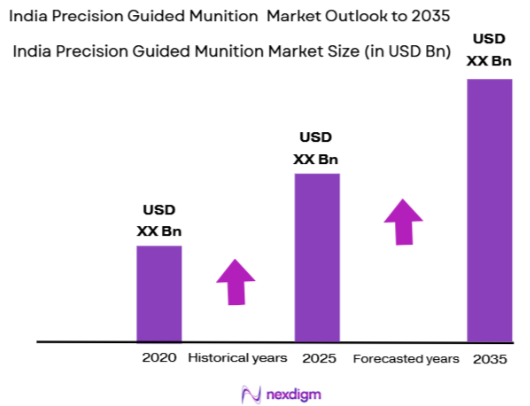
The India Precision Guided Munition market is valued at approximately USD ~ billion, driven by increased defense budgets and modernization efforts within the Indian Armed Forces. Advancements in missile guidance technology and the growing demand for more accurate, efficient, and safe weaponry are key factors propelling this market. Additionally, the evolving security environment in South Asia, along with strategic collaborations and technology transfers, continues to support the market’s growth trajectory.India and key neighboring countries, including Pakistan and China, dominate the market due to their heightened defense requirements and technological advancements. The Indian government’s focus on indigenization and reducing dependency on foreign suppliers has led to strong demand for locally produced precision guided munitions. Strategic military alliances with global powers also contribute to India’s dominance in the sector.
Market Segmentation
By System Type
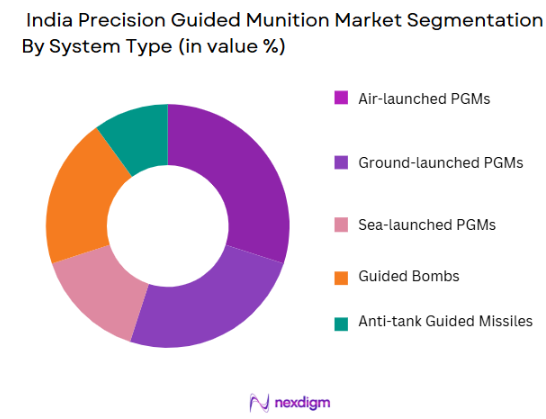
The India Precision Guided Munition market is segmented by system type into air-launched PGMs, ground-launched PGMs, sea-launched PGMs, guided bombs, and anti-tank guided missiles. Among these, air-launched PGMs hold a dominant position due to their advanced capabilities and widespread use in various airstrikes. The Indian Air Force continues to focus on upgrading its fleet with precision-guided air-to-ground munitions, driving significant investments in this sub-segment. Additionally, the increasing collaboration with global defense manufacturers further strengthens the growth of air-launched PGMs in the market.
By Platform Type
The market is also segmented by platform type into land platforms, air platforms, naval platforms, subsea platforms, and space platforms. Air platforms are dominating the market, accounting for the largest share. The Indian Air Force’s ongoing modernization and procurement programs, alongside the rising reliance on precision strikes, have led to substantial growth in air-based platforms. Furthermore, the adoption of multi-role combat aircraft and UAVs equipped with PGMs is expanding the market share of air platforms.

Competitive Landscape
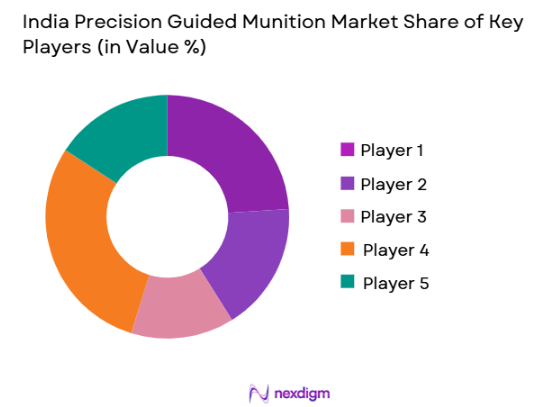
The India Precision Guided Munition market is dominated by a few key players, including local manufacturers like Bharat Dynamics Limited and defense giants such as Lockheed Martin and MBDA. The consolidation of major players within the market highlights the influence of these companies in shaping the direction of India’s defense sector. Their strong presence is bolstered by long-term contracts with the Indian government and the expanding defense procurement plans of India.
| Company | Establishment Year | Headquarters | Technology Advancements | Global Reach | Partnerships | Revenue | Product Portfolio | Manufacturing Capacity |
| Bharat Dynamics Limited | 1970 | Hyderabad, India | ~ | ~ | ~ | ~ | ~ | ~ |
| Lockheed Martin | 1912 | Bethesda, USA | ~ | ~ | ~ | ~ | ~ | ~ |
| MBDA | 2001 | Paris, France | ~ | ~ | ~ | ~ | ~ | ~ |
| Raytheon Technologies | 1922 | Waltham, USA | ~ | ~ | ~ | ~ | ~ | ~ |
| Rafael Advanced Defense Systems | 1958 | Haifa, Israel | ~ | ~ | ~ | ~ | ~ | ~ |
India Precision Guided Munition Market Analysis
Growth Drivers
Increase in Defense Budgets
India’s defense budget allocation has risen in recent fiscal cycles, directly influencing procurement of precision guided munitions (PGMs). For FY 2024‑25, the Government of India allocated INR ~crore (~USD ~billion), up from INR ~crore in FY 2023‑24, with the capital budget (which funds acquisition of weapons and systems) growing by approximately ~percent over previous estimates. ~percent of the defence capital procurement budget has been earmarked for domestic industry, signaling funding directed toward domestically produced advanced weaponry, including PGMs. This robust fiscal commitment ensures consistent financial support for force modernization programs that incorporate precision strike capabilities.
Strategic Defense Collaborations with Global Powers
India’s strategic defense collaborations are augmenting access to advanced technologies relevant to precision guided munitions. Recent policy reforms plan to raise the foreign direct investment cap for defence firms from ~ percent to ~percent under the automatic route, potentially increasing foreign capital inflows and technology transfers from partners such as the United States, France, and Israel. In 2024‑25, defence exports hit a record INR ~crore, demonstrating growing integration with global supply chains. These collaborations facilitate co-development and local production of sophisticated PGMs, reinforcing India’s modernization and self‑reliance goals within the defence sector.
Market Challenges
High Development Costs
The development and integration of precision guided munitions involve high expenditure, reflected in major capital outlays within India’s defence procurement programs. For example, the Indian Ministry of Defence recently approved a comprehensive acquisition package valued at approximately INR ~crore (~USD ~billion) to enhance combat capabilities, which includes missiles and radar systems — significant funding indicative of the scale required for modern PGM systems. These high cost thresholds strain defense budgets and necessitate careful prioritization across competing modernization needs. Such capital intensity presents a barrier for accelerated domestic development and procurement cycles without sustained fiscal support.
Regulatory Barriers and Export Restrictions
While India’s defense industry is growing, regulatory controls and international export restrictions constrain the ability to fully commercialize precision guided munition technologies abroad. As India adheres to international arms control frameworks, including export licensing and technology transfer protocols, this creates compliance requirements that can delay or complicate foreign sales of sensitive PGM systems. Domestic regulations, coupled with necessary alignment to export control regimes maintained by partner countries, require rigorous certification and oversight before products can be exported, adding procedural complexity and slowing market expansion beyond India’s borders.
Market Opportunities
Growing Demand for Autonomous Defense Systems
The demand for autonomous defense platforms incorporating PGMs is increasing within India’s armed forces. Indigenous systems such as the Nagastra‑1 loitering munition, developed domestically with significant indigenous content, have been ordered in quantities exceeding 450 units, reflecting operational interest in autonomous precision strike capability. This demand is driven by evolving threat profiles and the need for lower‑risk engagement options. The drive toward networked, unmanned systems integrates PGMs into broader autonomous platforms (UAVs and loitering systems), enabling adaptive deployment in contested environments. These trends highlight PGM relevance within broader autonomous modernization pathways for the Indian military.
Technological Advancements in Missile Guidance
Technological innovation within India’s defense ecosystem is creating opportunities for advanced guidance technologies. India has ongoing indigenous development projects, such as Laser Beam Rider Guidance (LBRG) systems that enhance the accuracy of precision guided munitions. The Ministry of Defence’s 2024‑25 annual report highlights such advanced guidance initiatives, pointing to enhanced targeting performance and integration potential across missile classes. These advancements position Indian defense firms to offer improved PGM solutions that meet contemporary battlefield requirements, reducing reliance on legacy systems and promoting competitive indigenous technologies in both domestic and allied markets. (mod.gov.in)
Future Outlook
Over the next decade, the India Precision Guided Munition market is expected to experience substantial growth. This growth will be driven by India’s continued defense modernization, increased investments in indigenous manufacturing, and strengthening defense relations with global powers. Advancements in missile guidance technology and a growing emphasis on unmanned aerial systems are also expected to contribute to market expansion. Furthermore, regional geopolitical tensions are likely to spur demand for advanced weaponry and defense capabilities in India.
Major Players
- Bharat Dynamics Limited
- Lockheed Martin
- MBDA
- Raytheon Technologies
- Rafael Advanced Defense Systems
- Boeing
- General Dynamics
- Northrop Grumman
- Thales Group
- Elbit Systems
- Saab
- Kongsberg Gruppen
- Larsen & Toubro
- DRDO
- India Ministry of Defence
Key Target Audience
- Investors and venture capitalist firms
- Indian Ministry of Defence (MOD)
- Indian Air Force
- Indian Army
- Indian Navy
- Defense contractors
- Export markets
- Global defense agencies
Research Methodology
Step 1: Identification of Key Variables
This phase involves conducting an in-depth ecosystem analysis, identifying major stakeholders in the Indian Precision Guided Munition market. Key variables impacting the market, including technology trends, geopolitical influences, and defense procurement strategies, are gathered from secondary research sources and proprietary databases.
Step 2: Market Analysis and Construction
Historical data on market performance, including production capacities, defense spending, and product deployment, is compiled. Market trends, including procurement strategies and technological evolution, are analyzed to construct a reliable market model.
Step 3: Hypothesis Validation and Expert Consultation
Hypotheses related to market drivers, challenges, and growth opportunities are validated through consultations with defense experts, engineers, and senior professionals from defense manufacturing firms. Computer-assisted telephone interviews (CATI) will be conducted to refine data and ensure the validity of hypotheses.
Step 4: Research Synthesis and Final Output
Final market data is synthesized from bottom-up research, corroborated through direct engagements with leading defense manufacturers and end users. Insights from industry leaders

- Executive Summary
- Research Methodology(Definitions, Scope, Industry Assumptions, Market Sizing Approach, Primary & Secondary Research Framework, Data Collection & Verification Protocol, Analytic Models & Forecast Methodology, Limitations & Research Validity Checks)

- Market Definition and Scope
- Value Chain & Stakeholder Ecosystem
- Regulatory / Certification Landscape
- Sector Dynamics Affecting Demand
- Strategic Initiatives & Infrastructure Growth

- Growth Drivers
Increase in defense budgets
Strategic defense collaborations with global powers
Technological advancements in precision targeting systems - Market Challenges
High development costs
Regulatory barriers and export restrictions
Complex integration into existing platforms
- Trends
Miniaturization of guidance systems
Integration with AI for autonomous targeting
Rise in hypersonic precision guided munitions
- Market Opportunities
Growing demand for autonomous defense systems
Technological advancements in missile guidance
Emerging defense markets and international collaborations
- Government regulations
ITAR compliance
Missile Technology Control Regime
National Defense Authorization Act - SWOT analysis
Strong indigenous production capabilities
Challenges with technology transfer
Opportunities in foreign defense alliances
- Porters 5 forces
Bargaining power of suppliers
Threat of new entrants
Intensity of competitive rivalry

- By Market Value, 2020-2025
- By Installed Units, 2020-2025
- By Average System Price, 2020-2025
- By System Complexity Tier, 2020-2025

- By System Type (In Value%)
Air-launched PGMs
Ground-launched PGMs
Sea-launched PGMs
Guided Bombs
Anti-tank Guided Missiles - By Platform Type (In Value%)
Land Platforms
Air Platforms
Naval Platforms
Subsea Platforms
Space Platforms
- By Fitment Type (In Value%)
Man-portable PGMs
Vehicle-mounted PGMs
Aircraft-mounted PGMs
Naval Platform-mounted PGMs
Ship-to-air PGMs - By EndUser Segment (In Value%)
Indian Armed Forces
Defense Contractors
Private Military Contractors
Defense Agencies
Export Markets - By Procurement Channel (In Value%)
Direct Government Procurement
Defense Contracts
Third-party Vendors
Strategic Partnerships
International Collaboration

- Market Share Analysis
- CrossComparison Parameters(Technology adoption, Market penetration, Product portfolio, Pricing strategy, Geographic reach)
- SWOT Analysis of Key Competitors
- Pricing & Procurement Analysis
- Key Players
Bharat Dynamics Limited
Larsen & Toubro Limited
Rafael Advanced Defense Systems
MBDA
Lockheed Martin
Boeing
General Dynamics
Saab
Northrop Grumman
Thales Group
Elbit Systems
Raytheon Technologies
Kongsberg Gruppen
Tata Advanced Systems
DRDO (Defence Research and Development Organisation)
India Ministry of Defence

- Growing demand from the Indian military for enhanced precision capabilities
- Shift towards modernization of India’s defense platforms
- Rising defense exports in neighboring countries
- Increased collaboration between defense contractors and government entities

- Forecast Market Value, 2026-2035
- Forecast Installed Units, 2026-2035
- Price Forecast by System Tier, 2026-2035
- Future Demand by Platform, 2026-2035


 Request a Sample
 Ask for Customization
 Get a Quote
 Enquire Now