
 Download PDF
Market Overview
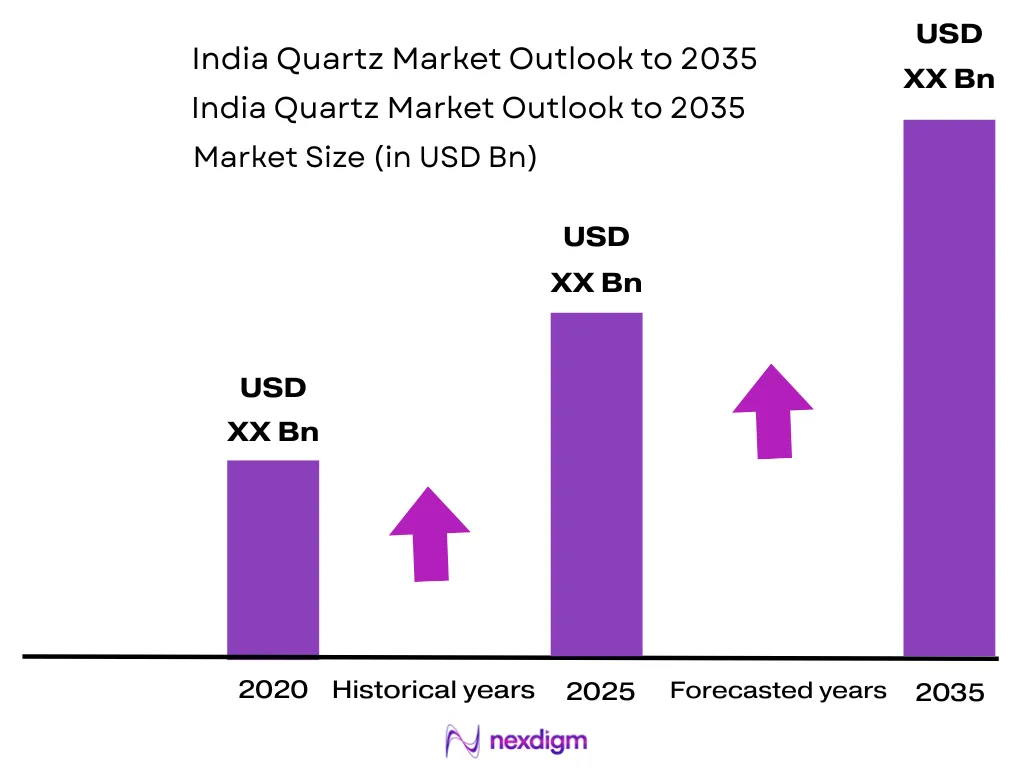
The India quartz market is valued at USD ~ billion, based on a five-year historical analysis spanning 2019–2024, with production volumes reaching 2.1 million metric tons. Growth is driven primarily by rising construction and infrastructure projects in urban hubs, where cement and engineered quartz demand has reached 1.2 million tons. Additionally, the electronics and semiconductor industry consumes over 300,000 tons of high-purity quartz for photovoltaic panels, silicon wafers, and optical instruments, fueled by the government’s National Solar Mission, which reported installation of 10 GW solar capacity. Industrial growth in chemicals and glass manufacturing has also increased quartz demand, with over 450,000 tons utilized in glass and chemical processing. The government’s initiatives to enhance domestic mining output are projected to improve raw material availability, which in turn strengthens downstream quartz processing industries.
Macro indicators support this growth, as India’s GDP is projected at USD 4.5 trillion, with industrial production at 3.9 trillion INR, highlighting the correlation between national industrial expansion and quartz consumption. Northern and Western India dominate quartz production and consumption, particularly Rajasthan, Gujarat, and Madhya Pradesh, where high-grade quartz mines contribute over 60% of total domestic output. Cities such as Jaipur, Ahmedabad, and Indore serve as industrial and distribution hubs due to their well-developed infrastructure, including rail and road networks facilitating export and domestic logistics. Southern regions, particularly Karnataka and Tamil Nadu, are notable for engineered quartz processing units supporting construction and interior design sectors. Industrial clusters in these regions, including Hyderabad and Bengaluru, also drive electronics and semiconductor demand, accounting for high-purity quartz consumption exceeding 150,000 tons annually. The dominance of these cities is further strengthened by state-level mining policies, skilled workforce availability, and proximity to export ports such as Mumbai and Chennai, which handle over 1 million tons of quartz exports collectively. The urban industrial centers also benefit from electricity availability exceeding 3,500 kWh per capita, supporting large-scale processing facilities.
Market Segmentation
By Product Type
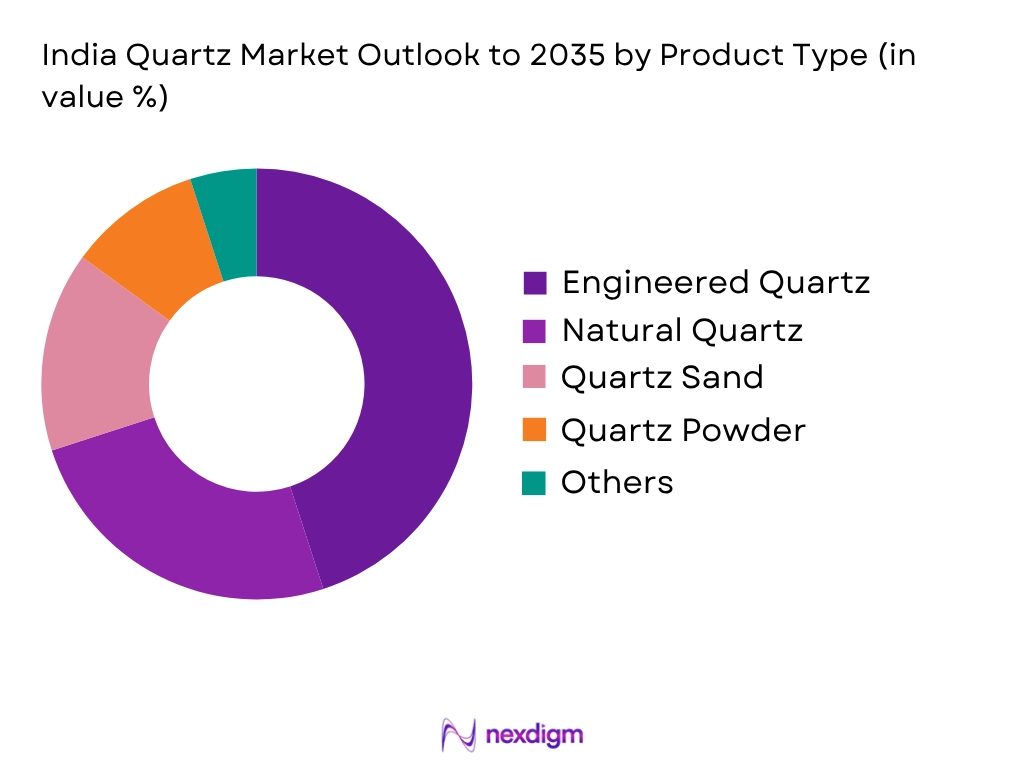
Engineered quartz dominates the market due to its widespread use in high-end residential and commercial construction. Engineered quartz offers uniform quality, higher durability, and aesthetic appeal compared to natural quartz. Demand is fueled by urban housing projects and luxury interior fit-outs, which collectively consumed 750,000 tons of engineered quartz in the period. Additionally, engineered quartz is favored in countertops, flooring, and wall cladding due to its chemical resistance and low porosity. Industrial processors benefit from standardized production, with Gujarat and Rajasthan supplying 60% of raw material to processing hubs. Urban developers are driving bulk procurement, and government-backed housing projects have allocated 1.1 million square meters for engineered quartz surfaces, indirectly stimulating demand. Market adoption is further accelerated by rising per capita income reaching USD 2,500 in urban India, allowing middle- and upper-class households to afford premium surfaces.
By End-use Industry
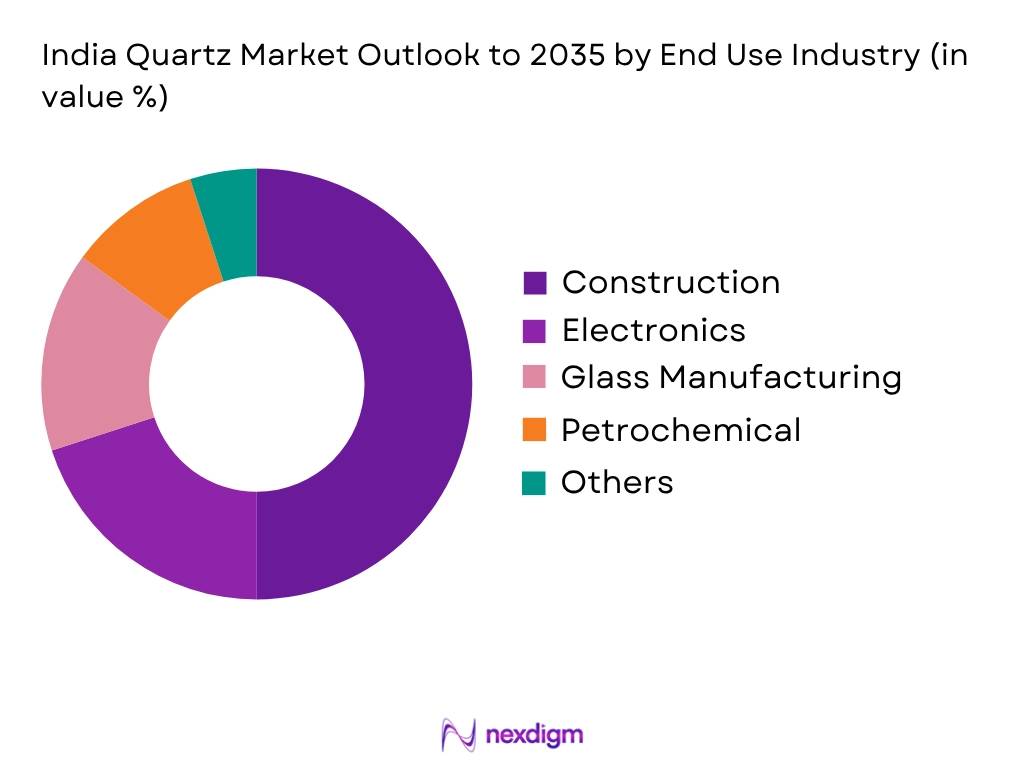
The construction and infrastructure segment leads the market, driven by ongoing urban development and public infrastructure projects consuming over 1 million tons of quartz in processed and raw forms. Metro rail projects, industrial parks, and smart city initiatives have created sustained demand for engineered quartz and high-purity sand. Residential construction also uses quartz for countertops, flooring, and decorative cladding. Regions such as Maharashtra and Karnataka are major buyers, benefiting from high GDP per capita and industrial development indices, which reached 2.1 trillion INR and 1.5 trillion INR, respectively. Industrial electricity access of over 3,000 kWh per capita enables large-scale processing and fabrication. Consumer awareness about durability and aesthetics has increased adoption of quartz products, with developers incorporating over 2 million square meters of quartz in public and private projects. The growth in urban construction and commercial office development directly correlates with the increased demand for construction-grade quartz.
Competitive Landscape
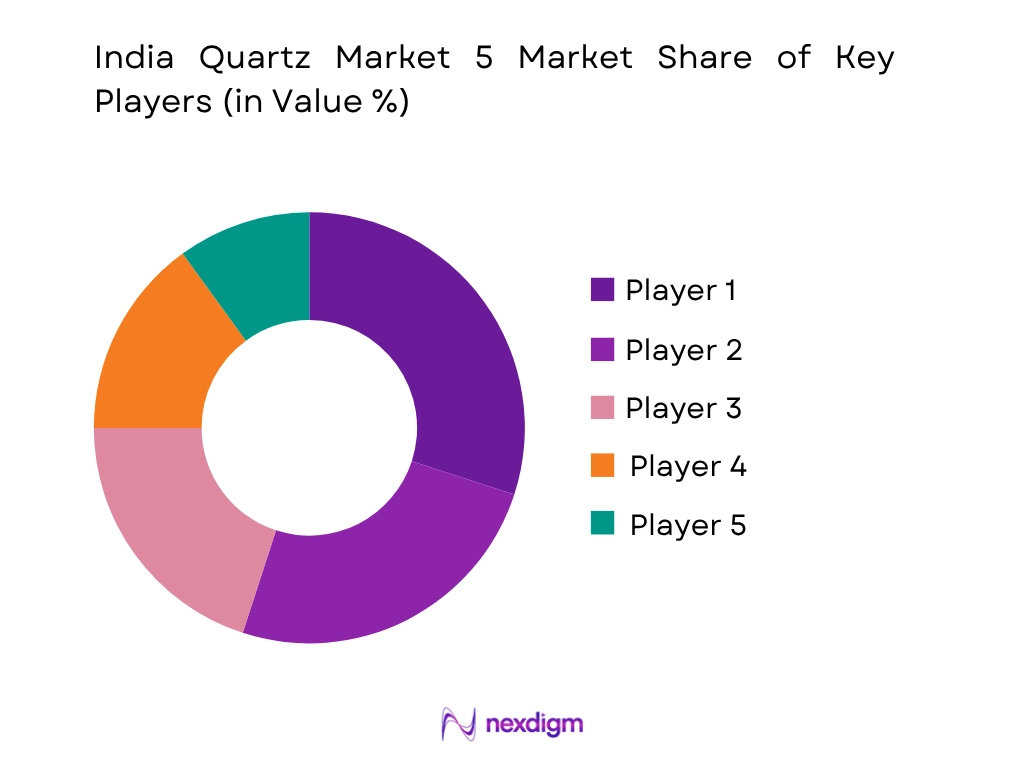
The India quartz market is concentrated among large domestic miners and global suppliers such as Ultrafine Minerals and Gujarat Quartz Industries, controlling key high-purity quartz reserves and engineered quartz production lines. The market is also influenced by international imports for electronics-grade quartz.
| Company Name | Establishment | Headquarters | Production Capacity | Distribution Reach | Product Range | Quality Certification | R&D Investments | Strategic Partnerships |
| Gujarat Quartz Industries | 1985 | Gujarat, India | ~ | ~ | ~ | ~ | ~ | ~ |
| Krishna Quartz Pvt. Ltd. | 1990 | Rajasthan, India | ~ | ~ | ~ | ~ | ~ | ~ |
| SDB Quartz Pvt. Ltd. | 2000 | Karnataka, India | ~ | ~ | ~ | ~ | ~ | ~ |
| Pioneer Quartz Works | 1995 | Maharashtra, India | ~ | ~ | ~ | ~ | ~ | ~ |
| Ultratech Quartz Pvt. Ltd. | 2005 | Tamil Nadu, India | ~ | ~ | ~ | ~ | ~ | ~ |
India Quartz Market
Growth Drivers
Surge in Construction Activity and Infrastructure Investment Supporting Quartz Demand
India’s infrastructure expansion and robust construction activity are major drivers behind the rising consumption of quartz for engineered surfaces, glass, and ceramic applications. According to provisional real GDP growth data, India’s real GDP grew at 8.2% in a major quarterly estimate that reflects strong demand in construction‑driven sectors like building materials and heavy infrastructure . The Index of Industrial Production (IIP) for May 2024 reported a manufacturing index value of 149.7 and an infrastructure/ construction goods index of 185.1, reflecting elevated output in sectors that use quartz materials . This robust industrial performance coincides with government spending on highways, metro rail, and urban development, boosting demand for quartz as a raw material for glass, engineered stone countertops, and finishing products. Quartz, prized for hardness and chemical resistance, is used extensively in construction for durable flooring and wall cladding. The presence of over 3,200 real estate projects using engineered quartz surfaces spread across metro and emerging cities further emphasizes construction’s role in driving market growth.
Electronics and Solar PV Manufacturing as High‑Purity Quartz Demand Engines
The growth of electronics manufacturing and solar photovoltaic (PV) capacity is another key driver pushing high‑purity quartz demand in India. High‑purity quartz is essential for silicon wafer crucibles and solar glass, which are foundational components in semiconductors and PV modules. In 2025, India’s crucible‑grade high‑purity quartz demand is linked to an annual 8.5 million unit silicon wafer production capacity, each requiring approximately 1.2 kilograms of high‑purity quartz for manufacturing. Solar sector expansion is supported by national renewable energy targets and utility‑scale installations; major Indian solar producers accounted for an estimated installation of 12,000 megawatts of new solar capacity in the domestic PV market, driving quartz use for solar glass and crucibles. Quartz’s high thermal stability and purity makes it indispensable in semiconductor frequency control devices, where 1,200,000,000 smartphones rely on quartz crystals yearly, each containing roughly 0.7 grams of quartz. The electronics and solar segments help diversify quartz demand away from traditional building uses toward advanced technology applications, aligning with macroeconomic improvements in manufacturing and renewable energy capacity supported by policy incentives and capital investment.
Market Challenges
Heavy Dependence on Unstandardized Raw Material Supply and Fragmented Mining Sector
One of the foremost challenges in the India quartz market is the fragmented nature of silica and quartz raw material supplies, which affects quality consistency and long‑term procurement. India possesses significant quartz and silica sand resources, but organized geological data and modern extraction frameworks remain limited, with historical production statistics showing production tracking only up to older years (e.g., historical India quartz mining data was last comprehensively recorded in 2015). The absence of updated, detailed production and reserve data at granular state and district levels complicates planning for investors and manufacturers relying on quartz inputs. Moreover, mining debris and under‑explored deposits are only recently being studied through collaborations between state mining departments and Indian Institutes of Technology, particularly around Bhilwara, Bijolia, Jodhpur, and Udaipur regions where quartz might be present in significant quantities . Such initiatives indicate a shift toward better resource mapping, but current mining operations face bottlenecks in mechanization, environmental clearances, logistics infrastructure, and extraction standardization. These structural issues in resource availability constrain consistent supply for high‑purity applications and add cost volatility for quartz input dependent industries like glass manufacturing, electronics, and solar PV production.
Manufacturing Output Variability Limiting Downstream Industrial Activity
Variability in industrial production and use‑sector demand presents another challenge for the quartz value chain, particularly for high‑tech and construction applications. Government industrial statistics indicate that manufacturing output growth has shown intermittent weakness, such as a reported slowing in factory expansion metrics in late‑stage annual surveys, deepening concerns over stable industrial demand for input materials like quartz. When industrial manufacturing momentum weakens, sectors such as electronics, foundry, and speciality glass—which are key users of quartz—face subdued orders and fluctuating inventory cycles. This creates uncertainty for suppliers in planning production schedules and capacity investments. Even though IIP data shows solid expansion in certain months (e.g., infrastructure goods index at 185.1 in May 2025) the broader manufacturing landscape still experiences phases of lagging new orders and slower hiring trends. Additionally, export demand softening in key markets can impact quartz components destined for global supply chains, as Indian manufacturers adjust output in alignment with global electronics and construction cycles. Such variability creates a risk profile that quartz market stakeholders must navigate through diversified product portfolios and flexible supply chain strategies.
Market Opportunities
Increasing Use of Quartz in Renewable Energy Sector Infrastructure
The renewable energy sector, particularly solar PV and wind infrastructure, offers a strong opportunity for expanded quartz consumption. Quartz is an integral component in the production of solar panel glass and solar crucibles, which are essential to PV module and silicon wafer fabrication. India’s renewable energy push has led to installation of significant capacity additions, with solar alone contributing to an estimated 12,000 megawatts of new PV installations driven by utility and rooftop projects. The increasing deployment of renewable energy infrastructure will require large volumes of high‑quality quartz glass and high‑purity silica for crucibles and wafers. Solar glass production, which increasingly looks for durability and optical clarity to improve panel output, directly benefits quartz‑based raw materials. As policy frameworks continue to support large‑scale renewable investments and local manufacturing of solar components, the quartz market has scope to diversify beyond traditional construction and industrial uses. Quartz producers positioned to supply high‑purity grades can tap into renewable value chains, particularly with India’s emphasis on energy transition infrastructure and domestic manufacturing incentives.
Growth in Engineered Quartz Products in Urban Residential and Commercial Interiors
The rapid expansion of urban real estate and commercial development presents another compelling opportunity for quartz applications. Engineered quartz surfaces—used in upscale residential, commercial interiors, and hospitality projects—have seen expanding usage due to their durability, stain resistance, and aesthetic appeal compared to traditional stone options. In 2025, data from industry sources indicates that over 3,200 large‑scale real estate projects incorporated engineered quartz for interiors, countertops, and cladding, with annual consumption approaching 1.1 million square meters of quartz‑based materials in metropolitan regions such as Mumbai, Delhi NCR, and Bengaluru. This trend extends to hotels and healthcare facilities, where quartz materials are preferred for hygiene and longevity, with an estimated 4,500 hotel projects and 2,100 hospitals adopting engineered quartz surfaces in 2025. These institutional and lifestyle consumption patterns underscore a burgeoning segment within the Indian construction value chain, offering quartz producers a premium, higher‑margin opportunity that coexists with bulk industrial demand. Continued urbanization, increasing consumer preference for quality surfaces, and rising commercial real estate activity all contribute to expanding demand for engineered quartz solutions.
Future Outlook
Over the next decade, the India quartz market is expected to grow robustly, supported by sustained infrastructure investment, urban housing projects, and expansion of electronics and semiconductor industries. The push for solar energy installations and smart city programs will drive high-purity quartz demand, while engineered quartz adoption will increase in residential and commercial construction. Government incentives for renewable energy and domestic mining policies will enhance production capabilities, ensuring stable raw material supply for downstream industries.
Major Players
- Gujarat Quartz Industries
- Krishna Quartz Pvt. Ltd.
- SDB Quartz Pvt. Ltd.
- Pioneer Quartz Works
- Ultratech Quartz Pvt. Ltd.
- Shree Ram Quartz
- Vikas Quartz Industries
- Quartz India Ltd.
- Ambuja Quartz Pvt. Ltd.
- Crystal Quartz Pvt. Ltd.
- Rajasthan Silica & Quartz
- Alok Quartz Pvt. Ltd.
- Shree Quartz Mining
- Rajasthani Quartz Industries
- Sagar Quartz Pvt. Ltd.
Key Target Audience
- Industrial Construction Companies
- Electronics Manufacturers
- Glass and Ceramics Manufacturers
- Solar Panel Producers
- Interior Design and Real Estate Firms
- Investments and Venture Capitalist Firms
- Government and Regulatory Bodies
- Export & Import Trade Corporations
Research Methodology
Step 1: Identification of Key Variables
The first step maps major stakeholders in the India Quartz market, including miners, processors, distributors, and end-users. Extensive secondary research from government mining records, industrial databases, and trade statistics is conducted to define key variables such as production capacity, purity levels, and supply chains.
Step 2: Market Analysis and Construction
Historical data is analyzed, including industrial production volumes (3.9 trillion INR) and electricity consumption for industrial processing (3,500 kWh per capita), correlating with quartz demand across sectors like construction, electronics, and glass manufacturing.
Step 3: Hypothesis Validation and Expert Consultation
Hypotheses on market demand trends are validated via interviews with executives from mining companies, industrial buyers, and fabrication units. Inputs include raw material supply constraints and industrial consumption patterns.
Step 4: Research Synthesis and Final Output
Data from secondary sources and expert consultations are synthesized with production, processing, and distribution statistics to produce validated market insights. This ensures comprehensive coverage of volume, value, and segmentation across all product types and end-use industries.

- Executive Summary
- Research Methodology (Market Definitions and Assumptions, Abbreviations, Market Sizing Approach, Consolidated Research Approach, Understanding Market Potential Through In-Depth Industry Interviews, Primary Research Approach, Limitations and Future Conclusions)

- Definition and Scope
- Overview Genesis
- Timeline of Major Players
- Business Cycle
- Supply Chain and Value Chain Analysis

- Growth Drivers (Rising Construction & Real Estate Activities, Electronics & Semiconductor Industry Expansion, Growing Demand for Engineered Quartz Countertops)
- Market Challenges (Regulatory Compliance & Environmental Clearances, Price Volatility in Raw Quartz and Silica)
- Opportunities (High Demand from Semiconductor & Solar Panel Industry, Export Potential to Middle East and Asia)
- Trends (Shift Towards Engineered Quartz Products, Sustainable Mining Practices & Green Certifications)
- Government Regulation (Mining Lease Policies & Permits, Environmental Protection Regulations)
- SWOT Analysis
- Stake Ecosystem
- Porter’s Five Forces
- Competition Ecosystem

- By Value (2020-2025)
- By Volume (2020-2025)
- By Average Price (2020-2025)

- By Product Type (In Value %)
Natural Quartz
Engineered Quartz
Silica Quartz
Quartz Sand
Quartz Powder - By End-use Industry (In Value %)
Construction & Infrastructure
Electronics & Semiconductor
Glass Manufacturing
Chemical & Petrochemical
Jewelry & Gemstones - By Distribution Channel (In Value %)
Direct Sales to Industrial Buyers
Distributors & Dealers
E-Commerce & Online Retail - By Region (In Value %)
Northern India
Western India
Eastern India
Southern India

- Market Share of Major Players on Value/Volume
- Cross Comparison Parameters (Company Overview, Business Strategy Archetype, Product Portfolio Breadth Index, Retail Footprint & Channel Mix, Distribution Network Scale, Brand Equity & IP Partnerships, Production Footprint & Capacity Utilization, Quality & Safety Compliance Scores)
- SWOT Analysis of Major Players
- Pricing Analysis Basis SKUs for Major Players
- Detailed Profiles of Major Companies
Gujarat Quartz Industries
Krishna Quartz Pvt. Ltd.
SDB Quartz Pvt. Ltd.
Rajasthan Silica & Quartz
Quartz India Ltd.
Pioneer Quartz Works
Shree Quartz Mining
Ultratech Quartz Pvt. Ltd.
Vikas Quartz Industries
Alok Quartz Pvt. Ltd.
Ambuja Quartz Pvt. Ltd.
Shree Ram Quartz
Crystal Quartz Pvt. Ltd.
Rajasthani Quartz Industries
Sagar Quartz Pvt. Ltd.

- Market Demand and Utilization
- Purchasing Power and Budget Allocations
- Regulatory and Compliance Requirements
- Needs, Desires, and Pain Point Analysis
- Decision-Making Process

- By Value (2026-2035)
- By Volume (2026-2035)
- By Average Price (2026-2035)


 Request a Sample
 Ask for Customization
 Get a Quote
 Enquire Now