
 Download PDF
Market Overview
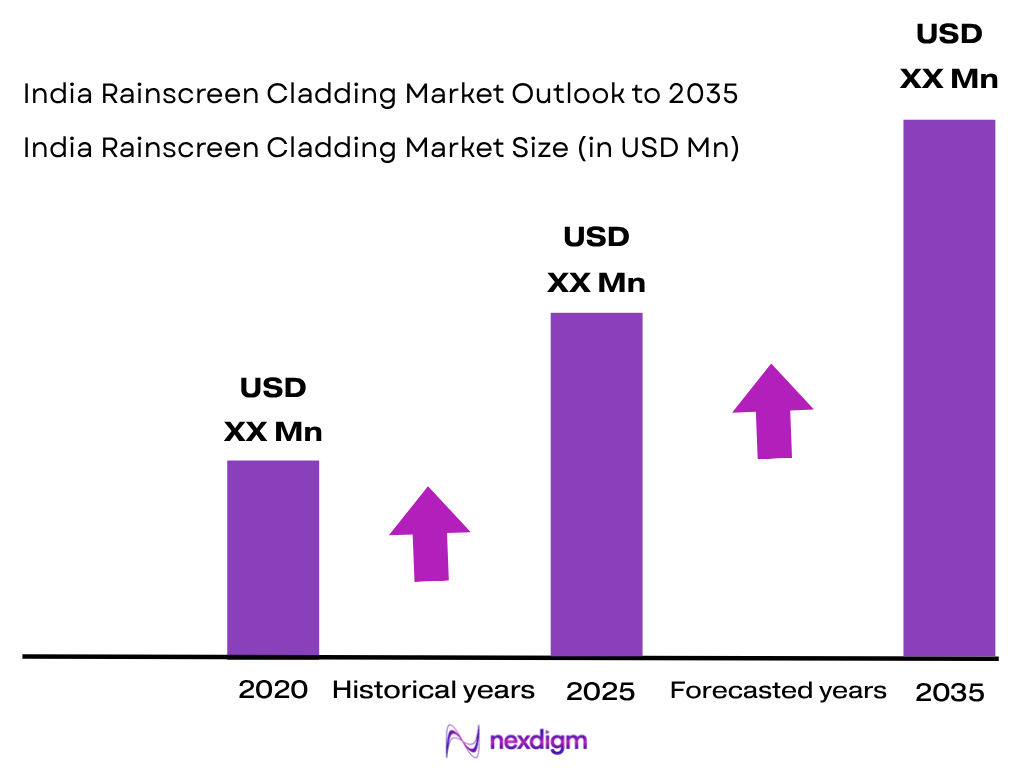
The India Rainscreen Cladding Market is valued at approximately ~USD XX million, supported by expansion in commercial construction, high-rise residential projects, data centres and green buildings. India’s GDP increased from about USD 3.50 trillion to USD 3.76 trillion, while aggregate GVA at current prices rose from INR 263.16 lakh crore to INR 288.54 lakh crore. These macro fundamentals support façade demand across offices, institutional buildings, premium housing and infrastructure-led developments.
Mumbai, Delhi NCR, Bengaluru, Hyderabad, Chennai and Pune dominate India Rainscreen Cladding Market demand because they concentrate high-rise housing, Grade-A offices, IT campuses, airports and data centres. India operates more than 130 data centres covering over 12.5 million sq. ft. with more than 1,180 MW of IT load, while over 35 additional facilities representing more than 5.7 million sq. ft. and 987 MW have been announced, largely around these major urban clusters.
Market Segmentation
By Material Type
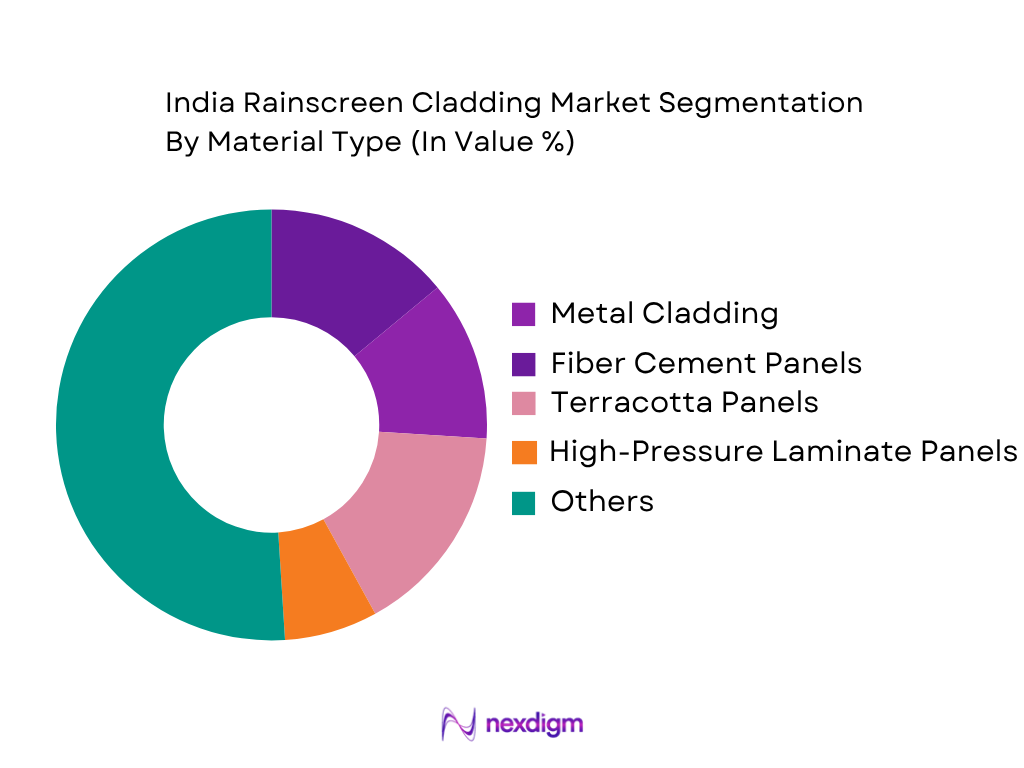
India Rainscreen Cladding Market is segmented by material into aluminium composite panels, fire-rated ACP, solid aluminium panels, terracotta panels, fiber cement panels, HPL panels, zinc composite panels, aluminium honeycomb panels, natural stone, ceramic and other architectural materials. Aluminium composite panels represent the dominant modeled sub-segment because India has developed substantial domestic ACP manufacturing, coating, fabrication and distribution capability. ACP provides low dead load, large panel formats, rapid installation and extensive PVDF, FEVE, metallic, stone-look and wood-look finishes. It is widely specified across commercial towers, IT campuses, retail developments, hospitals and premium residential projects. Domestic availability further reduces dependence on imported finished façade panels. Fire-safety concerns are simultaneously changing the composition of ACP demand toward mineral-core FR and A2 systems, especially in high-rise projects. The NBC includes comprehensive fire and life-safety provisions for modern complex buildings, including high rises and glazed buildings, while current BIS work continues to update Part 4 requirements.
By Building Type
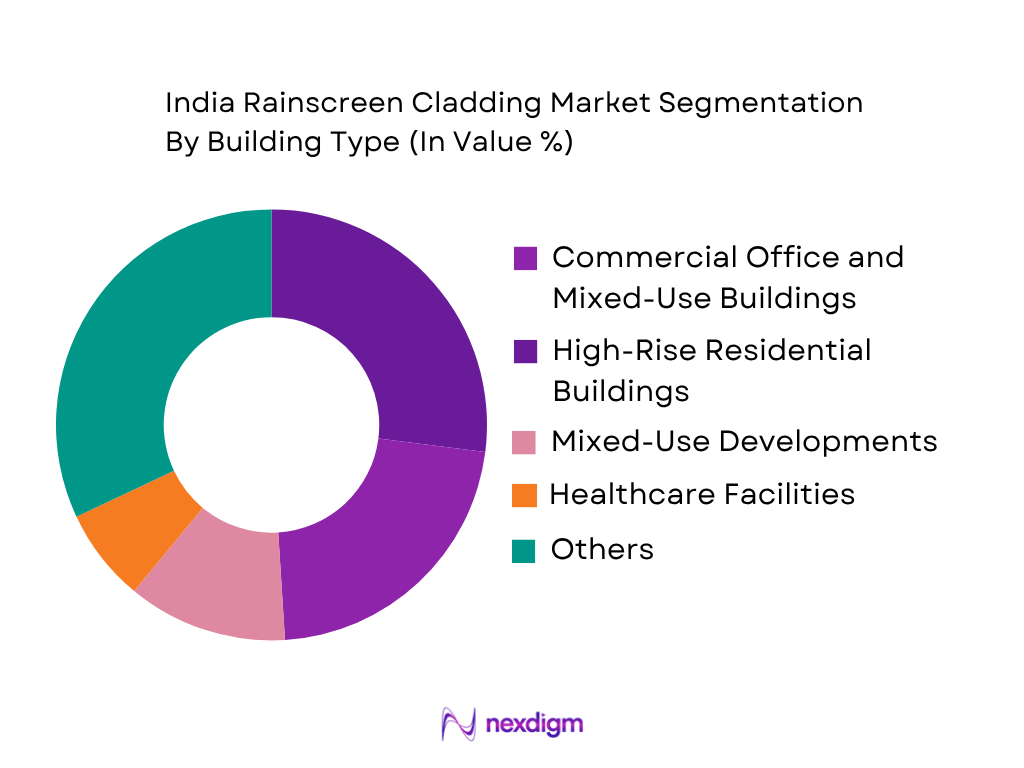
India Rainscreen Cladding Market is segmented into commercial offices, IT and ITES campuses, high-rise residential buildings, retail centres, hotels, healthcare facilities, educational buildings, airports, data centres, industrial buildings and mixed-use projects. Commercial offices and IT/ITES buildings represent the dominant modeled demand segment because these assets place high emphasis on façade identity, thermal control, maintenance, lightweight construction and long lifecycle finishes. India is adding approximately 300,000 square feet of commercial floor space every day, according to the Bureau of Energy Efficiency, while buildings account for more than 30% of national electricity consumption. This creates a strong link between façade design and building energy performance. Rainscreen systems can accommodate external insulation, ventilated cavities and solar-resistant cladding while helping architects create differentiated elevations. The same demand pattern is reinforced by IT campuses and data centres, where India already has over 12.5 million square feet of operational data-centre space requiring durable and maintainable building envelopes.
Competitive Landscape
The India Rainscreen Cladding Market combines large domestic ACP manufacturers, premium international façade brands and specialized panel suppliers. Competition is shaped by manufacturing capacity, fire-rated product availability, architect specification, dealer reach, façade-contractor relationships, coating capability, project references and technical support. Domestic manufacturers have strengthened their position by investing in coil coating and large-scale panel production, while international brands compete through premium fire-tested products, engineering support and landmark project credentials.
| Major Player | Establishment Year | Headquarters | Primary Façade Offering | Manufacturing Capability | Fire-Rated Portfolio | Distribution Reach | Technical / Specification Support | Key Application Strength |
| Aludecor Lamination Pvt. Ltd. | 2004 | Kolkata, India | ~ | ~ | ~ | ~ | ~ | ~ |
| VIVA Composite Panel Pvt. Ltd. | 2003 | Mumbai, India | ~ | ~ | ~ | ~ | ~ | ~ |
| Alstone | 2009 | New Delhi, India | ~ | ~ | ~ | ~ | ~ | ~ |
| Alstrong Enterprises India Pvt. Ltd. | 2001 | New Delhi, India | ~ | ~ | ~ | ~ | ~ | ~ |
| 3A Composites / ALUCOBOND India | 2007 India manufacturing | Mumbai, India | ~ | ~ | ~ | ~ | ~ | ~ |
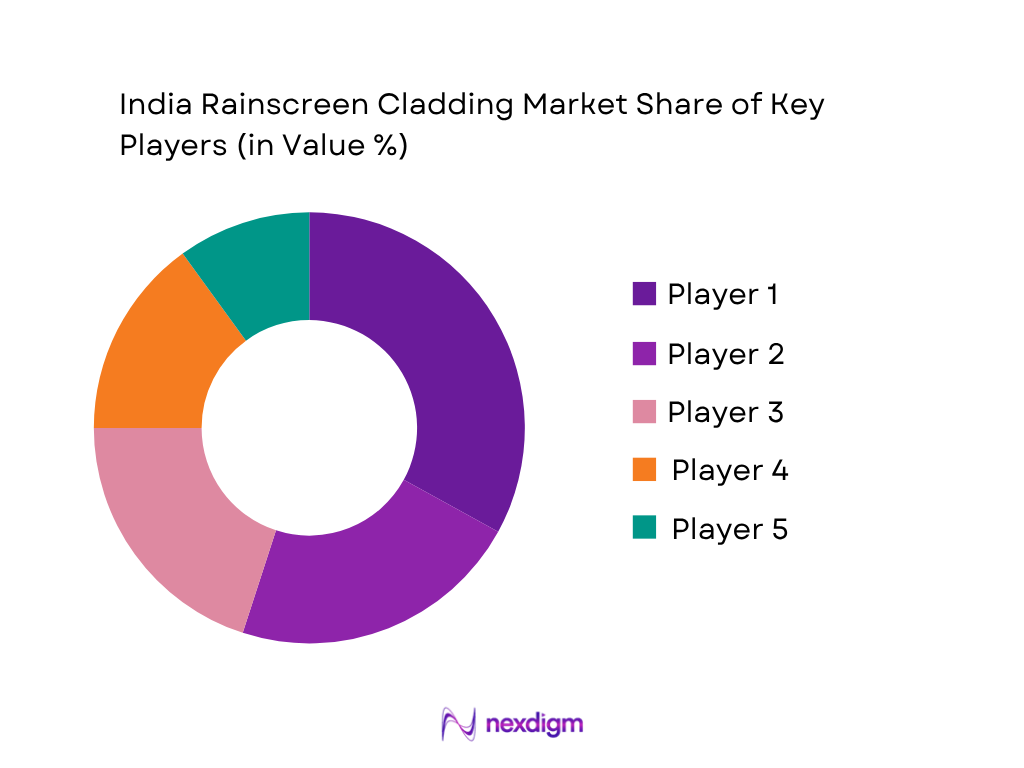
India Rainscreen Cladding Market Analysis
Growth Drivers
High-Rise, Commercial and Data Centre Construction Expanding Façade Demand
India’s expanding stock of commercial, technology and mission-critical buildings is creating a larger addressable base for rainscreen cladding, particularly aluminium, terracotta, fiber cement and insulated panel assemblies. Invest India reported more than 130 operational data centres, covering over 12.5 million sq. ft. and supporting more than 1,180 MW of IT load, while another 35+ facilities representing 5.7+ million sq. ft. and 987+ MW were announced for the 2024–2026 development pipeline. Mumbai-Navi Mumbai, Chennai, Delhi NCR, Bengaluru, Pune, Hyderabad and Kolkata form the primary data-centre clusters, all of which are major markets for engineered exterior envelopes. The Bureau of Energy Efficiency additionally reports that India is adding roughly 300,000 sq. ft. of commercial floor space every day, increasing requirements for lightweight, moisture-managed and thermally efficient façades. World Bank data place India’s 2024 GDP at USD 3.91 trillion and GDP per capita at USD 2,694.7, while IMF data indicate continued substantial gross investment. These indicators support continued development of offices, IT campuses, data centres and mixed-use projects where ventilated rainscreens can combine architectural differentiation with high-performance wall assemblies.
Green Building Expansion and Energy-Efficient Envelope Adoption
Green-building development is strengthening the case for rainscreen cladding systems that accommodate continuous insulation, ventilated cavities, durable exterior panels and improved moisture control. The Indian Green Building Council reported 13,720+ green and net-zero building projects covering more than 13.76 billion sq. ft. as of July 2024. Its current national portfolio has subsequently expanded to more than 20,012 registered projects, with over 16.33 billion sq. ft. of green footprint and 8,100+ certified and fully operational projects, illustrating the widening institutional base for performance-oriented building envelopes. The Bureau of Energy Efficiency states that buildings account for more than 30% of India’s electricity consumption and that approximately 300,000 sq. ft. of commercial floor space is being added each day. Rainscreen systems are relevant in this environment because external insulation, thermally optimized substructures and ventilated cavities can support envelope performance while allowing architects to use terracotta, aluminium, fiber cement, HPL and other durable finishes. World Bank data show India generated USD 3.91 trillion of GDP in 2024 and GDP per capita of USD 2,694.7, providing a large economic base for commercial, residential and institutional construction pursuing higher building-performance standards.
Market Challenges
Fire-Safety Compliance Increasing Requirements for Façade Material Selection
Fire-safety requirements are creating a significant technical challenge for India’s rainscreen cladding industry because façade performance depends on panel combustibility, insulation, cavity detailing, barriers, fixings and installation quality rather than visual appearance alone. The Bureau of Indian Standards issued a November 2024 preliminary draft for the fourth revision of National Building Code Part 4 – Fire and Life Safety, highlighting continued regulatory attention to fire prevention in modern buildings. Existing NBC provisions already address high-rise buildings, glazed buildings and complex occupancies. The scale of the underlying fire-safety issue is visible in Delhi Fire Service statistics: 31,575 emergency calls were recorded in 2023–24, along with 3,232 injuries and 1,303 deaths. The service operates 66 fire stations and maintains 245 firefighting and supporting vehicles across the capital. For rainscreen suppliers, this environment raises the importance of mineral-core FR ACP, A2 systems, solid aluminium, terracotta, fiber cement and appropriately detailed non-combustible insulation assemblies. Compliance documentation and traceable system components will become increasingly important for high-rise and institutional specifications. World Bank data place India’s 2024 GDP at USD 3.91 trillion, showing that these safety requirements affect one of the world’s largest construction economies.
Fragmented Construction Workforce and Specialist Installation Requirements
Rainscreen cladding installation requires specialist competence in subframe alignment, wind-load transfer, anchoring, cavity continuity, panel tolerances, drainage, fire stopping and façade access, making workforce capability a material execution challenge. Ministry of Labour and Employment data show more than 5.71 crore Building and Other Construction Workers registered across States and Union Territories during 2024, illustrating the enormous but highly fragmented construction labour base within which specialist façade teams operate. The Ministry also reported approximately INR 1.15 lakh crore of cumulative Building and Other Construction Workers cess collections, with more than INR 66,000 crore deployed through worker welfare schemes. Large workforce numbers do not automatically translate into availability of trained façade installers capable of handling rainscreen brackets, concealed fixings, high-rise anchoring and engineered ventilation cavities. Installation inconsistency can increase risks of water ingress, panel misalignment, thermal bridging and inadequate fire-barrier continuity. This challenge becomes more significant as technically demanding projects expand across Mumbai, Delhi NCR, Bengaluru, Hyderabad, Chennai and Pune instead of remaining concentrated among a limited group of experienced contractors. India’s 2024 GDP stood at USD 3.91 trillion, while the World Bank recorded GDP per capita at USD 2,694.7, reinforcing the scale of construction activity that specialist façade capability must support.
Market Opportunities
Non-Combustible and Higher Fire-Performance Rainscreen Systems
Growing regulatory attention to façade fire performance creates a strong future opportunity for manufacturers of A2 composite panels, solid aluminium, terracotta, fiber cement and mineral-based exterior-wall systems. The Bureau of Indian Standards released a November 2024 preliminary fourth-revision draft of NBC Part 4, while existing NBC requirements specifically address high-rise buildings, glazed buildings, atria and other complex occupancies. Current fire statistics demonstrate why the issue is commercially relevant: Delhi Fire Service reported 31,575 emergency calls, 3,232 injuries and 1,303 deaths in 2023–24, supported by a network of 66 fire stations. These conditions are likely to increase scrutiny of façade core composition, cavity detailing, insulation combustibility, fixing design and traceable test documentation in future high-rise projects. Suppliers capable of offering complete non-combustible assemblies rather than standalone decorative panels can therefore differentiate themselves in hospitals, offices, residential towers, hotels and public buildings. Green-building expansion adds another demand pool, with IGBC reporting 13,720+ green and net-zero projects covering over 13.76 billion sq. ft. in July 2024. World Bank data put India’s 2024 GDP at USD 3.91 trillion, indicating substantial underlying construction capacity for the adoption of higher-specification façade systems.
Data Centres, Green Buildings and High-Performance Institutional Façades
Data centres and sustainability-oriented buildings provide a sizeable future growth avenue for rainscreen cladding because both applications place greater emphasis on durability, thermal control, low maintenance and reliable exterior-envelope performance. Invest India identifies more than 130 operational data centres with over 12.5 million sq. ft. of space and 1,180 MW of IT load capacity. A further 35+ facilities representing more than 5.7 million sq. ft. and 987+ MW were announced for 2024–2026 and beyond, concentrated in Mumbai-Navi Mumbai, Chennai, Delhi NCR, Bengaluru, Pune, Hyderabad and Kolkata. Green construction is expanding simultaneously: IGBC recorded more than 13,720 projects and 13.76 billion sq. ft. of green and net-zero building footprint in July 2024. Airport infrastructure provides another relevant institutional application; Airports Authority of India reported 37.6 crore passengers at Indian airports during FY2023–24 and approximately INR 72,000 crore of airport capital expenditure by AAI and other operators over the preceding five-year period. These current indicators establish a strong pipeline for thermally insulated metal panels, fiber cement, terracotta and prefabricated ventilated façades.
Future Outlook
The India Rainscreen Cladding Market is forecast to expand at approximately ~X.X% CAGR during 2026–2035, driven by high-rise urban construction, commercial buildings, data centres, green building adoption and increasing demand for fire-safe façade materials. The market is expected to shift from basic decorative cladding toward engineered exterior-wall systems integrating fire performance, ventilated cavities, insulation, substructures and performance-tested fixing solutions.
Commercial construction will remain an important growth engine. The Bureau of Energy Efficiency states that India is adding approximately 300,000 square feet of commercial floor space every day, while around 40% of the building stock expected to exist over the coming two decades is yet to be constructed. This scale will create significant opportunity for architects and developers to specify higher-performance façade systems rather than conventional direct-fixed panels.
Major Players
- VIVA Composite Panel Pvt. Ltd.
- Aludecor Lamination Pvt. Ltd.
- Euro Panel Products Limited / EUROBOND
- Alstone Industries Pvt. Ltd.
- Alstrong Enterprises India Pvt. Ltd.
- E3 Panels
- 3A Composites / ALUCOBOND India
- Virgo Group
- Wonder Alu Board
- Alex Panels
- New Era Livingdeco
- Fundermax India
- EQUITONE / Etex India
- Saint-Gobain India
- Kingspan India
Key Target Audience
- Rainscreen Cladding and Architectural Panel Manufacturers
- Aluminium Composite Panel and Solid Aluminium Manufacturers
- Façade Contractors, Fabricators and System Integrators
- Property Developers and Commercial Real Estate Owners
- General Contractors and EPC Companies
- Architectural and Building-Envelope Design Firms
- Investments and Venture Capitalist Firms
- Government and Regulatory Bodies (Bureau of Indian Standards, Bureau of Energy Efficiency, Ministry of Housing and Urban Affairs, Central Public Works Department, State Fire Services and Urban Development Authorities)
Research Methodology
Step 1: Identification of Key Variables
The initial phase involves constructing an ecosystem map of the India Rainscreen Cladding Market covering panel manufacturers, aluminium suppliers, terracotta manufacturers, insulation companies, façade contractors, distributors, developers and architects. Desk research identifies critical variables including installed façade area, material penetration, building type, fire classification, regional construction activity, substructure type, high-rise intensity and green-building requirements.
Step 2: Market Analysis and Construction
Historical market demand is analyzed using top-down and bottom-up approaches. Top-down analysis examines construction GVA, commercial building additions, urban development, data-centre construction and green-building activity, while bottom-up analysis converts representative project floor areas into addressable façade areas. Material consumption, panel format, installation intensity and system penetration are then mapped across applications and regions.
Step 3: Hypothesis Validation and Expert Consultation
Market hypotheses are validated through CATI interviews and direct consultations with façade manufacturers, architects, façade consultants, system integrators, distributors and contractors. Interviews validate fire-rated product penetration, ACP-to-solid-panel substitution, regional material preferences, installation practices, substructure selection, imported-material usage, specification processes and contractor influence across commercial, residential and institutional projects.
Step 4: Research Synthesis and Final Output
The final stage triangulates government statistics, construction indicators, building regulations, company disclosures and primary interviews. Supplier-level information is reconciled with project-level façade-area calculations and top-down construction indicators. The resulting model evaluates material shares, building applications, regional demand, competitive positioning, fire-safe cladding adoption, local manufacturing and future retrofit and new-build opportunities.

- Executive Summary
- Research Methodology (Market Definitions and Assumptions, India Rainscreen Cladding Market Classification, Building-Envelope Scope, Ventilated Facade Mapping, Pressure-Equalized Rainscreen Assessment, Open-Joint Rainscreen Assessment, Closed-Joint Rainscreen Assessment, Terracotta Cladding Assessment, Aluminium Composite Panel Assessment, Fire-Rated ACP Assessment, Solid Aluminium Panel Assessment, Fiber Cement Panel Assessment, HPL Assessment, Natural Stone Assessment, Ceramic Cladding Assessment, Zinc Composite Panel Assessment, Honeycomb Panel Assessment, Substructure and Bracket Assessment, Fastener and Anchor Assessment, Continuous Insulation Assessment, Air and Water Barrier Assessment, Fire Performance Assessment, Wind-Load Assessment, Seismic Assessment, Thermal Performance Assessment, Moisture Management Assessment, ECBC Compliance Assessment, NBC Fire-Safety Assessment, Supply-Side Assessment, Demand-Side Assessment, Top-Down Market Sizing, Bottom-Up Market Sizing, Primary Industry Interviews, Construction Pipeline Assessment, Installed-Base Mapping, Data Triangulation, Forecasting Framework)

- Definition and Scope
- India Building-Envelope Industry Evolution and Development of Ventilated Rainscreen Facades, Terracotta Cladding, Aluminium Composite Panel Facades, Fire-Retardant ACP, A2 Non-Combustible Composite Panels, Solid Aluminium Facades, Fiber Cement Cladding, HPL Facades, Zinc Composite Panels, Honeycomb Panels, Natural Stone Rainscreens, Ceramic Facades, Dry-Clad Stone Systems, Thermally Insulated Facades, High-Rise Rainscreen Systems, Prefabricated Facade Assemblies, Sustainable Building Envelope Technologies
- Rainscreen Cladding Value Chain Analysis
- Rainscreen Cladding Supply Chain Analysis

- Growth Drivers (High-Rise Residential Development, Commercial Office Expansion, IT and Data Centre Construction, Energy-Efficient Building Envelope Adoption, Green Building Development, Ventilated Facade Adoption, Premium Architectural Facades, Institutional Construction, Airport and Infrastructure Development, Domestic ACP Manufacturing)
- Market Challenges (Fire-Safety Compliance, Low-Cost PE-Core ACP Competition, Skilled Facade Installer Availability, Substructure Engineering Complexity, Imported Premium Material Dependence, Wind and Seismic Design Requirements, Inconsistent Installation Quality, Water-Ingress Risk, Thermal-Bridge Control, Fragmented Contractor Ecosystem)
- Market Opportunities (A2 and Non-Combustible ACP, Terracotta Rainscreens, Fiber Cement Ventilated Facades, Solid Aluminium Cladding, High-Rise Recladding, Data Centre Building Envelopes, Hospital and Institutional Facades, Green Building Retrofits, Prefabricated Facade Systems, Local Substructure Manufacturing)
- Market Trends (Fire-Rated ACP Adoption, Solid Aluminium Panels, Large-Format Terracotta, Fiber Cement Boards, Concealed-Fix Systems, PVDF and FEVE Coatings, Thermally Broken Substructures, BIM-Based Facade Engineering, Dry-Cladding Systems, Prefabricated Panels, Low-Maintenance Facades, Sustainable and Recyclable Materials)
- Government Regulations and Standards (National Building Code Fire and Life Safety Requirements, Energy Conservation Building Code, Eco Niwas Samhita, IS 875 Wind Load Requirements, IS 1893 Seismic Design Requirements, Fire-Rated Facade Material Requirements, High-Rise Building Facade Requirements, State Building Bye-Laws, GRIHA Requirements, IGBC Requirements, BIS Product Standards)
- SWOT Analysis
- Porter’s Five Forces Analysis
- PESTLE Analysis

- By Market Value (2020-2025)
- By Installed Rainscreen Cladding Area (2020-2025)
- By Terracotta Rainscreen Installation Area (2020-2025)
- By ACP and Composite Panel Installation Area (2020-2025)
- By Solid Aluminium Cladding Installation Area (2020-2025)
- By Fiber Cement Rainscreen Installation Area (2020-2025)

- By Material Type (In Value %)
Terracotta Panels
Aluminium Composite Panels
Fire-Retardant ACP
A2 Non-Combustible Composite Panels
Solid Aluminium Panels
Fiber Cement Panels
High-Pressure Laminate Panels
Zinc Composite Panels
Aluminium Honeycomb Panels
Natural Stone Panels
Ceramic and Porcelain Panels
GFRC and GRC Panels
UHPC Panels
Wood and Wood-Look Panels
Other Architectural Rainscreen Materials - By Rainscreen System Type (In Value %)
Open-Joint Ventilated Rainscreen Systems
Closed-Joint Rainscreen Systems
Pressure-Equalized Rainscreen Systems
Drained and Back-Ventilated Systems
Cassette and Tray Systems
Male-Female Interlocking Systems
Concealed-Fix Systems
Exposed-Fix Systems
Large-Format Panel Systems
Prefabricated Rainscreen Assemblies - By Application (In Value %)
New Building Construction
Facade Replacement and Recladding
Energy-Efficiency Upgrades
Fire-Safety Facade Remediation
Architectural Facade Modernization
Moisture and Water-Ingress Remediation
Thermal Insulation Upgrades
High-Rise Facade Upgrades
Institutional Building Renovation
Green Building Facade Upgrades - By Building Type (In Value %)
Commercial Office Buildings
IT and ITES Campuses
High-Rise Residential Buildings
Premium Residential Developments
Shopping Malls and Retail Centres
Hotels and Hospitality Buildings
Hospitals and Healthcare Facilities
Educational and Institutional Buildings
Government Buildings
Airports and Transportation Infrastructure
Data Centres
Industrial and Manufacturing Buildings
Warehouses and Logistics Facilities
Mixed-Use Developments - By Construction Type (In Value %)
New Construction
Major Renovation
Facade Recladding
Building Envelope Retrofit
Adaptive Reuse
Vertical Expansion
Post-Fire Facade Replacement
Weather-Damage Rehabilitation - By Fixing Method (In Value %)
Visible Rivet Fixing
Visible Screw Fixing
Concealed Mechanical Fixing
Clip-and-Rail Systems
Cassette Hook-On Systems
Undercut Anchor Systems
Male-Female Interlocking Systems
Hybrid Mechanical Fixing Systems

- Market Share of Major Players (By India Revenue, Installed Area, ACP and Composite Panel Volume, Terracotta Project Portfolio, Fiber Cement Portfolio, Solid Aluminium Capability, Fire-Rated Product Portfolio, High-Rise Project Presence, Regional Reach, Dealer Network, Manufacturing Capacity, Facade Engineering Support, Warranty Capability, Green Building Compatibility)
- Cross Comparison Parameters (Rainscreen Cladding Material Portfolio Breadth, Fire-Rated and A2 Non-Combustible Product Capability, Domestic Manufacturing and Panel Fabrication Capacity, High-Rise and Wind-Load Engineering Capability, ECBC and Green Building Compatibility, Pan-India Dealer and Facade Contractor Network, Project Reference Base Across Commercial and Institutional Buildings, Warranty and Technical After-Sales Support)
- SWOT Analysis of Major Players (Manufacturing Scale, Fire Certification, Distribution Reach, Product Breadth, Project References, Technical Support, Sustainability, Innovation)
- Detailed Profiles of Major Companies
VIVA Composite Panel Pvt. Ltd.
Aludecor Lamination Pvt. Ltd.
Euro Panel Products Limited / EUROBOND
Alstone Industries Pvt. Ltd.
Alstrong Enterprises India Pvt. Ltd.
E3 Panels
3A Composites / ALUCOBOND India
Virgo Group
Wonder Alu Board
Alex Panels
New Era Livingdeco
Fundermax India
EQUITONE / Etex India
Saint-Gobain India
Kingspan India

- Real Estate Developer Requirement Assessment
- Architect Material Preference Assessment
- Facade Consultant Specification Assessment
- General Contractor Procurement Assessment
- Facade Contractor Product Preference Assessment
- Hospital and Institutional Client Requirement Assessment
- IT and Data Centre Client Requirement Assessment
- Government Procurement Assessment
- Fire-Rating Decision Factors
- Material Finish Preference Assessment
- Warranty Requirement Assessment

- By Market Value (2026-2035)
- By Installed Rainscreen Cladding Area (2026-2035)
- By Terracotta Rainscreen Installation Area (2026-2035)
- By ACP and Composite Panel Installation Area (2026-2035)
- By Solid Aluminium Cladding Installation Area (2026-2035)
- By Fiber Cement Rainscreen Installation Area (2026-2035)


 Request a Sample
 Ask for Customization
 Get a Quote
 Enquire Now