
 Download PDF
Market Overview
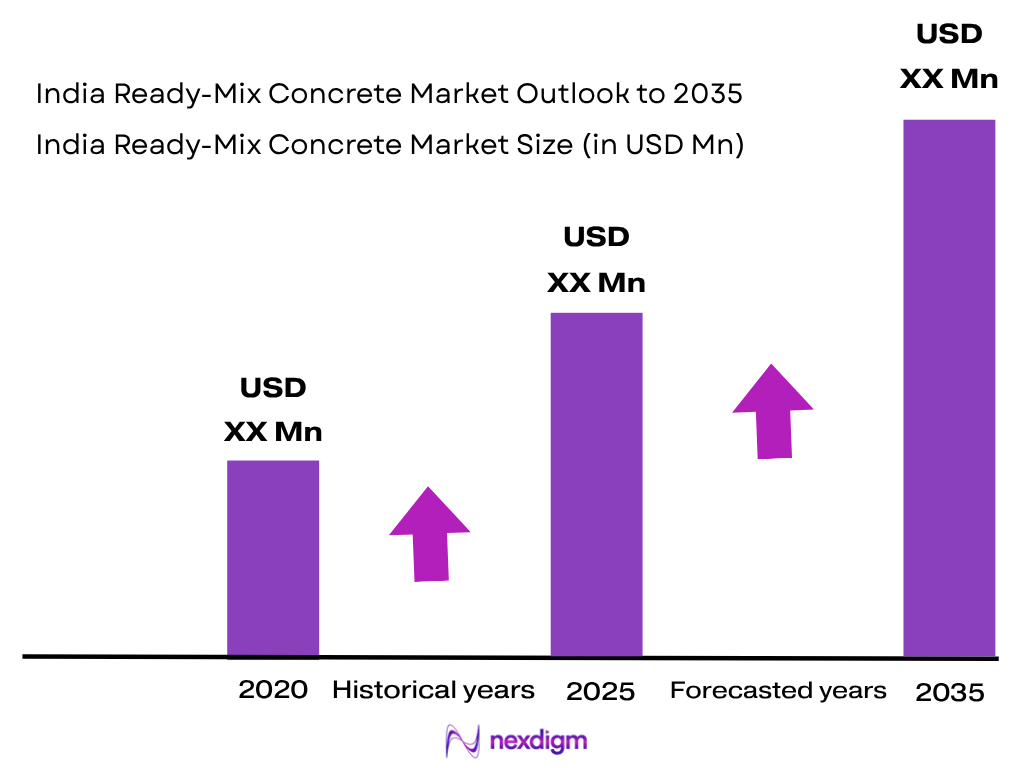
The India Ready-Mix Concrete Market is valued at ~USD XX billion, supported by increasing adoption of controlled concrete solutions across infrastructure, residential, commercial, and industrial construction activities. The market expansion is driven by large-scale infrastructure programs, urban development projects, metro rail expansion, highway construction, and rising preference for quality-assured concrete. The construction sector contributes significantly to economic activity, with infrastructure investment, urbanization, and organized construction practices supporting higher demand for ready-mix concrete solutions across major project categories.
The India Ready-Mix Concrete Market is concentrated across metropolitan and rapidly urbanizing regions including Mumbai, Delhi NCR, Bengaluru, Chennai, Hyderabad, Pune, and Ahmedabad due to high construction activity, infrastructure development, and commercial real estate expansion. These cities represent major consumption centers because of large residential developments, transportation projects, industrial corridors, and urban redevelopment programs. Regions with strong industrial bases and government infrastructure investments continue to generate consistent demand for ready-mix concrete suppliers, batching plants, and specialized concrete solutions.
Market Segmentation
By Application Type
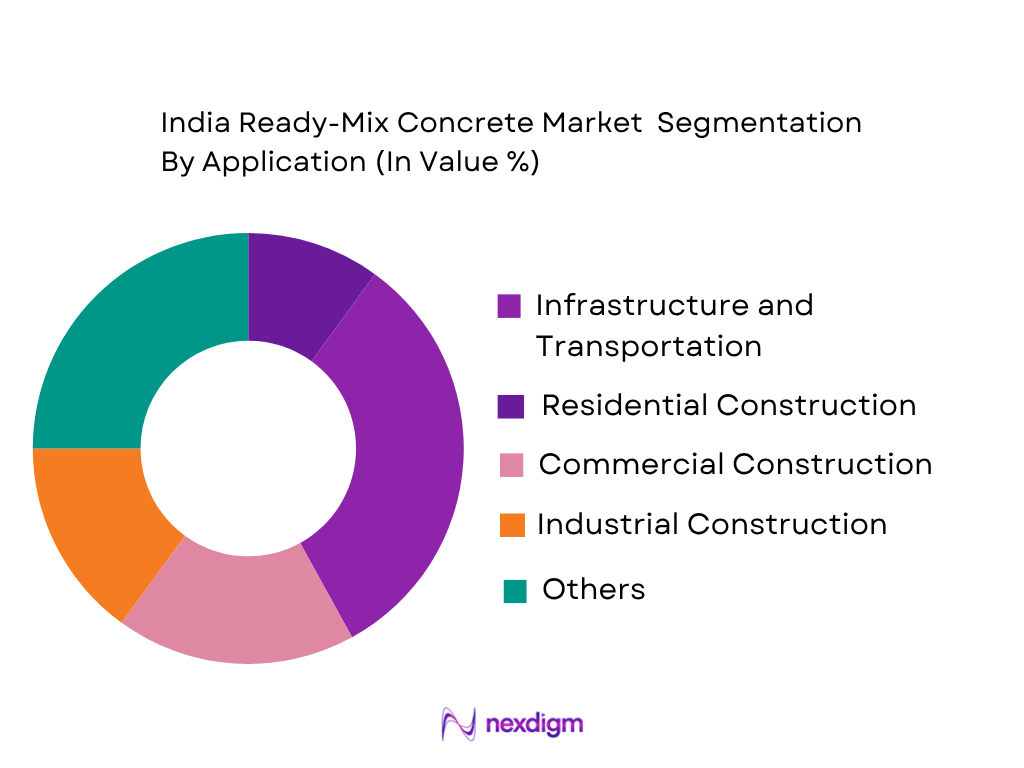
The India Ready-Mix Concrete Market is segmented by application type into residential construction, commercial construction, road and highway construction, metro and railway infrastructure, industrial facilities, power projects, airports, ports, water infrastructure, and urban development projects. Residential construction represents a dominant segment due to rapid urbanization, increasing housing demand, and large-scale residential development activities across major cities. Government housing initiatives, private real estate expansion, and increasing adoption of organized construction methods support ready-mix concrete usage in residential projects. Infrastructure applications such as highways, metros, bridges, and industrial facilities also contribute significantly due to their requirement for high-volume concrete supply, consistent quality, and faster construction timelines. Ready-mix concrete adoption is increasing as developers prefer controlled production environments, reduced wastage, and improved project execution efficiency compared with conventional site-mixed concrete.
By Concrete Grade Type
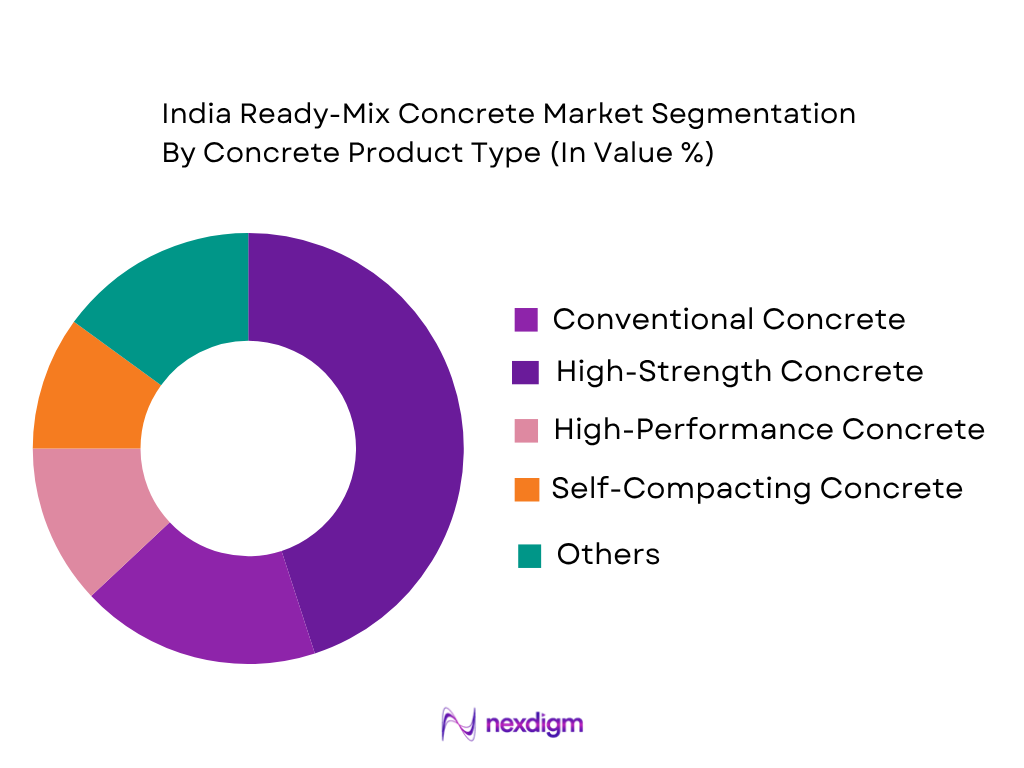
The India Ready-Mix Concrete Market is segmented by concrete grade type into conventional concrete, high-strength concrete, self-compacting concrete, high-performance concrete, fiber-reinforced concrete, and low-carbon concrete. Conventional concrete grades represent the leading segment because they are extensively used across residential buildings, commercial structures, and general infrastructure projects. The broad applicability, established construction practices, and cost-effectiveness of standard concrete grades support their widespread adoption. However, demand for advanced concrete grades is increasing due to requirements for higher durability, faster construction cycles, and improved structural performance in large infrastructure projects. High-performance and self-compacting concrete are increasingly used in complex structures such as metro stations, bridges, and high-rise buildings where enhanced strength and workability are required. Sustainable concrete solutions are also gaining attention due to increasing focus on environmentally responsible construction practices.
Competitive Landscape
The India Ready-Mix Concrete Market is characterized by the presence of large cement companies, independent ready-mix concrete producers, and regional suppliers operating across major construction hubs. Leading companies compete through plant network expansion, concrete technology development, project execution capability, logistics efficiency, and customized concrete solutions. The market includes established cement manufacturers with integrated raw material access as well as specialized ready-mix providers serving infrastructure and real estate projects.
| Company | Establishment Year | Headquarters | Plant Network | Product Portfolio | Major Applications | Technology Capability | Geographic Presence |
| UltraTech Concrete | 1983 | Mumbai, India | ~ | ~ | ~ | ~ | ~ |
| ACC Concrete | 1936 | Mumbai, India | ~ | ~ | ~ | ~ | ~ |
| Ambuja Cements Ready Mix Concrete | 1983 | Mumbai, India | ~ | ~ | ~ | ~ | ~ |
| RDC Concrete | 1993 | Mumbai, India | ~ | ~ | ~ | ~ | ~ |
| Nuvoco Vistas Ready Mix Concrete | 1999 | Kolkata, India | ~ | ~ | ~ | ~ | ~ |
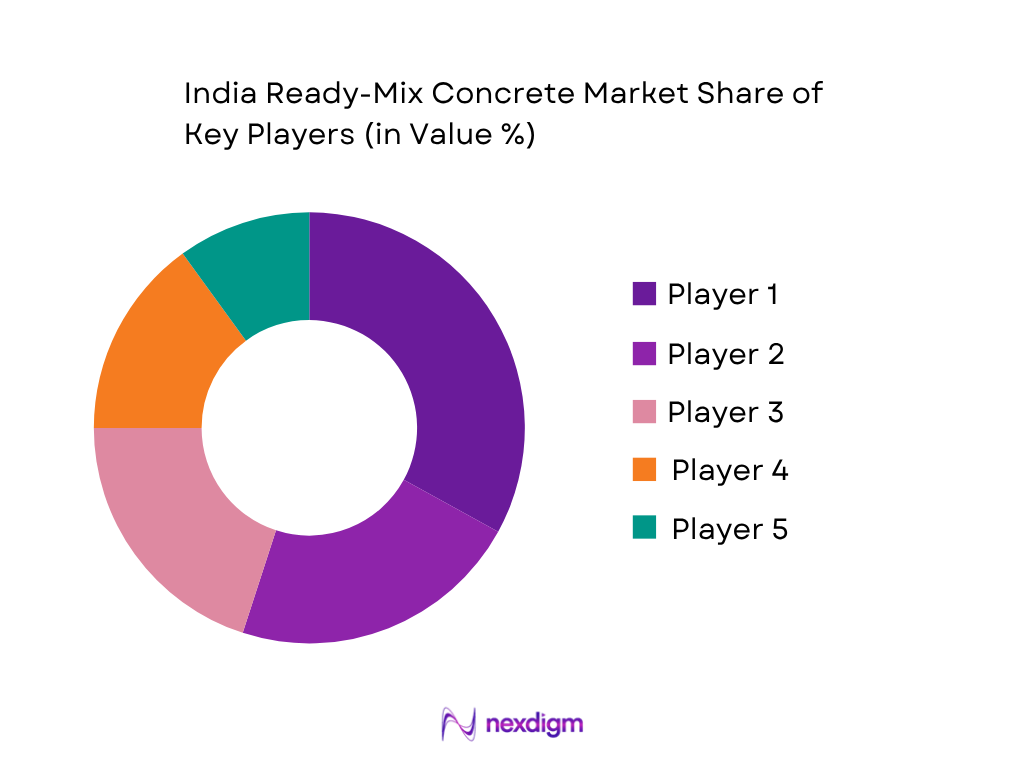
India Ready-Mix Concrete Market Analysis
Growth Drivers
Infrastructure Development Programs and Highway Expansion
Infrastructure development remains a primary growth driver for the India Ready-Mix Concrete Market due to large-scale investments in transportation, urban infrastructure, and public construction projects. The National Highways Authority of India has expanded the national highway network to more than 146,000 km, creating continuous demand for concrete used in pavements, bridges, flyovers, and road structures. The Ministry of Road Transport and Highways allocated more than ₹2.7 lakh crore for infrastructure development activities, supporting highway construction and modernization projects. Government programs such as Bharatmala Pariyojana and regional connectivity initiatives are increasing demand for consistent-quality concrete supplied through organized ready-mix facilities. The construction sector also benefits from India’s infrastructure-focused economic expansion, with the World Bank highlighting infrastructure investment as a critical contributor to productivity and urban growth. Ready-mix concrete adoption is increasing among contractors involved in highways, metro projects, and large public works because it provides controlled quality, faster placement, and reduced material wastage compared with conventional site mixing. Expansion of expressways, bridges, logistics corridors, and urban transport networks continues to create opportunities for ready-mix producers with regional batching capacity and efficient delivery systems.
Urban Housing Development and Real Estate Construction Growth
Rapid urbanization and increasing housing demand are supporting growth in the India Ready-Mix Concrete Market as residential and commercial construction activities expand across metropolitan and emerging cities. The Ministry of Housing and Urban Affairs reported that India’s urban population exceeded 490 million people, increasing demand for residential buildings, commercial spaces, utilities, and urban infrastructure. Government housing programs such as Pradhan Mantri Awas Yojana continue to support residential construction activities, while private developers increasingly adopt ready-mix concrete for high-rise buildings and large housing projects. The Reserve Bank of India reported continued expansion in construction-related economic activity, supported by infrastructure and real estate investment. Major cities including Mumbai, Delhi NCR, Bengaluru, Hyderabad, Chennai, and Pune have witnessed significant construction activity requiring reliable concrete supply networks. Ready-mix concrete provides advantages such as controlled mix design, reduced labor dependency, and faster construction schedules, making it suitable for large-scale housing projects. Increasing preference among developers for standardized construction quality and project efficiency is accelerating the replacement of traditional on-site concrete mixing with organized ready-mix solutions.
Market Challenges
High Transportation Dependency and Limited Rural Penetration
Transportation dependency remains a major challenge for the India Ready-Mix Concrete Market because concrete production is closely linked to delivery distance, road connectivity, and mixer truck availability. Ready-mix concrete generally requires delivery within a limited time period after batching, making localized plant networks essential. India has more than 6.3 million km of road network, but uneven infrastructure quality across rural and remote areas creates logistical challenges for ready-mix suppliers. Rural construction markets often rely on conventional site-mixed concrete due to limited availability of batching plants and transportation constraints. The Ministry of Rural Development continues to focus on improving rural connectivity through road development programs, highlighting the infrastructure gap between urban and rural regions. Ready-mix producers face higher operational complexity when serving dispersed construction locations because transportation costs, vehicle utilization, and delivery scheduling directly affect efficiency. Expansion into smaller cities requires investment in strategically located plants, fleet management systems, and regional supply chains. Limited rural adoption remains a challenge because construction activity is geographically distributed and requires significant infrastructure investment before ready-mix concrete penetration can increase.
Raw Material Availability and Production Cost Pressure
Raw material availability challenges affect the India Ready-Mix Concrete Market because cement, aggregates, water, and admixtures are essential inputs for concrete production. India produced approximately 410 million tonnes of cement, according to industry and government production data, making it one of the largest cement-producing countries globally; however, regional supply variations influence ready-mix operations. Aggregate availability is also affected by quarry regulations, transportation limitations, and environmental restrictions. The Ministry of Mines regulates mineral extraction activities, including sources supplying construction materials, which can impact long-term availability in certain regions. Ready-mix producers require consistent-quality aggregates to maintain concrete performance, but variations in aggregate properties can affect strength, durability, and mix design. Cement supply fluctuations and transportation disruptions can create challenges for maintaining uninterrupted production schedules. Additionally, establishing ready-mix facilities requires significant investment in batching plants, mixer fleets, land, and quality-control systems. These factors create operational barriers, particularly for smaller regional suppliers competing with established companies that have integrated supply networks and larger production capacities.
Market Opportunities
Green Concrete Adoption and Low-Carbon Construction Materials
Sustainable construction practices are creating opportunities for green concrete adoption in the India Ready-Mix Concrete Market as developers and infrastructure agencies focus on reducing environmental impact. India’s construction sector is increasingly adopting supplementary cementitious materials such as fly ash, slag, and recycled aggregates to improve sustainability performance. The Ministry of Power reported that India generated more than 290 million tonnes of fly ash, creating a significant resource base for alternative concrete materials. Government initiatives promoting sustainable infrastructure and green buildings are encouraging the use of environmentally optimized construction materials. The Bureau of Energy Efficiency and green building organizations have emphasized resource-efficient construction practices, supporting demand for lower-emission concrete solutions. Ready-mix producers are developing specialized mixes incorporating alternative materials to meet project requirements for durability and environmental compliance. Infrastructure modernization programs, commercial developments, and industrial projects increasingly require sustainable construction approaches, creating opportunities for suppliers offering low-carbon concrete solutions. Adoption of green concrete technologies can help ready-mix companies differentiate through improved environmental performance while supporting national sustainability objectives.
Digital Concrete Ordering and Automated Delivery Systems
Digitalization of construction processes provides significant opportunities for the India Ready-Mix Concrete Market through online ordering platforms, automated dispatch systems, fleet tracking, and AI-based delivery optimization. Large-scale construction projects require precise coordination between batching plants, mixer trucks, contractors, and project schedules. India’s digital infrastructure expansion, supported by more than 900 million internet users, is enabling wider adoption of technology-based construction solutions. Digital platforms allow contractors to schedule concrete requirements, monitor deliveries, and improve communication with suppliers. Automated dispatch systems help optimize truck routes, reduce waiting time, and improve plant utilization. Government initiatives promoting digital transformation in infrastructure development are encouraging technology adoption across construction-related industries. Ready-mix producers are increasingly integrating GPS tracking, production monitoring, and automated batching controls to improve operational efficiency. The growth of smart cities, industrial facilities, metro projects, and large commercial developments creates demand for technology-enabled concrete supply chains. Digital ordering and automation provide opportunities to improve service reliability, reduce operational inefficiencies, and strengthen customer relationships in the ready-mix concrete sector.
Future Outlook
Over the next decade, the India Ready-Mix Concrete Market is expected to witness continued expansion driven by infrastructure modernization, urban development, residential construction, and increasing adoption of technology-enabled concrete production. Government investment in transportation networks, smart cities, industrial corridors, and housing projects is expected to support market demand. The shift toward sustainable construction materials, digital ordering systems, automated batching, and advanced concrete formulations will further influence industry development.
Major Players
- UltraTech Concrete
- ACC Concrete
- Ambuja Cements Ready Mix Concrete
- RDC Concrete
- Nuvoco Vistas Ready Mix Concrete
- Prism Johnson Ready Mix Concrete
- Ramco Ready Mix Concrete
- Dalmia Cement Bharat Ready Mix Concrete
- Tata Concrete
- JK Lakshmi Cement Ready Mix Concrete
- Godrej Construction Ready Mix Concrete
- My Home Industries Ready Mix Concrete
- RMC Readymix India
- Ahlcon Ready Mix Concrete
- Bharat Ready Mix Concrete
Key Target Audience
- Cement manufacturers and ready-mix concrete producers
- Infrastructure developers and EPC contractors
- Residential and commercial real estate developers
- Construction equipment and concrete technology providers
- Investments and venture capitalist firms
- Government and regulatory bodies (Ministry of Road Transport and Highways, Ministry of Housing and Urban Affairs, Bureau of Indian Standards)
- Industrial construction companies and manufacturing facility developers
- Concrete admixture and construction material suppliers
Research Methodology
Step 1: Identification of Key Variables
The initial phase involves developing an ecosystem map covering major stakeholders operating within the India Ready-Mix Concrete Market. This includes analysis of concrete producers, cement suppliers, construction companies, infrastructure developers, and regulatory authorities to identify key variables influencing market performance.
Step 2: Market Analysis and Construction
This phase involves analyzing historical industry trends, construction activity, concrete consumption patterns, production capacity, plant expansion, and application-wise demand. Supply-side and demand-side assessments are conducted to evaluate market dynamics and industry structure.
Step 3: Hypothesis Validation and Expert Consultation
Market assumptions are validated through discussions with industry participants including ready-mix concrete manufacturers, construction contractors, infrastructure developers, and technical experts. These consultations provide operational insights related to production, applications, and competitive positioning.
Step 4: Research Synthesis and Final Output
The final stage combines primary and secondary research findings to develop a comprehensive market assessment. Data validation is performed through triangulation of industry information, company analysis, construction trends, and stakeholder insights to ensure accurate market interpretation.

- Executive Summary
- Research Methodology (Market Definitions and Assumptions, Ready-Mix Concrete Market Classification, Market Sizing Approach, Top-Down Analysis, Bottom-Up Analysis, Demand-Side Assessment, Supply-Side Assessment, Concrete Consumption Assessment, Cement and Aggregate Supply Assessment, Ready-Mix Plant Mapping, Batch Plant Capacity Assessment, Transportation Radius Analysis, Project Pipeline Assessment, Primary Industry Interviews, Data Triangulation, Forecasting Framework, Limitations and Future Conclusions)

- Definition and Scope
- Market Evolution and Development of Organized Ready-Mix Concrete Industry
- Ready-Mix Concrete Value Chain Analysis
- Ready-Mix Concrete Supply Chain Analysis

- Growth Drivers (Infrastructure Development Programs, Highway and Expressway Expansion, Urban Housing Development, Smart City Projects, Metro Rail Expansion, Industrial Corridor Development, Real Estate Construction Growth, Government Infrastructure Spending, Sustainable Construction Adoption, Increasing Contractor Preference for Quality-Controlled Concrete)
- Market Challenges (Limited Rural Ready-Mix Penetration, High Transportation Dependency, Raw Material Availability Issues, Cement Supply Fluctuation, Aggregate Quality Variation, High Initial Plant Investment, Mixer Truck Availability Constraints, Regional Demand Volatility, Weather-Related Construction Delays, Competition from Site-Mixed Concrete)
- Market Opportunities (Green Concrete Adoption, Low-Carbon Construction Materials, Infrastructure Modernization, Smart City Development, Data Center Construction, Industrial Manufacturing Facilities, Digital Concrete Ordering Platforms, Automated Dispatch Systems, Advanced Concrete Mix Solutions, Recycled Concrete Aggregate Usage)
- Market Trends (Increasing Ready-Mix Concrete Adoption, Digital Fleet Management, Automated Batching Systems, Sustainable Concrete Mix Development, High-Performance Concrete Demand, Precast Construction Integration, Urban Infrastructure Expansion, Quality-Controlled Concrete Preference, Construction Technology Integration, AI-Based Delivery Optimization)
- Government Regulations and Standards (Bureau of Indian Standards Concrete Specifications, Ministry of Road Transport and Highways Construction Standards, National Building Code Requirements, Environmental Clearance Regulations, Construction and Demolition Waste Management Rules, Green Building Standards, Cement Quality Regulations, Infrastructure Project Specifications)
- SWOT Analysis
- Porter’s Five Forces Analysis
- PESTLE Analysis
- Stakeholder Ecosystem
- Competition Ecosystem

- By Market Value (2020-2025)
- By Concrete Production Volume (2020-2025)
- By Ready-Mix Concrete Consumption Volume (2020-2025)
- By Average Selling Price (2020-2025)
- By Commercial Construction Concrete Consumption (2020-2025)
- By Residential Construction Concrete Consumption (2020-2025)

- By Concrete Grade (In Value %)
M10-M20 Concrete
M25-M40 Concrete
M45-M60 Concrete
High-Strength Concrete
Self-Compacting Concrete
Fiber-Reinforced Concrete
High-Performance Concrete
Low-Carbon Concrete - By Application Type (In Value %)
Residential Construction
Commercial Buildings
Road and Highway Construction
Metro and Railway Infrastructure
Bridges and Flyovers
Industrial Facilities
Power Plants
Ports and Airports
Water Infrastructure Projects
Urban Development Projects - By End User Type (In Value %)
Real Estate Developers
Infrastructure Developers
Government Construction Agencies
Industrial Manufacturers
Commercial Property Developers
Road Construction Contractors
Metro Rail Corporations
Power and Energy Companies
Specialized Construction Contractors - By Delivery Mode (In Value %)
Transit Mixer Delivery
Concrete Pump Delivery
Boom Pump Delivery
Volumetric Concrete Delivery
On-Site Batching Solutions
Centralized Batching Plant Supply - By Region (In Value %)
North India
Delhi NCR
Uttar Pradesh
Rajasthan
Punjab
South India
Tamil Nadu
Karnataka
Telangana
Andhra Pradesh
West India
Maharashtra
Gujarat
Goa
East India
West Bengal
Odisha
Bihar - By Concrete Technology (In Value %)
Conventional Ready-Mix Concrete
High-Durability Concrete
Green Concrete
Recycled Aggregate Concrete
Rapid Strength Concrete
Waterproof Concrete
Temperature-Controlled Concrete

- Market Share of Major Players (By Revenue, Concrete Volume Supplied, Geographic Presence, Application Coverage, Plant Network, Customer Segment)
- Cross Comparison Parameters (Ready-Mix Plant Network Coverage, Installed Production Capacity, Geographic Presence, Concrete Grade Portfolio, Infrastructure Project Experience, Digital Ordering Capability, Fleet and Logistics Network, Sustainable Concrete Solutions)
- SWOT Analysis of Major Players
- Detailed Profiles of Major Companies
UltraTech Concrete
ACC Concrete
Ambuja Cements Ready Mix Concrete
Tata Concrete
Nuvoco Vistas Ready Mix Concrete
Ramco Ready Mix Concrete
Prism Johnson Ready Mix Concrete
Dalmia Cement Bharat Ready Mix Concrete
RDC Concrete
Ahlcon Ready Mix Concrete
RMC Readymix India
My Home Industries Ready Mix Concrete
Bharat Road Carrier Ready Mix Concrete
Godrej Construction Ready Mix Concrete
JK Lakshmi Cement Ready Mix Concrete

- Construction Contractor Concrete Procurement Assessment
- Residential Developer Concrete Requirement Analysis
- Commercial Real Estate Concrete Demand Assessment
- Highway and Expressway Project Concrete Consumption Analysis
- Metro Rail Construction Concrete Requirement Assessment
- Industrial Facility Construction Demand Analysis

- By Market Value (2026-2035)
- By Concrete Production Volume (2026-2035)
- By Ready-Mix Concrete Consumption Volume (2026-2035)
- By Average Selling Price (2026-2035)
- By Commercial Construction Concrete Consumption (2026-2035)
- By Residential Construction Concrete Consumption (2026-2035)


 Request a Sample
 Ask for Customization
 Get a Quote
 Enquire Now