
 Download PDF
Market Overview
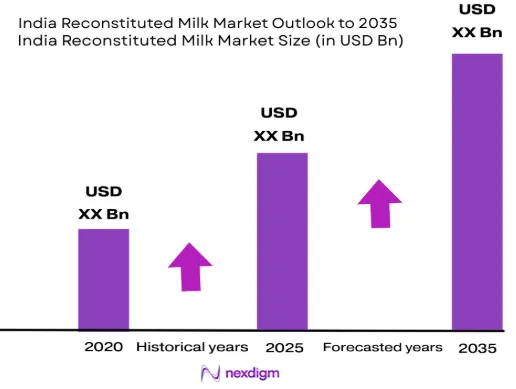
The India Reconstituted Milk Market is valued at USD ~ billion, based on the published India reconstituted milk market trajectory. Demand is driven by liquid milk standardisation, SMP-based lean-season balancing, WMP-based full-cream formulations, UHT milk, dairy beverages, sweets, bakery and institutional procurement. India’s milk production reached 239.3 million tonnes, while per-capita availability reached 471 grams/day, supporting powder reconstitution and recombined milk usage. Uttar Pradesh, Rajasthan, Madhya Pradesh, Gujarat, Andhra Pradesh, Karnataka, Maharashtra, Punjab, Haryana and Tamil Nadu dominate the India Reconstituted Milk Market because they combine high milk production, cooperative procurement, private dairy plants, milk powder capacity, UHT processing and dense consumption corridors. Delhi NCR, Mumbai, Bengaluru, Hyderabad, Chennai, Ahmedabad and Pune are important demand centres due to modern trade, quick commerce, HoReCa, institutional kitchens and high packaged dairy penetration.
Market Segmentation
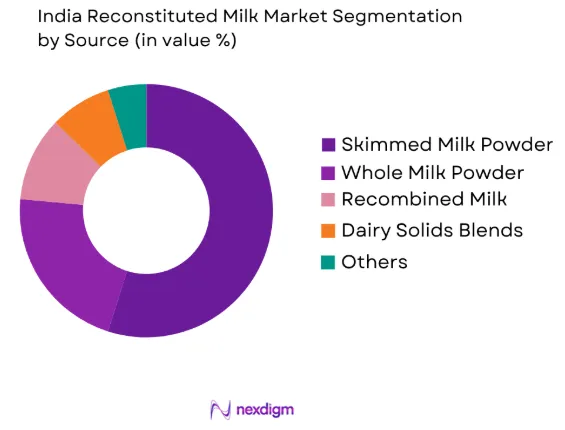
By Source
India Reconstituted Milk Market is segmented by source into whole milk powder based reconstituted milk, skimmed milk powder based reconstituted milk, anhydrous milk fat or butterfat based recombined milk, dairy whitener and dairy solids blends, and milk protein concentrate or whey-based blends. Whole milk powder based reconstituted milk holds the dominant market share because India’s dairy consumption remains strongly linked to full-cream milk, tea, coffee, sweets, desserts and family nutrition. Whole milk powder gives processors a fat-containing base that can be rehydrated for full-bodied dairy beverages, sweets, bakery fillings, frozen desserts and foodservice formulations. It also supports regions where chilled milk logistics are difficult or where processors need shelf-stable inputs. The segment benefits from household familiarity with milk powder, demand from mithai manufacturers and the need for consistent fat and SNF levels in value-added dairy products.
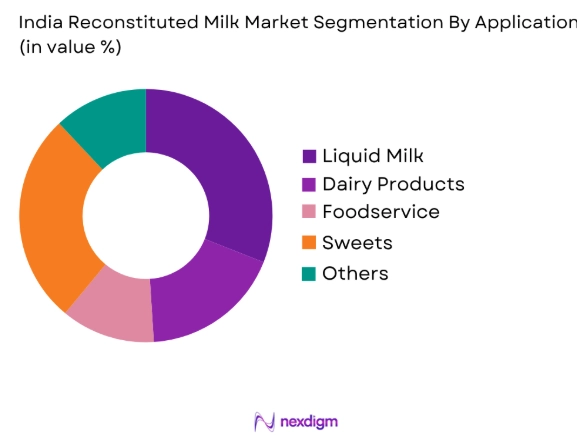
By Application
India Reconstituted Milk Market is segmented by application into liquid milk standardisation, dairy products manufacturing, HoReCa and foodservice, sweets, bakery and confectionery, UHT and dairy beverages, and institutional procurement. Liquid milk standardisation holds the dominant market share because Indian processors frequently use SMP, WMP, cream and butterfat to correct fat and SNF levels across toned milk, double-toned milk, full-cream milk and seasonal supply gaps. The Indian dairy system has strong flush-season and lean-season variability, making powder conversion commercially important for cooperative unions and private dairies. Reconstituted milk also supports pouch milk distribution when fresh procurement is uneven across regions. This segment is especially relevant for large milk brands that must maintain consistency across daily supply, retail packs, institutional contracts and city-level milk routes.
Competitive Landscape
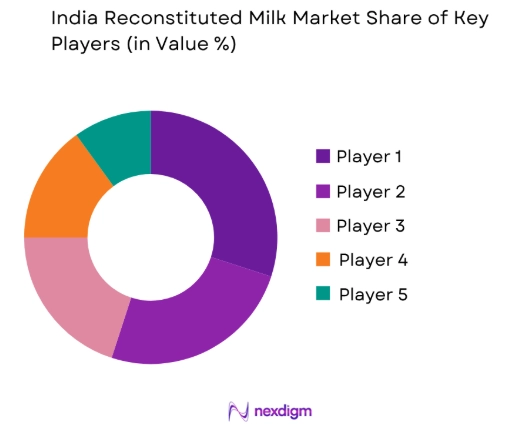
The India Reconstituted Milk Market is highly competitive and led by cooperative federations, state milk unions, national dairy brands and private processors. GCMMF/Amul, Mother Dairy, Karnataka Milk Federation, Aavin and Parag Milk Foods are influential because they combine milk procurement, SMP stocks, UHT processing, pouch milk distribution, institutional reach and branded dairy portfolios. Competition is shaped by cooperative milk pool access, powder inventory, lean-season balancing, HoReCa distribution, FSSAI compliance and value-added dairy innovation.
| Company | Establishment Year | Headquarters | Milk Procurement Strength | Powder / Solids Capability | UHT / Aseptic Capability | Key Product Exposure | Channel Strength | Strategic Positioning |
| Gujarat Cooperative Milk Marketing Federation / Amul | 1973 | Anand, Gujarat | ~ | ~ | ~ | ~ | ~ | ~ |
| Mother Dairy Fruit & Vegetable | 1974 | Noida, Uttar Pradesh | ~ | ~ | ~ | ~ | ~ | ~ |
| Karnataka Milk Federation / Nandini | 1974 | Bengaluru, Karnataka | ~ | ~ | ~ | ~ | ~ | ~ |
| Tamil Nadu Cooperative Milk Producers’ Federation / Aavin | 1958 | Chennai, Tamil Nadu | ~ | ~ | ~ | ~ | ~ | ~ |
| Parag Milk Foods | 1992 | Mumbai, Maharashtra | ~ | ~ | ~ | ~ | ~ | ~ |
India Reconstituted Milk Market Analysis
Growth Drivers
Large Milk Production Base Enables Seasonal Reconstitution
India Reconstituted Milk Market is supported by a large domestic milk base that allows cooperatives and private dairies to convert surplus milk into skimmed milk powder and whole milk powder during flush periods and reconstitute it during lean periods. Basic Animal Husbandry Statistics reports milk production of 247.87 million tonnes and per-capita milk availability of 485 grams per day in 2024–25, while India ranks 1st globally in milk production. USDA FAS reports SMP production at 0.77 MMT in 2025 and 0.79 MMT in 2026, directly supporting reconstitution. World Bank records India’s 2024 GDP at USD 3.91 trillion, supporting large-scale packaged dairy demand.
High Fluid Milk Consumption Supports Reconstituted Milk Balancing
India Reconstituted Milk Market benefits from very large fluid milk demand, where SMP-based reconstitution is used to maintain liquid milk availability, toned milk standards, dairy beverage output and institutional supply. USDA FAS records fluid milk production of 216.5 MMT in 2025 and 221.4 MMT in 2026, with fluid milk consumption of 216.48 MMT in 2025 and 221.37 MMT in 2026. This near-matching production-consumption structure keeps reconstitution relevant for daily supply continuity. World Bank records India’s population at 1.45 billion in 2024 and GDP per capita at USD 2,694.7, creating a broad household base for affordable pouch milk, UHT milk, dairy whitener and powder-derived milk products.
Market Challenges
Limited Import Dependence Reduces External Supply Cushion
India Reconstituted Milk Market faces a sourcing challenge because the country relies mainly on domestic milk and SMP availability rather than imports. USDA FAS states that India’s milk production caters to almost all domestic demand and imports remain insignificant; it also reports SMP imports of nearly 1 thousand MT in 2026, virtually unchanged from 2025. This limits external supply cushioning when lean-season demand rises or cooperative powder stocks tighten. At the same time, India’s fluid milk consumption is reported at 216.48 MMT in 2025 and 221.37 MMT in 2026, leaving little room for supply disruption. World Bank records India’s 2024 GDP growth at 6.5, reinforcing demand-side pressure on formal dairy supply chains.
Quality Compliance and Adulteration Surveillance Increase Operating Burden
India Reconstituted Milk Market faces strict quality-control requirements because reconstituted milk must meet fat, SNF, hygiene, labelling and safety standards while competing with fresh pouch milk and loose milk. A PIB release states that FSSAI conducted pan-India surveillances for milk and milk products in 2011, 2016, 2018, 2020, 2022 and 2023, and asked States/UTs to deploy Food Safety on Wheels for rapid screening of milk and milk products. This compliance intensity affects processors using SMP, WMP and recombined milk bases. The market also operates within a vast consumer economy: World Bank records India’s population at 1.45 billion and consumer inflation at 5.0 in 2024, making affordability and safety assurance simultaneous operating pressures.
Market Opportunities
SMP-Based Reconstitution Can Serve Lean-Season and Institutional Demand
India Reconstituted Milk Market has an opportunity in lean-season milk balancing, institutional kitchens, hostels, hospitals, railways, defence canteens and public nutrition-linked supply. USDA FAS states that SMP is reconstituted into liquid milk and milk products mostly during the lean season, with SMP consumption at 0.76 MMT in 2025 and 0.78 MMT in 2026. This creates room for processors with reliable powder hydration, quality testing and bulk liquid milk standardisation. Domestic demand is supported by milk production of 247.87 million tonnes and per-capita milk availability of 485 grams per day in 2024–25. World Bank records GDP per capita at USD 2,694.7, supporting packaged, standardised and affordable dairy consumption.
Quick Commerce and Regional Access Create Opportunity for UHT and Powder-Derived Dairy
India Reconstituted Milk Market has an opportunity in UHT milk, dairy beverages, dairy whitener, flavoured milk and powder-derived products distributed through modern trade, e-commerce and quick commerce. USDA FAS identifies improving availability and accessibility of milk products across regions through e-commerce and quick commerce as a demand driver, while reporting fluid milk production of 221.4 MMT and consumption of 221.37 MMT for 2026. This supports reconstituted formats that can move beyond daily chilled delivery constraints. World Bank records India’s population at 1.45 billion, GDP at USD 3.91 trillion, and internet use at 70 in 2025, strengthening the addressable base for digitally distributed shelf-stable dairy formats.
Future Outlook
The India Reconstituted Milk Market is expected to grow at a forecast benchmark CAGR of 8.4% during the 2026–2035 period, supported by the country’s large milk base, seasonal milk balancing needs, SMP and WMP utilisation, UHT milk, HoReCa growth and value-added dairy manufacturing. India remains one of the most attractive dairy markets due to its cooperative network, private dairy expansion and increasing formalisation of packaged milk. Over the next decade, processors are expected to invest in powder hydration systems, aseptic packaging, automated fat-SNF testing, UHT capacity, fortified milk and lactose-free dairy. Demand will expand across metro cities, Tier-I cities, sweet manufacturers, bakery chains, institutional kitchens, railways, defence canteens, hospitals and quick-commerce grocery platforms. However, the market will continue to face challenges from informal loose milk, adulteration concerns, powder stock volatility and consumer preference for fresh milk.
Major Players
- Gujarat Cooperative Milk Marketing Federation / Amul
- Mother Dairy Fruit & Vegetable
- Karnataka Milk Federation / Nandini
- Tamil Nadu Cooperative Milk Producers’ Federation / Aavin
- Rajasthan Cooperative Dairy Federation / Saras
- Punjab State Cooperative Milk Producers’ Federation / Verka
- Bihar State Milk Co-operative Federation / Sudha
- Parag Milk Foods
- Hatsun Agro Product
- Heritage Foods
- Dodla Dairy
- Lactalis India
- Milky Mist Dairy
- Nestlé India
- Britannia Dairy
Key Target Audience
- Dairy cooperatives and milk unions
- Private dairy processors and packaged milk companies
- Milk powder, dairy whitener and dairy ingredient manufacturers
- UHT milk and aseptic packaging companies
- HoReCa, bakery, mithai and foodservice procurement teams
- Institutional dairy buyers and public procurement agencies
- Investments and venture capitalist firms
- Government and regulatory bodies (Food Safety and Standards Authority of India, Ministry of Fisheries, Animal Husbandry & Dairying, National Dairy Development Board, Department of Animal Husbandry & Dairying, State Dairy Federations)
Research Methodology
Step 1: Identification of Key Variables
The initial phase involves constructing an ecosystem map for the India Reconstituted Milk Market, covering dairy farmers, milk societies, cooperative unions, private processors, SMP plants, UHT units, distributors, HoReCa buyers and institutions. Key variables include milk procurement, powder stocks, fat-SNF standards, seasonal balancing, UHT demand and regional milk deficits.
Step 2: Market Analysis and Construction
This phase compiles historical and current information on milk production, per-capita availability, cooperative procurement, SMP and WMP usage, packaged milk demand, institutional procurement and foodservice dairy consumption. The market is constructed using top-down dairy balance-sheet analysis and bottom-up modelling based on processor output, powder-to-liquid conversion and application-level demand.
Step 3: Hypothesis Validation and Expert Consultation
Market hypotheses are validated through structured interviews with cooperative unions, private dairies, milk powder traders, foodservice distributors, sweet manufacturers, retail buyers and institutional procurement teams. These consultations help refine source mix, product applications, seasonal reconstitution patterns, quality standards, powder availability and regional demand assumptions.
Step 4: Research Synthesis and Final Output
The final phase integrates secondary data, primary validation, company benchmarking and segment-level triangulation. The final output is cross-checked against published reconstituted milk values, government dairy statistics, NDDB data, FSSAI standards, company portfolios and channel-level demand to provide a reliable assessment of the India Reconstituted Milk Market.

- Executive Summary
- Research Methodology (Market definitions and assumptions, reconstituted milk classification, recombined milk classification, SMP-to-liquid milk conversion, WMP-to-liquid milk conversion, dairy whitener exclusion and inclusion logic, milk solids equivalent calculation, bottom-up processor validation, top-down dairy balance sheet approach, primary interviews with cooperatives and private dairies, distributor checks, retail audit, HoReCa procurement checks, institutional tender validation, limitations and forecast framework)

- Definition and Scope
- Market Genesis and Evolution
- Role of Reconstituted Milk in India’s Dairy Economy
- Business Cycle and Seasonality
- Supply Chain and Value Chain Analysis

- Growth Drivers (Large milk production base, SMP availability, cooperative procurement network, UHT adoption, HoReCa dairy demand, mithai and bakery consumption, institutional nutrition demand)
- Market Challenges (Milk adulteration, quality testing, powder price volatility, informal milk competition, cold-chain limitations, regulatory scrutiny, consumer perception)
- Opportunities (Fortified milk, lactose-free milk, protein-enriched milk, UHT packs, HoReCa bulk milk, private-label dairy, institutional tenders, B2B dairy ingredients)
- Trends (Premium milk powders, protein enrichment, aseptic packaging, cooperative digitisation, milk testing automation, direct-to-consumer dairy, clean-label demand)
- SWOT Analysis
- PESTLE Analysis
- Porter’s Five Forces

- By Value (2020-2025)
- By Volume (2020-2025)
- By Average Realization Price (2020-2025)

- By Product Type (In Value %)
Whole Reconstituted Milk
Skimmed Reconstituted Milk
Recombined Milk
Toned Reconstituted Milk
Double-Toned Reconstituted Milk - By Distribution Channel (In Value %)
Cooperative Milk Booths and Parlours
Kirana and General Trade
Modern Trade and Supermarkets
E-Commerce and Quick Commerce
HoReCa and Foodservice Distribution - By End User (In Value %)
Households
Cooperative Dairy Unions
Private Dairy Processors
Sweet Shops and Mithai Manufacturers
Bakeries and Food Manufacturers - By Region (In Value %)
North India
West India
South India
East India
Central India

- Market Share of Major Players (Value share, volume share, milk procurement-linked share, powder-equivalent share, UHT-linked share)
- Cross Comparison Parameters (Milk procurement footprint, SMP stock access, WMP and dairy whitener portfolio, UHT and aseptic capability, pouch milk distribution network, cooperative or private sourcing model, HoReCa and institutional exposure, FSSAI quality and testing infrastructure)
- SWOT Analysis of Major Players
- SKU and Price Benchmarking
- Detailed Profiles of Major Companies
Gujarat Cooperative Milk Marketing Federation / Amul
Mother Dairy Fruit & Vegetable
Karnataka Milk Federation / Nandini
Tamil Nadu Cooperative Milk Producers’ Federation / Aavin
Rajasthan Cooperative Dairy Federation / Saras
Punjab State Cooperative Milk Producers’ Federation / Verka
Bihar State Milk Co-operative Federation / Sudha
Parag Milk Foods
Hatsun Agro Product
Heritage Foods
Dodla Dairy
Lactalis India
Milky Mist Dairy
Nestlé India
Britannia Dairy

- Household Consumer Analysis
- Cooperative Dairy Union Analysis
- Private Dairy Processor Analysis
- HoReCa Operator Analysis
- Mithai and Bakery Manufacturer Analysis

- By Value (2026-2035)
- By Volume (2026-2035)
- By Average Realization Price (2026-2035)


 Request a Sample
 Ask for Customization
 Get a Quote
 Enquire Now