

 Download PDF
Market Overview
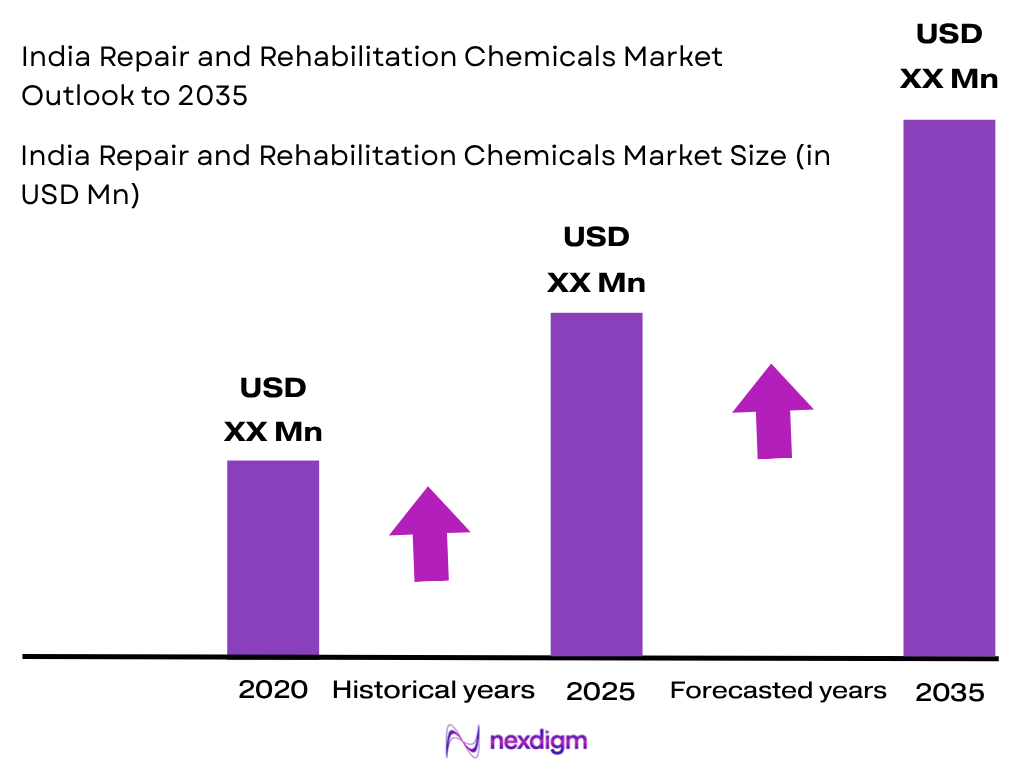
The India Repair and Rehabilitation Chemicals Market is valued at approximately ~USD XX million, supported by ageing buildings, infrastructure maintenance, waterproofing rehabilitation and structural strengthening. Construction GVA at current prices increased from about ₹21.79 lakh crore in the preceding period to ₹23.98 lakh crore in the latest comparable period. This expanding installed concrete asset base supports recurring consumption of polymer-modified mortars, micro-concrete, injection resins, grouts, corrosion treatments and protective coatings.
Delhi NCR, Mumbai Metropolitan Region, Bengaluru, Chennai, Hyderabad and Pune are major demand centres because they combine mature building stocks, metro systems, bridges, flyovers and high-density commercial assets. Operational metro infrastructure expanded from approximately 860 km across 20 cities in the preceding period to 945 km across 21 cities in the latest period, increasing the stock of viaducts, stations, tunnels and structural concrete requiring lifecycle inspection, leakage remediation and rehabilitation.
Market Segmentation
By Product Type
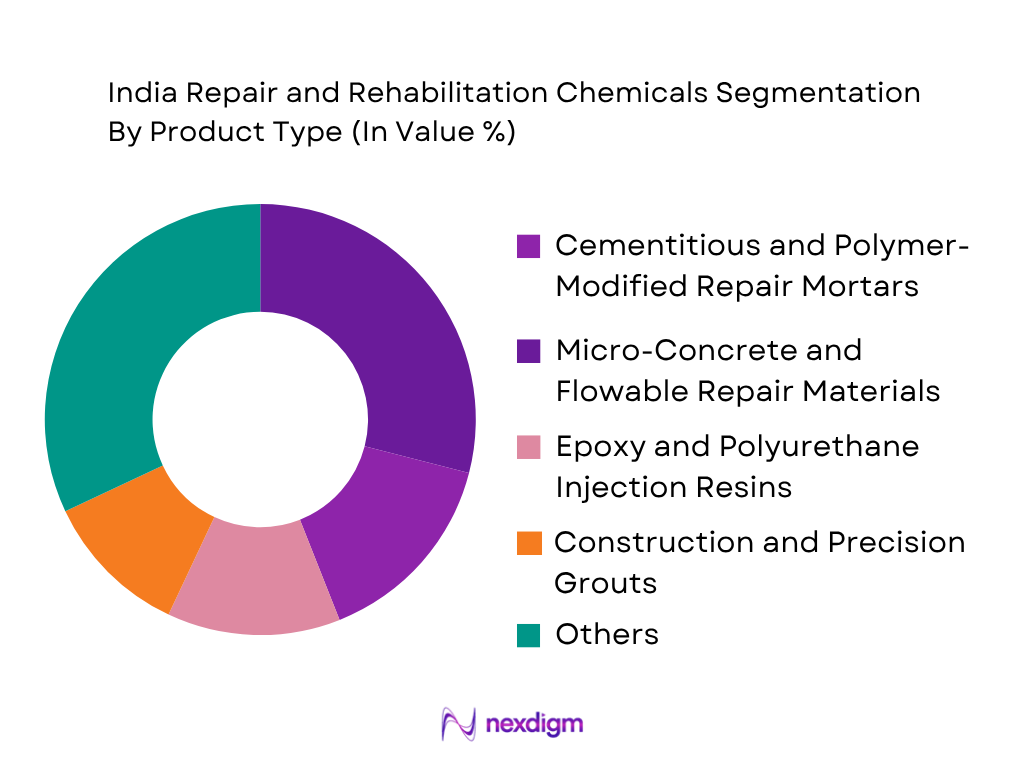
The India Repair and Rehabilitation Chemicals Market is segmented into cementitious repair mortars, polymer-modified repair mortars, micro-concrete, epoxy and polyurethane injection systems, grouts, corrosion-protection systems, protective coatings, waterproofing rehabilitation materials and structural-strengthening systems. Cementitious and polymer-modified repair mortars represent the dominant segment because the country has a large installed base of reinforced-concrete buildings, bridges, metro viaducts and public infrastructure requiring patch repair, section reinstatement and treatment of spalling concrete. Polymer modification is particularly relevant where higher adhesion, reduced permeability and improved durability are required. Flowable micro-concrete is widely applicable to column and beam jacketing and inaccessible repair locations, while epoxy injection serves structural cracks and polyurethane systems address active leakage. The scale of national construction activity reinforces the repair base: construction GVA reached about ₹23.98 lakh crore in the latest comparable period, while first-half construction GVA subsequently reached ₹11.98 lakh crore, sustaining a continuously expanding concrete asset stock.
By Repair Application
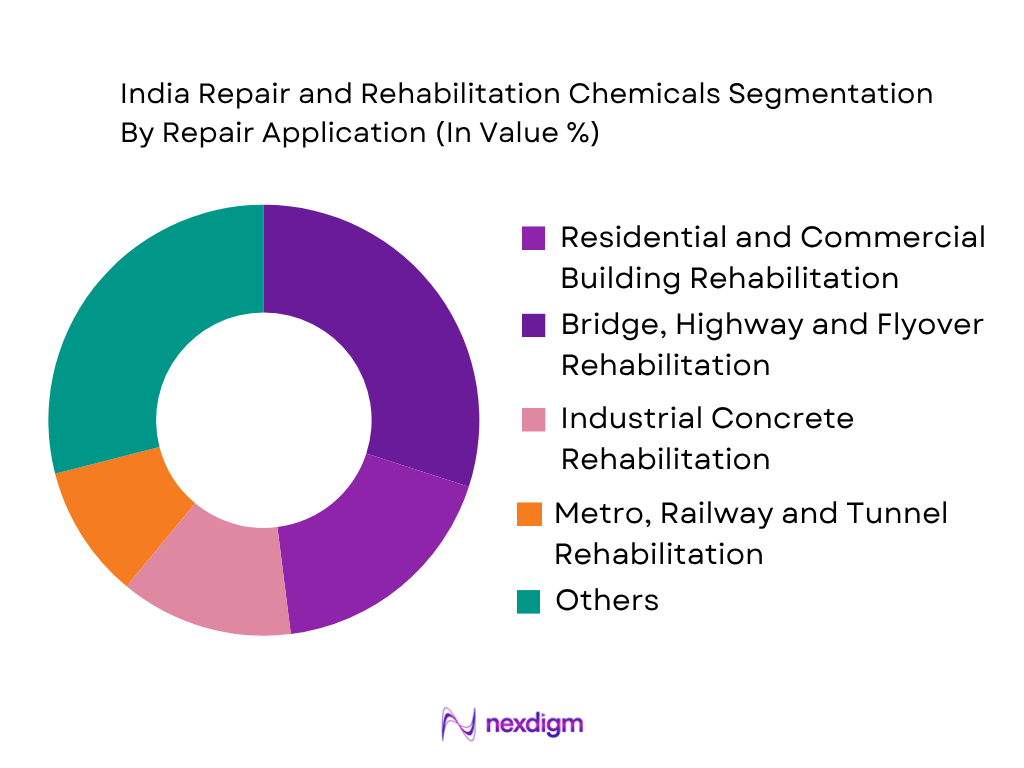
The India Repair and Rehabilitation Chemicals Market is segmented into building rehabilitation, bridge and flyover rehabilitation, metro and tunnel repair, industrial concrete maintenance, dam and water-infrastructure rehabilitation, crack injection, corrosion treatment and structural strengthening. Building rehabilitation holds the dominant position because India combines a very large residential stock with continuing urban construction and widespread requirements for leakage repair, spalling treatment, façade rehabilitation and structural retrofitting. PMAY-U data show 118.64 lakh houses sanctioned, 114.33 lakh grounded and 85.04 lakh completed or delivered, creating an enormous installed housing base that will progressively require lifecycle maintenance. Infrastructure applications are also becoming increasingly important: the national highway network reached 146,145 km, while metro systems reached 945 km across 21 cities. These assets create recurring requirements for bridge deck repairs, pier rehabilitation, tunnel injection, bearing grouts, protective coatings and CFRP strengthening. Dam rehabilitation adds another technically demanding application pool.
Competitive Landscape
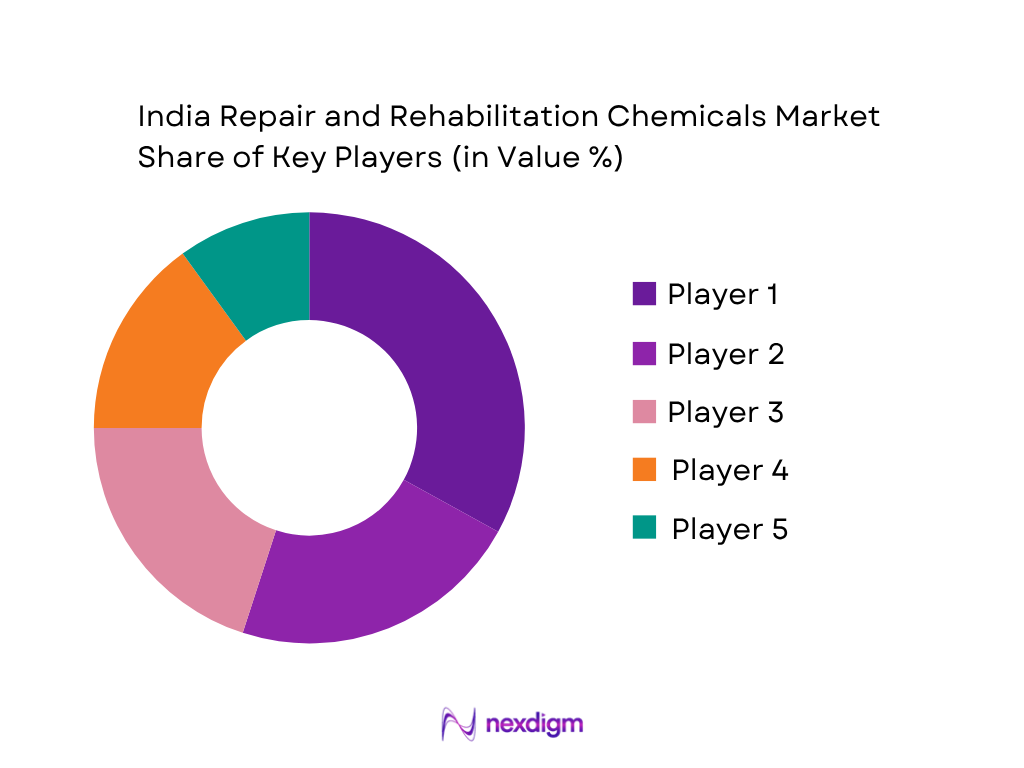
The India Repair and Rehabilitation Chemicals Market combines multinational construction-chemical companies with established domestic manufacturers. Competition is determined less by commodity product breadth and more by complete rehabilitation-system capability, including polymer-modified mortars, micro-concrete, injection resins, grouts, corrosion control, waterproofing and CFRP strengthening. Suppliers with Indian manufacturing, specification relationships, contractor training and project support are better positioned for CPWD, NHAI, metro, industrial and institutional rehabilitation work.
| Major Player | Establishment Year | Headquarters | Repair Mortars / Micro-Concrete | Injection / Grouting | Corrosion Protection | Structural Strengthening | India Manufacturing | Infrastructure Technical Support |
| Fosroc | 1972 | Dubai, UAE | ||||||
| Sika | 1910 | Baar, Switzerland | ||||||
| Pidilite Industries | 1959 | Mumbai, India | ||||||
| MC-Bauchemie | 1961 | Bottrop, Germany | ||||||
| MAPEI | 1937 | Milan, Italy |
India Repair and Rehabilitation Chemicals Market Analysis
Growth Drivers
Aging Urban Buildings and Expanding Transport Infrastructure Are Increasing Structural Rehabilitation Requirements
The India Repair and Rehabilitation Chemicals Market is being driven by the combination of a rapidly expanding built environment and an increasingly large stock of concrete assets requiring lifecycle maintenance. Ministry of Housing and Urban Affairs data show that 118.64 lakh urban houses had been sanctioned under PMAY-U in 2024, with 114.33 lakh grounded and 85.04 lakh completed or delivered, creating a substantial future base for waterproofing renewal, spalling repair, crack treatment and structural rehabilitation. Transport infrastructure adds another layer: Ministry of Road Transport and Highways data record 146,145 km of National Highways, including 48,422 km of four-lane-and-above highways and approximately 2,138 km of operational high-speed corridors in 2024. The Economic Survey also recorded 945 km of operational metro and RRTS lines and another 939 km under construction across 27 cities, increasing exposure to viaduct, station and tunnel maintenance. World Bank data place India’s 2024 nominal GDP at USD3.9099 trillion and GDP per capita at USD2,694.7. This expanding asset base supports recurring consumption of polymer-modified repair mortars, micro-concrete, injection resins, corrosion treatments and protective coatings.
Bridge, Metro and Dam Rehabilitation Programs Are Creating Recurring Infrastructure Repair Demand
Government-led preservation of bridges, metro systems and dams is another major growth driver for the India Repair and Rehabilitation Chemicals Market because these structures require structural strengthening, leakage control, grouting and corrosion mitigation rather than only routine maintenance. Indian Railways reported 163,810 bridges as of April 2024, comprising 740 important bridges, 13,176 major bridges and 149,894 minor bridges. During the same reporting cycle, 2,132 railway bridges were strengthened, rehabilitated or rebuilt, directly supporting applications for micro-concrete, epoxy injection, bearing grouts and protective systems. India also operates more than 6,000 dams, while World Bank-supported rehabilitation programs had already upgraded 200 large dams in 2024. Urban rail adds a further rehabilitation base, with 945 km of metro and RRTS infrastructure operational and daily ridership reaching 1.01 crore passengers in March 2024, increasing the importance of rapid, low-disruption maintenance. World Bank data record India’s nominal GDP at USD3.9099 trillion in 2024 and GDP per capita at USD2,694.7, supporting continued public investment in asset preservation and structural life extension.
Market Challenges
Skilled Applicator Availability and Uneven Site Execution Can Limit Repair-System Performance
The India Repair and Rehabilitation Chemicals Market faces a significant workmanship challenge because structural rehabilitation depends on correct defect diagnosis, surface preparation, reinforcement treatment, mixing, placement, curing and quality verification. Government skilling data demonstrate the scale of this issue: under PMKVY, 13,276 construction-sector candidates were trained in FY2023-24, increasing to 52,475 candidates in FY2024-25, while CPWD announced in 2025 that it planned to train approximately 35,000 workers across the current and following financial years. CPWD also introduced a requirement that contractors on projects above ₹10,000 crore engage at least 20 certified skilled workers out of every 100 workers or provide formal on-site training. These measures reflect the technical capability required for specialist construction and rehabilitation work. CPWD separately categorizes structural repair, rehabilitation and retrofitting as specialized civil work, highlighting the need for experienced agencies. World Bank data record India’s 2024 nominal GDP at USD3.9099 trillion and GDP per capita at USD2,694.7. For repair-chemical suppliers, the challenge is therefore not only supplying material but ensuring correct application through trained contractors, site supervision and technical support.
Diverse Asset Conditions, Moisture Exposure and Operational Constraints Complicate Repair Execution
India’s Repair and Rehabilitation Chemicals Market also faces technical challenges from highly varied deterioration conditions across buildings, bridges, tunnels and hydraulic structures. Indian Railways manages 163,810 bridges, while 2,132 bridges were strengthened, rehabilitated or rebuilt in the 2023-24 operating cycle, demonstrating the scale of structures requiring different repair approaches. Metro systems add another 945 km of operational infrastructure carrying about 1.01 crore passengers daily, meaning many repairs must be executed within short service windows without disrupting operations. Dam rehabilitation presents a different technical environment: India has more than 6,000 dams, and rehabilitation programs address seepage, damaged spillways, drainage improvement and structural strengthening under continuous hydraulic exposure. PMAY-U simultaneously represents 85.04 lakh completed urban houses, where occupied-building access can complicate leakage repair, concrete patching and structural intervention. Repair products therefore have to perform across dry, wet, overhead, submerged and traffic-exposed conditions while remaining compatible with existing concrete. World Bank data place India’s 2024 nominal GDP at USD3.9099 trillion and GDP per capita at USD2,694.7, underscoring the economic scale of the infrastructure base whose varied conditions complicate standardized rehabilitation.
Market Opportunities
High-Flow Micro-Concrete, Injection Systems and CFRP Strengthening Have Strong Scope in Asset-Life Extension
High-performance structural repair technologies represent a major future opportunity in the India Repair and Rehabilitation Chemicals Market because current infrastructure conditions increasingly favor strengthening and localized rehabilitation over complete replacement. Indian Railways’ inventory of 163,810 bridges, including 13,176 major bridges, provides a large base for bearing repairs, section reinstatement, crack injection and strengthening. The rehabilitation of 2,132 railway bridges in the latest 2024 reporting cycle demonstrates active demand for structural intervention. Urban transport offers another technically suitable application base: 945 km of metro and RRTS lines were operational, while 939 km were under construction across 27 cities, expanding the stock that will require future maintenance. High-flow micro-concrete can support column, beam and bearing-zone reinstatement; low-viscosity epoxy can restore structural cracks; and CFRP systems can improve flexural, shear and confinement capacity without major structural enlargement. World Bank data record India’s nominal GDP at USD3.9099 trillion in 2024 and GDP per capita at USD2,694.7. These current infrastructure volumes provide a strong platform for future adoption of engineered repair systems focused on structural life extension, faster installation and lower demolition requirements.
Dam, Tunnel and Urban Water Rehabilitation Can Expand Demand for Injection and Durability Chemicals
Dam, tunnel and water-infrastructure rehabilitation offers a substantial future growth avenue for India’s Repair and Rehabilitation Chemicals Market because leakage, seepage, abrasion and deteriorated concrete require specialist materials rather than conventional patching. India operates more than 6,000 dams, and World Bank-supported programs had already upgraded 200 large dams in 2024 using modern inspection and rehabilitation approaches. Central Water Commission rehabilitation frameworks explicitly cover leakage through masonry and concrete dams, foundation seepage, drainage improvement, structural strengthening and damaged spillway repair, creating applications for microfine cement grouts, polyurethane injection, structural mortars and protective coatings. Urban infrastructure provides an additional base: the Smart Cities Mission had undertaken 8,011 projects worth around ₹1.64 lakh crore as of June 2024, of which 7,153 projects worth about ₹1.43 lakh crore had been completed. Metro systems also operated 945 km of lines, creating additional demand for tunnel leakage injection and concrete protection. World Bank data record India’s 2024 nominal GDP at USD3.9099 trillion and GDP per capita at USD2,694.7. These current assets support future opportunities in PU injection, corrosion protection, anti-carbonation coatings and low-carbon repair materials.
Future Outlook
The India Repair and Rehabilitation Chemicals Market is expected to expand at approximately ~X.X% CAGR during 2026-2035, driven by the ageing of a rapidly expanding infrastructure and building stock, greater emphasis on structural safety, and increased preference for asset-life extension rather than premature replacement. Transportation infrastructure will be a major source of future demand. India’s National Highway network stands at 146,145 km, including 48,422 km with four lanes or more and about 2,138 km of operational high-speed corridors. Every expansion in the national concrete infrastructure base ultimately creates requirements for deck repair, joint rehabilitation, corrosion mitigation, grouting and protective treatments.
Major Players
- Forsook Chemicals India Pvt. Ltd.
- Sika India Pvt. Ltd.
- Master Builders Solutions India
- Pidilite Industries Ltd. / Dr. Fixit
- MC-Bauchemie India Pvt. Ltd.
- MAPEI Construction Products India Pvt. Ltd.
- CICO Technologies Ltd.
- Sunanda Speciality Coatings Pvt. Ltd.
- STP Limited
- MYK Arment Pvt. Ltd.
- Asian Paints Ltd. / SmartCare
- Penetron India / Regional Solutions
- ARDEX Endura India Pvt. Ltd.
- Choksey Chemicals Pvt. Ltd.
- Kryton India / Regional Distribution
Key Target Audience
- Repair and Rehabilitation Chemical Manufacturers
- Structural Repair and Retrofitting Contractors
- Bridge, Highway, Metro and Tunnel Contractors
- Residential, Commercial and Industrial Asset Owners
- Construction Chemical Distributors and Specialist Applicators
- Investments and Venture Capitalist Firms
- Government and Regulatory Bodies (Central Public Works Department, Ministry of Road Transport and Highways, National Highways Authority of India, Central Water Commission, Bureau of Indian Standards, Ministry of Housing and Urban Affairs)
- Infrastructure Concessionaires and Facility Management Companies
Research Methodology
Step 1: Identification of Key Variables
The initial phase involves constructing an ecosystem map covering repair-chemical manufacturers, raw-material suppliers, distributors, structural engineers, contractors, government departments and infrastructure asset owners. Secondary and proprietary research identifies deterioration mechanisms, product technologies, asset classes and project specifications. Core variables include repair area, defect severity, material intensity, structural requirement, project type and regional infrastructure concentration.
Step 2: Market Analysis and Construction
Historical demand is assessed using construction GVA, building stock, highway and metro infrastructure, dam rehabilitation and urban development indicators. Top-down analysis estimates the addressable rehabilitation base, while bottom-up analysis evaluates manufacturer sales, distributor throughput, contractor consumption and material usage per repair application. Results are reconciled across mortars, micro-concrete, injection systems, grouts, corrosion treatments and strengthening materials.
Step 3: Hypothesis Validation and Expert Consultation
Market hypotheses are validated through computer-assisted telephone interviews and structured discussions with structural-repair contractors, product manufacturers, civil engineers, waterproofing specialists, distributors and infrastructure contractors. Consultations assess defect diagnosis, typical repair depths, micro-concrete consumption, injection requirements, corrosion recurrence, specification practices and site-productivity constraints. Findings refine the demand estimates and competitive positioning.
Step 4: Research Synthesis and Final Output
The final phase triangulates government infrastructure statistics, public program data, supplier information and primary interviews. Demand is validated by product type, repair application, customer class and region. Forecasting incorporates ageing buildings, bridge preservation, metro maintenance, dam rehabilitation, industrial repair, structural retrofitting, corrosion protection and adoption of high-performance and lower-carbon rehabilitation technologies.

- Executive Summary
- Research Methodology (Market Definitions and Assumptions, India Repair and Rehabilitation Chemicals Market Classification, Cementitious Repair Mortar Assessment, Polymer-Modified Repair Mortar Assessment, Micro-Concrete Assessment, Epoxy Repair Mortar Assessment, Crack Injection Resin Assessment, Polyurethane Injection Assessment, Cementitious Injection Grout Assessment, Non-Shrink Grout Assessment, Precision Grout Assessment, Reinforcement Passivation Assessment, Corrosion Inhibitor Assessment, Protective Coating Assessment, Anti-Carbonation Coating Assessment, Structural Strengthening Assessment, CFRP Assessment, GFRP Assessment, Epoxy Bonding Assessment, Shotcrete and Guniting Assessment, RCC Jacketing Assessment, Waterproofing Rehabilitation Assessment, Building Façade Repair Assessment, Bridge and Flyover Rehabilitation Assessment, Metro and Tunnel Rehabilitation Assessment, Dam and Water Infrastructure Rehabilitation Assessment, Marine and Coastal Concrete Assessment, IS 456 Durability Assessment, IS 13311 Non-Destructive Testing Assessment, CPWD Repair and Rehabilitation Assessment, IRC Bridge Repair Assessment, NHAI Rehabilitation Assessment, Adhesion Strength Assessment, Compressive Strength Assessment, Chloride Resistance Assessment, Carbonation Assessment, Top-Down Market Sizing, Bottom-Up Market Sizing, Contractor Interviews, Structural Engineer Interviews, Distributor Mapping, Government Project Mapping, Data Triangulation, Forecasting Framework)

- Definition and Scope
- India Repair and Rehabilitation Chemicals Industry Evolution and Development of Conventional Cement-Sand Patching, Polymer-Modified Repair Mortars, Flowable Micro-Concrete, Non-Shrink Grouts, Epoxy Injection Resins, Polyurethane Injection Resins, Cementitious Injection Grouts, Reinforcement Passivation Systems, Rust Removers, Corrosion Inhibitors, Anti-Carbonation Coatings, Protective Elastomeric Coatings, Shotcrete and Guniting Systems, RCC Jacketing, Structural Epoxy Bonding, CFRP Strengthening, GFRP Strengthening, Waterproofing Rehabilitation, Bridge Deck Repair, Tunnel Leakage Injection, Dam Rehabilitation and Low-Carbon Repair Technologies
- Repair and Rehabilitation Chemicals Value Chain Analysis
- Repair and Rehabilitation Chemicals Supply Chain Analysis
- Cement and SCM Suppliers, Polymer Modifier Suppliers, SBR Latex Suppliers, Acrylic Polymer Suppliers, Epoxy Resin Suppliers, Polyurethane Resin Suppliers, Corrosion Inhibitor Suppliers, Carbon Fibre Suppliers, Glass Fibre Suppliers, Silica Fume Suppliers, Mineral Filler Suppliers, Specialty Additive Suppliers, Repair Chemical Manufacturers, Local Blenders, Importers, Construction Chemical Distributors, Structural Repair Contractors, Waterproofing Contractors, Injection Contractors, Bridge Contractors, Metro Contractors, Dam Rehabilitation Contractors, Structural Engineers, Government Agencies, Municipal Bodies and Industrial Facility Owners

- Growth Drivers (Aging Residential and Commercial Building Stock, NHAI Bridge Rehabilitation, State PWD Repair Programs, Metro Asset Maintenance, Railway Bridge Rehabilitation, Dam Rehabilitation and Improvement Program, Urban Water Infrastructure Renewal, Industrial Asset Maintenance, Coastal Corrosion Exposure, Building Leakage Remediation, Structural Safety Audits, Asset-Life Extension)
- Market Challenges (Unorganized Applicator Base, Skilled Repair Contractor Availability, Incorrect Defect Diagnosis, Poor Surface Preparation, Hidden Reinforcement Corrosion, Chloride Contamination, Moisture Behind Repairs, Repair-Material Compatibility, Crack Reopening, Product Substitution, Site Quality Control, Public Tender Specification Variation, Occupied-Building Repair Constraints, Traffic Closure Constraints)
- Market Opportunities (Polymer-Modified Structural Repair Mortars, High-Flow Micro-Concrete, Rapid-Setting Repair Systems, Low-Viscosity Epoxy Injection, PU Leakage Injection, Migrating Corrosion Inhibitors, Anti-Carbonation Coatings, CFRP Strengthening, Seismic Retrofitting, Bridge Rehabilitation Systems, Metro and Tunnel Injection Systems, Dam Rehabilitation Chemicals, Low-Carbon Repair Materials, Predictive Maintenance-Linked Rehabilitation)
- Market Trends (SBR Polymer-Modified Repair Mortars, Prepacked Micro-Concrete, Epoxy Crack Injection, Hydrophilic PU Injection, CFRP Wrapping, RCC Jacketing, Corrosion Inhibitor Adoption, Anti-Carbonation Coatings, Spray-Applied Repair Mortars, Rapid-Cure Repair Systems, Integrated Repair-and-Waterproofing Systems, Digital Condition Assessment, NDT-Led Rehabilitation, Low-Carbon Repair Technologies)
- Government Regulations and Standards (CPWD Repair and Rehabilitation Guidelines, CPWD Maintenance Requirements, IS 456 Concrete Durability Requirements, IS 13311 Non-Destructive Testing, IRC Bridge Repair Guidelines, NHAI Maintenance and Rehabilitation Specifications, MoRTH Specifications for Road and Bridge Works, Bureau of Indian Standards Requirements, Dam Safety Framework, DRIP Rehabilitation Requirements, Metro Rail Structural Maintenance Requirements, National Building Code Structural Safety Requirements, Occupational Safety Requirements)
- SWOT Analysis
- Porter’s Five Forces Analysis
- PESTLE Analysis

- By Market Value (2020-2025)
- By Repair Chemical Consumption Volume (2020-2025)
- By Cementitious Repair Mortar Consumption (2020-2025)
- By Polymer-Modified Repair Mortar Consumption (2020-2025)
- By Micro-Concrete Consumption (2020-2025)
- By Epoxy Injection Resin Consumption (2020-2025)
- By Polyurethane Injection Consumption (2020-2025)

- By Product Type (In Value %)
Cementitious Repair Mortars
Polymer-Modified Repair Mortars
Flowable Micro-Concrete
Epoxy Repair Mortars
Rapid-Setting Repair Mortars
Epoxy Injection Resins
Polyurethane Injection Resins
Cementitious Injection Grouts
Non-Shrink Grouts
Precision Grouts
Reinforcement Passivation Coatings
Rust Removers and Converters - By Repair Application (In Value %)
Spalling Concrete Repair
Delaminated Concrete Repair
Honeycombing Repair
Structural Crack Injection
Non-Structural Crack Sealing
Rebar Corrosion Repair
Concrete Section Reinstatement
Column and Beam Jacketing
Void Filling and Grouting
Baseplate and Machine Grouting
Façade Concrete Repair - By Deterioration Mechanism (In Value %)
Reinforcement Corrosion
Carbonation-Induced Deterioration
Chloride-Induced Corrosion
Water Ingress
Honeycombing
Spalling
Delamination
Chemical Attack
Sulfate Attack - By Structure Type (In Value %)
Residential Buildings
Commercial Buildings
Government Buildings
Hospitals
Schools and Institutional Buildings
Industrial Plants
Factories
Warehouses
Highway Bridges - By Repair Technology (In Value %)
Hand-Applied Polymer-Modified Mortar
Form-and-Pour Micro-Concrete
Wet-Mix Shotcrete
Dry-Mix Guniting
Epoxy Pressure Injection
Polyurethane Injection
Cementitious Pressure Grouting
RCC Jacketing
Steel Plate Bonding
CFRP Wrapping

- Market Share of Major Players (By India Revenue, Repair Mortar Volume, Micro-Concrete Portfolio, Injection Resin Portfolio, Grouting Portfolio, Corrosion Protection Portfolio, Protective Coating Portfolio, CFRP Strengthening Exposure, Building Rehabilitation Exposure, Bridge and Highway Exposure, Metro and Tunnel Exposure, Dam and Water Infrastructure Exposure, India Manufacturing Capacity, Distributor Network, Technical Specification Support)
- Cross Comparison Parameters (Structural Repair Mortar Micro-Concrete and Grout Portfolio Breadth, Epoxy PU and Cementitious Injection Technology Capability, Rebar Corrosion Carbonation and Chloride Protection Capability, CFRP GFRP and Structural Strengthening System Capability, Building Bridge Metro and Dam Rehabilitation Reference Base, India Manufacturing Warehousing and Project Distribution Network Reach, CPWD NHAI PWD and Infrastructure Specification Exposure, Structural Engineer Contractor Training Site Testing and Technical Support Capability)
- SWOT Analysis of Major Players
- Competitive Positioning Matrix
- Major Companies
Fosroc Chemicals India Pvt. Ltd.
Sika India Pvt. Ltd.
Master Builders Solutions India
Pidilite Industries Ltd. / Dr. Fixit
MC-Bauchemie India Pvt. Ltd.
MAPEI Construction Products India Pvt. Ltd.
CICO Technologies Ltd.
Sunanda Speciality Coatings Pvt. Ltd.
STP Limited
MYK Arment Pvt. Ltd.
Asian Paints Ltd. / SmartCare
Penetron India / Regional Solutions
ARDEX Endura India Pvt. Ltd.
Choksey Chemicals Pvt. Ltd.
Kryton India / Regional Distribution

- Injection Specialist Requirement Assessment
- Waterproofing Contractor Requirement Assessment
- Bridge Contractor Requirement Assessment
- Metro Contractor Requirement Assessment
- Industrial Maintenance Contractor Requirement Assessment
- Structural Engineer Specification Assessment
- Housing Society Requirement Assessment
- Commercial Property Owner Requirement Assessment

- By Market Value (2026-2035)
- By Repair Chemical Consumption Volume (2026-2035)
- By Cementitious Repair Mortar Consumption (2026-2035)
- By Polymer-Modified Repair Mortar Consumption (2026-2035)
- By Micro-Concrete Consumption (2026-2035)
- By Epoxy Injection Resin Consumption (2026-2035)
- By Polyurethane Injection Consumption (2026-2035)


 Request a Sample
 Ask for Customization
 Get a Quote
 Enquire Now
