
 Download PDF
Market Overview
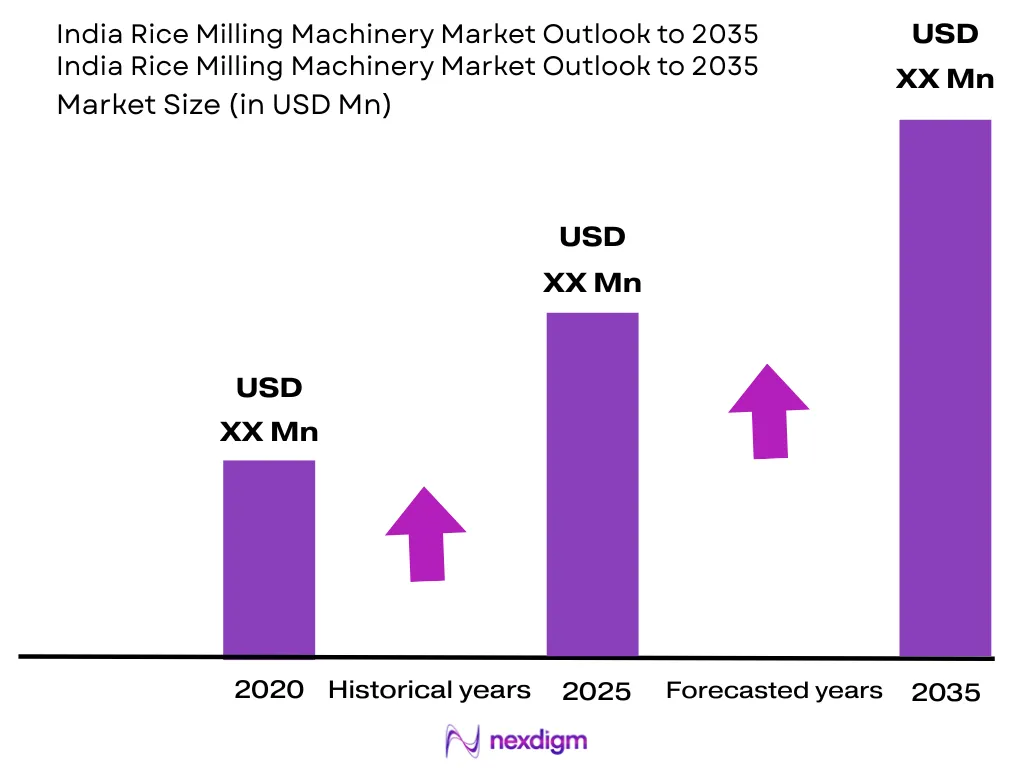
The India Rice Milling Machinery Market was valued at USD ~ Million in 2024, underpinned by the country’s status as the world’s largest rice producer and exporter. According to data published by the Ministry of Agriculture and Farmers Welfare (MoAFW) and the Food Corporation of India (FCI), India produced approximately 135 million metric tons of paddy rice, while annual rice exports exceeded 22 million metric tons, reinforcing India’s dominant position in global rice trade. Continuous modernization of milling infrastructure, surging demand for premium basmati and non-basmati rice, rapid adoption of automated processing systems, and government-backed initiatives to reduce post-harvest losses are the principal factors driving equipment demand across the country.
Market Segmentation
By Machinery Type
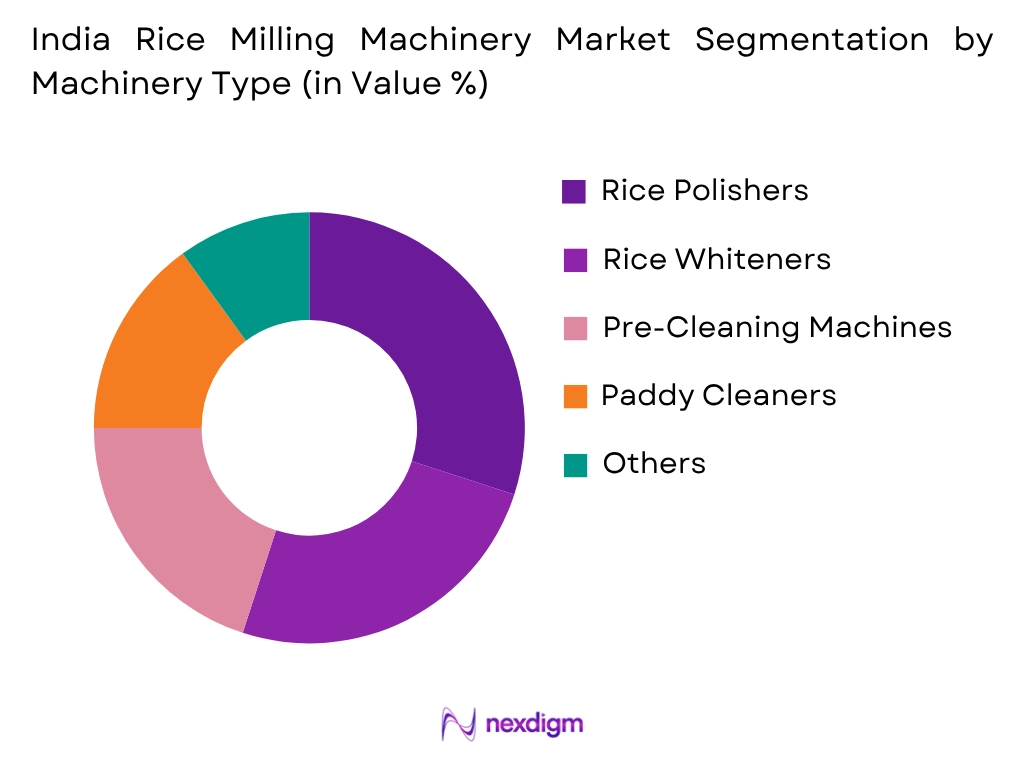
India Rice Milling Machinery Market is segmented by machinery type into Pre-Cleaning Machines, Paddy Cleaners, Destoners, Rubber Roll Huskers, Paddy Separators, Rice Whiteners, Rice Polishers, Color Sorters, Rice Graders, Length Graders, Packaging Systems, and Complete Rice Milling Plants. Recently, Rice Whiteners and Polishers hold the dominant market share within this segmentation due to their central role in determining the commercial grade and market value of processed rice. Indian rice processors are increasingly focused on maximizing head rice recovery, improving grain lustre, and achieving export-grade quality specifications required by international buyers in the Middle East, Africa, and Southeast Asia. The rapid expansion of branded consumer rice, growing preference for polished and double-polished rice, and the proliferation of large-scale rice processing parks under government cluster development programs have encouraged widespread investment in whitening and polishing lines. Furthermore, an accelerating cycle of equipment replacement and the commissioning of new integrated milling complexes have reinforced the dominance of these machinery categories. Their direct impact on final product quality, recovery efficiency, and profitability makes them indispensable capital investments for medium-scale and large commercial rice processing facilities across India.
By Automation Level
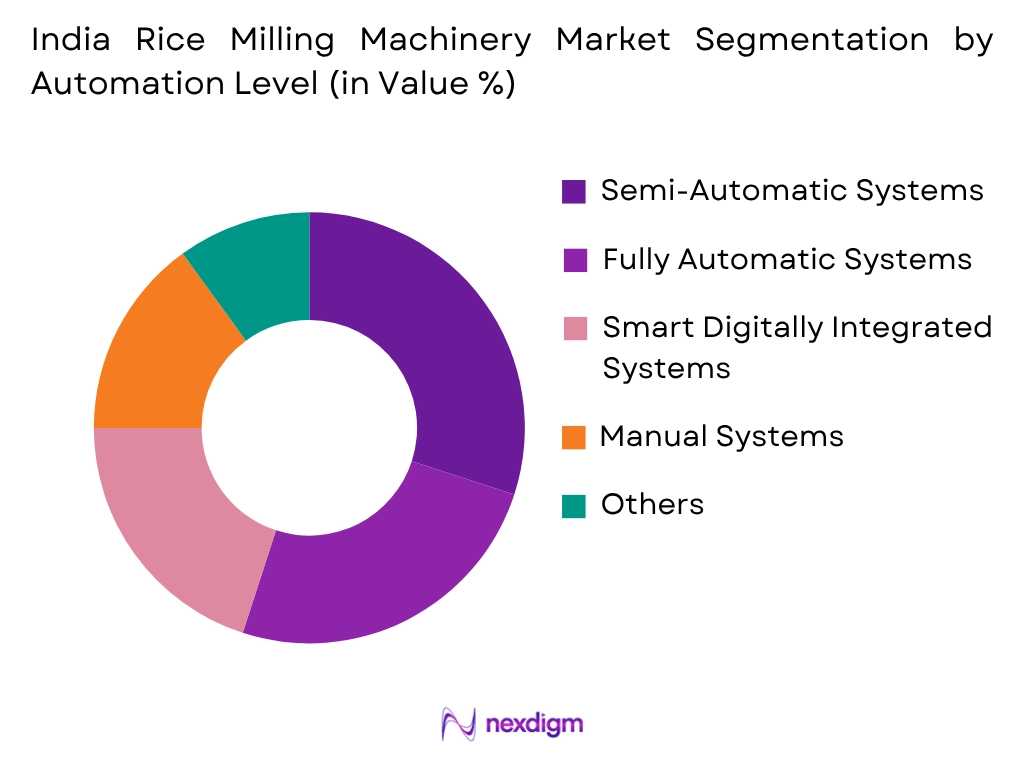
India Rice Milling Machinery Market is segmented by automation level into Manual Systems, Semi-Automatic Systems, Fully Automatic Systems, and Smart Digitally Integrated Systems. Currently, Semi-Automatic Systems hold the largest market share, reflecting the vast installed base of small and medium-scale mills distributed across India’s major rice-producing states. However, Fully Automatic Systems represent the fastest-growing segment, driven by increasing investment from large commercial millers and integrated food processing companies seeking to optimize throughput, minimize labor dependency, and consistently meet export quality benchmarks. Government incentive schemes under the Pradhan Mantri Formalisation of Micro food processing Enterprises (PM FME) scheme and the Production Linked Incentive (PLI) scheme for food processing are accelerating automation adoption by improving access to subsidized credit and capital support. As energy and labor costs rise and domestic and international buyers demand greater quality consistency and traceability, the transition from semi-automatic to fully automated milling systems is expected to gain significant momentum across India’s rice processing industry throughout the forecast period.
Competitive Landscape
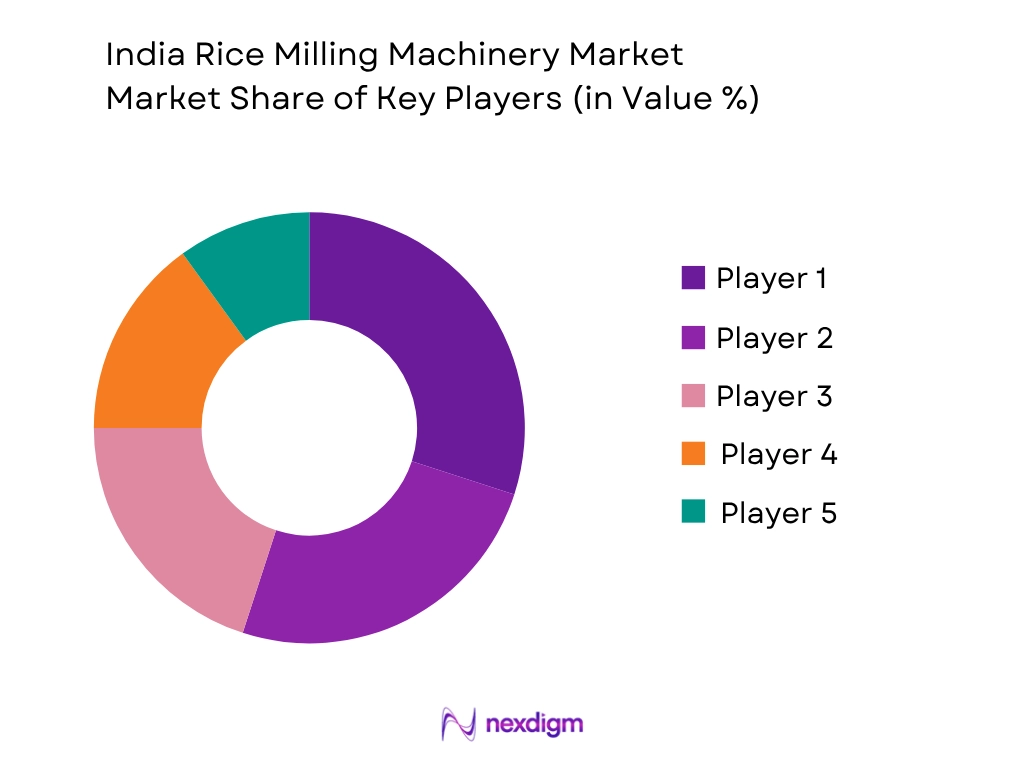
The India Rice Milling Machinery Market is characterized by the simultaneous presence of global technology leaders, established domestic manufacturers, and a large base of regional and small-scale equipment fabricators serving the country’s diverse rice milling industry. International companies such as Bühler Group and Satake Corporation maintain strong positions in the premium and large-scale segment through advanced milling technologies, while Indian manufacturers such as Milltec Machinery, Fowler Westrup, and Guru Nanak Industries dominate the mid-market and small-mill segments through cost-competitive offerings, extensive dealer networks, and localized after-sales support. Competition is primarily driven by equipment efficiency, rice recovery performance, automation capabilities, service network coverage, and the ability to offer affordable turnkey plant installation solutions tailored to India’s fragmented milling landscape.
| Company | Establishment Year | Headquarters | Rice Milling Portfolio | Automation Capability
|
Color Sorting Technology | Service Network | Turnkey Plant Solutions | Processing Capacity Range |
| Bühler Group | 1860 | ~ | ~ | ~ | ~ | ~ | ~ | ~ |
| Satake Corporation | 1896 | ~ | ~ | ~ | ~ | ~ | ~ | ~ |
| Milltec Machinery | 1998 | ~ | ~ | ~ | ~ | ~ | ~ | ~ |
| Fowler Westrup | 1962 | ~ | ~ | ~ | ~ | ~ | ~ | ~ |
| Agro Millers Pvt. Ltd. | 1985 | ~ | ~ | ~ | ~ | ~ | ~ | ~ |
India Rice Milling Machinery Market Analysis
Growth Drivers
World’s Largest Rice Production Base and Expanding Commercial Processing Infrastructure
The India rice milling machinery market is fundamentally supported by the country’s unrivalled position as the world’s largest rice producer and exporter. According to the Ministry of Agriculture and Farmers Welfare (MoAFW), India produced approximately 135 million metric tons of paddy rice, with the rice crop cultivated across more than 44 million hectares of agricultural land spanning states including West Bengal, Uttar Pradesh, Punjab, Andhra Pradesh, Telangana, and Odisha. The Agricultural and Processed Food Products Export Development Authority (APEDA) reported that India’s rice exports exceeded 22 million metric tons in value terms, making the country the undisputed global leader in rice export volumes. The sheer scale of paddy production creates immense and sustained demand for the full spectrum of rice milling equipment ranging from pre-cleaners and rubber roll huskers to optical color sorters, polishers, and automated packaging systems. A rapidly growing base of large integrated rice mills, rice processing parks established under national cluster development programs, and the ongoing consolidation of fragmented small mills into commercial enterprises are collectively driving investment in modern, high-capacity milling infrastructure. The Food Corporation of India (FCI) and state-level civil supplies corporations continue to procure rice at scale, providing institutional demand that incentivizes millers to invest in capacity enhancement and quality improvement technologies.
Government Initiatives Supporting Agricultural Mechanization and Food Processing Modernization
A comprehensive array of central and state government schemes is actively stimulating investment in rice milling machinery and post-harvest processing infrastructure across India. The Ministry of Food Processing Industries (MoFPI) has implemented the Production Linked Incentive (PLI) scheme for food processing, the Pradhan Mantri Formalisation of Micro food processing Enterprises (PM FME) scheme, and the Mega Food Parks scheme, all of which provide capital subsidies, credit-linked incentives, and infrastructure support to food processing enterprises including rice millers. According to the National Bank for Agriculture and Rural Development (NABARD), agricultural infrastructure financing through the Agriculture Infrastructure Fund (AIF) has channelled thousands of crore rupees into post-harvest management and primary processing facilities since its inception. The Government of India’s target to double farmers’ income and reduce post-harvest losses has further focused policy attention on improving milling efficiency, reducing grain breakage, and enhancing recovery rates through technology adoption. State government programs in major rice-producing states including Andhra Pradesh, Punjab, and West Bengal offer additional machinery purchase subsidies and technology upgradation grants. The World Bank has noted India’s strong trajectory of agricultural value-chain investment, reinforcing the policy-driven demand environment for modern rice milling technologies. Collectively, these government programs are substantially expanding the addressable market for rice milling machinery manufacturers and equipment suppliers operating across India.
Market Challenges
Highly Fragmented Small-Scale Milling Sector with Limited Capital Investment Capacity
One of the most significant structural challenges facing the India rice milling machinery market is the extreme fragmentation of the domestic milling industry, dominated by a vast number of small and micro-scale rice mills with limited financial capacity for machinery upgrades. According to the Ministry of Food Processing Industries, India has over 80,000 rice mills, the majority of which are small operations processing fewer than two tons of paddy per hour and operating with aging semi-automatic or manual equipment. These mills often lack access to formal institutional credit, operate on thin margins, and face seasonal cash flow constraints tied to paddy procurement cycles. The International Finance Corporation (IFC) has highlighted that access to affordable equipment financing remains a critical barrier for small agro-processing enterprises in India. The fragmented structure of the milling industry makes it difficult for machinery manufacturers to efficiently distribute, install, and service equipment at scale. Furthermore, price sensitivity in the small-mill segment limits adoption of advanced automation technologies, optical sorting systems, and energy-efficient milling solutions, restricting the growth of the premium machinery segment. While government subsidy schemes partially offset these constraints, the administrative complexity and limited awareness of available support programs further impede technology adoption among the smallest mill operators.
Inadequate Rural Infrastructure and Inconsistent Power Supply Affecting Mill Modernization
Inadequate rural infrastructure, particularly unreliable electricity supply and poor road connectivity, represents a persistent challenge for the rice milling machinery market in India. A significant proportion of rice mills, especially those in eastern and northeastern states such as West Bengal, Odisha, Bihar, and Assam, continue to suffer from frequent power outages, voltage fluctuations, and inadequate power supply hours during peak paddy processing seasons. Modern automated rice milling equipment, including optical color sorters, electronic control systems, and precision grading machines, requires stable and high-quality electrical supply for optimal performance and longevity. Power instability increases the risk of equipment damage, data loss in digital control systems, and operational downtime, raising the effective cost of equipment ownership. According to the Central Electricity Authority (CEA), while national electrification coverage has expanded significantly, power supply quality and reliability in rural agricultural and agro-industrial areas continues to lag behind urban industrial zones. Poor road infrastructure in some rice-growing regions also complicates equipment logistics, installation, and after-sales service, increasing costs for both manufacturers and mill operators. Until infrastructure gaps are more comprehensively addressed, the adoption of sophisticated milling technologies in smaller mills and rural processing hubs will remain constrained.
Market Opportunities
Rapid Adoption of Automated Color Sorting and Digital Milling Technologies
India’s rice processing industry presents one of the world’s most significant opportunities for suppliers of advanced automated sorting and digital milling solutions. With paddy production exceeding 135 million metric tons annually and a rapidly growing base of large commercial mills targeting export markets in the Middle East, Africa, Europe, and Southeast Asia, processors are under strong and increasing pressure to meet stringent international quality specifications. Optical color sorters and AI-powered sorting systems are witnessing particularly rapid adoption as exporters seek to comply with maximum residue limits, foreign matter tolerances, and grain uniformity requirements imposed by importing countries. The growing penetration of branded consumer rice in India’s domestic market, estimated to be one of Asia’s fastest-growing packaged food segments, is also driving demand for premium sorting and grading equipment. Additionally, the Government of India’s push to reduce rice milling losses from the current national average of approximately 8-10% to international best practice levels through technology adoption creates a compelling use case for advanced machinery investment. The integration of IoT sensors, real-time process monitoring systems, and predictive maintenance platforms into milling operations is gaining traction among India’s leading rice exporters and integrated processing companies. As the industry continues to scale and formalize, demand for intelligent, connected milling systems is expected to grow substantially throughout the forecast period.
Expansion of Export-Oriented Basmati and Non-Basmati Rice Processing Capacity
The continued rapid expansion of India’s rice export industry creates compelling and sustained opportunities for rice milling machinery suppliers across the entire equipment spectrum. India’s rice export revenues have grown substantially in recent years, with APEDA data confirming that basmati rice exports alone generate foreign exchange earnings exceeding USD 4 billion annually, while non-basmati exports have more than doubled in volume during the past decade. Export-oriented processing facilities demand sophisticated and high-precision milling equipment including length graders, colour sorters, whiteners, polishers, moisture meters, and automated packaging systems capable of achieving consistent export-grade quality specifications. The Indian government’s export promotion policies, including the Market Access Initiative and agricultural export infrastructure development programs, actively support the construction and modernization of export-oriented processing facilities. Punjab, Haryana, and western Uttar Pradesh have emerged as major hubs for large-scale basmati milling complexes, while coastal states and inland processing zones are expanding non-basmati export processing capacity. The premium commanded by export-grade milled rice versus domestic-grade produce creates strong financial incentives for millers to invest in advanced machinery that can maximize head rice recovery, improve grain appearance, and ensure compliance with food safety traceability requirements. As India’s rice export ambitions continue to grow, machinery suppliers offering comprehensive, high-performance processing solutions stand to benefit significantly from this structural expansion.
Future Outlook
The India Rice Milling Machinery Market is expected to witness robust growth over the forecast period, supported by India’s expanding rice production base, accelerating modernization of milling infrastructure, and rising adoption of automated processing technologies driven by export market requirements. Government incentive programs under MoFPI, APEDA, and NABARD are expected to continue stimulating investment in advanced milling equipment, particularly among medium and large commercial mill operators. Growing demand for premium branded rice in domestic markets and increasing export volumes of both basmati and non-basmati varieties will further encourage millers to upgrade processing lines. Digitalization, energy-efficient machinery, and integrated rice processing park development are anticipated to be key themes shaping the industry’s evolution through 2035.
Major Players
- Satake Corporation
- Bühler Group
- Milltec Machinery Pvt. Ltd.
- Fowler Westrup (India) Pvt. Ltd.
- Agro Millers Pvt. Ltd.
- Suri Engineers
- Guru Nanak Industries
- KMT Group
- Goldin India Enterprises
- Anand Agricultural University Enterprises
- Hubli Textile & Agro Products
- Alvan Blanch Group
- Zhengzhou VOS Machinery
- Hunan Chenzhou Grain & Oil Machinery
- Wuhan Anon Tech
Key Target Audience
- Rice Milling Plant Owners and Operators
- Agricultural Equipment Manufacturers
- Grain Processing Equipment Distributors
- Rice Processing Cooperatives
- Food Processing and Packaging Companies
- Investments and Venture Capitalist Firms
- Government and Regulatory Bodies (MoFPI – Ministry of Food Processing Industries, APEDA – Agricultural and Processed Food Products Export Development Authority, FSSAI – Food Safety and Standards Authority of India, NABARD, FCI – Food Corporation of India)
- Agricultural Infrastructure and Industrial Development Companies
Research Methodology
Step 1: Identification of Key Variables
The initial phase involves constructing a comprehensive ecosystem map covering paddy producers, rice mill operators, equipment manufacturers, distributors, technology providers, and regulatory authorities within the India Rice Milling Machinery Market. Extensive secondary research is conducted using industry databases, trade publications, company reports, and government statistics published by MoAFW, APEDA, MoFPI, NABARD, and other relevant bodies to identify the critical variables influencing market performance.
Step 2: Market Analysis and Construction
Historical industry data is compiled and analyzed to evaluate machinery installations, equipment replacement cycles, milling capacity additions, and revenue generation across major rice-producing states and processing clusters. Market sizing is developed through both demand-side and supply-side assessments, enabling a robust understanding of industry dynamics and competitive positioning across India’s diverse regional milling landscape.
Step 3: Hypothesis Validation and Expert Consultation
Market assumptions and preliminary findings are validated through computer-assisted telephone interviews (CATIs) and consultations with rice mill operators, machinery manufacturers, distributors, and industry experts across major states including Punjab, West Bengal, Andhra Pradesh, and Uttar Pradesh. These interactions provide operational insights, purchasing behavior trends, technology adoption patterns, and future investment perspectives specific to the Indian market.
Step 4: Research Synthesis and Final Output
The final phase involves triangulating data obtained from primary interviews, secondary sources, and proprietary databases. Information regarding product segments, machinery demand, regional consumption patterns, government scheme impact, and competitive developments is consolidated to produce a comprehensive and validated assessment of the India Rice Milling Machinery Market.

- Executive Summary
- Research Methodology (Market Definitions and Assumptions, Abbreviations, Market Sizing Approach, Top-Down Analysis, Bottom-Up Analysis, Demand-Side Assessment, Supply-Side Assessment, Primary Industry Interviews with Rice Millers and Equipment Manufacturers, Trade Data Analysis, Data Triangulation, Forecasting Framework, Limitations and Future Conclusions)

- Definition and Scope
- Market Evolution and Industry Genesis
- Timeline of Major Industry Developments in Rice Processing Industry
- India Rice Production and Processing Ecosystem
- Rice Milling Industry Value Chain Analysis

- Growth Drivers (Rising Domestic Rice Production, Expansion of Commercial Rice Mills, Growing Demand for Premium Rice Quality, Increasing Processing Efficiency Requirements, Adoption of Automated Milling Technologies)
- Market Challenges (High Capital Investment Requirements, Fragmented Small-Scale Milling Sector, Inadequate Rural Infrastructure, Limited Access to Institutional Financing, Skilled Technician Shortages)
- Market Opportunities (Color Sorting Expansion, Smart Mill Automation, Energy-Efficient Milling Solutions, Rice Bran Value Recovery Systems, Integrated Turnkey Milling Plants)
- Market Trends (IoT-Enabled Milling Equipment, Optical Sorting Adoption, High Yield Milling Systems, Low Broken Rice Technologies, Digital Monitoring Platforms)
- Government Regulations (FSSAI Food Safety Standards, APEDA Export Quality Norms, Bureau of Indian Standards (BIS) Compliance, Ministry of Food Processing Industries (MoFPI) Schemes, Energy Conservation Building Code)
- SWOT Analysis
- Porter’s Five Forces Analysis
- PESTLE Analysis
- Stakeholder Ecosystem
- Competition Ecosystem
- Rice Milling Cluster Analysis
- Rice Processing Infrastructure Assessment
- Machinery Localization and Manufacturing Assessment

- By Market Value (2020-2025)
- By Units Installed (2020-2025)
- By Average Selling Price (2020-2025)

- By Machinery Type (In Value %)
Pre-Cleaning Machines
Paddy Cleaners
Destoners
Rubber Roll Huskers
Paddy Separators
Rice Whitener Machines
Rice Polishers
Rice Graders
Color Sorters
Length Graders
Packaging and Bagging Systems
Complete Rice Milling Plants - By Milling Capacity (In Value %)
Less than 2 Tons/Hour
2–5 Tons/Hour
5–10 Tons/Hour
10–20 Tons/Hour
Above 20 Tons/Hour - By Automation Level (In Value %)
Manual Systems
Semi-Automatic Systems
Fully Automatic Systems
Smart and Digitally Integrated Systems - By Rice Processing Stage (In Value %)
Pre-Processing Equipment
Husking Equipment
Whitening Equipment
Polishing Equipment
Sorting and Grading Equipment
Packaging Equipment - By End User (In Value %)
Small-Scale Rice Mills
Medium-Scale Rice Mills
Large Commercial Rice Mills
Rice Processing Cooperatives
Integrated Rice Processing Companies - By Region (In Value %)
West Bengal
Punjab
Uttar Pradesh
Andhra Pradesh and Telangana
Odisha
Other Rice Producing States

- Market Share of Major Players (By Value, Units Sold, Installed Base, Product Category, Milling Capacity Segment)
- Cross Comparison Parameters (Rice Milling Capacity Range, Head Rice Recovery Performance, Energy Consumption per Ton Processed, Automation and Digital Integration Capability, Color Sorting Accuracy, After-Sales Service Network Strength, Spare Parts Availability and Lead Time, Turnkey Plant Installation Expertise)
- SWOT Analysis of Major Players
- Pricing Analysis by Equipment Category and Capacity
- Distributor and Dealer Network Assessment
- Detailed Profiles of Major Companies
Satake Corporation
Bühler Group
Milltec Machinery Pvt. Ltd.
Fowler Westrup (India) Pvt. Ltd.
Agro Millers Pvt. Ltd.
Suri Engineers
Guru Nanak Industries
KMT Group
Goldin India Enterprises
Anand Agricultural University Enterprises
Hubli Textile & Agro Products
Alvan Blanch Group
Zhengzhou VOS Machinery
Hunan Chenzhou Grain & Oil Machinery
Wuhan Anon Tech

- Milling Capacity Utilization Assessment (Plant Throughput, Downtime, Processing Efficiency, Recovery Rates, Operational Hours)
- Investment and Procurement Analysis (Capex Allocation, Equipment Replacement Cycles, Financing Patterns, Vendor Selection Criteria)
- Rice Recovery and Yield Optimization Assessment (Head Rice Yield, Broken Rice Ratio, Bran Recovery, Milling Losses, Product Quality Consistency)
- Operational Pain Point Analysis (Maintenance Costs, Labor Dependency, Energy Consumption, Spare Parts Availability, Machine Downtime)
- Technology Adoption Assessment (Automation Penetration, Smart Controls Usage, Sensor Integration, Data Monitoring, Predictive Maintenance Adoption)

- By Market Value (2026-2035)
- By Units Installed (2026-2035)
- By Average Selling Price (2026-2035)


 Request a Sample
 Ask for Customization
 Get a Quote
 Enquire Now