
 Download PDF
Market Overview
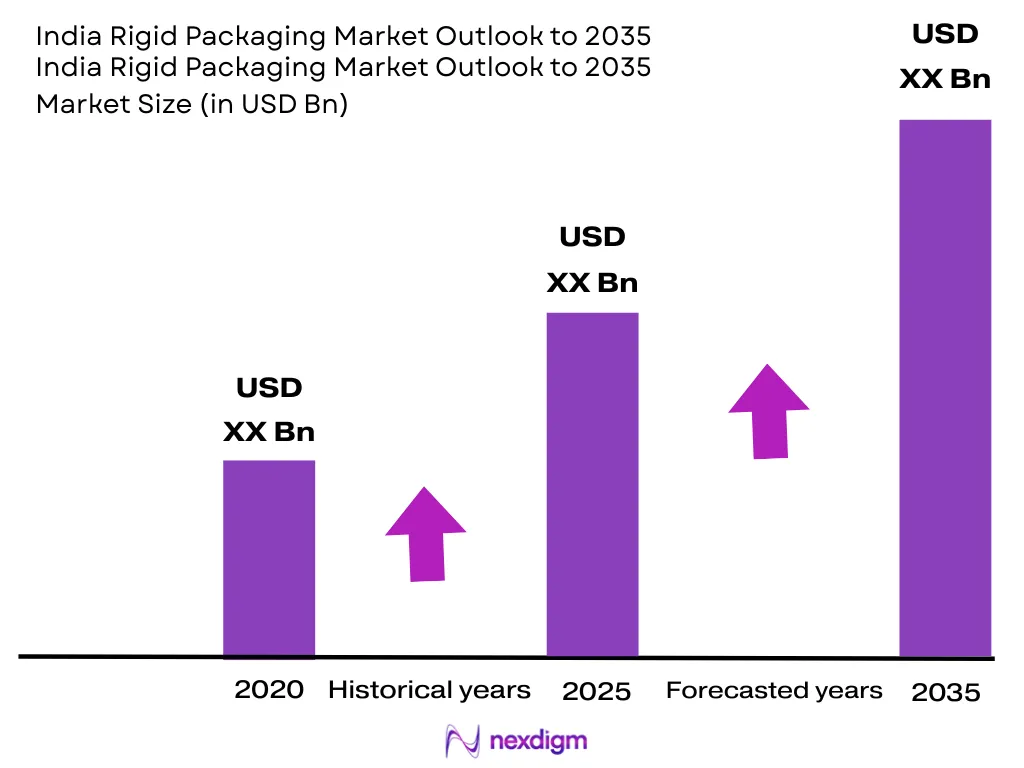
The India Rigid Packaging Market was valued at approximately USD ~ Billion in 2024 and is anticipated to expand at a CAGR of approximately 10.10% during 2025-2034, reaching approximately USD ~ Billion by 2034, tracking growth in India’s broader packaging industry, which is projected to expand from approximately USD 106.34 billion in 2025 to approximately USD 149.82 billion by 2032. The market continues to be driven by robust demand from India’s food and beverage, pharmaceutical, and personal care sectors, with PET securing approximately 33.02% material share in 2025 on the strength of beverage and pharmaceutical demand. Domestic capacity expansion continues at pace, exemplified by Mold-Tek Packaging’s January 2024 opening of new production units across Haryana, Tamil Nadu, and Telangana, alongside a new Mahad, Maharashtra facility manufacturing pails for Grasim Industries, collectively raising the company’s production capacity to approximately 54,000 tonnes by the end of fiscal year 2024-25. Extended Producer Responsibility regulations requiring recycled content are simultaneously reshaping the industry, with targets ratcheting to 60% by 2029, accelerating converter investment in recycled PET and other circular material capacity.
Market Segmentation
By Material Type
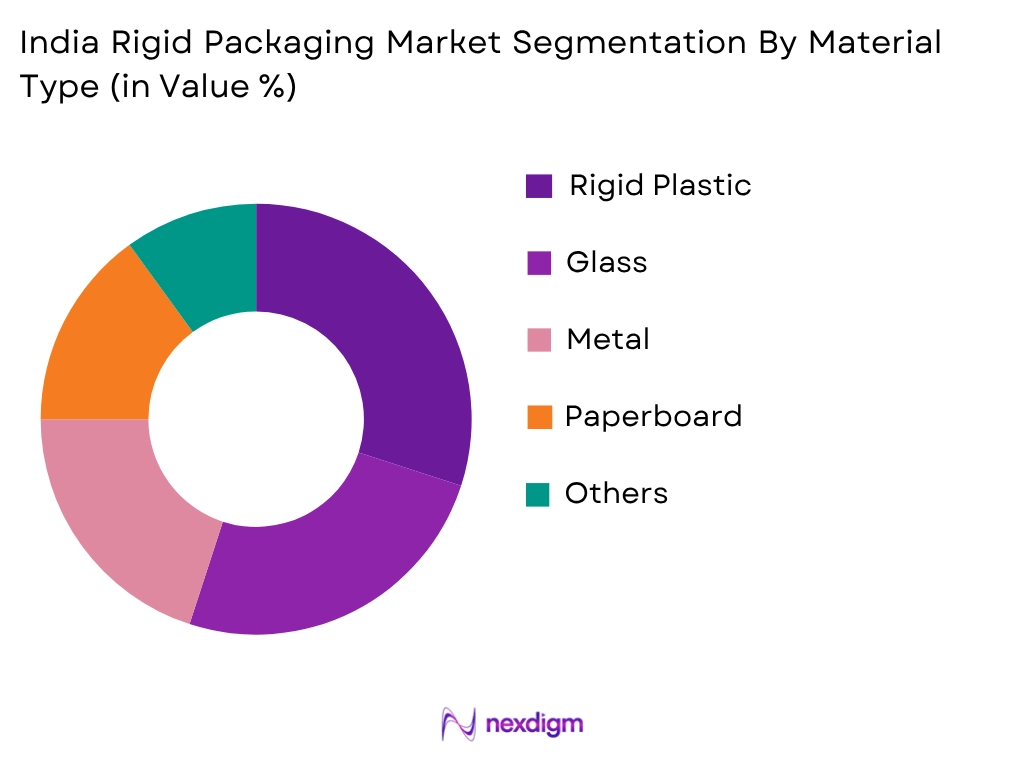
Rigid Plastic, encompassing PET, polypropylene, polyethylene, and other resin types, dominates the India Rigid Packaging Market, with PET alone securing approximately 33.02% share in 2025 on the strength of beverage and pharmaceutical demand, while polypropylene is projected to grow at approximately 7.42% CAGR through 2031, supported by microwave-safe food tubs and automotive component applications. Regulatory pushes for higher recycled content continue to favor investment in recycled PET (rPET) capacity, with Ganesha Ecopet tripling its bottle-grade rPET output to approximately 42,000 tonnes per annum using Starlinger systems, positioning the company to capture approximately 25% of national PET waste by 2026. Paperboard, though a comparatively smaller material category within rigid packaging, is expanding fastest at approximately 12.21% CAGR through 2030, as e-commerce platforms, quick-service restaurants, and government procurement teams increasingly demand visibly recyclable packaging alternatives. Glass retains niche strength in premium spirits and parenteral pharmaceutical drugs, while metal cans continue to secure extended shelf life for processed foods distributed across India’s rural markets, where ambient temperature storage remains common.
By Product Type
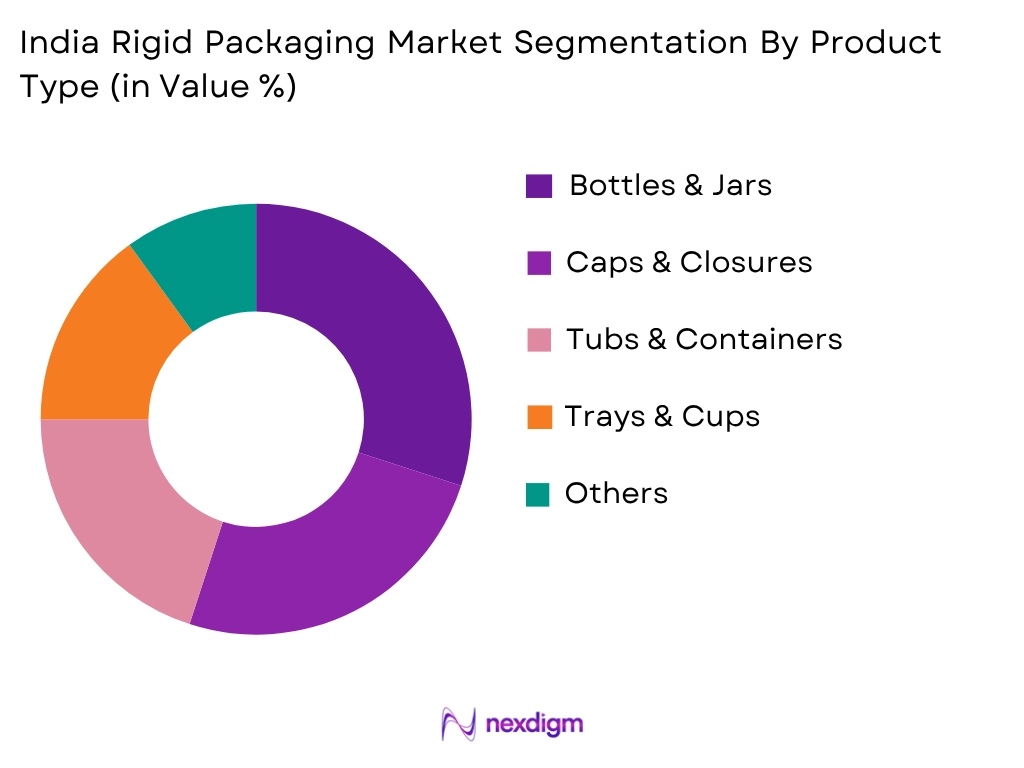
Bottles & Jars represent the largest product-type segment in the India Rigid Packaging Market, driven by increasing demand from the food, beverage, and pharmaceutical industries, with PET bottles commanding particular strength given their cost-effectiveness, non-breakable properties, and lightweight characteristics well suited to packaged drinking water, carbonated drinks, and cosmetics applications. Cold-chain investment targeted to reach approximately Rs 5 lakh crore by 2032 under the PM Gati Shakti plan continues to expand PET preform demand for both beverage and pharmaceutical vial applications, while packaged fresh milk alone represents an approximately USD 20 billion opportunity by 2026 as semi-urban consumers continue shifting from loose to branded milk supply. The INR 15,000 crore Animal Husbandry Infrastructure Fund is actively financing processing units that specify multilayer HDPE bottles for improved shelf life, while direct-to-consumer dairy brands such as Country Delight, which raised approximately USD 20 million in fresh capital in 2025, have adopted tamper-evident PET packaging designs to guarantee product delivery within 36 hours. Caps & Closures and Tubs & Containers continue to expand alongside broader packaged food and personal care consumption growth across India’s expanding organized retail sector.
Competitive Landscape
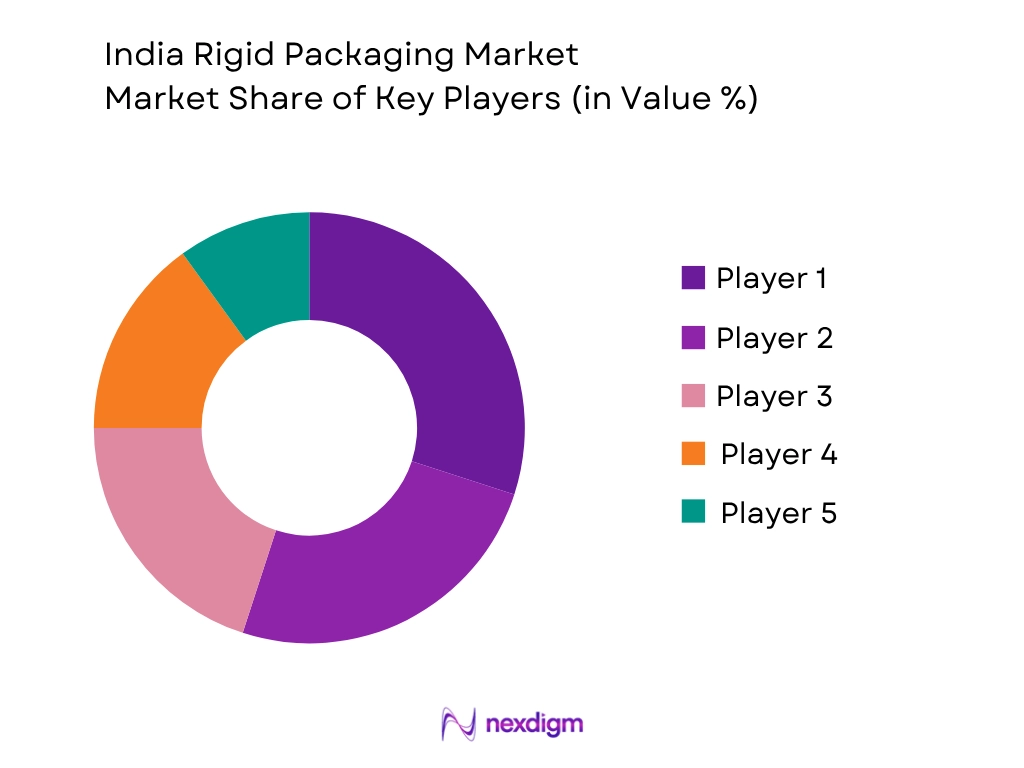
The India Rigid Packaging Market features a mix of large, vertically integrated petrochemical conglomerates, specialized rigid packaging converters, and global packaging majors competing across plastic, glass, and metal material categories. Reliance Industries Limited maintains substantial backward integration into PET and polymer resin production, providing a structural feedstock advantage over converters reliant on imported or third-party resin supply. Mold-Tek Packaging Limited has pursued aggressive capacity expansion, adding new production units across Haryana, Tamil Nadu, and Telangana in January 2024 alongside a new Mahad, Maharashtra facility, collectively targeting approximately 54,000 tonnes of production capacity by the end of fiscal year 2024-25. UFlex Limited continues to strengthen its circular economy credentials, having recycled approximately 6,600 tonnes of post-consumer PET in fiscal year 2024 as part of its backward integration strategy, while Ganesha Ecosphere’s Ganesha Ecopet subsidiary has tripled its bottle-grade rPET output to approximately 42,000 tonnes per annum. Global majors including Amcor continue to introduce sustainability-oriented innovation to the Indian market, exemplified by the company’s February 2024 launch of a lightweight PET bottle offering a 30% reduction in material use and a 25% reduction in carbon emissions relative to conventional PET bottles.
| Company | Established | Headquarters | Primary Product Portfolio | Rigid Packaging Portfolio | Manufacturing Presence | Major End-Use Industries | Key Strategic Focus | Certifications & Compliance |
| Reliance Industries Limited | 1966 | ~
|
~ | ~ | ~ | ~ | ~ | ~ |
| Mold-Tek Packaging Limited | 1985 | ~
|
~ | ~ | ~ | ~ | ~ | ~ |
| UFlex Limited | 1985 | ~
|
~ | ~ | ~ | ~ | ~ | ~ |
| Amcor plc | 1860 | ~ | ~ | ~ | ~ | ~ | ~ | ~ |
| Ganesha Ecosphere Limited | 1987 | ~
|
~ | ~ | ~ | ~ | ~ | ~ |
India Rigid Packaging Market Analysis
Growth Drivers
Booming Packaged Beverage, Dairy and Pharmaceutical Demand
The India rigid packaging market is experiencing sustained growth due to rising consumption of packaged beverages, branded dairy products, and pharmaceutical formulations, all of which rely heavily on PET bottles, HDPE containers, and glass or plastic vials for primary packaging. Packaged fresh milk alone represents an approximately USD 20 billion opportunity by 2026, as semi-urban consumers continue shifting from loose to branded milk supply, with the INR 15,000 crore Animal Husbandry Infrastructure Fund actively financing processing units that specify multilayer HDPE bottles for improved shelf life. Cold-chain investment targeted to reach approximately Rs 5 lakh crore by 2032 under the PM Gati Shakti plan continues to expand PET preform demand for both beverage and pharmaceutical vial applications, reflecting the structural relationship between India’s logistics infrastructure buildout and rigid packaging consumption. Dabur India’s February 2025 announcement of an approximately USD 66 million investment in Madhya Pradesh over two years, dedicated to expanding installed filling and manufacturing capacities, further illustrates the scale of FMCG-driven capital investment continuing to expand demand for rigid packaging formats across India’s consumer goods sector.
Domestic Capacity Expansion by Converters and Resin Producers
Sustained capacity investment from India’s leading rigid packaging converters and resin producers continues to expand the domestic supply base available to serve growing end-market demand. Mold-Tek Packaging Company increased its rigid plastic packaging capacity through the January 2024 opening of new production units in Haryana, Tamil Nadu, and Telangana, alongside the purchase of land in Mahad, Maharashtra, for a manufacturing plant with a capacity of 1,500 tonnes dedicated to producing pails for Grasim Industries, collectively targeting approximately 54,000 tonnes of total production capacity by the end of fiscal year 2024-25. Nayara Energy announced the commissioning of its second polypropylene plant in the first half of 2024, expanding India’s domestic PP resin supply base available to rigid packaging converters. This sustained pattern of capacity investment across both resin production and downstream converting operations continues to strengthen India’s domestic rigid packaging manufacturing base, reducing reliance on imported finished packaging while supporting the country’s rapidly expanding food, beverage, and pharmaceutical manufacturing sectors.
Market Challenges
EPR Recycled-Content Ratchet and Compliance Costs
India’s Extended Producer Responsibility framework continues to impose escalating recycled-content requirements on rigid plastic packaging producers, with targets ratcheting to 60% by 2029, requiring sustained and substantial investment in recycled PET and other circular material capacity to maintain compliance. This regulatory trajectory is accelerating mergers between resin suppliers and fillers as the industry establishes integrated ecosystems capable of lowering reverse logistics costs and capturing extended producer credits, reshaping traditional converter-brand owner relationships across the industry. Smaller and mid-sized converters without the capital resources to invest in recycled-content processing capability or long-term supply agreements with recyclers face particular difficulty maintaining compliance while remaining cost-competitive against larger, vertically integrated players such as Reliance Industries and UFlex. These compliance costs continue to compound with underlying resin price volatility, creating a challenging dual pressure on converter margins across the industry.
Resin Price Volatility and Fragmented SME Converter Base
The India Rigid Packaging Market continues to navigate significant resin price volatility, with polypropylene prices ranging between approximately USD 970 and USD 990 per tonne on a CFR basis in early 2025, creating persistent cash flow stress for small and medium-sized converters operating on thin margins. This volatility particularly affects the large fragmented base of smaller regional converters that lack the purchasing scale, long-term supply agreements, or backward integration into resin production available to larger vertically integrated players. Competition from paperboard and other fiber-based substitution, which is expanding at approximately 12.21% CAGR through 2030 as e-commerce platforms, quick-service restaurants, and government procurement teams increasingly favor visibly recyclable packaging alternatives, adds further competitive pressure on conventional rigid plastic packaging formats. This combination of input cost volatility, compliance burden, and material substitution pressure continues to squeeze margins across India’s fragmented rigid packaging converter base, particularly for smaller players without diversified material capabilities spanning plastic, paperboard, and other emerging formats.
Market Opportunities
Growth in Recycled PET and Circular Material Capacity
India’s escalating EPR recycled-content requirements, ratcheting to 60% by 2029, continue to create substantial opportunity for converters and resin producers investing in recycled PET and other circular material capacity. Ganesha Ecopet’s tripling of its bottle-grade rPET output to approximately 42,000 tonnes per annum using Starlinger systems, positioning the company to capture approximately 25% of national PET waste by 2026, illustrates the scale of opportunity available to early movers in this space. Parallel capacity expansion from Indorama Ventures, Dhunseri, and Varun Beverages is expected to add approximately 100,000 tonnes of recycled PET capacity by 2025, with plants clustering near port-proximate locations in Maharashtra and Tamil Nadu to support export flexibility alongside domestic supply. Coca-Cola India’s collection and recycling campaign, conducted alongside Reliance Retail, further illustrates how major brand owners are directly investing in India’s PET collection infrastructure to secure long-term recycled feedstock access, creating opportunity for converters capable of participating in these emerging closed-loop supply arrangements.
Lightweighting and Sustainable Material Innovation
Growing brand owner and regulatory emphasis on sustainable packaging design creates substantial opportunity for converters investing in lightweighting and next-generation material innovation. Amcor’s February 2024 launch of a lightweight PET bottle for water and carbonated soft drinks, offering a 30% reduction in material use and a 25% reduction in carbon emissions compared to traditional PET bottles, illustrates the type of design innovation increasingly demanded by brand owners seeking to reduce both packaging costs and environmental footprint simultaneously. Bioplastic capacity is also emerging as a credible long-term opportunity, with PLA bioplastic capacity of approximately 75,000 tonnes expected to come online by 2026, introducing fresh competition to conventional petrochemical-based rigid packaging even as cost parity with traditional resins remains some years away. As India’s circular economy narrative continues to strengthen brand acceptance of recycled and lightweighted packaging formats, converters that can combine material innovation with cost-competitive production are increasingly well positioned to capture premium contract positioning from major food, beverage, and personal care brand owners operating in India.
Future Outlook
The India Rigid Packaging Market is expected to witness robust expansion over the forecast period, supported by continued growth in packaged beverages, branded dairy, and pharmaceutical consumption, sustained domestic capacity investment from converters and resin producers, and escalating regulatory pressure driving recycled-content and lightweighting innovation. Continued expansion of cold-chain infrastructure under the PM Gati Shakti plan, combined with growing direct-to-consumer and organized retail penetration, will further support underlying demand for rigid packaging formats across India’s food, beverage, and personal care sectors. The market is also likely to benefit from continued investment in recycled PET and bioplastic capacity, positioning India’s rigid packaging industry to meet both domestic sustainability mandates and growing export market expectations for circular packaging credentials.
Major Players
- Reliance Industries Limited
- Mold-Tek Packaging Limited
- UFlex Limited
- Amcor plc
- Ganesha Ecosphere Limited
- Jindal Poly Films Limited
- Tetra Pak India Private Limited
- Berry Global, Inc.
- Sealed Air Corporation
- SABIC Innovative Plastics
- Nayara Energy Limited
- Indorama Ventures Public Company Limited
- Dhunseri Ventures Limited
- AGI Greenpac Limited
- Hindustan National Glass & Industries Limited
Key Target Audience
- Rigid Packaging Manufacturers
- Food & Beverage Manufacturers
- Pharmaceutical & Healthcare Companies
- Personal Care & Cosmetics Manufacturers
- Household Product Manufacturers
- Investment and Venture Capitalist Firms
- Government and Regulatory Bodies (Central Pollution Control Board (CPCB), Food Safety and Standards Authority of India (FSSAI), Bureau of Indian Standards (BIS))
- Raw Material Suppliers and Resin Producers
Research Methodology
Step 1: Identification of Key Variables
The research process begins with identifying the complete ecosystem of the India Rigid Packaging Market, including raw material suppliers, packaging converters, resin producers, food and beverage manufacturers, and regulatory authorities. Extensive secondary research is conducted using company annual reports, government publications, trade associations, customs statistics, industry journals, and proprietary databases to determine the variables influencing market demand, pricing, production, consumption, and technological developments.
Step 2: Market Analysis and Construction
Historical market information is collected and analyzed to estimate market size, production volumes, import-export activity, application-wise demand, and pricing trends. A combination of top-down and bottom-up approaches is used to estimate market revenues and validate segment-level performance. Consumption patterns across food and beverage, pharmaceutical, and personal care packaging are evaluated to establish an accurate representation of the industry.
Step 3: Hypothesis Validation and Expert Consultation
The preliminary findings are validated through Computer-Assisted Telephone Interviews (CATIs) and structured discussions with rigid packaging converters, procurement managers, distributors, packaging engineers, regulatory experts, and senior executives operating within the Indian packaging industry. These interviews help verify market assumptions, competitive developments, technology adoption trends, pricing dynamics, and future investment opportunities while refining the overall market estimates.
Step 4: Research Synthesis and Final Output
The final stage integrates insights obtained from primary interviews with quantitative information collected through secondary sources. Data triangulation techniques are applied to reconcile differences between supply-side and demand-side estimates, ensuring robust market forecasting. The report is then reviewed through multiple quality assurance checkpoints to deliver a comprehensive analysis covering market size, segmentation, competitive landscape, future outlook, and strategic recommendations for industry stakeholders.

- Executive Summary
- Research Methodology (Market Definitions and Assumptions, Abbreviations, Market Sizing Approach, Top-Down Analysis, Bottom-Up Analysis, Demand-Side Assessment, Supply-Side Assessment, Primary Industry Interviews, Secondary Research Validation, Data Triangulation, Forecasting Framework, Limitations and Future Conclusions)

- Definition and Scope
- Market Evolution and Industry Genesis
- Timeline of Major Industry Developments
- Rigid Packaging Industry Value Chain Analysis
- Supply Chain Analysis

- Growth Drivers (Booming Packaged Beverage & Dairy Demand, Cold-Chain Infrastructure Expansion, Domestic Capacity Expansion by Converters, Growth in Pharmaceutical Vial & Bottle Demand, Rising DTC & Branded FMCG Penetration, E-Commerce-Driven Secondary Packaging Growth)
- Market Challenges (EPR Recycled-Content Ratchet & Compliance Costs, Resin Price Volatility, Fragmented SME Converter Base, Competition from Paperboard Substitution, Regional Regulatory Variation, Raw Material Import Dependency)
- Market Opportunities (Growth in rPET & Recycled-Content Capacity, Lightweighting & Sustainable Material Innovation, Bioplastic (PLA) Capacity Expansion, Multilayer HDPE Growth in Dairy & Milk Processing, Export-Oriented Manufacturing Growth, Premiumization-Driven Glass & Metal Packaging Demand)
- Market Trends (Growth in Recycled PET (rPET) Adoption, Lightweight Bottle Design Innovation, Bioplastic & PLA Material Development, Multilayer Barrier Packaging Growth, Tamper-Evident & Smart Packaging Adoption, Regional Recycling Cluster Development)
- Government Regulations (Extended Producer Responsibility (EPR) Recycled-Content Targets, Plastic Waste Management Rules, FSSAI Food-Contact Packaging Standards, Bureau of Indian Standards (BIS) Specifications, PM Gati Shakti Cold-Chain Infrastructure Policy, Import Compliance for Resin & Packaging Machinery)
- Import and Export Analysis (Trade Volume, Major Import Sources, Export Destinations, HS Code Analysis, Trade Balance)
- Raw Material Availability Analysis (Domestic & Imported PET Resin, Polypropylene & Polyethylene Resin, Recycled PET (rPET) Feedstock, Glass Cullet & Silica Sand, Aluminum & Tinplate Stock)
- Technology Landscape (Injection & Blow Molding Technologies, Bottle-to-Bottle Recycling Technologies, Lightweighting & Preform Design Technologies, Multilayer Barrier Coating Technologies, Digital Printing & Labeling Systems)
- Sustainability Assessment (Recycled Content (rPET/PCR) Adoption, Lightweighting & Material Reduction, Bioplastic & Compostable Material Development, Glass & Metal Circularity, Circular Economy Partnerships)
- PESTLE Analysis
- SWOT Analysis
- Porter’s Five Forces Analysis
- Stakeholder Ecosystem
- Competition Ecosystem

- By Market Value (2020-2025)
- By Volume Consumption (2020-2025)
- By Average Selling Price (2020-2025)

- By Material Type (In Value %)
Rigid Plastic (PET, PP, PE, PVC & PS)
Glass
Metal (Aluminum & Tinplate)
Paperboard & Cartons
Bioplastics - By Product Type (In Value %)
Bottles & Jars
Cans & Tins
Tubs & Containers
Caps & Closures
Trays & Cups
Rigid Boxes & Cartons - By Application (In Value %)
Food & Beverage
Pharmaceuticals & Healthcare
Personal Care & Cosmetics
Household & Homecare
Industrial - By End User (In Value %)
Food & Beverage Manufacturers
Pharmaceutical Companies
Personal Care & Cosmetics Manufacturers
Household Product Manufacturers
Industrial Manufacturers - By Region (In Value %)
North India
South India
West India
East India
Northeast India

- Market Share of Major Players (By Value, Volume, Material Type, Application, Product Category)
- Cross Comparison Parameters (Product Portfolio Breadth, Recycled-Content Capability, Backward Integration into Resin, Application Technical Support, Manufacturing Capacity, Regulatory Compliance & Certifications, Food & Beverage Customer Base, Innovation & New Product Launch Frequency)
- SWOT Analysis of Major Players
- Pricing Analysis by Product Category and Format
- Production Capacity Analysis
- Manufacturing Footprint Analysis
- Distribution Network Analysis
- Innovation Benchmarking
- Detailed Profiles of Major Companies
Reliance Industries Limited
Mold-Tek Packaging Limited
UFlex Limited
Amcor plc
Ganesha Ecosphere Limited
Jindal Poly Films Limited
Tetra Pak India Private Limited
Berry Global, Inc.
Sealed Air Corporation
SABIC Innovative Plastics
Nayara Energy Limited
Indorama Ventures Public Company Limited
Dhunseri Ventures Limited
AGI Greenpac Limited
Hindustan National Glass & Industries Limited

- Consumption Pattern Analysis (Industrial Usage, Batch Size, Product Category Penetration, Seasonal Demand, Reformulation Activity)
- Purchasing Criteria (Regulatory Compliance, Recycled-Content Availability, Cost Efficiency, Barrier Performance, Tamper-Evidence, Shelf Appeal)
- Procurement and Supplier Selection Analysis
- Recycled-Content Adoption Assessment
- Premium vs Conventional Packaging Demand
- Product Attribute Preference Analysis (Moisture & Barrier Performance, Seal Integrity, Recyclability, Weight Efficiency, Print & Label Clarity, Shelf Life Extension)
- Sustainability & Regulatory Compliance Influence on Packaging Investment
- Pain Point Analysis
- Decision-Making Process

- By Market Value (2026-2035)
- By Volume Consumption (2026-2035)
- By Average Selling Price (2026-2035)


 Request a Sample
 Ask for Customization
 Get a Quote
 Enquire Now