

 Download PDF
Market Overview
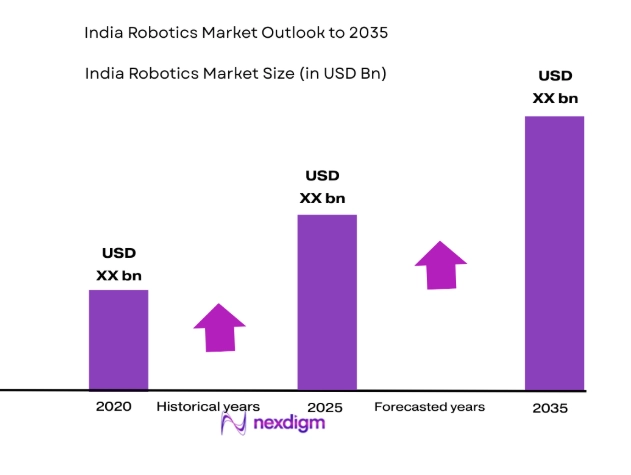
Based on a recent historical assessment, the India Robotics market is valued at approximately USD ~ million according to data referenced from the International Federation of Robotics and industrial automation investment statistics reported across India’s manufacturing sector. Market expansion is primarily driven by accelerating industrial automation across automotive, electronics, pharmaceuticals, and warehouse logistics operations. Manufacturing firms increasingly deploy robotic systems for assembly, welding, inspection, and material handling processes that enhance productivity, reduce operational errors, and support large-scale production environments across modern industrial facilities.
Industrial clusters located across Bengaluru, Pune, Chennai, and Hyderabad dominate robotics deployment due to strong automotive production, electronics manufacturing, and technology research ecosystems supporting automation adoption. These cities host large manufacturing plants, robotics system integrators, and engineering research centers that facilitate robotics implementation across multiple industries. Advanced manufacturing parks, logistics hubs, and technology innovation ecosystems in these cities continue driving robotics integration through collaborative engineering partnerships, industrial digitalization programs, and increasing investment in artificial intelligence-enabled automation systems.
Market Segmentation
By Product Type
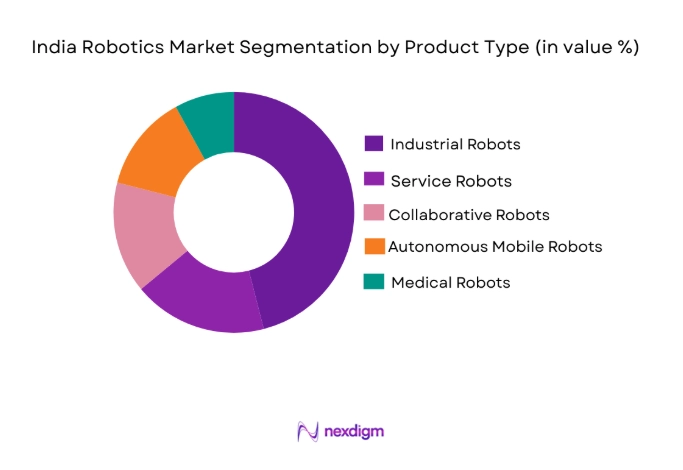
India Robotics market is segmented by product type into industrial robots, service robots, collaborative robots, autonomous mobile robots, and medical robots. Recently, industrial robots has a dominant market share due to factors such as strong adoption across automotive assembly plants, electronics manufacturing facilities, and heavy engineering production lines that require precision automation and continuous operational efficiency. Large automotive manufacturers and electronics producers deploy robotic arms extensively for welding, painting, assembly, and inspection processes. Industrial robots also benefit from established supplier ecosystems, trained engineering talent, and strong integration support from automation providers, making them the most widely deployed robotic systems across India’s manufacturing sector.
By Platform Type
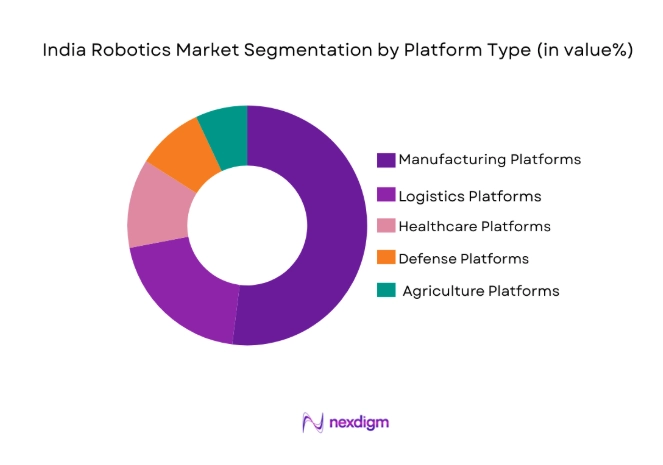
India Robotics market is segmented by platform type into manufacturing platforms, healthcare platforms, logistics platforms, defense platforms, and agriculture platforms. Recently, manufacturing platforms has a dominant market share due to factors such as strong industrial automation demand, the expansion of automotive production lines, and increasing investment in smart factory technologies across major manufacturing clusters. Robotics systems deployed within manufacturing environments perform critical tasks including assembly, packaging, inspection, and precision machining. Government initiatives supporting digital manufacturing and industrial modernization further encourage robotics adoption across large production facilities.
Competitive Landscape
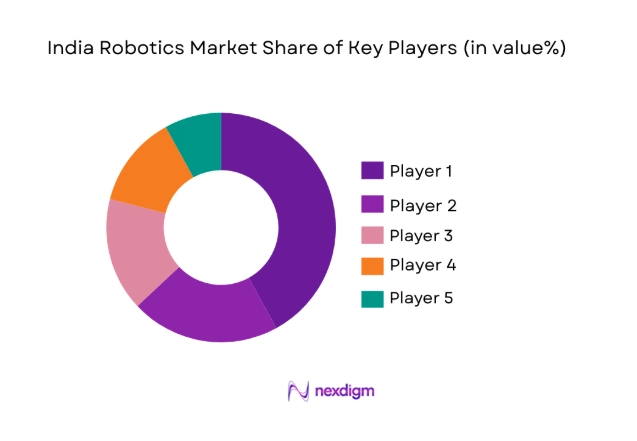
The India Robotics market features a moderately consolidated competitive environment where global robotics manufacturers compete alongside domestic automation technology firms. International robotics companies dominate industrial robotics supply due to advanced technology capabilities, established manufacturing automation expertise, and extensive global supply chains. Domestic robotics companies increasingly focus on warehouse automation, artificial intelligence robotics platforms, and logistics automation technologies. Strategic partnerships between robotics manufacturers, industrial automation integrators, and technology startups continue strengthening innovation and accelerating robotics adoption across manufacturing and service industries.
| Company Name | Establishment Year | Headquarters | Technology Focus | Market Reach | Key Products | Revenue | Automation Application Focus |
| ABB Robotics | 1988 | Switzerland | ~ | ~ | ~ | ~ | ~ |
| Fanuc Corporation | 1956 | Japan | ~ | ~ | ~ | ~ | ~ |
| KUKA AG | 1898 | Germany | ~ | ~ | ~ | ~ | ~ |
| GreyOrange | 2011 | India | ~ | ~ | ~ | ~ | ~ |
| Addverb Technologies | 2016 | India | ~ | ~ | ~ | ~ | ~ |
India Robotics Market Analysis
Growth Drivers
Industrial Automation Expansion Across Manufacturing Industries
Rapid industrial automation across automotive manufacturing electronics production pharmaceutical manufacturing and engineering industries significantly accelerates demand for robotics technologies throughout India’s industrial sector. Manufacturing companies increasingly deploy robotic systems to perform repetitive precision tasks such as welding assembly material handling inspection and packaging within high-volume production environments. Robotics integration allows companies to improve production speed maintain product consistency and reduce operational downtime caused by manual manufacturing processes. Industrial automation also improves workplace safety by enabling robots to perform hazardous tasks involving heavy machinery high temperatures or chemical exposure. Large multinational manufacturers operating production facilities in India continuously invest in robotics systems to maintain global production standards and operational efficiency. Advanced robotic arms equipped with machine vision sensors artificial intelligence control systems and automated programming capabilities further expand industrial robotics applications. Manufacturing clusters located across automotive production hubs increasingly adopt robotics systems as part of smart factory transformation programs designed to enhance productivity and digital manufacturing capabilities.
Rapid Expansion of Warehouse Automation and E Commerce Logistics Robotics
India’s rapidly expanding digital commerce ecosystem significantly increases demand for robotics systems capable of automating large-scale warehouse operations and logistics fulfillment centers. Online retail companies operate massive distribution centers that process thousands of customer orders daily requiring efficient inventory movement sorting packaging and shipment preparation. Robotics technologies including autonomous mobile robots automated storage systems and robotic picking solutions enable logistics companies to process high volumes of parcels efficiently within complex warehouse environments. Automation significantly improves order fulfillment speed reduces manual labor dependency and minimizes operational errors in inventory handling processes. Large logistics operators invest heavily in robotics solutions integrated with warehouse management software artificial intelligence routing systems and automated sorting infrastructure. Robotics deployment also enables companies to scale warehouse operations rapidly during peak demand periods associated with large online retail events. Growing digital retail penetration and increasing parcel delivery volumes therefore drive continuous robotics adoption across logistics warehouses and fulfillment facilities nationwide.
Market Challenges
High Capital Investment and Long Deployment Cycles for Industrial Robotics Systems
Robotics systems often require substantial initial investment costs covering hardware procurement system integration software configuration and workforce training which creates adoption barriers particularly for small and medium-sized manufacturing companies. Industrial robots used in complex manufacturing processes involve sophisticated mechanical components precision sensors artificial intelligence control systems and safety infrastructure that significantly increase capital expenditure requirements. Companies must also invest in factory floor redesign electrical infrastructure upgrades and digital control systems to accommodate robotics integration. Implementation cycles often extend for several months because robotics deployment requires engineering customization safety compliance testing and operational training programs for technicians and operators. Small manufacturing enterprises frequently hesitate to invest in robotics technologies due to uncertainty regarding return on investment and operational complexity. Financial constraints therefore limit robotics adoption among smaller industrial firms despite the long-term productivity benefits of automation. Additionally ongoing maintenance costs software updates and engineering support requirements further increase total cost of ownership for advanced robotics systems.
Limited Skilled Workforce for Robotics Programming and Maintenance
Successful robotics deployment requires specialized engineering expertise including robotics programming system integration artificial intelligence algorithm management and mechanical maintenance capabilities which remain limited within several segments of India’s industrial workforce. Robotics systems require trained engineers capable of configuring robot motion algorithms calibrating machine vision sensors and integrating robotic hardware with digital manufacturing software platforms. Many manufacturing companies face difficulties recruiting technicians and engineers with advanced robotics engineering expertise required to maintain automated production lines. Skill shortages increase implementation timelines because companies must invest in training programs or depend on external robotics system integrators for installation and maintenance services. Educational institutions and technical training centers are gradually expanding robotics engineering courses but workforce supply remains lower than industry demand. Limited availability of trained robotics specialists therefore slows robotics adoption particularly in emerging manufacturing regions lacking strong engineering talent ecosystems.
Opportunities
Expansion of Collaborative Robots for Small and Medium Manufacturing Enterprises
Collaborative robots designed to safely operate alongside human workers present a major growth opportunity within India’s manufacturing sector particularly among small and medium-sized enterprises seeking flexible automation solutions. Unlike traditional industrial robots collaborative robots require lower infrastructure investment simplified programming interfaces and minimal safety barriers allowing easier integration into existing production lines. These robots can assist workers in tasks such as component assembly packaging machine loading and quality inspection while maintaining safe human-robot interaction environments. Collaborative robots therefore enable small manufacturers to gradually automate operations without implementing large-scale industrial automation infrastructure. Increasing affordability and modular robotics deployment models further encourage adoption among emerging manufacturing companies. Technology providers continue developing user-friendly collaborative robotics platforms equipped with artificial intelligence vision systems and adaptive motion capabilities. As manufacturing companies seek productivity improvements while maintaining workforce flexibility collaborative robots present strong growth opportunities across diverse industrial sectors.
Growing Adoption of Robotics in Healthcare and Surgical Automation
Healthcare robotics technologies including surgical robots rehabilitation robots and hospital service robots represent an emerging opportunity within India’s healthcare technology ecosystem. Hospitals increasingly adopt robotic surgical systems capable of performing minimally invasive procedures with extremely high precision improved surgical visualization and enhanced patient recovery outcomes. Robotic systems enable surgeons to conduct complex medical procedures with greater accuracy reducing surgical complications and improving operational efficiency within modern healthcare facilities. Healthcare providers also deploy service robots for hospital logistics medicine delivery patient monitoring and disinfection operations particularly within large hospital networks. Rapid expansion of private healthcare infrastructure and advanced medical technology centers increases demand for robotics technologies capable of supporting complex surgical and clinical procedures. Medical robotics manufacturers therefore collaborate with hospitals healthcare technology providers and research institutions to expand robotic healthcare solutions across India’s rapidly developing healthcare sector.
Future Outlook
The India Robotics market is expected to experience sustained expansion driven by industrial digitalization, increasing adoption of artificial intelligence technologies, and the modernization of manufacturing infrastructure. Smart factories, autonomous logistics systems, and advanced healthcare robotics will significantly increase robotics demand across multiple sectors. Government initiatives supporting automation and advanced manufacturing will further strengthen robotics deployment. Expanding startup ecosystems and venture investments in robotics innovation are also expected to accelerate technology development and commercialization across the country.
Major Players
- ABB Robotics
- Fanuc Corporation
- KUKA AG
- Yaskawa Electric Corporation
- Mitsubishi Electric
- Omron Robotics
- Kawasaki Robotics
- Denso Robotics
- Nachi-Fujikoshi
- Universal Robots
- GreyOrange
- Addverb Technologies
- Systemantics Robotics
- Hi-Tech Robotic Systemz
- Tata Elxsi Robotics
Key Target Audience
- Industrial manufacturing companies
- Robotics system integrators
- Logistics and warehouse automation operators
- Healthcare technology providers
- Investments and venture capitalist firms
- Government and regulatory bodies
- Defense and security organizations
Research Methodology
Step 1: Identification of Key Variables
The research process begins with identifying critical variables influencing the India Robotics market including automation adoption levels, industrial robotics deployment, logistics automation demand, and healthcare robotics development. These variables help define market boundaries and the structure of industry analysis.
Step 2: Market Analysis and Construction
Market data is constructed through the evaluation of manufacturing automation investments, robotics installation statistics, logistics automation deployments, and healthcare robotics adoption across major industries to estimate the market structure and demand distribution.
Step 3: Hypothesis Validation and Expert Consultation
Industry experts, automation engineers, robotics integrators, and manufacturing specialists are consulted to validate assumptions, confirm technological developments, and verify market demand patterns influencing robotics adoption.
Step 4: Research Synthesis and Final Output
All research findings are synthesized through structured data modeling, expert insights, and secondary research validation to generate the final comprehensive report outlining the India Robotics market dynamics and strategic insights.

- Executive Summary
- Research Methodology (Definitions, Scope, Industry Assumptions, Market Sizing Approach, Primary & Secondary Research Framework, Data Collection & Verification Protocol, Analytic Models & Forecast Methodology, Limitations & Research Validity Checks)

- Market Definition and Scope
- Value Chain & Stakeholder Ecosystem
- Regulatory / Certification Landscape
- Sector Dynamics Affecting Demand
- Strategic Initiatives & Infrastructure Growth

- Growth Drivers
Expansion of Smart Manufacturing and Industry 4.0 Adoption
Growing Investments in Warehouse Automation and Logistics Robotics
Rising Demand for Precision Robotics in Healthcare and Surgery - Market Challenges
High Initial Capital Investment for Advanced Robotics Systems
Limited Skilled Workforce for Robotics Integration and Maintenance
Complex System Integration with Legacy Industrial Infrastructure - Market Opportunities
Increasing Adoption of Collaborative Robots in Small and Medium Enterprises
Expansion of Robotics Applications in Agriculture Automation
Growing Defense Robotics Demand for Surveillance and Autonomous Systems - Trends
Integration of Artificial Intelligence and Machine Vision in Robotics
Expansion of Autonomous Mobile Robots in Warehousing and Logistics - Government Regulations
- SWOT Analysis
- Porter’s Five Forces

- By Market Value, 2020-2025
- By Installed Units, 2020-2025
- By Average System Price, 2020-2025
- By System Complexity Tier, 2020-2025

- By System Type (In Value%)
Industrial Robotics Systems
Service Robotics Systems
Collaborative Robots (Cobots)
Autonomous Mobile Robots
Medical and Surgical Robots - By Platform Type (In Value%)
Manufacturing Robotics Platforms
Healthcare Robotics Platforms
Defense and Security Robotics Platforms
Agriculture Robotics Platforms
Logistics and Warehouse Robotics Platforms - By Fitment Type (In Value%)
New System Integration
Retrofit Automation Solutions
Modular Robotics Deployment
Cloud-Connected Robotics Systems - By End User Segment (In Value%)
Industrial Manufacturing Enterprises
Healthcare and Medical Institutions
Defense and Government Organizations

- Market Share Analysis
- Cross Comparison Parameters (System Type Portfolio, Platform Integration Capability, Robotics Payload Capacity, Autonomous Navigation Technology, AI and Machine Vision Capability, End Industry Coverage, Global Supply Chain Strength)
- SWOT Analysis of Key Competitors
- Pricing & Procurement Analysis
- Key Players
ABB Robotics
KUKA AG
Fanuc Corporation
Yaskawa Electric Corporation
Universal Robots
Kawasaki Robotics
Mitsubishi Electric
Omron Robotics
Nachi-Fujikoshi
Denso Robotics
GreyOrange
Addverb Technologies
Systemantics Robotics
Tata Elxsi Robotics
Hi-Tech Robotic Systemz

- Manufacturing Sector Accelerating Adoption of Robotic Automation for Productivity Enhancement
- Healthcare Institutions Deploying Surgical Robots for Precision Procedures
- Defense Organizations Investing in Autonomous Surveillance and Tactical Robotics
- Logistics Companies Integrating Warehouse Robotics for High Volume Order Fulfillment

- Forecast Market Value, 2026-2035
- Forecast Installed Units, 2026-2035
- Price Forecast by System Tier, 2026-2035
- Future Demand by Platform, 2026-2035


 Request a Sample
 Ask for Customization
 Get a Quote
 Enquire Now