

 Download PDF
Market Overview
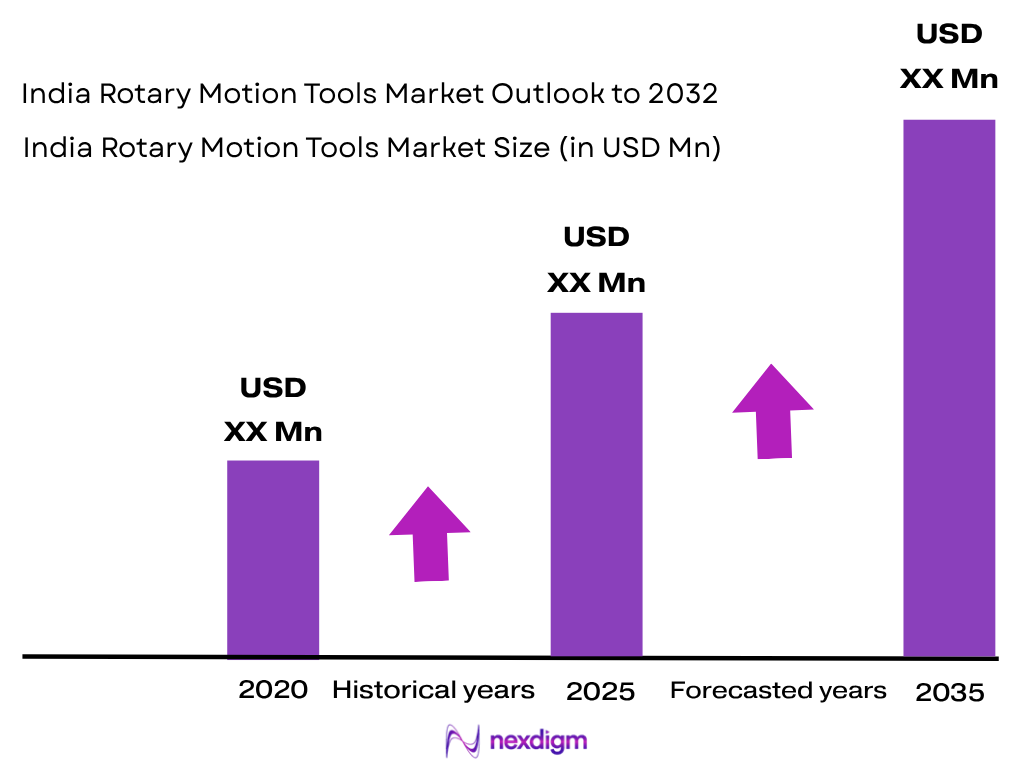
The India Rotary Motion Tools Market is estimated at ~USD ~ billion in 2024, with the 2026–2035 CAGR at ~%. The market is closely linked to India’s expanding machine-tool and manufacturing ecosystem. IMTMA reported Indian machine-tool consumption of ₹27,265 crore in FY2023-24, compared with ₹24,536 crore in FY2022-23, while production increased from ₹12,328 crore to ₹13,571 crore. The broader industrial sector represented 24.6% of India’s GDP in 2024, reinforcing the addressable manufacturing base for milling, drilling, grinding, honing and other rotary tooling applications.
The India Rotary Motion Tools Market is concentrated around established manufacturing clusters in Maharashtra, Gujarat, Tamil Nadu, Karnataka, Haryana and Telangana, where automotive, engineering, machine-tool, aerospace and industrial-equipment production create dense tooling demand. Pune and the wider Maharashtra industrial belt benefit from automotive and engineering manufacturing; Chennai and Bengaluru have strong automotive, aerospace and precision-engineering ecosystems; Gujarat has extensive engineering and industrial manufacturing activity; and the Delhi-NCR region supports automotive, machinery and general engineering demand. The concentration of CNC machining capacity and industrial suppliers makes these locations important hubs for rotary tooling consumption.
Market Segmentation
By Tool Type
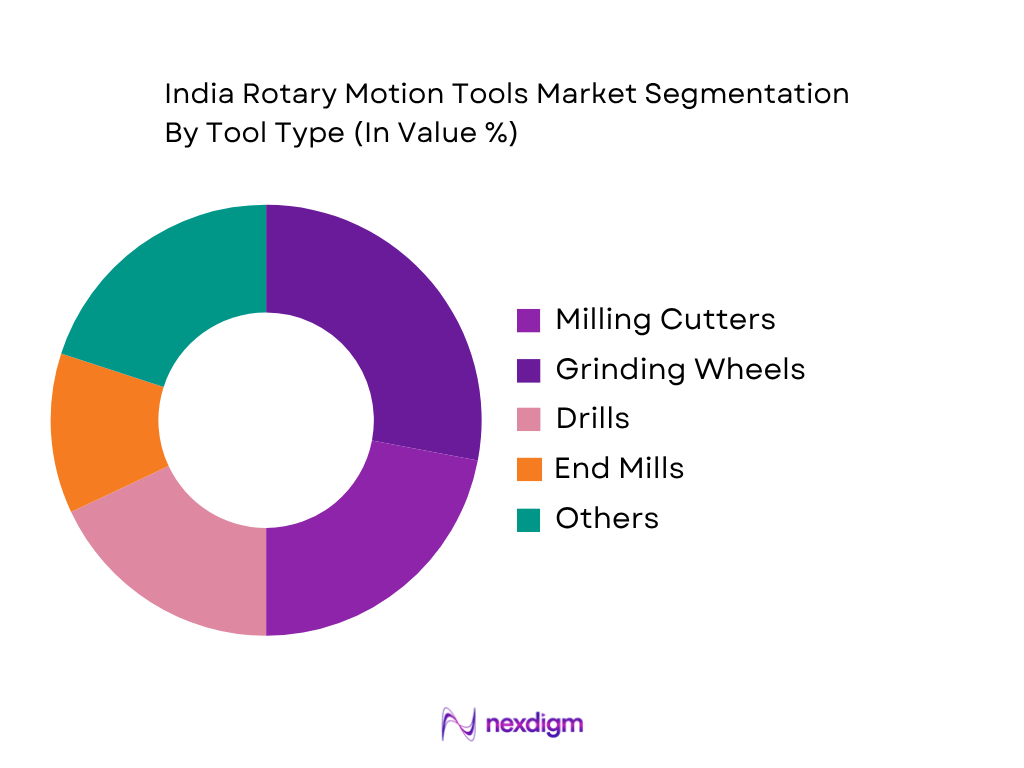
The India Rotary Motion Tools Market is segmented by tool type into milling cutters, grinding wheels, drills, honing tools, boring heads, end mills, face mills, ball-nose cutters, reamers and rotary burrs. Milling cutters and end mills are expected to represent the dominant sub-segment, supported by their broad utilization across CNC machining centres, automotive components, industrial machinery, aerospace components and general engineering applications. India’s machine-tool consumption reached ₹27,265 crore in FY2023-24, demonstrating the scale of the machinery base that consumes precision cutting and finishing tools. Milling applications also benefit from increasing adoption of CNC machining, multi-axis machining and high-speed material removal. End mills are particularly relevant for slotting, profiling, pocketing, contouring and complex component geometries, while face mills support high-volume material removal. The increasing complexity of automotive, aerospace and industrial components strengthens demand for specialised tool geometries rather than standard-purpose tooling. Grinding wheels remain significant for finishing and dimensional accuracy, while drills and reamers maintain broad usage for hole-making operations. As manufacturers pursue higher productivity and tool-life optimisation, premium carbide, coated and application-specific rotary tools are expected to gain importance within the overall product mix.
By End-Use Industry
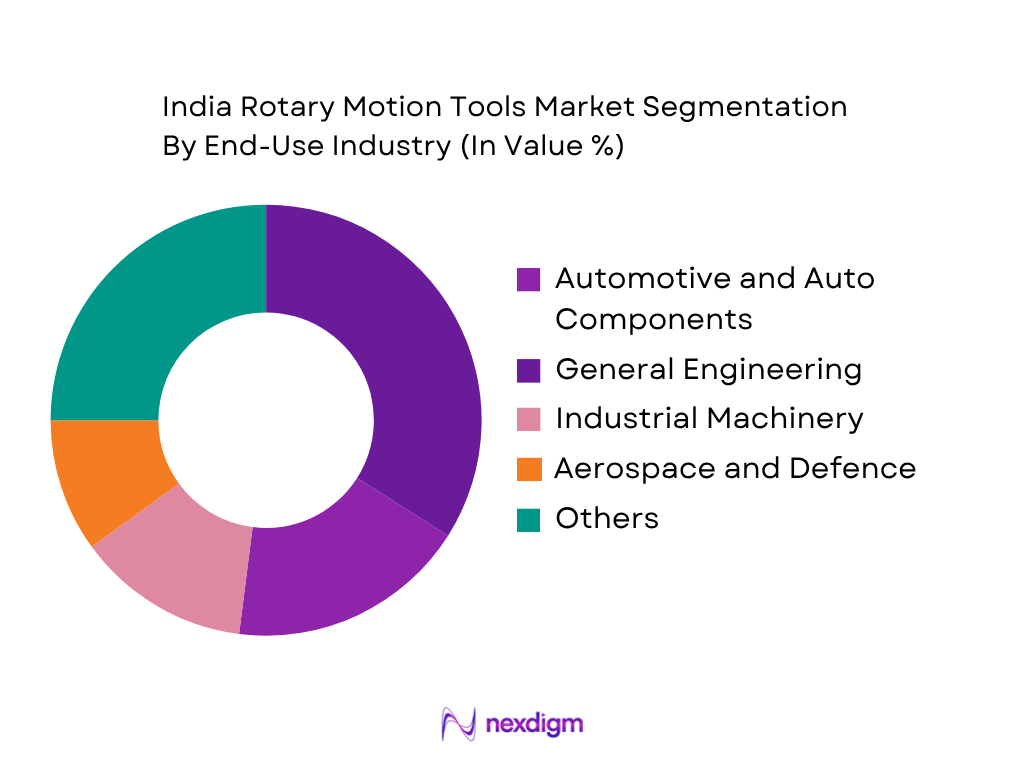
The India Rotary Motion Tools Market is segmented by end-use industry into automotive and auto components, aerospace and defence, general engineering, industrial machinery, metal fabrication, construction equipment, railways, oil and gas, power generation, and electronics and electrical equipment. Automotive and auto components are expected to account for the dominant share because the sector combines extremely high production volumes with extensive machining requirements across powertrain, transmission, braking, steering, suspension and structural components. SIAM reported 3,10,36,476 vehicles produced in FY2024-25, compared with 2,84,39,036 vehicles in FY2023-24. Two-wheelers alone increased from 2,14,68,527 units to 2,38,83,857 units, while passenger-vehicle production increased from 49,01,840 to 50,61,164 units. Siam These production volumes create recurring demand for drilling, milling, reaming, boring, grinding and finishing operations. The automotive sector also increasingly requires tighter dimensional tolerances and higher productivity, encouraging manufacturers to shift from conventional tooling toward carbide, coated and application-specific rotary tools.
Competitive Landscape
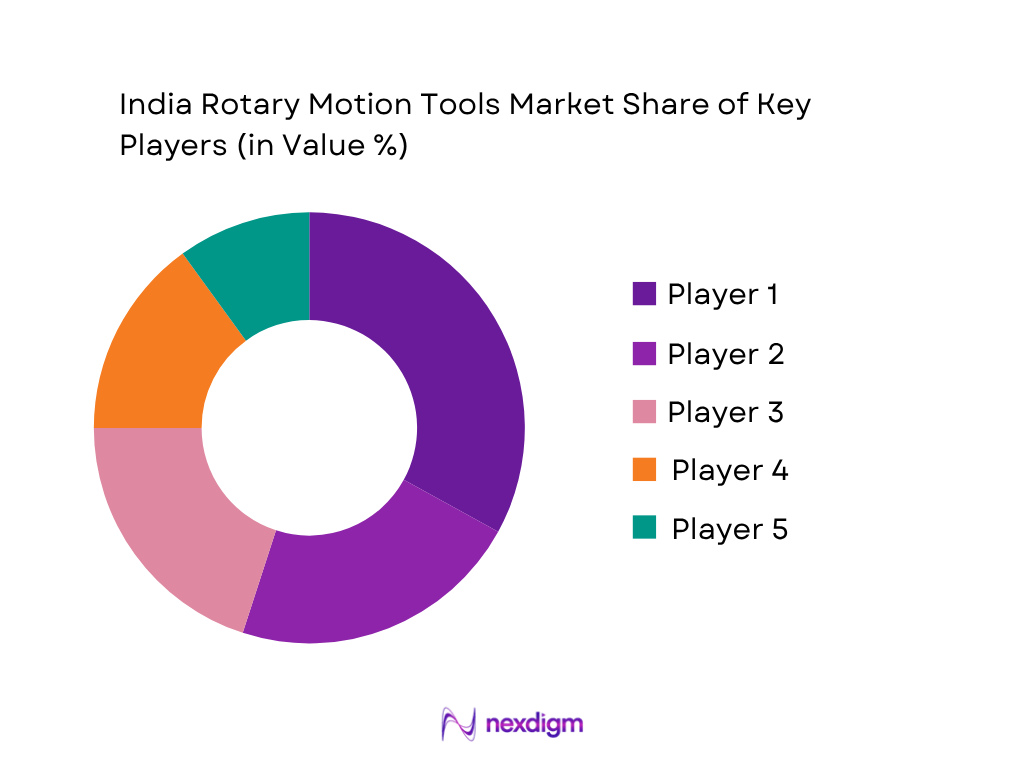
The India Rotary Motion Tools Market includes global cutting-tool manufacturers, industrial power-tool companies, abrasive manufacturers and specialised Indian tooling suppliers. Competition is increasingly based on carbide and abrasive technology, coating capability, tool geometry, tool life, CNC compatibility, application engineering and distribution reach rather than basic product availability alone. Global players such as Sandvik Coromant, Kennametal, Mitsubishi Materials, Seco Tools and Dormer Pramet compete alongside Indian manufacturers and established industrial tooling companies.
| Company | Established | Headquarters | Tool Portfolio | Material Technology | Coating Capability |
| Sandvik Coromant | 1942 | Sandviken, Sweden | ~ | ~ | ~ |
| Kennametal | 1938 | Pittsburgh, USA | ~ | ~ | ~ |
| Mitsubishi Materials | 1871 | Tokyo, Japan | ~ | ~ | ~ |
| Seco Tools | 1932 | Fagersta, Sweden | ~ | ~ | ~ |
| Dormer Pramet | 1953 | Šumperk, Czech Republic | ~ | ~ | ~ |
India Rotary Motion Tools Market Analysis
Growth Drivers
CNC Machine Tool Adoption and Automotive Manufacturing
The India Rotary Motion Tools Market is strongly supported by the expansion of CNC-based manufacturing, machine-tool consumption and automotive production. IMTMA reports that Indian machine-tool consumption reached ₹27,265 crore in FY2023-24, while its provisional estimate for FY2024-25 reached ₹31,781 crore. Machine-tool production also increased from ₹13,571 crore to ₹14,566 crore across the same period, expanding the installed base requiring milling cutters, drills, grinding tools, reamers and other rotary tooling. Automotive manufacturing provides an additional high-frequency tooling requirement: SIAM reports total vehicle production of 2,84,39,036 units in FY2023-24 and 3,10,36,476 units in FY2024-25, including 50,61,164 passenger vehicles and 2,38,83,857 two-wheelers in FY2024-25. The combination of CNC machining and high-volume vehicle production increases requirements for repeatable cutting performance, dimensional accuracy and tool-life consistency across engine, transmission, chassis, braking and structural components. IMF data also indicates real GDP growth of 6.5 in FY2024-25, with investment growth of 7.1 in the same period, supporting the broader industrial investment environment.
Aerospace, Defence and Precision Engineering Expansion
Aerospace, defence and precision engineering are strengthening the demand base for high-performance rotary tooling because these industries require machining of complex geometries, hardened materials and components with tight dimensional tolerances. India’s indigenous defence production reached ₹1,27,434 crore in FY2023-24, while defence production reached approximately ₹1,50,590 crore in FY2024-25. Defence exports also reached ₹23,622 crore in FY2024-25, creating additional manufacturing requirements for export-oriented components and systems. The Ministry of Defence has also reported approximately 16,000 MSMEs participating in the defence industrial ecosystem, widening the potential machining base beyond major public-sector manufacturers. In the automotive component ecosystem, World Bank trade data records India’s 2024 exports of motor-vehicle parts and accessories at approximately USD 7.41 billion, including USD 670.9 million of motor-vehicle transmissions. These activities require rotary tools capable of milling, drilling, boring, grinding and finishing aluminium alloys, steels, superalloys and other engineered materials. IMF data showing 6.5 real GDP growth in FY2024-25 and 7.1 investment growth provides additional macroeconomic support for continued industrial-capacity expansion.
Market Challenges
Dependence on Imported Advanced Tool Materials
The India Rotary Motion Tools Market faces supply-chain exposure because advanced rotary tools depend on specialised carbide grades, abrasive materials, coatings and other engineered inputs whose availability can be influenced by international supply conditions. IMTMA reports Indian machine-tool imports of ₹15,352 crore in FY2023-24, increasing to a provisional ₹18,686 crore in FY2024-25, indicating substantial dependence on imported machinery within the wider machining ecosystem. Machine-tool consumption simultaneously increased from ₹27,265 crore to ₹31,781 crore, meaning the demand environment is expanding while manufacturers continue to rely substantially on international equipment and technology. For rotary-tool suppliers, this creates requirements for application-specific carbide grades, PVD/CVD coatings, diamond and CBN technologies and precision grinding capabilities. The challenge is particularly relevant when machining aerospace alloys, hardened steels and automotive components where standard tooling may not provide adequate tool life. IMF data reports India’s merchandise imports increasing 6.2 in FY2024-25 in U.S.-dollar terms, reinforcing the scale of external industrial supply exposure. Domestic capability development therefore remains important for reducing lead-time risks and improving supply continuity for high-performance tooling.
Tool-Life Variability and Skilled Application Requirements
Tool-life variability represents a significant challenge because rotary-tool performance depends on cutting parameters, workpiece material, machine rigidity, coolant conditions, tool geometry, coating selection and operator or application-engineer expertise. India’s rapidly expanding machining base increases the number of production environments where these variables must be controlled consistently. IMTMA recorded machine-tool consumption of ₹31,781 crore in FY2024-25, while SIAM reported 3,10,36,476 vehicles produced during the same fiscal year, illustrating the scale of industrial operations where consistent machining performance is required. Aerospace and defence applications add further complexity because India’s defence production reached ₹1,50,590 crore and defence exports reached ₹23,622 crore in FY2024-25. In such applications, premature tool wear can affect dimensional accuracy, surface finish and production continuity. The challenge is therefore not limited to tool manufacturing; it extends to tool selection, cutting-parameter optimisation, precision grinding, coating selection, coolant management and application engineering. IMF data also places India’s FY2024-25 investment growth at 7.1, indicating continuing capital formation that can introduce more sophisticated machinery requiring technically capable tooling support.
Market Opportunities
Localized Rotary Tool Manufacturing and EV Component Machining
The India Rotary Motion Tools Market has an opportunity to expand through localized production of carbide milling cutters, drills, reamers, grinding tools and application-specific rotary geometries. The underlying industrial base is already expanding: IMTMA reports machine-tool consumption of ₹31,781 crore in FY2024-25, compared with ₹27,265 crore in FY2023-24, while domestic machine-tool production reached ₹14,566 crore on a provisional basis. Automotive production provides a particularly relevant application pool, with SIAM reporting 3,10,36,476 vehicles produced in FY2024-25. Electric-vehicle manufacturing adds new machining requirements for motor housings, reduction gears, transmission components, battery enclosures and lightweight structural components. World Bank WITS data shows India exported USD 7.41 billion of motor-vehicle parts and accessories in 2024, demonstrating the country’s integration into international component supply chains. Local rotary-tool manufacturers can therefore address both domestic machining requirements and export-oriented component manufacturing. The opportunity also aligns with the broader industrial investment environment, with IMF reporting 7.1 investment growth in FY2024-25. Future competitive differentiation can come from domestically engineered carbide grades, application-specific geometries, advanced coatings and technical support located close to automotive and engineering production clusters.
Aerospace and Defence Tooling and Smart Machining Solutions
Aerospace and defence manufacturing create an opportunity for premium rotary tooling because component production increasingly requires high-precision machining, complex geometries and controlled surface finishes. India’s defence production reached ₹1,50,590 crore in FY2024-25, while defence exports reached ₹23,622 crore, creating a growing domestic and export-oriented production ecosystem. Government information also identifies approximately 16,000 MSMEs within the defence manufacturing ecosystem, providing a broad potential customer base for specialised machining tools. At the same time, the Indian machine-tool industry recorded provisional consumption of ₹31,781 crore in FY2024-25, creating a larger installed machinery base suitable for advanced tooling and digital machining solutions. This environment supports opportunities for high-performance carbide milling cutters, coated drills, precision grinding systems, customised rotary geometries and tool-life monitoring. Automated tool management and digital tool presetting can help manufacturers control tool usage across increasingly complex CNC operations, while Industry 4.0-compatible tooling can connect tool data with production-management systems. IMF data reports 6.5 real GDP growth in FY2024-25, supporting a broader environment of sustained industrial activity.
Future Outlook
Over the forecast period, the India Rotary Motion Tools Market is expected to benefit from increasing CNC machining penetration, manufacturing localisation and expansion of high-precision production. Automotive and auto-component manufacturing should remain a major demand centre, while aerospace, defence, industrial machinery and electric-vehicle component production create additional applications for specialised tooling. The transition toward carbide, coated and application-specific rotary tools is expected to accelerate as manufacturers focus on tool life, machining productivity and dimensional consistency. Increasing use of automated tool management, digital tool presetting and tool-life monitoring should further shift competition toward technically differentiated solutions.
Major Players
- Sandvik Coromant
- Kennametal India
- Mitsubishi Materials India
- Seco Tools
- Dormer Pramet
- Iscar India
- Walter Tools India
- Tungaloy India
- Kyocera Precision Tools India
- Guhring India
- OSG India
- WIDIA India
- YG-1 India
- Carborundum Universal
- Miranda Tools
Key Target Audience
- Automotive and Auto-Component Manufacturers
- Aerospace and Defence Component Manufacturers
- CNC Machine Tool Manufacturers
- Industrial Machinery and Equipment Manufacturers
- Rotary Tool and Cutting Tool Manufacturers
- Investments and Venture Capitalist Firms
- Government and Regulatory Bodies
Research Methodology
Step 1: Identification of Key Variables
The initial phase involves mapping the India Rotary Motion Tools Market ecosystem across tool manufacturers, material suppliers, coating providers, machine-tool manufacturers, distributors and industrial end users. The assessment identifies key variables including tool type, material grade, geometry, coating, application, tool life, CNC compatibility and end-use industry.
Step 2: Market Analysis and Construction
Historical market information is compiled using machine-tool production and consumption indicators, industrial production activity, automotive manufacturing volumes and defence-production data. Bottom-up analysis evaluates demand across milling, drilling, grinding, honing, boring and related rotary-tool applications to establish the market structure.
Step 3: Hypothesis Validation and Expert Consultation
Market hypotheses are validated through discussions with rotary-tool manufacturers, CNC machining specialists, automotive component manufacturers, aerospace suppliers, distributors and application engineers. These consultations are used to assess purchasing behaviour, technology adoption, tool replacement cycles, preferred grades and application-specific performance requirements.
Step 4: Research Synthesis and Final Output
The final stage integrates secondary research, industry data and expert inputs to develop the market estimates, segmentation shares, competitive assessment and forecast framework. Company-level analysis evaluates product portfolios, material technologies, coating capabilities, distribution networks, application engineering and positioning across major Indian manufacturing industries.

- Executive Summary
- Research Methodology (Market Definition and Scope, Rotary Motion Tool Classification, Rotary Cutting Tool Mapping, Milling Cutter Assessment, Grinding Wheel Assessment, Drilling Tool Assessment, Honing Tool Evaluation, Boring Head Assessment, Rotary Tool Material Analysis, Tool Geometry Assessment, Cutting Speed and Feed Analysis, Tool Diameter Assessment, Tool Life Assessment, Power Source Assessment, Industrial Application Mapping, Demand-Side Assessment, Supply-Side Assessment, Domestic Manufacturing Capability Assessment, Import Dependency Assessment, Distribution Channel Assessment, Primary Industry Interviews, Top-Down Analysis, Bottom-Up Analysis, Data Triangulation, Forecasting Framework)

- Definition and Scope
- India Rotary Motion Tools Industry Evolution and Development of Milling Cutters, Grinding Wheels, Drills, Honing Tools, Boring Heads, Rotary Cutting Systems, Carbide Rotary Tools, High-Speed Steel Tools, Diamond Cutting Tools, CBN Tools, Indexable Milling Systems, Solid Carbide Cutters, End Mills, Face Mills, Ball-Nose Cutters, Reamers, Rotary Burrs, High-Performance Grinding Systems, CNC-Compatible Rotary Tools and Automated Tooling Solutions
- Rotary Motion Tools Value Chain Analysis
- Rotary Motion Tools Supply Chain Analysis
- High-Speed Steel Suppliers, Carbide Material Suppliers, Tungsten Carbide Suppliers, Abrasive Grain Suppliers, Diamond and CBN Suppliers, Tool-Coating Providers, Tool-Grinding Equipment Suppliers, Milling Cutter Manufacturers, Grinding Wheel
- Manufacturers, Drill Manufacturers, Rotary Tool Manufacturers, Tool Holder Manufacturers, Industrial Distributors, Tool Dealers, CNC Machine Tool Manufacturers, Automotive Manufacturers, Aerospace Manufacturers, General Engineering Companies and Industrial End Users

- Growth Drivers (CNC Machine Tool Adoption, Automotive Manufacturing, Aerospace and Defence Machining, Industrial Automation, Precision Engineering Demand, Infrastructure Development, Manufacturing Localization, Increasing Machining Complexity, Higher Machine Utilization, Replacement of Conventional Tools, Industry 4.0 Adoption, Demand for High-Performance Tooling)
- Market Challenges (Dependence on Imported Advanced Tool Materials, Tungsten Carbide Supply Exposure, Abrasive Material Supply Constraints, Advanced Coating Requirements, Tool-Life Variability, Skilled Tooling Engineer Shortage, Low-Cost Tool Competition, Counterfeit Tools, Machine Compatibility Requirements, Precision Grinding Constraints, Raw Material Volatility, High Application Engineering Requirements)
- Market Opportunities (Localized Rotary Tool Manufacturing, Aerospace and Defence Tooling, Electric Vehicle Component Machining, High-Performance Carbide Milling Cutters, Advanced Coated Drills, Precision Grinding Solutions, Customized Rotary Tool Geometries, Automated Tool Management, Smart Tool-Life Monitoring, Digital Tool Presetting, Industry 4.0-Compatible Tooling, Export-Oriented Rotary Tool Manufacturing)
- Market Trends (Cordless Tool Adoption, High-Speed Machining, Multi-Axis CNC Machining, Advanced Carbide Grades, PVD and CVD Coatings, High-Performance Abrasives, Modular Tooling, Digital Tool Monitoring, Automated Tool Presetting, Minimum-Quantity Lubrication, Dry Machining, Tool-Life Optimization)
- Government Regulations and Standards (BIS Standards, ISO Tool Standards, Machine Tool Safety Requirements, Occupational Safety Requirements, Industrial Waste Regulations, Environmental Compliance, Import Quality Requirements, Product Certification, Aerospace Quality Standards, Automotive Supplier Quality Requirements)
- SWOT Analysis
- Porter’s Five Forces Analysis
- PESTLE Analysis
- Stakeholder Ecosystem
- Competition Ecosystem

- By Market Value (2020-2025)
- By Rotary Motion Tool Consumption Volume (2020-2025)
- By Milling Cutter Consumption Volume (2020-2025)
- By Grinding Wheel Consumption Volume (2020-2025)
- By Drilling Tool Consumption Volume (2020-2025)
- By Honing Tool Consumption Volume (2020-2025)
- By Boring Head Consumption Volume (2020-2025)
- By Average Selling Price per Rotary Motion Tool (2020-2025)

- By Tool Type (In Value %)
Milling Cutters
Grinding Wheels
Drills
Honing Tools
Boring Heads
End Mills
Face Mills
Ball-Nose Cutters
Rotary Burrs - By Tool Material (In Value %)
High-Speed Steel
Cemented Carbide
Cermet
Ceramic
CBN / PCBN
PCD / Diamond
Abrasive Materials - By Tool Design (In Value %)
Solid Tools
Indexable Tools
Replaceable-Head Tools
Modular Rotary Tools
Single-Piece Rotary Tools
Multi-Edge Cutting Tools - By Power / Drive Type (In Value %)
Electric
Pneumatic
Hydraulic
Battery-Powered
Machine-Driven - By Application (In Value %)
Milling
Grinding
Drilling
Honing
Boring
Reaming
Polishing
Deburring
Surface Finishing
Precision Machining - By End-Use Industry (In Value %)
Automotive and Auto Components
Aerospace and Defence
General Engineering
Industrial Machinery
Metal Fabrication
Construction Equipment
Railways
Oil and Gas
Power Generation
Electronics and Electrical Equipment - By Distribution Channel (In Value %)
Direct Industrial Sales
Authorized Distributors
Specialty Tool Dealers
Industrial Hardware Stores
Online B2B Platforms
E-Commerce Retail - By Region (In Value %)
North India
South India
West India
East India
Central India
Northeast India

- Market Share of Major Players (By India Revenue, Rotary Tool Portfolio, Milling Cutter Portfolio, Grinding Product Range, Drill Portfolio, Carbide Grade Coverage, Abrasive Technology, Coating Capability, Tool Diameter Range, CNC Compatibility, Automotive Exposure, Aerospace and Defence Exposure, Distribution Network, Application Engineering Capability, Domestic Manufacturing Capability)
- Cross Comparison Parameters (Tool Material and Grade Range, Cutting Speed and Feed Capability, Tool Diameter and Geometry Range, Carbide and Abrasive Technology, PVD and CVD Coating Capability, Tool-Life and Productivity Performance, CNC and Multi-Axis Compatibility, India Manufacturing Distribution and Application Support)
- SWOT Analysis of Major Players
- Detailed Profiles of Major Companies
Bosch Power Tools India
Stanley Black & Decker India
Makita Power Tools India
Hilti India
HiKOKI Power Tools India
Atlas Copco India
Kulkarni Power Tools
FEIN Power Tools India
Ingersoll Rand India
Snap-on India
KPT Industries
Carborundum Universal
Dongcheng Power Tools
Groz Engineering
SFO Technologies

- CNC Machining Requirement Assessment
- Milling Tool Consumption Analysis
- Grinding Tool Requirement Assessment
- Drilling and Hole-Making Requirement Analysis
- Precision Component Manufacturing Assessment
- Automotive Component Machining Requirement
- Aerospace and Defence Machining Requirement
- Industrial Machinery Tooling Assessment
- Tool Replacement and Tool-Life Requirement Analysis

- By Market Value (2026-2032)
- By Rotary Motion Tool Consumption Volume (2026-2032)
- By Milling Cutter Consumption Volume (2026-2032)
- By Grinding Wheel Consumption Volume (2026-2032)
- By Drilling Tool Consumption Volume (2026-2032)
- By Honing Tool Consumption Volume (2026-2032)
- By Boring Head Consumption Volume (2026-2032)
- By Average Selling Price per Rotary Motion Tool (2026-2032)


 Request a Sample
 Ask for Customization
 Get a Quote
 Enquire Now
