

 Download PDF
Market Overview
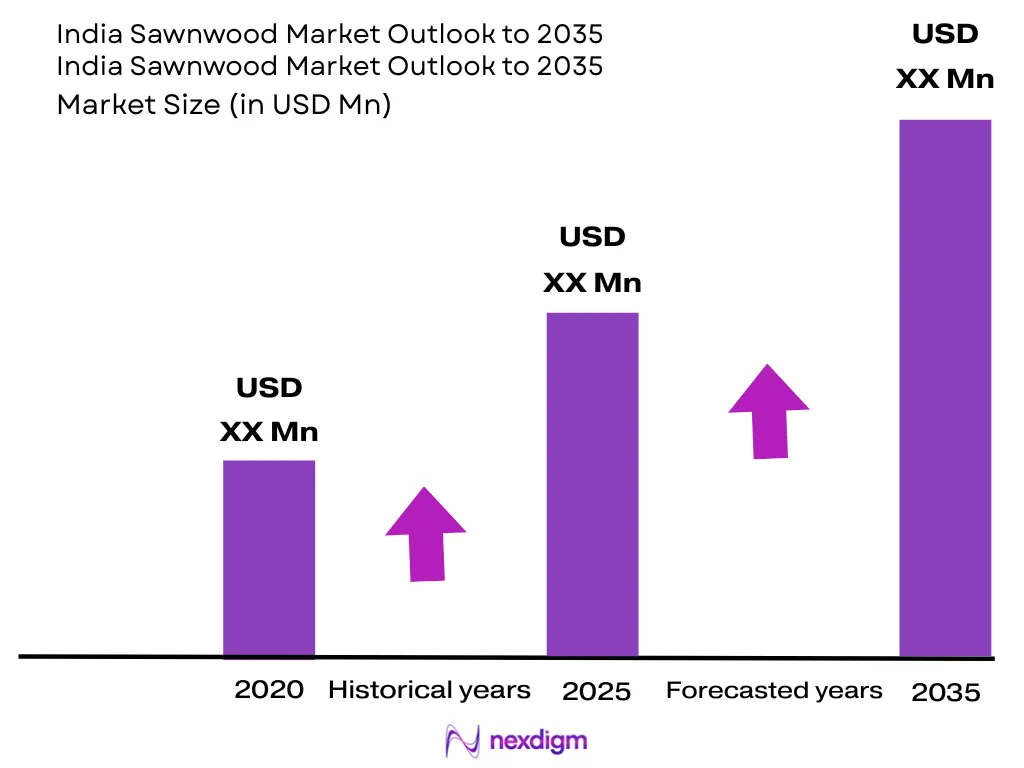
The India Sawnwood Market was valued at approximately USD ~ Million in 2024, reflecting the country’s position as one of the world’s largest consumers of wood products and among the most significant importers of sawnwood and logs on a global scale. According to data published by the Food and Agriculture Organization, the Ministry of Environment, Forest and Climate Change (MoEFCC), and the Indian Plywood Industries Research and Training Institute (IPIRTI), India’s forest cover extends across approximately 80 million hectares, yet domestic commercial timber production remains structurally constrained by restrictions on felling in natural forests and government-owned land. The market is consequently characterised by substantial import dependence, particularly for premium hardwood species, alongside a rapidly expanding agroforestry and farm forestry sector that is progressively assuming greater importance as a domestic timber supply source. Demand is primarily driven by a large and growing construction industry, surging furniture manufacturing output, expanding packaging and pallet requirements, and rising income levels supporting higher per-capita wood consumption across urban and semi-urban markets.
Market Segmentation
By Wood Species Type
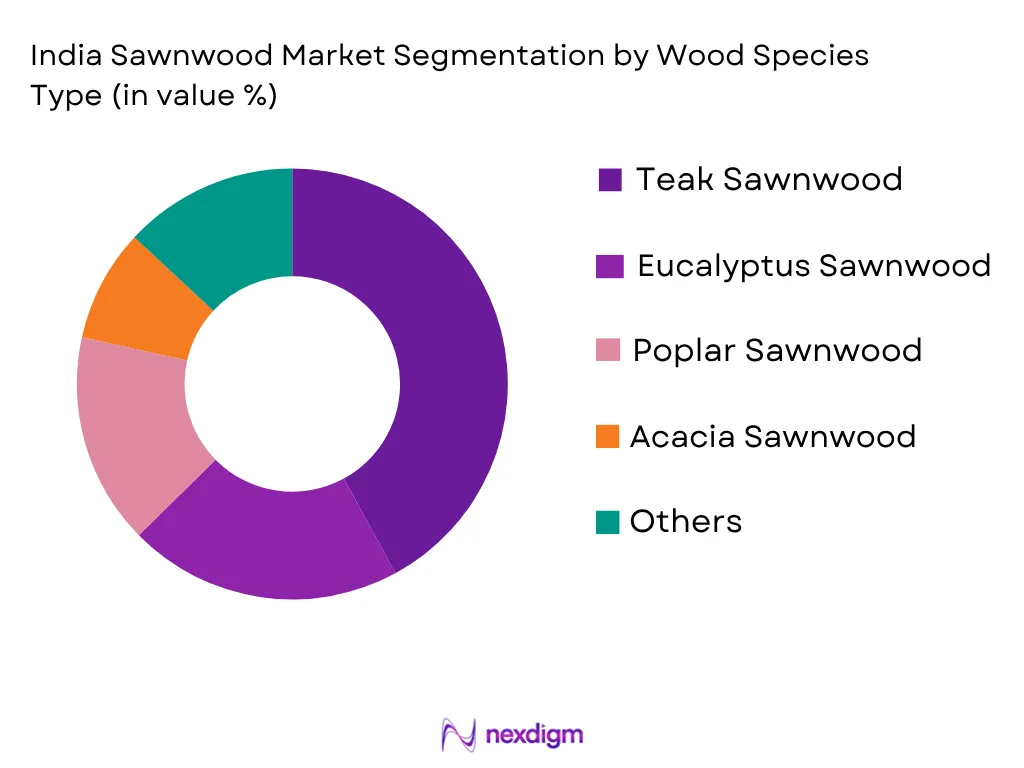
India Sawnwood Market is segmented by wood species type into Teak Sawnwood, Eucalyptus Sawnwood, Poplar Sawnwood, Acacia Sawnwood, Sal and Hardwood Sawnwood, and Other Commercial Species. Teak Sawnwood holds the dominant share in value terms owing to its premium positioning in the Indian timber market, exceptional durability, natural oil content, and widespread demand across furniture manufacturing, interior joinery, boat building, and high-end residential construction. Teak is revered in Indian consumer and trade markets as the benchmark premium timber species, commanding significant price premiums over alternative hardwood and softwood options. Domestically grown teak from government-managed plantations in Madhya Pradesh, Maharashtra, Gujarat, and Tamil Nadu, as well as imports from Myanmar, Ghana, Ecuador, and other origins, collectively supply the market. Although supply from Myanmar has faced international trade scrutiny, Indian importers have progressively diversified sourcing to African and Latin American origins. The species also benefits from an established processing ecosystem of specialist teak sawmills, seasoning yards, and timber depots concentrated in key trading hubs including Gandhidham, Mumbai, Chennai, and Kolkata. Strong consumer brand recognition, architect and designer specification preference, and generational purchasing behaviour reinforce teak’s dominant market position across value-added furniture and joinery segments.
By End-Use Industry
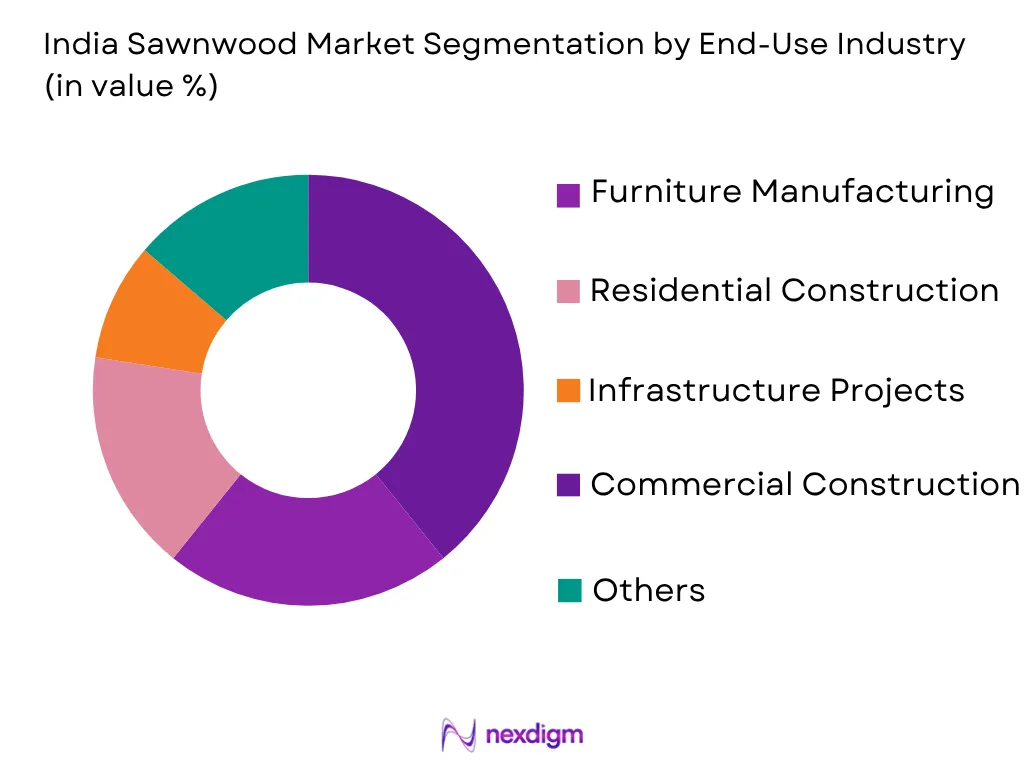
India Sawnwood Market is segmented by end-use industry into Residential Construction, Commercial Construction, Furniture Manufacturing, Packaging & Pallets, Infrastructure Projects, and Joinery & Interior Applications. Furniture Manufacturing represents the largest single end-use segment by value, driven by India’s position as one of the world’s fastest-growing furniture markets and the deep-rooted preference for solid wood furniture among Indian consumers across income segments. The organised and unorganised furniture manufacturing sectors collectively consume large volumes of teak, eucalyptus, poplar, acacia, and imported hardwood and softwood sawnwood for production of beds, wardrobes, dining sets, office furniture, and decorative interior components. Rising urbanisation, expanding middle-class household formation, and growth in real estate completions are generating strong incremental demand for wood-based furniture products. Additionally, Residential Construction constitutes a major sawnwood consumption segment, with timber used extensively for door and window frames, roof structures, flooring, and form-shuttering applications. The segment benefits from government affordable housing programmes including Pradhan Mantri Awas Yojana (PMAY), which targets the construction of millions of new housing units across urban and rural India, generating sustained and large-scale demand for construction-grade sawnwood products throughout the forecast period.
Competitive Landscape
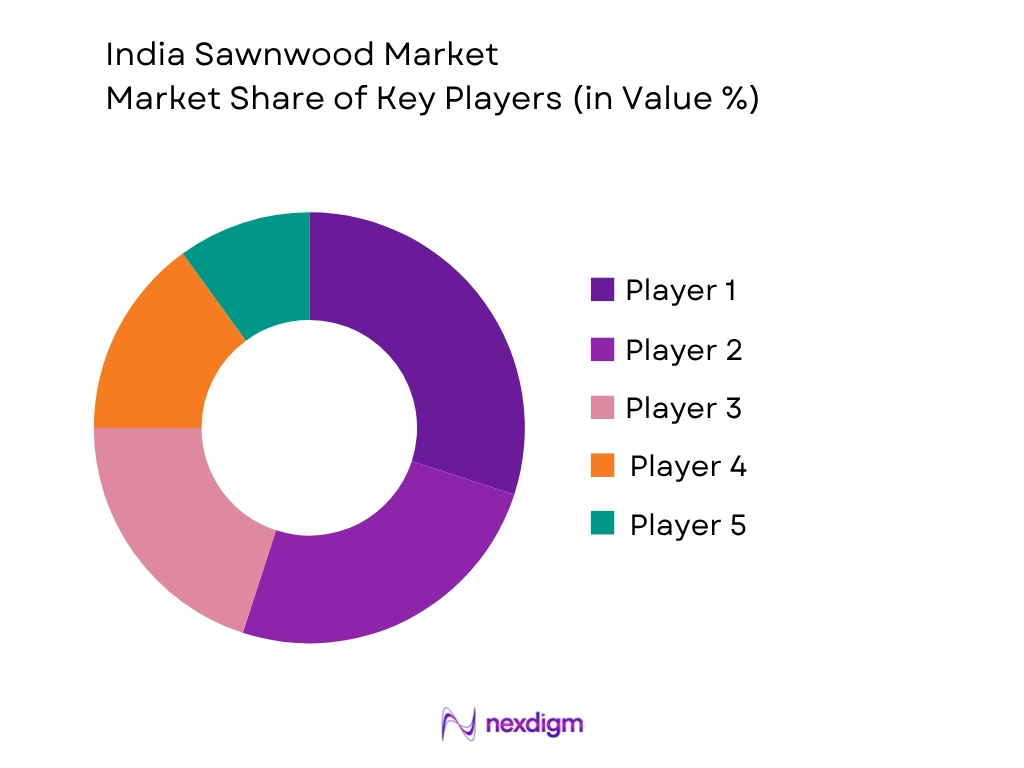
The India Sawnwood Market is highly fragmented, comprising a large number of small-to-medium unorganised sawmill operators, timber traders, agroforestry-based log suppliers, and a smaller number of larger organised players with established import networks and processing infrastructure. The organised sector is anchored by integrated wood products companies with downstream plywood, decorative laminate, and furniture manufacturing operations. Major participants leverage import trading relationships, strategic sawmill locations near ports and timber depots, species diversification, and downstream integration to maintain competitive positioning. Companies with FSC or PEFC chain-of-custody certification are increasingly sought out by export-oriented furniture manufacturers, institutional buyers, and multinational construction developers requiring certified timber documentation. The market is also characterised by strong regional concentration, with key timber trading hubs operating in Gujarat, Maharashtra, Tamil Nadu, Uttar Pradesh, and West Bengal.
| Company | Establishment Year | Headquarters | Plantation Assets | Sawmill Capacity | FSC/PEFC Certification | Export Presence | Product Portfolio | End-Use Focus |
| Century Plyboards (India) Ltd. | 1982 | ~ | ~ | ~ | ~ | ~ | ~ | ~ |
| Greenlam Industries Ltd. | 2013 | ~ | ~ | ~ | ~ | ~ | ~ | ~ |
| Kitply Industries Ltd. | 1981 | ~ | ~ | ~ | ~ | ~ | ~ | ~ |
| Archidply Industries Ltd. | 1995 | ~ | ~ | ~ | ~ | ~ | ~ | ~ |
| Ganesh Timber Mart | 1975 | ~ | ~ | ~ | ~ | ~ | ~ | ~ |
India Sawnwood Market Analysis
Growth Drivers
Expansion of Agroforestry and Farm Forestry Timber Supply
India’s sawnwood industry is increasingly supported by the rapid expansion of agroforestry and farm forestry plantations, which have emerged as the primary source of domestically produced commercial timber in the context of strict restrictions on felling in natural and government forests. Under the National Agroforestry Policy 2014 and subsequent state-level initiatives, millions of smallholder farmers across Uttar Pradesh, Punjab, Haryana, Andhra Pradesh, and Telangana have planted commercial timber species including eucalyptus, poplar, acacia, and casuarina on agricultural land. According to the Indian Council of Forestry Research and Education (ICFRE), agroforestry now covers approximately 28 million hectares across India and contributes a substantial and growing proportion of domestic roundwood supply to sawmills and wood processing units. Poplar cultivation in the Indo-Gangetic Plain, particularly in western Uttar Pradesh and Punjab, has created a major regional sawnwood supply base serving plywood, packaging, and furniture industries. Eucalyptus farming in Andhra Pradesh, Telangana, and Karnataka supplies both pulpwood and sawlog markets, with selected clonal varieties increasingly delivering log diameters suitable for sawnwood conversion. Government incentives for tree planting on private land, easing of transit permit requirements for farm-grown timber under several state policies, and rising farm-gate timber prices are encouraging continued expansion of on-farm timber cultivation. This growing agroforestry timber base is progressively reducing India’s dependence on imported logs and sawnwood for lower-grade applications while supporting rural farm income diversification.
Urbanisation, Construction Activity, and Housing Programme Demand
India’s sustained urbanisation trajectory and large-scale government housing programmes represent the most significant structural growth drivers for the sawnwood market over the forecast period. The country’s urban population is projected to exceed 600 million by 2030, generating enormous demand for new residential and commercial construction across Tier 1, Tier 2, and Tier 3 cities. The Pradhan Mantri Awas Yojana (PMAY) urban and rural housing missions have targeted the construction of tens of millions of affordable housing units, generating consistent demand for construction-grade sawnwood used in door and window frames, roof structures, concrete formwork shuttering, and interior finishing. India’s construction sector is one of the largest employers in the economy and a major consumer of timber across structural and non-structural applications. Rising per-capita incomes, household formation among young working-age populations, and growing aspirational demand for wood-finished interiors are accelerating furniture consumption across urban and semi-urban markets. The rapid expansion of organised retail, commercial real estate, hospitality, and institutional construction sectors is also generating growing demand for specification-grade sawnwood in joinery, flooring, and interior applications. India’s large and young demographic profile, combined with government infrastructure investment programmes and real estate sector growth, ensures that construction-driven timber demand will remain robust across the forecast horizon.
Market Challenges
Deforestation Regulations and Domestic Log Supply Constraints
The India sawnwood market faces a fundamental structural challenge arising from strict government restrictions on commercial felling in natural forests and government-owned forest land, which severely limit domestic log availability from traditional timber-producing sources. The Forest Conservation Act 1980 and its subsequent amendments, along with the Supreme Court’s landmark 1996 judgement in the Godavarman case, effectively halted large-scale commercial timber harvesting from natural forests across most of India. State forest departments operate under stringent felling quotas and transit permit systems that restrict timber movement and create significant compliance burdens for sawmill operators and timber traders. This regulatory environment has structurally reduced the volume of domestically harvested natural timber available to sawmills and forced the industry to rely increasingly on agroforestry sources and imported logs and sawnwood. Timber smuggling and illegal logging from natural forests persist in certain states, creating unfair competition for legally sourced timber and undermining traceability efforts. Import dependency for premium hardwood species, particularly teak, rosewood, and tropical hardwoods, exposes the industry to international price volatility, currency risk, and trade policy changes in key supplying countries. Managing these supply constraints while complying with increasingly stringent traceability and due diligence requirements from export markets represents a persistent operational challenge for Indian sawnwood processors and traders.
Fragmented Industry Structure and Sawmill Productivity Constraints
The Indian sawnwood processing sector is characterised by extreme fragmentation, with the vast majority of sawmill capacity concentrated in small-scale, unorganised units operating with limited mechanisation, low capital investment, and minimal compliance with environmental and safety standards. According to industry estimates, India has a large number of registered and unregistered sawmills distributed across timber trading hubs, port cities, and rural agricultural regions, with most operating as micro or small enterprises. Low levels of kiln-drying adoption result in high moisture content timber being sold for construction and furniture applications, leading to dimensional instability, shrinkage, and product quality issues downstream. Recovery rates in Indian sawmills are generally lower than international benchmarks due to the use of older circular saw technology, limited log sorting infrastructure, and workforce skill constraints. The unorganised sector’s dominance makes it difficult to implement industry-wide quality standards, species traceability systems, and certification programmes. Additionally, limited access to formal credit and working capital financing constrains investment in modern sawmill equipment, kiln-drying facilities, and grading technology. Addressing these structural productivity constraints through industry modernisation, skill development, and technology adoption incentives will be essential for improving the competitiveness of Indian sawnwood processors against imported finished lumber and engineered wood alternatives.
Market Opportunities
Government Housing Programmes and Construction Sector Timber Demand
India’s large-scale government housing and infrastructure investment programmes represent a substantial and durable demand opportunity for the sawnwood market, particularly for construction-grade timber used in formwork, framing, joinery, and interior applications. The Pradhan Mantri Awas Yojana (PMAY) programme, targeting urban and rural affordable housing delivery, has mobilised significant construction activity across all major states, generating ongoing demand for cost-effective, structurally adequate sawnwood products. Smart Cities Mission, AMRUT urban development programmes, and National Infrastructure Pipeline projects are collectively driving demand for timber in commercial, institutional, and infrastructure construction applications. Rising government investment in educational facilities, healthcare infrastructure, and public housing under various central and state schemes will sustain long-term construction-sector timber requirements. The organised real estate sector, increasingly dominated by RERA-registered developers, is also expanding the market for specification-grade, certified, and traceable timber products in premium residential and commercial projects. India’s construction industry is expected to grow into one of the world’s largest by 2035, creating an enormous incremental demand base for all categories of wood-based construction materials. Sawnwood producers and importers that can supply consistent quality, certified, and competitively priced products to organised construction supply chains will be well-positioned to capture this structural demand growth.
Furniture Manufacturing Export Growth and Value-Added Processing
India’s rapidly growing furniture manufacturing sector and its aspirations for global export market share present significant opportunities for sawnwood producers capable of supplying consistent, certified, and specification-grade timber to organised manufacturing operations. India is among the world’s largest furniture markets by consumption and has emerged as a growing export base for solid wood, engineered wood, and upholstered furniture products destined for markets in the United States, United Kingdom, European Union, and the Middle East. Government export promotion initiatives and the Production Linked Incentive (PLI) framework for furniture manufacturing are attracting investment in organised furniture production facilities that require traceable, certified sawnwood inputs. The development of furniture manufacturing clusters in states including Rajasthan, Uttar Pradesh, Maharashtra, and Tamil Nadu is creating concentrated demand centres for processed timber products. Expanding investment in kiln-drying facilities, precision sawing technology, and FSC chain-of-custody certification will enable Indian sawnwood processors to supply export-quality timber to organised furniture manufacturers. Additionally, the growth of e-commerce furniture retail, organised home furnishing chains, and architect-specified interior fit-out projects is elevating quality expectations and certification requirements across the domestic furniture supply chain. These converging demand signals create a compelling opportunity for sawnwood industry participants to invest in value-added processing capabilities and certification infrastructure.
Future Outlook
The India Sawnwood Market is expected to witness strong growth over the forecast period, supported by rapid urbanisation, large-scale government housing and infrastructure programmes, expanding furniture manufacturing output, and the progressive growth of agroforestry-based domestic timber supply. The continued expansion of eucalyptus, poplar, acacia, and teak farm forestry plantations is anticipated to increase domestic log availability, partially offsetting import dependency over the longer term. Investments in sawmill modernisation, kiln-drying adoption, and grading technology are expected to improve sawnwood quality and processing efficiency across organised sector participants. Growing demand for certified, traceable, and legally sourced timber from export-oriented furniture manufacturers, multinational construction companies, and institutional procurement frameworks will drive progressive adoption of FSC and PEFC certification across the supply chain. Rising per-capita incomes, household formation among young urban demographics, and increasing consumer preference for wood-based interior products are expected to sustain strong underlying demand through 2035. The formalisation of timber trading, digital procurement platforms, and improved transit permit systems are anticipated to improve market efficiency and supply chain transparency over the forecast horizon.
Major Players
- Century Plyboards (India) Ltd.
- Greenlam Industries Ltd.
- Kitply Industries Ltd.
- Archidply Industries Ltd.
- Ganesh Timber Mart
- Shiv Shakti Timber Industries
- National Plywood Industries Ltd.
- Sarda Plywood Industries Ltd.
- Duro Ply Industries Ltd.
- Mayur Timber Traders
- Mangalam Timber Products Ltd.
- Uniply Industries Ltd.
- Ecoboard Industries Ltd.
- Timber World India
- Yuken India Ltd.
Key Target Audience
- Forestry and Timber Production Companies
- Sawmill Operators and Wood Processing Enterprises
- Furniture Manufacturing Companies
- Residential and Commercial Construction Companies
- Building Material Distributors and Timber Traders
- Investments and Venture Capitalist Firms
- Government and Regulatory Bodies (Ministry of Environment, Forest and Climate Change (MoEFCC), Indian Council of Forestry Research and Education (ICFRE), State Forest Departments, Ministry of Housing and Urban Affairs)
- Timber Importers, Exporters and International Timber Trading Organisations
Research Methodology
Step 1: Identification of Key Variables
The initial phase involves constructing an ecosystem map covering agroforestry operators, state forest corporations, sawmills, timber importers, traders, construction companies, and furniture manufacturers operating within the India Sawnwood Market. Extensive secondary research is conducted using industry associations, trade databases, forestry reports, and government publications including data from the Ministry of Environment Forest and Climate Change (MoEFCC), Indian Plywood Industries Research and Training Institute (IPIRTI), Directorate General of Foreign Trade (DGFT), and Indian Council of Forestry Research and Education (ICFRE) to identify variables influencing market demand and supply.
Step 2: Market Analysis and Construction
This phase focuses on gathering historical information relating to timber harvesting volumes, sawnwood production, domestic consumption, import and export performance, pricing trends, and end-use demand across key consuming industries. Market revenues are estimated using a combination of production volumes, average selling prices, and trade flow assessments while validating relationships between supply-side and demand-side indicators specific to India’s agroforestry and import-dependent supply structure.
Step 3: Hypothesis Validation and Expert Consultation
Market assumptions are validated through structured interviews with timber importers, sawmill operators, agroforestry plantation managers, furniture manufacturers, timber traders, and industry specialists. These consultations provide operational insights regarding production capacity utilisation, import procurement trends, species availability, pricing dynamics, regulatory compliance, and investment developments, ensuring greater accuracy of market estimates across India’s highly fragmented and regionally diverse sawnwood industry.
Step 4: Research Synthesis and Final Output
The final stage integrates findings from primary and secondary research to develop market forecasts, segmentation analysis, competitive benchmarking, and strategic recommendations. Data triangulation techniques are applied to validate market estimates and generate a comprehensive assessment of the India Sawnwood Market while ensuring consistency across all segments, regions, and stakeholder perspectives within this complex and rapidly evolving market environment.

- Executive Summary
- Research Methodology (Market Definitions and Assumptions, Abbreviations, Market Sizing Approach, Top-Down Analysis, Bottom-Up Analysis, Demand-Side Assessment, Supply-Side Assessment, Primary Industry Interviews, Forestry Sector Validation Framework, Trade Flow Assessment, Data Triangulation, Forecasting Framework, Limitations and Future Conclusions)

- Definition and Scope
- Market Evolution and Industry Genesis
- Timeline of Major Industry Developments
- Forestry and Wood Processing Industry Ecosystem
- Sawnwood Value Chain Analysis

- Growth Drivers (Agroforestry and Farm Forestry Expansion, Construction Activity Growth, Furniture Manufacturing Demand, Urbanisation and Real Estate Development, Import Timber Supply Diversification)
- Market Challenges (Deforestation Regulations and Log Supply Constraints, Fragmented Sawmill Sector, High Import Dependency for Premium Species, Timber Smuggling and Traceability Gaps, Competition from Engineered Wood and Plywood Substitutes)
- Market Opportunities (Agroforestry-Based Timber Integration, FSC/PEFC Certified Timber Demand, Government Housing Programme Demand, Digital Timber Trading Platforms, Sawmill Modernisation Investments)
- Market Trends (Plantation Timber Utilisation Growth, Kiln-Dried Lumber Adoption, Sawmill Mechanisation, Eucalyptus and Poplar Expansion, Sustainable Construction Material Preference)
- Government Regulations (Forest Conservation Act, Timber Transit Rules, Environmental Clearance Requirements, Agroforestry Policy 2014, National Forest Policy)
- SWOT Analysis
- Porter’s Five Forces Analysis
- PESTLE Analysis
- Stakeholder Ecosystem
- Competition Ecosystem

- By Market Value (2020-2025)
- By Volume (2020-2025)
- By Average Realized Price (2020-2025)

- By Wood Species Type (In Value %)
Teak Sawnwood
Eucalyptus Sawnwood
Poplar Sawnwood
Acacia Sawnwood
Sal and Hardwood Sawnwood
Other Commercial Wood Species - By Product Form (In Value %)
Rough Sawn Lumber
Planed Sawnwood
Kiln-Dried Sawnwood
Treated Sawnwood
Structural Sawn Timber
Appearance Grade Lumber - By End-Use Industry (In Value %)
Residential Construction
Commercial Construction
Industrial Construction
Furniture Manufacturing
Packaging and Pallets
Joinery and Interior Applications
Infrastructure and Utility Projects - By Distribution Channel (In Value %)
Direct Sales to Industrial Buyers
Timber Traders and Wholesalers
Building Material Distributors
Retail Timber Depots
Import Trading Companies - By Region (In Value %)
North India
South India
West India
East India
Central India

- Market Share of Major Players (By Value, Production Volume, Import Volume, Sawmill Capacity)
- Cross Comparison Parameters (Annual Sawnwood Production Capacity, Plantation Area, Sawmill Recovery Rate, Kiln Drying Capacity, FSC/PEFC Certified Timber Share, Import Revenue Share, Number of Sawmill Facilities, Product Grade Portfolio)
- SWOT Analysis of Major Players
- Benchmarking Analysis of Major Players
- Pricing Analysis (By Species, Grade, Moisture Content, Thickness, Import vs Domestic Sales)
- Detailed Profiles of Major Companies
Century Plyboards (India) Ltd.
Greenlam Industries Ltd.
Kitply Industries Ltd.
Archidply Industries Ltd.
Ganesh Timber Mart
Shiv Shakti Timber Industries
National Plywood Industries Ltd.
Sarda Plywood Industries Ltd.
Duro Ply Industries Ltd.
Mayur Timber Traders
Mangalam Timber Products Ltd.
Uniply Industries Ltd.
Ecoboard Industries Ltd.
Timber World India
Yuken India Ltd.

- Consumption Pattern Assessment (Consumption Frequency, Product Mix, Industry Demand Share, Volume Utilisation, Seasonal Demand)
- Sawnwood Utilisation by Industry (Construction Usage, Furniture Manufacturing Share, Packaging Consumption, Infrastructure Demand, Industrial Applications)
- Procurement and Sourcing Analysis (Contract Duration, Supplier Preference, Import Dependence, Procurement Volume, Lead Time Requirements)
- Buyer Preference Analysis (Species Preference, Grade Preference, Moisture Requirements, Certification Requirements, Delivery Expectations)
- Price Sensitivity Analysis (Price Elasticity, Grade-Based Pricing, Regional Price Variations, Volume Discounts, Contract Pricing Trends)

- By Market Value (2026-2035)
- By Volume (2026-2035)
- By Average Realized Price (2026-2035)


 Request a Sample
 Ask for Customization
 Get a Quote
 Enquire Now