
 Download PDF
Market Overview
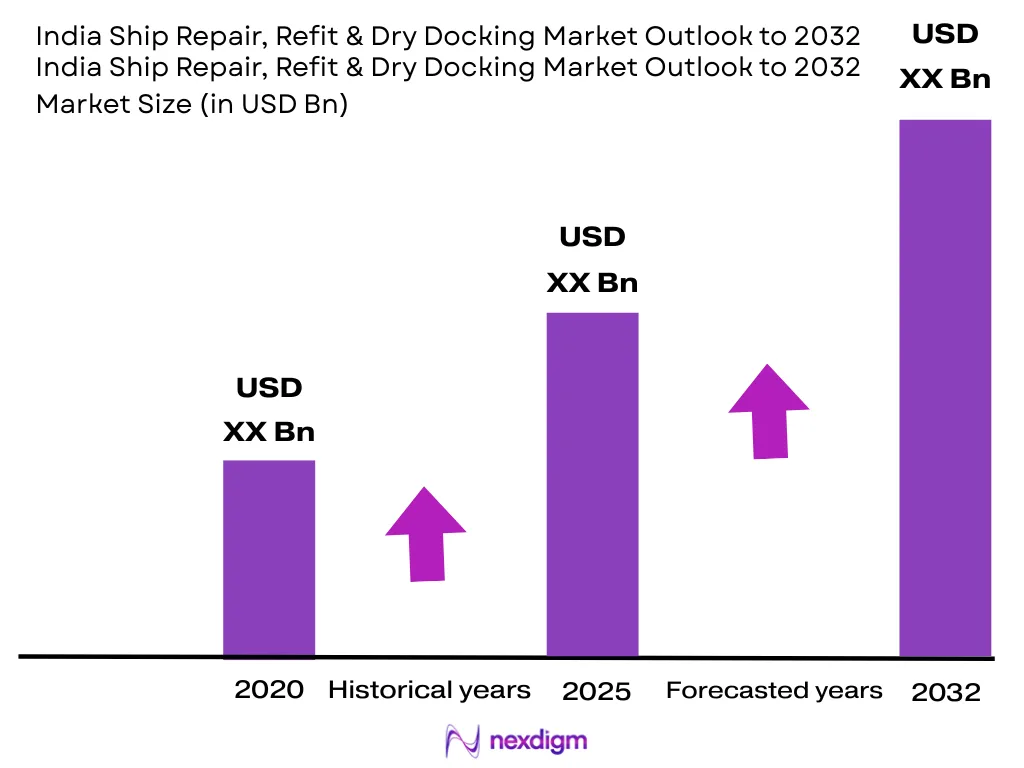
The India Ship Repair, Refit & Dry Docking Market was valued at approximately USD 1.3 billion in 2024 and is projected to reach USD 2.8 billion by 2033, growing at a CAGR of approximately 7.9% during 2025-2033, according to IMARC Group estimates. India repaired approximately 418 ships in 2023-24, with 227 vessels handled by the private sector and the remainder by public sector shipyards, according to the Ministry of Ports, Shipping and Waterways (MoPSW). The Indian ship repair market currently accounts for less than 1% of the global ship repair market, despite approximately 7-9% of international shipping traffic passing within 300 nautical miles of India’s coastline. The country currently operates approximately 42 dry docks, significantly fewer than China (approximately 450), South Korea (approximately 400), and the United States (approximately 117). The market is supported by Maritime India Vision 2030 and Amrit Kaal Vision 2047, which set ambitious targets to position India among the top five global maritime nations and develop the ship repair industry into a USD 1.7 billion segment by 2032.
Market Segmentation
By Service Type
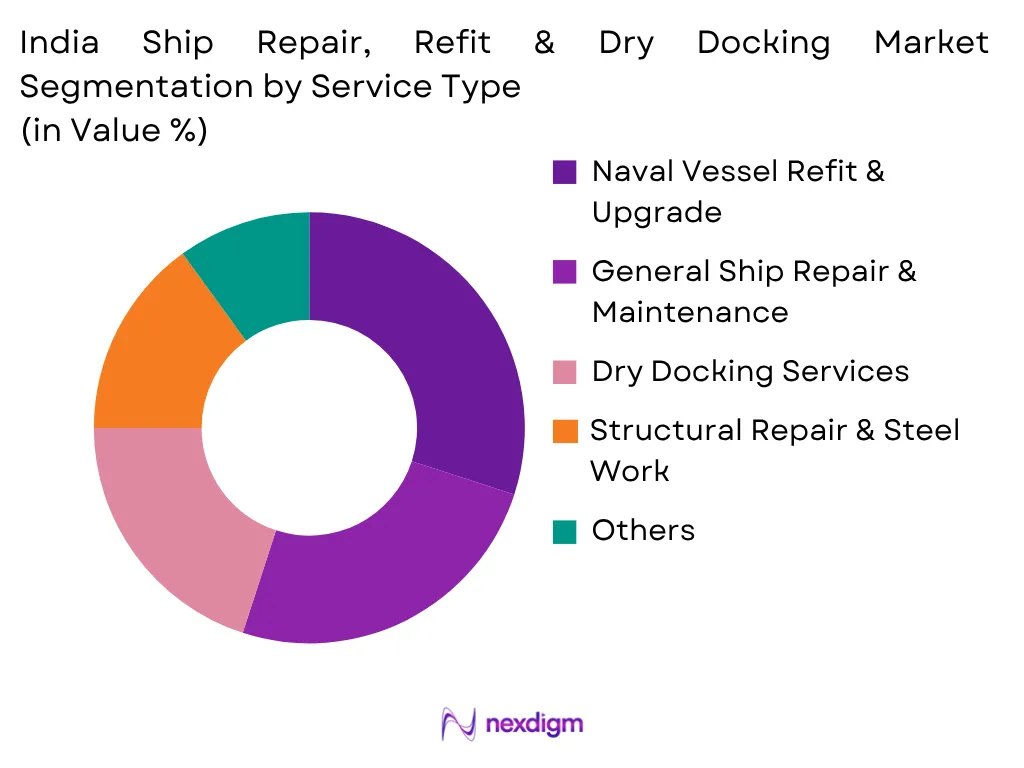
Naval vessel refit and upgrade services account for a significant share of the India ship repair market owing to the Indian Navy’s expanding fleet, continuous refit calendar requirements, and the government’s priority to indigenize naval maintenance under the Aatmanirbhar Bharat initiative. Mazagon Dock Shipbuilders Limited declared contracts worth INR 1,500 crore for naval ship overhauls, reflecting the scale of defense-driven demand in the sector. Cochin Shipyard Limited signed a Master Ship Repair Agreement (MSRA) with the United States Navy in April 2024, becoming the third Indian shipyard after L&T Kattupalli and Mazagon Dock to do so, establishing a formal framework for repairing US Military Sealift Command Fleet Support Ships. The Indian Navy’s expanding fleet of destroyers, frigates, submarines, and the INS Vikrant aircraft carrier generates recurring refit and maintenance requirements that provide a stable revenue base for India’s public sector shipyards. Dry docking and hull maintenance services represent a complementary growth segment, driven by increasing commercial vessel traffic, IMO environmental compliance mandates, and mandatory periodic survey requirements. Continuous government investment in upgrading public sector shipyard infrastructure, combined with growing foreign vessel capture opportunities, is further strengthening the technical capability of Indian shipyards across naval and commercial repair categories.
By Shipyard Type
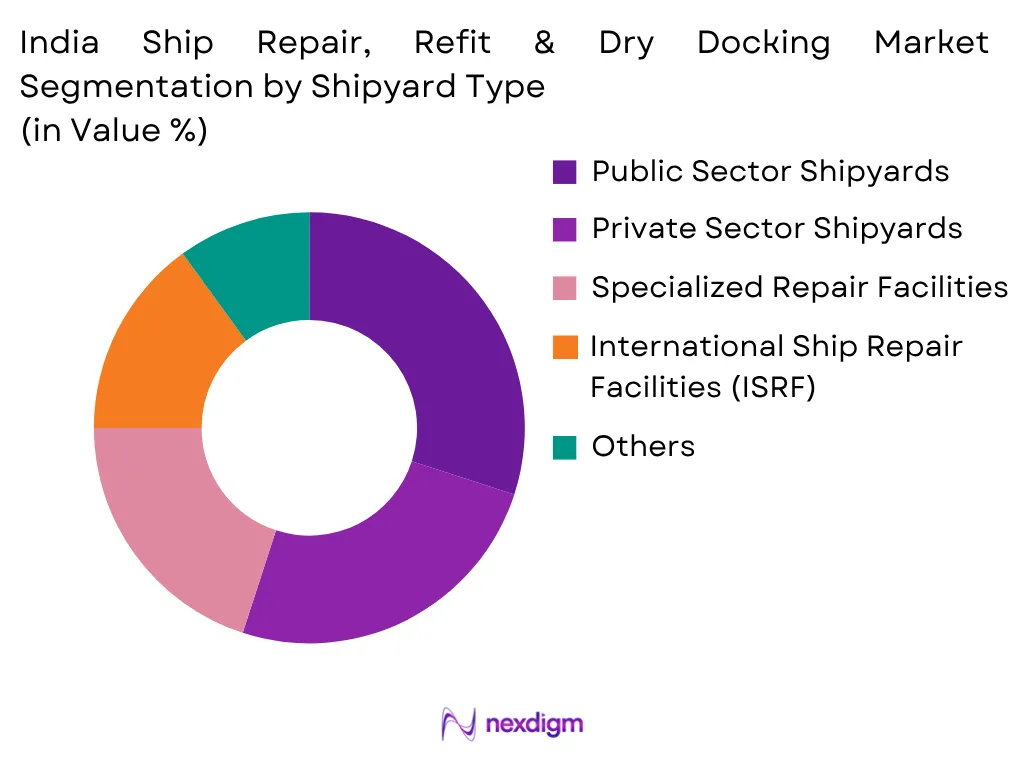
Public sector shipyards continue to account for the dominant share of ship repair and dry docking revenue in India due to their established infrastructure, long-standing relationship with the Indian Navy and Coast Guard, and continued government investment in facility modernization. Cochin Shipyard Limited operates India’s largest shipbuilding and maintenance facility, with its newly commissioned International Ship Repair Facility (ISRF) inaugurated in August 2024 on Willingdon Island in Kochi, covering 42 acres and including a 6,000-tonne syncrolift, six repair workstations, approximately 1,128 metres of quay, and repair capacity for vessels up to 130 metres in length. The ISRF is estimated to increase India’s national ship repair capacity by approximately 25% and reinforces Kochi’s position as South Asia’s emerging maritime maintenance hub. Government-linked shipyards such as Hindustan Shipyard, Mazagon Dock, Garden Reach Shipbuilders, and Goa Shipyard further support naval and commercial repair operations across key coastal clusters. Private sector shipyards, including L&T Kattupalli, Mandovi Drydocks, and Chowgule & Co., are expanding their commercial repair capabilities to capture growing demand from domestic coastal shipping operators, offshore energy companies, and foreign vessel owners transiting Indian waters.
Competitive Landscape
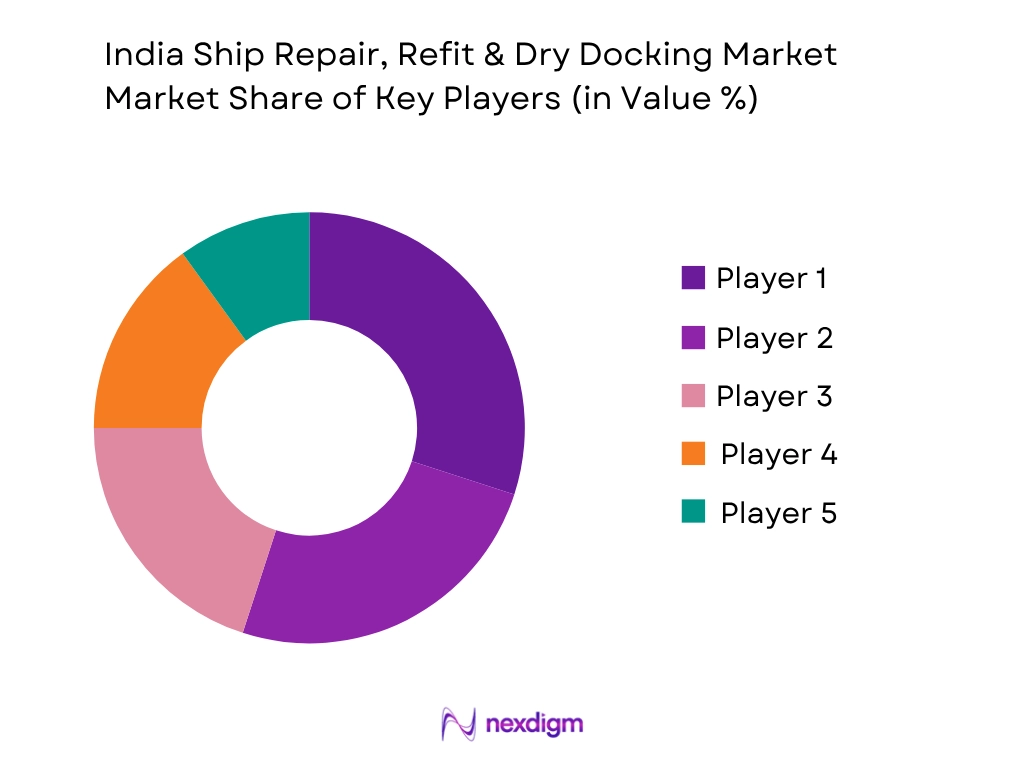
The India Ship Repair, Refit & Dry Docking Market is led by a core group of public sector shipyards that combine large-scale dry dock infrastructure with deep expertise in naval and commercial repair. Cochin Shipyard Limited, Hindustan Shipyard Limited, Mazagon Dock Shipbuilders Limited, Garden Reach Shipbuilders & Engineers, and Goa Shipyard Limited collectively account for the majority of domestic ship repair revenue, driven by long-term naval maintenance contracts and an expanding commercial service portfolio. Private sector participants are gradually increasing their market presence through investments in floating dry docks, specialized repair equipment, and international service agreements. Competitive differentiation centers on dry dock capacity, naval classification approvals, turnaround efficiency, international repair agreement credentials, and growing capability in green retrofit and emission compliance services.
| Company | Establishment Year | Headquarters | Primary Service Focus | Dry Dock Capacity
|
Naval Repair Capability | Commercial Repair Capability | Export Market Presence | Green Retrofit Capability |
| Cochin Shipyard Limited (CSL) | 1972 | ~ | ~ | ~ | ~ | ~ | ~ | ~ |
| Hindustan Shipyard Limited (HSL) | 1941 | ~ | ~ | ~ | ~ | ~ | ~ | ~ |
| Mazagon Dock Shipbuilders Limited (MDL) | 1934 | ~ | ~ | ~ | ~ | ~ | ~ | ~ |
| Garden Reach Shipbuilders & Engineers (GRSE) | 1884 | ~ | ~ | ~ | ~ | ~ | ~ | ~ |
| Goa Shipyard Limited (GSL) | 1957 | ~ | ~ | ~ | ~ | ~ | ~ | ~ |
India Ship Repair, Refit & Dry Docking Market Analysis
Growth Drivers
Maritime India Vision 2030, Amrit Kaal Vision 2047, and Indian Navy Modernization
India’s national maritime policy framework continues to be the most significant structural growth driver for the ship repair, refit, and dry docking market. Maritime India Vision 2030 has established a bold target to elevate India’s global ranking in shipbuilding and ship repair from over 20th place to the top 10, while the Amrit Kaal Vision 2047 has set an even more ambitious goal of achieving a top 5 global position. The Union Budget 2025-26 reinforced these ambitions through dedicated provisions aimed at positioning India as one of the top five global maritime centers. According to IMARC Group, the India ship repairing market reached USD 1.3 billion in 2024 and is projected to reach USD 2.8 billion by 2033 at a CAGR of 7.9%, reflecting accelerating growth momentum. Government investment in the Maritime Development Fund and infrastructure modernization programs across public sector shipyards is steadily strengthening India’s repair capacity and international competitiveness. The Indian Navy’s continuous fleet expansion program, including destroyers, frigates, submarines, and the INS Vikrant aircraft carrier, generates a sustained demand pipeline for naval refit, overhaul, and maintenance services. In February 2025, A.P. Moller-Maersk entered into a Memorandum of Understanding with Cochin Shipyard Limited to explore partnerships in ship repair, maintenance, and construction activities, signaling growing international confidence in India’s maritime service capabilities. These policy-driven investments and strategic partnerships are expected to accelerate India’s transition from a regional service provider to a competitive participant in the global ship repair value chain.
Strategic Coastal Location and International Ship Repair Agreement Expansion
India’s geographic position on major international shipping lanes provides a significant latent advantage for the ship repair sector that is increasingly being converted into active commercial opportunity. Approximately 7-9% of global international shipping traffic passes within 300 nautical miles of India’s coastline, according to the Maritime Amrit Kaal Vision 2023, representing a substantial and underutilized captive market for ship repair, replenishment, and maintenance services. Cochin Shipyard Limited became the third Indian shipyard to sign a Master Ship Repair Agreement (MSRA) with the United States Navy in April 2024, following L&T Kattupalli and Mazagon Dock Shipbuilders, allowing US Military Sealift Command vessels in the Central Command area to be repaired in India. The inauguration of CSL’s International Ship Repair Facility in August 2024, which commenced commercial operations by docking the HSC Parali belonging to the Lakshadweep Administration, marked a critical milestone in India’s strategy to attract foreign vessels and reduce the outflow of repair revenue to overseas shipyards such as those in Singapore, Dubai, and Colombo. The global ship repairing market was valued at approximately USD 38.45 billion in 2025 and is projected to reach USD 58.77 billion by 2030, growing at a CAGR of 9.1%, reflecting strong underlying global demand. India’s annual unrealized ship repair potential has been estimated at approximately INR 6,000 crore, with long-term potential to build a market of INR 14,000 crore, indicating the scale of the opportunity available if infrastructure and turnaround efficiency are improved to international standards.
Market Challenges
Limited Dry Dock Capacity and Import Dependency for Spare Parts
India’s ship repair sector continues to face significant structural constraints arising from limited dry dock infrastructure relative to global competitors and high dependency on imported spare parts and marine equipment. As of 2023-24, India operated only approximately 42 dry docks, compared to approximately 450 in China, 400 in South Korea, and 117 in the United States, creating a fundamental capacity gap that limits India’s ability to capture a proportionate share of global ship repair demand. The lack of a strong domestic ancillary ecosystem compels Indian shipyards to import spare parts and specialized equipment from Europe, Japan, and the United States, making repair costs approximately 1.4 times higher and turnaround times approximately 1.4 to 1.6 times longer than leading global repair yards, according to CRISIL 2025 analysis. India’s Logistics Performance Index rankings reflect persistent bottlenecks in trade facilitation and supply chain efficiency that directly impact the ship repair industry’s competitiveness. Customs clearance delays for imported spare parts, combined with the absence of a well-integrated domestic marine component supply chain, remain among the most frequently cited operational challenges by shipyard operators. Government initiatives such as dedicated ship repair cluster development near major ports, similar to MRO hub models adopted for the aviation sector, are being considered as mechanisms to address these structural gaps in infrastructure and supply chain integration.
Skilled Workforce Shortages and Competition from Established Asian Repair Hubs
Shortages of experienced marine engineers, welders, coating specialists, and technical supervisors continue to limit throughput at several Indian shipyards, creating scheduling backlogs during peak demand periods and constraining the sector’s ability to scale. Singapore thrives on free trade, tax incentives, and a well-integrated supply chain that attracts international vessel owners, while South Korea supports its ancillary industry through research and development incentives and organized business networks, models that India is increasingly studying for adaptation. Dubai and Colombo have established themselves as preferred repair destinations for vessels transiting the Arabian Sea and Indian Ocean trade routes, directly competing with Indian ports for vessels that might otherwise divert to Kochi, Visakhapatnam, or Mumbai for maintenance services. Geopolitical and commercial competition from these established hubs means India must simultaneously invest in dry dock capacity expansion, workforce skills development, regulatory streamlining, and supply chain integration to meaningfully improve its share of the global ship repair market. The global ship repair and maintenance service market was valued at USD 32.0 billion in 2026 and is forecast to reach USD 60.6 billion by 2036, representing a substantial opportunity that India must urgently position to capture through coordinated policy and investment action.
Market Opportunities
International Ship Repair Facility Expansion and Foreign Vessel Capture
The commissioning of Cochin Shipyard’s International Ship Repair Facility in 2024 and the signing of Master Ship Repair Agreements with the United States Navy represent a transformative opportunity for India to begin capturing a meaningful share of the international ship repair market. India’s annual ship repair market is currently estimated at approximately INR 2,000 crore (approximately USD 240 million), with an overall unrealized potential of INR 6,000 crore, and a 10-year addressable potential exceeding INR 14,000 crore (approximately USD 1.7 billion) if systematic infrastructure and capability development occurs. CSL’s ISRF adds approximately 42 acres of dedicated repair infrastructure, a 6,000-tonne syncrolift, and six repair workstations, estimated to boost national ship repair capacity by approximately 25%. In April 2025, Cochin Shipyard entered into a Memorandum of Understanding with Drydocks World, a leading international maritime services provider, to enhance ship repair cluster capabilities further. Government policy supporting the development of specialized ship repair clusters at major ports across the west, south, and east coasts of India is expected to progressively create additional repair capacity. The global dry dock services market is projected to grow from USD 22.11 billion in 2024 to USD 31.45 billion by 2034 at a CAGR of 4.5%, driven by IMO compliance requirements, aging fleet maintenance, and offshore energy sector demand, all of which create sustained volume opportunities for Indian shipyards improving their technical and logistical competitiveness.
Green Retrofit Market and IMO Environmental Compliance Upgrades
The accelerating pace of international maritime environmental regulation presents a substantial and growing opportunity for India’s ship repair sector. The International Maritime Organization’s Carbon Intensity Indicator (CII) rating framework, the IMO 2020 sulphur cap, ballast water management conventions, and forthcoming FuelEU Maritime regulations are collectively driving unprecedented demand for scrubber installations, LNG conversion retrofits, energy efficiency upgrades, and exhaust gas cleaning systems across the global commercial fleet. Tightening environmental and safety regulations are driving upgrades such as scrubbers, fuel-efficiency enhancements, hybrid propulsion solutions, and digital monitoring systems, generating repair and conversion revenue that was not available in prior market cycles. India’s Green Hydrogen Mission and national emphasis on renewable energy provide a complementary policy framework that positions Indian shipyards well for future green propulsion retrofits, including hydrogen and ammonia fuel system conversions. Investment in digital shipyard capabilities, including AI-based predictive maintenance, augmented reality inspections, and IoT sensor integration, further strengthens the value proposition of Indian facilities for environmentally compliant refit services. Manufacturers and operators investing in IMO-compliant repair capabilities, green coating systems, and alternative fuel retrofit infrastructure are therefore well positioned to capture growing international demand for environmentally certified vessel maintenance services.
Future Outlook
The India Ship Repair, Refit & Dry Docking Market is expected to witness strong and sustained growth through the 2035 forecast period, driven by government policy under Maritime India Vision 2030 and Amrit Kaal Vision 2047, expanding Indian Navy fleet maintenance requirements, growing commercial vessel traffic, and the accelerating capture of international ship repair business. The commissioning of new international repair facilities, expansion of dry dock infrastructure, and establishment of specialized maritime MRO clusters are expected to progressively reduce India’s turnaround time gap relative to Singapore, Dubai, and South Korea. Investments in digital shipyard technologies, AI-powered predictive maintenance, green retrofit capabilities, and domestic ancillary component manufacturing will further strengthen the competitiveness of Indian repair yards. India’s favorable geographic position, cost-competitive skilled workforce, and growing alignment with international naval partners through Master Ship Repair Agreements position the sector to significantly expand its share of the global ship repair market through 2035.
Major Players
- Cochin Shipyard Limited (CSL)
- Hindustan Shipyard Limited (HSL)
- Mazagon Dock Shipbuilders Limited (MDL)
- Garden Reach Shipbuilders & Engineers Limited (GRSE)
- Goa Shipyard Limited (GSL)
- Hooghly Cochin Shipyard Limited (HCSL)
- Udupi Cochin Shipyard Limited (UCSL)
- L&T Shipbuilding (Kattupalli Shipyard)
- Shoft Shipyard Pvt. Ltd.
- Mandovi Drydocks Ltd.
- Chowgule & Co. Pvt. Ltd.
- Timblo Drydocks Pvt. Ltd.
- Dempo Shipbuilding & Engineering Pvt. Ltd.
- Sembmarine Kakinada Ltd.
- Alcock Ashdown (Gujarat) Ltd.
Key Target Audience
- Shipyard Operators and Ship Repair Companies
- Indian Navy and Indian Coast Guard
- Commercial Shipping Companies and Fleet Operators
- Offshore Oil & Gas Companies
- Marine Equipment and Spare Parts Suppliers
- Port Authorities and Maritime Cluster Developers
- Investments and Venture Capitalist Firms
- Government and Regulatory Bodies (Ministry of Ports, Shipping & Waterways (MoPSW), Indian Register of Shipping (IRS), Directorate General of Shipping (DGS), Ministry of Defence)
Research Methodology
Step 1: Identification of Key Variables
The research begins by identifying the major stakeholders across India’s ship repair, refit, and dry docking value chain, including public and private shipyards, dry dock operators, marine equipment suppliers, classification societies, shipping companies, naval procurement agencies, and port authorities. Extensive secondary research is conducted using government publications, Ministry of Ports Shipping and Waterways statistical reports, company annual reports, industry associations, and proprietary databases to establish the key variables influencing market performance.
Step 2: Market Analysis and Construction
Historical market information is compiled and evaluated to estimate the overall market size, number of vessels repaired, dry dock utilization rates, revenue generation by service category and vessel type, and pricing trends. Both demand-side and supply-side indicators are analyzed using bottom-up and top-down market sizing approaches, drawing on shipyard capacity data, vessel refit calendars, regulatory inspection cycles, and commercial shipping traffic statistics to ensure comprehensive market coverage.
Step 3: Hypothesis Validation and Expert Consultation
Preliminary market estimates and analytical assumptions are validated through Computer Assisted Telephone Interviews (CATIs) and structured discussions with shipyard executives, naval procurement officers, commercial shipping operators, marine equipment suppliers, classification society surveyors, and maritime policy experts. These interviews provide valuable commercial and operational insights that strengthen the reliability of market estimates.
Step 4: Research Synthesis and Final Output
The final stage integrates primary research findings with secondary information to develop a comprehensive assessment of market size, segmentation, competitive landscape, infrastructure analysis, and future opportunities. Multiple validation techniques, including data triangulation and cross-verification against Ministry of Ports Shipping and Waterways official statistics, are employed to ensure the consistency, accuracy, and credibility of the final market report.

- Executive Summary
- Research Methodology (Market Definitions and Assumptions, Abbreviations, Market Taxonomy, Market Sizing Approach, Top-Down Analysis, Bottom-Up Analysis, Demand-Side Assessment, Supply-Side Assessment, Primary Industry Interviews, Secondary Research Validation, Data Triangulation, Forecasting Framework, Limitations and Future Conclusions)

- Definition and Scope
- Market Evolution and Industry Genesis
- Timeline of Major Industry Developments
- Industry Value Chain Analysis
- Supply Chain Analysis

- Growth Drivers (Maritime India Vision 2030 & Amrit Kaal Vision 2047, Indian Navy Modernization & Fleet Expansion, Rising Commercial Shipping Traffic, Government Incentives and Budgetary Support, International Ship Repair Agreements, Strategic Coastal Location on Global Shipping Lanes, Growing Offshore Oil & Gas Sector, IMO Environmental Compliance-Driven Retrofit Demand)
- Market Challenges (Limited Dry Dock Capacity Relative to Global Competitors, Import Dependency for Spare Parts & Equipment, Longer Turnaround Times vs Singapore & Dubai, Skilled Workforce Shortages, Fragmented Ancillary Ecosystem, Regulatory and Customs Clearance Delays, Competition from China, South Korea, and Singapore)
- Market Opportunities (International Ship Repair Facility (ISRF) Expansion, Green Shipping Retrofit Market, US Navy & Foreign Naval Repair Agreements, Ship Repair Cluster Development, LNG & Alternative Fuel Conversion Retrofits, Digital Shipyard Transformation, Public-Private Partnership Models, Cruise & Passenger Vessel Repair)
- Market Trends (AI-Powered Predictive Maintenance, Remote Inspection Technologies, Scrubber & Ballast Water Treatment Retrofits, Green Dry Dock Initiatives, Modular Repair Systems, Digitalization of Repair Operations, Drone-Based Hull Inspections, Condition-Based Maintenance)
- Government Regulations & Policy Framework (Maritime India Vision 2030, Amrit Kaal Vision 2047, Shipbuilding Financial Assistance Policy, Cabotage Law Relaxation, ISRF Policy, IACS Classification Requirements, IMO MARPOL Compliance, Indian Register of Shipping Standards, Environmental Clearance Norms)
- Dry Dock Infrastructure Analysis (Number and Capacity of Dry Docks, Public vs Private Dry Dock Distribution, Regional Dry Dock Availability, Floating Dry Dock Fleet, Syncrolift Facilities, Planned Dry Dock Additions)
- Naval Repair & Refit Market Analysis (Indian Navy Refit Calendar, Submarine Refit Requirements, Aircraft Carrier Maintenance, Coast Guard Vessel Maintenance Programs)
- Spare Parts & Ancillary Ecosystem Assessment (Import Dependency Analysis, Domestic Component Manufacturing, Supply Chain Bottlenecks, Strategic Sourcing Initiatives)
- International Competitiveness Analysis (India vs Singapore, Dubai, China, South Korea in Repair Cost, Turnaround Time, Dock Availability, Skilled Labor)
- Environmental Compliance & Green Retrofit Analysis (IMO 2020 Sulphur Cap Impact, Ballast Water Management Convention Retrofits, CII Rating Compliance, LNG Conversion Projects)
- SWOT Analysis
- Porter’s Five Forces Analysis
- PESTLE Analysis
- Stakeholder Ecosystem
- Competition Ecosystem

- By Market Value (2020-2025)
- By Volume of Ships Repaired (2020-2025)
- By Average Revenue per Vessel (2020-2025)

- By Service Type (In Value %)
General Ship Repair & Maintenance
Dry Docking Services
Hull Maintenance & Anti-Corrosion Treatment
Engine & Propulsion System Overhaul
Naval Vessel Refit & Upgrade
Electrical & Electronic Systems Repair
Green Retrofit & Emission Compliance Upgrades
Structural Repair & Steel Work - By Vessel Type (In Value %)
Naval Warships & Submarines
Commercial Cargo Ships & Bulk Carriers
Crude Oil & Chemical Tankers
Container Ships
Offshore Support Vessels
Passenger & Cruise Vessels
Tugboats, Barges & Coastal Vessels
Dredgers & Specialty Vessels - By End User (In Value %)
Indian Navy & Coast Guard
Commercial Fleet Operators
Offshore Oil & Gas Companies
Government & Public Sector Undertakings
Foreign Vessel Operators - By Shipyard Type (In Value %)
Public Sector Shipyards
Private Sector Shipyards
Specialized Repair Facilities
International Ship Repair Facilities (ISRF) - By Region (In Value %)
West Coast (Mumbai, Goa, Gujarat)
South Coast (Kochi, Visakhapatnam)
East Coast (Kolkata, Chennai)
Andaman & Nicobar Islands
Other Coastal Regions

- Market Share Analysis (By Value, Number of Ships Repaired, Dry Dock Capacity, Naval vs Commercial Revenue, Public vs Private Sector)
- Cross Comparison Parameters (Number of Dry Docks, Total Dock Area, Naval Repair Capability, Maximum Vessel DWT Handled, Crane Capacity, Annual Ships Repaired, International Repair Agreements, Green Retrofit Capability, Turnaround Time)
- SWOT Analysis of Major Players
- Pricing Analysis (By Vessel Type, By Service Category, By Dock Type, Comparison with Regional Competitors)
- Detailed Profiles of Major Companies
Cochin Shipyard Limited (CSL)
Hindustan Shipyard Limited (HSL)
Mazagon Dock Shipbuilders Limited (MDL)
Garden Reach Shipbuilders & Engineers Limited (GRSE)
Goa Shipyard Limited (GSL)
Hooghly Cochin Shipyard Limited (HCSL)
Udupi Cochin Shipyard Limited (UCSL)
L&T Shipbuilding (Kattupalli Shipyard)
Shoft Shipyard Pvt. Ltd.
Mandovi Drydocks Ltd.
Chowgule & Co. Pvt. Ltd.
Timblo Drydocks Pvt. Ltd.
Dempo Shipbuilding & Engineering Pvt. Ltd.
Sembmarine Kakinada Ltd.
Alcock Ashdown (Gujarat) Ltd.

- Fleet Operator Demand Analysis (Indian Navy Fleet Requirements, Merchant Fleet Age Profile, Offshore Vessel Maintenance Cycles)
- Dry Docking Frequency Analysis (By Vessel Class, By Regulatory Requirement, By Operator Type)
- Repair Expenditure Analysis (By Vessel Type, By Service Category, By End User)
- Foreign Vessel Capture Rate Analysis
- Turnaround Time Preference Analysis

- By Market Value (2026-2032)
- By Volume of Ships Repaired (2026-2032)
- By Average Revenue per Vessel (2026-2032)


 Request a Sample
 Ask for Customization
 Get a Quote
 Enquire Now