
 Download PDF
Market Overview
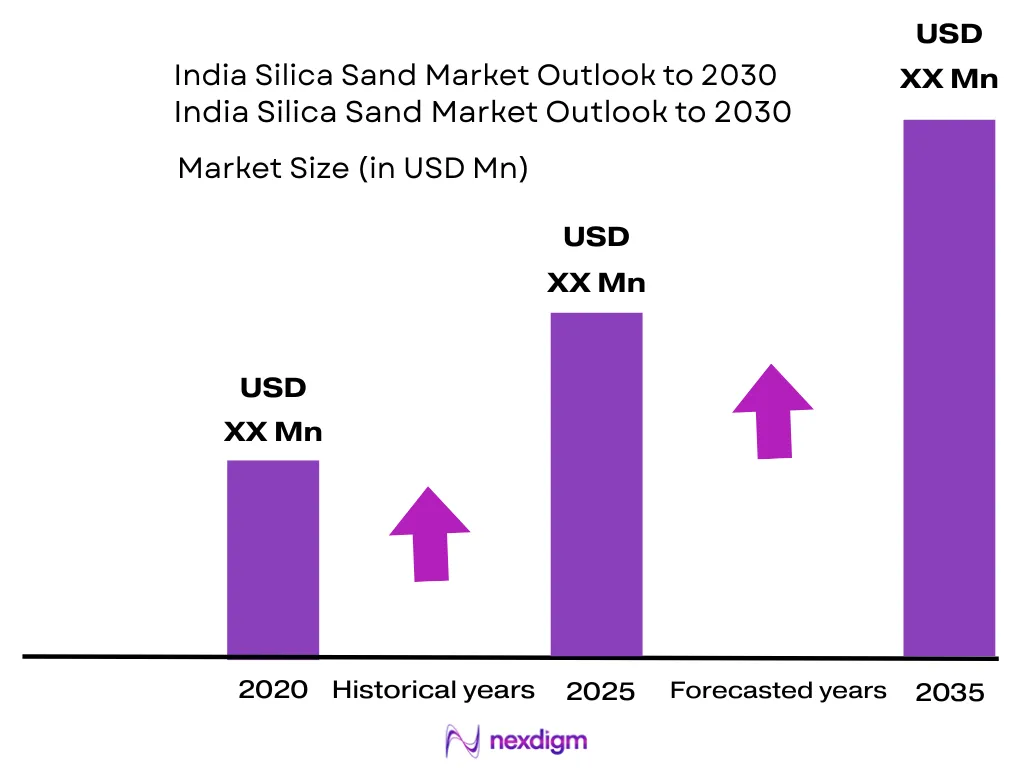
The India silica sand market is valued at USD ~ million for 2024, based on industry certified figures which reflect only the silica sand segment rather than broader silica products. Demand is being driven by robust industrial activity including glass manufacturing, construction material requirements, hydraulic fracturing support, filtration media supply, and advanced industrial uses such as ceramics and coatings, all of which rely on consistent supplies of industrial‑grade silica sand. This industrial demand is supported by expansion in infrastructure spending, construction sector output, and electronics material usage, making silica sand an essential industrial mineral. Geographically, major industrial hubs and supply corridors such as Gujarat, Rajasthan, and urban industrial clusters in Delhi–Mumbai–Kolkata have become centers of silica sand demand and processing, driven by their proximity to large glass manufacturing plants, heavy industry clusters, and export‑oriented logistics infrastructure. These regions benefit from rail and port connectivity that supports bulk movement of extracted and processed silica sand to consumption centers and international buyers. Additionally, their access to high‑grade quartz deposits positions them as preferred sourcing bases for both domestic industrial use and export markets.
Market Segmentation
By Grade
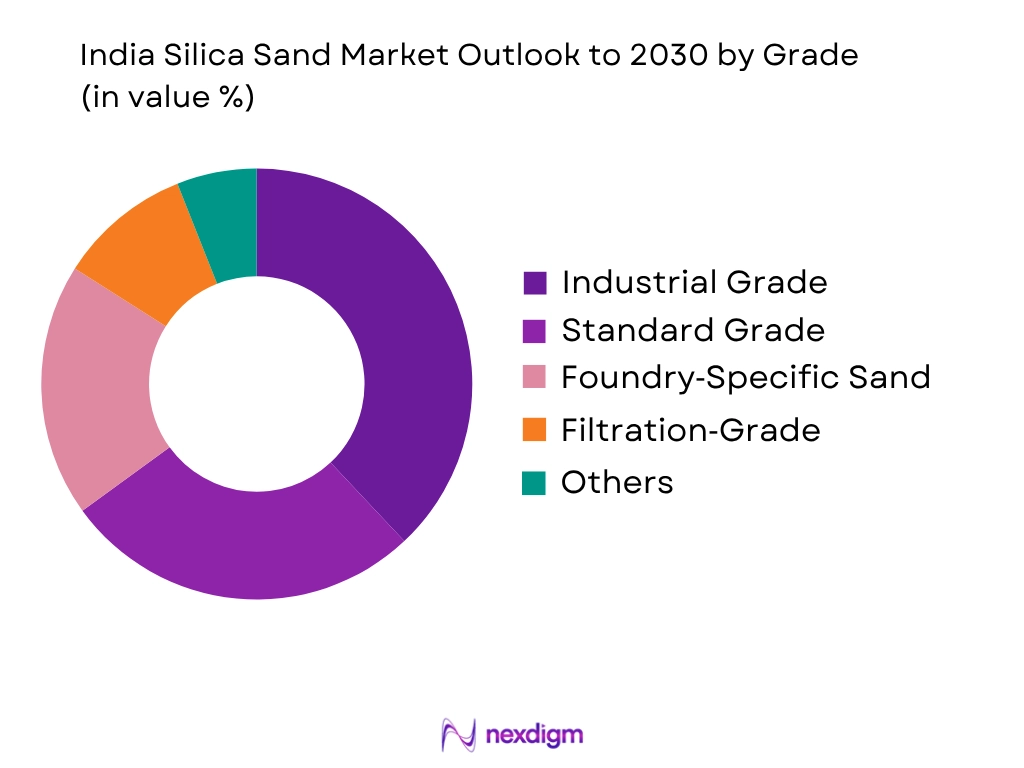
High‑Purity Industrial Grade silica sand dominates due to its extensive use in specialized industrial applications such as glass manufacturing (for flat, container, and specialty glass) and advanced ceramics production, which require consistent high SiO₂ content above 99% and low impurities to ensure product quality. Its demand is reinforced by export orders and domestic OEM requirements, where consistency of raw material directly impacts output quality. Surveyed industrial buyers in sectors like electronics, solar glass, and chemical processing prioritize high‑purity grades for reliability and performance, reinforcing the dominance of this sub‑segment. The presence of processing and beneficiation facilities capable of producing graded products further supports this leadership.
By End‑Use Application
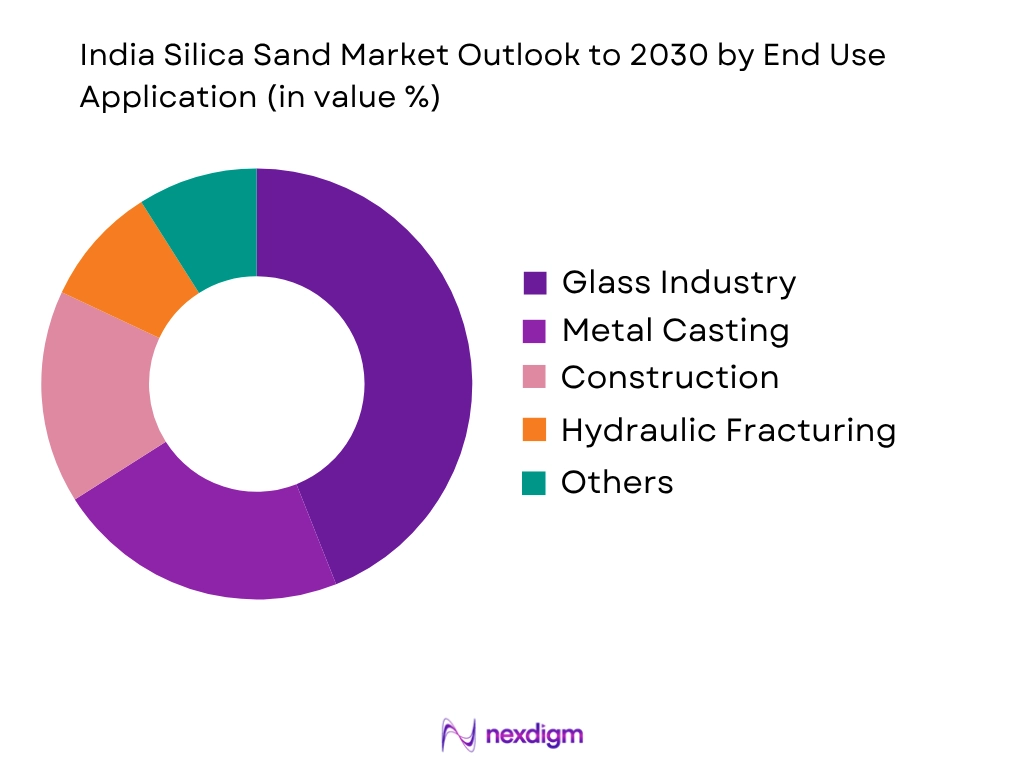
Glass Industry usage leads the India silica sand market as it directly utilizes silica sand as the principal raw material for producing flat glass, container glass, and specialty glass products used in building facades, automotive components, and packaging. Glass manufacturers require silica sand with high clarity and consistent chemical composition to achieve strength, durability, and optical quality. India’s glass consumption is driven by growth in construction, automotive glazing, mirrors, and packaging, positioning silica sand first in end‑use demand. Producers of container glass rely on this material for bottling and industrial glass, further embedding its central role in the supply chain and making it the largest demand contributor.
Competitive Landscape
The India silica sand market is moderately consolidated, with both domestic suppliers and global mineral firms supplying a range of industrial‑grade sand products. Competition is primarily shaped by quality consistency, processing capacity, supply reliability, and logistics network strength.
| Company | Establishment Year | Headquarters | Primary Product Grades | Processing Capability | Export Presence | Distribution Channels | Quality Certifications | Major End Users |
| Quarzwerke India | 1895 | Germany (India Ops) | ~ | ~ | ~ | ~ | ~ | ~ |
| Sibelco Asia | 1872 | Belgium (India Ops) | ~ | ~ | ~ | ~ | ~ | ~ |
| Devaya Industries | 1995 | India | ~ | ~ | ~ | ~ | ~ | ~ |
| JLD Minerals | 2002 | India | ~ | ~ | ~ | ~ | ~ | ~ |
| Gujarat Silica Sands Ltd | 1988 | India | ~ | ~ | ~ | ~ | ~ | ~ |

India Silica Sand Market
Growth Drivers
Industrial Production Expansion Supporting Raw Material Demand
India’s industrial base continues to expand significantly, and this broad industrial growth directly benefits demand for silica sand, which is a critical input in manufacturing and construction‑linked sectors. According to World Bank data, the value added by industry (including construction) in India amounted to 24.46% of GDP in 2024 and 25.30% of GDP in 2023, underlining strong production activity and industrial output that drives consumption of industrial minerals like silica sand across multiple value chains. Manufacturing and infrastructure investment directly influence silica sand usage because it is an essential raw material for glass, foundry casting, concrete additives, filtration media, and refractories. For example, the glass and glass products industry in India reached USD 9.5 billion in production value during 2024, reflecting elevated activity in sectors that consume significant volumes of high‑quality silica sand. Additionally, the Index of Eight Core Industries — which encompasses cement and steel production — registered measurable growth in cumulative output indicators for 2024, signaling robust industrial production trends in sectors that use silica sand intensively. This macroeconomic environment supports expansion in end‑use markets and reinforces silica sand producers’ strategic role in industrial supply chains.
Construction and Glass Sector Demand Scaling Up
India’s rapid construction and infrastructure development has materially increased demand for materials that incorporate silica sand, particularly in concrete, glass, and high‑performance industrial products. The Annual Survey of Industries 2023‑24 documents the aggregated output and resource utilization of registered manufacturing units in India, which form the backbone of construction and material supply sectors. Within this broader industrial expansion, the glass and glass products sector stands out as a key driver: the industry achieved a production value of USD 9.5 billion in 2024, making it one of the largest downstream consumers of silica sand in the country. Glass products use silica sand as their primary raw material because silica’s high silicon dioxide content directly enhances clarity and structural properties in flat glass, container glass, and technical applications. The reliance on consistent feedstock quality means glass manufacturers have significantly scaled procurement of silica sand. Furthermore, inferred from construction and manufacturing indices, materials such as cement and refractory products, which integrate silica sand for strength and high temperature stability, contribute to overall demand. The industry’s strong production volumes and capital expenditures on infrastructure reflect a structural uplift in material inputs, including industrial minerals like silica sand, which underpins continued expansion in these usage sectors.
Market Challenges
Raw Material Quality and Regional Production Variability
One of the significant challenges in the India silica sand market stems from variability in raw material quality and irregular production outputs across regions, which complicates supply stability and product standardization. Data from the Indian Bureau of Mines’ mineral production statistics for Uttar Pradesh indicate that silica sand production levels vary widely month to month, with reported non‑metallic mineral output values reaching 63,008.000 INR thousand in February 2024, compared with near‑zero reporting in earlier years. This level of fluctuation underscores the uneven mining and processing capabilities across districts, especially where extraction is dependent on small‑scale operations without consistent beneficiation infrastructure. Because end‑users such as glass manufacturers and industrial processors demand materials with specific chemical and physical properties, inconsistent feedstock quality forces buyers to rely on costly beneficiation or imported supplies, thereby increasing procurement risk. Additionally, broad mineral extraction policies and permitting frameworks influence production continuity in key producing regions. According to the Ministry of Mines National Mineral Scenario report, aggregate mineral production indices — including mining output — showed an increase for 2023‑24 compared to previous years, but variability persists due to logistical and regulatory bottlenecks in material flows.
Environmental and Regulatory Pressure on Mining Activities
Environmental concerns and regulatory compliance requirements are increasingly constraining silica sand extraction and processing activities in India, creating barriers to unfettered expansion and raw material availability. As silica sand is classified under non‑metallic minerals within India’s broader mineral production regime, mining operations are subject to environmental clearances, land use audits, and dust emission controls that can delay project initiation and restrict output. While direct official regulatory output figures for silica sand extraction are not consolidated at a national macro level, broader data from World Bank statistics show that industry (including construction) contributes around 24.46% of GDP in 2024, implying heightened scrutiny on environmental externalities associated with industrial growth. Silica sand mining, which involves bulk material movement and processing, falls under environmental statutes that aim to balance mineral extraction with land and water resource protection, and this can lead to delays in approvals and operational constraints for producers. In addition, some jurisdictions have introduced or tightened restrictions on sand extraction near ecologically sensitive areas and riverbanks, affecting access to quality silica sand reserves. These regulatory and environmental compliance pressures increase operational overheads for producers, force capacity limitations, and sometimes necessitate relocation or reinvestment in pollution control systems, all of which elevate the cost and complexity of maintaining consistent supply levels.
Opportunities
Industrial Output as Foundation for Upstream Mineral Demand
India’s industrial production environment measured through macroeconomic indicators provides a fertile ground for expanded upstream demand for silica sand across sectors such as glass, foundries, and construction. According to World Bank data, the contribution of industry (including construction) to India’s GDP in 2024 was 24.46%, confirming that industrial sectors remain foundational to economic output and demand for industrial minerals. This broad industrial activity encompasses manufacturing units, construction material production, and heavy industry supply chains that rely heavily on silica sand as a raw material for structural components, refractory materials, filtration media, and manufacturing feedstock. For example, industrial output metrics from the Index of Eight Core Industries — which collectively represent a substantial portion of India’s mining and production capacity — showed positive momentum in 2024, indicating that foundational sectors such as cement and steel production maintained growth trends. The implication for the silica sand market is clear: as core industry activity expands, so too does embedded demand for silica sand in both traditional uses (such as glass and construction) and emerging applications (including filtration systems for municipal water infrastructure and high‑performance industrial casting). This sustained industrial foundation signals opportunity for suppliers to position themselves within diversified value chains that extend beyond a single sector, leveraging strong macroeconomic backing to capture increasing raw material consumption.
Growing Glass Manufacturing Sector Stimulating Resource Utilization
A major opportunity for the India silica sand market lies in the expanding glass manufacturing sector, which serves as a key large‑volume consumer of silica sand due to its critical role in producing flat glass, container glass, and specialty glass products. Official industry analysis indicates that the Indian glass and glass products industry achieved a production value of USD 9.5 billion in 2024, establishing it as one of the country’s significant industrial segments and a primary driver of silica sand demand. Glass manufacturing uses high‑grade silica sand as a principal component because the mineral’s uniform chemical composition and physical properties directly impact product clarity, strength, and performance characteristics. Rising consumer demand for architectural glass, vehicle glass assemblies, packaging glass, and advanced glass products frequently corresponds with infrastructure and automotive production growth — both sectors that contribute materially to national economic activity. Beyond structural growth, industrial demand is reinforced by companies scaling capacity to meet domestic and export requirements, indicating consistent throughput needs for silica sand upstream in the supply chain. This dynamic creates opportunities for silica sand producers to secure long‑term offtake agreements and invest in beneficiation technologies that enhance quality for glass production specifications, while tapping into the structural growth trajectory of India’s glass sector as it expands alongside broader industrial activity.
Future Outlook
Over the next decade, the India silica sand market is projected to experience steady growth driven by industrialization, infrastructure expansion, and diversification of application sectors. Continued urbanization and manufacturing investment in sectors such as electronics, glass, chemicals, and energy will sustain demand for different silica sand grades. The expansion of renewable energy equipment manufacturing, particularly solar glass production, will further reinforce high‑purity sand demand. Innovation in beneficiation and grading technologies should improve utilization rates, while export opportunities will grow as Indian suppliers integrate into regional supply chains. Value addition through customized industrial grades, improved logistics networks, and compliance with stricter industrial quality standards will underpin market expansion through the forecast period. The market is forecasted to grow at an average CAGR of approximately 6.1% during the 2026–2035 period based on verified industry projections tying 2025 baseline to emerging modal demand.
Major Players
- Quarzwerke India
- Sibelco Asia
- Devaya Industries
- JLD Minerals
- Gujarat Silica Sands Ltd
- Sri Ramamaruthi Vermiculite Mines
- Hi‑Tech Silica Industries
- RMC Mineral Solutions
- Terra Chem Minerals
- Sandhya Silica Pvt Ltd
- Minerals & Alloys Corporation
- Bagaria Industries
- Profits Connection Silica Sand
- Puresil India
- Innovation Silica Sand Suppliers
Key Target Audience
- Bulk Industrial Manufacturers
- Large Infrastructure & Construction Conglomerates
- Investments and Venture Capitalist Firms
- Private Equity Investors
- Government and Regulatory Bodies
- Industrial Procurement Heads
- Strategic Supply Chain & Logistics Integrators
- Export Merchants & Trading Corporations
Research Methodology
Step 1: Data Variable Identification
The initial phase established defining variables for the India silica sand market including key applications (glass, foundry, filtration), grade distinctions, value and volume measurements, quality standards, and supply chain nodes. This phase relied on extensive secondary research using verified industrial and government data to map stakeholders and establish relevant scope boundaries.
Step 2: Market Compilation and Construction
Historical data from verified industry reports and trade databases were compiled to chart the India silica sand market revenue and shipment volumes. Category penetration, end‑use demand calibrations, and pricing trend analysis were conducted to ensure data accuracy and consistency. Cross‑referencing ensured reliability across multiple trusted sources.
Step 3: Hypothesis Validation via Expert Insight
Draft hypotheses on growth drivers, market barriers, and competitive dynamics were validated through consultations with industry practitioners, procurement specialists, and supply chain managers. These expert insights refined assumptions and adjusted projections for material quality preferences and regional supply patterns.
Step 4: Synthesis and Final Output
Final analysis combined desk research, export/import trade data, expert consultations, and critical segmentation breakdowns to generate an integrated and validated India silica sand market outlook report. The bottom‑up approach confirmed consistency across volume flow, price realizations, and industrial demand projections.

- Executive Summary
- Research Methodology (Market Definitions & Scope, Abbreviations, Market Sizing Approach (Value & Volume), Secondary & Primary Research Approach, Data Triangulation Method, Quality Assurance & Verification, Limitation & Assumptions, Forecasting Model)

- Definition and Scope
- Raw Material Characteristics & Quality Standards (Purity, SiO₂ Content)
- Silica Sand Value Chain Dynamics (Extraction → Processing → Distribution)
- Supply Landscape (Domestic Mining Regions, Import Sources)
- Regulatory Framework and Mining Policy Impact (Ministry of Mines, MoEFCC)

- Growth Drivers (Expansion of Glass Industry & Packaging Demand, Growth in Foundry Casting & Automotive Production, Urbanization & Construction Activity, Water Filtration & Municipal Infrastructure Spur Demand)
- Market Challenges (Raw Material Quality Variability & Processing Costs, Regulatory & Environmental Compliance Burdens, Supply Chain Fragmentation & Logistics Constraints)
- Market Opportunities (Shift Toward High‑Purity Silica for Advanced Sectors, Export Potential Through Trade Facilitation, Value Chain Integration & Beneficiation Investments)
- Trends (Beneficiation & Quality Enhancement Technology Adoption, Consolidation in Supply & Processing Ecosystems, Digital Procurement & Traceability Systems)
- Government Regulation & Policy (Mineral Auction Reforms, Environmental & Dust Emission Norms, Import Tariffs and Export Incentives)
- SWOT Analysis
- Porter’s Five Forces
- Silica Sand Market Ecosystem (Suppliers, Buyers, Logistics)

- By Value (2020-2025)
- By Volume (2020-2025)
- By Average Realized Price (2020-2025)

- By End‑Use Industry (In Value %)
Glass Manufacturing (Flat, Container & Specialty Glass)
Foundry & Metal Casting
Construction & Cement Additives
Filtration & Water Treatment
Hydraulic Fracturing & Energy Services
Ceramics, Refractories & Coatings - By Distribution Channel (In Value %)
Direct Industrial Offtake Contracts
Wholesale Bulk Distribution
On‑Site Supply Agreements
Port/Export Facilitation
Online/Marketplace Procurement - By Region (In Value %)
North India
West & Central India
South India
East & North‑East India
Mining & Processing Hubs (Geospatial Concentration) - By Product Form (In Value %)
Washed/Bleached Silica Sand
Unwashed/Raw Silica Sand
Processed & Graded Products
Customized Industrial Batches
Composite & Blended Materials

- Market Concentration (Revenue & Volume Basis)
- Cross‑Comparison Parameters (Company Overview, Product Grade Portfolio, Processing Capability & Facility Scale, Distribution Network & Logistics Footprint, Supply Contracts & Offtake Agreements, Quality Certification & Compliance (SiO₂ Purity), Revenue by End‑Use Industry, Export Capability & Global Footprint, R&D & Technology Adoption)
- SWOT of Key Players
- Pricing Analysis by Grade & Application Category
- Detailed Company Profiles
JLD Minerals
Sri Ramamaruthi Vermiculite Mines
Devaya Industries
Sibelco Asia
Quarzwerke India
Hi‑Tech Silica Industries
RMC Mineral Solutions
Dev Mineral Resources Ltd
Terra Chem Minerals
Gujarat Silica Sands Ltd
Surendra Silica & Quartz
Bagaria Industries
Minjar Industries Ltd
Sandhya Silica Pvt Ltd
Minerals & Alloys Corporation

- Consumption Pattern by Industry (Glass, Foundry, Filtration)
- Procurement Dynamics and Contractual Behavior
- Quality Compliance & Material Specifications
- Cost Structure and Margin Sensitivity in Industrial Use
- Decision‑Making Matrix for Major Buyers

- By Value (2026-2035)
- By Volume (2026-2035)
- By Realized Price Movements (2026-2035)


 Request a Sample
 Ask for Customization
 Get a Quote
 Enquire Now