
 Download PDF
Market Overview
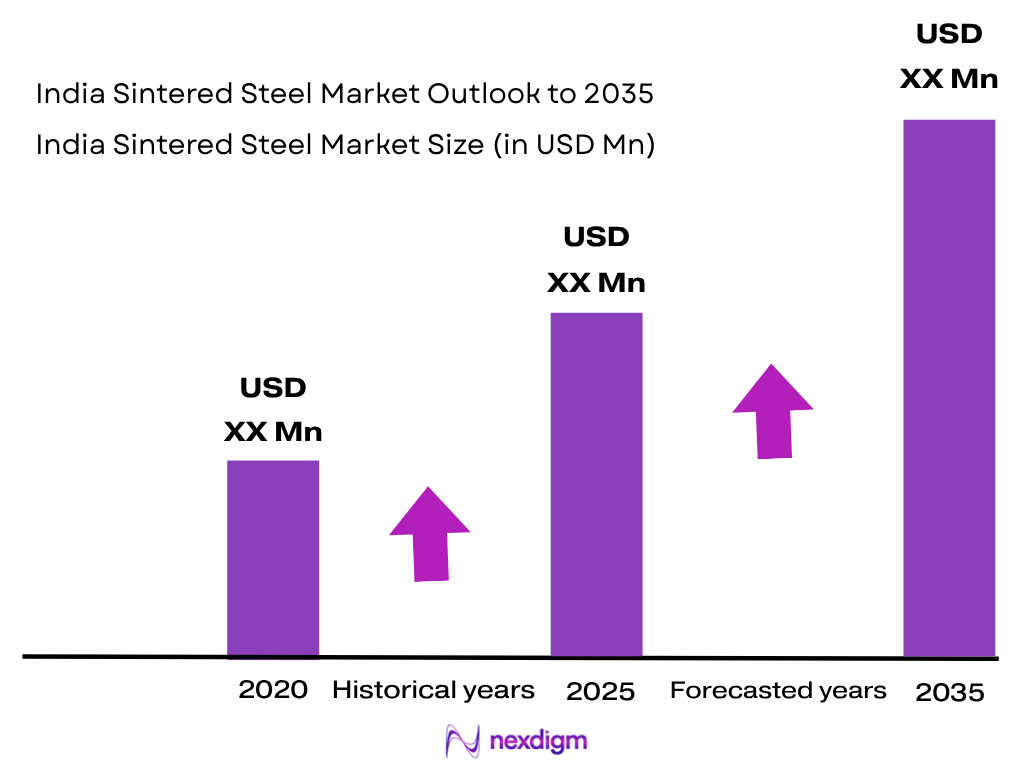
The India Sintered Steel Market is supported by the country’s expanding automotive, engineering, electrical equipment, appliance and industrial machinery manufacturing base. The market size is represented by USD XX billion, with the forecast CAGR placeholder of XX% for the forecast period. India’s broader industrial sector accounted for 24.6% of GDP, according to World Bank data, providing a substantial downstream manufacturing base for powder-metallurgy components. Automotive production reached 284,390,366 units in FY2023-24 and increased to 310,364,174 units in FY2024-25, according to SIAM. These manufacturing volumes support demand for gears, bushings, bearings, rotors, structural components and other precision sintered parts.
The India Sintered Steel Market is concentrated around major automotive and engineering manufacturing clusters including Maharashtra, Tamil Nadu, Gujarat, Karnataka, Haryana and the Delhi-NCR region. These locations benefit from established OEM networks, Tier-1 and Tier-2 component suppliers, metal-processing capabilities and developed logistics infrastructure. India’s finished-steel production reached 139.153 million tonnes during FY2023-24, while consumption reached 136.291 million tonnes, demonstrating the scale of the domestic metal-processing ecosystem. Automotive manufacturing provides an additional downstream base, with 50,61,164 passenger vehicles and 238,83,857 two-wheelers produced during FY2024-25.
Market Segmentation
By Product Type
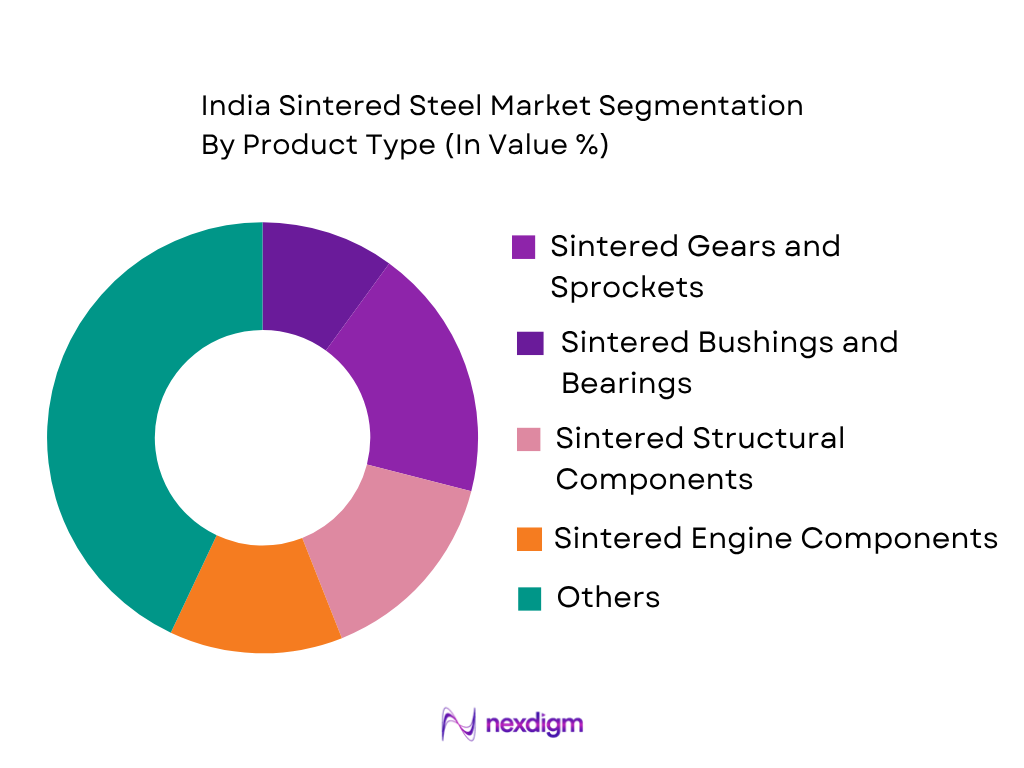
The India Sintered Steel Market is segmented by product type into structural sintered steel components, sintered gears and sprockets, sintered bushings and bearings, engine components, transmission components, chassis and suspension components, electrical and magnetic components, compressor components, power-tool components and other precision sintered steel components. Sintered gears and sprockets are positioned as the leading sub-segment because automotive and two-wheeler manufacturers require high-volume production of geometrically complex components with consistent dimensions and controlled material utilization. India’s automotive industry produced 310,364,174 vehicles during FY2024-25, including 238,838,357 two-wheelers, creating a substantial downstream requirement for precision components. Sintered gears can be manufactured with repeatable dimensional characteristics and integrated design features, making them relevant to transmissions, actuators and powertrain systems. Bushings, bearings and structural components also benefit from powder-metallurgy processing, but gears and sprockets have a particularly broad application base across passenger vehicles, commercial vehicles, motorcycles and industrial machinery.
By End-Use Industry
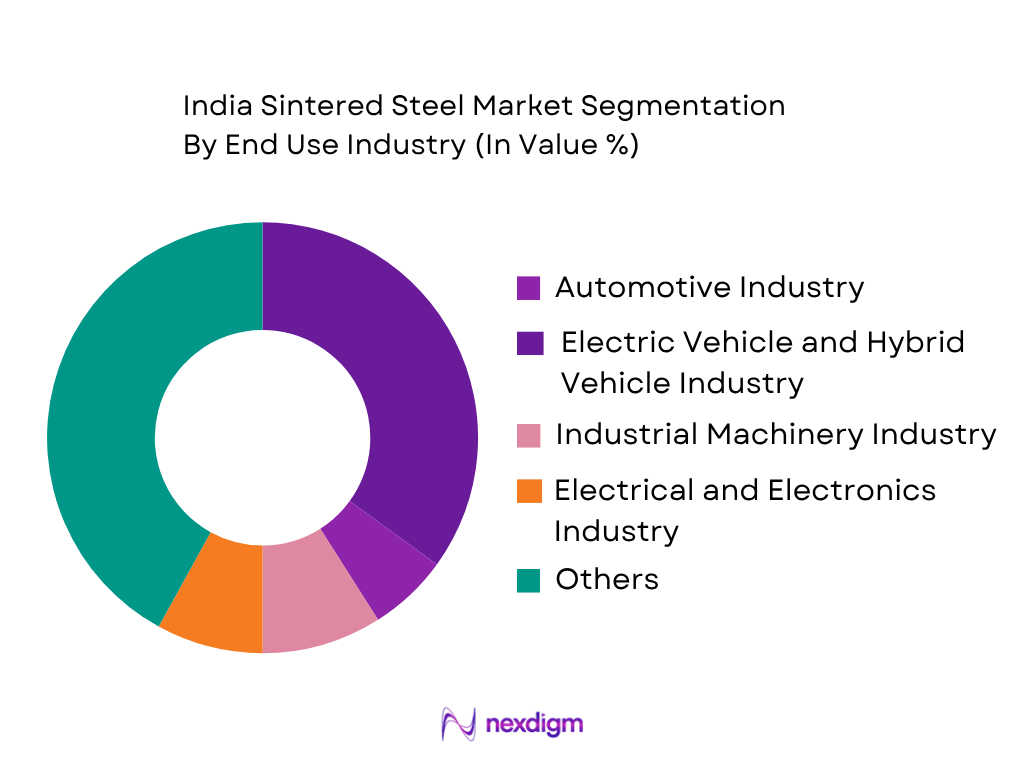
The India Sintered Steel Market is segmented by end-use industry into automotive, two-wheeler, electric vehicle and hybrid vehicle, electrical and electronics, home appliance, industrial machinery, HVAC and refrigeration, power tools, agricultural machinery and precision engineering. The automotive industry represents the leading application segment because India’s large vehicle manufacturing ecosystem creates recurring demand for engineered metal components across engines, transmissions, braking systems, steering systems and auxiliary mechanisms. SIAM recorded 310,364,174 total vehicle units produced during FY2024-25, including 50,611,64 passenger vehicles, 10,349,47 commercial vehicles, 10,500,20 three-wheelers and 238,838,57 two-wheelers. The country’s steel ecosystem further supports component manufacturing, with 144.299 million tonnes of crude steel produced during FY2023-24. Electrification is adding another application pathway through motors, actuators and other precision components. The breadth of India’s automotive supplier network therefore provides sintered steel manufacturers with opportunities across conventional and electrified platforms.
Competitive Landscape
The India Sintered Steel Market includes global powder-metallurgy specialists, automotive component manufacturers and companies serving precision-engineering applications. Competitive differentiation is based on powder metallurgy process capability, component complexity, automotive qualification, production capacity, tooling capabilities, material portfolio and relationships with OEM and Tier-1 customers. The large Indian automotive manufacturing ecosystem provides an important customer base, while India’s developing EV ecosystem is creating additional requirements for motor, actuator and other precision components. SIAM recorded 43,01,848 passenger-vehicle domestic sales and 1,96,07,332 two-wheeler domestic sales during FY2024-25, reinforcing the scale of potential component demand.
| Company | Establishment Year | Headquarters | Product Portfolio | Automotive Applications | Manufacturing Capability | Powder Metallurgy Capability | Major End-Use | India Presence |
| GKN Powder Metallurgy | 1759 | Birmingham, UK | ~ | ~ | ~ | ~ | ~ | ~ |
| Höganäs | 1797 | Höganäs, Sweden | ~ | ~ | ~ | ~ | ~ | ~ |
| Sumitomo Electric Sintered Alloy | 1917 | Osaka, Japan | ~ | ~ | ~ | ~ | ~ | ~ |
| Miba | 1927 | Laakirchen, Austria | ~ | ~ | ~ | ~ | ~ | ~ |
| Sintercom India | 2008 | Pune, India | ~ | ~ | ~ | ~ | ~ | ~ |
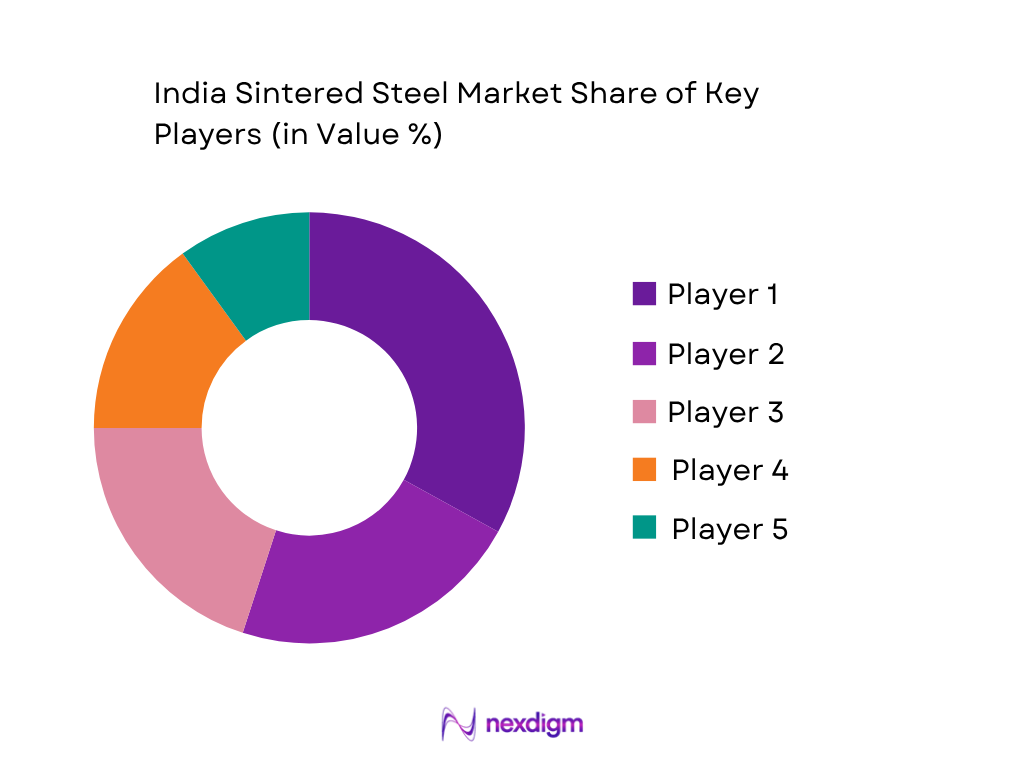
India Sintered Steel Market Analysis
Growth Drivers
Expansion of Automotive Production
Expansion of automotive production is strengthening the addressable demand base for sintered steel components because powder-metallurgy parts are widely applicable to gears, sprockets, bushings, rotors, structural components and other precision-engineered automotive parts. India’s automobile industry produced 31,036,476 vehicles in FY2024-25, compared with 28,439,036 vehicles in FY2023-24, according to the Society of Indian Automobile Manufacturers. Two-wheeler production reached 23,883,857 units, while passenger-vehicle production reached 5,061,164 units during FY2024-25. The broader manufacturing environment also supports component localization: the World Bank reported that Indian manufacturing grew by 9.9 in FY2023-24, while overall real GDP growth reached 8.2. IMF data subsequently indicated real GDP growth of 6.5 for FY2024-25, maintaining a strong macroeconomic environment for industrial production. India’s motor-vehicle-parts exports were valued at approximately US$7.41 billion in 2024, with exported quantities reaching 1.34 billion kg, according to World Bank WITS data. This combination of high vehicle output, expanding component manufacturing and substantial automotive-parts trade supports continued utilization of material-efficient powder-metallurgy technologies. Increasing production volumes also provide manufacturers with opportunities to replace machining-intensive components with near-net-shape sintered parts where dimensional consistency, material utilization and repeatable high-volume production are technically suitable.
Growth of Two-Wheeler Manufacturing
Growth in two-wheeler manufacturing provides a significant downstream driver for India’s sintered steel market because motorcycles and scooters incorporate numerous compact, repeatable metal components suitable for powder-metallurgy production, including gears, sprockets, bushings, hubs, rotors and structural parts. SIAM records 23,883,857 two-wheelers produced in FY2024-25, compared with 21,468,527 units in FY2023-24, while domestic two-wheeler sales increased from 17,970,304 units to 19,543,965 units over the same period. This production scale creates recurring requirements for high-volume precision components where material efficiency and dimensional repeatability are important manufacturing considerations. The macroeconomic backdrop is also supportive: the World Bank reported Indian real GDP growth of 8.2 in FY2023-24 and identified manufacturing growth of 9.9 as an important contributor. IMF data recorded real GDP growth of 6.5 for FY2024-25, indicating continued economic expansion despite moderation. India also exported US$7.41 billion of motor-vehicle parts and accessories in 2024, covering 1.34 billion kg, demonstrating the scale of the domestic automotive-component production ecosystem. As two-wheeler manufacturers and suppliers increase localization, sintered-steel producers can address applications requiring consistent geometry, controlled density and repeatable production.
Market Challenges
Volatility in Metal Powder Inputs
Volatility in metal powder inputs presents a challenge for Indian sintered-steel manufacturers because powder metallurgy depends on consistent availability and specification of iron, alloying elements and other metallic inputs. Changes in international commodity conditions can affect procurement planning, inventory requirements and component manufacturing economics, particularly when specialized powders are imported or exposed to global supply-chain disruptions. The World Bank’s commodity framework continues to track substantial movements across metals and raw materials, while India’s merchandise-trade exposure adds another layer of sensitivity. World Bank WITS data shows India exported US$7.41 billion of motor-vehicle parts and accessories in 2024, with exports weighing 1.34 billion kg, demonstrating the close integration between domestic component production and international markets. At the macroeconomic level, IMF data records Indian consumer-price inflation at 4.8 in FY2024-25, following 5.4 in FY2023-24, while real GDP growth remained at 6.5 in FY2024-25. These conditions indicate that manufacturers continue operating in an environment where input availability and broader cost pressures must be managed alongside industrial expansion. For sintered-steel producers, powder specifications cannot easily be changed without validating density, dimensional performance and mechanical characteristics. Consequently, fluctuations in raw-material availability can create qualification, inventory and production-planning challenges, particularly for automotive components requiring stable metallurgical properties.
High Tooling and Press Investment Requirements
High tooling and press investment requirements can constrain the expansion of sintered-steel manufacturing because the process depends on specialized powder-compaction presses, precision tooling, sintering furnaces, controlled-atmosphere systems and post-processing equipment. The capital intensity becomes particularly relevant when manufacturers develop new component geometries requiring dedicated dies and process validation. India’s industrial environment provides a substantial manufacturing base, but companies must allocate investment carefully across competing production technologies. The World Bank reported that manufacturing growth reached 9.9 in FY2023-24, while overall Indian real GDP growth reached 8.2, demonstrating strong industrial activity but also increasing the need for productive manufacturing capacity. IMF data places real GDP growth at 6.5 in FY2024-25, with gross investment at 33.6 of GDP in its macroeconomic framework. Although investment supports industrial modernization, individual sintered-steel producers still face the challenge of recovering specialized equipment and tooling investments through sufficient production volumes. Automotive customers can also require rigorous validation before approving a new powder-metal component for production. India’s vehicle industry produced 31,036,476 vehicles in FY2024-25, creating substantial potential demand, but suppliers must achieve adequate scale and utilization to justify dedicated tooling and press capacity.
Market Opportunities
EV Motor and Powertrain Components
EV motor and powertrain components represent an opportunity for India’s sintered-steel market because electric drivetrains require compact, precise and increasingly lightweight components, while localized EV manufacturing can create additional demand for powder-metallurgy technologies. India produced 31,036,476 vehicles in FY2024-25, including 23,883,857 two-wheelers, providing a large manufacturing base from which electrified powertrain applications can develop. SIAM’s data also records 1,050,020 three-wheelers produced during the same period, an important vehicle category for electrification in India. The World Bank reported that Indian manufacturing grew by 9.9 in FY2023-24 and specifically identified electronics and green-technology products as areas with potential for export diversification. World Bank WITS data records US$39.44 billion of Indian exports under HS Chapter 85, covering electrical machinery and electronic equipment, during 2024. This broader electrical-manufacturing ecosystem creates opportunities for suppliers developing soft-magnetic and precision powder-metal components for electric motors, actuators and power-electronic systems. IMF data indicates real GDP growth of 6.5 in FY2024-25, supporting continued expansion of industrial demand. For sintered-steel producers, the opportunity is therefore linked to engineering components around electrified mobility rather than simply conventional engine parts, particularly where controlled magnetic properties, dimensional accuracy, complex geometries and high-volume manufacturing are required.
Advanced Powder Metallurgy Materials
Advanced powder-metallurgy materials represent an opportunity as Indian manufacturers move toward higher-performance automotive, industrial, aerospace and precision-engineering components that require improved strength, wear resistance, dimensional stability or magnetic performance. The underlying manufacturing environment is substantial: India’s vehicle production reached 31,036,476 units in FY2024-25, while motor-vehicle-parts exports reached US$7.41 billion and 1.34 billion kg in 2024, according to World Bank WITS. These figures demonstrate the depth of the component ecosystem into which advanced powder-metal technologies can be integrated. The World Bank reported manufacturing growth of 9.9 in FY2023-24 and highlighted electronics and green technology as potential areas for export diversification. India also exported US$39.44 billion of electrical machinery and electronic equipment under HS Chapter 85 in 2024, indicating a sizeable downstream industrial base for components requiring specialized material characteristics. IMF data recorded real GDP growth of 6.5 in FY2024-25, while gross investment was recorded at 33.6 of GDP in the same period. These conditions create an environment for investment in higher-performance materials, improved sintering controls and advanced process technologies. The opportunity is particularly relevant for components where conventional machining generates substantial material waste or cannot economically produce the required geometry at high production volumes.
Future Outlook
The India Sintered Steel Market is expected to benefit from continued expansion of automotive manufacturing, localization of engineered components, industrial automation and electrification. The domestic automotive industry produced more than 310 million vehicles during FY2024-25, while electric two-wheeler sales reached 1,149,334 units during the same period. The development of EV manufacturing is creating additional opportunities for powder-based components used in motors, actuators and other systems. India’s large steel-processing ecosystem and expanding manufacturing base should continue supporting demand for precision, lightweight and material-efficient component technologies.
Major Players
- GKN Powder Metallurgy
- Höganäs AB
- Sumitomo Electric Sintered Alloy
- Miba AG
- Sintercom India Limited
- Fine Sinter Co., Ltd.
- Porite India
- Mahindra CIE Automotive
- Munjal Auto Industries
- DENSO India
- Schaeffler India
- BorgWarner India
- ZF India
- Miba Sintered Components
- Tata AutoComp Systems
Key Target Audience
- Automotive OEMs and Tier-1 Component Manufacturers
- Two-Wheeler and Powertrain Component Manufacturers
- Electric Vehicle and Electric Motor Component Manufacturers
- Industrial Machinery and Precision Engineering Companies
- Investments and Venture Capitalist Firms
- Government and Regulatory Bodies (Ministry of Heavy Industries, Ministry of Steel, Department for Promotion of Industry and Internal Trade)
- Metal Powder and Powder Metallurgy Equipment Suppliers
- Electrical, Appliance and HVAC Component Manufacturers
Research Methodology
Step 1: Identification of Key Variables
The initial phase involves mapping the India Sintered Steel Market ecosystem across powder suppliers, tooling providers, compaction equipment manufacturers, sintered-component producers and downstream OEMs. Key variables include component production, powder consumption, manufacturing processes, end-use applications and regional production clusters. Secondary information is validated against government, industry and company disclosures.
Step 2: Market Analysis and Construction
Historical market information is compiled through a combination of top-down and bottom-up approaches covering automotive production, industrial manufacturing, metal consumption and powder-metallurgy applications. Component-level demand is assessed across gears, bushings, bearings, structural parts, transmission components and magnetic components. Supply-side capacity and manufacturing footprints are incorporated to construct the market baseline.
Step 3: Hypothesis Validation and Expert Consultation
Market hypotheses are developed around component adoption, material utilization, manufacturing technology and end-use demand. These hypotheses are validated through discussions with industry participants covering powder metallurgy manufacturers, automotive suppliers, component buyers and engineering specialists. Operational insights are used to validate production assumptions, application mapping and technology adoption.
Step 4: Research Synthesis and Final Output
The final stage integrates demand-side and supply-side findings into a consolidated India Sintered Steel Market assessment. Component-level findings are cross-checked against automotive production, industrial activity, steel production and company-level manufacturing information. Data triangulation is then applied to establish consistent market estimates, segmentation structures and the long-term outlook.

- Executive Summary
- Research Methodology (Market Definition and Scope, India Sintered Steel Market Classification, Powder Metallurgy Process Mapping, Metal Powder Assessment, Compaction Technology Analysis, Sintering Technology Evaluation, Secondary Operations Assessment, Material Qualification Framework, Demand-Side Assessment, Supply-Side Assessment, Top-Down Market Sizing, Bottom-Up Market Sizing, Primary Industry Interviews, End-Use Industry Validation, Data Triangulation, Forecasting Framework, Research Limitations)

- Definition and Scope
- India Sintered Steel Industry Evolution
- Sintered Steel Value Chain Analysis
- Sintered Steel Supply Chain Analysis

- Growth Drivers (Expansion of Automotive Production, Increasing Powder Metal Content in Vehicle Components, Growth of Two-Wheeler Manufacturing, Electric Vehicle Component Localization, Expansion of Industrial Machinery Production, Increasing Manufacturing Automation, Demand for Material-Efficient Production, Growth of Precision Engineering, Expansion of Domestic Component Manufacturing)
- Market Challenges (Volatility in Metal Powder Inputs, High Tooling and Press Investment Requirements, Energy Requirements for Sintering, Powder Quality Qualification, Manufacturing Yield Management, Competition from Machining and Forging, Specialized Technical Expertise Requirements, Dependence on Advanced Equipment, Component Design Limitations, Qualification Requirements for Safety-Critical Components)
- Market Opportunities (EV Motor and Powertrain Components, Advanced Powder Metallurgy Materials, High-Performance Automotive Components, Aerospace Powder Metal Applications, Medical Components, Industrial Automation Components, Soft Magnetic Components, Material-Efficient Manufacturing, Advanced Sintering Technologies, Powder-Based Additive Manufacturing)
- Market Trends (Automotive Lightweighting, Increased Powder Metal Content, EV Component Development, Advanced Alloy Powder Adoption, Automated Compaction, Energy-Efficient Sintering, Near-Net-Shape Manufacturing, Precision Component Miniaturization, Soft Magnetic Material Development, Digital Process Monitoring)
- Government Regulations and Standards (Ministry of Heavy Industries Automotive Manufacturing Initiatives, Make in India Manufacturing Programs, Production Linked Incentive Schemes, Bureau of Indian Standards Requirements, Automotive Industry Standards, Quality Control Orders, Environmental Compliance Requirements, Factory Safety Regulations, Import Standards for Metal Powders, Hazardous Waste Management Requirements)
- SWOT Analysis
- Porter’s Five Forces Analysis
- PESTLE Analysis
- Stakeholder Ecosystem
- Competition Ecosystem

- By Market Value (2020-2025)
- By Production Volume (2020-2025)
- By Consumption Volume (2020-2025)
- By Average Selling Price (2020-2025)
- By Iron Powder Consumption Volume (2020-2025)
- By Stainless Steel Powder Consumption Volume (2020-2025)
- By Sintered Component Production Volume (2020-2025)

- By Product Type (In Value %)
Structural Sintered Steel Components
Sintered Gears and Sprockets
Sintered Bushings and Bearings
Sintered Engine Components
Sintered Transmission Components
Sintered Chassis and Suspension Components
Sintered Electrical and Magnetic Components
Sintered Compressor Components
Other Precision Sintered Steel Components - By Material Type (In Value %)
Iron-Based Sintered Steel
Low-Alloy Sintered Steel
High-Alloy Sintered Steel
Stainless Steel Powder-Based Components
Nickel-Alloy Sintered Steel
Copper-Alloy Sintered Components
Carbon-Enhanced Sintered Steel
Pre-Alloyed Powder Metallurgy Steel - By Manufacturing Process (In Value %)
Powder Mixing and Blending
Compaction and Pressing
Conventional Press-and-Sinter
Warm Compaction
Metal Injection Molding
High-Temperature Sintering
Vacuum Sintering
Continuous Belt Sintering
Secondary Sizing and Coining - By Application (In Value %)
Engine Components
Transmission and Gear Components
Motor and Pump Components
Bearing and Bushing Components
Structural Components
Magnetic Components
Compressor Components
Valve and Fluid-Control Components
Industrial Machinery Components
Precision Engineering Components - By End-Use Industry (In Value %)
Automotive Industry
Two-Wheeler Industry
Electric Vehicle and Hybrid Vehicle Industry
Electrical and Electronics Industry
Home Appliance Industry
Industrial Machinery Industry
HVAC and Refrigeration Industry
Power Tool Industry
Agricultural Machinery Industry
Precision Engineering Industry - By Region (In Value %)
Maharashtra
Tamil Nadu
Gujarat
Karnataka
Haryana
Uttar Pradesh
Telangana
Andhra Pradesh
Delhi-NCR
Other Indian Regions

- Market Share of Major Players (By India Revenue, Sintered Component Production Capacity, Product Portfolio, Automotive Component Coverage, Industrial Component Coverage, Material Technology Portfolio, Manufacturing Technology, Customer Base, Production Facilities, Geographic Presence, OEM Relationships, Export Capability, R&D Capability, Tooling Capability, Supply Chain Integration)
- Cross Comparison Parameters (Sintered Component Portfolio Breadth, Annual Production Capacity, Automotive Component Coverage, Powder Metallurgy Technology Capability, Material Grade Portfolio, Compaction Press Capability, Sintering Furnace Capability, Secondary Processing Capability)
- SWOT Analysis of Major Players
- Detailed Profiles of Major Companies
GKN Powder Metallurgy India
Sintercom India Limited
Fine Sinter Co., Ltd.
Höganäs India Private Limited
Sumitomo Electric Sintered Alloy India Private Limited
Mahindra CIE Automotive Limited
Puneet Precision Components
Miba Sintered Components India Private Limited
Porite India Private Limited
Munjal Auto Industries Limited
GKN Automotive India
DENSO India Private Limited
BorgWarner India Private Limited
Schaeffler India Limited
ZF Commercial Vehicle Control Systems India Limited

- Automotive OEM Component Requirement Assessment
- Two-Wheeler Component Manufacturer Demand Analysis
- Electric Vehicle Component Requirement Assessment
- Automotive Tier-1 Supplier Procurement Analysis
- Industrial Machinery Manufacturer Requirement Assessment
- Electrical and Electronics Component Demand Analysis

- By Market Value (2026-2035)
- By Production Volume (2026-2035)
- By Consumption Volume (2026-2035)
- By Average Selling Price (2026-2035)
- By Iron Powder Consumption Volume (2026-2035)
- By Stainless Steel Powder Consumption Volume (2026-2035)
- By Sintered Component Production Volume (2026-2035)


 Request a Sample
 Ask for Customization
 Get a Quote
 Enquire Now