

 Download PDF
 Download PDF
Market Overview
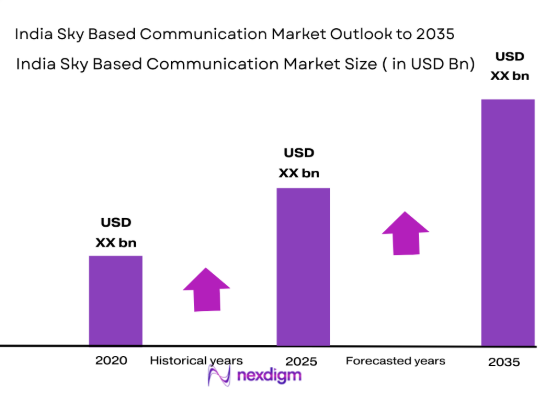
Based on a recent historical assessment, the India Sky Based Communication Market was valued at approximately USD ~ billion, supported by data published by the Indian Space Research Organization, Department of Telecommunications, and India Brand Equity Foundation. The market size is driven by rising deployment of satellite communication systems for broadband connectivity, defense communication, disaster management, remote sensing data relay, and aviation connectivity. Increased public investment in space infrastructure, higher private participation under national space policy reforms, and expanding demand for low latency communication across remote regions continue to sustain overall market expansion.
Based on a recent historical assessment, major dominance within the India Sky Based Communication Market is observed across regions such as Bengaluru, Hyderabad, Chennai, and national-level integration with global satellite hubs in the United States and Europe. Bengaluru and Hyderabad lead due to concentration of space research centers, satellite manufacturing facilities, and private launch service providers, while Chennai supports ground station infrastructure and integration services. International partnerships with satellite operators in the United States and European Union strengthen technology access, capacity leasing, and interoperability, enabling faster adoption across civil, defense, and commercial communication applications.
Market Segmentation
By Product Type
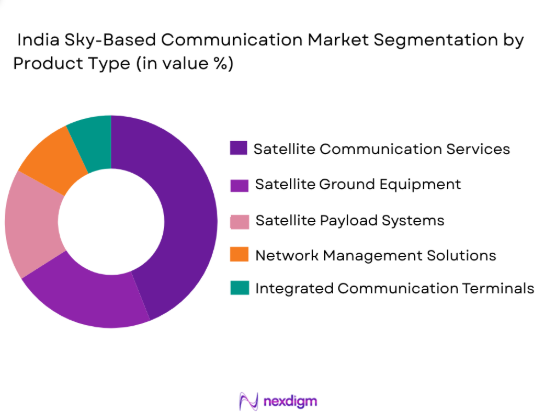
India Sky Based Communication Market is segmented by product type into satellite communication services, satellite ground equipment, satellite payload systems, and network management solutions. Recently, satellite communication services have a dominant market share due to expanding broadband connectivity requirements in remote regions, rising defense and government demand for secure communication links, strong service-level agreements from established operators, and increasing integration with aviation and maritime platforms. The service segment benefits from existing orbital assets, scalable capacity leasing models, and faster deployment timelines compared to hardware-intensive segments. Government-backed connectivity programs, disaster response frameworks, and enterprise digital transformation initiatives further support sustained demand for managed satellite communication services across multiple end-use verticals.
By Platform Type
India Sky Based Communication Market is segmented by platform type into geostationary orbit platforms, low Earth orbit platforms, medium Earth orbit platforms, high altitude platform systems, and hybrid integrated platforms. Recently, geostationary orbit platforms have had a dominant market share due to their long-established infrastructure, wide coverage capability, and reliability for continuous communication services across large geographic areas. These platforms are extensively used for defense networks, national broadcasting, disaster response communication, and backbone connectivity for remote regions. Existing investments in GEO satellites, mature ground station ecosystems, and long-term service contracts reinforce their dominance. Additionally, GEO platforms support stable bandwidth provisioning and compatibility with legacy systems, making them the preferred choice for government and enterprise communication requirements.

Competitive Landscape
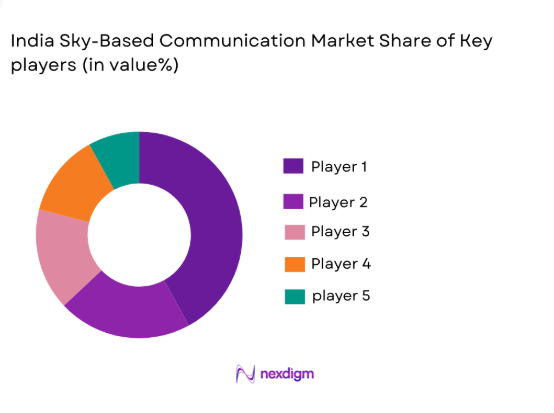
The India Sky Based Communication Market exhibits a moderately consolidated competitive landscape, with a mix of government-backed organizations and private enterprises shaping service availability, infrastructure deployment, and technology development. Major players influence market direction through long-term capacity agreements, proprietary satellite platforms, and partnerships with global satellite operators, creating high entry barriers while encouraging selective private participation.
| Company Name | Establishment Year | Headquarters | Technology Focus | Market Reach | Key Products | Revenue | Satellite Assets |
| ISRO | 1969 | Bengaluru, India | ~ | ~ | ~ | ~ | ~ |
| Antrix Corporation | 1992 | Bengaluru, India | ~ | ~ | ~ | ~ | ~ |
| NSIL | 2019 | Bengaluru, India | ~ | ~ | ~ | ~ | ~ |
| Tata Advanced Systems | 2007 | Hyderabad, India | ~ | ~ | ~ | ~ | ~ |
| Bharti Airtel | 1995 | New Delhi, India | ~ | ~ | ~ | ~ | ~ |
India Sky Based Communication Market Analysis
Growth Drivers
National Satellite Connectivity Expansion Programs
This growth driver is rooted in large-scale government initiatives aimed at extending reliable communication access to remote, border, island, and underserved regions through satellite-based networks that complement terrestrial infrastructure. The driver is reinforced by sustained public funding allocated to digital inclusion, emergency communication preparedness, and secure government networks. Satellite systems enable rapid deployment without geographic constraints, making them critical for connectivity in mountainous, forested, and maritime zones. Increasing integration of satellite links into national broadband frameworks strengthens resilience against terrestrial outages. Defense and internal security agencies increasingly depend on satellite communication for secure operations. Policy-level encouragement for private sector participation accelerates service availability. Advances in satellite payload efficiency reduce operational costs over time. Interoperability with global satellite networks further enhances service reliability and scalability.
Commercial Aviation and Maritime Connectivity Demand
This driver reflects the rising requirement for uninterrupted voice and data connectivity across aircraft and maritime vessels operating beyond terrestrial network coverage. Airlines increasingly integrate satellite-based communication systems to support cockpit communication, passenger connectivity, and real-time operational monitoring. Maritime operators rely on satellite links for navigation, safety compliance, logistics coordination, and crew welfare. Growth in air traffic and commercial shipping intensifies demand for high-throughput satellite solutions. Regulatory mandates for safety communication strengthen adoption. Service providers benefit from long-term contracts and recurring revenue models. Technological advancements in phased-array antennas improve performance. Integration with global mobility platforms enhances network coverage consistency.
Market Challenges
High Capital Intensity and Long Asset Lifecycles
This challenge arises from the substantial upfront investment required for satellite manufacturing, launch services, ground infrastructure, and spectrum coordination. Long development cycles delay revenue realization and increase exposure to technological obsolescence risks. Financing constraints limit participation by smaller firms. Asset lifecycles extending over decades restrict rapid technology refresh. Insurance and launch risks add cost uncertainty. Dependence on foreign launch or component suppliers can create vulnerabilities. Regulatory approvals further extend timelines. These factors collectively constrain market agility and scalability.
Spectrum Allocation and Regulatory Complexity
This challenge is driven by the limited availability of orbital slots and radio frequency spectrum essential for satellite communication operations. Coordination with international regulatory bodies increases compliance complexity. Delays in licensing can postpone service rollout. Overlapping civilian, defense, and commercial spectrum demands create allocation conflicts. Policy uncertainty affects private investment confidence. Cross-border coordination is essential for interference management. Compliance costs burden operators. Regulatory harmonization remains gradual, affecting deployment speed.
Opportunities
Private Sector Participation under Space Policy Reforms
This opportunity is enabled by national reforms encouraging private investment across satellite manufacturing, launch services, and communication service provisioning. Liberalized policies reduce entry barriers and foster innovation. Public-private partnerships enhance capacity utilization. Domestic manufacturing initiatives support supply chain localization. Commercial operators gain access to national satellite assets. Increased competition improves service affordability. International collaboration expands market reach. Venture capital interest accelerates technology development.
Integration of LEO Satellite Constellations: Integration of LEO Satellite Constellations
This opportunity stems from the deployment of low Earth orbit satellite constellations offering low latency and high throughput communication services. LEO systems complement existing GEO infrastructure. Demand from enterprise connectivity, mobility platforms, and IoT applications increases adoption. Technological advancements reduce terminal costs. Regulatory frameworks increasingly accommodate LEO operations. Interoperability improves network resilience. Global partnerships enhance coverage. This creates new service models and revenue streams.
Future Outlook
The India Sky Based Communication Market is expected to experience sustained expansion over the next five years, supported by policy reforms, increased private participation, and advancing satellite technologies. Growth trends indicate stronger integration of LEO and GEO systems, rising demand from mobility and defense applications, and enhanced regulatory clarity. Technological developments in payload efficiency and ground terminals are expected to improve service economics. Demand-side drivers remain anchored in connectivity resilience and national security priorities.
Major Players
- ISRO
- Antrix Corporation
- NewSpace India Limited
- Tata Advanced Systems
- Bharti Airtel
- OneWeb India
- Hughes Communications India
- Nelco
- L&TDefence
- Astra Microwave
- Data Patterns
- Bharat Electronics Limited
- Godrej Aerospace
- Alpha Design Technologies
- MTAR Technologies
Key Target Audience
- Defense ministries
- Government and regulatory bodies
- Satellite operators
- Telecom service providers
- Aviation operators
- Maritime companies
- Infrastructure developers
- Investment and venture capitalist firms
Research Methodology
Step 1: Identification of Key Variables
Key variables related to satellite assets, service models, regulatory frameworks, and demand sectors were identified through secondary research and industry databases to define the analytical scope and data boundaries.
Step 2: Market Analysis and Construction
Qualitative and quantitative insights were synthesized to construct the market structure, segment dynamics, and competitive landscape using validated secondary data and policy documents.
Step 3: Hypothesis Validation and Expert Consultation
Industry experts, policy analysts, and technology specialists were consulted to validate assumptions, demand drivers, and regulatory impacts affecting the market.
Step 4: Research Synthesis and Final Output
All validated inputs were integrated into a structured analytical framework to produce consistent, data-aligned market insights.

- Executive Summary
India Sky Based Communication Market Research Methodology (Definitions, Scope, Industry Assumptions, Market Sizing Approach, Primary & Secondary Research Framework, Data Collection & Verification Protocol, Analytic Models & Forecast Methodology, Limitations & Research Validity Checks)

- Market Definition and Scope
- Value Chain & Stakeholder Ecosystem
- Regulatory / Certification Landscape
- Sector Dynamics Affecting Demand
- Strategic Initiatives & Infrastructure Growth

- Growth Drivers
Government space and communication modernization initiatives
Rising demand for nationwide broadband and connectivity coverage
Defense and strategic communication requirements
Growth in satellite enabled aviation and mobility services
Advancements in satellite manufacturing and launch capabilities - Market Challenges
High capital expenditure for satellite and airborne platforms
Spectrum allocation and regulatory complexities
Long development and deployment timelines
Dependence on launch availability and orbital coordination
Cybersecurity and signal resilience concerns - Market Opportunities
Expansion of low earth orbit communication constellations
Integration of sky-based communication with 5G and future networks
Development of indigenous satellite and platform manufacturing ecosystems
- Trends
Shift toward software defined and flexible payload architectures
Increasing use of low latency communication platforms
Integration of artificial intelligence for network optimization
Focus on dual use civilian and defense communication systems
Rising interest in optical and laser-based communication links - Government Regulations & Space Policy
National space communication and satellite policy frameworks
Spectrum management and licensing regulations
Private sector participation and foreign investment norms - SWOT Analysis
Stakeholder and Ecosystem Analysis
Porter’s Five Forces Analysis
Competition Intensity and Ecosystem Mapping

By Market Value, 2020-2025
By Installed Units, 2020-2025
By Average System Price, 2020-2025
By System Architecture Tier, 2020-2025

- By System Type (In Value%)
Satellite communication payload systems
High altitude platform station communication systems
Airborne relay and aerial communication nodes
Hybrid satellite airborne integrated networks
Emergency and disaster response sky communication systems - By Platform Type (In Value%)
Geostationary satellite platforms
Low earth orbit satellite constellations
High altitude pseudo satellite platforms
Manned airborne communication platforms
Unmanned aerial communication platforms - By Fitment Type (In Value%)
New communication satellite deployment programs
Upgrade and modernization of existing sky networks
Defense and strategic communication integration
Commercial aviation and mobility communication fitments
Research, testing, and demonstration deployments
By End User Segment (In Value%)
Defense and homeland security agencies
Commercial telecommunications operators
Civil aviation authorities and airlines
Disaster management and emergency services
Scientific research and space agencies - By Procurement Channel (In Value%)
Direct government and space agency procurement
Public sector undertaking contracts
Private satellite operator procurement
Public private partnership programs
International collaboration and leasing arrangements - By Technology (in Value%)
Ka band and Ku band communication technologies
Laser and optical communication systems
Software defined and reconfigurable payloads
Inter satellite link technologies
Ground segment integration and network management systems

- Market share snapshot of major players
- Cross Comparison Parameters (orbital capability, payload technology maturity, network latency performance, regulatory compliance strength, production scalability, launch access, partnership ecosystem, cost competitiveness, innovation pipeline, lifecycle support capability)
- SWOT Analysis of Key Competitors
- Pricing & Procurement Analysis
- Key Players
Indian Space Research Organization
New Space India Limited
Bharti Airtel Satellite Services
Tata Advanced Systems Limited
Larsen and Toubro Space Systems
OneWeb India
Hughes Communications India
Ananth Technologies
Bharat Electronics Limited
Lockheed Martin Space
Airbus Defence and Space
Thales Alenia Space
Northrop Grumman Space Systems
Boeing Satellite Systems
Viasat Inc.

- Defense and security demand for secure resilient communication links
- Telecom operators focus on rural and remote connectivity
- Aviation sector requirements for continuous high bandwidth communication
- Disaster management agencies reliance on rapid deployable sky networks

- Forecast Market Value, 2026-2035
- Forecast Installed Units, 2026-2035
- Price Forecast by System Tier, 2026-2035
- Future Demand by Platform, 2026-2035


 Request a Sample
 Ask for Customization
 Get a Quote
 Enquire Now