

 Download PDF
Market Overview
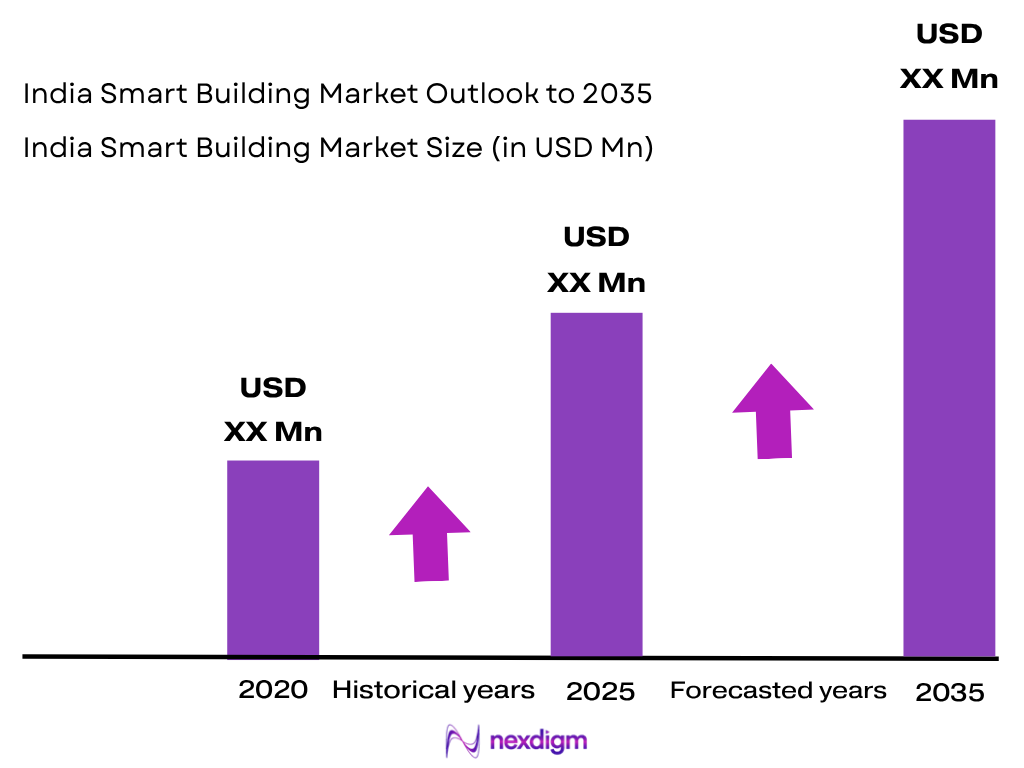
The India Smart Building Market is valued at approximately ~USD XX billion, with demand supported by rapid commercial construction, energy-efficiency requirements and digital building operations. India’s gross office absorption expanded from 61.6 million sq. ft. to 79.0 million sq. ft. across successive annual periods, while BEE reports building-sector energy consumption of about 76 Mtoe, reinforcing demand for BMS, HVAC controls, metering, occupancy analytics and cloud-based energy-management platforms across commercial properties.
Bengaluru, Hyderabad, Mumbai, Delhi-NCR, Pune and Chennai form the principal smart-building demand hubs because they concentrate Grade-A offices, technology campuses, GCCs, data centres and premium commercial assets. New office supply moved from 56.7 million sq. ft. to 52.3 million sq. ft. across consecutive annual periods, while Bengaluru, Hyderabad and Pune led the latest completions. Their concentration of future-ready and green-certified assets supports continued deployment of automation, energy monitoring and integrated building controls.
Market Segmentation
By Solution Type
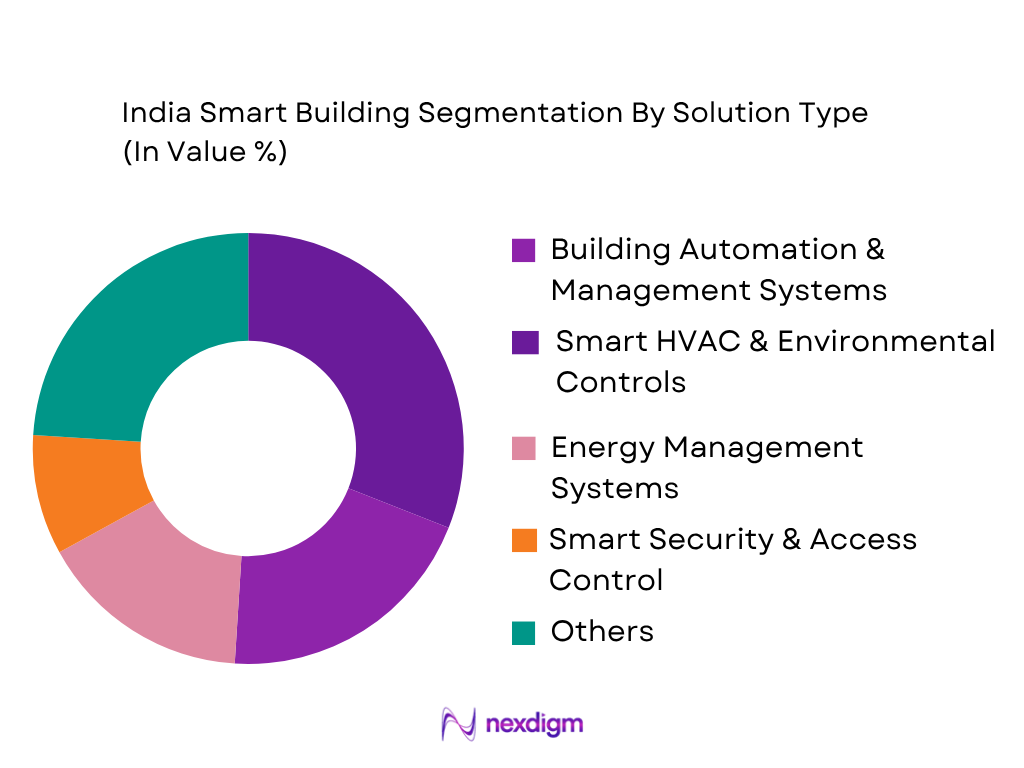
The India Smart Building Market is segmented into building management systems, building automation and control systems, energy management systems, smart HVAC controls, smart lighting and occupancy controls, integrated security, and analytics platforms. Building management and automation systems represent the dominant segment because they function as the supervisory layer connecting HVAC, lighting, power, fire, access and metering infrastructure. BEE states that India’s building sector accounts for more than 30% of national electricity consumption and that commercial buildings are expanding rapidly, increasing the need for centralized energy and equipment control. The Energy Conservation and Sustainable Building Code further emphasizes efficient HVAC, lighting, electrical systems and renewable-energy integration. Open architectures from leading vendors increasingly connect legacy and third-party equipment through BACnet, Modbus, KNX and APIs, making BMS platforms the foundation for retrofit as well as greenfield smart-building deployments.
By Building Type
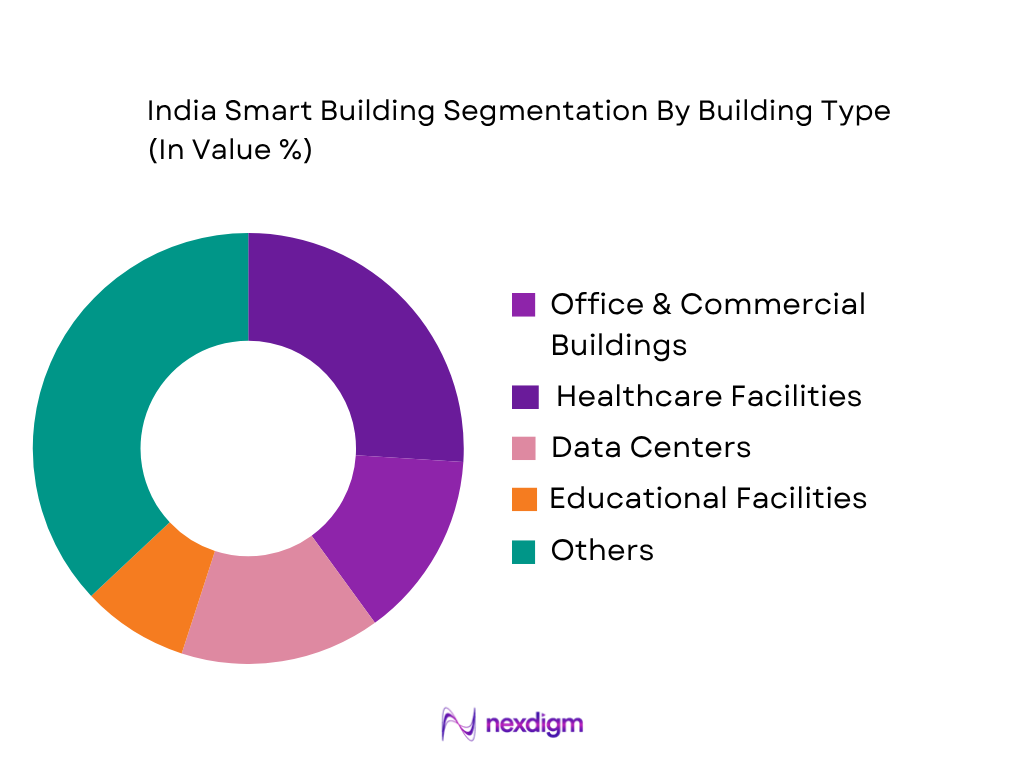
The India Smart Building Market is segmented into office buildings, data centres, healthcare facilities, retail properties, hotels, educational campuses, industrial and logistics facilities, government buildings and smart residential developments. Office buildings represent the dominant segment because India continues to add large volumes of technology-led Grade-A commercial space that requires integrated HVAC, access, lighting, energy and workplace-management systems. Gross office absorption reached 79.0 million sq. ft. in the latest full-year period, while new completions totaled 52.3 million sq. ft.; more than half of fourth-quarter completions were green-certified. GCC leasing alone reached 29.4 million sq. ft., demonstrating the concentration of digitally sophisticated occupiers that typically demand high-quality, energy-efficient assets. Data centres form another fast-rising smart-building category because India’s colocation capacity reached 977 MW across seven leading cities, creating intensive requirements for cooling optimization, power monitoring and predictive maintenance.
Competitive Landscape
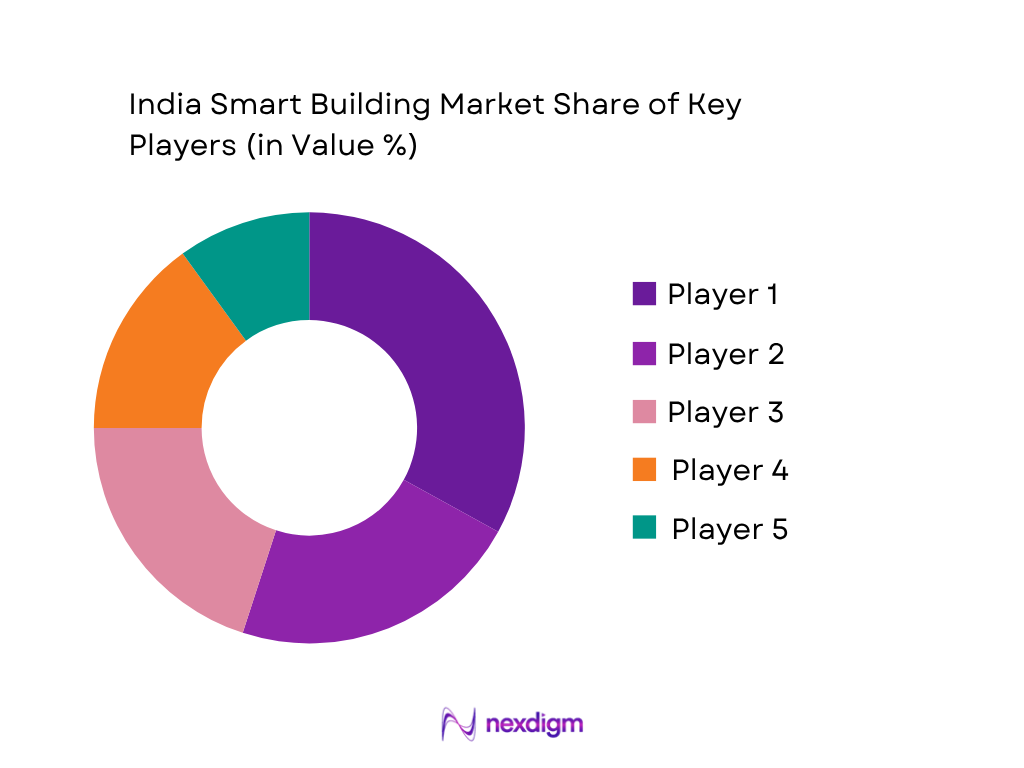
The India Smart Building Market features global building-automation, electrification and HVAC technology companies competing alongside systems integrators and specialized digital-building providers. Honeywell, Schneider Electric, Siemens, Johnson Controls and ABB maintain broad positions because their portfolios extend beyond individual controllers into BMS platforms, HVAC integration, energy management, cloud software, analytics and open-protocol connectivity. Competitive differentiation increasingly depends on brownfield integration, cybersecurity, AI-enabled optimization, lifecycle services and the ability to connect third-party equipment rather than supplying isolated hardware.
| Company | Establishment Year | Headquarters | Core Smart-Building Platform | BAS/BMS Capability | Energy Management | AI & Analytics Capability | Interoperability | India Market Focus |
| Honeywell | 1906 | Charlotte, USA | ||||||
| Schneider Electric | 1836 | Rueil-Malmaison, France | ||||||
| Siemens | 1847 | Munich & Berlin, Germany | ||||||
| Johnson Controls | 1885 | Cork, Ireland | ||||||
| ABB | 1988 | Zurich, Switzerland |
India Smart Building Market Analysis
Growth Drivers
Expansion of Commercial Building Stock and Energy-Efficiency Regulation
India’s Smart Building Market is being driven by rapid commercial construction alongside tighter building-energy requirements that increasingly favor automated HVAC, lighting, metering and centralized building-management systems. The Bureau of Energy Efficiency states that India is adding roughly 300,000 square feet of commercial floor space every day, creating a substantial flow of newly constructed properties that can incorporate digital controls at the design stage. BEE’s State Energy Efficiency Index 2024 records 24 states with Energy Conservation Building Code notifications and 20 states that have integrated the code into municipal building bylaws. In residential efficiency, 13 states had prepared Eco Niwas Samhita versions, while another 6 states were awaiting approval for notification. These regulatory developments increase the relevance of smart HVAC controls, power monitoring, occupancy-based lighting and energy-management software. The broader economic environment supports this investment cycle: World Bank data place India’s 2024 GDP at USD 3,909.89 billion and GDP per capita at USD 2,694.7. As developers construct larger portfolios of offices, hospitals, hotels and institutional facilities, compliance, energy monitoring and lifecycle operating efficiency are creating stronger demand for integrated smart-building platforms rather than isolated mechanical and electrical equipment.
Expansion of Data Centres, Smart-City Infrastructure and Connected Facilities
The expansion of digital infrastructure is strengthening demand for smart-building technologies because data centres, technology campuses and digitally managed public infrastructure require continuous cooling control, environmental sensing, security integration and power monitoring. Government data indicate that India’s data-centre capacity increased from approximately 375 MW in 2020 to around 1,500 MW in 2025, while 38,231 GPUs had been onboarded through 14 empanelled service providers and data centres under the national AI compute framework. Smart-city investments provide another connected-infrastructure foundation. As of November 2024, the Smart Cities Mission had issued work orders for 8,066 projects worth ₹1,64,669 crore, with 7,352 projects worth ₹1,47,366 crore completed. All 100 smart cities operated Integrated Command and Control Centres, while 84,000 CCTV cameras and more than 17,026 kilometres of water networks were connected through digital surveillance or SCADA infrastructure. The World Bank reports India’s 2024 GDP at USD 3,909.89 billion, demonstrating the macroeconomic scale supporting technology-intensive infrastructure investment. These developments expand the addressable environment for IoT sensors, cloud BMS, remote facility monitoring and predictive equipment-management systems across private and public assets.
Market Challenges
Legacy Building Integration and Fragmented Automation Architecture
Legacy building integration remains a major challenge for India’s Smart Building Market because existing offices, hospitals, hotels and institutional properties frequently contain different generations of HVAC controllers, electrical equipment, meters, fire systems and proprietary building-automation technologies. The regulatory landscape itself demonstrates variation in technology readiness: BEE’s State Energy Efficiency Index 2024 records 24 states with Energy Conservation Building Code notifications, but only 20 states had incorporated those requirements into municipal building bylaws. For residential efficiency, 13 states had drafted Eco Niwas Samhita versions while 6 states remained at the approval stage. This uneven implementation creates different technical and compliance environments for system integrators operating nationally. Meanwhile, BEE reports around 300,000 square feet of new commercial space being constructed each day, meaning new digitally enabled properties are being added alongside a much larger installed base requiring phased modernization. India’s 2024 GDP reached USD 3,909.89 billion, according to the World Bank, while GDP per capita stood at USD 2,694.7. For building owners, modernization therefore involves balancing new digital investment against existing usable mechanical infrastructure. Gateway deployment, protocol conversion, sensor retrofits and controller replacement can increase project complexity, especially where BACnet, Modbus, KNX and proprietary systems must coexist within a single building-management architecture.
Building OT Cybersecurity and Specialized Technical Workforce Requirements
Increasing connectivity creates a significant cybersecurity and workforce challenge for the India Smart Building Market because modern BMS platforms connect HVAC controllers, access-control devices, cameras, meters, cloud services and remotely accessible IoT sensors. CERT-In recorded 2,041,360 cybersecurity incidents in 2024, rising to 2,944,248 incidents in 2025, illustrating the expanding threat environment surrounding India’s connected infrastructure. Capacity building is also substantial: CERT-In trained 12,014 officials through 23 cybersecurity programmes in 2024, while 104 cybersecurity drills had involved around 1,450 organizations across government and critical sectors. These figures highlight the level of specialized capability required to secure digital infrastructure. Smart buildings introduce similar requirements because operational technology must remain continuously available while connected to enterprise IT networks and remote service platforms. India’s broader macroeconomic base—USD 3,909.89 billion of GDP in 2024, according to the World Bank—is supporting rapid digitization, but faster digital adoption also increases the requirement for controls engineers who understand networking, cybersecurity, HVAC logic and building operations simultaneously. Building owners therefore face challenges not only in purchasing smart technologies but also in commissioning, protecting and maintaining them throughout their lifecycle, especially across multi-vendor environments containing legacy controllers and cloud-connected devices.
Market Opportunities
AI-Driven Building Operations and Smart Data Centre Infrastructure
AI-driven automation represents a substantial opportunity for India’s Smart Building Market as high-density computing facilities create demand for real-time cooling optimization, fault detection, digital twins and predictive maintenance. Government information shows India’s data-centre capacity reached approximately 1,500 MW in 2025, compared with around 375 MW in 2020. Under the IndiaAI compute framework, 38,231 GPUs had also been onboarded through 14 empanelled service providers and data centres, establishing a larger domestic infrastructure base for AI workloads. These facilities require precise control of cooling systems, electrical distribution, humidity, airflow, equipment alarms and access infrastructure, creating ideal operating environments for advanced BMS and autonomous optimization technologies. India’s World Bank-recorded GDP of USD 3,909.89 billion in 2024 and GDP per capita of USD 2,694.7 provide the macroeconomic context for expanding digital infrastructure investment. Smart-building vendors can use this installed base to extend beyond conventional dashboards toward AI-based fault detection, predictive chiller maintenance, automated cooling sequencing and digital representations of physical equipment. Similar technologies can subsequently migrate into office portfolios, hospitals, airports and industrial campuses. Current data-centre expansion therefore creates a practical technology proving ground for more autonomous, analytics-intensive smart-building architectures across India.
Grid-Interactive Buildings, Distributed Energy and Smart EV Charging Integration
India’s energy transition creates a significant opportunity for smart buildings to evolve from passive electricity consumers into digitally managed energy nodes integrating solar generation, storage, EV charging and flexible loads. The Ministry of New and Renewable Energy reported total renewable-energy capacity of 209.44 GW in December 2024, including 97.86 GW of solar and 48.16 GW of wind capacity. Public EV charging infrastructure is developing alongside this electricity transition: the Ministry of Heavy Industries reported 12,146 operational public charging stations in February 2024, rising to 29,277 stations by August 2025. Rooftop generation is also becoming more distributed; PM Surya Ghar had crossed 1.009 million rooftop installations by March 2025, and installed capacity under the programme reached 9,566.89 MW by March 2026. India’s 2024 GDP of USD 3,909.89 billion, according to the World Bank, supports the broader investment capacity behind this electrification. These current infrastructure developments create opportunities for smart-building platforms to coordinate building demand, rooftop solar, batteries and charging loads through a common energy-management layer. Commercial campuses, offices, hotels and mixed-use developments can therefore adopt grid-interactive control architectures that optimize equipment schedules, charging demand and distributed generation while improving operational visibility.
Future Outlook
The India Smart Building Market is projected to expand at approximately ~XX% CAGR during 2026-2035, supported by continued commercial real-estate development, building-energy regulation, rapid data-centre investment and modernization of existing building stock. Smart-building deployment is expected to move beyond conventional centralized BMS toward cloud-connected, AI-assisted and portfolio-wide operating platforms. Retrofit activity will become particularly important because large quantities of Indian building stock contain legacy HVAC, lighting and electrical equipment that can increasingly be connected using gateways, open protocols and edge controllers rather than completely replaced. BEE notes that India is adding roughly 300,000 sq. ft. of commercial floor space every day, while a significant portion of the building stock expected over the next two decades has yet to be constructed.
Major Players
- Honeywell
- Schneider Electric
- Siemens
- Johnson Controls
- ABB
- Bosch
- Delta Electronics India
- Legrand India
- Larsen & Toubro
- Carrier
- Trane Technologies
- Daikin India
- 75F
- Distech Controls
- Beckhoff Automation
Key Target Audience
- Smart Building Technology and Building Automation Manufacturers
- Commercial Real Estate Developers and Property Owners
- Data Center and Mission-Critical Facility Operators
- HVAC, Electrical and Building Controls Solution Providers
- Facility Management and Building Operations Companies
- Investments and Venture Capitalist Firms
- Government and Regulatory Bodies (Ministry of Power, Bureau of Energy Efficiency, Ministry of Housing and Urban Affairs, Central Electricity Authority)
- Energy Service Companies and Building Energy Management Providers
Research Methodology
Step 1: Identification of Key Variables
The initial phase involves constructing an ecosystem map encompassing automation OEMs, HVAC companies, IoT providers, real-estate developers, facility managers, system integrators and building owners within the India Smart Building Market. Secondary research is used to identify variables including building stock, BMS penetration, retrofit activity, electricity consumption, solution mix, building type and digital-technology adoption.
Step 2: Market Analysis and Construction
Historical data is compiled across building automation, energy management, HVAC controls, security systems and connected-building software. The analysis combines top-down assessment of commercial-building and construction activity with bottom-up evaluation of system installations, supplier portfolios, retrofit cycles and building-level technology expenditure to construct the market framework.
Step 3: Hypothesis Validation and Expert Consultation
Market hypotheses are validated through CATIs and structured interviews with automation vendors, system integrators, developers, facility managers, HVAC contractors and commercial property operators. These consultations assess procurement patterns, equipment replacement cycles, cloud migration, interoperability requirements, customer pain points and adoption of AI, analytics and energy-optimization solutions.
Step 4: Research Synthesis and Final Output
The final phase triangulates primary insights with government energy information, commercial real-estate activity, data-centre infrastructure and company disclosures. Bottom-up technology assessment is reconciled with the top-down building-demand framework to validate segmentation, competitive positioning and future adoption patterns for the India Smart Building Market.

- Executive Summary
- Research Methodology (Market Definitions and Assumptions, Smart Building Market Boundary, Building Management System Classification, Building Automation System Mapping, IoT Device and Sensor Assessment, HVAC Controls Assessment, Lighting Automation Assessment, Energy Management System Evaluation, Physical Security and Access Control Assessment, Fire and Life Safety Integration, Smart Metering Assessment, Cloud Building Platform Mapping, AI-Based Building Analytics Assessment, Top-Down Market Sizing, Bottom-Up Market Sizing, Installed-Base Assessment, New-Build versus Retrofit Demand Assessment, Supply-Side Interviews, Demand-Side Interviews, System Integrator Assessment, Data Triangulation, Forecasting Framework, Limitations and Future Conclusions)

- Definition and Scope
- India Smart Building Industry Evolution
- Smart Building Value Chain Analysis
- Smart Building Technology Stack and Architecture
- Smart Building Supply Chain Analysis
- Smart Building Ecosystem Mapping

- Growth Drivers (Expansion of Commercial Building Stock, Increasing Building Electricity Consumption, Energy Conservation and Sustainable Building Code Adoption, Data Center Infrastructure Expansion, Growing Building Electrification, Corporate Decarbonization Requirements, Smart City Infrastructure Development, IoT Sensor Deployment, Cloud-Based Facility Management, Demand for Predictive Maintenance)
- Market Challenges (Legacy Building System Integration, High Retrofit Complexity, Fragmented Building Automation Architecture, Proprietary Protocol Lock-In, Building OT Cybersecurity Risks, Skilled Controls Engineer Availability, Multi-Vendor System Interoperability, Building Data Silos, Long Building Equipment Replacement Cycles, Capital Allocation Constraints)
- Market Opportunities (AI-Driven Autonomous Building Operations, Existing Commercial Building Retrofits, Smart Data Center Infrastructure, Digital Twin Deployment, Grid-Interactive Efficient Buildings, Portfolio-Wide Cloud BMS, Distributed Energy Resource Integration, Smart EV Charging Integration, Automated Fault Detection and Diagnostics, Net-Zero Building Transformation)
- Market Trends (AI-Based HVAC Optimization, IoT-Connected Building Devices, Wireless Building Automation, Cloud-Native BMS, Occupancy-Based Controls, Predictive Equipment Maintenance, Digital Building Twins, Indoor Environmental Quality Monitoring, Integrated Energy and Building Management, Building-to-Grid Connectivity)
- Government Regulations and Standards (Energy Conservation Act, Energy Conservation and Sustainable Building Code, Eco Niwas Samhita, National Building Code of India, BEE Building Energy Efficiency Programmes, BEE Star Rating for Buildings, State ECBC Implementation, Electrical Safety Requirements, Fire and Life Safety Requirements, Smart Cities Mission Building Infrastructure)
- SWOT Analysis
- Porter’s Five Forces Analysis
- PESTLE Analysis
- Stakeholder Ecosystem
- Competition Ecosystem

- By Market Value (2020-2025)
- By New Smart Building Deployment Value (2020-2025)
- By Existing Building Retrofit Value (2020-2025)
- By Building Automation and Controls Revenue (2020-2025)
- By Building Management System Revenue (2020-2025)
- By Energy Management System Revenue (2020-2025)

- By Solution Type (In Value %)
Building Management Systems
Building Automation and Control Systems
Energy Management Systems
Smart HVAC Controls
Smart Lighting and Occupancy Controls
Smart Metering and Power Monitoring Systems
Fire and Life Safety Systems
Security, Surveillance and Access Control Systems
Integrated Workplace Management Systems
Building Analytics and Optimization Platforms - By Component (In Value %)
Hardware, Software, Services, Sensors and IoT Devices
Controllers and Gateways
Smart Meters
Actuators and Drives
Building Management Servers
Edge Computing Devices
Cloud Platforms - By Building Type (In Value %)
Office Buildings
Retail and Shopping Centers
Hotels and Hospitality Buildings
Hospitals and Healthcare Facilities
Educational Campuses
Airports and Transportation Facilities
Data Centers
Industrial and Logistics Buildings
Government Buildings
Smart Residential Buildings - By Deployment Type (In Value %)
New-Build Smart Buildings
Existing Building Retrofits
Greenfield Integrated Automation,
Brownfield BMS Modernization
On-Premise Building Management,
Cloud-Connected Building Management
Hybrid Building Management Architecture - By Technology (In Value %)
IoT-Enabled Building Automation
Artificial Intelligence and Machine Learning
Cloud-Based Building Management
Edge Computing
Digital Twins
Wireless Building Controls
ACnet-Based Automation
NX-Based Automation

- Market Share of Major Players (India Smart Building Revenue, Building Automation Revenue, BMS Installed Base, Commercial Building Presence, Data Center Presence, Retrofit Capability, System Integration Capability, Software Portfolio, Controls Portfolio, Service Network)
- Cross Comparison Parameters (BMS Platform Breadth, HVAC Automation Capability, IoT Sensor Integration Capability, Open-Protocol Interoperability, AI and Predictive Analytics Capability, Building Energy Management Capability, Cybersecurity and OT Protection Capability, India System Integration and After-Sales Network)
- SWOT Analysis of Major Players (Product Portfolio, Technology Capability, Installed Base, Partner Ecosystem, Service Coverage, Digital Platform Capability)
- Detailed Profiles of Major Companies
Honeywell
Schneider Electric
Siemens
Johnson Controls
ABB
Bosch
Delta Electronics India
Legrand India
Larsen & Toubro
Carrier
Trane Technologies
Daikin India
75F
Distech Controls
Beckhoff Automation

- Commercial Building Owner Requirement Assessment
- Real Estate Developer Requirement Assessment
- Data Center Smart Building Requirement Assessment
- Healthcare Smart Building Requirement Assessment
- Hospitality Smart Building Requirement Assessment
- Corporate Office Requirement Assessment

- By Market Value (2026-2035)
- By New Smart Building Deployment Value (2026-2035)
- By Existing Building Retrofit Value (2026-2035)
- By Building Automation and Controls Revenue (2026-2035)
- By Building Management System Revenue (2026-2035)
- By Energy Management System Revenue (2026-2035)


 Request a Sample
 Ask for Customization
 Get a Quote
 Enquire Now
