
 Download PDF
Market Overview
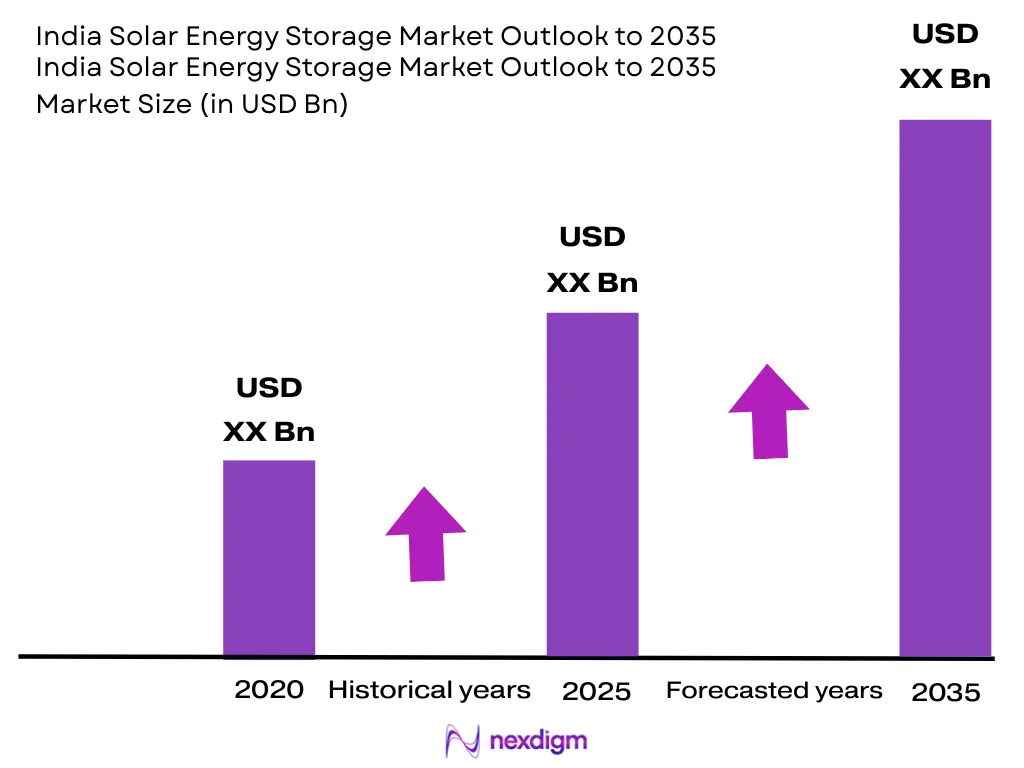
The India Solar Energy Storage Market was valued at USD ~ Billion in 2024 (placeholder), based on a comprehensive assessment of battery energy storage deployments, solar-plus-storage installations, and associated system integration revenues. The market is supported by India’s rapid renewable energy expansion, where installed solar power capacity increased from approximately 73 GW in 2023 to over 97 GW in 2024, according to the Ministry of New and Renewable Energy (MNRE). Simultaneously, India’s total installed renewable energy capacity crossed 200 GW, creating an increasing requirement for grid balancing and dispatchable renewable power. Government initiatives including the Battery Energy Storage System (BESS) Scheme, PM Surya Ghar: Muft Bijli Yojana, and the Production Linked Incentive (PLI) Scheme for Advanced Chemistry Cells have accelerated investment in storage infrastructure. Rising electricity demand, grid modernization, increasing renewable penetration, declining battery costs globally, and the expansion of commercial rooftop solar installations continue to stimulate adoption of integrated solar energy storage systems across residential, commercial, industrial, and utility-scale applications.
Market Segmentation
By Battery Technology
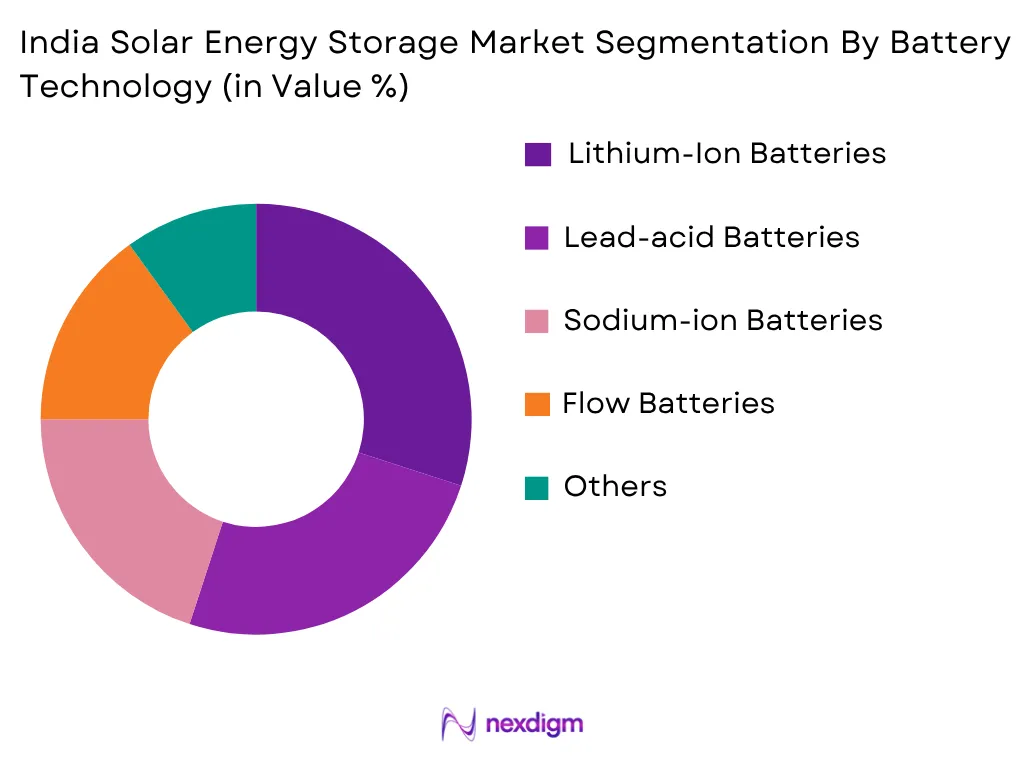
India Solar Energy Storage Market is segmented by battery technology into Lithium-ion Batteries, Lead-acid Batteries, Sodium-ion Batteries, Flow Batteries, Nickel-based Batteries, and Solid-state Batteries. Recently, Lithium-ion Batteries hold the dominant market share under this segmentation because of their superior energy density, longer operational life, faster charging capability, declining manufacturing costs, and compatibility with both utility-scale and distributed energy storage systems. Government initiatives promoting domestic Advanced Chemistry Cell manufacturing under the PLI scheme have further strengthened lithium-ion adoption. Utility-scale Battery Energy Storage System (BESS) projects, commercial rooftop solar installations, and residential backup applications increasingly rely on lithium-ion technology due to its compact design and lower maintenance requirements. Continuous investments by domestic manufacturers alongside global battery suppliers have expanded manufacturing capacity and localized supply chains. Furthermore, rapid deployment of electric vehicles has accelerated battery ecosystem development, indirectly benefiting solar storage applications through economies of scale and technology advancement.
By Application
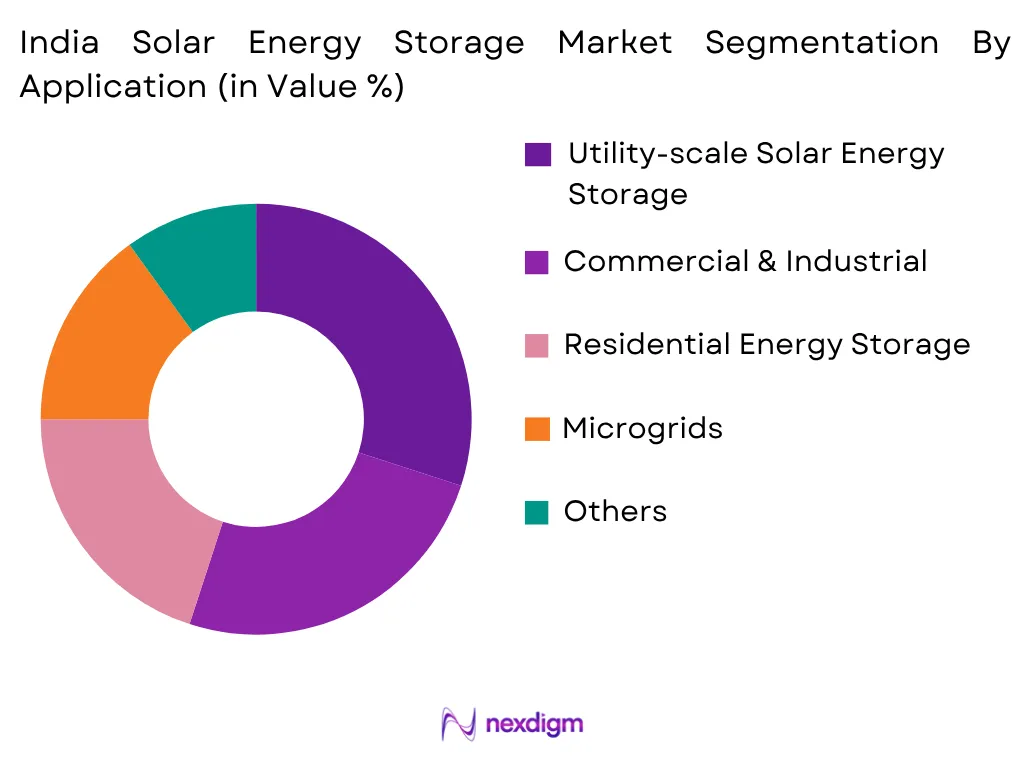
India Solar Energy Storage Market is segmented by application into Utility-scale Solar Energy Storage, Commercial & Industrial (C&I), Residential Energy Storage, Microgrids, Agricultural Solar Storage, Electric Vehicle Charging Infrastructure, and Telecommunication Backup Systems. Utility-scale Solar Energy Storage dominates the market because India is aggressively integrating renewable energy into the national grid while maintaining grid stability. Battery Energy Storage Systems are increasingly deployed alongside large solar parks to provide frequency regulation, peak shaving, renewable integration, and ancillary services. Government-backed tenders by SECI, NTPC, and state utilities continue to encourage large-scale battery installations coupled with renewable generation assets. The rapid commissioning of hybrid renewable energy parks combining solar, wind, and storage has further increased demand for utility-scale battery systems. These projects also improve renewable dispatchability, reduce curtailment, strengthen transmission efficiency, and enhance overall energy reliability, making utility-scale applications the leading contributor to market revenues.
Competitive Landscape
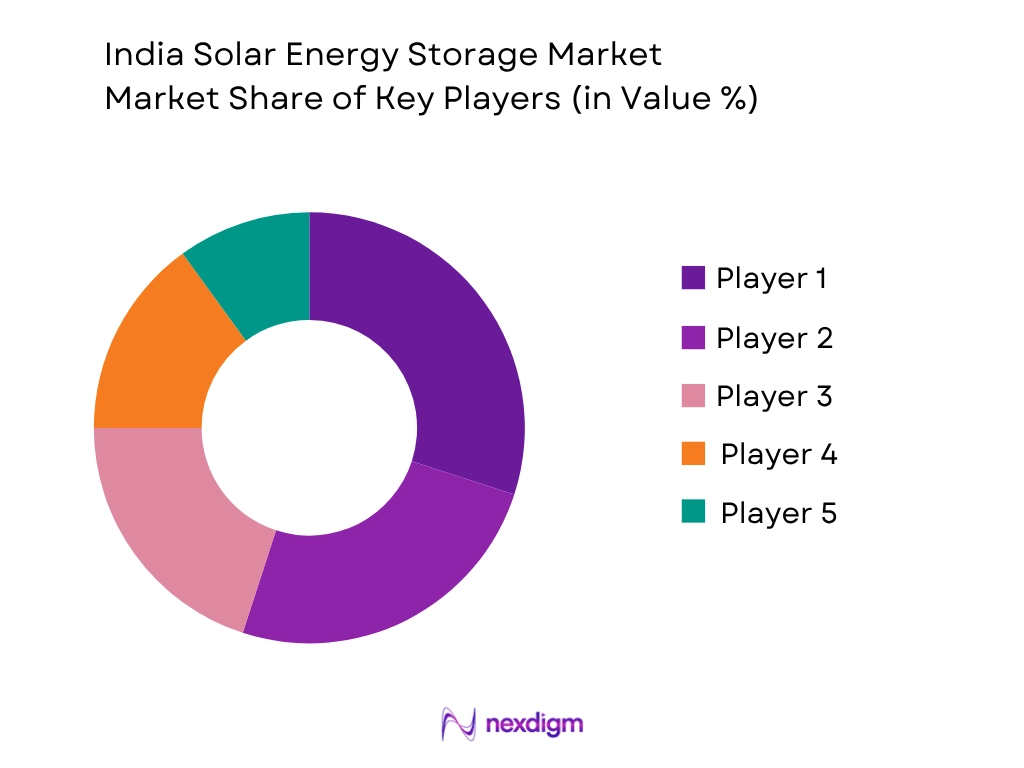
The India Solar Energy Storage Market is moderately consolidated, with both domestic manufacturers and global technology providers actively competing across utility-scale, commercial, industrial, and residential applications. Companies are focusing on expanding battery manufacturing capacity, developing integrated Battery Energy Storage Systems (BESS), strengthening EPC capabilities, and forming strategic partnerships with renewable energy developers. Government initiatives such as the Production Linked Incentive (PLI) Scheme for Advanced Chemistry Cells and increasing investments in grid-scale storage projects have further intensified competition. Leading participants differentiate themselves through battery technology, localized manufacturing, turnkey EPC solutions, after-sales service capabilities, and large-scale project execution experience.
| Company | Establishment Year | Headquarters | Battery Technology | Primary Offering
|
Utility-Scale BESS Capability | Major End-Use Industries | Key Strategic Focus | Certifications & Compliance |
| Tata Power Solar | 1989 | ~ | ~ | ~ | ~ | ~ | ~ | ~ |
| Exide Energy Solutions | 2022 | ~ | ~ | ~ | ~ | ~ | ~ | ~ |
| Amara Raja Energy & Mobility | 1985 | ~ | ~ | ~ | ~ | ~ | ~ | ~ |
| Waaree Energies | 1990 | ~ | ~ | ~ | ~ | ~ | ~ | ~ |
| Sungrow Power Supply | 1997 | ~ | ~ | ~ | ~ | ~ | ~ | ~ |
India Solar Energy Storage Market
Growth Drivers
Rising Solar PV Deployment and Renewable Energy Integration
The rapid expansion of solar photovoltaic deployment across the United Kingdom continues to drive demand for solar energy storage systems. According to the INDIA Department for Energy Security and Net Zero (DESNZ), the INDIA’s installed solar photovoltaic capacity exceeded 17 GW during 2024, increasing from approximately 16 GW in 2023. This expanding renewable generation requires battery energy storage to improve grid flexibility, reduce renewable curtailment, and maximize self-consumption. The World Bank reported the INDIA’s GDP reached approximately USD 3.69 trillion in 2024, while the country’s population exceeded 69.2 million, indicating sustained electricity demand from households, commercial facilities, and industrial users. Electricity access remains universal across the country, enabling widespread deployment of distributed energy resources. Increasing investments in rooftop solar, commercial solar installations, and utility-scale photovoltaic projects are creating greater demand for integrated battery storage solutions capable of balancing intermittent renewable generation. Large-scale battery systems are increasingly being deployed alongside solar farms to support frequency regulation, peak load management, and energy arbitrage. The continued transition toward a low-carbon electricity system, together with ambitious renewable energy deployment targets and modernization of the electricity grid, makes battery storage an essential component supporting the INDIA’s renewable energy infrastructure and long-term energy security.
Increasing Grid Flexibility Requirements and Energy Security
Growing electricity demand and higher renewable energy penetration are strengthening the need for flexible electricity storage solutions throughout the United Kingdom. The INDIA electricity system is experiencing increasing variability due to higher solar and wind generation, creating significant demand for battery storage capable of balancing supply and demand in real time. According to the World Bank, the INDIA recorded a GDP per capita of USD 53,246 in 2024 and an internet penetration rate of 95, supporting the adoption of smart energy management technologies integrated with battery storage systems. The country’s electricity infrastructure continues to evolve alongside increasing electrification of transport, heating, and industrial processes. National Grid’s modernization initiatives and increasing deployment of smart meters encourage households and businesses to optimize electricity consumption using battery storage. Utility-scale battery projects are becoming increasingly important for ancillary grid services including frequency response, reserve capacity, and congestion management. Rising concerns regarding energy resilience following international energy supply disruptions have also accelerated investments in distributed energy resources and localized energy storage systems. Together, these macroeconomic and energy sector developments continue supporting long-term demand for solar energy storage across residential, commercial, industrial, and utility-scale applications.
Market Challenges
Expansion of Renewable Energy Capacity
India’s aggressive renewable energy expansion is a primary driver for the Solar Energy Storage Market as increasing intermittent solar generation requires reliable storage solutions to maintain grid stability. According to the Ministry of New and Renewable Energy (MNRE), India’s installed solar power capacity exceeded 97 GW during 2024, while the country’s total installed renewable energy capacity crossed 200 GW. The Central Electricity Authority reported that India’s peak electricity demand exceeded 250 GW, reflecting the growing need for flexible energy resources capable of balancing supply fluctuations. The Ministry of Power has also projected substantial battery storage deployment under the National Electricity Plan to support renewable integration and reduce renewable energy curtailment. India’s electricity generation surpassed 1,900 TWh during the recent fiscal period, indicating continuous growth in power consumption across residential, commercial, and industrial sectors. Simultaneously, utility-scale solar parks in Rajasthan, Gujarat, Karnataka, and Tamil Nadu continue to expand, increasing the requirement for Battery Energy Storage Systems (BESS) that provide frequency regulation, peak shaving, voltage support, and renewable energy dispatchability. These macroeconomic and power sector developments collectively strengthen demand for advanced solar energy storage infrastructure across both grid-connected and distributed renewable energy applications.
Government Incentives and Domestic Battery Manufacturing
Government policy support is significantly accelerating India’s Solar Energy Storage Market through incentives focused on domestic manufacturing, renewable energy deployment, and grid modernization. The Government of India approved the Production Linked Incentive (PLI) Scheme for Advanced Chemistry Cell manufacturing with an allocation covering 50 GWh of domestic battery manufacturing capacity. The Ministry of Power has also introduced the Viability Gap Funding (VGF) Scheme for Battery Energy Storage Systems supporting 4,000 MWh of storage deployment. Under PM Surya Ghar: Muft Bijli Yojana, the government aims to provide rooftop solar systems to 10 million households, increasing long-term demand for residential storage solutions. India’s Union Budget also continues prioritizing renewable infrastructure investments alongside transmission modernization. The Reserve Bank of India reported sustained capital expenditure growth toward infrastructure development, supporting renewable integration projects nationwide. Simultaneously, the National Green Hydrogen Mission and renewable purchase obligations encourage greater deployment of dispatchable renewable energy systems, where battery storage plays an essential role. These coordinated policy initiatives reduce investment uncertainty, encourage localization of battery manufacturing, strengthen supply chains, and improve investor confidence, creating favorable conditions for long-term growth of India’s solar energy storage ecosystem.
Market Challenges
Dependence on Imported Battery Raw Materials
Despite increasing domestic manufacturing capacity, India’s Solar Energy Storage Market remains heavily dependent on imported lithium, cobalt, nickel, graphite, and advanced battery cells. India possesses limited domestic reserves of several critical battery minerals, resulting in substantial reliance on international supply chains. According to the Ministry of Commerce and Industry, imports of lithium-ion batteries and battery components continued to increase during 2024 to support electric mobility and renewable energy applications. Global supply chain disruptions and geopolitical uncertainties increase procurement risks for battery manufacturers and project developers. India’s merchandise imports remained above USD 675 billion during the recent fiscal period, reflecting continued dependence on imported industrial inputs. Rising battery demand from electric vehicles further intensifies competition for critical raw materials, potentially affecting storage system deployment timelines. Although domestic manufacturing initiatives are progressing, localized production of battery cells and critical minerals remains insufficient to satisfy rapidly expanding market demand. These structural challenges create uncertainties regarding supply availability, project execution schedules, manufacturing scalability, and long-term supply chain resilience for India’s rapidly expanding solar energy storage sector.
Grid Integration and Transmission Constraints
Grid infrastructure limitations remain a significant challenge for India’s Solar Energy Storage Market despite continuous investments in transmission expansion. According to the Central Electricity Authority, India’s installed generation capacity exceeded 470 GW during 2024, while renewable energy integration continues to increase rapidly across multiple states. However, transmission congestion, grid balancing requirements, and variability in renewable generation create operational complexities for system operators. Large renewable energy parks located in Rajasthan, Gujarat, and other resource-rich states require extensive interstate transmission infrastructure before stored renewable energy can be efficiently dispatched nationwide. India’s transmission network exceeds 490,000 circuit kilometers, yet continuous expansion is required to accommodate future renewable energy additions. Distribution companies also face operational and financial challenges that may delay widespread deployment of distributed battery storage systems. Integrating Battery Energy Storage Systems into existing grid infrastructure requires advanced energy management systems, digital monitoring platforms, forecasting tools, and updated grid codes. These technical requirements increase project complexity while necessitating continuous investment in transmission modernization and grid flexibility improvements to fully realize the benefits of solar energy storage.
Market Opportunities
Expansion of Utility-Scale Battery Energy Storage Systems
India’s rapid expansion of renewable energy generation creates substantial opportunities for utility-scale Battery Energy Storage Systems. The National Electricity Plan identifies large-scale battery deployment as essential for maintaining grid reliability while integrating increasing volumes of solar and wind generation. The Ministry of Power has already approved Viability Gap Funding for 4,000 MWh of Battery Energy Storage Systems, while SECI and NTPC continue issuing large-scale storage tenders across multiple states. India’s total installed renewable energy capacity exceeding 200 GW creates an immediate requirement for energy shifting, ancillary services, and frequency regulation. The Central Electricity Authority has also outlined future storage requirements to support higher renewable penetration within the national grid. State utilities increasingly recognize battery storage as a cost-effective solution for peak demand management and transmission optimization. Simultaneously, declining battery technology costs, improvements in battery performance, and increasing participation from private investors create favorable conditions for expanding utility-scale storage deployments. These developments position India as one of the most promising markets for large-scale solar energy storage infrastructure over the coming decade.
Growth of Distributed Solar and Residential Energy Storage
Rapid adoption of rooftop solar systems presents significant opportunities for residential and commercial solar energy storage solutions throughout India. Under PM Surya Ghar: Muft Bijli Yojana, the Government of India aims to support rooftop solar deployment across 10 million households, substantially expanding the addressable market for behind-the-meter battery systems. India’s urban population continues to increase while electricity consumption rises across residential, commercial, and institutional sectors, strengthening demand for uninterrupted power supply and energy independence. Commercial and industrial consumers are increasingly investing in captive renewable energy systems to optimize electricity costs and improve operational reliability. Simultaneously, expanding digital infrastructure, data centers, hospitals, educational institutions, and telecom networks require reliable backup power that battery storage systems can efficiently provide. Government initiatives promoting distributed renewable energy, combined with improvements in battery technology, localized manufacturing, digital energy management systems, and financing availability, create strong long-term opportunities for widespread adoption of decentralized solar energy storage solutions across both urban and semi-urban markets.
Future Outlook
The India Solar Energy Storage Market is expected to witness substantial expansion over the forecast period as renewable energy penetration continues to increase and battery storage becomes an essential component of the national electricity infrastructure. The transition toward round-the-clock renewable power, coupled with increasing grid flexibility requirements, is expected to accelerate battery deployments across utility-scale, commercial, industrial, and residential sectors. Government support through battery manufacturing incentives, renewable energy policies, and energy storage obligations is likely to strengthen domestic manufacturing capabilities while reducing import dependence. Growing investments in hybrid renewable energy parks, smart grids, and distributed energy resources are expected to create long-term opportunities for technology providers, EPC contractors, battery manufacturers, and system integrators.
Major Players
- Tata Power Solar
- Exide Energy Solutions
- Amara Raja Energy & Mobility
- Waaree Energies
- Reliance New Energy
- Adani Green Energy
- JSW Energy
- Vikram Solar
- Luminous Power Technologies
- Servotech Renewable Power System
- Sungrow Power Supply
- BYD India
- Delta Electronics India
- Schneider Electric India
- Hitachi Energy India
Key Target Audience
- Ministry of New and Renewable Energy (MNRE)
- Central Electricity Authority (CEA)
- Solar Power Developers and Independent Power Producers (IPPs)
- Battery Energy Storage System (BESS) Manufacturers
- Distribution Companies (DISCOMs)
- EPC Contractors and Renewable Energy Integrators
- Investments and Venture Capitalist Firms
- Government and Regulatory Bodies (MNRE, Central Electricity Regulatory Commission (CERC), Solar Energy Corporation of India (SECI), Bureau of Indian Standards (BIS))
Research Methodology
Step 1: Identification of Key Variables
The research process begins by developing a comprehensive ecosystem map covering all stakeholders involved in the India Solar Energy Storage Market, including battery manufacturers, solar developers, EPC contractors, inverter suppliers, utilities, regulators, and end users. Extensive secondary research is conducted using government publications, company annual reports, industry associations, customs databases, and proprietary databases to identify key market variables influencing demand, supply, investment, and technology adoption. This stage establishes the foundation for market estimation and forecasting.
Step 2: Market Analysis and Construction
Historical market information is compiled and analyzed using both top-down and bottom-up methodologies. The assessment includes installed battery energy storage capacity, solar-plus-storage project deployments, battery manufacturing capacity, renewable energy installations, import-export trends, and application-wise adoption. Market revenues are validated by analyzing project-level investments, battery deployment statistics, and utilization across residential, commercial, industrial, and utility-scale segments. Multiple data points are triangulated to improve the accuracy and consistency of the market estimates.
Step 3: Hypothesis Validation and Expert Consultation
The preliminary market findings are validated through Computer-Assisted Telephone Interviews (CATIs) and detailed discussions with industry experts representing battery manufacturers, renewable energy developers, EPC companies, utilities, technology providers, distributors, and government stakeholders. These consultations provide insights into technology adoption, investment trends, procurement practices, future demand, competitive dynamics, and regulatory developments. Feedback from industry participants is incorporated into the market model to strengthen the reliability of the analysis.
Step 4: Research Synthesis and Final Output
The final stage involves integrating findings from primary interviews with secondary research to produce a comprehensive and validated market assessment. Demand-side and supply-side analyses are reconciled through data triangulation, while segmentation, competitive benchmarking, and forecasting models are refined using industry inputs. The final report provides an in-depth assessment of market size, competitive landscape, growth opportunities, challenges, emerging technologies, and future outlook, ensuring accurate and actionable intelligence for business decision-makers.

- Executive Summary
- Research Methodology (Market Definitions and Assumptions, Abbreviations, Market Sizing Approach, Top-Down Analysis, Bottom-Up Analysis, Demand-Side Assessment, Supply-Side Assessment, Primary Industry Interviews, Secondary Research Validation, Data Triangulation, Forecasting Framework, Limitations and Future Conclusions)

- Definition and Scope
- Market Evolution and Industry Genesis
- Timeline of Major Industry Developments
- Solar Energy Storage Industry Value Chain Analysis
- Supply Chain Analysis

- Growth Drivers (Expansion of Renewable Energy Capacity, Utility-scale Battery Deployment, Government Incentives, Increasing Grid Stability Requirements, Declining Battery Costs, Rural Electrification, Growing Commercial Solar Installations, Rising Peak Power Demand)
- Market Challenges (High Capital Investment, Dependence on Imported Battery Cells, Raw Material Availability, Recycling Infrastructure Gaps, Grid Integration Complexity, Land Availability, Financing Constraints, Technology Standardization Issues)
- Market Opportunities (Battery Manufacturing Localization, Renewable Energy Parks, Smart Grid Deployment, Solar Rooftop Expansion, Electric Vehicle Charging Infrastructure, Virtual Power Plants, Green Hydrogen Integration, Rural Mini-Grid Development)
- Market Trends (Grid-scale BESS Adoption, AI-enabled Energy Management Systems, Hybrid Renewable Projects, Second-life EV Batteries, Long-duration Energy Storage, Advanced Battery Chemistry, Digital Twin Monitoring, Containerized Storage Solutions)
- Government Regulations (National Electricity Plan, Electricity (Amendment) Rules, Central Electricity Authority Guidelines, Battery Waste Management Rules, Renewable Energy Storage Obligations, BIS Standards for Batteries, PLI Scheme, Grid Connectivity Regulations)
- SWOT Analysis
- PESTLE Analysis
- Porter’s Five Forces Analysis
- Stakeholder Ecosystem
- Competition Ecosystem

- By Market Value (2020-2025)
- By Installed Capacity (2020-2025)
- By Average Selling Price (2020-2025)

- By Battery Technology (In Value %)
Lithium-ion Battery
Lead-acid Battery
Sodium-ion Battery Flow Battery
Nickel-based Battery
Solid-state Battery - By Application (In Value %)
Utility-Scale Solar Energy Storage
Commercial & Industrial (C&I)
Residential Energy Storage
Microgrid Systems
Agricultural Solar Storage
Electric Vehicle Charging with Solar Storage
Telecommunication Backup Systems - By Ownership Model (In Value %)
Customer-Owned Systems
Third-Party Owned Systems
Energy-as-a-Service (EaaS)
Utility-Owned Storage Systems
Community Energy Storage - By End User (In Value %)
Residential
Commercial Buildings
Industrial Manufacturing
Utilities
Agriculture
Telecommunications
Public Infrastructure
Data Centers - By Component (In Value %)
Battery Cells
Battery Modules
Battery Management System (BMS)
Power Conversion System (PCS)
Energy Management System (EMS)
Inverters
Thermal Management System
Monitoring & Control Software - By Installation Type (In Value %)
Behind-the-Meter
Front-of-the-Meter
Standalone Energy Storage
Co-located Solar + Storage
Hybrid Renewable Energy Systems - By Region (In Value %)
North India
South India
East India
West India
Central India
North-East India

- Market Share of Major Players (By Value, Installed Capacity, Battery Technology, Application, End User)
- Cross Comparison Parameters (Battery Technology Portfolio, Installed Storage Capacity, Manufacturing Capacity, Domestic Manufacturing Presence, EPC Capabilities, BESS Project Portfolio, Distribution & Service Network, Technology Partnerships & R&D Investments)
- SWOT Analysis of Major Players
- Pricing Analysis (By Battery Chemistry, Capacity, Application and System Configuration)
- Recent Strategic Developments (Capacity Expansion, Acquisitions, Joint Ventures, Product Launches, Government Projects)
- Investment & Funding Analysis
- Detailed Profiles of Major Companies
Tata Power Solar
Exide Energy Solutions
Amara Raja Energy & Mobility
Waaree Energies
Luminous Power Technologies
Reliance New Energy
Adani Green Energy
JSW Energy
Vikram Solar
Servotech Renewable Power System
Delta Electronics India
Sungrow Power Supply
BYD India
Schneider Electric India
Hitachi Energy India

- Market Demand and Energy Storage Utilization
- Power Consumption Pattern Analysis (Residential, Commercial, Industrial, Agricultural, Utility-scale)
- Electricity Cost Optimization Analysis
- Peak Load Management Assessment
- Renewable Energy Integration Assessment
- Energy Reliability and Backup Requirements
- Purchase Decision Analysis (Capex vs Opex Preference, ROI Expectations, Battery Life Consideration, Warranty Preference, Financing Availability)
- Customer Pain Point Analysis
- Technology Adoption Assessment
- Grid Dependency Analysis
- ESG and Sustainability Adoption

- By Market Value (2026-2035)
- By Installed Capacity (2026-2035)
- By Average Selling Price (2026-2035)


 Request a Sample
 Ask for Customization
 Get a Quote
 Enquire Now