
 Download PDF
 Download PDF
Market Overview
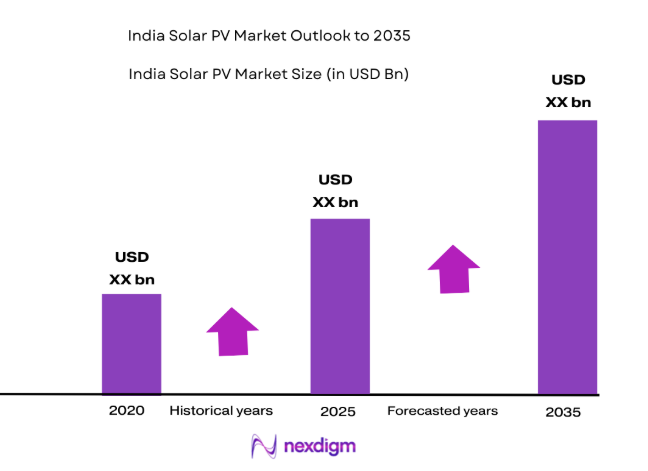
The India Solar PV market size was valued at approximately USD ~ billion based on recent historical assessments from credible industry estimates, reflecting strong growth in solar photovoltaic deployment across the country. This market valuation is driven by supportive government policies such as renewable energy targets and subsidy programs, increasing capacity addition, and declining technology costs that have expanded investment from utilities, corporations, and residential projects. Solar PV systems’ expanding role in India’s energy transition underpins robust market demand.
The market is particularly prominent in regions with high solar irradiance and infrastructure readiness, including Rajasthan, Gujarat, and Tamil Nadu, where large‑scale solar parks and utility projects are concentrated. These regions benefit from abundant land availability, clear skies, and strong grid connectivity, which attract developers and investors. Urban centers such as Delhi and Bengaluru also drive demand for distributed solar solutions due to increasing energy requirements and sustainability commitments by businesses and households.
Market Segmentation
By Product Type
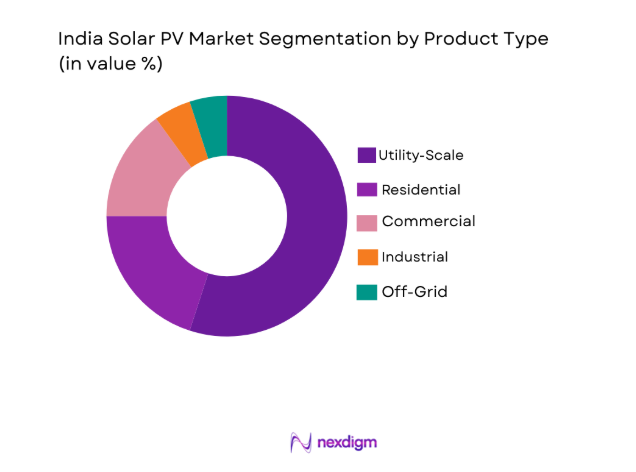
The India Solar PV market is segmented by product type into utility-scale solar systems, residential solar systems, commercial solar systems, industrial solar systems, and off-grid solar systems. Among these, utility-scale solar systems dominate the market due to increasing investments from both the government and private sector, aiming to achieve renewable energy targets and ensure grid stability. These large-scale systems generate substantial power to meet the growing energy demands of urban and industrial regions, benefiting from favorable policies and subsidies.
By Platform Type
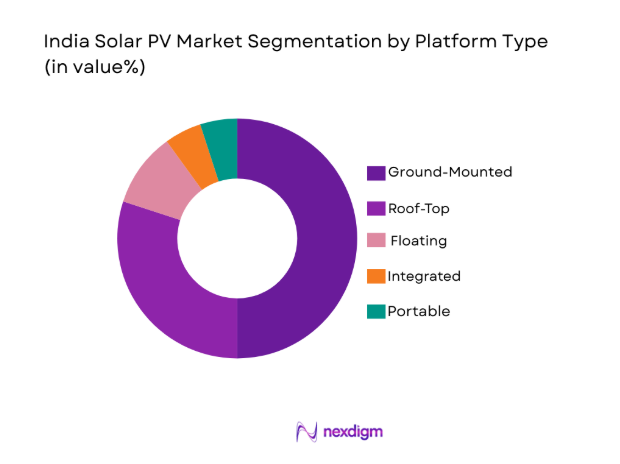
India’s Solar PV market is segmented by platform type into ground-mounted solar systems, roof-top solar systems, floating solar systems, integrated solar solutions, and portable solar solutions. Among these, ground-mounted solar systems lead the market, driven by large-scale investments and the availability of land for solar parks. These systems, located in regions with high solar irradiance, are more efficient and capable of generating significant amounts of electricity to feed into the grid, making them the preferred choice for utility-scale solar projects.
Competitive Landscape
The India Solar PV market is highly competitive, with a mix of established players and new entrants vying for market share. Major players dominate the landscape, benefiting from strong government support and expanding solar infrastructure. The competitive nature of the market is fostered by increasing consolidation, where large companies acquire smaller ones to scale operations, leading to enhanced technological capabilities and market expansion.
| Company Name | Establishment Year | Headquarters | Technology Focus | Market Reach | Key Products | Revenue (USD) | Additional Parameter |
| Tata Power Solar | 1993 | Mumbai | ~ | ~ | ~ | ~ | ~ |
| ReNew Power | 2011 | Gurgaon | ~ | ~ | ~ | ~ | ~ |
| Adani Solar | 2009 | Ahmedabad | ~ | ~ | ~ | ~ | ~ |
| Vikram Solar | 2006 | Kolkata | ~ | ~ | ~ | ~ | ~ |
| Waaree Energies | 2007 | Mumbai | ~ | ~ | ~ | ~ | ~ |

India Solar PV Market Analysis
Growth Drivers
Government Support and Policy Framework
The Indian government plays a crucial role in driving the growth of the solar PV market through policies such as the National Solar Mission and the Solar Park Scheme. These initiatives provide solar developers and investors with subsidies, tax incentives, and other financial support. The government’s focus on increasing the renewable energy share, particularly solar power, aligns with its goal of reducing dependence on fossil fuels and combating climate change. Additionally, ambitious solar energy generation targets have been set, aiming to significantly enhance the country’s renewable energy capacity in the coming years. The government’s support is also evident in its focus on creating the necessary infrastructure and policy framework to encourage investments in solar energy. These incentives help create a competitive market environment, enabling solar technology developers and installers to scale up their operations efficiently. This strong policy backing has been a key driver for the rapid adoption of solar PV systems in both urban and rural regions of India.
Technological Advancements and Cost Reduction
Technological innovations in solar power generation, particularly in the efficiency of solar panels and energy storage solutions, are driving down costs, making solar energy more affordable. As solar PV technology continues to improve, the cost per installed watt decreases, facilitating broader adoption across residential, commercial, and industrial sectors. For instance, innovations in solar panel materials and design have led to higher energy conversion rates, allowing systems to produce more electricity with less surface area. Furthermore, advancements in energy storage technology, such as lithium-ion batteries and other storage solutions, have made it possible to store excess solar energy generated during the day for use during cloudy periods or nighttime. The availability of advanced solar equipment, alongside the integration of solar PV systems with energy storage solutions, further boosts market demand, particularly in areas where grid access is unreliable. As solar technology becomes increasingly affordable, India’s solar PV market is expected to expand significantly across all sectors, from individual homes to large-scale industrial and utility projects.
Market Challenges
High Initial Investment Costs
Despite the decreasing costs of solar technology over the years, the high initial capital investment required for the installation of solar systems remains a significant barrier. The upfront costs of purchasing and installing solar panels, inverters, and energy storage systems can be prohibitive, especially for smaller commercial enterprises and residential customers. While the long-term savings from solar energy are substantial, these high initial expenses pose a challenge, particularly in rural areas where access to financing options and infrastructure is limited. In addition to the installation costs, the costs associated with land acquisition, installation labor, and maintenance can further deter potential buyers. Although government subsidies and tax incentives help reduce the financial burden, the capital-intensive nature of solar installation continues to limit market penetration, particularly in lower-income or rural regions. Addressing the affordability challenge, especially through improved financing models and lower-cost technologies, will be crucial to accelerating widespread adoption.
Grid Integration and Intermittency Issues
One of the most significant challenges to the growth of the solar PV market in India is the integration of solar power into the existing grid infrastructure. Solar energy is weather-dependent and varies depending on the time of day, seasons, and weather conditions. This intermittency issue makes it difficult to ensure a continuous, reliable supply of power from solar systems. The existing grid infrastructure, which was primarily designed for conventional energy sources, is not fully equipped to handle the fluctuations in solar energy generation. This leads to the need for additional infrastructure upgrades, such as smart grids and energy storage systems, to stabilize the supply of solar energy. The lack of widespread and efficient energy storage solutions exacerbates the issue, particularly in areas with inconsistent sunlight or in the event of sudden weather changes. Overcoming this challenge will require significant investment in both grid modernization and energy storage technologies, alongside a more flexible and dynamic approach to grid management to accommodate solar power’s variable nature.
Opportunities
Expansion of Solar Rooftop Solutions
With increasing urbanization and high energy demands in urban areas, rooftop solar installations are becoming increasingly popular in India. As more homeowners and businesses look for ways to reduce their energy bills and contribute to sustainability goals, rooftop solar systems offer an ideal solution. In densely populated urban areas, where land is scarce, rooftop installations are an efficient use of space. The government’s push to make solar more affordable through incentives, subsidies, and favorable financing options has contributed to the growth of the rooftop solar market. Additionally, as the cost of solar panels continues to decrease, more residential and commercial buildings are opting for rooftop solar installations to offset electricity consumption from the grid. This segment presents significant growth opportunities as India’s cities and towns expand. For commercial and industrial sectors, adopting rooftop solar solutions can lead to significant energy savings and reduce operational costs. The rise in government-backed net-metering schemes and easy installation processes has further accelerated the adoption of rooftop solar systems across India.
Integration with Energy Storage Systems
As the solar PV market continues to grow, integrating energy storage systems with solar power solutions presents an important opportunity. Energy storage systems, such as batteries, can store excess energy produced during sunny periods for later use during the night or on cloudy days, helping to overcome the intermittency issues associated with solar power generation. This integration ensures a more reliable and consistent energy supply, particularly in remote or off-grid areas where solar energy is often the primary source of power. The growing demand for energy independence, particularly among consumers in rural areas, is further driving the need for solar-plus-storage systems. Additionally, the adoption of energy storage systems will enhance the efficiency of solar systems, allowing businesses and households to become less reliant on the grid. The development of more affordable, scalable, and efficient energy storage solutions will be a key enabler in the widespread adoption of integrated solar storage systems, creating substantial growth opportunities within India’s solar PV market. As the government and private sector invest in improving energy storage technologies, this market segment is poised to see significant growth in the coming years.
Future Outlook
The Indian solar PV market is expected to continue its upward trajectory, driven by government policies, technological advancements, and increasing consumer awareness of the benefits of renewable energy. The next five years will likely witness further advancements in solar panel efficiency and energy storage solutions, combined with enhanced infrastructure and grid integration. Continued regulatory support, coupled with international investments, will fuel market growth, with significant developments expected in rural electrification and large-scale solar projects.
Major Players
- Tata Power Solar
- ReNew Power
- Adani Solar
- Vikram Solar
- Waaree Energies
- Jinko Solar
- Longi Solar
- Trina Solar
- First Solar
- SunPower Corporation
- SMA Solar Technology
- Canadian Solar
- Risen Energy
- L&T Solar
- GCL-Poly Energy
Key Target Audience
- Investments and venture capitalist firms
- Government and regulatory bodies
- Solar installation companies
- Commercial enterprises
- Residential property developers
- Energy utilities
- Large-scale solar farm operators
Research Methodology
Step 1: Identification of Key Variables
The identification of key market variables such as technology trends, regulatory frameworks, and consumer behavior patterns.
Step 2: Market Analysis and Construction
In-depth analysis of market drivers, challenges, and opportunities, along with segmentation based on product types, platform types, and geographic regions.
Step 3: Hypothesis Validation and Expert Consultation
Engagement with industry experts to validate hypotheses and market assumptions through interviews and consultations.
Step 4: Research Synthesis and Final Output
Consolidation of data, findings, and analysis into a comprehensive report that addresses all aspects of the market.

- Executive Summary
- Research Methodology (Definitions, Scope, Industry Assumptions, Market Sizing Approach, Primary & Secondary Research Framework, Data Collection & Verification Protocol, Analytic Models & Forecast Methodology, Limitations & Research Validity Checks)

- Market Definition and Scope
- Value Chain & Stakeholder Ecosystem
- Regulatory / Certification Landscape
- Sector Dynamics Affecting Demand
- Strategic Initiatives & Infrastructure Growth

- Growth Drivers
Government Support and Subsidies
Decreasing Solar Panel Costs
Technological Advancements in Solar Power Systems - Market Challenges
High Initial Investment Costs
Land Acquisition Issues for Large-Scale Projects
Dependence on Weather Conditions - Market Opportunities
Integration with Energy Storage Solutions
Growth in Rural Electrification
Technological Innovations in Solar Power Generation - Trends
Increasing Adoption of Rooftop Solar Solutions
Rise in Hybrid Solar Systems - Government Regulations
- SWOT Analysis
- Porter’s Five Forces

- By Market Value, 2020-2025
- By Installed Units, 2020-2025
- By Average System Price, 2020-2025
- By System Complexity Tier, 2020-2025

- By System Type (In Value%)
Utility-Scale Solar Systems
Residential Solar Systems
Commercial Solar Systems
Industrial Solar Systems
Off-Grid Solar Systems - By Platform Type (In Value%)
Ground-Mounted Solar Systems
Roof-Top Solar Systems
Floating Solar Systems
Integrated Solar Solutions
Portable Solar Solutions - By Fitment Type (In Value%)
On-Grid Solar Systems
Off-Grid Solar Systems
Hybrid Solar Systems
Integrated Solar Systems - By End User Segment (In Value%)
Residential Users
Commercial Users
Industrial Users

- Market Share Analysis
- Cross Comparison Parameters (System Type, Platform Type, Procurement Channel, End User Segment, Fitment Type, Market Value, Installed Units)
- SWOT Analysis of Key Competitors
- Pricing & Procurement Analysis
- Key Players
Tata Power Solar Systems Ltd
Adani Solar
ReNew Power
Vikram Solar
Waaree Energies Ltd
Loom Solar
NTPC Limited
Jinko Solar
First Solar
Sungrow Power Supply Co. Ltd
Longi Solar
SMA Solar Technology AG
Trina Solar
Azure Power
Siemens Gamesa Renewable Energy

- Increased Adoption by Residential Sector
- Commercial and Industrial Sectors Leading Solar Integration
- Government Push for Rural Electrification
- Shift Towards Hybrid Solutions in Industrial Applications

- Forecast Market Value, 2026-2035
- Forecast Installed Units, 2026-2035
- Price Forecast by System Tier, 2026-2035
- Future Demand by Platform, 2026-2035


 Request a Sample
 Ask for Customization
 Get a Quote
 Enquire Now