

 Download PDF
 Download PDF
Market Overview
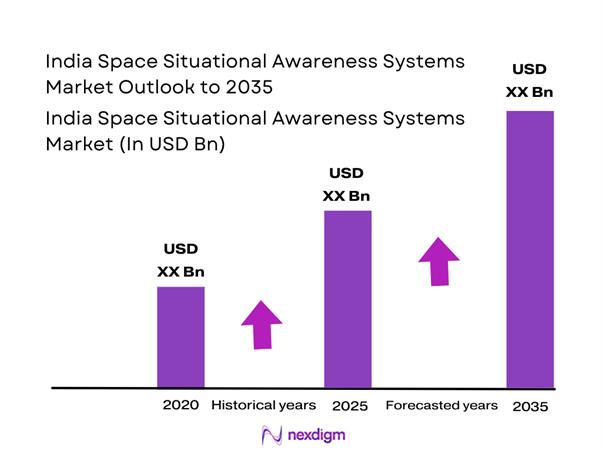
The India Space Situational Awareness Systems market current size stands at around USD ~ million and reflects steady institutional and strategic demand expansion. Activity levels increased across 2024 and 2025 driven by satellite launches, orbital congestion monitoring, and defense modernization priorities. The market demonstrates growing integration of ground-based sensors, analytics software, and tracking infrastructure. Demand momentum is supported by expanding satellite constellations, civil space missions, and defense surveillance programs. Technology adoption accelerated with improved data fusion and monitoring accuracy. Long-term investments continue to strengthen national space security capabilities.
The market is primarily concentrated across key aerospace and defense hubs with strong space infrastructure and policy support. Southern and central regions dominate due to established launch facilities, research institutions, and defense manufacturing clusters. Government-led programs drive ecosystem maturity through public–private collaboration models. Growing participation of private space firms strengthens supply depth and service innovation. Regulatory clarity and national space policy alignment further enhance market stability. The ecosystem benefits from coordinated development between defense, civil space agencies, and commercial operators.
Market Segmentation
By Technology Type
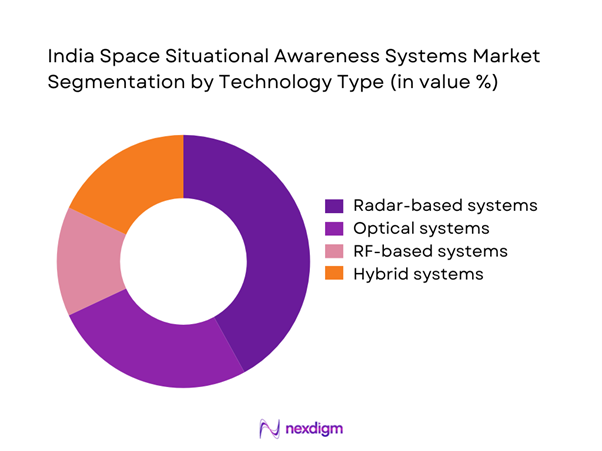
Radar-based surveillance systems dominate due to their established reliability and long-range monitoring capabilities across orbital regimes. Optical and electro-optical systems continue gaining traction for precise object identification and space debris tracking. RF-based detection platforms support complementary situational awareness functions for mission planning and anomaly detection. Hybrid architectures integrating multiple sensing modalities are increasingly adopted to improve tracking accuracy and reduce operational blind spots. Software-defined analytics platforms are expanding usage due to enhanced data processing, automation, and integration with command systems.
By End Use
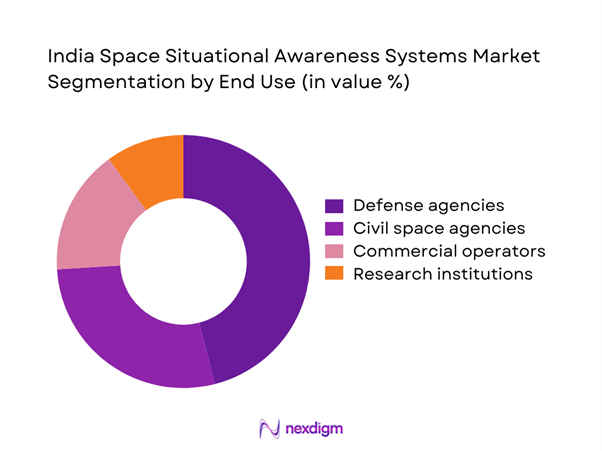
Defense and national security agencies represent the dominant end users due to mission-critical monitoring requirements and strategic surveillance mandates. Civil space agencies follow with demand linked to satellite fleet management and collision avoidance operations. Commercial satellite operators are increasingly adopting SSA solutions to protect high-value assets. Research organizations utilize systems for orbital modeling and debris analysis. Emerging commercial service providers support data analytics and situational awareness as managed services.
Competitive Landscape
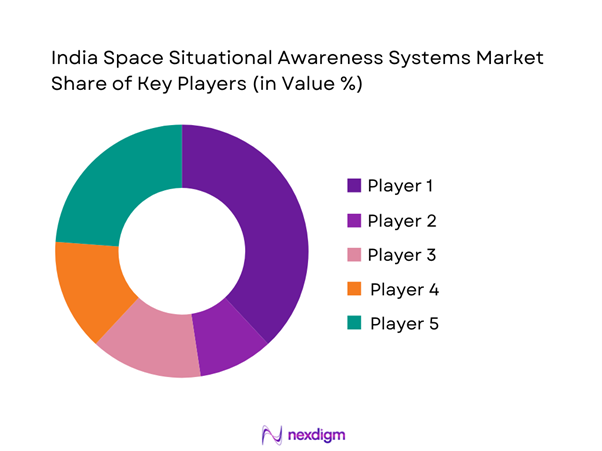
The competitive environment is characterized by a mix of government-led organizations and private technology developers. Market participation is shaped by long procurement cycles, technical qualification requirements, and regulatory oversight. Strategic collaborations and indigenous capability development define competitive positioning.
| Company Name | Establishment Year | Headquarters | Formulation Depth | Distribution Reach | Regulatory Readiness | Service Capability | Channel Strength | Pricing Flexibility |
| ISRO | 1969 | India | ~ | ~ | ~ | ~ | ~ | ~ |
| DRDO | 1958 | India | ~ | ~ | ~ | ~ | ~ | ~ |
| Ananth Technologies | 1992 | India | ~ | ~ | ~ | ~ | ~ | ~ |
| Bharat Electronics | 1954 | India | ~ | ~ | ~ | ~ | ~ | ~ |
| Tata Advanced Systems | 2010 | India | ~ | ~ | ~ | ~ | ~ | ~ |
India Space Situational Awareness Systems Market Analysis
Growth Drivers
Rising satellite launches and mega-constellation deployments
Rising satellite launches and mega-constellation deployments continue increasing the need for real-time orbital monitoring and collision avoidance capabilities. Expanding satellite counts during 2024 and 2025 significantly increased data processing requirements across national space monitoring frameworks. Defense modernization initiatives emphasized enhanced situational awareness to protect strategic orbital assets. Increasing dependency on satellite-enabled communication and navigation services strengthened operational monitoring priorities. Advancements in sensor technologies improved detection accuracy across multiple orbital layers. Integration of analytics platforms accelerated operational responsiveness for space domain awareness missions. Government-backed investments supported infrastructure expansion and system upgrades. Growing international collaboration encouraged adoption of interoperable monitoring standards. Heightened awareness of space debris risks strengthened long-term monitoring mandates. National security considerations remained a central driver of system deployment decisions.
Growing orbital congestion and debris risk
Growing orbital congestion and debris risk has intensified demand for predictive tracking and collision avoidance capabilities across operators. The increase in low-earth orbit deployments during 2024 elevated collision probability concerns. Mission planners increasingly rely on automated warning and avoidance systems. Advanced modeling tools became essential to prevent service disruptions and asset losses. Enhanced debris tracking improved satellite mission reliability. Regulatory emphasis on space sustainability strengthened operational compliance. Public sector programs expanded monitoring capacity for congested orbital zones. International coordination efforts encouraged improved data accuracy standards. Continuous tracking reduced risk exposure for high-value assets. Risk mitigation priorities accelerated system adoption rates.
Challenges
High capital cost of sensor deployment and maintenance
High capital cost of sensor deployment and maintenance remains a significant barrier for widespread infrastructure expansion. Advanced radar and optical systems require substantial investment for installation and upkeep. Budget limitations restrict rapid scalability across monitoring networks. Long development timelines delay deployment of next-generation systems. Infrastructure upgrades demand sustained funding commitments. Maintenance complexity increases operational expenditure over time. Limited commercial cost recovery models restrict private participation. Technical complexity raises lifecycle management challenges. Financial constraints slow modernization across legacy systems. Cost sensitivity impacts long-term procurement planning.
Limited indigenous high-precision tracking infrastructure
Limited indigenous high-precision tracking infrastructure constrains independent monitoring capabilities. Dependence on external data sources reduces operational autonomy. Technology development cycles remain lengthy for advanced sensing platforms. Integration challenges persist between legacy and modern systems. Skilled workforce shortages affect system deployment and maintenance efficiency. Data processing limitations restrict real-time analytics performance. Limited test facilities slow validation processes. Import dependency impacts supply reliability. Security protocols increase development complexity. Scaling domestic capabilities requires sustained investment focus.
Opportunities
Development of indigenous SSA constellations
Development of indigenous SSA constellations offers significant scope for technological self-reliance and operational autonomy. Government programs increasingly prioritize domestic manufacturing capabilities. Localized development reduces dependency on foreign data providers. Indigenous solutions enable customization for national mission requirements. Enhanced data ownership improves security posture. Investment in domestic innovation supports long-term sustainability. Collaborative platforms encourage industry participation. Emerging startups contribute specialized analytics capabilities. System integration opportunities expand across civil and defense domains. Policy support strengthens commercialization prospects.
Public–private partnerships in space surveillance
Public–private partnerships in space surveillance present opportunities for shared infrastructure development and cost optimization. Collaborative frameworks allow risk sharing between government and industry stakeholders. Private participation accelerates innovation and deployment timelines. Service-based models enable scalable monitoring solutions. Commercial analytics providers enhance data interpretation capabilities. Shared data platforms improve situational awareness coverage. Regulatory support encourages private sector involvement. Funding mechanisms attract technology-focused investments. Joint missions improve operational efficiency. Partnership models support long-term ecosystem growth.
Future Outlook
The India Space Situational Awareness Systems market is expected to experience steady expansion through 2035 driven by increased satellite deployments and security priorities. Continued government investment and private sector participation will strengthen infrastructure depth. Advancements in analytics, automation, and sensor integration will enhance monitoring efficiency. Policy alignment and international collaboration will further support long-term market development.
Major Players
- ISRO
- DRDO
- Ananth Technologies
- Bharat Electronics
- Tata Advanced Systems
- Alpha Design Technologies
- Larsen and Toubro Defence
- Digantara
- Bellatrix Aerospace
- Dhruva Space
- GalaxEye
- Agnikul Cosmos
- Paras Defence
- Astra Microwave
- Data Patterns
Key Target Audience
- Government anddefenseagencies
- Indian Space Research Organisation and ISRO centers
- Ministry of Defence and affiliated units
- Commercial satellite operators
- Space technology startups
- Satellite launch service providers
- Investments and venture capital firms
- Space policy and regulatory authorities
Research Methodology
Step 1: Identification of Key Variables
Market scope was defined using system types, application areas, and end-user categories. Key performance indicators were established based on operational relevance and deployment intensity. Data points were aligned with current space infrastructure frameworks.
Step 2: Market Analysis and Construction
Quantitative and qualitative inputs were synthesized to assess technology adoption patterns. Demand indicators were mapped against government programs and commercial activity. Segmentation logic was structured around functional and operational relevance.
Step 3: Hypothesis Validation and Expert Consultation
Findings were validated through consultations with domain experts and industry stakeholders. Assumptions were refined based on operational insights and deployment trends. Feedback loops ensured consistency and accuracy.
Step 4: Research Synthesis and Final Output
All data inputs were consolidated into a structured analytical framework. Trends, drivers, and risks were evaluated for consistency. Final outputs were aligned with industry dynamics and future outlook considerations.

- Executive Summary
- Research Methodology (Market Definitions and scope alignment for SSA systems, segmentation logic across sensing and analytics layers, bottom-up market sizing using program-level spending and contracts, revenue attribution by system type and deployment model, primary validation through space agency and defense stakeholder interviews, data triangulation using satellite launch and tracking datasets, assumption framework based on national space policy and defense modernization trends)

- Definition and scope of space situational awareness systems
- Evolution of SSA capabilities in India’s space and defense ecosystem
- Operational role in collision avoidance and space traffic management
- Ecosystem structure including government, defense, and private players
- Supply chain and data flow architecture
- Regulatory and policy environment governing space domain awareness

- Growth Drivers
Rising satellite launches and mega-constellation deployments
Growing orbital congestion and debris risk
National security and space defense modernization programs
Increasing reliance on satellite-enabled services
Government push for indigenous space technologies
Expansion of private space sector participation - Challenges
High capital cost of sensor deployment and maintenance
Limited indigenous high-precision tracking infrastructure
Data-sharing and interoperability constraints
Regulatory uncertainty around space traffic management
Skilled workforce and data analytics capability gaps
Dependence on foreign tracking data sources - Opportunities
Development of indigenous SSA constellations
Public–private partnerships in space surveillance
Export potential for SSA software and analytics
Integration of AI and predictive analytics
Regional leadership in space traffic management
Dual-use applications for civil and defense sectors - Trends
Shift toward autonomous space monitoring systems
Integration of AI and machine learning in SSA analytics
Growth of commercial SSA service providers
Increased focus on space sustainability frameworks
Real-time data fusion and visualization platforms
International collaboration for space domain awareness - Government Regulations
- SWOT Analysis
- Stakeholder and Ecosystem Analysis
- Porter’s Five Forces Analysis
- Competition Intensity and Ecosystem Mapping

- By Value, 2020–2025
- By Volume, 2020–2025
- By Active Systems, 2020–2025
- By Average Selling Price, 2020–2025

- By Fleet Type (in Value %)
Ground-based SSA systems
Space-based SSA payloads
Hybrid sensor networks - By Application (in Value %)
Space debris tracking
Collision avoidance and conjunction assessment
Space traffic management
Mission assurance and anomaly detection
Launch and re-entry monitoring - By Technology Architecture (in Value %)
Radar-based tracking systems
Optical and electro-optical systems
RF and signal intelligence-based tracking
AI-enabled data fusion and analytics platforms - By End-Use Industry (in Value %)
Defense and strategic agencies
Civil space agencies
Commercial satellite operators
Launch service providers
Research and academic institutions - By Connectivity Type (in Value %)
Ground network–connected systems
Cloud-enabled SSA platforms
Secure defense communication networks
Hybrid connectivity architectures

- Market structure and competitive positioning
Market share snapshot of major players - Cross Comparison Parameters (technology capability, sensor coverage, data accuracy, system scalability, integration capability, pricing model, government alignment, service support)
- SWOT Analysis of Key Players
- Pricing and Commercial Model Benchmarking
- Detailed Profiles of Major Companies
Indian Space Research Organisation (ISRO)
Defence Research and Development Organisation (DRDO)
Ananth Technologies
Alpha Design Technologies
Larsen & Toubro Defence
Tata Advanced Systems
Bharat Electronics Limited
Digantara
Bellatrix Aerospace
Agnikul Cosmos
Dhruva Space
GalaxEye Space
Lockheed Martin
Northrop Grumman
LeoLabs

- Demand and utilization drivers
- Procurement and tender dynamics
- Buying criteria and vendor selection
- Budget allocation and financing preferences
- Implementation barriers and risk factors
- Post-purchase service and support expectations

- By Value, 2026–2035
- By Volume, 2026–2035
- By Active Systems, 2026–2035
- By Average Selling Price, 2026–2035


 Request a Sample
 Ask for Customization
 Get a Quote
 Enquire Now