

 Download PDF
Market Overview
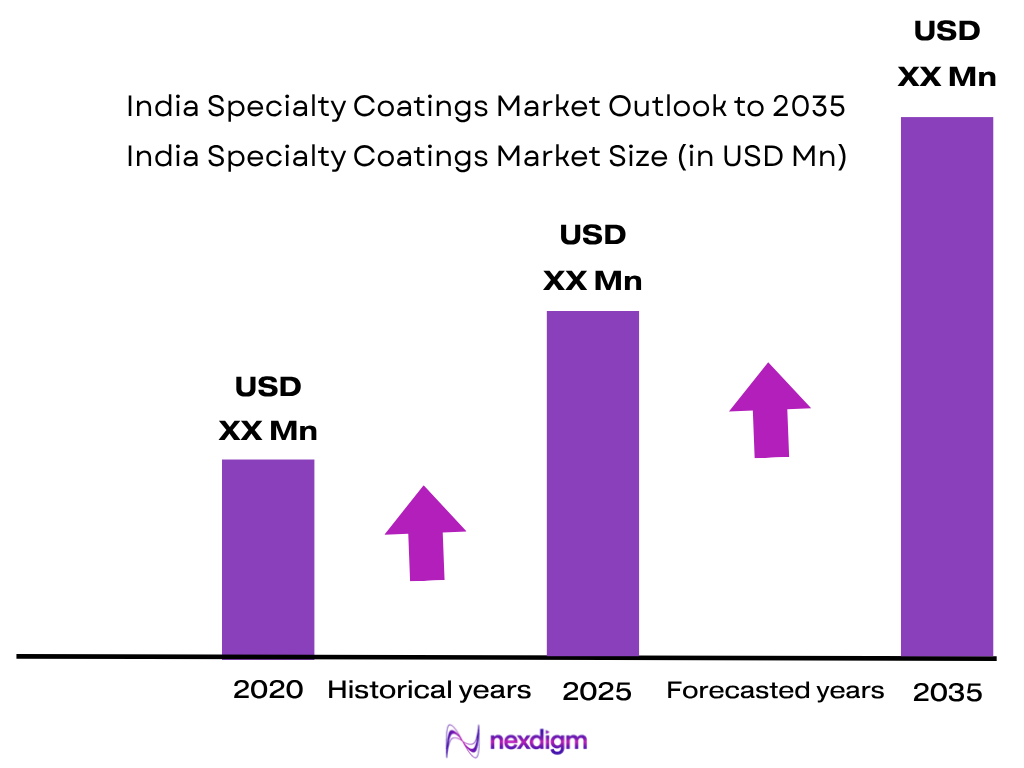
The India Specialty Coatings Market is valued at approximately ~USD X.X billion, compared with ~USD X.X billion in the preceding comparable period. Demand is supported by industrial manufacturing, automotive production, infrastructure, steel, energy and asset-protection requirements. India’s crude steel output increased from 140.8 million tonnes to 149.6 million tonnes, while automobile production reached 30.61 million units, creating substantial substrate volumes requiring automotive, protective, powder, heat-resistant and other performance coatings.
Western and southern industrial corridors are the most influential specialty-coatings demand centres. Mumbai-Pune, Ahmedabad-Vadodara, Chennai-Hosur and Bengaluru benefit from concentrations of automotive OEMs, engineering companies, refineries, petrochemical facilities, steel processing, appliances and export manufacturing. Western India is particularly important because Maharashtra and Gujarat combine ports, refineries, petroleum and petrochemical corridors with large manufacturing clusters. Renewable-energy capacity also expanded from approximately 180.4 GW to 198.96 GW, broadening demand for protective coatings across solar, wind and associated infrastructure.
Market Segmentation
By Coating Type
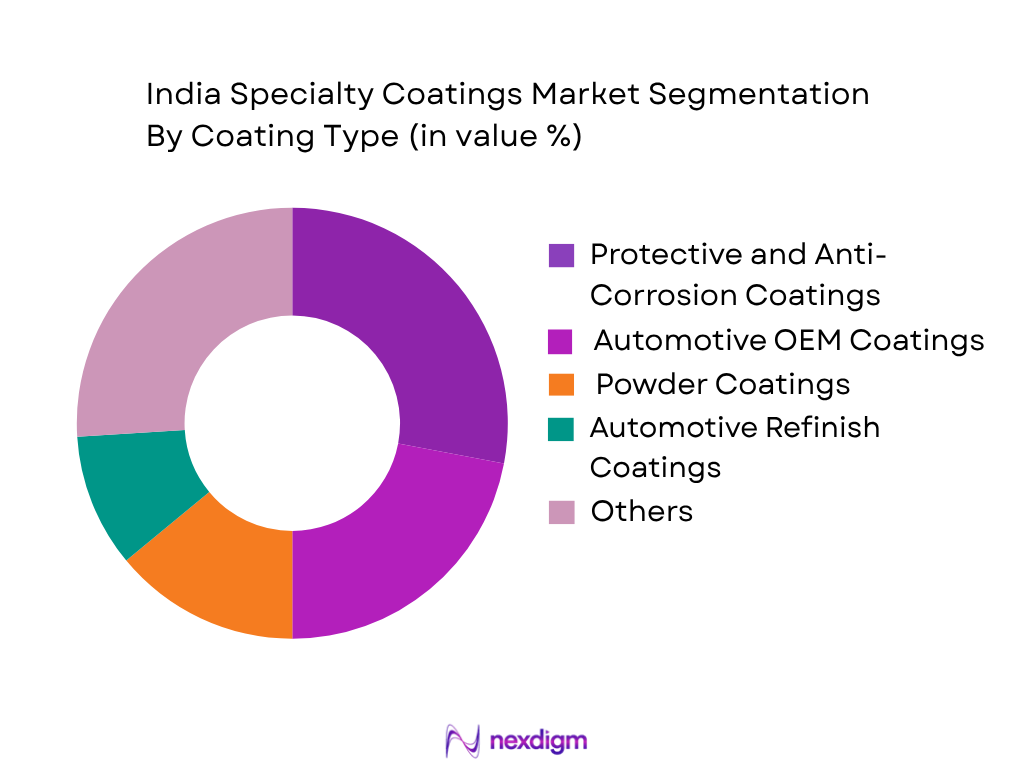
The India Specialty Coatings Market is segmented by coating type into protective and anti-corrosion coatings, automotive OEM coatings, automotive refinish coatings, powder coatings, coil coatings, marine coatings, industrial floor coatings, packaging and can coatings, and other functional coatings. Protective and anti-corrosion coatings constitute the leading specialty segment in the working market model because India has a large installed base of steel-intensive infrastructure, refineries, petrochemical plants, pipelines, ports, power assets and industrial machinery exposed to moisture, chemicals and high temperatures. Infrastructure development also increases consumption of primers, epoxy intermediates, polyurethane topcoats and high-build systems. Asian Paints PPG identifies infrastructure, oil and gas, power generation, construction, machinery and renewable-energy projects as important drivers of its non-automotive industrial business. Growing awareness of lifecycle maintenance and passive fire protection further supports specification-led demand.
By Resin Chemistry
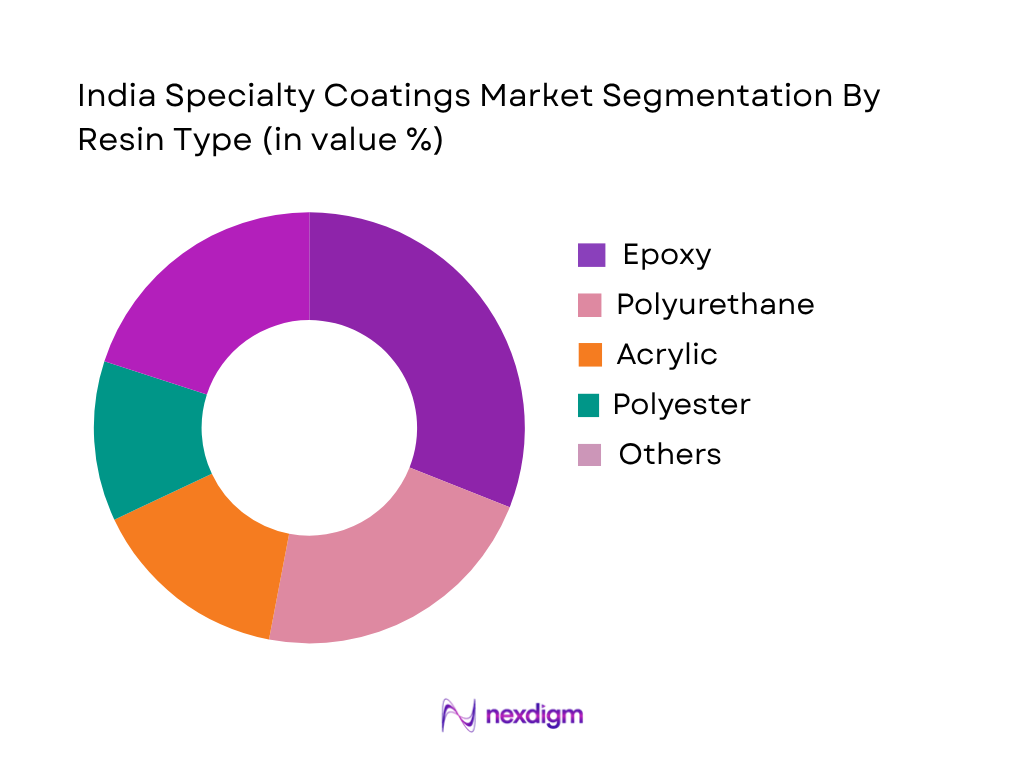
By resin chemistry, the India Specialty Coatings Market is segmented into epoxy, polyurethane, acrylic, polyester, alkyd, fluoropolymer, silicone, polyurea/polysiloxane and other specialty resin systems. Epoxy-based systems hold the dominant position because their adhesion, barrier properties, chemical resistance and corrosion protection make them applicable across structural steel, flooring, tanks, pipelines, industrial machinery, marine assets and process facilities. Published India protective-coatings research identifies epoxy as the dominant resin, while industrial-coatings research also places epoxy among the largest resin technologies. Epoxies are especially entrenched as primers and intermediate coats in multilayer protective systems and as high-build linings for aggressive operating environments. Their broad substrate compatibility and ability to incorporate zinc, glass flake and specialized curing agents further reinforce their importance in India’s specification-driven industrial coating applications.
Competitive Landscape
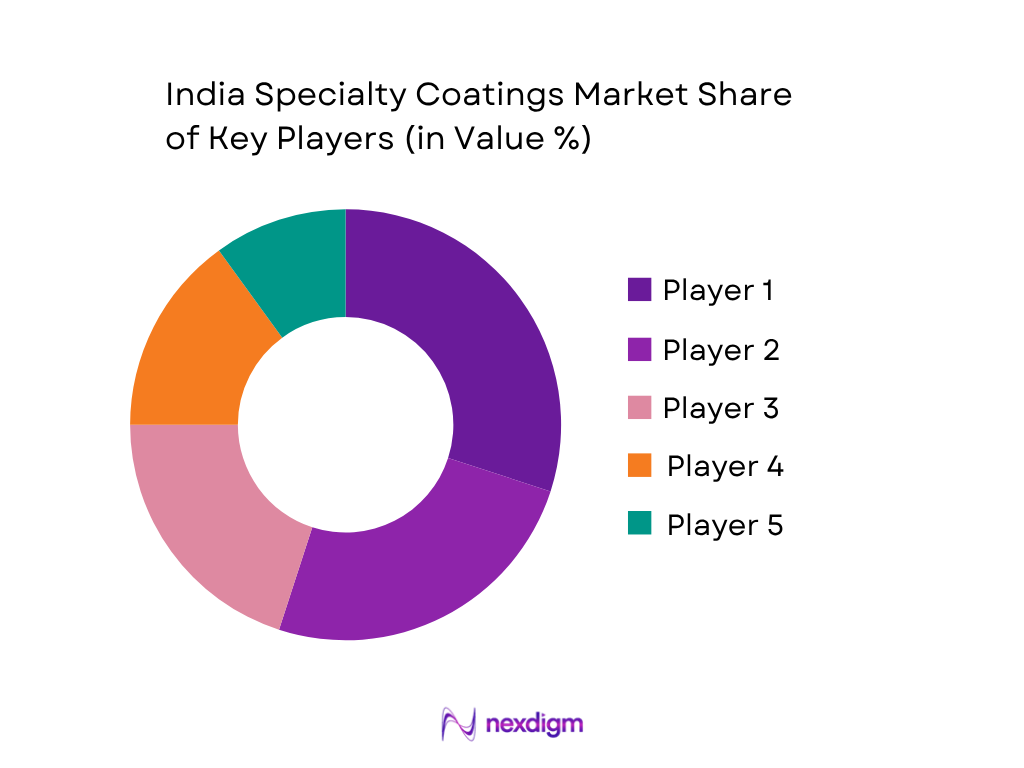
The India Specialty Coatings Market has a mix of Indian coating majors, multinational technology companies and application-focused specialists. Competition is considerably more technical than in decorative paints because automotive OEM approvals, corrosion specifications, coating-system warranties, application engineering and qualification cycles create meaningful barriers to entry. Kansai Nerolac has a particularly strong automotive-industrial position, while Asian Paints participates through PPG-linked businesses covering automotive, refinish, protective, powder, packaging and marine coatings. Berger, Akzo Nobel and Nippon Paint also maintain broad industrial capabilities.
| Major Player | Establishment | Headquarters | Protective Coatings | Automotive Coatings | Powder Coatings | Marine/Heavy Duty | Low-VOC Technology | Technical/OEM Positioning |
| Asian Paints / PPG Businesses | 1942* | Mumbai | ~ | ~ | ~ | ~ | ~ | ~ |
| Kansai Nerolac Paints | 1920 | Mumbai | ~ | ~ | ~ | ~ | ~ | ~ |
| Berger Paints India | 1923 | Kolkata | ~ | ~ | ~ | ~ | ~ | ~ |
| Akzo Nobel India | 1954* | Gurugram | ~ | ~ | ~ | ~ | ~ | ~ |
| Nippon Paint India | 2006* | Chennai | ~ | ~ | ~ | ~ | ~ |
India Specialty Coatings Market Analysis
Growth Drivers
Expansion of Automotive and Engineering Manufacturing
India’s expanding automotive and engineering production base is creating a structurally larger substrate pool for automotive OEM coatings, refinish systems, powder coatings, electrocoats, primers, clearcoats, underbody protection and high-performance component coatings. The Ministry of Heavy Industries reported 31.03 million automobiles produced during FY2024-25, comprising 5.061 million passenger vehicles, 1.033 million commercial vehicles, 1.050 million three-wheelers and 23.884 million two-wheelers. Electric mobility is adding technically demanding applications: official data recorded 92,170 electric passenger vehicles, 8,660 electric commercial vehicles, 632,780 electric three-wheelers and 948,420 electric two-wheelers produced during FY2023-24. The underlying manufacturing economy provides additional support; World Bank data place India’s manufacturing value added at about USD 490.4 billion in 2024, while GDP stood at approximately USD 3.76 trillion. These production volumes directly support requirements for corrosion-resistant primers, cathodic electro-deposition coatings, powder finishes, abrasion-resistant systems, battery-pack protection and thermal-management coatings. The Ministry of Heavy Industries additionally allocated ₹25,938 crore to the automobile and auto-component PLI programme and ₹10,900 crore to PM E-DRIVE, strengthening domestic mobility manufacturing and consequently expanding addressable industrial coating applications.
Infrastructure, Steel and Renewable-Energy Asset Expansion
India’s infrastructure and heavy-asset pipeline is a major demand engine for protective, anti-corrosion, intumescent, high-temperature, flooring, pipeline, marine and weather-resistant specialty coatings. The Ministry of Road Transport and Highways reported a 146,145-km National Highway network in 2024, including 48,422 km of four-lane-and-above highways and approximately 2,138 km of operational high-speed corridors. The Union Budget provided ₹11,11,111 crore for central capital expenditure in FY2024-25 and another ₹1.5 lakh crore in long-term interest-free loans to states for infrastructure investment. Steel-intensive industrial development reinforces coating consumption: the Ministry of Steel recorded 144.299 million tonnes of crude steel production and 179.515 million tonnes of domestic crude-steel capacity in FY2023-24, followed by 112.011 million tonnes of production during April-December FY2024-25. Renewable infrastructure is creating another large exposure base; the Ministry of New and Renewable Energy reported 198.96 GW of renewable capacity in August 2024, including 89.43 GW solar and 47.19 GW wind. These assets require corrosion barriers, UV-resistant systems, structural-steel coatings, tower coatings, flooring and maintenance recoats throughout their operating lives.
Market Challenges
Dependence on Imported Chemicals and Specialty Petrochemical Inputs
Specialty coating manufacturers face supply-chain exposure because advanced formulations depend on resins, solvents, monomers, curing agents, functional additives and other petrochemical intermediates whose domestic availability is uneven. The Department of Chemicals and Petrochemicals reported ₹6,31,898 crore of chemical and petrochemical imports, excluding pharmaceuticals and fertilizers, in FY2024-25. Within the upstream chemical basket, imports included ₹7,755 crore of methanol, ₹4,034 crore of acetic acid and ₹11,105 crore of styrene, while polypropylene imports reached ₹15,627 crore and purified terephthalic acid imports reached ₹13,501 crore. These numbers indicate the scale of India’s exposure to international chemical supply chains, which matters for coating formulators using petrochemical-derived binders, solvents and specialty intermediates. The broader manufacturing economy generated approximately USD 490.4 billion of manufacturing value added in 2024, according to World Bank data, meaning coating producers must compete with several large manufacturing industries for chemical feedstocks and logistics capacity. Domestic petrochemical production was 42.161 million tonnes in FY2023-24, against installed capacity of 52.287 million tonnes, highlighting why localization of specialized coating inputs remains an important operational issue rather than merely a procurement consideration.
Application Complexity and Performance Qualification Across Industrial Assets
Specialty coatings face a commercialization challenge that conventional decorative products largely avoid: performance is dependent on substrate preparation, coating-system design, film build, curing conditions, application skill and end-user qualification. India’s scale magnifies this requirement. The Ministry of Ports, Shipping and Waterways reported 819.294 million tonnes of cargo handled by major ports in FY2023-24, including 245.995 million tonnes of petroleum, oil and lubricants cargo, 191.982 million tonnes of coal and 61.046 million tonnes of iron ore. During the first nine months of FY2024-25, major ports had already handled 621.760 million tonnes. These ports, storage systems, cranes, pipelines, tanks and marine structures operate in aggressive corrosion environments where improper application can materially reduce coating life. Similarly, India produced 144.299 million tonnes of crude steel in FY2023-24, providing a large base of fabricated steel requiring controlled surface preparation and specification compliance. World Bank data put national GDP at approximately USD 3.76 trillion in 2024, illustrating the economic scale of the asset base requiring protection. For coating suppliers, consequently, laboratory performance alone is insufficient; technical-service networks, applicator training, field inspection, OEM approvals and specification capability remain major barriers to rapid product substitution and new-supplier entry.
Market Opportunities
Renewable Energy, EV and Advanced Mobility Coating Applications
India’s energy-transition and electric-mobility manufacturing base is creating new applications for thermal-management coatings, dielectric systems, battery fire-protection materials, corrosion-resistant battery-pack coatings, busbar insulation, wind-turbine protection and solar-infrastructure coatings. Current operating indicators provide a substantial base for future adoption. The Ministry of New and Renewable Energy recorded 198.96 GW of renewable-energy capacity in August 2024, comprising 89.43 GW of solar, 47.19 GW of wind, 46.92 GW of large hydro, 10.35 GW of bio-power and 5.07 GW of small hydro. Renewable capacity subsequently reached 253.96 GW in November 2025, with solar capacity at 132.85 GW and wind at 53.99 GW. Electric mobility is simultaneously enlarging the addressable coating ecosystem: official Ministry of Heavy Industries data recorded 92,170 electric passenger vehicles, 632,780 electric three-wheelers and 948,420 electric two-wheelers produced in FY2023-24. India’s broader GDP was approximately USD 3.76 trillion in 2024, according to the World Bank, providing a large industrial base for capital deployment. These installed assets create opportunities for coatings suppliers able to meet electrical insulation, thermal control, UV durability, salt resistance, abrasion resistance and long-service-life requirements.
Electronics Manufacturing and High-Performance Functional Coatings
India’s expanding electronics production ecosystem creates a significant future opportunity for conformal coatings, moisture barriers, electrically insulating coatings, EMI-shielding systems, thermal-interface coatings, protective encapsulation and high-purity functional coating technologies. Government data show electronics production reaching ₹11.3 lakh crore in FY2024-25, while electronics exports reached ₹3.27 lakh crore. Mobile-phone production alone reached ₹5.45 lakh crore, supported by approximately 300 manufacturing units, and mobile-phone exports reached ₹2 lakh crore. The sector has generated approximately 2.5 million jobs over the preceding decade, demonstrating the scale of the domestic production ecosystem that now requires localized component materials and manufacturing consumables. Electronics exports reached USD 22.2 billion in the first half of FY2025-26, strengthening the importance of internationally compliant production processes and component protection. At the macroeconomic level, the World Bank recorded approximately USD 490.4 billion in manufacturing value added in 2024, providing a substantial base for higher-value industrial materials. Specialty coating suppliers that can provide controlled dielectric strength, humidity resistance, thermal dissipation, thin-film uniformity and compatibility with automated electronics manufacturing therefore have a credible opportunity to move beyond conventional industrial coatings into higher-specification functional materials.
Future Outlook
The India Specialty Coatings Market is expected to expand at a forecast CAGR of approximately ~X.X% during 2026–2035. Growth is likely to be increasingly driven by performance requirements rather than purely coating volume. Infrastructure longevity, automotive and EV production, renewable-energy installations, refinery and petrochemical investments, rail and metro systems, electronics manufacturing and domestic industrialization should expand the addressable market. Protective coatings will continue benefiting from corrosion-management requirements across structural steel and process industries, while powder coatings should gain from improved material utilization and lower solvent emissions. Automotive suppliers are expected to invest in lower-bake, high-solids and energy-efficient paint systems as OEMs attempt to reduce manufacturing energy intensity. Berger has already highlighted low-bake and EV-oriented industrial formulations, while Kansai Nerolac is developing compact coating processes, high-solid products and solutions for multiple vehicle categories.
Emerging white spaces include battery-pack protection, thermal-management coatings, conformal electronics coatings, corrosion-under-insulation systems, intumescent fire-protection coatings, offshore and wind-energy coatings, high-performance tank linings and advanced powder coatings. Import substitution will also become commercially important for specialty resins, additives and high-specification formulations where domestic manufacturers can achieve customer qualification and consistent performance.
Major Players
- Asian Paints PPG Pvt. Ltd.
- PPG Asian Paints Pvt. Ltd.
- Berger Paints India Ltd.
- Berger Becker Coatings Pvt. Ltd.
- Kansai Nerolac Paints Ltd.
- Akzo Nobel India Ltd.
- Nippon Paint India Pvt. Ltd.
- Jotun India Pvt. Ltd.
- Hempel India Pvt. Ltd.
- Axalta Coating Systems India Pvt. Ltd.
- BASF Coatings
- Sherwin-Williams India
- Carboline India
- Beckers Group
- Sika India Pvt. Ltd.
Key Target Audience
- Specialty Coatings Manufacturers
- Industrial Resin, Pigment and Performance-Additive Manufacturer
- Automotive, Engineering and Capital-Goods OEMs
- Oil & Gas, Petrochemical, Power and Infrastructure Asset Owners
- EPC Contractors and Approved Industrial Coating Applicators
- Industrial Coatings Distributors and Specialty Chemical Suppliers
- Investments and Venture Capitalist Firms
- Government and Regulatory Bodies
Research Methodology
Step 1: Identification of Key Variables
The initial stage involves constructing an India Specialty Coatings Market ecosystem covering coating formulators, resin and additive suppliers, OEMs, EPC contractors, applicators, distributors and industrial end users. Secondary research is used to identify critical variables including coating consumption, substrate area, resin mix, technology mix, replacement cycles, average selling prices and end-use production indicators.
Step 2: Market Analysis and Construction
Historical demand is evaluated through both top-down and bottom-up approaches. Top-down analysis begins with the broader industrial coatings ecosystem and isolates specialty performance applications, while bottom-up analysis considers automotive output, steel production, infrastructure assets, industrial capacity, coated surface area, coating consumption per application and maintenance frequency. Company disclosures and trade flows are used to reconcile supply.
Step 3: Hypothesis Validation and Expert Consultation
Initial market hypotheses are validated through structured interviews and CATIs with specialty-coating manufacturers, raw-material suppliers, technical managers, distributors, OEM procurement teams, EPC contractors and coating applicators. Interviews focus on product volumes, realized pricing, competitive positioning, resin technologies, specification practices, customer approval processes and changes in demand across end-use industries.
Step 4: Research Synthesis and Final Output
Primary findings are triangulated against company annual reports, government production statistics, industry associations, trade information and end-use indicators. Segment-level results are reconciled with overall market demand through both supply- and consumption-side models. Forecasts are then constructed using industry production, infrastructure investment, technology substitution, recoat cycles, localization, pricing and regulatory trends.

- Executive Summary
- Research Methodology (Market Definition and Scope, India Specialty Coatings Taxonomy, Coating Function Classification, Resin Chemistry Mapping, Technology Classification, Market Sizing Framework, Top-Down Analysis, Bottom-Up Analysis, Domestic Production Assessment, Import Dependency Assessment, Demand-Side Assessment, Supply-Side Assessment, End-Use Application Mapping, OEM and Maintenance Demand Assessment, Primary Industry Interviews, Trade-Flow Validation, Data Triangulation, Forecasting Framework, Scenario Analysis, Assumptions and Limitations)

- Definition and Scope
- India Specialty Coatings Industry Evolution and Technology Development
- Specialty Coatings Manufacturing and Formulation Process
- Specialty Coatings Value Chain Analysis
- India Specialty Coatings Supply Chain Analysis

- Growth Drivers (Infrastructure and Industrial Capex Expansion, Automotive and EV Manufacturing Growth, Rising Corrosion-Protection Requirements, Oil and Gas and Petrochemical Capacity Expansion, Renewable-Energy Installations, Railway and Metro Infrastructure Development, Growth of Electronics Manufacturing, Increasing Asset-Life and Lifecycle-Cost Focus)
- Market Challenges (Raw-Material Price Volatility, Dependence on Imported Specialty Resins and Additives, Long OEM Qualification Cycles, High Product-Validation Costs, Skilled Applicator Shortage, Surface-Preparation Quality Variability, Environmental Compliance Costs, Price Competition from Regional and Unorganized Suppliers)
- Market Opportunities (EV Battery and Component Coatings, Corrosion-Under-Insulation Coatings, Intumescent Fire Protection, Electronics and Conformal Coatings, High-Performance Tank Linings, Wind-Turbine Coatings, Solar Functional Coatings, Low-Temperature Cure Powder Coatings, Water-Borne Industrial Coatings, High-Solids and Solvent-Free Coatings, Import Substitution of Specialty Formulations)
- Market Trends (Low-VOC Technology Migration, High-Solids Coating Adoption, Water-Borne Industrial Coatings, Powder-Coating Penetration, Low-Bake and Fast-Cure Technologies, Chrome-Free and Heavy-Metal-Free Systems, Nano-Enabled Functional Coatings, Longer-Life Anti-Corrosion Systems, Direct-to-Metal Coatings, Smart and Self-Healing Coatings)
- Regulatory and Standards Landscape (Bureau of Indian Standards, VOC and Air-Emission Requirements, Lead and Heavy-Metal Restrictions, Hazardous and Other Wastes Regulations, Environmental Protection Requirements, Factory and Worker Safety Requirements, Food-Contact Coating Standards, Automotive OEM Specifications, Railway and Infrastructure Coating Specifications)
- SWOT Analysis
- Porter’s Five Forces Analysis
- PESTLE Analysis

- By Market Value (2020-2025)
- By Coating Consumption Volume (2020-2025)
- By Domestic Production Volume (2020-2025)
- By Import Volume (2020-2025)
- By Export Volume (2020-2025)
- By OEM Coating Demand Volume (2020-2025)
- By Maintenance and Recoat Volume (2020-2025)
- By Average Realized Selling Price (2020-2025)
- By Application Revenue (2020-2025)

- By Coating Type (In Value %)
Protective and Anti-Corrosion Coatings
Automotive OEM Coatings
Automotive Refinish Coatings
Powder Coatings
Coil Coatings
Marine Coatings
Industrial Floor Coatings
Packaging and Can Coatings
Fire-Protective and Intumescent Coatings
High-Temperature and Heat-Resistant Coatings
Pipeline and Tank Linings
Electrical and Electronics Coatings
Functional and Smart Coatings - By Resin Chemistry (In Value %)
Epoxy Coatings
Polyurethane Coatings
Acrylic Coatings
Polyester Coatings
Alkyd Coatings
Fluoropolymer Coatings
Silicone Coatings
Vinyl Ester Coatings
Polyurea Coatings
Polysiloxane Coatings
Hybrid Resin Systems - By Technology (In Value %)
Solvent-Borne Coatings
Water-Borne Coatings
Powder Coatings
High-Solids Coatings
100% Solids Coatings
UV-Cured Coatings
Electron-Beam-Cured Coatings
Two-Component Reactive Coatings - By End-Use Industry (In Value %)
Automotive and Mobility
Oil and Gas
Petrochemicals and Refineries
Construction and Infrastructure
Power Generation
Renewable Energy
Steel and Metals
Industrial Machinery and Capital Goods
Marine and Shipbuilding
Railways and Metro Systems
Aerospace and Defence
Electrical and Electronics
Consumer Durables and Appliances
Packaging
Food and Beverage Processing
Pharmaceuticals and Healthcare
Water and Wastewater Infrastructure - By Substrate (In Value %)
Carbon Steel
Galvanized Steel
Stainless Steel
Aluminium
Other Non-Ferrous Metals
Concrete
Plastics and Polymer Composites
Wood and Engineered Wood
Glass
Electronic Components and Printed Circuit Boards - By Customer Type (In Value %)
Automotive OEMs
Industrial OEMs
Tier-I and Tier-II Component Manufacturers
EPC Contractors
Infrastructure Developers
Oil and Gas Asset Owners
Public-Sector Undertakings
Marine and Shipyard Operators
Approved Applicators
Maintenance Contractors
Automotive Refinish Workshops
Industrial Distributors and Dealers

- Market Share of Major Players (By Revenue, Volume, Coating Type, Resin Chemistry, Technology, End-Use Industry, Customer Type, Distribution Channel)
- Cross Comparison Parameters (Specialty Coating Portfolio Breadth, India Specialty-Coating Manufacturing Capacity, Protective and Corrosion Technology Depth, Automotive OEM Approval Penetration, Powder and Coil Coating Capability, High-Solids and Low-VOC Portfolio Share, End-Use Specification Wins, Technical Service and Approved Applicator Network)
- SWOT Analysis of Major Players
- Detailed Profiles of Major Companies
Asian Paints PPG
PPG Asian Paints
Berger Paints India
Berger Becker Coatings
Kansai Nerolac Paints
Akzo Nobel India
Nippon Paint India
Jotun India
Hempel India
Axalta Coating Systems India
BASF Coatings
Sherwin-Williams India
Carboline India
Beckers Group
Sika India

- OEM and EPC Vendor Qualification Behaviour
- Technical Service Requirement
- Buyer Pain Points
- Technology Adoption Assessment
- Replacement and Recoat Behaviour
- Price versus Lifecycle-Cost Assessmen

- By Market Value (2026-2035)
- By Coating Consumption Volume (2026-2035)
- By Domestic Production Volume (2026-2035)
- By Import Volume (2026-2035)
- By Export Volume (2026-2035)
- By OEM Coating Demand Volume (2026-2035)
- By Maintenance and Recoat Volume (2026-2035)
- By Average Realized Selling Price (2026-2035)
- By Application Revenue (2026-2035)


 Request a Sample
 Ask for Customization
 Get a Quote
 Enquire Now