
 Download PDF
Market Overview
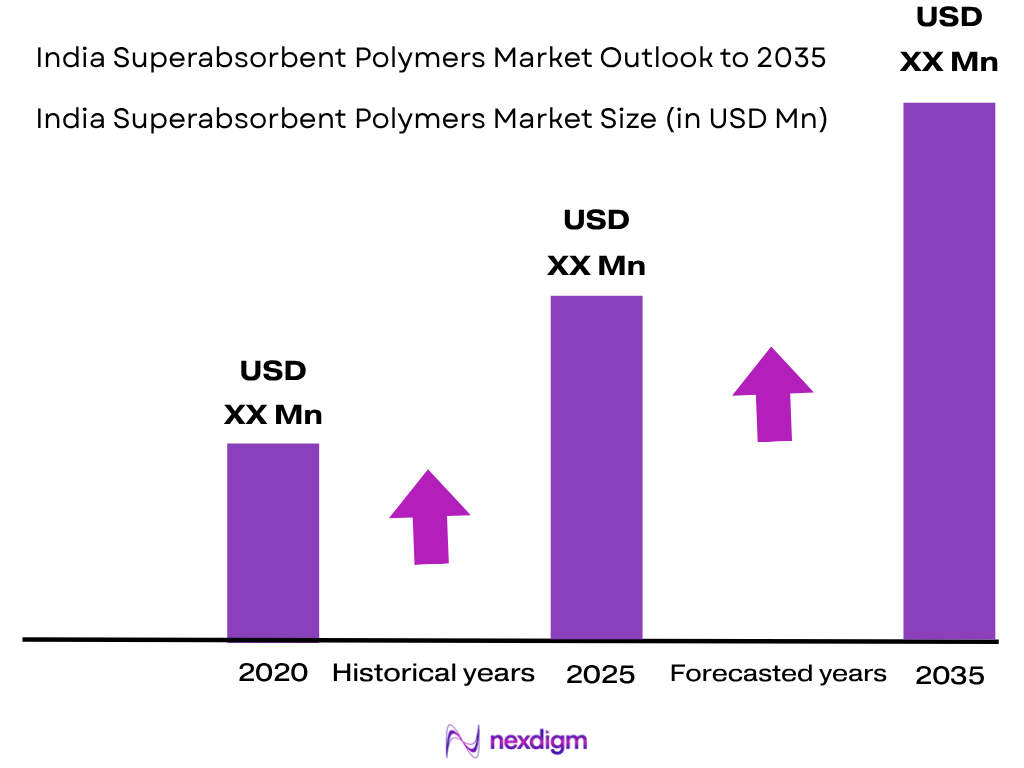
The India Superabsorbent Polymers Market is valued at ~USD XXX million in 2024 and is supported primarily by expanding disposable hygiene consumption, increasing awareness of adult incontinence products, rising feminine hygiene adoption, healthcare applications and emerging agricultural water-management uses. Demand is closely linked with the country’s large population base, expanding urban population and development of organized hygiene-product manufacturing. Increasing preference for thinner, lighter and higher-absorbency diapers and sanitary products is also encouraging manufacturers to use SAP grades offering faster absorption, higher retention and improved absorbency under pressure. The market is further influenced by domestic hygiene-product manufacturing, imports of specialty SAP grades and the development of localized polymer and chemical manufacturing capabilities.
The India Superabsorbent Polymers Market is concentrated around major industrial, consumer and chemical-manufacturing clusters, particularly Maharashtra, Gujarat, Tamil Nadu, Karnataka, Telangana, Uttar Pradesh and Delhi-NCR. Maharashtra and Gujarat benefit from established chemical and petrochemical infrastructure, ports and large manufacturing ecosystems, while Tamil Nadu and Karnataka provide strong consumer-goods, healthcare and industrial manufacturing bases. Delhi-NCR and Uttar Pradesh represent important consumption centers because of their large population and expanding distribution infrastructure. Hyderabad and Bengaluru additionally support healthcare and advanced manufacturing applications. The geographic structure creates opportunities for SAP suppliers to establish regional warehouses, technical-service centers and converter partnerships close to hygiene-product manufacturers.
Market Segmentation
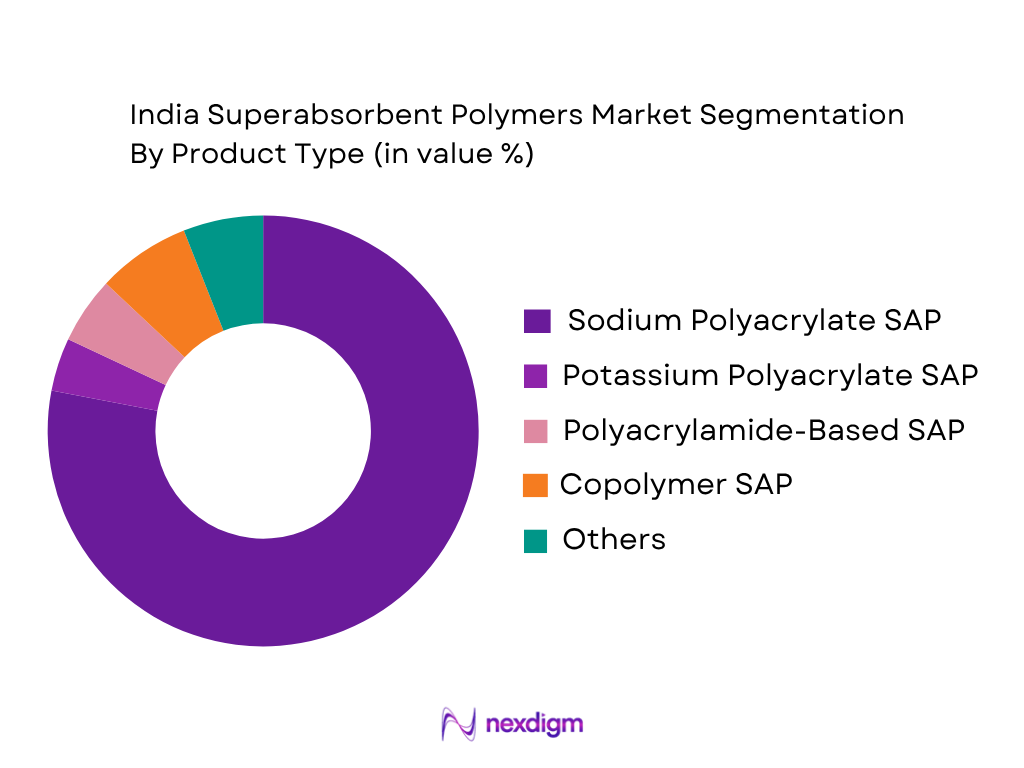
By Product Type
The India Superabsorbent Polymers Market is segmented by product type into sodium polyacrylate superabsorbent polymers, potassium polyacrylate superabsorbent polymers, polyacrylamide-based SAP, copolymer SAP, bio-based and modified natural polymer SAP, and other specialty superabsorbent polymers. Sodium polyacrylate represents the dominant sub-segment because of its established use in disposable hygiene products and its combination of high liquid absorption, retention and manufacturing compatibility. Baby diapers, adult incontinence products and feminine hygiene products require SAP capable of rapidly absorbing fluid and retaining it within the absorbent core. Sodium polyacrylate has therefore become closely integrated with high-speed hygiene-product converting processes. Its established formulation technologies, availability across multiple performance grades and familiarity among hygiene-product manufacturers further reinforce its position. Demand is also supported by efforts to develop thinner products without compromising absorbency, encouraging manufacturers to optimize SAP utilization and particle characteristics. Specialty and bio-based SAP grades are gaining attention because of sustainability requirements and application-specific performance, but their adoption remains more focused. Consequently, sodium polyacrylate continues to represent the primary product platform for India’s SAP consumption.
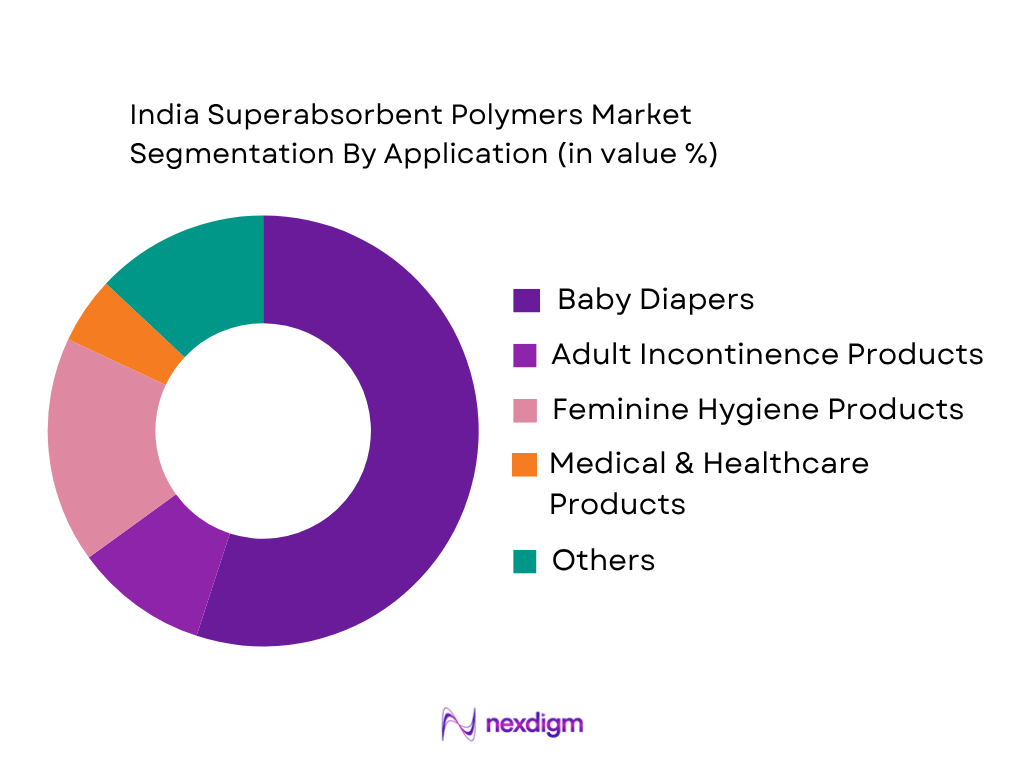
By Application
The India Superabsorbent Polymers Market is segmented by application into baby diapers, adult incontinence products, feminine hygiene products, medical and healthcare products, agriculture and horticulture, industrial absorbents, cable and wire protection, and specialty applications. Baby diapers represent the dominant application because SAP is an essential component of modern absorbent cores, allowing manufacturers to achieve high fluid uptake and retention while reducing reliance on conventional absorbent materials. India’s large infant population, increasing urbanization and gradual movement toward organized disposable hygiene products support the application. Feminine hygiene represents another established application, particularly as sanitary-product manufacturers increasingly focus on thinner designs and improved liquid management. Adult incontinence represents an emerging opportunity because awareness of continence-care products is increasing and India’s aging population is expanding. Medical applications can include absorbent dressings and fluid-management products, while agriculture and horticulture provide opportunities for water-retention applications. Industrial applications remain comparatively specialized. Overall, hygiene products account for the core demand base, while performance improvements and greater product awareness are expected to broaden SAP adoption into adult care, medical and agricultural applications.
Competitive Landscape
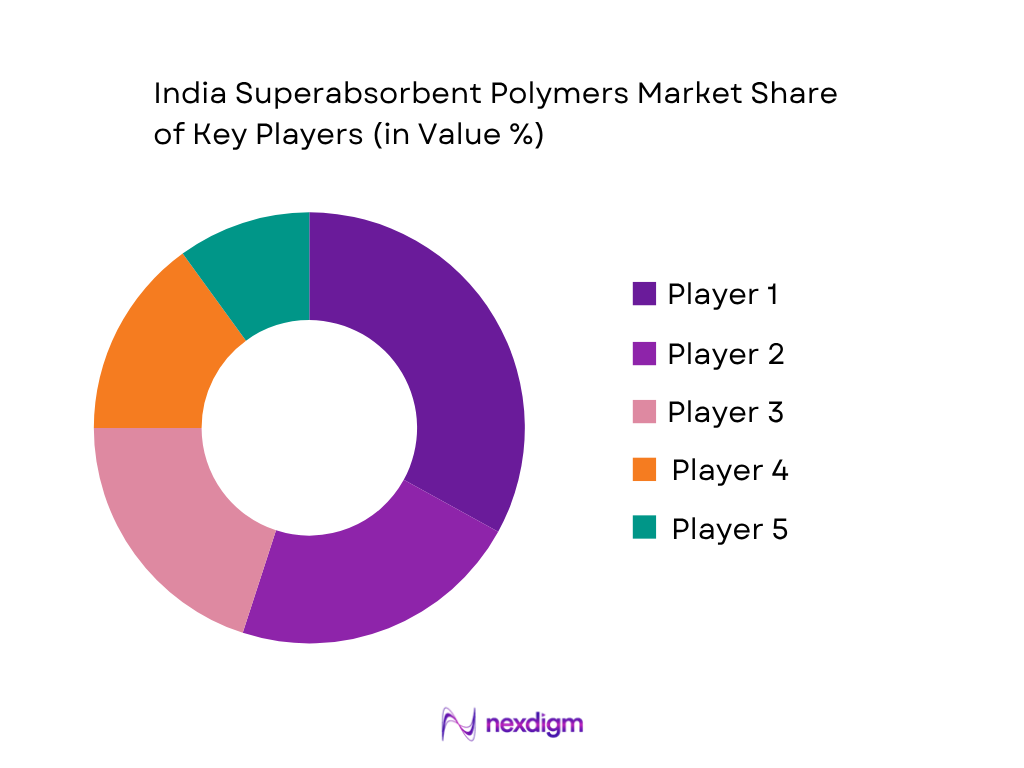
The India Superabsorbent Polymers Market includes global specialty-chemical companies, polymer manufacturers and suppliers serving hygiene-product manufacturers through domestic and international supply networks. Competition is centered on absorption capacity, absorption speed, retention under pressure, particle-size consistency, product purity, supply reliability and technical support. Manufacturers serving the Indian hygiene industry also compete through application-specific SAP grades and partnerships with diaper, sanitary-product and medical-product converters. The competitive environment is increasingly influenced by demand for thinner absorbent products, improved SAP efficiency and lower environmental impact.
| Major Player | Establishment Year | Headquarters | SAP Product Focus | India Supply Presence | Key Applications | Performance Capability | Sustainability / Innovation |
| BASF SE | 1865 | Ludwigshafen, Germany | ~ | ~ | ~ | ~ | ~ |
| Evonik Industries AG | 2007 | Essen, Germany | ~ | ~ | ~ | ~ | ~ |
| Nippon Shokubai Co., Ltd. | 1941 | Osaka, Japan | ~ | ~ | ~ | ~ | ~ |
| Sumitomo Seika Chemicals Co., Ltd. | 1944 | Osaka, Japan | ~ | ~ | ~ | ~ | ~ |
| LG Chem | 1947 | Seoul, South Korea | ~ | ~ | ~ | ~ | ~ |
India Superabsorbent Polymers Market Analysis
Growth Drivers
Expansion of Disposable Diaper Adoption
Expansion of disposable diaper adoption is a key demand driver for the India Superabsorbent Polymers Market because SAP is a core absorbent material used to improve liquid uptake, retention and product thinness. India had a population of 1,450,935,791 in 2024, compared with 1,438,069,596 in 2023, providing a very large underlying consumer base for infant-care products. The World Bank also recorded a crude birth rate of 16.0 births per 1,000 people in 2024, compared with 16.1 in 2023, indicating continued annual additions to the infant population despite declining fertility. India’s GDP reached USD 3.91 trillion in 2024, while GDP per capita reached USD 2,694.7, reflecting the scale of the domestic economy and gradual expansion of purchasing capacity. Disposable diapers require SAP grades with controlled particle size, rapid absorption and high liquid-retention capability, particularly as manufacturers seek thinner products and improved leakage protection. The combination of a large population, continuing births, rising economic activity and expansion of organized consumer-product manufacturing provides a broad demand foundation. Consequently, SAP suppliers can benefit from increased consumption of baby-care products while manufacturers simultaneously optimize absorbent-core designs to use polymer more efficiently.
Growing Elderly Population, Feminine Hygiene and Healthcare Product Demand
India’s demographic and healthcare development is creating multiple downstream applications for superabsorbent polymers beyond infant diapers. The World Bank reports India’s population at 1.45 billion in 2024 and life expectancy at 72 years, establishing a large population base alongside increasing longevity. The country’s GDP reached USD 3.91 trillion, while GDP per capita was USD 2,694.7, providing a broad economic base for expansion of consumer healthcare and hygiene-product manufacturing. India’s fertility rate was 2.0 births per woman in 2024, while the crude birth rate stood at 16 births per 1,000 people, meaning infant-care demand remains substantial even as demographic patterns evolve. Feminine hygiene products use absorbent materials requiring rapid fluid acquisition and retention, while adult-care products require stronger performance under pressure and longer-duration fluid management. Healthcare manufacturers can also use specialized absorbent materials in dressings and other medical applications. These conditions allow SAP suppliers to diversify from conventional baby-diaper applications into feminine hygiene, adult incontinence and healthcare products. India’s expanding manufacturing ecosystem further supports domestic conversion and distribution of these products, creating opportunities for application-specific SAP grades with improved absorption speed, retention and material efficiency.
Market Challenges
Acrylic Acid Feedstock Dependency and Petrochemical Raw Material Volatility
Acrylic-acid feedstock dependency creates an important supply-side challenge for the India Superabsorbent Polymers Market because conventional SAP production relies heavily on acrylic-acid and sodium-acrylate chemistry. India’s economic scale makes the issue particularly relevant: GDP reached USD 3.91 trillion in 2024, while merchandise exports were approximately USD 434.4 billion according to World Bank trade data. India also imported approximately USD 672.1 billion of merchandise under the latest World Bank trade dataset, illustrating the country’s extensive dependence on international supply chains for industrial inputs. Chemical manufacturers therefore operate within an environment influenced by global feedstock availability, international logistics and imported intermediate materials. SAP producers serving hygiene manufacturers must maintain consistent polymer characteristics because changes in acrylic-acid quality or formulation can affect absorption capacity, swelling behavior, retention and particle characteristics. Substituting suppliers is consequently more complex than simply changing a commodity input, particularly where hygiene-product manufacturers have qualified specific SAP grades for high-speed converting lines. India’s expanding industrial economy increases the importance of dependable chemical supply, while global petrochemical disruptions can transmit into domestic procurement conditions. Greater integration of upstream chemical production, supplier diversification and inventory planning can reduce exposure, but these measures require additional manufacturing coordination and technical qualification.
Limited Domestic Specialty SAP Production and Import Dependency for Advanced Grades
Limited domestic availability of specialized SAP grades can constrain the India Superabsorbent Polymers Market when hygiene and medical-product manufacturers require differentiated absorption, retention and pressure-resistance characteristics. India’s GDP reached USD 3.91 trillion in 2024 and manufacturing remains an important component of the economy, while total population reached 1,450,935,791, creating a large potential downstream market. World Bank trade data show merchandise imports of approximately USD 672.1 billion under its latest reported trade indicators, highlighting the scale of India’s connection with international industrial supply chains. For SAP users, import exposure becomes particularly relevant when advanced surface-crosslinked, high-retention or application-specific grades are not available locally in sufficient volumes. Imported material can introduce longer procurement cycles, shipping dependencies and additional inventory requirements. Hygiene manufacturers also require consistent polymer specifications, meaning that changing from one SAP grade to another may require product-performance validation and production-line testing. This creates a barrier to rapid supplier substitution. At the same time, developing domestic specialty SAP production requires access to acrylic-acid feedstocks, polymerization technology, quality-control infrastructure and technical expertise. India’s large domestic economy provides a basis for localization, but establishing commercially competitive specialty-grade production requires coordinated investment across feedstock, polymer manufacturing and downstream hygiene-product conversion.
Market Opportunities
High-Performance Hygiene-Grade SAP and Adult Incontinence Applications
High-performance hygiene-grade SAP represents an important opportunity as India’s demographic structure and consumer-product ecosystem create demand for more efficient absorbent materials. India’s population reached 1,450,935,791 in 2024, while life expectancy reached 72 years, according to World Bank data. The economy generated USD 3.91 trillion of GDP and GDP per capita reached USD 2,694.7, establishing a large domestic economic base for consumer and healthcare products. India also recorded a crude birth rate of 16 births per 1,000 people, supporting continued demand for infant-care products. These conditions provide SAP manufacturers with two complementary application pathways: established baby diapers and emerging adult-care products. Advanced SAP grades can improve absorption speed, liquid retention and absorbency under pressure, allowing hygiene manufacturers to develop thinner products while maintaining functional performance. Adult incontinence products are particularly suited to differentiated grades because their requirements can include higher retention, repeated fluid handling and improved pressure resistance. Suppliers can therefore move toward application-specific SAP portfolios rather than supplying only standardized polymer grades. Domestic technical centers, converter partnerships and application testing can further support qualification of higher-performance products. The opportunity is strengthened by India’s large consumer base and expanding economic activity, which can support wider adoption of differentiated hygiene products.
Agricultural Water-Retention Applications and Domestic SAP Manufacturing Integration
Agricultural water-retention applications and domestic SAP manufacturing provide opportunities to diversify India’s superabsorbent-polymer ecosystem beyond disposable hygiene products. India has a population of 1.45 billion and GDP of USD 3.91 trillion, while the World Bank recorded GDP growth of 6.5 in 2024, indicating substantial underlying economic activity. Agriculture remains an important component of the economy, and the World Bank reported agricultural growth of 4.6 in fiscal 2024/25, compared with 2.7 in the preceding year. These conditions create an application environment for water-retention polymers designed to absorb and retain moisture around plant roots and potentially reduce the frequency of irrigation. SAP suppliers can develop agriculture-specific formulations for horticulture, nurseries and selected water-stressed cultivation systems rather than relying entirely on hygiene demand. At the supply level, India’s large industrial economy and extensive trade network provide a foundation for greater localization of acrylic-acid derivatives, polymerization and specialty SAP manufacturing. World Bank trade indicators record merchandise exports of approximately USD 434.4 billion and merchandise imports of approximately USD 672.1 billion, highlighting the scale of India’s international industrial integration. Localizing specialty SAP production could improve supply responsiveness while supporting export-oriented manufacturing capabilities. Together, agricultural applications and domestic production integration create pathways for broader utilization of superabsorbent polymer technology.
Future Outlook
The India Superabsorbent Polymers Market is expected to develop through increasing disposable hygiene adoption, expansion of feminine hygiene products and growing demand for adult incontinence solutions. Product manufacturers are expected to focus increasingly on thinner absorbent cores, faster fluid acquisition and higher retention performance. The development of specialty SAP grades should create opportunities beyond conventional baby diapers. Agriculture and horticulture can provide an additional demand avenue as water-management requirements become more important. Medical and healthcare applications are also expected to support specialty polymer consumption. At the supply level, localization of chemical feedstocks and polymer manufacturing could improve supply security and reduce reliance on imported specialty grades.The competitive landscape is likely to increasingly emphasize product performance, application engineering, sustainability and customer-specific formulation. Suppliers that establish strong relationships with hygiene-product converters and provide technical support for SAP optimization can participate across multiple application categories.
Major Players
- BASF SE
- Evonik Industries AG
- Nippon Shokubai Co., Ltd.
- Sumitomo Seika Chemicals Co., Ltd.
- LG Chem
- Formosa Plastics Corporation
- Yixing Danson Technology
- Shandong Nuoer Biological Technology
- SDP Global Co., Ltd.
- Kao Corporation
- Sumitomo Chemical Co., Ltd.
- SNF Group
- Itaconix Corporation
- Reliance Industries Limited
- Gujarat Alkalies and Chemicals Limited
Key Target Audience
- Superabsorbent Polymer Manufacturers
- Baby Diaper and Hygiene Product Manufacturers
- Feminine Hygiene and Adult Incontinence Product Manufacturers
- Medical and Healthcare Product Manufacturers
- Acrylic Acid and Specialty Chemical Producers
- Agricultural Input and Water-Retention Product Manufacturers
- Investments and Venture Capitalist Firms
- Government and Regulatory Bodies (Ministry of Chemicals and Fertilizers, Department of Chemicals and Petrochemicals, Ministry of Environment Forest and Climate Change, Central Pollution Control Board, Bureau of Indian Standards)
Research Methodology
Step 1: Identification of Key Variables
The initial phase involves constructing an ecosystem map covering acrylic-acid suppliers, polymer manufacturers, SAP producers, hygiene-product manufacturers, converters, distributors and specialty users. Key variables include polymer chemistry, absorption capacity, retention performance, particle size, production capacity, application requirements and end-use consumption. Particular emphasis is placed on India’s baby-care, feminine-hygiene, adult-care and medical-product ecosystems.
Step 2: Market Analysis and Construction
This phase compiles historical information concerning SAP consumption, domestic manufacturing, imports, exports, production capacity and application demand. Market construction is performed across product type, performance characteristics, application, end-use industry and geographic dimensions. Top-down indicators are combined with bottom-up assessments of hygiene-product production and SAP requirements to construct the market model.
Step 3: Hypothesis Validation and Expert Consultation
Market hypotheses are developed and validated through engagement with SAP manufacturers, hygiene-product converters, chemical suppliers, distributors and application specialists. Discussions assess procurement specifications, absorption requirements, product qualification procedures, technical performance and sustainability expectations. These inputs are used to validate assumptions and refine company-level and application-level assessments.
Step 4: Research Synthesis and Final Output
The final phase integrates supply-side, demand-side, trade and company-level information into the India Superabsorbent Polymers Market model. Production, consumption, imports and exports are cross-checked to identify inconsistencies and validate market estimates. The final analysis incorporates market size, segmentation, competitive landscape, growth drivers, challenges, opportunities and future development pathways.

- Executive Summary
- Research Methodology (Market Definition and Scope, India Superabsorbent Polymers Market Classification, Superabsorbent Polymer Product Mapping, Polymer Chemistry Assessment, Absorption and Retention Performance Assessment, Application-Level Demand Analysis, End-Use Industry Assessment, Domestic Production Mapping, Production Capacity Assessment, Acrylic Acid and Sodium Acrylate Feedstock Assessment, Import and Export Trade Analysis, Domestic Manufacturing Assessment, Demand-Side Assessment, Supply-Side Assessment, Top-Down Market Sizing, Bottom-Up Market Sizing, Primary Industry Interviews, Hygiene Product Converter Interviews, Data Triangulation, Forecasting Framework, Market Share Validation, Limitations and Future Conclusions)

- Definition and Scope
- India Superabsorbent Polymers Industry Evolution
- Superabsorbent Polymers Value Chain Analysis Supply Chain Analysis
- Raw Material-to-SAP Conversion Chain Analysis
- Acrylic Acid and Sodium Acrylate Feedstock Availability Assessment
- Domestic SAP Production and Import Dependency Assessment

- Growth Drivers (Expansion of Disposable Diaper Adoption, Rising Birth Cohort, Growing Elderly Population, Increasing Adult Incontinence Awareness, Expansion of Feminine Hygiene Products, Healthcare Product Manufacturing Growth, Agricultural Water-Efficiency Requirements, Increasing Demand for High-Absorbency Materials, Lightweight Hygiene Product Development)
- Market Challenges (Acrylic Acid Feedstock Dependency, Petrochemical Raw Material Volatility, Limited Domestic Specialty SAP Production, Import Dependency for Advanced Grades, Environmental Concerns Regarding Conventional SAP Disposal, Recycling Limitations, Product Qualification Requirements, Manufacturing Technology Gaps, Supply Chain Disruptions, Competition from Alternative Absorbent Materials)
- Market Opportunities (High-Performance Hygiene-Grade SAP, Adult Incontinence Applications, Sustainable and Bio-Based SAP Development, Agricultural Water-Retention Applications, Medical Absorbent Materials, High-Retention Surface-Crosslinked SAP, Specialty Industrial Absorbents, Next-Generation Absorption Technologies, Domestic Acrylic Acid and SAP Manufacturing Integration, Regional Export Development)
- Market Trends (Thinner Diaper Core Development, Higher Absorption-to-Weight Ratios, Surface-Crosslinked SAP Adoption, High-Pressure Absorbency Development, Adult Incontinence Product Innovation, Sustainable Hygiene Materials, Bio-Based SAP Research, Agricultural Water Management, Specialty Medical Absorbents, Automated SAP Dispensing and Hygiene Manufacturing)
- Government Regulations and Standards (Bureau of Indian Standards Requirements, Central Pollution Control Board Environmental Requirements, Ministry of Environment Chemical Regulations, Occupational Safety and Health Requirements, Food Safety and Standards Authority of India Requirements, Agricultural Input Regulations, Medical Device Requirements, Hazardous Chemical Handling Requirements, Plastic Waste Management Requirements, Product Safety and Labeling Requirements)
- SWOT Analysis
- Porter’s Five Forces Analysis
- PESTLE Analysis
- Stakeholder Ecosystem

- By Market Value (2020-2025)
- By Market Volume (2020-2025)
- By Superabsorbent Polymer Consumption Volume (2020-2025)
- By Domestic Production Volume (2020-2025)
- By Import Volume (2020-2025)

- By Product Type (In Value %)
Sodium Polyacrylate Superabsorbent Polymers
Potassium Polyacrylate Superabsorbent Polymers
Polyacrylamide-Based Superabsorbent Polymers
Copolymer Superabsorbent Polymers
Other Specialty Superabsorbent Polymers - By Particle Size and Form (In Value %)
Standard SAP Granules
Fine-Particle SAP
Coarse-Particle SAP
Surface-Crosslinked SAP
Core-Shell SAP
Powdered SAP - By Absorption Performance (In Value %)
Standard Absorption Capacity
High Absorption Capacity
High Retention Capacity
Fast Absorption SAP
High-Performance Hygiene-Grade SAP - By Application Type (In Value %)
Baby Diapers
Adult Incontinence Products
Feminine Hygiene Products
Medical and Healthcare Products
Agriculture and Horticulture
Industrial Absorbents
Packaging and Specialty Applications - By End-Use Industry (In Value %)
Baby Care and Hygiene Products
Adult Incontinence Care
Feminine Hygiene
Healthcare and Medical Products
Agriculture and Horticulture
Food Packaging and Freshness Management
Electrical and Cable Manufacturing
Water Management Applications

- Market Share of Major Players (By India Revenue, SAP Sales Volume, Production Capacity, SAP Grade Portfolio, Absorption Performance, Hygiene Industry Exposure, Agricultural Application Exposure, Domestic Manufacturing Footprint, Import Dependence, Distribution Network Coverage, Regional Presence, OEM and Converter Customer Coverage, R&D Capability)
- Cross Comparison Parameters (Superabsorbent Polymer Revenue, Production Capacity, SAP Grade Portfolio Breadth, Absorption and Retention Performance, Hygiene Application Coverage, Adult Incontinence and Medical Application Capability, Sustainable SAP Technology Portfolio, India Manufacturing and Distribution Reach)
- SWOT Analysis of Major Players
- Detailed Profiles of Major Companies
BASF India Limited
Evonik India Private Limited
Nippon Shokubai Co., Ltd.
Sumitomo Seika Chemicals Co., Ltd.
LG Chem India Private Limited
Formosa Plastics Corporation
Yixing Danson Technology
Shandong Nuoer Biological Technology
SDP Global Co., Ltd.
Kao Corporation
Sumitomo Chemical Co., Ltd.
SNF India Private Limited
Itaconix Corporation
Gujarat Alkalies and Chemicals Limited
Reliance Industries Limited

- Baby Diaper Manufacturer SAP Procurement Assessment
- Adult Incontinence Product Manufacturer Absorbency Requirement Analysis
- Feminine Hygiene Product Manufacturer SAP Requirement Assessment
- Medical Absorbent Product Manufacturer Material Qualification Analysis
- Hygiene Product Converter SAP Specification Assessment
- Agricultural Input Manufacturer Water-Retention Polymer Assessment
- Horticultural Grower SAP Application Assessment
- Cable Manufacturer Moisture-Blocking Material Assessment
- Food Packaging Manufacturer Moisture-Absorption Assessment

- By Market Value (2026-2035)
- By Market Volume (2026-2035)
- By Superabsorbent Polymer Consumption Volume (2026-2035)
- By Domestic Production Volume (2026-2035)
- By Import Volume (2026-2035)


 Request a Sample
 Ask for Customization
 Get a Quote
 Enquire Now