

 Download PDF
Market Overview
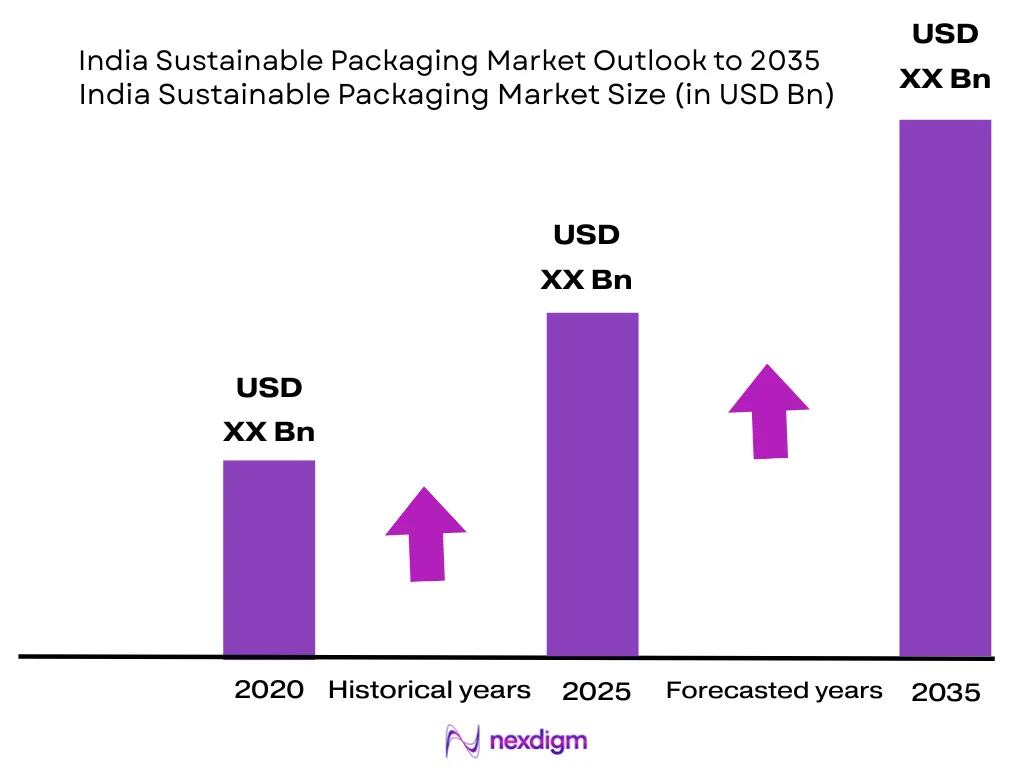
The India Sustainable Packaging Market is valued at approximately USD ~ billion and is forecast to expand at a CAGR of % during 2026–2035. India’s population increased from approximately 1.43 billion to 1.45 billion, while nominal economic output continued expanding across food processing, consumer goods, pharmaceuticals, retail, and e-commerce. Demand is driven by plastic-packaging EPR, recycled-content obligations, food-grade recycled PET, lightweighting, recyclable laminates, molded fiber, reusable containers, and packaging-waste traceability. Mumbai–Pune, Ahmedabad–Vadodara, Delhi NCR, Noida, Bengaluru, Chennai, Hyderabad, Kolkata, Daman, Silvassa, Baddi, and Haridwar dominate the India Sustainable Packaging Market. These hubs concentrate FMCG, food, beverage, pharmaceutical, personal-care, polymer, paperboard, printing, film-extrusion, tube, rigid-container, and recycling operations. UFlex is headquartered in Noida and operates Indian packaging facilities across Noida, Jammu, Sanand, and Dharwad, while Huhtamaki maintains a multi-site Indian flexible-packaging network serving major consumer industries.
Market Segmentation
By Material Type
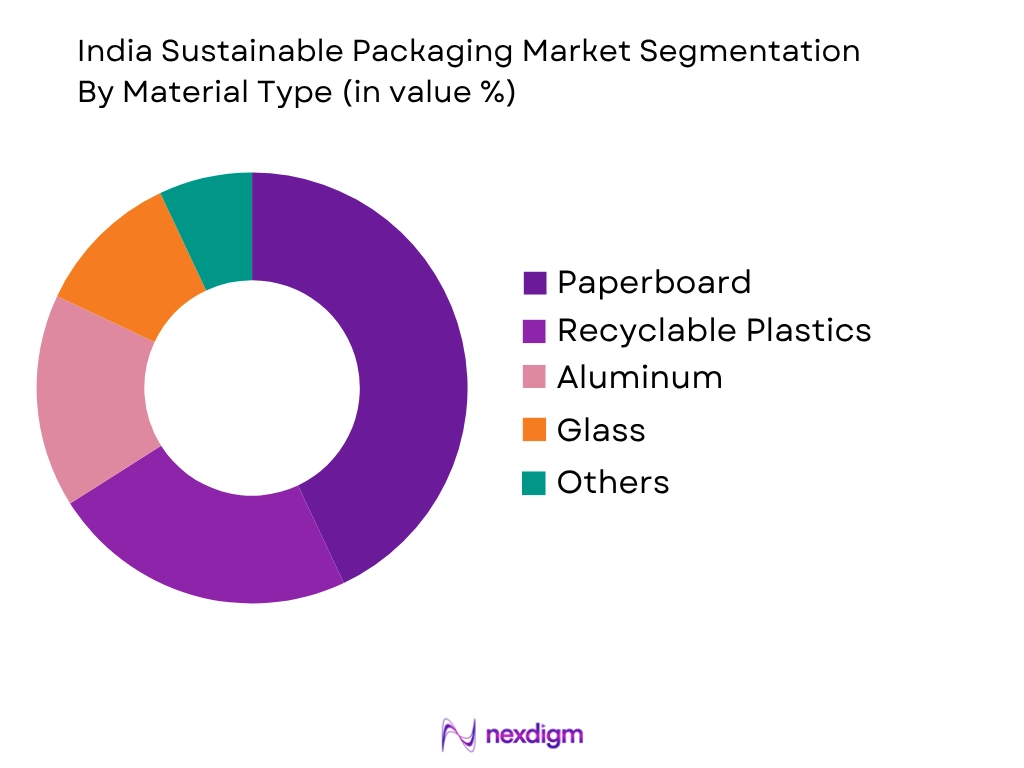
The India Sustainable Packaging Market is segmented into paper and paperboard, recycled and recyclable plastics, metals, glass, bio-based and compostable materials, jute and textile packaging, wood, and sustainable multi-material structures. Paper and paperboard hold the dominant position because corrugated boxes, folding cartons, paper sacks, molded-fiber trays, paper mailers, and protective inserts serve food, beverages, pharmaceuticals, consumer goods, e-commerce, and industrial transport. India’s extensive carton-converting, corrugation, printing, and recycled-fiber base supports this position. Paper-based substitution is also increasing in takeaway packaging and e-commerce. However, fiber formats require appropriate coatings where moisture, grease, oxygen, and sealing performance are critical. Recycled plastics remain essential for PET bottles, rigid containers, films, tubes, closures, trays, and pouches because they combine low weight with impact resistance and barrier performance. FSSAI’s framework permitting approved recycled PET in food-contact applications creates an additional pathway for high-quality bottle-to-bottle and food-packaging applications.
By End-Use Industry
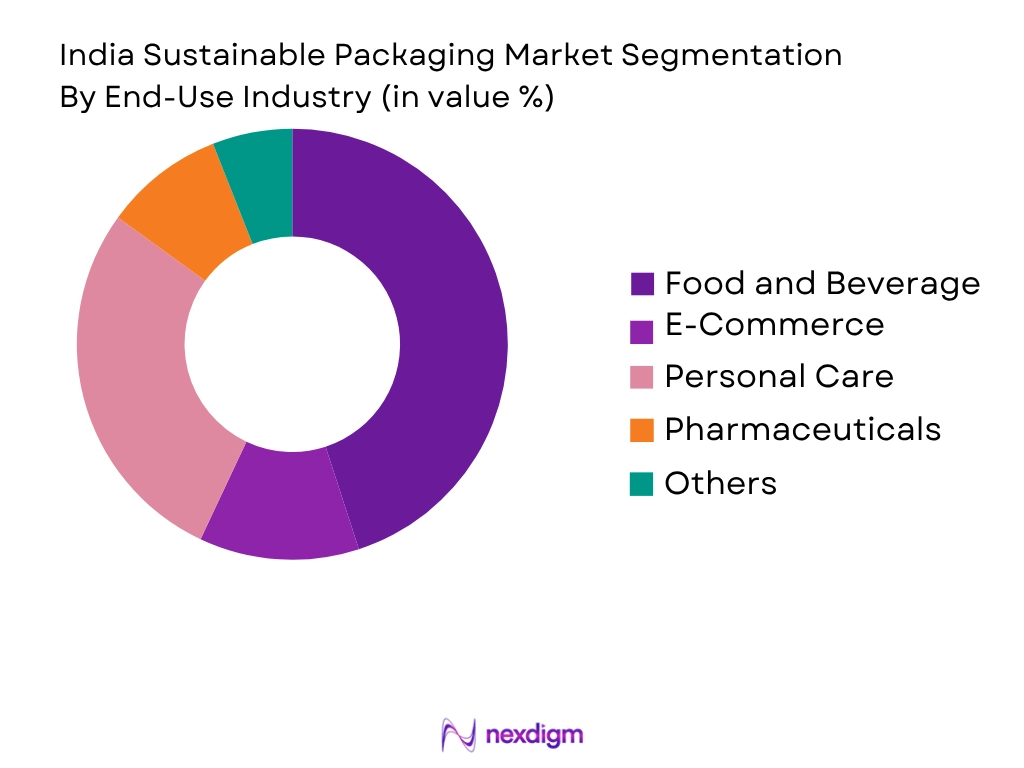
The India Sustainable Packaging Market is segmented into food and beverage, personal and household care, healthcare and pharmaceuticals, e-commerce and retail, foodservice, agriculture, industrial goods, electronics, and other applications. Food and beverage hold the dominant market position because the segment uses high volumes of flexible pouches, sachets, bottles, cartons, films, trays, cans, glass containers, corrugated cases, and liquid-food packs. Packaging must preserve product safety, aroma, moisture, texture, and shelf life across long and temperature-variable distribution routes. FMCG and food companies are increasingly evaluating mono-material laminates, recyclable polyethylene and polypropylene structures, recycled PET bottles, lightweight cartons, and molded-fiber foodservice packaging. E-commerce is another important application because right-sized boxes, paper mailers, fiber cushioning, and return-ready formats reduce material and freight intensity. Pharmaceutical packaging converts more cautiously because migration control, product stability, tamper evidence, sterility, and traceability take priority over rapid material substitution.
Competitive Landscape
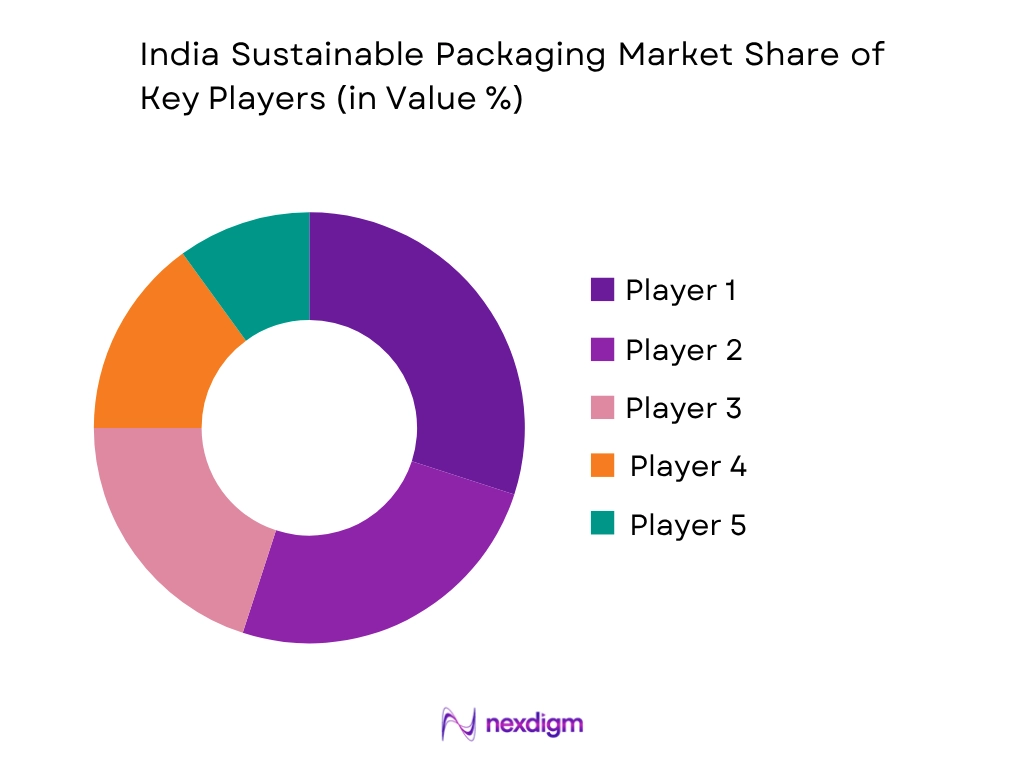
The India Sustainable Packaging Market includes integrated flexible-packaging companies, paperboard converters, tube manufacturers, rigid-plastic specialists, glass and metal packaging suppliers, and multinational packaging groups. UFlex competes through end-to-end films, laminates, pouches, chemicals, machinery, and aseptic packaging. Huhtamaki India has a long-established flexible-packaging and labelling presence. EPL is a global laminated-tube producer with backward-integrated film capability, while TCPL operates across paperboard cartons and flexible packaging. Manjushree Technopack is positioned in rigid plastic packaging. Competition increasingly depends on recyclable-material development, recycled-content integration, EPR support, food-contact compliance, manufacturing reach, lightweighting, and speed of commercial qualification.
| Company | Establishment Year | Headquarters | Sustainable Portfolio | Principal End Uses | Material Capability | India Footprint | Circularity Capability | Strategic Differentiation |
| UFlex | 1985 | Noida, India | ~ | ~ | ~ | ~ | ~ | ~ |
| Huhtamaki India | 1935 Indian operating heritage | Thane, India | ~ | ~ | ~ | ~ | ~ | ~ |
| EPL | 1982 | Mumbai, India | ~ | ~ | ~ | ~ | ~ | ~ |
| TCPL Packaging | 1987 | Mumbai, India | ~ | ~ | ~ | ~ | ~ | ~ |
| Manjushree Technopack | 1983 | Bengaluru, India | ~ | ~ | ~ | ~ | ~ | ~ |
India Sustainable Packaging Market Analysis
Growth Drivers
Urban Consumption and Organized Distribution Expansion
India’s expanding urban consumer base is increasing demand for recyclable cartons, corrugated shipping cases, paper mailers, lightweight bottles, mono-material pouches, molded-fiber foodservice packs, refill packaging, and reusable transport containers. World Bank data place India’s urban population at approximately 522.4 million people in 2025, creating concentrated packaging demand across Delhi NCR, Mumbai, Pune, Bengaluru, Chennai, Hyderabad, Ahmedabad, Kolkata, Surat, and other large consumption centres. The country’s nominal gross domestic product reached ₹318.07 lakh crore in 2024–25, while private consumption, retail distribution, food delivery, pharmaceuticals, personal care, and digital commerce continued generating high packaging throughput. These conditions favour packaging that can move efficiently through automated warehouses, regional distribution centres, quick-commerce dark stores, supermarkets, pharmacies, and last-mile delivery networks.
Industrial Growth and Mandatory Packaging Responsibility
India’s industrial expansion and plastic-packaging regulations are making packaging circularity a measurable operating requirement for producers, importers, brand owners, and recyclers. Nominal gross domestic product increased from ₹318.07 lakh crore in 2024–25 to ₹346.36 lakh crore in 2025–26, while real gross domestic product reached ₹323.12 lakh crore in 2025–26. Manufacturing represented a substantial component of national gross value added, supporting demand for films, bottles, tubes, cartons, sacks, trays, glass containers, metal cans, labels, and transport packaging across food, beverages, pharmaceuticals, chemicals, electronics, textiles, and consumer goods.
Market Challenges
Fragmented Collection and Inconsistent Recycled Feedstock Quality
India’s sustainable packaging market faces a structural challenge in converting widely dispersed post-consumer waste into consistent, specification-grade secondary material. Official data reported 4,136,188.83 tonnes of plastic waste generation in 2022–23, the latest year available in the government’s December 2024 parliamentary response. The same response recorded 2,614 registered plastic waste processors and approximately 103 lakh tonnes of plastic packaging waste processed cumulatively through the centralised EPR portal. Although processor participation has expanded, collection and material quality remain uneven across metropolitan areas, tier-two cities, small towns, industrial clusters, and rural districts.
Technical Conversion and Compliance Complexity
Sustainable packaging conversion requires manufacturers to balance recyclability and recycled content with shelf life, food safety, barrier performance, machinery compatibility, transport strength, appearance, and consumer convenience. A mono-material pouch may be easier to recycle than a multilayer laminate but may provide weaker oxygen, aroma, moisture, or puncture protection. Molded fibre can replace selected plastic trays and inserts, but grease, water, heat, and sealing performance must be validated. Recycled resin may affect colour, odour, clarity, impact resistance, and process stability, while lightweighting can create bottle paneling, carton compression, seal failure, or damage during distribution.
Market Opportunities
Food-Grade Recycled PET and Advanced Material Technologies
India has a significant opportunity to develop closed-loop food and beverage packaging through approved food-grade recycled PET, advanced sorting, decontamination, mono-material design, and automated material verification. FSSAI formally amended the packaging framework in March 2025 to permit recycled PET in food packaging when applicable standards and acceptance guidelines are satisfied. The subsequent technical guidelines define food-contact recycled PET as post-consumer food-grade resin that has undergone a validated decontamination process capable of achieving the required purity for direct food contact.
Rural Collection Networks and Distributed Recycling Infrastructure
Expansion of packaging recovery into rural areas and smaller urban centres can create a larger, more geographically balanced supply of paper, PET, rigid plastics, films, metals, and glass. India’s Plastic Waste Management Rules assign responsibilities to both urban local bodies and gram panchayats, recognising that packaging waste management cannot remain limited to metropolitan collection systems. Government support under Swachh Bharat Mission Grameen allows financial assistance of up to ₹16 lakh per block for establishing a plastic waste management unit. Facilities can also be developed in cluster mode to serve more than one block where local volumes are insufficient for standalone operations.
Future Outlook
The India Sustainable Packaging Market is expected to expand during 2026–2035 as environmental compliance, recycled-content targets, food-grade recycling, organized retail, e-commerce, and brand commitments reshape packaging design. Growth will involve material reduction, mono-material conversion, higher post-consumer content, reusable transport systems, improved waste collection, and greater traceability between producers and registered recyclers. Plastic-packaging EPR will remain the most influential regulatory force. India’s Plastic Waste Management framework applies to producers, importers, brand owners, plastic-waste processors, manufacturers, and other entities involved in plastic packaging. Packaging is classified into rigid, flexible, multilayered, compostable, and biodegradable categories, with obligations relating to recycling, reuse, recycled content, and end-of-life processing.
Major Players
- UFlex
- Huhtamaki India
- EPL
- TCPL Packaging
- Parksons Packaging
- ITC Packaging and Printing Business
- Manjushree Technopack
- Mold-Tek Packaging
- AGI Greenpac
- Tetra Pak India
- Amcor Flexibles India
- Constantia Flexibles India
- Cosmo First
- Polyplex Corporation
- Hindustan Tin Works
Key Target Audience
- Packaging material manufacturers and converters
- Food, beverage, pharmaceutical, and FMCG brand owners
- Retailers, e-commerce platforms, and foodservice operators
- Plastic-waste processors, recyclers, and producer-responsibility organizations
- Packaging distributors and contract packagers
- Investments and venture capitalist firms
- Private-equity and strategic packaging investors
- Government and regulatory bodies
Research Methodology
Step 1: Identification of Key Variables
The initial phase involves developing an ecosystem map covering material producers, converters, producers, importers, brand owners, producer-responsibility organizations, waste pickers, aggregators, recyclers, and regulators. Desk research identifies variables including material type, plastic-packaging category, package weight, recycled content, reuse, food-contact status, converter capacity, and regional recovery access.
Step 2: Market Analysis and Construction
Historical information is compiled by material, format, end-use industry, packaging level, sustainability strategy, and region. The bottom-up model evaluates converter shipments, packaging-unit volumes, material tonnage, recycled-content use, and customer adoption. The top-down model reviews industrial output, trade, resin and paper consumption, company revenues, producer EPR data, and end-market activity.
Step 3: Hypothesis Validation and Expert Consultation
Preliminary hypotheses are validated through computer-assisted telephone interviews with packaging engineers, converters, recyclers, producer-responsibility organizations, brand owners, procurement teams, waste aggregators, and regulatory professionals. Consultations assess material conversion, collection systems, recycled-feedstock quality, EPR certificates, food-contact compliance, production trials, and supplier selection.
Step 4: Research Synthesis and Final Output
Supply-side and demand-side findings are triangulated to reconcile converter output, raw-material shipments, customer procurement, recycling certificates, and processed-waste volumes. Segment shares and forecasts are tested against package weights, unit volumes, recycling targets, recycled-content obligations, production capacity, regional infrastructure, and expert feedback.

- Executive Summary
- Research Methodology (Market Definitions and Assumptions, Sustainable Packaging Inclusion and Exclusion Criteria, Abbreviations, Market Sizing Approach, Top-Down Analysis, Bottom-Up Analysis, Packaging-Volume Conversion Model, Material Flow Analysis, Demand-Side Assessment, Supply-Side Assessment, Converter Capacity Assessment, Primary Industry Interviews, Data Triangulation, Regulatory Scenario Modelling, Forecasting Framework, Limitations and Future Conclusions)

- Definition and Scope
- Market Evolution and Industry Genesis
- Transition from Conventional Packaging to Circular Packaging Systems
- Evolution of Packaging Lightweighting and Material Reduction
- Development of Recycled-Content Packaging
- Expansion of Paper, Paperboard and Molded-Fiber Packaging
- Development of Food-Grade Recycled Plastic Packaging

- Growth Drivers (Plastic Packaging EPR, Recycled-Content Obligations, Reuse Targets, E-Commerce Expansion, Packaged Food Growth, Organized Retail, Food-Grade rPET Approval and Corporate Sustainability Commitments)
- Market Challenges (Fragmented Collection, Informal and Formal System Coordination, Recycled Feedstock Quality, Flexible Packaging Recovery Gaps, Multi-Layered Packaging Disposal, Composting Infrastructure Limitations, Regulatory Documentation and Capital-Intensive Conversion)
- Market Opportunities (Food-Grade Recycled PET, Mono-Material Flexible Packaging, Bagasse and Molded Fiber, Reusable Transport Packaging, Rural Collection Networks, Bio-Based Polymers, Smart Sorting and Closed-Loop Brand Partnerships)
- Market Trends (Paperization, Lightweighting, High-PCR Packaging, Refill Pouches, Reusable Crates, Recyclable Laminates, Fiber-Based Foodservice Packaging, Digital EPR Traceability, Wash-Off Labels and Packaging Carbon Disclosure)
- SWOT Analysis
- Porter’s Five Forces Analysis
- PESTLE Analysis

- By Market Value (2020-2025)
- By Packaging Volume (2020-2025)
- By Packaging Unit Shipments (2020-2025)

- By Material Type (In Value %)
Paper and Paperboard
Corrugated Board
Molded Fiber
Recycled Plastic
Bio-Based Plastic
Compostable Plastic
Aluminum - By End-Use Industry (In Value %)
Food and Beverage
Personal Care and Cosmetics
Household Care
Healthcare and Pharmaceuticals
E-Commerce
Retail and Consumer Goods
Foodservice and Hospitality - By Distribution Channel (In Value %)
Direct Sales to Brand Owners
Packaging Distributors
Contract Packaging Companies
Digital Packaging Platforms
Industrial Wholesalers
Retail Packaging Suppliers
E-Commerce Packaging Providers - By Region (In Value %)
North India
West India
South India
East India
Central India
Northeast India

- Market Share of Major Players (By Value, Packaging Volume, Material Type, Packaging Format, End-Use Industry and Region)
- Cross Comparison Parameters (Sustainable Material Portfolio Breadth, Post-Consumer Recycled Content Capability, Mono-Material and Design-for-Recycling Expertise, India Manufacturing and Conversion Footprint, EPR and Recycling Certificate Support Capability, Food-Contact and FSSAI Compliance Capability, End-Use Industry Coverage, Packaging Innovation and Commercialization Speed)
- SWOT Analysis of Major Players
- Detailed Profiles of Major Companies
UFlex
Huhtamaki India
EPL
TCPL Packaging
Parksons Packaging
ITC Packaging and Printing Business
Manjushree Technopack
Mold-Tek Packaging
AGI Greenpac
Tetra Pak India
Amcor Flexibles India
Constantia Flexibles India
Cosmo First
Polyplex Corporation
Hindustan Tin Works

- Food and Beverage Brand Analysis
- Fast-Moving Consumer Goods Analysis
- Retailer and E-Commerce Analysis
- Foodservice Operator Analysis
- Personal Care and Cosmetics Analysis
- Healthcare and Pharmaceutical Analysis

- By Market Value (2026-2035)
- By Packaging Volume (2026-2035)
- By Packaging Unit Shipments (2026-2035)


 Request a Sample
 Ask for Customization
 Get a Quote
 Enquire Now