
 Download PDF
Market Overview
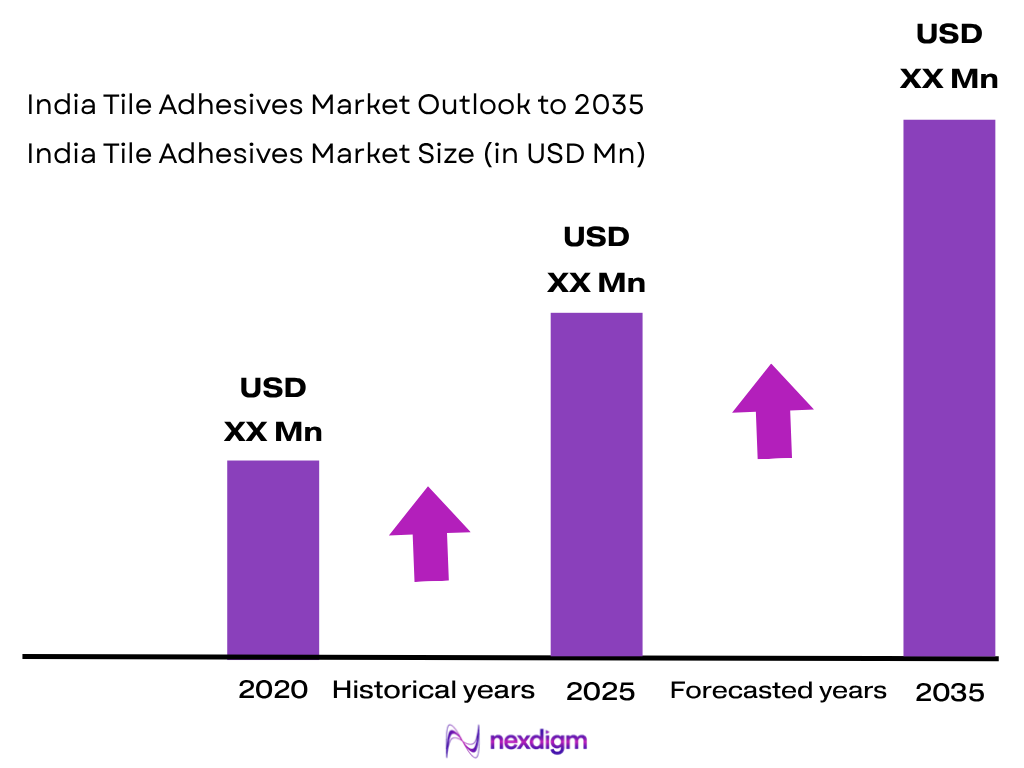
The India Tile Adhesives Market is valued at approximately ~USD XX million, supported by housing construction, vitrified-tile installation, renovation and conversion from site-mixed mortar. Across the latest two annual observations, real construction GVA increased from approximately ₹13.06 lakh crore to ₹14.46 lakh crore. Urban housing also provided a substantial installation base, with PMAY-U recording 118.63 lakh sanctioned houses, 114.33 lakh grounded houses and 85.04 lakh completed houses, supporting sustained demand for factory-mixed tile-fixing systems.
Delhi NCR, Mumbai-Pune, Bengaluru, Hyderabad, Chennai and Ahmedabad dominate the India Tile Adhesives Market because they combine dense apartment construction, premium housing, commercial fit-outs and high consumption of vitrified and large-format tiles. National construction activity moved from approximately ₹13.06 lakh crore to ₹14.46 lakh crore in real GVA across consecutive observations, while 85.04 lakh urban houses had been completed under PMAY-U, reinforcing adhesive demand across metropolitan and expanding Tier-II housing corridors.
Market Segmentation
By Product Type
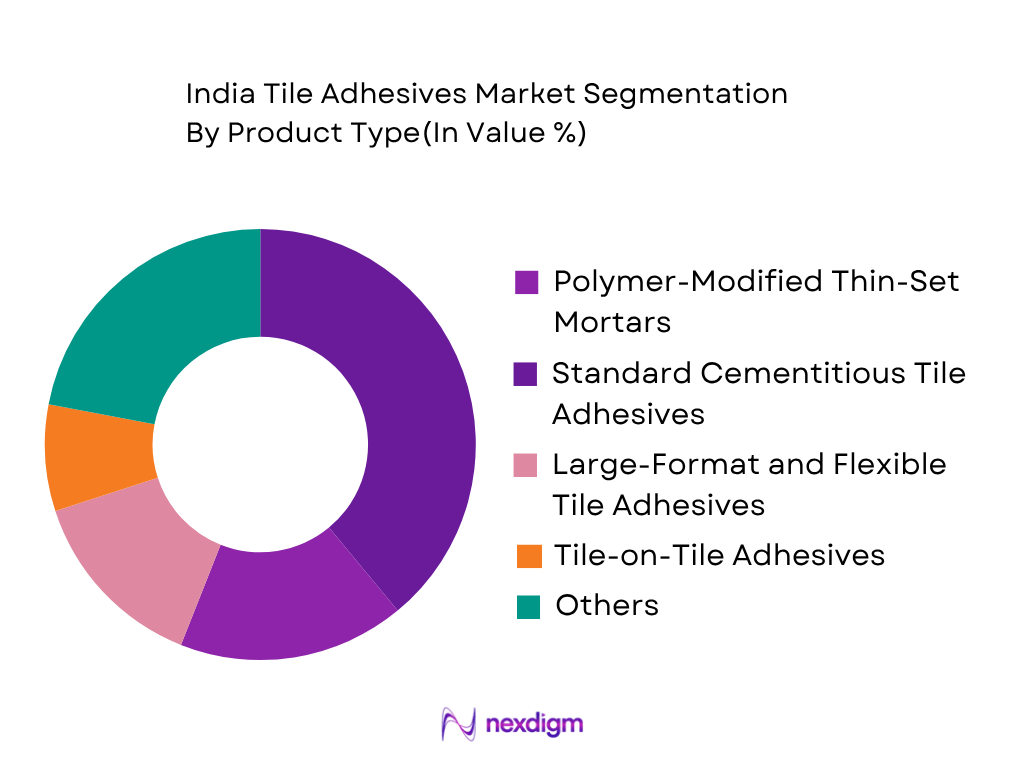
By Product Type: The India Tile Adhesives Market is segmented into standard cementitious adhesives, polymer-modified cementitious adhesives, flexible adhesives, large-format tile adhesives, rapid-setting systems, tile-on-tile adhesives, epoxy adhesives and specialized stone products. Polymer-modified cementitious tile adhesives hold the dominant modeled market share because they are suitable for the country’s large base of ceramic, vitrified and porcelain installations while providing stronger adhesion, better workability and improved performance on lower-absorption tiles than conventional cement-sand mortar. BIS standard IS 15477:2019 classifies tile adhesives across Type 1, Type 2, Type 3, Type 4 and Type 5 and evaluates performance through tensile adhesion, shear adhesion, open time, adjustment time, slip and deformability. This performance framework increasingly supports migration toward formulated adhesives for residential and commercial projects. Distribution depth also reinforces adoption: Roff reports more than 9,000 dealer outlets nationally, while Weber operates manufacturing at 10 strategic Indian locations.
By Tile and Stone Type
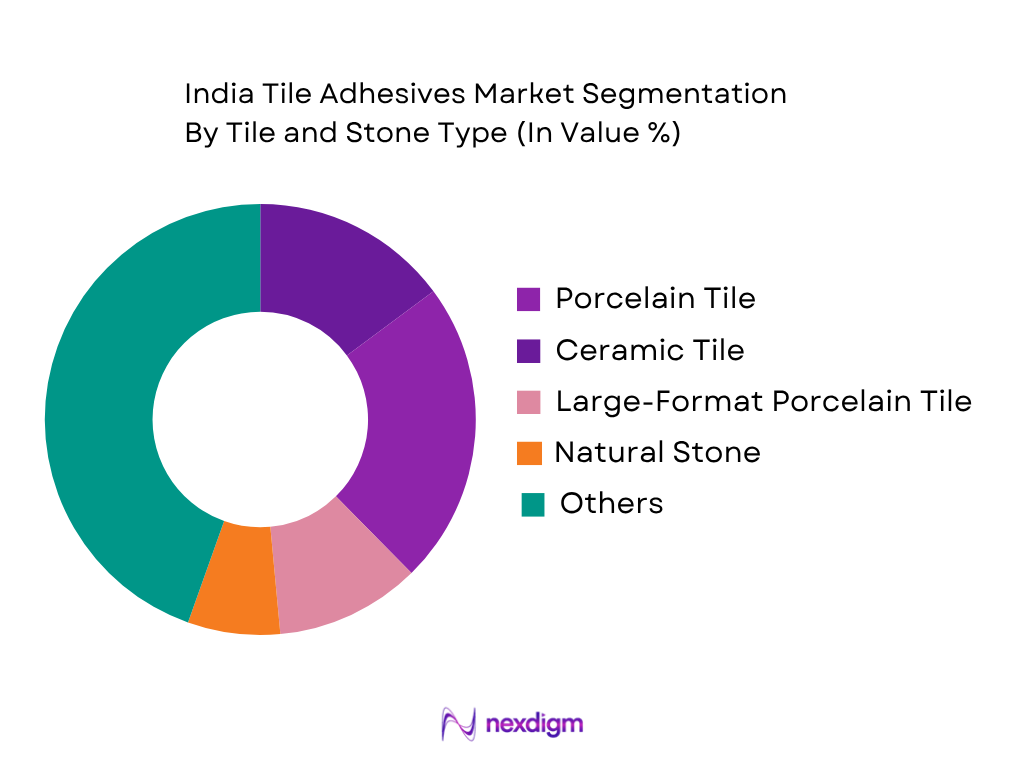
The India Tile Adhesives Market is segmented into ceramic tiles, vitrified tiles, porcelain tiles, large-format porcelain, natural stone, marble, granite, mosaics, glass tiles and engineered stone. Vitrified and porcelain tiles represent the dominant modeled demand category because their low water absorption and increasingly larger dimensions make polymer-modified adhesive systems technically preferable to conventional mortar beds. Large slabs also require improved adhesive transfer, longer workable time and greater resistance to vertical slip and thermal movement. Indian manufacturers have consequently expanded specialized product ranges covering vitrified, large-format and stone installation. MAPEI markets high-performance deformable adhesives specifically for large-format tiles, while MYK LATICRETE maintains dedicated tile, specialty and stone adhesive portfolios. Growing urban housing and premium interiors further reinforce the segment because vitrified tiles are widely used in apartment floors, bathrooms, kitchens and commercial interiors, creating a large recurring base for thin-bed factory-mixed adhesives.
Competitive Landscape
The India Tile Adhesives Market combines established construction-chemical companies, specialist tile-installation brands and diversified building-material manufacturers. Pidilite/Roff, Saint-Gobain Weber, MYK LATICRETE, ARDEX ENDURA and MAPEI compete through IS 15477-aligned product portfolios, large-format solutions, manufacturing proximity, dealer coverage and contractor education. Competitive advantage increasingly depends on product-class breadth and installation support rather than basic cementitious adhesive availability alone.
| Major Player | Establishment Year | Headquarters | IS 15477 / Performance Portfolio | Large-Format & Vitrified Capability | India Manufacturing Footprint | Dealer / Channel Reach | Stone & Specialty Systems | Applicator / Technical Support |
| Pidilite Industries / Roff | 1959 | Mumbai | ~ | ~ | ~ | ~ | ~ | ~ |
| Saint-Gobain Weber India | 2004 | Mumbai | ~ | ~ | ~ | ~ | ~ | ~ |
| MYK LATICRETE India | 1999 | Hyderabad | ~ | ~ | ~ | ~ | ~ | ~ |
| ARDEX ENDURA India | 1997 | Bengaluru | ~ | ~ | ~ | ~ | ~ | ~ |
| MAPEI Construction Products India | 2011 | Bengaluru | ~ | ~ | ~ | ~ | ~ | ~ |
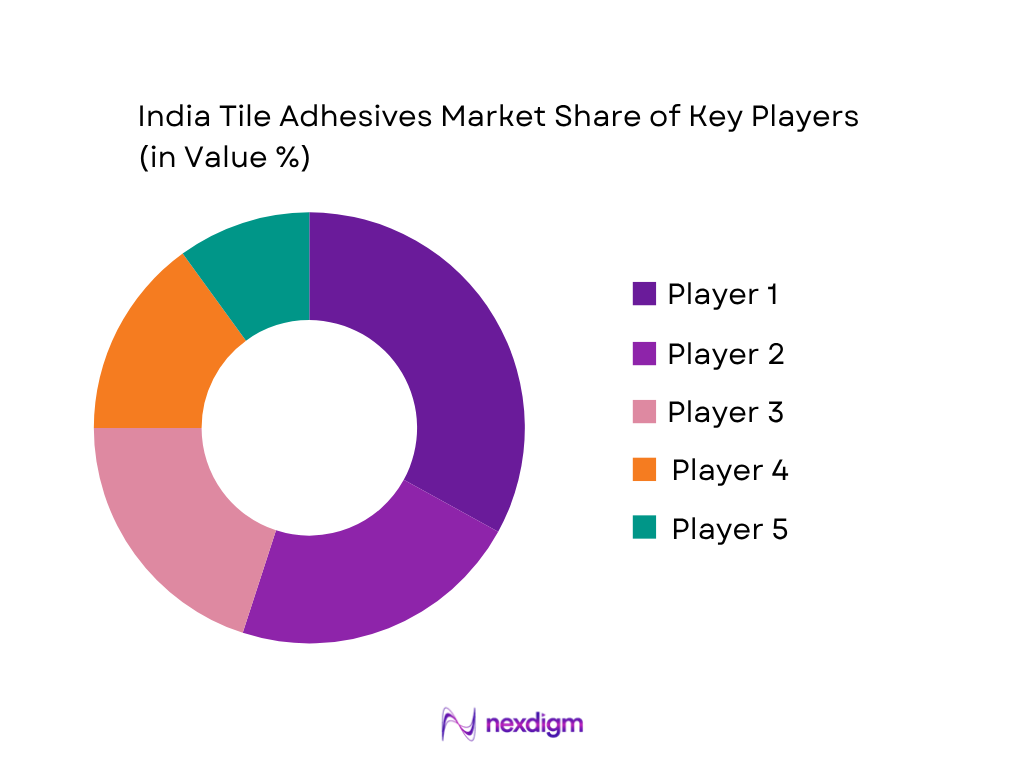
India Tile Adhesives Market Analysis
Growth Drivers
Urban Housing Construction and Organized Tile Installation Are Expanding Adhesive Consumption
India’s urban housing pipeline is increasing consumption of polymer-modified tile adhesives across bathrooms, kitchens, floors, balconies and common areas. Under PMAY-U, 118.63 lakh houses had been sanctioned, 114.33 lakh grounded and 85.04 lakh completed/delivered as of July 2024, compared with 78.15 lakh completed/delivered houses in November 2023. This expanding installed base supports both first-time tile installation and subsequent replacement demand. Construction activity also remains large: MoSPI’s revised national accounts place construction GVA at ₹22,77,317 crore in FY2023-24 and ₹24,49,208 crore in FY2024-25, while construction output increased from ₹69,07,841 crore to ₹73,79,454 crore. These volumes favour factory-mixed adhesives because large multi-unit projects require more consistent bond performance, controlled water addition and faster application than site-mixed cement-sand mortar. The macroeconomic base reinforces demand: World Bank data place India’s 2024 GDP at USD3.91 trillion, GDP per capita at USD2,694.7, and economic growth at 6.5. The combination of housing completions and rising construction output provides a broad demand platform for organized tile-fixing systems.
Vitrified, Porcelain and Large-Format Tile Installation Is Increasing Technical Adhesive Requirements
The shift toward vitrified, porcelain and larger-format surfaces is strengthening demand for higher-performance tile adhesives because low-absorption tiles require stronger polymer modification, improved wetting and greater resistance to slip than conventional ceramic installations. India’s construction output reached ₹73,79,454 crore in FY2024-25, up from ₹69,07,841 crore in FY2023-24, while construction GVA increased from ₹22,77,317 crore to ₹24,49,208 crore, expanding the total pipeline of residential and commercial surfaces requiring finishing systems. BIS currently classifies tile adhesives through Type 1, Type 2, Type 3, Type 4 and Type 5 categories under IS 15477 and evaluates tensile adhesion, shear adhesion, open time, slip and deformability, creating a technical framework that supports movement from generic mortar toward application-specific products. Urban housing construction reinforces the addressable installation base, with 114.33 lakh PMAY-U houses grounded and 85.04 lakh completed in July 2024. World Bank data record India’s 2024 GDP at USD3.91 trillion and GDP per capita at USD2,694.7. These current construction and macroeconomic indicators support continued premiumization toward flexible, large-format, porcelain and high-bond adhesive systems.
Market Challenges
Site-Mixed Mortar and Application Variability Continue to Limit Consistent Adhesive Conversion
Traditional cement-sand mortar remains an important substitute for packaged tile adhesives, particularly where contractor practices are informal and product selection is driven primarily by familiarity rather than technical specification. The challenge is magnified by India’s construction scale: construction output reached ₹73,79,454 crore in FY2024-25, while GVA from construction reached ₹24,49,208 crore. Housing activity is similarly extensive, with 114.33 lakh PMAY-U houses grounded and 85.04 lakh completed/delivered as of July 2024. Across this volume of installation work, incorrect water dosage, poor substrate cleaning, insufficient trowel coverage, excessive open time and inadequate back-buttering can reduce adhesive transfer and increase hollow spots, lippage or tile detachment. Larger vitrified and porcelain tiles make these execution errors more consequential because their low absorption provides less mechanical assistance to bonding than traditional porous ceramic products. BIS performance classifications provide a formal route for selecting adhesives, but field execution still determines whether specified performance is achieved. World Bank data show India’s 2024 GDP at USD3.91 trillion, GDP per capita at USD2,694.7, and growth at 6.5, underscoring the large construction economy across which applicator training and standardized installation remain necessary.
Imported Polymer Exposure and Product-Quality Variation Complicate Formulation Consistency
Tile adhesive manufacturers face raw-material and quality-management challenges because polymer-modified products depend on specialty petrochemical inputs alongside cement, cellulose ethers, fillers and performance additives. India’s Department of Chemicals and Petrochemicals reports actual polymer imports of 4,191 thousand tonnes in its latest published 2025 statistical series, following 5,313 thousand tonnes in the preceding actual observation, illustrating the continued scale of imported polymer flows into the domestic chemical economy. The same official dataset records major-petrochemical imports of 6,133 thousand tonnes, while production stood at 20,643 thousand tonnes, demonstrating that domestic supply remains supplemented materially by external sourcing. Although these totals cover broader polymer categories rather than tile-adhesive polymers alone, they indicate exposure to international feedstock availability across connected resin and additive markets. This matters because variation in redispersible polymers and rheology modifiers can affect water retention, open time, flexibility and bond performance. Meanwhile, construction GVA reached ₹24,49,208 crore in FY2024-25, meaning product consistency must be maintained across a very large application base. World Bank data place India’s 2024 GDP at USD3.91 trillion and GDP per capita at USD2,694.7, reinforcing the scale of the market in which organized manufacturers must differentiate from low-grade and inconsistent regional products.
Market Opportunities
Higher-Performance IS 15477 Adhesives and Large-Format Systems Can Capture Premium Applications
Higher-performance tile adhesives offer a clear future opportunity as Indian installations shift toward vitrified tiles, porcelain slabs, exterior applications and larger formats that demand stronger adhesion and greater deformability. BIS classifies tile adhesives through Type 1 to Type 5, giving manufacturers a structured framework for positioning products by application severity rather than relying on undifferentiated cementitious formulations. Current construction data provide the demand base: construction GVA reached ₹24,49,208 crore in FY2024-25, while total construction output reached ₹73,79,454 crore. Urban housing also continues to expand the addressable surface area. As of July 2026, PMAY-U and PMAY-U 2.0 together had 127.68 lakh houses sanctioned, 121.02 lakh grounded and 99.07 lakh completed/delivered, compared with 85.04 lakh completed houses in July 2024. This growing stock increases both new installation and future renovation opportunities for premium adhesives. World Bank data place India’s 2024 GDP at USD3.91 trillion, GDP per capita at USD2,694.7, and GDP growth at 6.5. These current indicators support future expansion of Type 3-Type 5, flexible exterior, porcelain-slab and large-format adhesive systems without relying on projected market statistics.
Tile-on-Tile Renovation and Tier-II/Tier-III Expansion Create a Broader Addressable Base
Tile-on-tile renovation, rapid-setting products and deeper organized distribution into Tier-II and Tier-III cities represent another future growth avenue for the India Tile Adhesives Market. The existing urban housing base is becoming large enough to create a meaningful replacement cycle: PMAY-U had 85.04 lakh completed houses in July 2024, rising to 99.07 lakh completed/delivered houses across PMAY-U and PMAY-U 2.0 by July 2026. At the same time, 121.02 lakh houses had been grounded and 127.68 lakh sanctioned, indicating a broad present-day pipeline of tiled residential surfaces. Tile-on-tile systems can reduce demolition and debris during bathroom, kitchen and floor refurbishment, while rapid-setting adhesives can shorten downtime in occupied homes and commercial spaces. Expansion outside major metropolitan markets is supported by the underlying national economy and construction scale: construction GVA reached ₹24,49,208 crore in FY2024-25, and World Bank data record India’s 2024 GDP at USD3.91 trillion, GDP per capita at USD2,694.7, and growth at 6.5. These current data support future penetration of branded adhesives through dealer networks, contractor training and application-specific products in emerging urban markets.
Future Outlook
The India Tile Adhesives Market is forecast to expand at approximately ~X.X% CAGR during 2026–2035. Growth is expected to be driven by conversion from conventional cement-sand mortar toward factory-produced adhesives, rising use of vitrified and porcelain tiles, larger tile dimensions, residential renovation and stronger awareness of IS 15477 performance classes. India’s construction base provides a substantial demand platform. MoSPI recorded real construction GVA of approximately ₹14.46 lakh crore in FY2023-24 versus ₹13.06 lakh crore in the preceding financial year, showing the scale of construction activity feeding tile installation across residential, commercial and institutional projects.
Major Players
- Pidilite Industries / Roff
- Saint-Gobain Weber India
- MYK LATICRETE India
- ARDEX ENDURA India
- MAPEI Construction Products India
- Sika India
- Asian Paints SmartCare
- UltraTech Building Products / TileFixo
- Astral Adhesives
- Kerakoll India
- CICO Technologies
- STP Limited
- MC-Bauchemie India
- Berger Paints India / HomeShield
- Magicrete Building Solutions
Key Target Audience
- Tile Adhesive and Dry-Mix Mortar Manufacturers
- Ceramic, Vitrified, Porcelain and Natural Stone Manufacturers
- Real Estate Developers and General Contractors
- Tile and Sanitaryware Distributors
- Tile, Stone and Interior Installation Contractors
- Building Material and Construction Chemical Distributors
- Investments and Venture Capitalist Firms
- Government and Regulatory Bodies (Bureau of Indian Standards, Ministry of Housing and Urban Affairs, Central Public Works Department, Ministry of Commerce and Industry, State Public Works Departments)
Research Methodology
Step 1: Identification of Key Variables
The initial phase involves constructing an ecosystem map covering cement and polymer suppliers, tile adhesive manufacturers, tile producers, dealers, distributors, contractors and applicators. Secondary and proprietary research identifies variables such as adhesive type, IS 15477 classification, tile format, substrate, construction activity, renovation intensity and regional manufacturing presence.
Step 2: Market Analysis and Construction
Historical information for the India Tile Adhesives Market is assessed using top-down and bottom-up approaches. Top-down analysis evaluates construction GVA, housing activity and project development, while bottom-up analysis estimates adhesive consumption from installed tile area, application thickness, product coverage, tile type and the organized-versus-site-mixed installation mix.
Step 3: Hypothesis Validation and Expert Consultation
Market hypotheses are validated through computer-assisted telephone interviews with tile adhesive producers, dry-mix manufacturers, tile dealers, distributors, contractors and applicators. These discussions help validate polymer-modified adhesive penetration, IS 15477 awareness, large-format adoption, dealer-level product preferences and applicator training requirements.
Step 4: Research Synthesis and Final Output
The final phase triangulates government construction and housing statistics, BIS standards, manufacturer disclosures and primary interviews. Bottom-up consumption estimates are reconciled against national and regional construction activity to establish product segmentation, application demand, distribution structure, competitive positioning and the strategic outlook for the India Tile Adhesives Market.

- Executive Summary
- Research Methodology (Market Definitions and Assumptions, India Tile Adhesives Market Boundary, IS 15477 Product Classification, Type 1 to Type 5 Adhesive Mapping, Cementitious versus Reactive Adhesive Classification, Polymer-Modified Mortar Assessment, Large-Format Tile Adhesive Assessment, Vitrified Tile Adhesive Assessment, Porcelain Tile Adhesive Assessment, Natural Stone Adhesive Assessment, Exterior Tile Adhesive Assessment, Wet-Area Adhesive Assessment, Tile-on-Tile Adhesive Assessment, Dealer and Distributor Mapping, Tile Applicator Mapping, Project Specification Assessment, Supply-Side Assessment, Demand-Side Assessment, Top-Down Market Sizing, Bottom-Up Market Sizing, Primary Industry Interviews, Housing and Construction Pipeline Assessment, Data Triangulation, Forecasting Framework)

- Definition and Scope
- Evolution of Tile Fixing Practices in India
- Transition from Site-Mixed Cement-Sand Mortar to Factory-Mixed Tile Adhesives
- Development of Polymer-Modified Cementitious Tile Adhesives
- Evolution of Vitrified and Porcelain Tile Fixing
- Emergence of Large-Format and Slab Adhesives
- Expansion of Tile-on-Tile Renovation Systems
- Development of Exterior and Façade Tile Adhesives
- Growth of Natural Stone and Premium Installation Systems
- Adoption of Rapid-Setting, Flexible and High-Deformability
- AdhesivesTile Adhesives Industry Value Chain Analysis
- Tile Adhesives Supply Chain Analysis
- Cement Suppliers, Redispersible Polymer Powder Suppliers, Cellulose Ether Suppliers, Graded Sand Suppliers, Mineral Filler Suppliers, Specialty Additive Suppliers, Epoxy Resin Suppliers, Tile Adhesive Manufacturers, Dry-Mix Plants, Regional Blenders, Packaging Suppliers, Tile and Sanitaryware Dealers, Construction Chemical Distributors, Tile Contractors, Applicators, Developers, Architects and Specifiers

- Growth Drivers (Urban Housing Construction, Vitrified Tile Consumption, Porcelain Tile Adoption, Large-Format Tile Installation, Residential Renovation, Bathroom Remodeling, Commercial Fit-Out, Premium Natural Stone Installation, Factory-Mixed Mortar Adoption, Applicator Productivity Requirements, Organized Retail Expansion, Specification-Based Construction)
- Market Challenges (Site-Mixed Cement-Sand Mortar Competition, Low-Cost Unorganized Adhesives, Incorrect Adhesive Selection, Poor Surface Preparation, Incorrect Mixing Water, Insufficient Adhesive Coverage, Applicator Skill Gaps, Large-Format Tile Lippage, Polymer Raw Material Dependence, IS 15477 Awareness, Counterfeit and Low-Grade Products, Regional Product Quality Variation)
- Market Opportunities (IS 15477 Type 3-Type 5 Adhesives, Large-Format Tile Adhesives, Flexible Exterior Adhesives, Tile-on-Tile Renovation Adhesives, Epoxy Tile and Stone Systems, Porcelain Slab Adhesives, Low-Dust Adhesives, Rapid-Setting Adhesives, Natural Stone Adhesives, Swimming Pool Adhesives, Contractor Training and Certification, Tier-II and Tier-III City Expansion)
- Market Trends (Polymer-Modified Thin-Bed Adhesives, Large-Format Tile Mortars, Higher IS 15477 Performance Classes, Flexible Exterior Adhesives, Tile-on-Tile Systems, White Adhesives, Epoxy Systems, Rapid-Setting Mortars, Low-Dust Formulations, Factory-Mixed Products, Applicator Training, Digital Product Selection)
- Government Regulations and Standards (IS 15477:2019 Classification, BIS Tile Adhesive Testing Requirements, Tensile Adhesion Strength, Shear Adhesion Strength, Open Time, Adjustment Time, Slip Resistance, Deformability, CPWD Specifications, State PWD Requirements, GRIHA and IGBC Considerations, Chemical Labelling and Worker Safety)
- SWOT Analysis
- PESTLE Analysis

- By Market Value (2020-2025)
- By Tile Adhesive Consumption Volume (2020-2025)
- By Cementitious Tile Adhesive Consumption (2020-2025)
- By Polymer-Modified Tile Adhesive Consumption (2020-2025)
- By Large-Format Tile Adhesive Consumption (2020-2025)
- By Epoxy Tile Adhesive Consumption (2020-2025)

- By Product Type (In Value %)
Standard Cementitious Tile Adhesives
Polymer-Modified Cementitious Tile Adhesives
Flexible Tile Adhesives
Highly Flexible Tile Adhesives
Large-Format Tile Adhesives
Rapid-Setting Tile Adhesives
Tile-on-Tile Adhesives
Epoxy Tile and Stone Adhesives
Ready-to-Use Tile Adhesives
Exterior Grade Tile Adhesives
White Tile and Stone Adhesives
Specialty High-Bond Adhesives - By Tile and Stone Type (In Value %)
Ceramic Tiles
Vitrified Tiles
Porcelain Tiles
Double-Charge Vitrified Tiles
Glazed Vitrified Tiles
Full-Body Vitrified Tiles
Large-Format Tiles
Large Porcelain Slabs
Natural Stone
Marble
Granite
Mosaic Tiles
Glass Tiles
Engineered Stone - By Application (In Value %)
Internal Floor Tile Installation
Internal Wall Tile Installation
Bathroom and Wet-Area Installation
Kitchen and Backsplash Installation
Large-Format Tile Installation
Tile-on-Tile Installation
Exterior Wall Tile Installation
Façade Tile Installation
Swimming Pool Tile Installation
Natural Stone Installation
Commercial Flooring Installation
High-Rise Residential Installation
Institutional Tile Installation - By Performance Class (In Value %)
IS 15477 Type 1 Adhesives
IS 15477 Type 2 Adhesives
IS 15477 Type 3 Adhesives
IS 15477 Type 4 Adhesives
IS 15477 Type 5 Adhesives
Slip-Resistant Adhesives
Extended Open-Time Adhesives
Rapid-Setting Adhesives
Flexible Adhesives
High-Deformability Adhesives
Water-Resistant Adhesives
Heat-Resistant Adhesives
Heavy-Tile and Large-Format Adhesives - By Construction Activity (In Value %)
New Residential Construction
Commercial Construction
Hospitality Construction
Institutional Construction
Infrastructure Buildings
Residential Renovation
Commercial Refurbishment
Bathroom Renovation
Kitchen Renovation
Tile Replacement
Tile-on-Tile Renovation - By Building Type (In Value %)
High-Rise Apartments
Mid-Rise Residential Buildings
Individual Houses and Villas
Commercial Offices
Shopping Malls and Retail
Hotels and Resorts
Hospitals
Educational Buildings
Airports and Transportation Buildings
Government Buildings
Mixed-Use Developments
Premium Residential Properties

- Market Share of Major Players (By India Revenue, Tile Adhesive Volume, Polymer-Modified Adhesive Portfolio, IS 15477 Type Portfolio, Large-Format Tile Adhesive Portfolio, Vitrified Tile Exposure, Natural Stone Exposure, Exterior Application Exposure, Residential Exposure, Commercial Exposure, Manufacturing Footprint, Dealer Network, Applicator Network, Specification Presence, Technical Support)
- Cross Comparison Parameters (Tile and Stone Adhesive Portfolio Breadth, IS 15477 Type 1-Type 5 Performance Capability, Large-Format Vitrified Porcelain and Slab Adhesive Capability, Exterior Wet-Area Tile-on-Tile and Natural Stone Capability, India Dry-Mix Manufacturing and Production Footprint, Tile Dealer Distributor and Applicator Network Reach, Flexible Rapid-Setting Low-Dust and Premium Polymer Technology Capability, Technical Specification Applicator Training and Jobsite Support Capability)
- SWOT Analysis of Major Players (Technology Portfolio, Manufacturing, Distribution, Contractor Reach, Brand Positioning)
- Major Companies
Pidilite Industries / Roff
Saint-Gobain Weber India
MYK LATICRETE India
ARDEX ENDURA India
MAPEI Construction Products India
Sika India
Asian Paints SmartCare
UltraTech Building Products / TileFixo
Astral Adhesives
Kerakoll India
CICO Technologies
STP Limited
MC-Bauchemie India
Berger Paints India / HomeShield
Magicrete Building Solutions

- Real Estate Developer Requirement Assessment
- Tile Contractor Requirement Assessment
- Applicator Requirement Assessment
- General Contractor Requirement Assessment
- Interior Fit-Out Contractor Requirement Assessment
- Architect and Specification Requirement Assessment
- Tile Manufacturer Partnership Assessment
- Tile Dealer Requirement Assessment

- By Market Value (2026-2035)
- By Tile Adhesive Consumption Volume (2026-2035)
- By Cementitious Tile Adhesive Consumption (2026-2035)
- By Polymer-Modified Tile Adhesive Consumption (2026-2035)
- By Flexible Tile Adhesive Consumption (2026-2035)
- By Large-Format Tile Adhesive Consumption (2026-2035)
- By Epoxy Tile Adhesive Consumption (2026-2035)


 Request a Sample
 Ask for Customization
 Get a Quote
 Enquire Now
