
 Download PDF
Market Overview
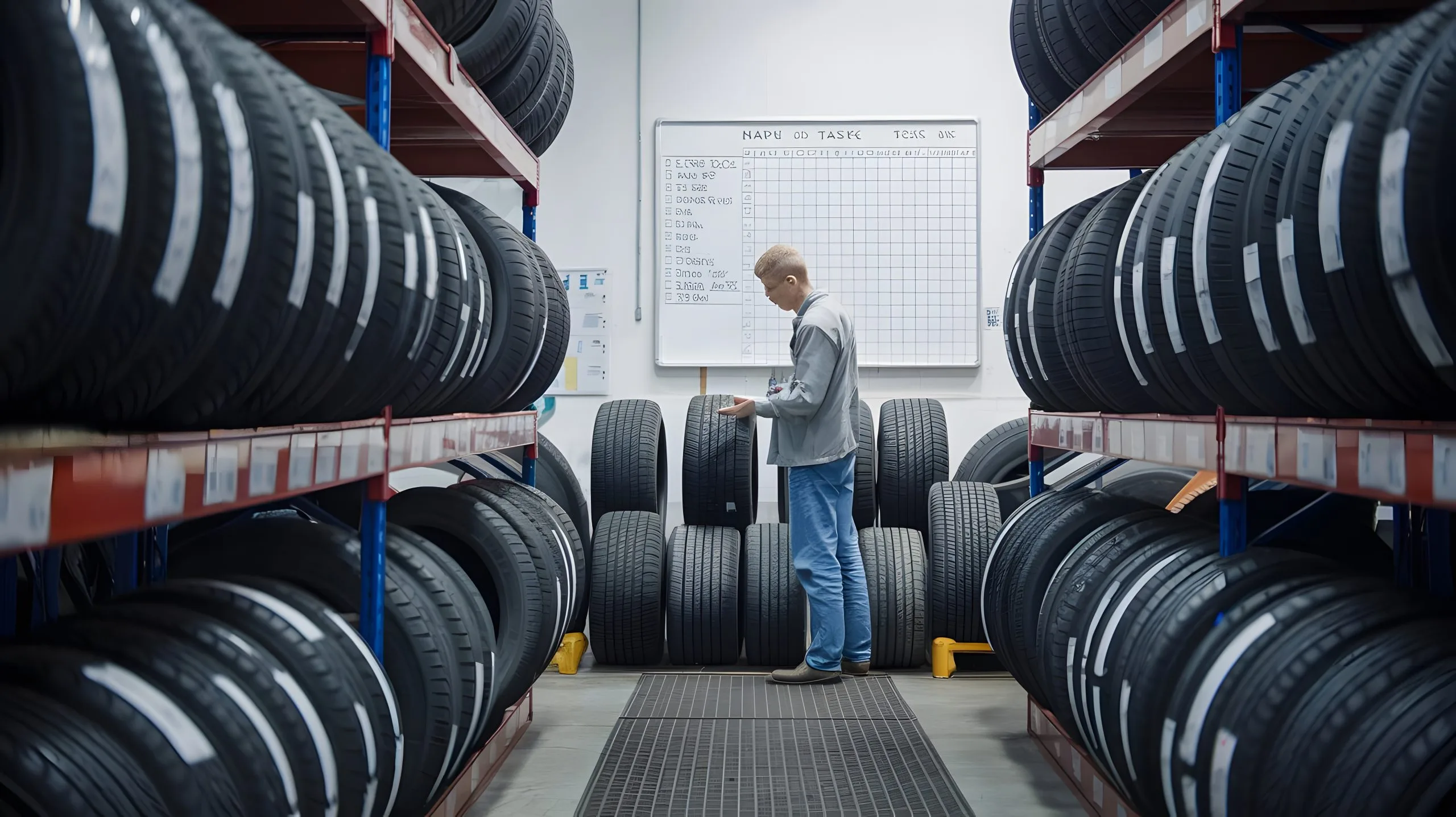
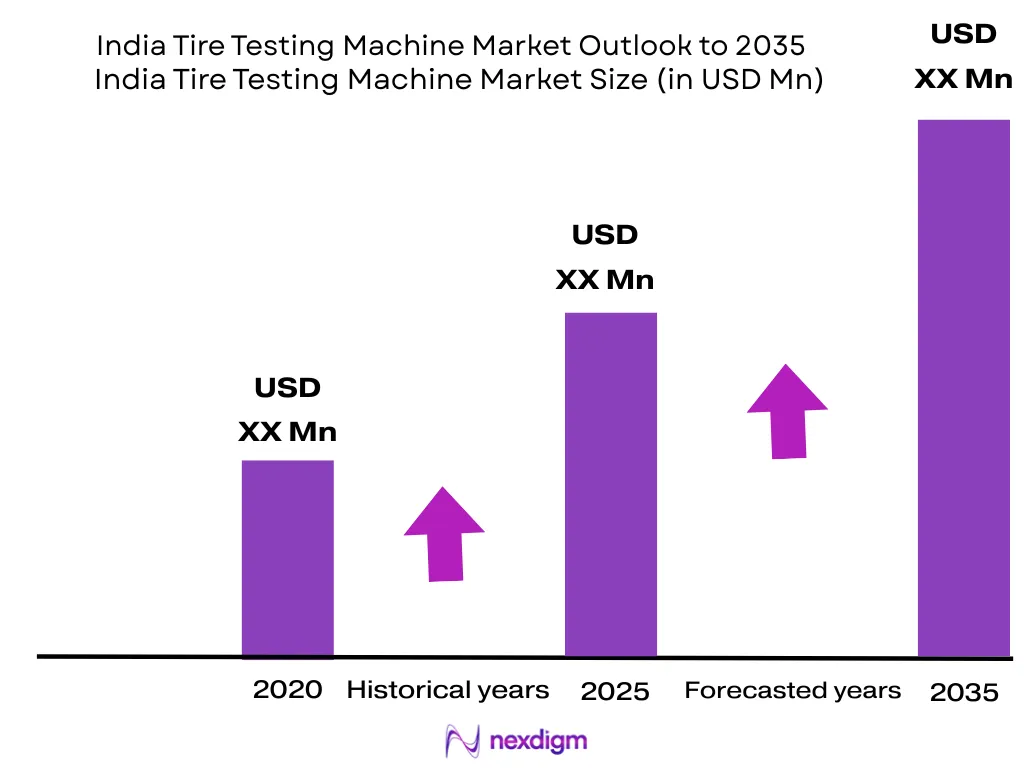
The India Tire Testing Machine Market is valued at approximately ~ million, compared with ~ million in the preceding reporting period. Demand is supported by tyre homologation, AIS-142 testing, BIS certification, production quality control, vehicle development, and laboratory expansion. India produced 23,214,969 vehicles across major categories during the first nine months of the reporting cycle, including substantial passenger, two-wheeler, three-wheeler, and commercial-vehicle volumes requiring continuous tyre validation. Pune, Chennai–Oragadam, Delhi–NCR–Manesar, Mysuru, Bengaluru–Hosur, Mumbai–Nashik–Aurangabad, Ahmedabad–Sanand, and Pithampur dominate the India Tire Testing Machine Market. Pune houses ARAI and a major automotive engineering cluster; Manesar contains ICAT and numerous vehicle manufacturers; Oragadam hosts GARC and automotive plants; Mysuru contains HASETRI’s consolidated research operations. These centres lead because they combine tyre plants, OEM engineering, homologation agencies, laboratories, proving grounds, automation suppliers, and qualified technical personnel. The India Tire Testing Machine Market covers laboratory and production equipment used to evaluate passenger-car, utility-vehicle, two-wheeler, three-wheeler, light-commercial, truck, bus, tractor, off-highway, aircraft, retreaded, smart, run-flat, and non-pneumatic tyres. The scope includes endurance testers, high-speed machines, rolling-resistance systems, tyre-uniformity equipment, force-and-moment rigs, dynamic balancers, geometry systems, wet-grip facilities, rolling-sound equipment, X-ray inspection, shearography, footprint analysis, pressure mapping, and machine-control software.
Market Segmentation
By Machine Type
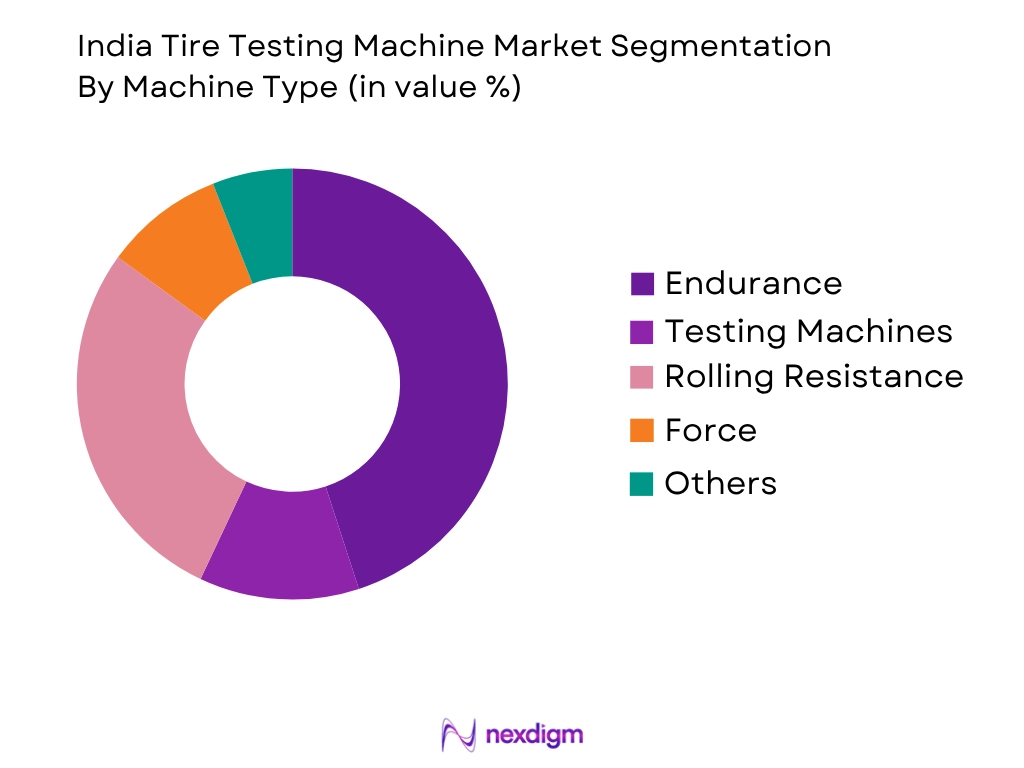
By machine type, the India Tire Testing Machine Market is segmented into endurance and high-speed testing machines, rolling-resistance machines, tyre-uniformity systems, force-and-moment systems, non-destructive inspection equipment, dynamic balance and geometry machines, wet-grip and surface-testing systems, and specialty tyre-testing equipment. Endurance and high-speed testing machines hold the dominant market share because durability testing is required across nearly every tyre category and product-development stage. These systems reproduce sustained combinations of speed, load, inflation pressure, temperature, and time to assess structural integrity, heat build-up, tread separation, sidewall fatigue, bead durability, and high-speed capability. India’s large two-wheeler, passenger-vehicle, commercial-vehicle, and tractor sectors create demand for machines spanning small tyre envelopes to high-load truck and agricultural configurations. Tyre manufacturers also use endurance systems for compound changes, new moulds, export homologation, production transfers, warranty investigations, and conformity testing. Multi-station machines improve throughput, while automatic temperature, pressure, vibration, and failure monitoring reduce operator dependence. Their broad applicability makes endurance and high-speed equipment the largest analytical segment.
By End User
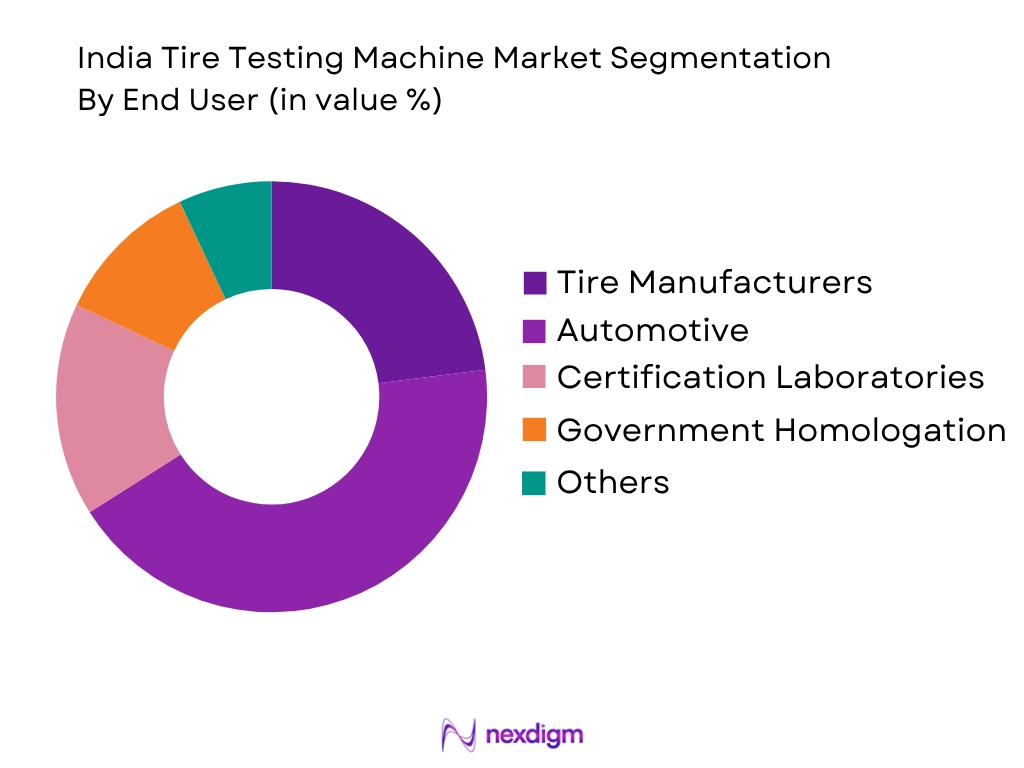
By end user, the India Tire Testing Machine Market is segmented into tyre manufacturers, automotive OEMs, government homologation laboratories, independent laboratories, two-wheeler and three-wheeler manufacturers, commercial-vehicle manufacturers, tractor and off-highway equipment manufacturers, research organisations, retreaders, and component suppliers. Tyre manufacturers hold the dominant market share because India has a broad domestic tyre-production base serving original-equipment, replacement, export, agricultural, two-wheeler, and commercial applications. Tyre companies require multiple testing stages, from raw-material and compound screening to finished-product endurance, uniformity, balance, rolling resistance, wet grip, noise, footprint, X-ray, and shearography inspection. Large plants also install end-of-line machines that must operate continuously and integrate with marking, grinding, sorting, and manufacturing execution systems. OEMs and homologation agencies represent important secondary buyers, but tyre manufacturers typically operate the widest machine portfolios and highest test volumes. Export programmes further require correlation with international standards and customer-specific test procedures, increasing demand for configurable machines, software-controlled recipes, reference correlation, and accredited laboratory practices.
Competitive Landscape
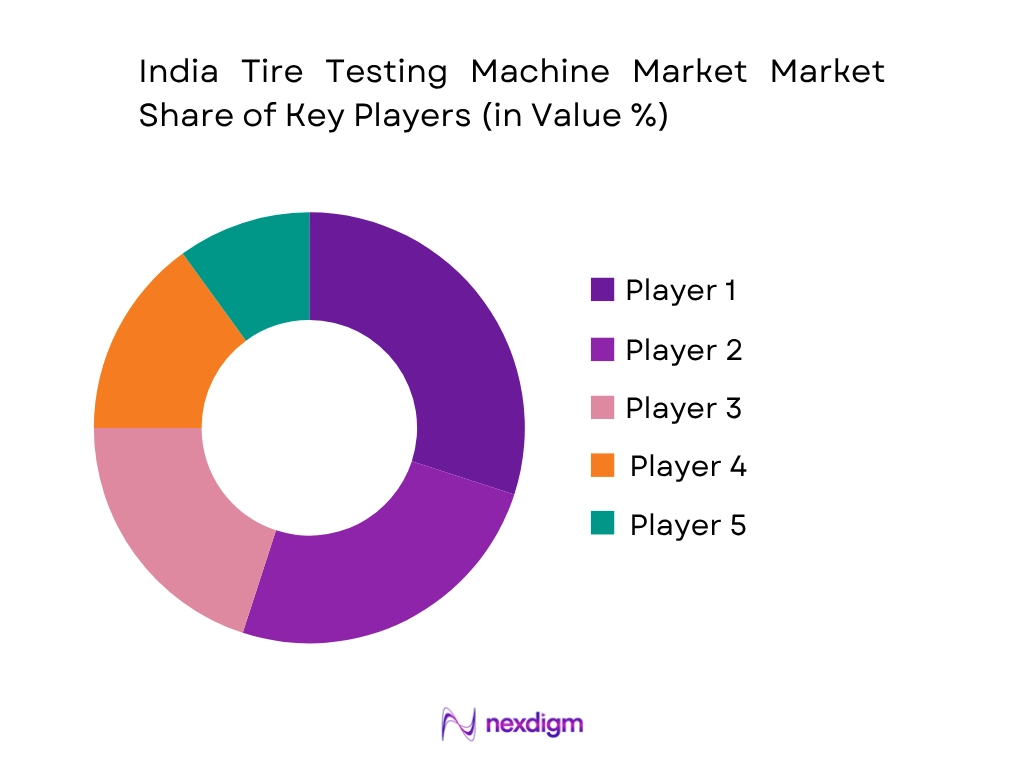
The India Tire Testing Machine Market comprises government-backed homologation centres, independent tyre laboratories, domestic engineering companies, international test-system manufacturers, and production-inspection specialists. Competition is determined by machine accuracy, load and speed capability, AIS–BIS–ISO compatibility, automation, local service, calibration support, imported-content dependence, software openness, and ability to engineer machines for two-wheelers, commercial vehicles, tractors, and electric vehicles. ARAI, ICAT, GARC, and HASETRI influence technical requirements through testing, certification, and laboratory services. Global equipment providers supply high-precision rolling-resistance, force-and-moment, uniformity, and inspection technologies, while domestic engineering companies compete through localisation, lower service lead times, customisation, and lifecycle support.
| Organisation | Established | Headquarters | Core Market Role | Main Tyre Capabilities | Vehicle Coverage | Regulatory Capability | Automation and Digital Capability | India Service Position |
| Automotive Research Association of India | 1966 | Pune | ~ | ~ | ~ | ~ | ~ | ~ |
| International Centre for Automotive Technology | 2006 | Manesar | ~ | ~ | ~ | ~ | ~ | ~ |
| Global Automotive Research Centre | NATRIP test centre | Oragadam | ~ | ~ | ~ | ~ | ~ | ~ |
| HASETRI | 1991 | Mysuru operations | ~ | ~ | ~ | ~ | ~ | ~ |
| MTS Systems | 1966 | Eden Prairie, United States | ~ | ~ | ~ | ~ | ~ | ~ |
India Tire Testing Machine Market Analysis
Growth Drivers
Expanding Automotive Production and Tyre Validation Requirements
India’s expanding automotive manufacturing base is increasing the need for endurance, high-speed, rolling-resistance, uniformity, dynamic-balance, geometry and non-destructive tyre-testing machines. Domestic factories produced 31,036,476 vehicles across passenger vehicles, commercial vehicles, three-wheelers, two-wheelers and quadricycles during FY 2024-25, compared with 28,439,036 vehicles in FY 2023-24. Production included 23,883,857 two-wheelers, 5,061,164 passenger vehicles, 1,050,020 three-wheelers and 1,034,947 commercial vehicles. Each category requires distinct tyre sizes, load envelopes, speeds, inflation pressures and durability cycles, encouraging tyre manufacturers and vehicle OEMs to operate wider machine portfolios. India also exported 5,362,884 vehicles, including 4,198,403 two-wheelers and 770,364 passenger vehicles, increasing the requirement to correlate domestic testing with overseas homologation and customer specifications. Macroeconomic conditions provide a supportive capital-investment environment: nominal GDP reached approximately ₹331.03 lakh crore in FY 2024-25, while real GVA reached about ₹171.80 lakh crore. These production and economic indicators justify continued investment in test-cell capacity, plant-quality systems, calibration equipment, software and machine modernisation.
AIS-142 Compliance and Broader Tyre Certification Requirements
Regulatory testing is a structural driver of the India Tire Testing Machine Market because tyre manufacturers must demonstrate performance under prescribed national standards before supplying products for regulated vehicle applications. ARAI identifies AIS-142 testing for C1, C2 and C3 tyres, covering rolling resistance, adhesion on wet surfaces and rolling-sound emissions. Its tyre laboratory also conducts endurance, tyre-strength, bead-unseating, load-speed and dynamic-growth tests under applicable AIS and Indian Standards. These procedures require calibrated road wheels or drums, high-resolution load and torque measurement, controlled tyre conditioning, inflation-pressure management, wet-track instrumentation, acoustic systems and traceable data acquisition. Regulatory demand extends beyond first approval because conformity-of-production programmes, construction changes, new tyre sizes and compound modifications require repeatable validation. The broader economic environment supports laboratory investment: nominal GVA reached ₹300.22 lakh crore in FY 2024-25, compared with ₹274.13 lakh crore in FY 2023-24, while India’s manufacturing sector operates within one of the world’s largest organised industrial systems. Regulatory compliance therefore creates recurring machine utilisation across ARAI, ICAT, GARC, HASETRI, tyre manufacturers and automotive OEM laboratories rather than one-time certification activity.
Market Challenges
High Capital Intensity and Dependence on Precision Imported Components
Advanced tyre-testing installations require investment far beyond the basic machine frame. High-speed endurance cells need reinforced foundations, protective enclosures, electric drives, cooling, pressure-control equipment, fire protection and remote operating rooms. Rolling-resistance laboratories require temperature-controlled conditioning, precision drums, low-drift force or torque transducers and reference-correlation systems. Force-and-moment rigs add high-speed flat belts, multi-axis load cells and real-time controllers. Many of these precision components, including specialised sensors, servo drives, high-speed bearings and flat belts, may be imported, exposing buyers to foreign-exchange movements, customs delays and long replacement lead times. The challenge is especially significant for smaller laboratories and domestic equipment manufacturers. Although India’s nominal GDP reached ₹331.03 lakh crore and real GDP expanded during FY 2024-25, individual capital-equipment decisions remain sensitive to utilisation, financing and automotive investment cycles. Commercial-vehicle production declined from 1,067,504 units to 1,034,947 units, illustrating how segment-level softness can delay dedicated heavy-duty test-cell investment even while total vehicle production rises. Suppliers must consequently offer modular platforms, staged automation, domestic fabrication, annual maintenance agreements and retrofit packages that lower upfront expenditure and reduce dependency on imported replacement parts.
Calibration Complexity and Limited Availability of Multidisciplinary Skills
Tyre-testing accuracy depends on specialists who understand mechanical engineering, tyre construction, vehicle dynamics, instrumentation, metrology, control systems and regulatory procedures. A rolling-resistance machine must correct for machine losses, drum geometry, speed, load, inflation pressure and temperature. A force-and-moment system can measure 6 components simultaneously, while wet-grip testing requires controlled water depth, track friction, braking instrumentation and reference-tyre correlation. Errors in alignment, load-cell calibration, pressure measurement or environmental conditioning can invalidate approval data or distort simulation models. India’s growing machine base therefore requires engineers capable of maintaining servo-hydraulic actuators, electric drives, spindle assemblies, high-speed data acquisition and laboratory software. The scale of automotive activity intensifies this requirement: domestic sales reached 25,609,399 vehicles in FY 2024-25, including 19,607,332 two-wheelers, 4,301,848 passenger vehicles, 958,679 commercial vehicles and 741,420 three-wheelers. India’s economy also supported a population of roughly 1.48 billion and projected real output expansion, but specialist tyre-laboratory skills remain concentrated in major automotive clusters. Training gaps can increase machine downtime, dependence on overseas service engineers, inconsistent testing practices and slower commissioning of new laboratories.
Market Opportunities
Electric-Vehicle Tyre Testing and High-Load Machine Development
Electric mobility creates a major opportunity for tyre-testing-machine suppliers because electric two-wheelers, three-wheelers, passenger vehicles and buses impose different torque, load, noise and energy-efficiency requirements. India registered 1,950,490 electric vehicles during calendar year 2024 out of 26,207,453 total vehicle registrations. By February 2025, the national electric-vehicle stock had reached approximately 5.675 million units within a total registered vehicle base of about 389.771 million units. Electric vehicles require rolling-resistance optimisation to preserve battery range, while battery mass increases vertical loading and instantaneous motor torque can accelerate tread wear. Reduced powertrain noise also makes tyre-generated noise and cavity resonance more noticeable. These factors create demand for higher-capacity endurance rigs, regenerative-braking simulation, torque-sensitive force-and-moment machines, wear simulators, thermal imaging and footprint-pressure systems. The opportunity is supported by India’s broader economic expansion: IMF reporting indicates real GDP growth of 6.5 in FY 2024-25 and 7.8 in the first quarter of FY 2025-26. Machine suppliers can use current EV volumes to justify new platforms without relying on speculative future sales, particularly for electric two- and three-wheeler tyre configurations.
Domestic Machine Localisation, Automation and Testing-as-a-Service
India has a clear opportunity to localise tyre-testing machinery and expand automated laboratory services. Domestic suppliers can manufacture machine frames, drums, safety enclosures, hydraulic power packs, electrical panels, fixtures and control software while selectively importing precision transducers or high-speed components. Localisation can shorten service response, reduce spare-parts delays and allow machines to be customised for India’s unusually broad mix of two-wheeler, three-wheeler, passenger, truck, bus, tractor and off-highway tyres. The addressable industrial base is substantial: vehicle production reached 31,036,476 units in FY 2024-25, while automobile exports reached 5,362,884 units. Nominal GVA reached ₹300.22 lakh crore, providing an expanding economic base for industrial equipment and automation. Automated uniformity, balance, X-ray and visual-inspection machines can integrate robotic loading, inflation, grinding, marking, sorting and manufacturing execution systems. Independent laboratories can also develop testing-as-a-service models for EV start-ups, retreaders, compound suppliers and smaller tyre companies that cannot justify full machine ownership. Current production volumes support immediate demand for domestic equipment engineering, retrofit services, remote diagnostics, predictive maintenance and shared testing capacity without requiring future market-size assumptions.
Future Outlook
The India Tire Testing Machine Market is forecast to expand at approximately ~XX% CAGR during the forecast period. Growth will be supported by automotive production, electric mobility, AIS-142 compliance, tyre exports, commercial-vehicle radialisation, plant automation, domestic machine localisation, and replacement of ageing laboratory controls. Electric mobility will alter tyre test requirements across two-wheelers, three-wheelers, passenger cars, buses, and commercial vehicles. India sold approximately 1.95 million electric vehicles during the calendar reporting period, while total cumulative registrations had reached about 4.4 million units by August of the same period. Higher vehicle mass, instant torque, frequent stop-start operation, and range sensitivity require improved rolling-resistance, wear, endurance, footprint, stiffness, and thermal testing. Two- and three-wheelers will remain particularly important. During the first nine months of the automotive reporting cycle, domestic two-wheeler sales reached 15,039,570 units, while three-wheeler sales reached 562,652 units. These volumes create recurring demand for small-envelope endurance, rolling-resistance, dynamic-growth, bead-unseating, strength, uniformity, and wet-performance machines.
Major Players
- Automotive Research Association of India
- International Centre for Automotive Technology
- Global Automotive Research Centre
- Hari Shankar Singhania Elastomer and Tyre Research Institute
- Larsen & Toubro Rubber Processing Machinery
- MTS Systems
- ZF Test Systems
- A&D Technology
- Kokusai
- Micro-Poise Measurement Systems
- Kobe Steel
- Instron
- TMSI
- Hofmann Maschinen- und Anlagenbau
- The Poling Group
Key Target Audience
- Tyre manufacturers and retread producers
- Automotive, electric-vehicle and commercial-vehicle manufacturers
- Two-wheeler and three-wheeler manufacturers
- Tractor, agricultural and off-highway equipment manufacturers
- Tyre machinery, inspection and automation suppliers
- Tyre material, compound and smart-sensor developers
- Investments and venture capitalist firms
- Government and regulatory bodies (Ministry of Road Transport and Highways, Ministry of Heavy Industries, Bureau of Indian Standards, Automotive Research Association of India, International Centre for Automotive Technology, Global Automotive Research Centre and National Accreditation Board for Testing and Calibration Laboratories)
Research Methodology
Step 1: Identification of Key Variables
The first phase maps tyre manufacturers, machine suppliers, automotive OEMs, homologation bodies, laboratories, automation companies, sensor providers, and calibration agencies. Variables include machine type, load, speed, tyre category, installed base, automation, pricing, localisation, utilisation, replacement cycle, and service income.
Step 2: Market Analysis and Construction
Historical machine purchases, tyre-production capacity, automotive output, AIS-142 testing, certification activity, laboratory additions, plant automation, imports, retrofits, and maintenance revenue are compiled. Top-down analysis estimates equipment intensity, while bottom-up analysis aggregates machines, selling prices, software, calibration, and services.
Step 3: Supply-Side Assessment
Suppliers are assessed by machine portfolio, tyre-size range, maximum load, maximum speed, measurement accuracy, automation, standards compatibility, local manufacturing, service coverage, spare-parts availability, engineering customisation, and installed references.
Step 4: Demand-Side Assessment
Tyre manufacturers, OEMs, testing agencies, EV companies, tractor manufacturers, retreaders, and component suppliers are evaluated by test throughput, machine utilisation, outsourcing behaviour, certification needs, capital expenditure, plant capacity, and replacement plans

- Executive Summary
- Research Methodology (Market Definitions and Assumptions, Abbreviations, Tire Testing Machine Market Boundary, Capital Equipment Revenue Recognition, New Machine Shipment Assessment, Installed Base Mapping, Retrofit and Modernisation Assessment, Top-Down Analysis, Bottom-Up Analysis, Demand-Side Assessment, Supply-Side Assessment, Tyre Plant Capacity Mapping, Homologation Laboratory Mapping, Primary Industry Interviews, Equipment Price Benchmarking, Data Triangulation, Forecasting Framework, Limitations and Future Conclusions)

- Definition and Scope
- Market Evolution and Industry Genesis
- Timeline of Major Industry Developments
- Evolution from Mechanical Drum Testers to Automated Multi-Axis Test Systems
- India Tyre Testing Machine Industry Business Cycle

- Growth Drivers (BIS Certification, CMVR Compliance, Rolling Resistance Regulation, Tyre Production, Vehicle Electrification, Export Homologation)
- Market Challenges (High Capital Cost, Import Dependence, Calibration Complexity, Skills Availability, Machine Downtime, Technology Obsolescence)
- Market Opportunities (EV Tyres, Domestic Equipment Manufacturing, Automated Inspection, Digital Twins, Smart Tyres, Testing Services)
- Market Trends (Automation, Electrification, Multi-Axis Testing, AI Inspection, Virtual Engineering, Localisation)
- Government Regulations and Industry Standards (CMVR, BIS Standards, AIS-142, Type Approval, Conformity of Production, Calibration)
- SWOT Analysis
- Porter’s Five Forces Analysis
- PESTLE Analysis

- By Market Value (2020-2025)
- By New Machine Sales Value (2020-2025)
- By Imported Machine Sales Value (2020-2025)

- By Machine Type (In Value %)
Tyre Endurance Testing Machines
High-Speed Performance Testing Machines
Rolling Resistance Testing Machines
Tyre Uniformity Testing Machines
Force and Moment Testing Machines - By Tyre Category (In Value %)
Scooter Tyres
Motorcycle Tyres
Three-Wheeler Tyres
Passenger Car Tyres
SUV and Utility Vehicle Tyres - By End User (In Value %)
Tyre Manufacturers
Automotive Original Equipment Manufacturers
Electric Vehicle Manufacturers
Two-Wheeler Manufacturers
Three-Wheeler Manufacturers
Passenger Vehicle Manufacturers - By Region (In Value %)
North India
South India
West India
East India
Central India

- Market Share of Major Players (By Value, Unit Shipments, Machine Type, End User, Application)
- Cross Comparison Parameters (Machine Portfolio Breadth, Maximum Tyre Load and Speed Envelope, Force–Moment–Rolling Resistance Measurement Accuracy, AIS-142–BIS–CMVR–ISO Test Method Compatibility, Flat-Belt–Drum–Uniformity–Inspection Technology Capability, Automation–Robotic Handling–Data Acquisition–Digital Twin Integration, India Installed Base–Field Service–Calibration–Spare Parts Coverage, EV–Two-Wheeler–Commercial–Agricultural–Smart Tyre Testing Readiness)
- SWOT Analysis of Major Players
- Detailed Profiles of Major Companies and Testing Organisations
Automotive Research Association of India
International Centre for Automotive Technology
Global Automotive Research Centre
Hari Shankar Singhania Elastomer and Tyre Research Institute
Larsen & Toubro Rubber Processing Machinery
MTS Systems
ZF Test Systems
A&D Technology
Kokusai
Micro-Poise Measurement Systems
Kobe Steel
Instron
TMSI
Hofmann Maschinen- und Anlagenbau
The Poling Group

- Tyre Manufacturer Analysis
- Two-Wheeler OEM Analysis
- Passenger Vehicle OEM Analysis
- Electric Vehicle Manufacturer Analysis
- Commercial Vehicle OEM Analysis

- By Market Value (2026-2035)
- By New Machine Sales Value (2026-2035)
- By Imported Machine Sales Value (2026-2035)


 Request a Sample
 Ask for Customization
 Get a Quote
 Enquire Now