

 Download PDF
Market Overview
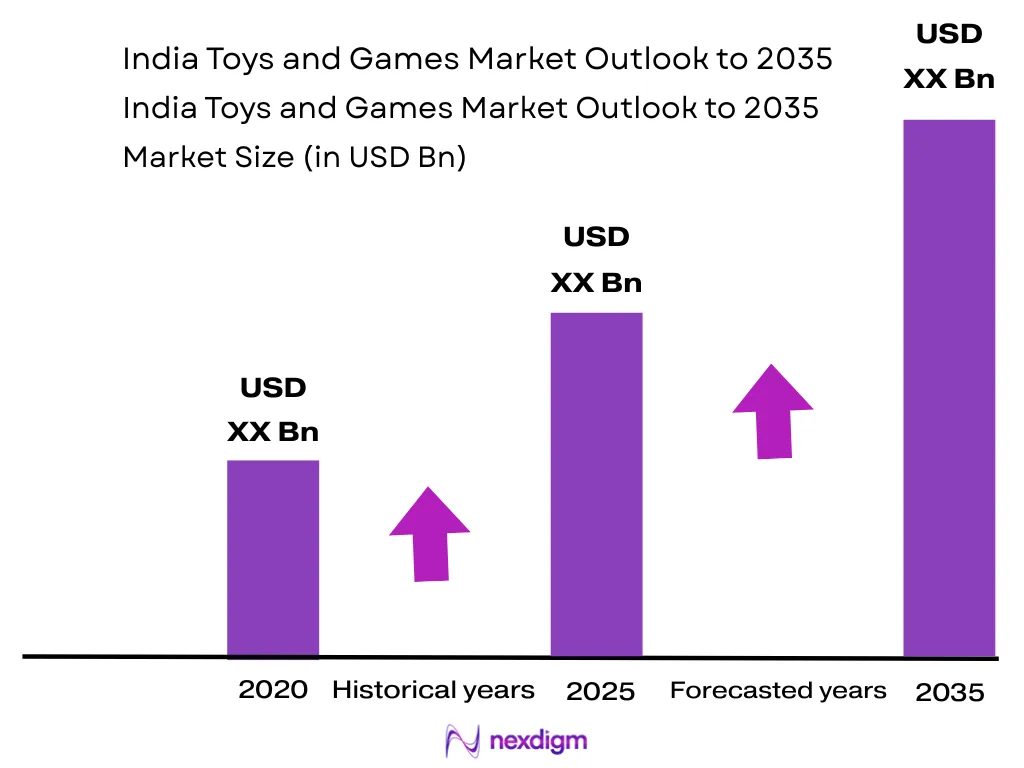
The India toys and games market is valued at approximately INR ~ crore in 2024 (about USD ~ billion) based on industry revenue tracking and trade data, reflecting a material expansion from around USD 1.9 billion in 2023 driven by rising disposable incomes, a large youth population, and increasing parental spend on educational and leisure products. Organized retail combined with rapid e‑commerce adoption has significantly broadened market access, while domestic manufacturing encouragement and BIS safety regulation enforcement have shifted demand toward quality, branded offerings.
Metropolitan and economically advanced regions such as Maharashtra (Mumbai, Pune), Delhi NCR, and Karnataka (Bengaluru) dominate the India toys and games market due to higher consumer purchasing power, concentrated retail infrastructure, and mature digital commerce penetration. These cities also host major distribution hubs and experiential retail outlets that amplify brand visibility and consumer engagement. Tier‑II urban clusters in states such as Tamil Nadu and Telangana are rapidly scaling due to rising incomes and improved logistics.
Market Segmentation
By Product Type
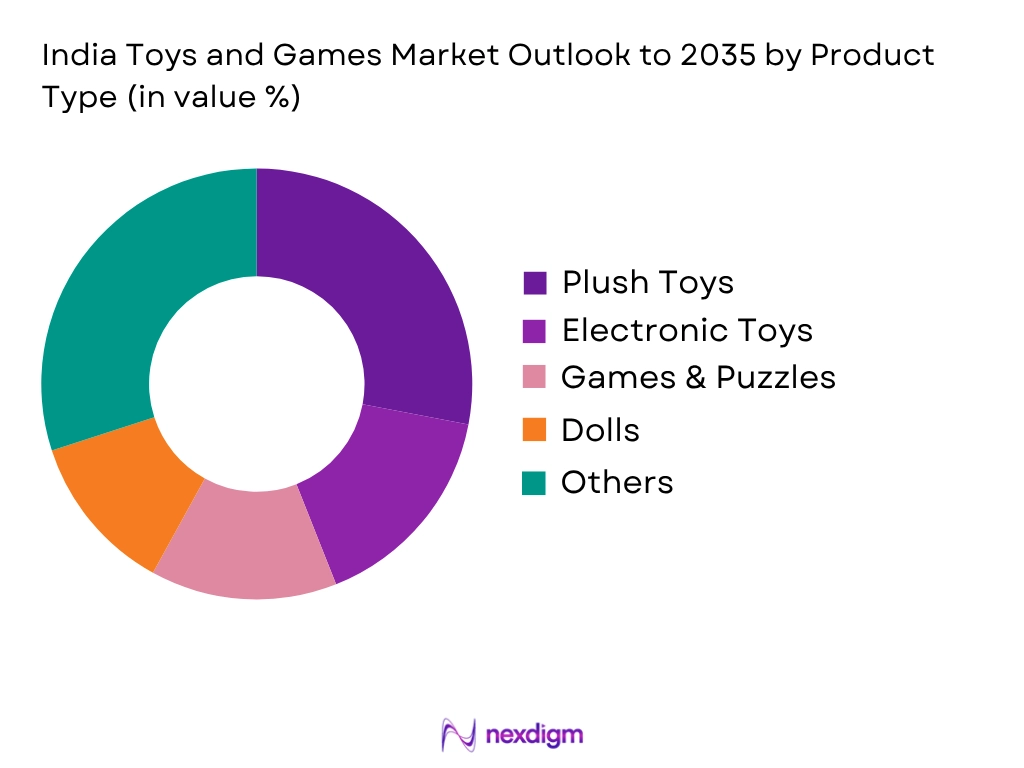
Plush toys retain the largest share of the overall product mix owing to their strong emotional resonance with both children and gifting occasions, establishing them as perennial best‑sellers across demographics. Soft toys, especially those tied to popular entertainment franchises and characters, benefit from sustained cultural relevance and strong supporting media and licensing ecosystems, driving repeat purchases. Electronic toys and games & puzzles are increasingly important, reflecting trends in technology integration and cognitive skill play, but they remain secondary to the broad appeal and purchase frequency of plush products. The diversified age reach of plush toys, combined with relatively simple supply chain requirements and stable unit economics, underpins their dominance.
By Distribution Channel
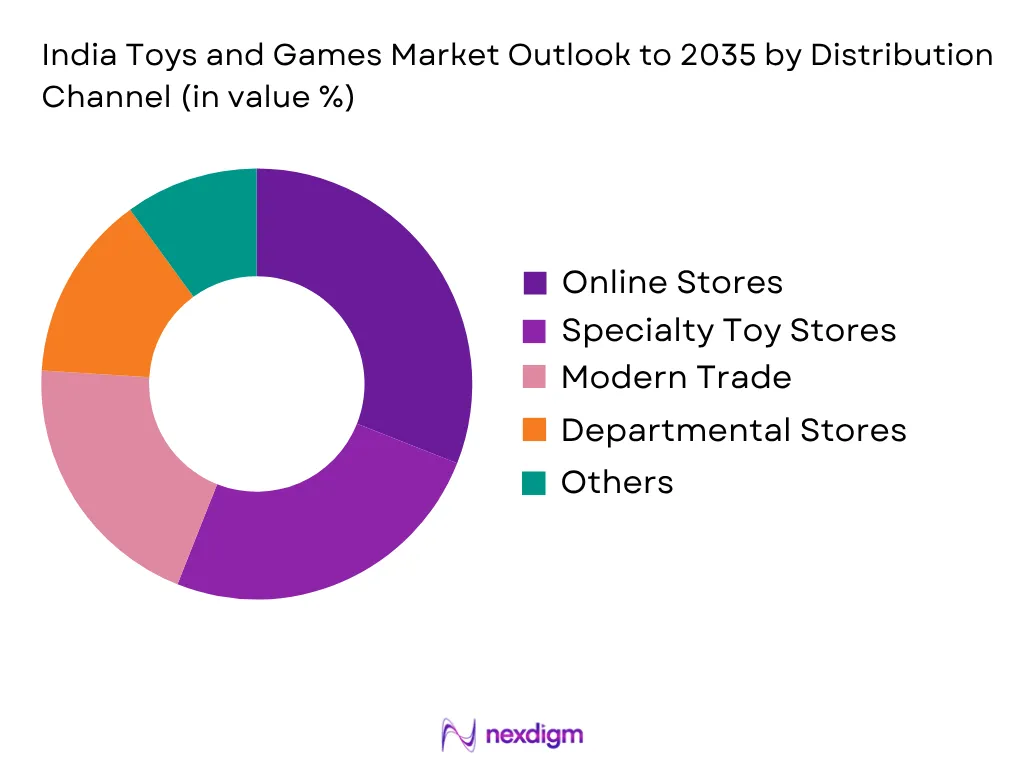
Online sales channels have emerged as the leading means of distribution, driven by affordability, convenience, and broad product assortments accessible even outside major cities. E‑commerce platforms facilitate wider catalog exposure, competitive pricing, and digital payment flexibility, making them particularly attractive to younger parents and gift buyers. Specialty toy stores remain strong in urban centers due to personalized service and experiential retail, while modern trade contributes stable volume via bundled promotions and seasonal displays. Departmental and unorganized retail channels retain relevance in smaller towns and local markets, though their share is eroded by the growth of organized and digital channels.
Competitive Landscape
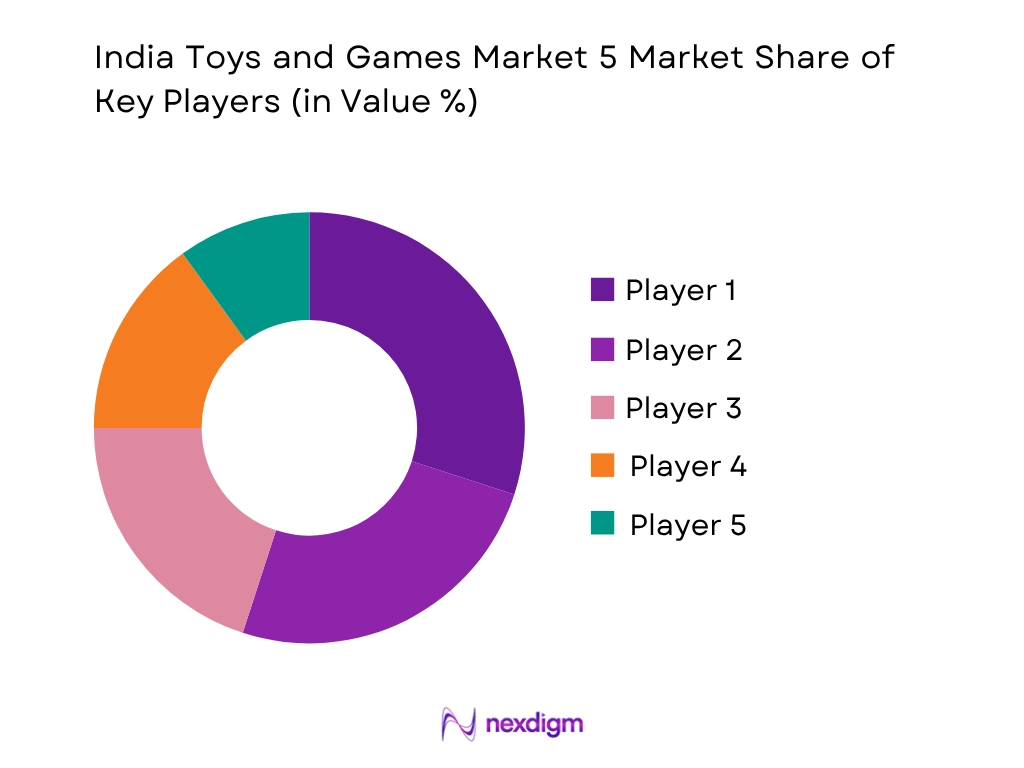
The India toys and games market is moderately competitive, with a mix of global multinationals and domestic brands shaping sector dynamics through differentiated product offerings, innovation pipelines, and channel strategies. Strong international players leverage global IP and franchise licensing, while local brands capitalize on regional customization and cost efficiency.
| Company | Est. Year | Headquarters | Product Portfolio Breadth | Retail Footprint | E‑Commerce Penetration | Brand Licensing Partnerships | Manufacturing Presence | Safety & Compliance Credentials |
| Funskool India | 1987 | Chennai, India | ~ | ~ | ~ | ~ | ~ | ~ |
| Mattel India | 1945 | El Segundo, USA (India ops) | ~ | ~ | ~ | ~ | ~ | ~ |
| Lego India | 1932 | Billund, Denmark (India ops) | ~ | ~ | ~ | ~ | ~ | ~ |
| Hasbro India | 1923 | Pawtucket, USA (India ops) | ~ | ~ | ~ | ~ | ~ | ~ |
| Hamleys India | 1760 | London, UK (India ops) | ~ | ~ | ~ | ~ | ~ | ~ |
India Toys and Games Market
Growth Drivers
Large Child Population and Youth Demographic Supporting Demand
India’s demographic structure features a significant young population that directly influences demand for toys and games, with approximately 357,277,018 children aged 0‑14 years estimated in 2024 based on World Bank data, representing a substantial consumer base for child‑oriented products. The high absolute number of youth ensures continued demand for age‑appropriate toys, learning products, and play materials. This large cohort is backed by broader demographic numbers — India’s total population stands at around 1.45 billion people — indicating a vast base for long‑term market consumption and intergenerational play goods demand beyond infancy into adolescence. Additionally, around 24.62% of the population was aged 0‑14, confirming that nearly one in four residents are children who are pivotal for toys and games consumption. These child demographics are not only relevant for traditional physical toys but increasingly influence demand for digital and educational play products, as parental spending priorities shift toward cognitive development and skill‑based leisure. The sustained youth presence ensures that manufacturers and retailers can rely on a deep and replenishing consumer segment year over year, undergirding structural growth potential in the broader toys and games ecosystem.
Rising Household Consumption of Non‑Food Goods Enhances Discretionary Purchasing
Household spending patterns across India indicate a notable shift toward non‑food consumption, which includes discretionary items that comprise toys and games. According to the Household Consumption Expenditure Survey: 2023‑24 by MoSPI, average monthly household spending has risen, with urban households spending an average Monthly Per Capita Consumption Expenditure (MPCE) of Rs. 6,996 and rural households at Rs. 4,122, showcasing increasing disposable income capacity across demographics. Non‑food expenditure — a proxy for discretionary spending potential — constituted about 60% of urban MPCE and 53% of rural MPCE, supporting demand for lifestyle and recreation products outside essential items. These trends illustrate that Indian households are allocating more of their consumption budgets toward goods beyond food and basic utilities, suggesting that a portion of this discretionary spend extends to children’s play and development categories. Furthermore, the narrowing urban‑rural gap in consumption (70% of urban spending in rural areas) highlights expanding purchasing power outside metropolitan markets, enabling wider geographic participation in toys and games sales. With consumption increasingly oriented toward non‑food items, the environment is conducive for manufacturers and retailers to drive category penetration through diversified offerings that align with evolving household budgets and preferences.
Market Challenges
Fragmented Industry Structure and Informal Sector Pressure
One of the core structural challenges facing the India toys and games market is its fragmented industry composition with a dominant informal segment that undermines formal players’ efforts to scale quality and safety. Analyses of the sector show that a large share of toy production and distribution remains unorganized, meaning that small workshops and informal vendors produce low‑cost products often outside regulated compliance frameworks. This fragmentation makes it difficult for branded companies to achieve economies of scale and consistent quality assurance, especially in rural and peri‑urban distribution channels where informal products are more accessible to price‑sensitive consumers. Additionally, India imports a significant volume of toys, with up to 80% of toys coming from import markets like China, contributing to supply chain volatility and competitive pressure on domestic manufacturing ecosystems. Imported goods can be priced aggressively due to established supply chains and economies of scale abroad, making it challenging for local manufacturers to match cost structures while maintaining compliance with evolving safety standards. The combination of informal market prevalence and high import penetration complicates efforts to formalize the industry, standardize quality, and stabilize distribution networks, thereby limiting growth momentum for established market participants.
Regulatory and Infrastructure‑Driven Bottlenecks in Local Manufacturing
Despite growth opportunities, the India toys and games market faces regulatory and infrastructure limitations that constrain domestic manufacturing capabilities. While Government of India surveys show expanding household consumption patterns, the underlying production ecosystem has not kept pace with this rising demand due to gaps in technology and testing infrastructure. The industry is characterized by limited end‑to‑end manufacturing facilities, inadequate specialized toy testing labs, and a lack of dedicated toy clusters or parks that could enhance localized production and quality control. Small and micro enterprises, which form a core part of domestic production, often operate with outdated machinery and lack capital investment, affecting product design, safety features, and global competitiveness. Furthermore, differential taxation applied to different toy categories under current GST rules (for example, variations between electronic and mechanical toys) adds complexity to cost structures and discourages innovation in certain product segments. These regulatory cost inputs combined with inadequate logistics and manufacturing infrastructure impede the scaling of domestic production, forcing many players to rely on imported components or finished goods, thereby exposing them to global supply chain disruptions and foreign exchange risks. Addressing these structural inefficiencies remains a significant challenge for broadening the industrial base and enhancing India’s self‑sufficiency in toys and games manufacturing.
Opportunities
Expanding Middle‑Income Consumption Base
India’s evolving consumption profile presents a distinct opportunity for expansion of the toys and games market through a growing middle‑income consumer base. Official government expenditure data indicates that households are increasingly allocating budgets toward non‑food items, with average monthly expenditures of Rs. 6,996 in urban areas and Rs. 4,122 in rural areas, signaling enhanced discretionary spending power. This trend suggests that more families can afford branded toys, educational games, and interactive play products which historically were considered premium purchases. Rising disposable income across diverse regions — supported by the narrowing gap between urban and rural consumption levels — enables toy manufacturers and retailers to extend offerings beyond major cities into emerging urban centers and semi‑urban populations. Moreover, sustained spending on durable and lifestyle products embeds toys and games within broader household expenditure patterns that extend beyond essential categories, creating scope for targeted marketing and category diversification. Given these consumption shifts, market participants can tailor products to different income segments, affordability tiers, and value propositions that resonate with spending patterns reflected in government expenditure surveys, unlocking higher category penetration and repeat consumer engagement.
Internet Penetration and Digital Access Enhancing Distribution Reach
In India, broadening digital connectivity provides a major opportunity for the toys and games market to access previously underserved consumers through online distribution channels. Data from the World Bank shows that internet usage reached approximately 70% of the Indian population, enabling wide reach for e‑commerce platforms that sell toys and games across regions with limited physical retail presence. Increasing online engagement, coupled with rising smartphone and digital payment adoption, allows retailers to market diverse product ranges and experiential offerings directly to consumers via digital storefronts — including niche, educational, and premium toy segments that may be underrepresented in local retail. Online platforms also enable dynamic pricing, customer reviews, and targeted promotions that improve consumer discovery and purchase confidence. As connectivity improves in rural and semi‑urban regions, e‑commerce presents a scalable channel to augment market coverage beyond metropolitan areas, aligning with the macro trend of rising non‑food household expenditure. This digital distribution opportunity enhances cost efficiency for manufacturers by reducing reliance on brick‑and‑mortar networks while tapping into latent demand from digitally engaged consumers seeking convenience and variety.
Future Outlook
The India toys and games market is poised for sustained expansion over the next decade, supported by demographic tailwinds, increasing consumer willingness to allocate household expenditure toward quality play and educational products, and robust digital commerce growth. Continuous enhancements in logistics and retail infrastructure, combined with policy emphasis on domestic manufacturing clusters (including incentives to become global export hubs), will further integrate India into global toy supply chains. Innovation in product segments—particularly technology‑integrated and educational play—will attract premium consumer segments, supporting value growth even as unit volume expands in less‑served regions and age cohorts. Projected growth is underpinned by current market intelligence which indicates a compound annual growth rate broadly in the 4–5% range for the full toys and games category over the mid‑term, with selected sub‑segments (e.g., educational and STEM play) exhibiting above‑market momentum due to evolving parental preferences and experiential learning frameworks.
Major Players
- Funskool India
- Mattel India
- Lego India
- Hasbro India
- Hamleys India
- Simba Toys India
- Wow Toys
- PlayShifu
- Spin Master
- Ravensburger India
- FirstCry Kids Brands
- Silverlit Toys India
- Moose Toys (India)
- Young Toys
- Micro Plastics Pvt. Ltd.
Key Target Audience
- Consumer Goods & FMCG Strategic Investment Funds
- Investments and Venture Capitalist Firms
- Private Equity Investors focused on Retail & Consumer Sectors
- Toy & Game Retail Chain Operators
- Large E‑Commerce Marketplaces
- Government and Regulatory Bodies
- Global Toy Manufacturers’ Business Expansion Teams
- Large Organized Retail Chains’ Kids & Leisure Category Heads
Research Methodology
Step 1: Market Definition and Variable Identification
The initial phase involved constructing a comprehensive market definition covering toys and games inclusive of product categories such as plush, electronic, educational, and games & puzzles. Critical variables influencing demand, supply chain dynamics, and pricing mechanisms were identified through extensive secondary sources and trade data to anchor the analysis.
Step 2: Data Collection and Historical Analysis
A combination of proprietary databases, industry reports, government trade figures, and verified secondary literature were compiled to establish historical revenue benchmarks and segment shares. Analytical models were applied to normalize data across sources, enabling robust volume and value constructs underpinning the 2024 market size.
Step 3: Expert Validation and Hypothesis Testing
Industry hypotheses regarding growth drivers, consumer preferences, and competitive positioning were validated through interviews with toy manufacturers, retail category leads, and distribution partners. These engagements provided operational context and corroborated modeling assumptions, refining forecasts and product segmentation interpretations.
Step 4: Forecasting and Synthesis
Forward‑looking market projections were developed using established extrapolation methods anchored in demographic and economic indicators, e‑commerce adoption rates, and segment‑specific demand trajectories. Outputs were synthesized into integrated narratives ensuring consistent cross‑validation with primary and secondary insights.

- Executive Summary
- Research Methodology (Market Definitions and Assumptions, Abbreviations, Data Sources & Verification, Primary Research Framework, Secondary Research Framework, Demand Forecasting Models [CAGR, Volume & Value Drivers, Price Indexing], Data Triangulation Methodology, Limitations)

- Market Definition and Scope
- Market Genesis and Development Phase Transition
- Consumer Adoption Curve (Kids & Family Lifecycle)
- Industry Value Chain (from Raw Materials to Retail and After‑Sales)
- Market Access and Distribution Network Structure
- Informal Market and Traditional Retail Dynamics

- Growth Drivers (Rising Disposable Income & Child Population Density Metrics, Adoption of Educational / STEM Play Trends, Commerce Penetration & Digital Influence, Licensing & IP‑Driven Demand (Entertainment Franchises)
- Market Challenges (Regulatory Barriers & Safety Compliance Requirements (BIS/IS Standards)
- Opportunities (Localization of Manufacturing and ‘Make in India’ Tax Incentives, Tier‑II & Tier‑III City Demand Acceleration)
- Trend Analysis (Sustainable & Eco‑Friendly Toys, Augmented Reality (AR) & App‑Linked Play)
- Regulatory and Safety Framework (Govt. Notifications & Enforcement)
- SWOT Analysis (Market Level)

- By Market Value (2020-2025)
- By Volume (2020-2025)
- By Average Price Realization (2020-2025)

- By Product Type (In Value %)
Action Figures & Character Toys (Volume & Value)
Educational & STEM Toys
Plush Toys
Puzzles & Board Games
Electronic & Digital Toys - By Age Cohort (In Value %)
0‑3 Years
4‑7 Years
8‑12 Years
13‑17 Years
Adult Games and Hobbyists - By Distribution Channel (In Value %)
Specialty Toy Stores
Modern Trade (Hypermarkets & Supermarkets)
E‑Commerce Platforms
Departmental Stores
Unorganized Retail - By Region (In Value %)
North India
South India
West India
East & North‑East India
Central India

- Market Share Analysis (Value & Volume)
- Cross‑Comparison Parameters (Company Overview, Business Strategy Archetype, Product Portfolio Breadth Index, Retail Footprint & Channel Mix, Distribution Network Scale, Brand Equity & IP Partnerships, Pricing Strategy & SKU Price Bands, Production Footprint & Capacity Utilization, Quality & Safety Compliance Scores, Consumer Engagement & Loyalty Metrics, Innovation Index & New Product Velocity, Revenue Growth & Margin Profile)
- Player Positioning Matrix (Premium vs. Mass vs. Value)
Product Pricing & SKU Mapping by Key Competitors
Strategic Initiatives and Recent Developments - Detailed Company Profiles
Mattel India
Hasbro India
Funskool India
Simba Toys India
Wow Toys
LeapFrog (Fisher‑Price)
Lego India
Spin Master
Ravensburger India
PlayShifu
Hamleys India
Young Toys
Silverlit Toys India
Moose Toys (India)
Local & Regional OEM Consortium

- Purchase Decision Drivers (Price Sensitivity, Safety, Brand Trust)
- Channel Preferences and Channel Shifts (Offline → Online)
- Parent vs. Child Influence Mapping
- Demographic Affinity Patterns
- Customer Retention & Repeat Purchase Metrics

- Forecast by Value (2026-2035)
- Forecast by Volume (2026-2035)
- Forecast by Average Price Point (ASP) Trends (2026-2035)


 Request a Sample
 Ask for Customization
 Get a Quote
 Enquire Now