
 Download PDF
Market Overview
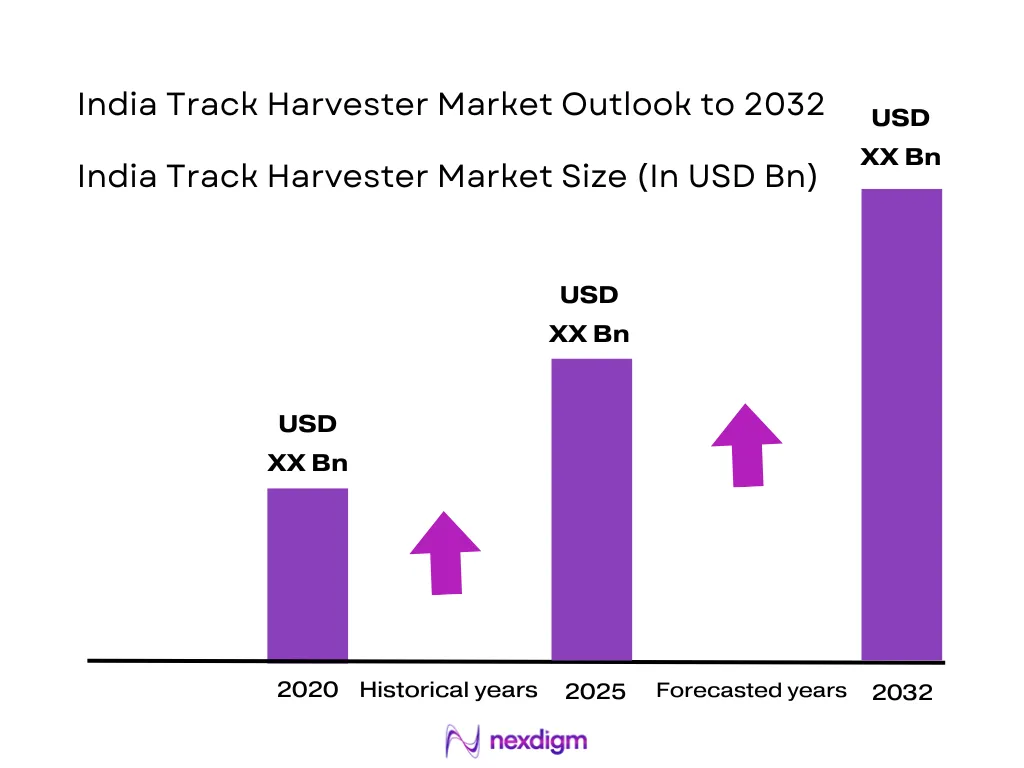
The India Track Harvester market current size stands at around USD ~ million and is being shaped by increasing mechanization demand in paddy-intensive belts, rising labor shortages during harvesting windows, and greater dependence on equipment that can operate efficiently in wet and soft soil conditions. Demand remains concentrated around specialized crop cycles where tracked mobility, reduced field losses, and higher operational stability matter more than conventional wheel-based combine alternatives. The market is also supported by stronger replacement demand from contractor fleets and growing adoption through institutional and subsidy-linked procurement channels.
Demand concentration is strongest across eastern, southern, and select northern agricultural clusters where paddy cultivation, waterlogged field conditions, and fragmented farm plots create favorable operating conditions for track harvesters. States such as Punjab, Haryana, West Bengal, Odisha, Andhra Pradesh, Telangana, Tamil Nadu, and Assam remain structurally important due to cropping intensity, mechanization readiness, and public support for farm equipment adoption. The ecosystem is more mature in regions with stronger dealer networks, custom hiring centers, localized service infrastructure, and policy-backed mechanization programs that encourage adoption among small and mid-sized farm operators.
Market Segmentation
By Product Type
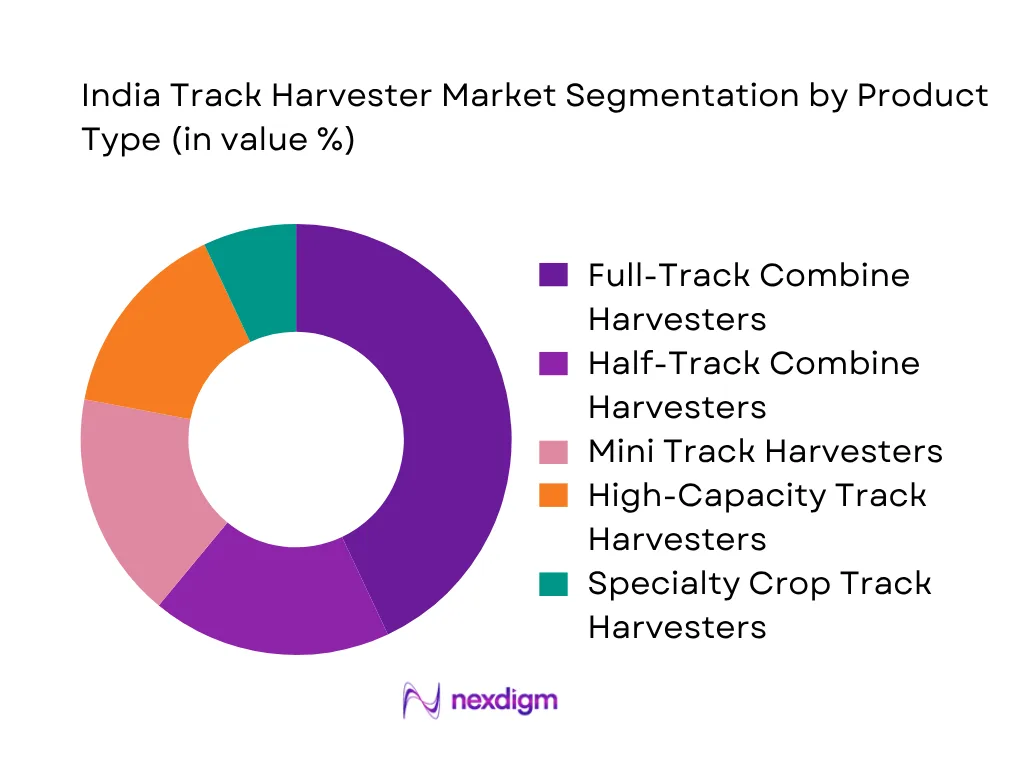
Full-track combine harvesters continue to dominate the India Track Harvester market because they offer superior mobility, lower ground pressure, and better performance in paddy fields with soft and waterlogged soil. Their dominance is particularly visible in regions where harvesting windows are short and field accessibility becomes a major operational constraint. High-capacity models are preferred by contractors and fleet owners for better daily coverage, while mini and specialty variants are gaining traction in fragmented farm belts and niche crop applications. Half-track models serve a transitional segment but remain relatively limited compared with full-track systems, especially where farmers prioritize harvesting efficiency, lower crop loss, and better field adaptability over upfront equipment affordability.
By Crop Type
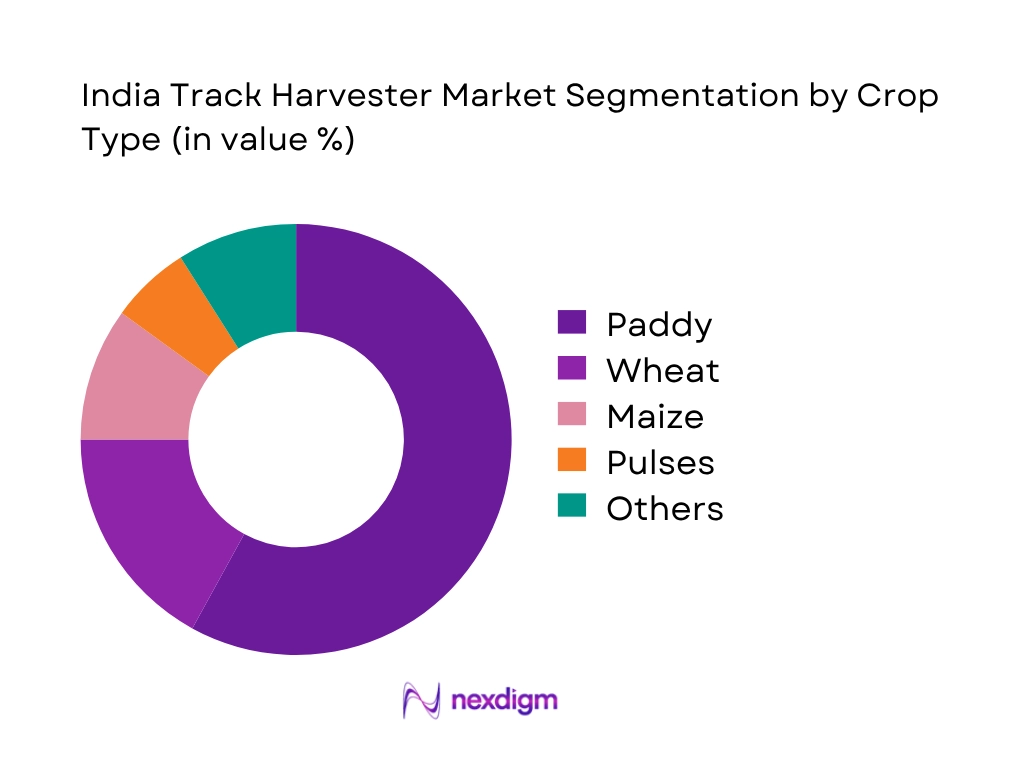
Paddy remains the leading crop segment in the India Track Harvester market due to the machine’s core suitability for wetland harvesting, reduced sinkage, and improved operational continuity under soft-soil conditions. This dominance is reinforced by concentrated demand in eastern and southern states where paddy acreage and multi-crop cycles support recurring utilization. Wheat follows as a secondary segment, especially where track harvesters are used as part of diversified contractor fleets. Maize, pulses, and oilseeds remain emerging applications but are comparatively smaller because harvesting requirements are often met through alternate mechanized equipment. Sugarcane-linked use cases remain limited and mostly experimental, with adoption concentrated around specialized field adaptations rather than mainstream equipment demand.
Competitive Landscape
The India Track Harvester market remains moderately concentrated, with competition shaped by product adaptability for paddy terrain, service readiness during peak harvest periods, dealer reach in mechanized farming clusters, and machine suitability for custom hiring operations. Competitive differentiation is increasingly tied to uptime reliability, operator familiarity, parts availability, and localized engineering for Indian field conditions.
| Company Name | Establishment Year | Headquarters | Formulation Depth | Distribution Reach | Regulatory Readiness | Service Capability | Channel Strength | Pricing Flexibility |
| Kubota Agricultural Machinery India | 2008 | Chennai, India | ~ | ~ | ~ | ~ | ~ | ~ |
| Yanmar India | 2019 | Chennai, India | ~ | ~ | ~ | ~ | ~ | ~ |
| CLAAS India | 2003 | Morinda, India | ~ | ~ | ~ | ~ | ~ | ~ |
| Preet Agro Industries | 1980 | Nabha, India | ~ | ~ | ~ | ~ | ~ | ~ |
| Kartar Agro Industries | 1975 | Jalandhar, India | ~ | ~ | ~ | ~ | ~ | ~ |
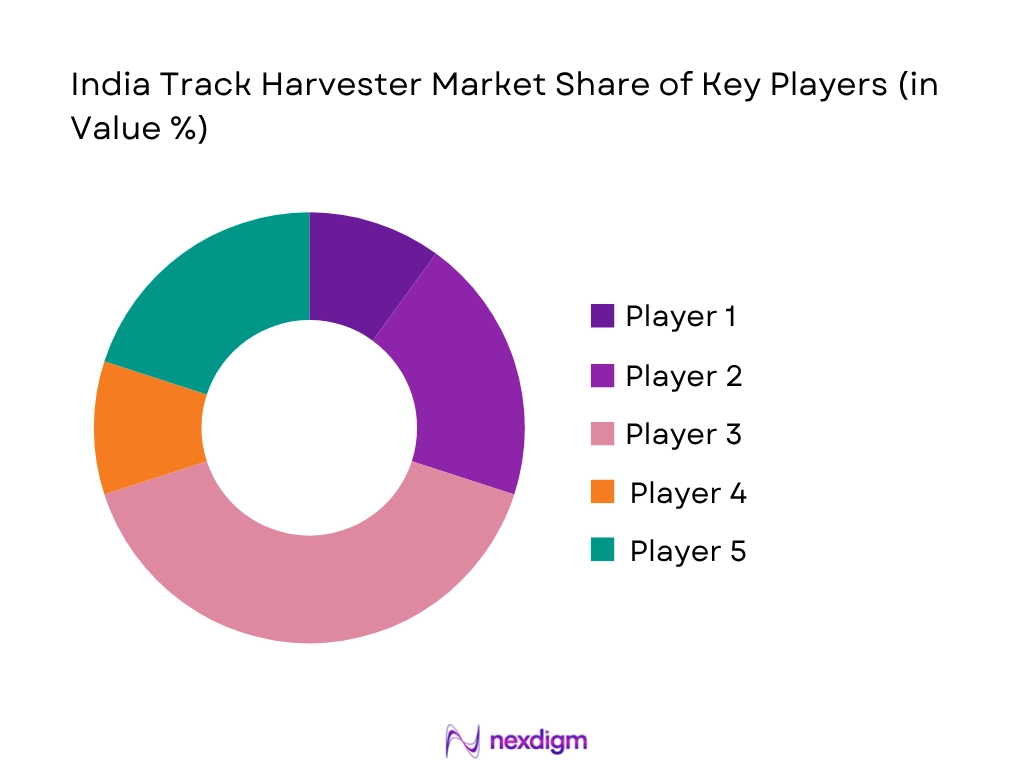
India Track Harvester Market Analysis
Growth Drivers
Rising labor shortages in peak harvesting seasons
India’s track harvester demand is being structurally supported by tightening farm labor availability during harvest windows, especially in paddy-intensive states. Agriculture and allied activities still employed 46.1 of India’s workforce in 2024-25, yet labor availability during peak harvesting remains constrained due to migration toward non-farm employment and compressed sowing-to-harvest cycles. India’s foodgrain output reached 357.73 million tonnes in 2024-25, increasing harvesting urgency and narrowing operational windows for contractors and large farms. Track harvesters gain relevance where delayed harvesting affects grain recovery and field turnaround, particularly in wet fields where manual labor productivity is lower and wheeled machines face mobility limitations. Expansion of paddy cultivation in waterlogged regions
Expansion of paddy cultivation in waterlogged regions
Track harvester adoption is strongly linked to India’s large and geographically concentrated rice ecosystem, especially in wetland and soft-soil cultivation zones. India’s rice area expanded from 47.83 million hectares in 2023-24 to 51.27 million hectares in 2024-25, while rice production increased from 137.82 million tonnes to 150.18 million tonnes. Key states aligned with track harvester suitability include Uttar Pradesh at 7.35 million hectares, West Bengal at 5.59 million hectares, Telangana at 4.81 million hectares, Odisha at 3.83 million hectares, Bihar at 3.24 million hectares, and Andhra Pradesh at 2.08 million hectares in 2024-25. These geographies have extensive irrigated or low-bearing-capacity fields where tracked mobility offers a practical harvesting advantage.
Challenges
High upfront cost of track harvesters
The addressable ownership base for track harvesters remains constrained by India’s farm structure and limited ability of smallholders to absorb specialized machinery investment. India’s average operational holding size stands at 1.08 hectares, while 86.1 of farmers are classified as small and marginal under the Agriculture Census. This creates a weak ownership case for low-frequency, high-capex machines such as track harvesters, which are better suited to high-utilization contractor models than single-farm use. The challenge is more acute in paddy belts with fragmented holdings, where field suitability exists but asset economics remain weak. As a result, direct ownership remains concentrated among larger farmers, custom operators, and mechanization-linked rural entrepreneurs
Limited financing access for small farmers
Financing remains a critical barrier because growth in agricultural credit has not translated evenly into specialized mechanization ownership for small farmers. India’s ground-level agricultural credit disbursement reached 28.67 lakh crore in FY 2024-25, and operative Kisan Credit Card accounts stood at 7.72 crore as of 31 March 2025. However, these credit flows primarily support crop operations, working capital, and short-cycle farm needs rather than advanced harvesting equipment. For track harvester purchases, repayment depends on seasonal machine utilization, access to multiple farm clusters, and contractor-style deployment. Smallholders with fragmented plots and irregular cash flows remain structurally disadvantaged, limiting financed ownership even in regions where track harvester utility is operationally high.
Opportunities
Expansion of custom hiring centers across rural regions
Custom Hiring Centers represent one of the strongest growth enablers for the India track harvester market because they improve machine access without requiring individual ownership. Between 2014-15 and 2025-26, India established 27,554 Custom Hiring Centres under farm mechanization programs. This is particularly important for track harvesters, whose economics improve when deployed across multiple farms during short harvesting windows. The opportunity is reinforced by India’s highly fragmented landholding pattern and the need for shared mechanization in paddy belts. For OEMs and fleet operators, CHC expansion creates a scalable route to place track harvesters in high-demand districts where field suitability exists but direct purchase affordability remains structurally constrained.
Penetration in eastern and north-eastern India paddy belts
Eastern and north-eastern India remain underpenetrated but highly relevant opportunity zones for track harvesters due to their crop profile, field conditions, and mechanization gap. In 2024-25, rice area stood at 5.59 million hectares in West Bengal, 3.83 million hectares in Odisha, 3.24 million hectares in Bihar, and 3.91 million hectares in Chhattisgarh. These states collectively represent large wetland and flood-prone paddy ecosystems where tracked machines can outperform wheeled alternatives in mobility and harvest continuity. The opportunity strengthens further as India recorded 150.18 million tonnes of rice output in 2024-25, reflecting sustained production depth in rice-heavy regions where custom operators, cooperatives, and institutional procurement can accelerate machine deployment.
Future Outlook
The India Track Harvester market is expected to witness stronger structural adoption over the forecast period as paddy mechanization deepens beyond traditional high-mechanization states. Growth will increasingly depend on contractor fleets, shared ownership models, and expansion into eastern and north-eastern farming belts. OEMs with localized engineering, reliable service coverage, and crop-specific machine adaptability are likely to gain stronger traction. Policy support for mechanization and rural equipment access will remain a key demand enabler.
Major Players
- Kubota Agricultural Machinery India
- Yanmar India
- CLAAS India
- John Deere India
- Preet Agro Industries
- Kartar Agro Industries
- Dasmesh Mechanical Works
- New Holland Agriculture CNH Industrial
- Mahindra and Mahindra Farm Equipment Sector
- SDF India Same Deutz Fahr
- VST Tillers Tractors
- Shrachi Agrimech
- Lovol Heavy Industry India
- Zoomlion Heavy Industry India
- Indo Farm Equipment
Key Target Audience
- Track harvester OEMs and agricultural machinery manufacturers
- Farm equipment dealers and regional distributor networks
- Custom Hiring Centers and farm machinery rental operators
- Farmer Producer Organizations and agricultural cooperatives
- Agri-tech platform operators and mechanization service providers
- Investments and venture capital firms
- Government and regulatory bodies with agency names including Ministry of Agriculture and Farmers Welfare, NABARD, and state agriculture departments
- Rural equipment financing institutions and agri-lending NBFCs
Research Methodology
Step 1: Identification of Key Variables
The research process began with identification of market-specific variables influencing demand and adoption of track harvesters in India. These included crop concentration, wetland suitability, ownership structure, mechanization intensity, dealer presence, service infrastructure, and custom hiring penetration across key agricultural states.
Step 2: Market Analysis and Construction
A structured market framework was developed using equipment movement patterns, installed operational presence, crop-linked utilization cycles, and domestic production versus import participation. Segment-level demand logic was mapped across product type, crop application, ownership model, region, and distribution structure to build a realistic market narrative.
Step 3: Hypothesis Validation and Expert Consultation
All working assumptions were validated through consultations with stakeholders across the value chain, including dealers, service operators, contractors, fleet owners, and farm mechanization participants. These interactions helped refine adoption behavior, replacement logic, service dependency, financing constraints, and regional usage differences.
Step 4: Research Synthesis and Final Output
The final output was prepared through synthesis of validated findings into a consulting-grade structure designed for strategic decision-making. Insights were organized across market behavior, segment dominance, competitive positioning, demand triggers, operational bottlenecks, and long-term expansion opportunities relevant to India’s evolving track harvester ecosystem.

- Executive Summary
- Research Methodology (Market Definitions and Track Harvester Classification, Bottom-Up Equipment Sales Modeling, OEM Production and Dealer Dispatch Analysis, Crop-wise Mechanization Penetration Assessment, Primary Interviews with OEMs Dealers and CHCs, Pricing Benchmarking across HP and Track Types, Demand-Supply Gap and Seasonal Utilization Mapping)

- Definition and Scope
- Market Evolution of Track-Based Harvesting in India
- Crop-wise Harvesting Mechanization Landscape
- Ecosystem Structure across OEMs Dealers and Rental Networks
- Supply Chain and Distribution Channel Structure
- Regulatory Environment and Subsidy Ecosystem

- Growth Drivers
Rising labor shortages in peak harvesting seasons
Expansion of paddy cultivation in waterlogged regions
Government subsidy programs for farm mechanization
Increasing adoption of custom hiring models
Improved efficiency and reduced crop loss from track systems
Growing awareness of soil compaction reduction benefits - Challenges
High upfront cost of track harvesters
Limited financing access for small farmers
Seasonal utilization constraints impacting ROI
Dependence on imported components such as rubber tracks
Limited skilled operators and maintenance technicians
Fragmented land holdings restricting equipment usage - Opportunities
Expansion of custom hiring centers across rural regions
Penetration in eastern and north-eastern India paddy belts
Localization of components to reduce costs
Integration of telematics and smart harvesting technologies
Export potential to similar agro-climatic regions
Growth of agri-tech platforms enabling equipment sharing - Trends
Shift from wheeled to track harvesters in wetland farming
Adoption of mini and compact track harvesters
Increasing OEM focus on fuel efficiency and productivity
Rise of rental and pay-per-use harvesting services
Technological upgrades in track durability and hydraulics
Partnerships between OEMs and agri-tech startups - Government Regulations
- SWOT Analysis
- Stakeholder and Ecosystem Analysis
- Porter’s Five Forces Analysis
- Competition Intensity and Ecosystem Mapping

- By Value, 2019–2024
- By Volume, 2019–2024
- By Domestic Production vs Imports Share, 2019–2024
- By Average Selling Price, 2019–2024

- By Product Type (in Value %)
Full-Track Combine Harvesters
Half-Track Combine Harvesters
Mini Track Harvesters
High-Capacity Track Harvesters
Specialty Crop Track Harvesters - By Crop Type (in Value %)
Paddy
Wheat
Maize
Pulses
Oilseeds
Sugarcane - By Ownership Model (in Value %)
Individual Farmers
Custom Hiring Centers
Contractor-Owned Fleet
Farmer Producer Organizations
Agri-Tech Rental Platforms - By Power Output (in Value %)
Below 60 HP
60–80 HP
80–100 HP
Above 100 HP - By Distribution Channel (in Value %)
OEM Direct Sales
Authorized Dealers
Agri Equipment Aggregators
Government Procurement Programs
Online B2B Platforms - By Region (in Value %)
North India
South India
East India
West India
North-East India

- Market structure and competitive positioning
- Market share snapshot of major players
- Cross Comparison Parameters (Production Capacity Units per Year, Track Technology Type, Engine Horsepower Range, Dealer and Service Network Reach, After-Sales Turnaround Time, Threshing and Separation Efficiency, Unloading Speed, Hydraulic System Performance, Ground Clearance, Rubber Track Durability, Spare Parts Availability, Operator Comfort and Cabin Ergonomics, Telematics and Smart Monitoring Features, Financing and Leasing Support, Average Seasonal Utilization Hours, Rental Yield per Season, Localization Level of Components)
- SWOT Analysis of Key Players
- Pricing and Commercial Model Benchmarking
- Detailed Profiles of Major Companies
Kubota Agricultural Machinery India
Yanmar India
CLAAS India
John Deere India
Preet Agro Industries
Kartar Agro Industries
Dasmesh Mechanical Works
New Holland Agriculture CNH Industrial
Mahindra and Mahindra Farm Equipment Sector
SDF India Same Deutz Fahr
VST Tillers Tractors
Shrachi Agrimech
Lovol Heavy Industry India
Zoomlion Heavy Industry India
Indo Farm Equipment

- Demand and utilization drivers across crop cycles
- Procurement and tender dynamics under subsidy schemes
- Buying criteria based on price performance and after-sales support
- Budget allocation and financing preferences among farmers and contractors
- Implementation barriers including terrain and operational constraints
- Post-purchase service expectations and spare parts availability

- By Value, 2025–2032
- By Volume, 2025–2032
- By Domestic Production vs Imports Share, 2025–2032
- By Average Selling Price, 2025–2032


 Request a Sample
 Ask for Customization
 Get a Quote
 Enquire Now