
 Download PDF
Market Overview
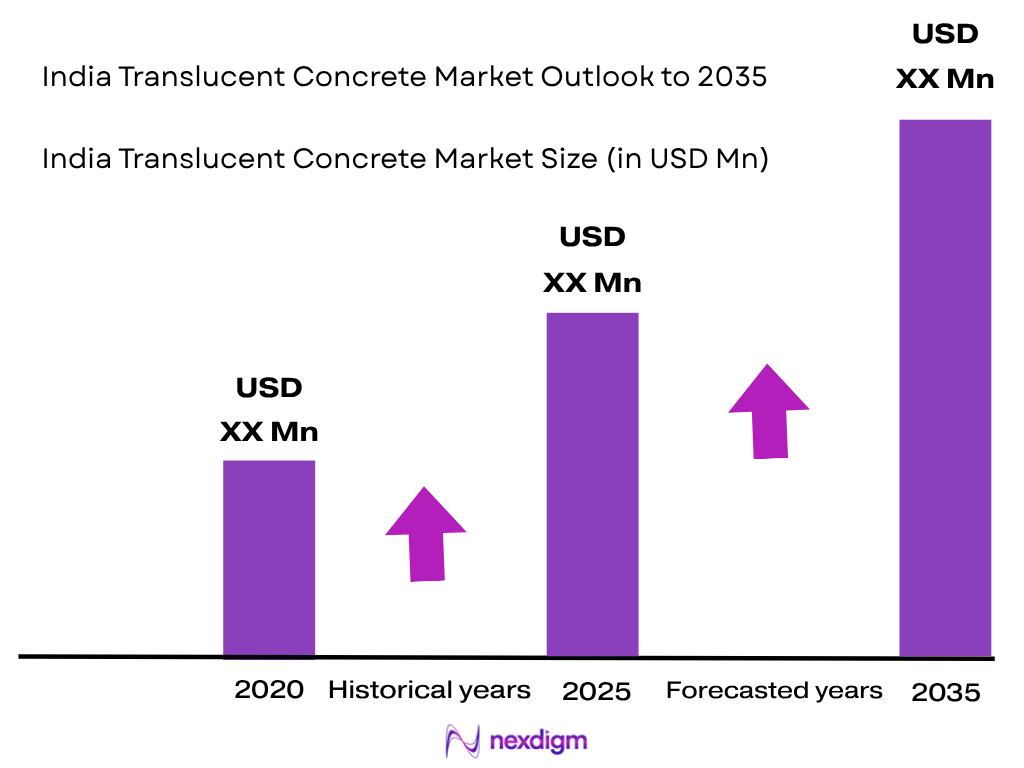
The India translucent concrete market is valued at approximately USD ~ million, compared with USD ~ million in the preceding period, reflecting rising commercialization of light-transmitting concrete in premium architectural and construction applications. Growth is being driven by demand for daylighting, sustainable façades, visually differentiated interiors, precast architectural elements and optical-fiber-integrated concrete. Published India-focused research identifies infrastructure development and sustainable construction practices as major demand catalysts, while translucent concrete is increasingly considered for façades, interior walls and decorative applications.
Delhi NCR, Mumbai, Bengaluru, Hyderabad, Chennai and Pune represent the principal demand centres, supported by large commercial-development pipelines, premium office construction, hospitality projects, transport infrastructure and high-value architectural projects. Industry demand has moved from approximately ~ square metres of addressable installations to around ~ square metres, alongside growth in premium façade and interior specifications. These metropolitan markets provide stronger ecosystems of architects, façade specialists, precast manufacturers, developers and contractors capable of handling customized light-transmitting building materials. Asia-Pacific adoption is also supported by urbanization and smart-city development.
Market Segmentation
By Light-Transmitting Technology
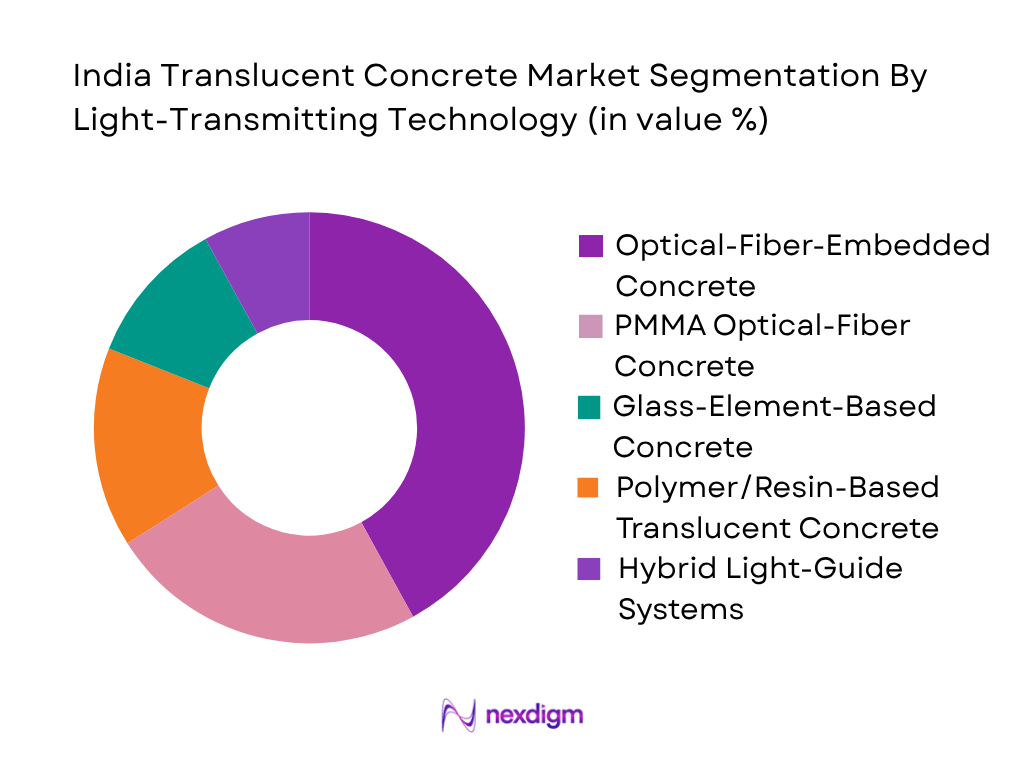
The India Translucent Concrete Market is segmented by light-transmitting technology into optical-fiber-embedded concrete, PMMA optical-fiber concrete, glass-element-based concrete, polymer/resin-based translucent concrete and hybrid light-guide systems. Optical-fiber-embedded concrete holds the dominant market share because it represents the most established approach for transferring natural or artificial light through a cementitious matrix while retaining the visual and physical characteristics of concrete. Optical fibers permit designers to create shadow transmission, illuminated façades, partitions and feature walls without replacing the concrete matrix with conventional transparent materials. Their compatibility with precast production also supports panels, slabs, blocks and customized architectural elements. Globally, optical-fiber solutions have an early-mover advantage and established manufacturing processes, while fiber-integrated systems remain particularly relevant for premium installations where visual performance and architectural differentiation justify higher material and fabrication costs.
By Application
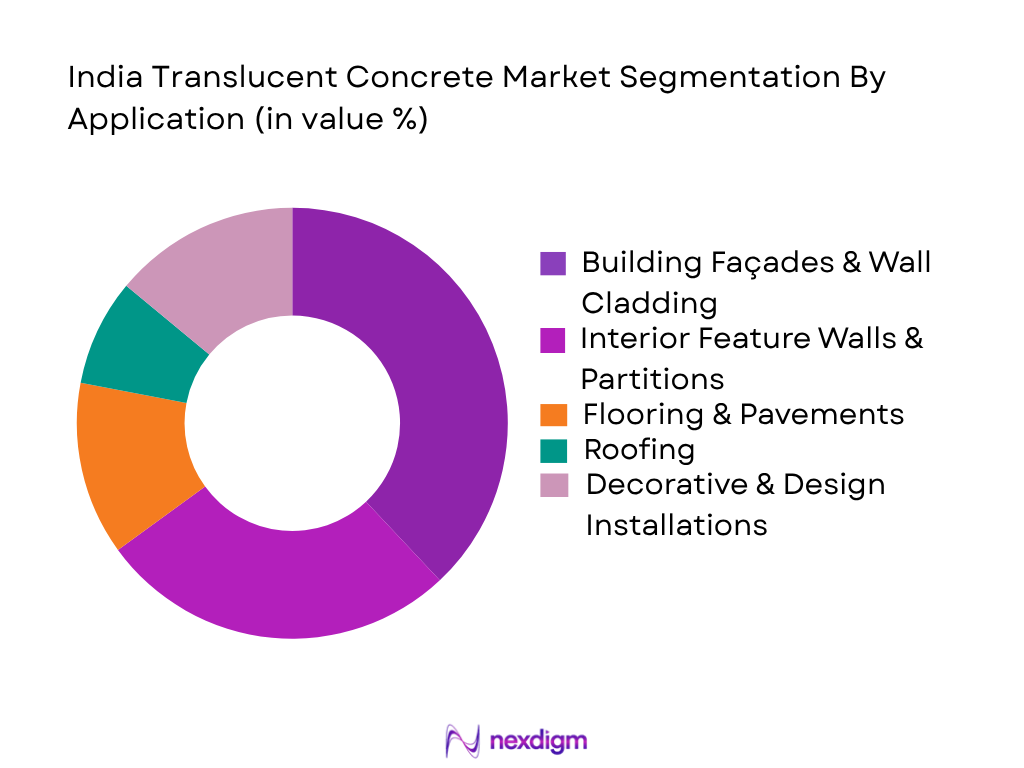
The India Translucent Concrete Market is segmented by application into building façades and wall cladding, interior feature walls and partitions, flooring and pavements, roofing, and decorative/design installations. Façades and wall cladding hold the dominant market share due to the material’s ability to combine architectural differentiation, daylight transmission, privacy and concrete-like durability. Translucent panels can transmit daylight during daytime and be combined with artificial illumination after dark, allowing architects to create visually distinctive building envelopes. Commercial offices, hotels, premium retail properties, institutional developments and landmark projects provide particularly relevant use cases. The segment also benefits from the growing importance of building-envelope aesthetics and sustainable daylighting. Multiple industry studies identify façade and wall-cladding applications as a leading use case for translucent concrete, reflecting their suitability for high-value architectural installations.
Competitive Landscape
The India Translucent Concrete Market remains a specialized competitive environment involving dedicated translucent-concrete technology developers, architectural-material manufacturers and large global building-material companies. Competition is shaped less by conventional commodity-concrete scale and more by light-transmission performance, optical-fiber integration, panel engineering, customization, precast manufacturing capability, façade expertise and architectural specification relationships. Dedicated specialists such as LUCEM and LiTraCon have played an important role in commercializing translucent concrete, while larger materials groups possess broader manufacturing and construction-material capabilities.
| Major Player | Establishment Year | Headquarters | Light Transmission Efficiency (%) | Compressive Strength (MPa) | Panel Thickness Range (mm) | Optical Fiber / Light-Guide Capability | India Project & Distribution Presence | Exterior Façade Capability |
| LUCEM GmbH | 2007 | Germany | ~ | ~ | ~ | ~ | ~ | ~ |
| LiTraCon / Litracon | 2004 | Hungary | ~ | ~ | ~ | ~ | ~ | ~ |
| Heidelberg Materials / Italcementi | 1873 | Germany | ~ | ~ | ~ | ~ | ~ | ~ |
| Pan-United Corporation Ltd. | 1999 | Singapore | ~ | ~ | ~ | ~ | ~ | ~ |
| Dupont Lightstone | 2013 | United States | ~ | ~ | ~ | ~ | ~ | ~ |
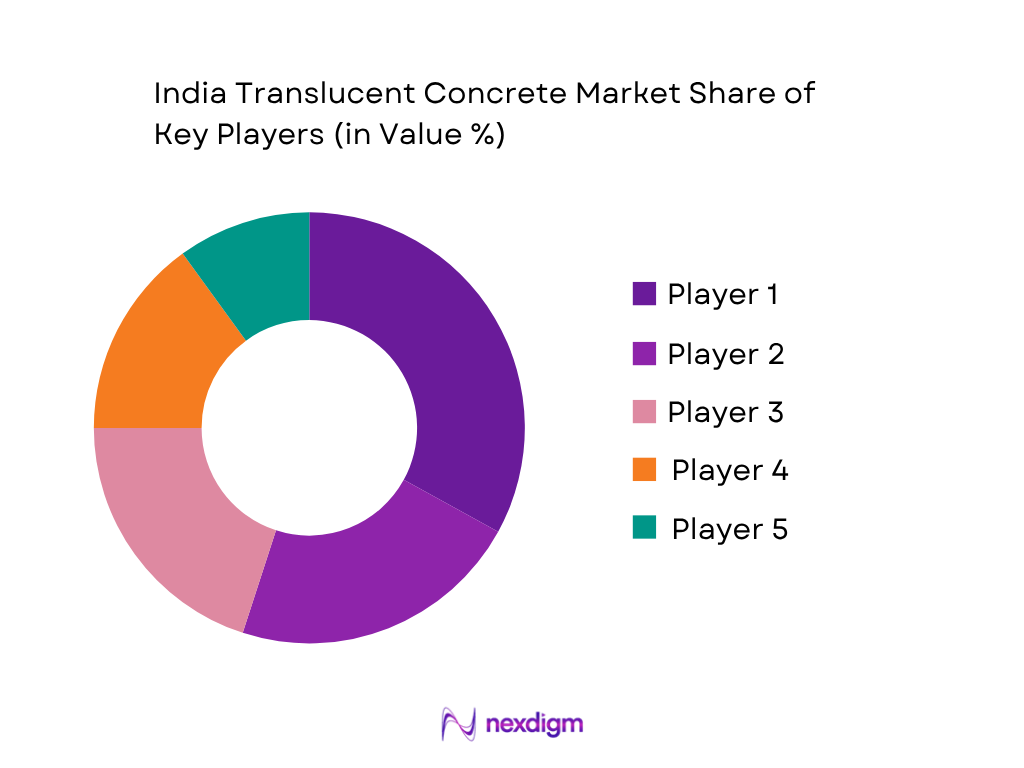
India Translucent Concrete Market Analysis
Growth Drivers
Expansion of Smart Urban Infrastructure and Architectural Public Assets
India’s expanding smart-urban infrastructure is strengthening the addressable application environment for translucent concrete in civic façades, feature walls, illuminated surfaces, public-realm elements and transportation structures. Government data recorded 8,075 Smart Cities Mission projects, including 7,380 completed projects across 100 cities. The physical infrastructure created included more than 1,740 km of smart roads, 713 km of cycle tracks, 9,433 smart classrooms, 172 e-health centres and clinics, 41 digital libraries and 152 health ATMs. Smart-city technology infrastructure also included 84,000 CCTV cameras, 1,884 emergency call boxes and more than 3,000 public-address systems. These assets are relevant to translucent concrete because technology-oriented civic developments provide specification opportunities for light-transmitting precast panels, backlit walls, architectural screens and customized concrete elements. India’s 2024 GDP stood at USD 3,909.89 billion, while GDP per capita reached USD 2,694.7. The combination of a large economic base, expanding public infrastructure and sophisticated urban architecture supports greater consideration of advanced cementitious materials capable of combining structural characteristics, daylight transmission and distinctive architectural effects.
Expansion of Airports and High-Specification Transportation Buildings
India’s aviation infrastructure expansion provides a direct demand driver for translucent concrete because airport terminals require premium façade systems, partitions, feature walls, signage structures, illuminated surfaces and visually differentiated passenger spaces. India recorded 159 airports at the end of 2024, compared with 149 airports in 2023, adding 10 airports to the national network. The government had accorded in-principle approval to 21 greenfield airports, of which 12 were operationalized, while another 9 greenfield airport proposals had received site clearance. During 2024, site clearance was granted for 4 projects at Doloo, Parandur, Kota and Raichur. Scheduled domestic airlines operated approximately 10.6 lakh flights carrying 153.7 million passengers in FY2023/24, compared with 10.0 lakh flights carrying 136.0 million passengers previously. This infrastructure and passenger base supports terminal modernization and architecturally differentiated construction. India’s 2024 GDP stood at USD 3,909.89 billion, with GDP per capita reaching USD 2,694.7. This combination provides a substantial economic and physical infrastructure foundation for specialized architectural applications such as optical-fiber concrete façades, illuminated walls, partitions and customized precast components.
Market Challenges
Limited Commercial Scale Against India’s Standardized Construction Ecosystem
Translucent concrete faces a commercialization challenge because India’s construction ecosystem operates at a scale that favors standardized, widely available materials supported by established manufacturing and installation networks. Government housing data recorded 118.64 lakh houses sanctioned under PMAY-U, of which 114.40 lakh houses had been grounded and 85.43 lakh houses completed or delivered. Another government update recorded 81.67 lakh occupied houses, demonstrating the enormous scale at which India’s mainstream building-material ecosystem operates. This construction environment highlights the challenge facing translucent concrete, which requires controlled optical-fiber placement, specialized casting, precise cutting and polishing, engineered anchoring and coordination with façade and lighting systems. Unlike conventional concrete components, light-transmitting panels depend on cooperation among precast fabricators, architects, structural engineers and specialist installers. India’s 2024 GDP stood at USD 3,909.89 billion, while GDP per capita reached USD 2,694.7, highlighting the scale of the broader economy that specialist suppliers must address. Commercial expansion therefore depends on developing standardized panel specifications, consistent optical performance, repeatable manufacturing, domestic fabrication capacity and trained installation networks capable of moving translucent concrete beyond isolated bespoke projects.
Technical Integration with Increasingly Complex Smart-Building Infrastructure
Translucent concrete must integrate with increasingly sophisticated Indian building environments incorporating structural systems, electrical infrastructure, lighting, façade anchorage, waterproofing, fire-safety provisions and digital technologies. Integrated Command and Control Centres were operational across 100 Smart Cities, supported by more than 84,000 CCTV cameras, 1,884 emergency call boxes and over 3,000 public-address systems. Approximately 17,026 km of water-supply networks were monitored through SCADA, while around 9,194 vehicles were RFID-enabled for automatic vehicle location. These numbers demonstrate how modern Indian urban projects increasingly combine civil construction with electrical, digital and monitoring infrastructure. Translucent-concrete façades and interiors therefore need to accommodate lighting equipment, electrical connections, panel anchorage, maintenance access and surrounding building-envelope components without compromising optical performance. India’s 2024 GDP reached USD 3,909.89 billion, while foreign-exchange reserves were approximately USD 646.4 billion during FY2023/24. This large and increasingly sophisticated construction environment raises expectations for technical reliability. Translucent-concrete suppliers consequently require engineering documentation, repeatable fabrication tolerances, structural testing, specialist installation capabilities and coordination with architects, façade contractors and electrical-system providers.
Market Opportunities
Smart-City Public Spaces and Technology-Integrated Architectural Surfaces
India’s established smart-city asset base creates a future commercialization opportunity for translucent concrete across illuminated public walls, civic façades, landscape structures, transit environments and interactive architectural surfaces. Government data recorded 7,380 completed projects out of 8,075 Smart Cities Mission projects across 100 cities. The resulting physical ecosystem includes more than 1,740 km of smart roads, 713 km of cycle tracks, 9,433 smart classrooms, 41 digital libraries, 172 e-health centres and clinics, and 152 health ATMs. These existing assets demonstrate an urban-development model extending beyond basic civil works toward technology-enabled and design-oriented public infrastructure. Translucent-concrete manufacturers can leverage this installed ecosystem to position optical-fiber panels, light-transmitting blocks and LED-integrated cementitious surfaces for future renovation, redevelopment and architectural projects without depending on mass structural adoption. India’s 2024 GDP stood at USD 3,909.89 billion, while GDP per capita reached USD 2,694.7. The combination of a large national economy, 100 smart-city ecosystems and thousands of completed technology-oriented projects creates a credible foundation for future specifications of advanced architectural concrete across public buildings, transportation facilities, landscape architecture and digitally integrated urban environments.
Airport Terminals and Architecturally Differentiated Infrastructure
India’s existing aviation infrastructure creates a strong future opportunity for translucent concrete manufacturers targeting high-visibility façades, illuminated partitions, passenger circulation areas, branded surfaces and architectural feature walls. India recorded 159 operational airports at the end of 2024, compared with 149 in 2023, representing an addition of 10 airports. Government approval had been provided for 21 greenfield airports, with 12 already operationalized, while 9 additional greenfield airport proposals had received site clearance. Of these, 4 sites—Doloo, Parandur, Kota and Raichur—received clearance during 2024. The underlying utilization base is substantial, with scheduled domestic airlines operating approximately 10.6 lakh flights and carrying 153.7 million passengers during FY2023/24, compared with approximately 10.0 lakh flights and 136.0 million passengers previously. These current indicators establish a substantial infrastructure base from which future terminal expansion, modernization and architectural upgrades can create opportunities for specialized materials. India’s 2024 GDP of USD 3,909.89 billion further supports an economic environment capable of sustaining sophisticated infrastructure development and greater use of differentiated architectural materials.
Future Outlook
The India Translucent Concrete Market is expected to expand at a forecast CAGR of approximately ~% during the forecast period, supported by premium commercial construction, green-building adoption, smart infrastructure, high-end hospitality, airport and transportation development, and increasing architectural experimentation with daylight-transmitting materials. Greater domestic fabrication and improvements in optical-fiber placement could gradually address the material’s high production cost and project lead times.
Demand is expected to shift from isolated decorative installations toward engineered precast panels, modular façade components, illuminated interior systems and customized architectural elements. Optical-fiber concrete should remain central to premium applications, while polymer, glass-based and hybrid light-guide technologies can broaden the performance and cost spectrum. Global research identifies optical-fiber optimization, lightweight panels, smart surfaces, integrated lighting and lower-carbon matrices among the areas shaping the category’s development.
Major Players
- LUCEM GmbH
- LiTraCon / Litracon
- Heidelberg Materials / Italcementi
- Pan-United Corporation Ltd.
- Dupont Lightstone
- CRE Panel GmbH
- LCT GesmbH
- Glass Block Technology Ltd.
- Fapinex LLC
- Beton Brož
- Florack Bauunternehmung GmbH
- Concrete LCDA
- Gravelli / LiCrete
- GBA Architectural Products
- Translucent Crete LLC
Key Target Audience
- Translucent Concrete Manufacturers and Technology Developers
- Precast Concrete and Architectural Panel Manufacturers
- Optical Fiber, PMMA Fiber and Light-Guide Material Suppliers
- Real Estate Developers, EPC Companies and Façade Contractors
- Cement, Specialty Concrete and Advanced Building Material Manufacturers
- Investments and Venture Capitalist Firms
- Government and Regulatory Bodies (Bureau of Indian Standards, Ministry of Housing and Urban Affairs, Central Public Works Department, Bureau of Energy Efficiency)
- Airport, Metro, Smart Infrastructure and Public-Building Development Authorities
Research Methodology
Step 1: Identification of Key Variables
The initial research phase involves constructing an ecosystem map covering stakeholders across the India Translucent Concrete Market, including cement suppliers, optical-fiber producers, precast manufacturers, technology developers, architects, façade contractors and developers. Secondary research is used to identify market-defining variables such as light-transmission technology, installed area, panel pricing, application mix, manufacturing capability and architectural specification activity.
Step 2: Market Analysis and Construction
Historical market development is assessed through a combination of top-down and bottom-up approaches. The top-down framework examines India’s addressable premium construction, façade, commercial-building and infrastructure environment, while the bottom-up approach evaluates translucent-concrete suppliers, project installations, panel consumption, installed surface area, product realization and relevant import activity to construct the underlying market model.
Step 3: Hypothesis Validation and Expert Consultation
Initial market hypotheses are validated through structured primary interviews and computer-assisted telephone interviews with translucent-concrete manufacturers, precast companies, optical-fiber suppliers, architects, façade specialists, contractors and building-material distributors. These interactions are designed to verify pricing, project pipelines, product specifications, procurement structures, technology preferences, installation requirements and constraints affecting adoption in the Indian market.
Step 4: Research Synthesis and Final Output
The final stage triangulates primary findings with supplier information, construction indicators, project activity and secondary databases. Bottom-up supplier and installation assessments are reconciled with the top-down addressable-market framework. Findings are then synthesized across technology, application, customer, competitive and geographic dimensions to develop the final India Translucent Concrete Market outlook and long-term growth framework.

- Executive Summary
- Research Methodology (Market Definition and Scope, India Translucent Concrete Market Classification, Light-Transmitting Concrete Technology Mapping, Optical-Fiber-Embedded Concrete Assessment, PMMA Optical Fiber Concrete Evaluation, Glass-Fiber Light-Transmitting Concrete Analysis, Resin and Polymer-Based Translucent Concrete Assessment, Precast Translucent Concrete Panel Evaluation, Translucent Concrete Block Assessment, Architectural Panel Performance Mapping, Light Transmission Efficiency Analysis, Compressive Strength Assessment, Flexural Strength Evaluation, Optical Fiber Density Analysis, Panel Thickness and Dimension Assessment, Surface Finish Evaluation, Façade Application Mapping, Interior Application Assessment, Building Type Demand Mapping, Precast Manufacturing Assessment, Architectural Specification Analysis, Supply-Side Assessment, Demand-Side Assessment, Top-Down Market Sizing, Bottom-Up Market Sizing, Primary Industry Interviews, Data Triangulation, Forecasting Framework)

- Definition and Scope
- India Translucent Concrete Industry Evolution and Development of Optical-Fiber-Embedded Concrete, Light-Transmitting Cementitious Materials, Precast Translucent Concrete Panels, Architectural Façade Systems, Interior Feature-Wall Applications, Daylighting Solutions, High-Performance Concrete Matrices, PMMA Optical Fiber Integration, Glass Light-Guide Technologies, Custom Architectural Elements, Smart Concrete Surfaces, LED-Integrated Concrete, Low-Carbon Concrete Matrices, Automated Fiber Placement, Digital Fabrication and Advanced Precast Manufacturing
- Translucent Concrete Value Chain Analysis
- Translucent Concrete Supply Chain Analysis
- Cement and Binder Suppliers, Fine Aggregate Suppliers, Optical Fiber Manufacturers, PMMA Fiber Suppliers, Glass Light-Guide Suppliers, Admixture Manufacturers, Translucent Concrete Technology Developers, Precast Concrete Manufacturers, Architectural Panel Fabricators, Façade System Suppliers, Specialty Material Distributors, Architects, Façade Consultants, Lighting Designers, General Contractors, Specialty Installers, Developers and Building Owners

- Growth Drivers (Increasing Demand for Daylighting Solutions, Expansion of Premium Architectural Construction, Adoption of Signature Building Façades, Growing Demand for Material Differentiation, Expansion of High-End Commercial Interiors, Increasing Precast Construction Adoption, Sustainable Building Design Requirements, Development of Smart and Interactive Building Surfaces)
- Market Challenges (High Translucent Concrete Production Cost, High Optical Fiber Cost, Limited Domestic Manufacturing Scale, Labor-Intensive Fiber Placement, Complex Precast Manufacturing Requirements, Limited Architect and Contractor Familiarity, Structural and Façade Integration Challenges, Long Project-Specific Lead Times, Specialty Installation Requirements, Competition from Architectural Glass and Alternative Daylighting Materials)
- Market Opportunities (Domestic Translucent Concrete Manufacturing, Automated Optical Fiber Placement, Lightweight Translucent Concrete Panels, Low-Carbon Cementitious Matrices, Integrated LED Concrete Systems, Smart and Interactive Façades, Modular Translucent Concrete Systems, High-End Interior Applications, Public Infrastructure Applications, Additive Manufacturing and 3D-Printed Translucent Concrete)
- Market Trends (Increasing Adoption of Optical-Fiber-Embedded Concrete, Growth of Custom Precast Panels, Integration of LED Backlighting, Development of Lightweight Panels, Increasing Use in Feature Walls and Signature Façades, Adoption of Digital Fabrication, Development of Low-Carbon Concrete Matrices, Application-Specific Panel Engineering, Growth of Smart Concrete Surfaces, Increasing Architectural Material Customization)
- Government Regulations and Standards (Bureau of Indian Standards Concrete Requirements, National Building Code Requirements, IS 456 Concrete Requirements, IS 516 Concrete Testing Standards, Precast Concrete Requirements, Structural Anchorage Requirements, Façade Wind-Load Requirements, Fire and Life-Safety Requirements, Seismic Design Requirements, Building Envelope Performance Requirements, Environmental Building Requirements, Occupational Safety Requirements)
- SWOT Analysis
- Porter’s Five Forces Analysis
- PESTLE Analysis
- Stakeholder Ecosystem
- Competition Ecosystem

- By Market Value (2020-2025)
- By Installed Volume (2020-2025)
- By Installed Surface Area (2020-2025)
- By Average Selling Price per Square Meter (2020-2025)
- By Precast Translucent Concrete Panel Consumption Volume (2020-2025)
- By Optical-Fiber-Embedded Concrete Consumption Volume (2020-2025)
- By Translucent Concrete Block and Tile Consumption Volume (2020-2025)
- By Exterior Façade Application Volume (2020-2025)
- By Interior Architectural Application Volume (2020-2025)

- By Light-Transmitting Technology (In Value %)
Optical-Fiber-Embedded Cementitious Concrete
PMMA Optical-Fiber Concrete
Glass-Fiber and Glass-Element-Based Concrete
Polymer and Resin-Based Translucent Concrete
Hybrid Light-Guide Concrete Systems
Integrated LED Translucent Concrete
Alternative Light-Transmitting Cementitious Systems - By Product Form (In Value %)
Precast Translucent Concrete Panels
Translucent Concrete Slabs
Translucent Concrete Blocks and Bricks
Translucent Concrete Tiles
Custom Architectural Elements
Decorative Concrete Components
Furniture and Interior Elements
Bespoke Formed and 3D Elements - By Application (In Value %)
Building Façades
Exterior Wall Cladding
Interior Feature Walls
Partitions and Space Dividers
Flooring and Pavements
Staircases and Vertical Circulation Elements
Reception Desks and Countertops
Signage and Branded Architectural Surfaces
Landscape and Public-Realm Installations
Furniture and Decorative Applications - By End-Use Building Type (In Value %)
Corporate Offices and Headquarters
Hotels and Hospitality Buildings
Retail and Luxury Stores
Airports and Transportation Facilities
Museums, Galleries and Cultural Buildings
Educational and Institutional Buildings
Healthcare Facilities
Government and Civic Buildings
High-End Residential Buildings
Mixed-Use Developments - By Functional Property (In Value %)
Daylighting and Light-Transmitting Systems
Structural and Load-Bearing Systems
Non-Structural Architectural Systems
Thermal-Performance-Oriented Systems
Acoustic-Performance-Oriented Systems
Decorative and Aesthetic Systems
Integrated LED and Artificially Illuminated Systems - By Construction Route (In Value %)
Factory-Manufactured Precast Systems
Project-Specific Custom Precast Systems
Modular Panel Systems
Custom Fabricated Architectural Elements
Additive-Manufactured and 3D-Printed Systems - By Project Type (In Value %)
New Construction
Major Renovation
Façade Retrofit
Interior Fit-Out
Public-Realm Redevelopment
Landmark and Signature Architecture - By Region (In Value %)
North India
South India
West India
East India
Central India

- Market Share of Major Players (By India Revenue, Translucent Concrete Product Portfolio, Optical-Fiber Technology Capability, Precast Panel Portfolio, Light Transmission Performance, Panel Size and Thickness Range, Exterior Façade Capability, Interior Application Coverage, Customization Capability, Integrated Lighting Capability, Manufacturing Capacity, India Distribution Network, Architectural Specification Reach, Project Portfolio, Technical Support Capability)
- Cross Comparison Parameters (Light Transmission Efficiency, Compressive Strength Performance, Panel Size and Thickness Range, Optical Fiber and Light-Guide Technology Capability, India Project and Distribution Presence, Exterior Façade Application Capability, Customization and Integrated Lighting Capability, Manufacturing Scalability and Lead-Time Capability)
- SWOT Analysis of Major Players
- Competitive Positioning Matrix
- Translucent Concrete Technology and Architectural Application Benchmarking
- Panel Performance, Anchorage and Building System Integration Assessment
- India Distribution, Architectural Specification and Technical Support Assessment
- Detailed Profiles of Major Companies
LUCEM GmbH
LiTraCon / Litracon
Heidelberg Materials / Italcementi
Pan-United Corporation Ltd.
Dupont Lightstone
CRE Panel GmbH
LCT GesmbH
Glass Block Technology Ltd.
Fapinex LLC
Beton Brož
Florack Bauunternehmung GmbH
Concrete LCDA
Gravelli / LiCrete
GBA Architectural Products
Translucent Crete LLC

- Architectural Façade Requirement Assessment
- Exterior Wall Cladding Demand Analysis
- Interior Feature-Wall Requirement Assessment
- Corporate Office and Headquarters Demand Analysis
- Hospitality Building Application Assessment
- Luxury Retail Application Requirement Analysis
- Airport and Transportation Facility Demand Assessment
- Museum and Cultural Building Application Analysis
- Institutional Building Requirement Assessment
- High-End Residential Application Analysis
- Daylighting Performance Requirement Assessment
- Light Transmission Efficiency Requirement Analysis
- Panel Thickness and Dimension Requirement Assessment

- By Market Value (2026-2035)
- By Installed Volume (2026-2035)
- By Installed Surface Area (2026-2035)
- By Average Selling Price per Square Meter (2026-2035)
- By Precast Translucent Concrete Panel Consumption Volume (2026-2035)
- By Optical-Fiber-Embedded Concrete Consumption Volume (2026-2035)
- By Translucent Concrete Block and Tile Consumption Volume (2026-2035)
- By Exterior Façade Application Volume (2026-2035)
- By Interior Architectural Application Volume (2026-2035)


 Request a Sample
 Ask for Customization
 Get a Quote
 Enquire Now