
 Download PDF
Market Overview
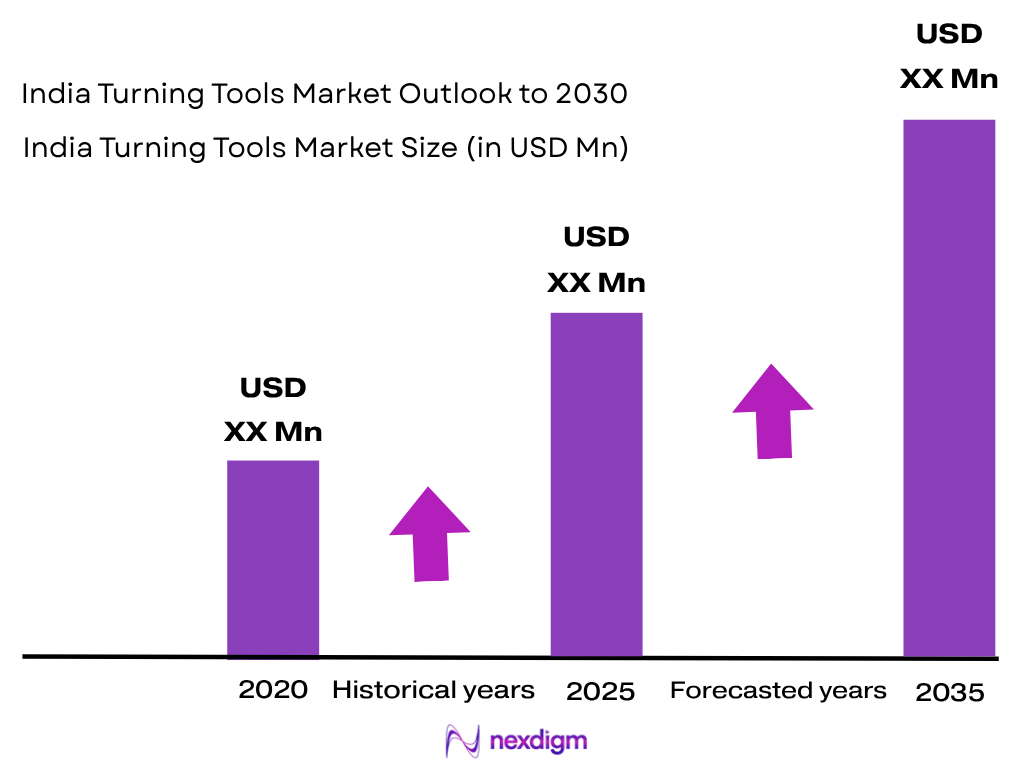
The India Turning Tools Market is valued at approximately ~ USD XX million in 2024, compared with ~ USD XX million in 2023, supported by expanding CNC machining capacity, automotive component production, precision engineering and industrial automation. Turning tools are increasingly required for steel, cast iron, aluminium and alloy-component machining across automotive, aerospace, defence and general engineering applications. The market is also driven by replacement of conventional tooling with carbide, coated and indexable solutions that improve machining productivity, dimensional consistency and tool life.
The India Turning Tools Market is concentrated around major manufacturing clusters such as Pune, Chennai, Bengaluru, Gurugram-Manesar, Ahmedabad, Mumbai-Pune and Hyderabad, where automotive, aerospace, industrial machinery and precision-engineering activities create recurring demand for turning tools. Maharashtra, Tamil Nadu, Karnataka, Gujarat and Haryana benefit from established machine-tool ecosystems, large automotive component bases and growing CNC machining capacity. Pune and Chennai are particularly important because of their concentration of vehicle and component manufacturers, while Bengaluru and Hyderabad support aerospace, defence and high-precision engineering applications.
Market Segmentation
By Tool Type
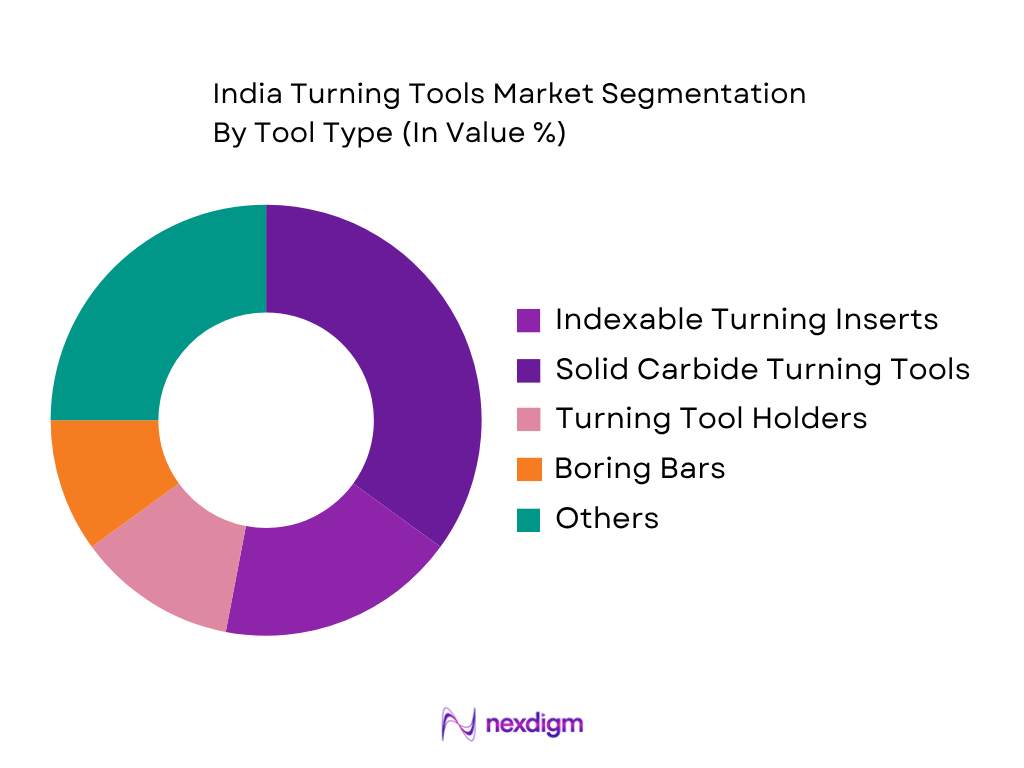
India Turning Tools Market is segmented into indexable turning inserts, solid carbide turning tools, turning tool holders, boring bars, threading tools, grooving tools, parting tools, profiling tools, external turning tools and internal turning tools. Indexable turning inserts hold the dominant market share at ~XX% in 2024, primarily because they provide replaceable cutting edges, standardized geometries and flexibility across multiple CNC turning operations. Their ability to support roughing, semi-finishing, finishing, threading, grooving and profiling makes them suitable for high-volume automotive and general engineering production. Indexable inserts also reduce machine downtime compared with resharpening conventional solid tools because worn inserts can be replaced rapidly. The availability of different carbide grades, chipbreakers and coatings enables manufacturers to match tooling with steel, cast iron, aluminium and stainless-steel components. Increasing adoption of CNC lathes and turning centres further supports demand because indexable tooling can be integrated into standardized tool-management systems. Automotive component manufacturers, industrial machinery producers and job shops therefore represent important consumption bases for this segment.
By End-Use Industry
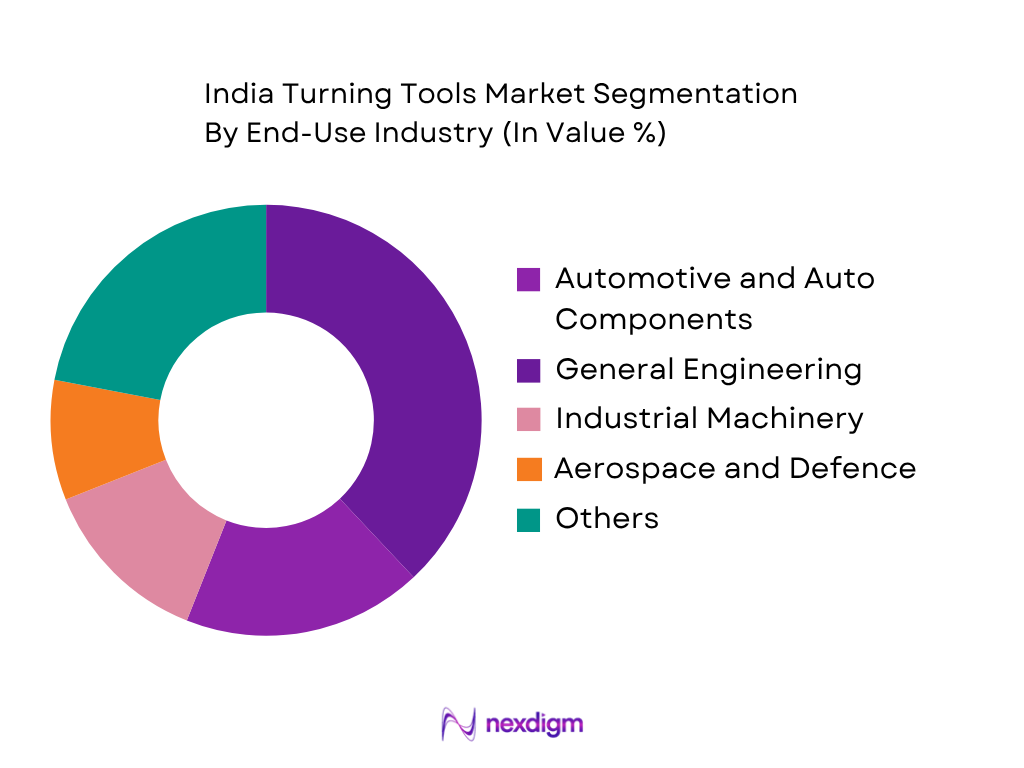
India Turning Tools Market is segmented into automotive and auto components, aerospace and defence, general engineering, industrial machinery, oil and gas, power generation, electronics, railways, construction equipment and die-and-mould manufacturing. Automotive and auto components represent the dominant segment with an estimated placeholder share of ~XX% in 2024, supported by extensive machining requirements for shafts, gears, hubs, brake components, transmission parts, engine components and other precision metal parts. Automotive production requires high repeatability and dimensional accuracy, making CNC turning and advanced cutting tools essential throughout component manufacturing. The increasing complexity of vehicle components also encourages manufacturers to use coated carbide inserts and specialized geometries that can improve material removal rates and maintain consistent surface finishes. India’s established automotive clusters provide a broad customer base for turning-tool manufacturers and distributors. Demand additionally comes from tier-1, tier-2 and smaller machining suppliers that manufacture components for passenger vehicles, commercial vehicles, two-wheelers and industrial applications.
Competitive Landscape
The India Turning Tools Market comprises established global cutting-tool manufacturers, specialized tooling companies and domestic suppliers competing across carbide grades, insert geometries, coatings, tool holders and application engineering. Major companies differentiate through product breadth, tool-life performance, CNC machining expertise, distribution coverage and technical support. Global players maintain strong positions through advanced coating technologies and broad tooling portfolios, while domestic and regional suppliers compete through customization, availability and application-specific solutions.
| Company | Establishment Year | Headquarters | Turning Tool Portfolio | Carbide Grade Capability | Coating Technology |
| Sandvik Coromant | 1942 | Sweden | ~ | ~ | ~ |
| Kennametal | 1938 | USA | ~ | ~ | ~ |
| Mitsubishi Materials | 1934 | Japan | ~ | ~ | ~ |
| ISCAR | 1952 | Israel | ~ | ~ | ~ |
| Seco Tools | 1932 | Sweden | ~ | ~ | ~ |
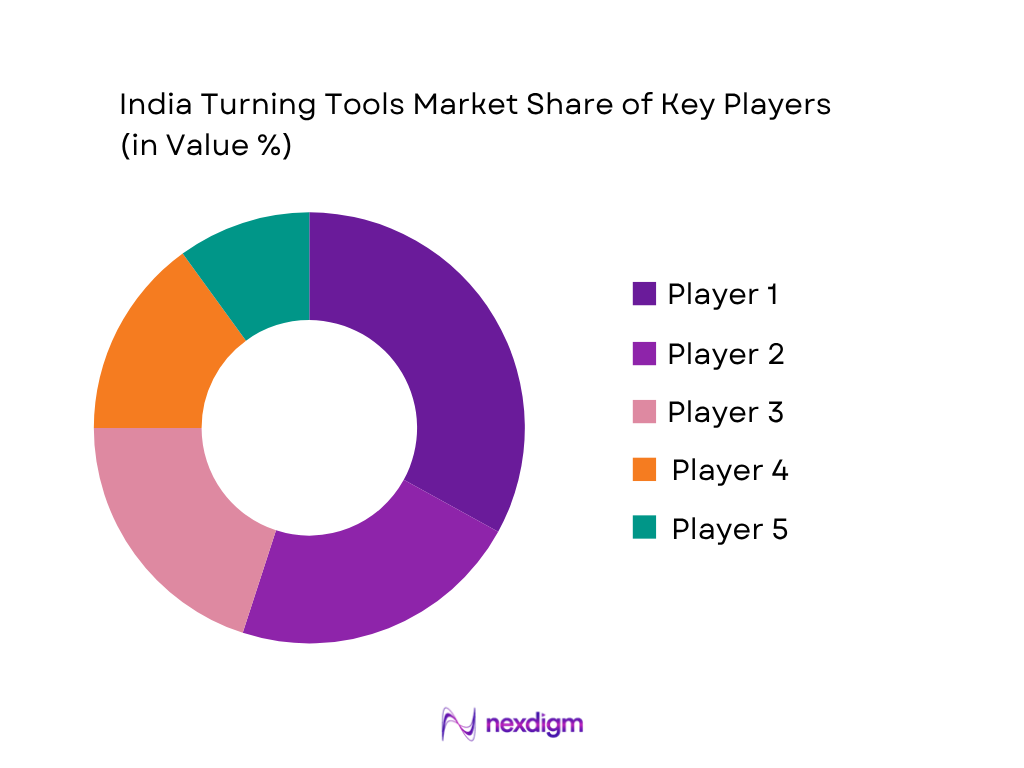
India Turning Tools Market Analysis
Growth Drivers
CNC Turning Machine Adoption and Automotive Component Manufacturing
The India Turning Tools Market is being supported by rising CNC-based manufacturing and sustained automotive production, creating recurring requirements for indexable inserts, carbide grades, boring tools, threading tools and grooving systems. Ministry of Heavy Industries data show machine-tool production increased from ₹13,571 crore in FY2023-24 to ₹14,286 crore in FY2024-25, while dies, moulds and press tools increased from ₹15,600 crore to ₹18,400 crore over the same period. This expanding capital-goods base directly strengthens the installed ecosystem in which turning tools are consumed. Automotive machining provides another major demand channel: SIAM reported 3,06,10,778 vehicles produced in calendar 2024, including 42,74,793 passenger vehicles, 9,51,991 commercial vehicles and 1,95,43,093 two-wheelers. SIAM also reported 3,10,36,476 vehicles produced in FY2024-25, including 5,061,164 passenger vehicles and 23,883,857 two-wheelers. These production volumes require repeated machining of shafts, gears, hubs, housings, transmission components and other metal parts. India’s broader manufacturing environment also remains supportive, with MoSPI reporting that manufacturing GVA increased 12.7% in FY2023-24 under the revised national accounts series. Consequently, higher CNC utilization, component localization and production automation are strengthening the underlying requirement for reliable, repeatable and high-productivity turning tools.
Aerospace, Defence and Precision Engineering Demand
Aerospace, defence and precision-engineering expansion is strengthening demand for high-performance turning tools capable of machining difficult alloys and maintaining tight dimensional tolerances. The Government of India reported defence production of ₹1,26,887 crore in FY2023-24, while production subsequently reached ₹1,50,590 crore in FY2024-25, demonstrating continued expansion of the domestic defence manufacturing base. Defence exports also reached ₹23,622 crore in FY2024-25, compared with ₹21,083 crore in FY2023-24, indicating increasing participation of Indian manufacturers in international defence supply chains. These activities require precision machining of steel, titanium, aluminium and other engineering materials, supporting demand for coated carbide inserts, CBN tools, specialized geometries and application-specific turning solutions. The wider capital-goods ecosystem is also expanding: Ministry of Heavy Industries data show production of process-plant equipment reached ₹31,505 crore in FY2024-25, while production of heavy electrical equipment reached ₹3,72,200 crore. India’s electronics manufacturing ecosystem is developing in parallel, with the government reporting electronics production of approximately ₹12 lakh crore in FY2024-25, compared with approximately ₹1.9 lakh crore in FY2014-15. These developments broaden precision-machining requirements beyond conventional automotive applications. Increasing domestic defence production, sophisticated engineering programs and localization of component manufacturing therefore create a stronger application base for advanced turning tools, particularly where tool rigidity, surface finish, dimensional stability and predictable tool life are critical.
Market Challenges
Dependence on Imported Advanced Tooling and Carbide Supply
The India Turning Tools Market faces supply-chain exposure because sophisticated machining ecosystems continue to rely on imported machine tools, advanced tooling technologies and specialized inputs. Ministry of Heavy Industries data show that India’s machine-tool sector recorded ₹14,286 crore of production and ₹18,686 crore of imports in FY2024-25, while exports were ₹1,472 crore. Although machine tools are not identical to cutting tools, this trade structure demonstrates the broader capital-goods industry’s continuing dependence on overseas technology and equipment. The challenge is particularly relevant for turning-tool users requiring advanced carbide grades, specialized coatings, high-precision holders and application-specific tooling. Tool performance depends on consistent availability of tungsten-carbide-based cutting materials, tool substrates, coating technologies and precision manufacturing capabilities. At the broader manufacturing level, MoSPI’s ASI 2023-24 recorded 2.53 lakh registered factories within the survey coverage, illustrating the enormous diversity of industrial users that must be served with different tooling specifications. The Ministry of Heavy Industries also reported machine-tool production rising from ₹6,602 crore in FY2020-21 to ₹14,286 crore in FY2024-25, indicating rapid domestic capability development but also a continuing need for imported equipment and technology. For turning-tool manufacturers, this environment increases exposure to international supply conditions, lead times and technology availability. It also makes domestic development of advanced carbide grades, coatings, tool geometries and precision-manufacturing capabilities strategically important for reducing supply vulnerability.
Tool-Life Variability and Skilled Application Engineering Constraints
Tool-life consistency and availability of technically skilled personnel remain important challenges for the India Turning Tools Market because advanced turning performance depends on correct tool selection, cutting parameters, workpiece material, machine rigidity, coolant conditions and chip-control requirements. Government data show that the Indian manufacturing sector had more than 2 crore estimated total employment in FY2024-25, while the Annual Survey of Industries recorded 2.67 lakh registered manufacturing establishments in the same period. The scale and diversity of this industrial base creates a substantial requirement for technically capable tooling personnel who can optimize insert grades, chipbreakers, cutting speeds, feeds and depths of cut across different CNC platforms. The Ministry of Skill Development and Entrepreneurship has continued to identify sector-specific skill gaps and support demand-driven training, while the Skill India Programme carries an outlay of ₹8,800 crore for the period 2022-23 to 2025-26. At the workforce level, PLFS 2023-24 data reported that 4.1% of people aged 15-59 had received formal vocational or technical training, with 30.6% receiving training through informal sources. For turning-tool users, the resulting skills environment can make application engineering particularly important, especially for aerospace alloys, hardened steels, interrupted cuts and high-speed machining. Variability in operator capability can therefore translate into inconsistent tool life, surface finish and productivity. Suppliers with application-engineering support, tool-selection assistance and digital monitoring capabilities can reduce this operational challenge.
Market Opportunities
Localized Carbide Tool Manufacturing and Premium Domestic Production
The India Turning Tools Market presents an opportunity for localized production of carbide inserts, coated tools, holders and specialized turning systems as domestic manufacturing capacity expands. Ministry of Heavy Industries data show machine-tool production reached ₹14,286 crore in FY2024-25, up from ₹13,571 crore in FY2023-24, while dies, moulds and press tools increased from ₹15,600 crore to ₹18,400 crore. The broader capital-goods sector has also expanded substantially, with production across heavy engineering equipment and multiple capital-goods categories reaching ₹5,69,900 crore in FY2024-25. This creates a larger domestic customer base for locally manufactured precision tooling. Automotive manufacturing provides another immediate application pool, with SIAM recording 3,10,36,476 vehicles produced in FY2024-25, while passenger-vehicle production reached 5,061,164 units and two-wheeler production reached 23,883,857 units. Defence localization adds another premium application base: defence production reached ₹1,50,590 crore in FY2024-25, while defence exports reached ₹23,622 crore. These industrial developments create opportunities for domestic suppliers to develop carbide grades, PVD-coated inserts, application-specific chipbreakers and specialized geometries tailored to Indian machining conditions. Localization can also improve product availability and technical support for smaller machining companies that require rapid replacement and application assistance. The opportunity therefore extends beyond basic tooling toward higher-value products combining substrate engineering, coatings, precision grinding and application-specific design.
EV Component Machining and Digital Turning Solutions
Electric-vehicle manufacturing and Industry 4.0 adoption create an expanding opportunity for specialized turning tools designed for aluminium, copper, hardened steels and other materials used in modern vehicle components. Government data show 19,50,490 electric vehicles were sold in calendar 2024, according to the Ministry of Heavy Industries and Vahan, while registered EVs reached 19.68 lakh in FY2024-25, compared with 16.81 lakh in FY2023-24. The government’s PLI-Auto programme has an approved budgetary outlay of ₹25,938 crore, supporting advanced automotive-technology manufacturing and supply-chain development. EV production requires machining across motor housings, shafts, gears, thermal-management components, braking systems and other precision parts, creating requirements for specialized geometries and high-performance tooling. Digital manufacturing provides a parallel opportunity: turning-tool suppliers can integrate tool-life monitoring, digital tool presetting, automated tool management and machining-data collection into CNC production environments. India’s electronics manufacturing ecosystem reinforces this direction, with electronics production reaching approximately ₹12 lakh crore in FY2024-25, according to the Government of India. The combination of EV adoption, advanced automotive manufacturing and electronics-related production provides a broader base for digitally enabled machining. Suppliers can therefore move beyond conventional insert sales toward customized tooling packages, tool-management software, presetting systems and predictive tool-replacement solutions. Current manufacturing investment conditions support this transition without requiring assumptions about future market size or CAGR.
Future Outlook
Over the coming years, the India Turning Tools Market is expected to expand as manufacturers increase CNC machine utilization, automate production and demand higher machining productivity. Growth will be supported by automotive and auto-component manufacturing, aerospace and defence production, industrial machinery and precision engineering. Increasing adoption of coated carbide inserts, specialized chipbreakers and application-specific tool geometries is expected to improve tooling performance. The shift toward Industry 4.0 manufacturing will also encourage digital tool monitoring, automated tool presetting and tool-life management.
Major Players
- Sandvik Coromant
- Kennametal
- Mitsubishi Materials
- ISCAR
- Seco Tools
- Dormer Pramet
- Walter Tools
- Kyocera
- Tungaloy
- TaeguTec
- WIDIA
- Sumitomo Electric Hardmetal
- OSG
- YG-1
- HMT
Key Target Audience
- Automotive and Auto-Component Manufacturers
- Aerospace and Defence Component Manufacturers
- CNC Machine Tool Manufacturers
- Industrial Machinery Manufacturers
- Cutting Tool Manufacturers and Distributors
- Investments and Venture Capitalist Firms
- Government and Regulatory Bodies (Ministry of Heavy Industries, Department for Promotion of Industry and Internal Trade)
- Precision Engineering and Contract Machining Companies
Research Methodology
Step 1: Identification of Key Variables
The initial phase involves constructing an ecosystem map covering cutting-tool manufacturers, carbide and coating suppliers, CNC machine-tool manufacturers, distributors and industrial end users. The assessment identifies variables such as tool type, material grade, coating, machining operation, end-use industry and regional demand. These variables establish the foundation for market sizing and segmentation.
Step 2: Market Analysis and Construction
Historical market information is compiled across turning-tool consumption, production activity, CNC machining adoption and end-use manufacturing demand. The analysis evaluates indexable inserts, solid carbide tools, boring tools, threading tools, grooving tools and other turning-tool categories. Supply-side capacity, distribution structures and import dependence are incorporated into the market assessment.
Step 3: Hypothesis Validation and Expert Consultation
Market hypotheses are validated through discussions with cutting-tool manufacturers, distributors, CNC machining companies and industrial users. Industry participants provide insights into tooling preferences, carbide grades, coating adoption, replacement cycles, machining applications and purchasing behaviour. These inputs are used to validate market segmentation and competitive positioning.
Step 4: Research Synthesis and Final Output
The final stage integrates demand-side and supply-side findings into a consolidated assessment of the India Turning Tools Market. Company portfolios, product capabilities, application coverage and distribution networks are compared to establish the competitive landscape. The resulting analysis supports historical assessment, current-market evaluation and the forecast framework through 2030.

- Executive Summary
- Research Methodology (Market Definition and Scope, Turning Tools Classification, Market Sizing Framework, Top-Down Analysis, Bottom-Up Analysis, Demand-Side Assessment, Supply-Side Assessment, Primary Industry Interviews, Tool Consumption Assessment, Import-Export Analysis, Data Triangulation, Forecasting Framework, Market Validation, Limitations and Conclusions)

- Definition and Scope
- India Turning Tools Industry Evolution and Development of CNC Turning, Indexable Turning Inserts, Carbide Turning Tools, Solid Carbide Turning Tools, External Turning Systems, Internal Turning Tools, Threading Tools, Grooving Tools, Parting Tools, Boring Tools, Profiling Tools, High-Speed Steel Turning Tools, PCD Turning Tools, CBN Turning Tools, Advanced Coated Tools and Multi-Axis Turning Solutions
- Turning Tools Value Chain Analysis
- Turning Tools Supply Chain Analysis
- Carbide Powder Suppliers, Tungsten Carbide Suppliers, Tool Steel Suppliers, PVD and CVD Coating Providers, Tool Grinding Equipment Suppliers, Insert Manufacturers, Tool Holder Manufacturers, Turning Tool Producers, CNC Machine Tool Manufacturers, Industrial Distributors, Tooling Dealers, Application Engineering Providers, CNC Job Shops, Automotive Component Manufacturers, Aerospace Component Manufacturers, General Engineering Manufacturers and Industrial End Users

- Growth Drivers (CNC Turning Machine Adoption, Automotive Component Manufacturing, Aerospace and Defence Machining, Precision Engineering Demand, Industrial Automation, Manufacturing Localization, Increasing Machining Complexity, Higher CNC Utilization, Replacement of Conventional Tools, Industry 4.0 Adoption, Expansion of Engineering Clusters, Demand for High-Performance Turning)
- Market Challenges (Dependence on Imported Carbide Grades, Tungsten Carbide Supply Exposure, Advanced Coating Requirements, Tool-Life Variability, Skilled Tooling Engineer Shortage, Low-Cost Tool Competition, Counterfeit Turning Inserts, Machine Compatibility Requirements, Precision Grinding Constraints, Small-Batch Production Requirements, Raw Material Supply Volatility, High Application Engineering Requirements)
- Market Opportunities (Localized Carbide Turning Tool Manufacturing, Aerospace and Defence Turning Solutions, Electric Vehicle Component Machining, High-Performance Turning Inserts, Advanced PVD-Coated Tools, Customized Turning Geometries, Automated Tool Management, Smart Tool-Life Monitoring, Digital Tool Presetting, Industry 4.0-Compatible Turning Tools, Export-Oriented Tool Manufacturing, Premium Domestic Tool Production)
- Market Trends (Higher CNC Turning Utilization, Multi-Axis Turning, Advanced Insert Geometries, High-Feed Turning, Dry and Minimum-Quantity Lubrication Machining, PVD and CVD Coating Development, Digital Tool Monitoring, Automated Tool Presetting, High-Speed Machining, Multi-Tasking Machining)
- Government Regulations and Standards (BIS Standards, ISO Turning Tool Standards, Machine Tool Safety Requirements, Occupational Safety Requirements, Environmental Compliance, Industrial Waste Regulations, Import Standards, Quality Certification Requirements, Aerospace Machining Standards, Automotive Supplier Quality Requirements)
- SWOT Analysis
- Porter’s Five Forces Analysis
- PESTLE Analysis
- Stakeholder Ecosystem
- Competition Ecosystem

- By Market Value (2020-2025)
- By Turning Tool Consumption Volume (2020-2025)
- By Indexable Turning Insert Consumption Volume (2020-2025)
- By Solid Turning Tool Consumption Volume (2020-2025)
- By External Turning Tool Consumption Volume (2020-2025)
- By Internal Turning Tool Consumption Volume (2020-2025)
- By Threading Tool Consumption Volume (2020-2025)

- By Tool Type (In Value %)
Indexable Turning Inserts
Turning Tool Holders
Boring Bars
Threading Tools
Grooving Tools
Parting Tools
External Turning Tools
Internal Turning Tools - By Tool Material (In Value %)
Cemented Carbide
High-Speed Steel
Cermet
Ceramic
CBN / PCBN
PCD - By Coating Type (In Value %)
Uncoated Turning Tools
TiN-Coated Tools
TiCN-Coated Tools
TiAlN-Coated Tools
Al₂O₃-Coated Tools
Multilayer PVD-Coated Tools
Multilayer CVD-Coated Tools
Diamond-Coated Tools - By Machining Operation (In Value %)
Rough Turning
Finish Turning
Facing
Boring
Threading
Grooving
Parting-Off
Profiling
Chamfering - By Workpiece Material (In Value %)
Carbon Steel
Alloy Steel
Stainless Steel
Cast Iron
Aluminium Alloys
Titanium Alloys
Nickel-Based Alloys
Hardened Steel
Non-Ferrous Metals - By End-Use Industry (In Value %)
Automotive and Auto Components
Aerospace and Defence
General Engineering
Industrial Machinery
Oil and Gas
Power Generation
Electronics
Railways
Construction Equipment
Die and Mold Manufacturing - By Region (In Value %)
North India
South India
West India
East India
Central India

- Market Share of Major Players (By India Revenue, Turning Tool Portfolio, Indexable Insert Portfolio, Carbide Grade Coverage, Coating Technology, Tool Geometry Range, Automotive Exposure, Aerospace and Defence Exposure, Distribution Network, Application Engineering Capability, Domestic Manufacturing Capability, Import Dependency, Product Customization, Tool-Life Performance, Customer Support)
- Cross Comparison Parameters (Turning Insert Grade Range, Insert Geometry and Chipbreaker Coverage, Carbide and Cermet Grade Capability, PVD and CVD Coating Capability, External and Internal Turning Portfolio, Threading Grooving and Parting Coverage, Tool-Life and Machining Productivity Capability, India Manufacturing and Application Support Network)
- SWOT Analysis of Major Players
- Detailed Profiles of Major Companies
Sandvik Coromant India
Kennametal India
Mitsubishi Materials India
Iscar India
Seco Tools India
Dormer Pramet India
Kyocera Precision Tools India
Tungaloy India
Walter Tools India
TaeguTec India
WIDIA India
Sumitomo Electric Hardmetal India
OSG India
YG-1 India
Hindustan Machine Tools / HMT

- CNC Turning Application Assessment
- Indexable Insert Replacement Demand Analysis
- Aerospace and Defence Turning Requirement Analysis
- General Engineering Application Assessment
- High-Precision Component Machining Analysis
- Tool-Life and Productivity Requirement Assessment
- Customized Turning Tool Requirement Analysis

- By Market Value (2026-2030)
- By Turning Tool Consumption Volume (2026-2030)
- By Indexable Turning Insert Consumption Volume (2026-2030)
- By Solid Turning Tool Consumption Volume (2026-2030)
- By External Turning Tool Consumption Volume (2026-2030)
- By Internal Turning Tool Consumption Volume (2026-2030)
- By Threading Tool Consumption Volume (2026-2030)


 Request a Sample
 Ask for Customization
 Get a Quote
 Enquire Now
