

 Download PDF
 Download PDF
Market Overview
The India Turret Systems market current size stands at around USD ~ million, reflecting sustained defense modernization and platform upgrade programs across land and naval forces. Demand during 2024 and 2025 was supported by increased procurement of armored platforms, modernization of legacy combat vehicles, and higher integration of remotely operated weapon stations. The market continues to witness rising system integration intensity, driven by evolving battlefield doctrines and the growing emphasis on survivability, accuracy, and crew protection across operational environments.
The market is primarily concentrated across northern and western regions due to the presence of major defense manufacturing clusters, testing facilities, and operational commands. Southern India plays a key role through naval shipbuilding and system integration activities, while eastern regions support component manufacturing and testing ecosystems. Policy-driven indigenization, expanding private sector participation, and infrastructure modernization initiatives continue to strengthen domestic supply chains and accelerate technology adoption.
Market Segmentation
By Platform Type
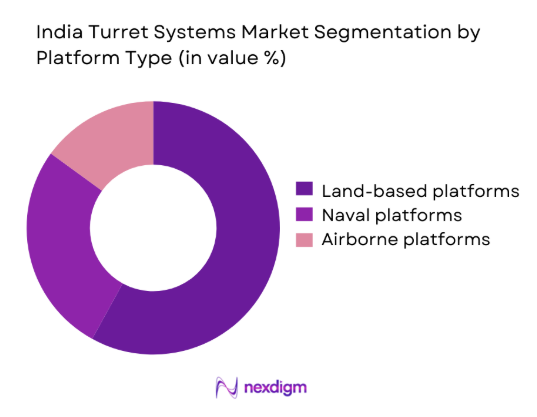
The platform-based segmentation is dominated by land-based turret systems due to continuous modernization of armored fleets and infantry combat vehicles. High deployment density, replacement of aging assets, and integration of advanced fire control systems sustain strong demand across this segment. Naval turret systems represent the second-largest share, driven by coastal security upgrades and fleet expansion initiatives. Airborne and special mission platforms hold a smaller share, primarily focused on surveillance, counter-drone, and lightweight weapon integration roles. Increasing interoperability requirements and modular turret designs continue to influence platform-level demand patterns across defense forces.
By Technology Architecture
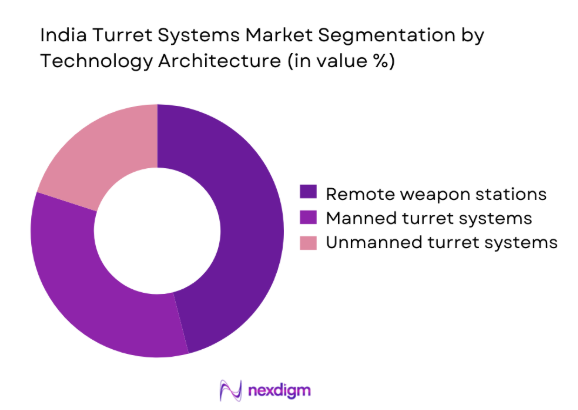
Technology architecture segmentation is led by remote weapon stations, reflecting the shift toward crew survivability and network-enabled warfare. These systems benefit from enhanced situational awareness and reduced exposure risks. Manned turret systems continue to maintain relevance in heavy armor platforms due to firepower requirements and operational familiarity. Unmanned and autonomous turret systems are witnessing accelerating adoption driven by advancements in sensors, stabilization technologies, and battlefield automation. Hybrid architectures combining manual override and digital controls are gaining traction across multiple deployment environments.
Competitive Landscape
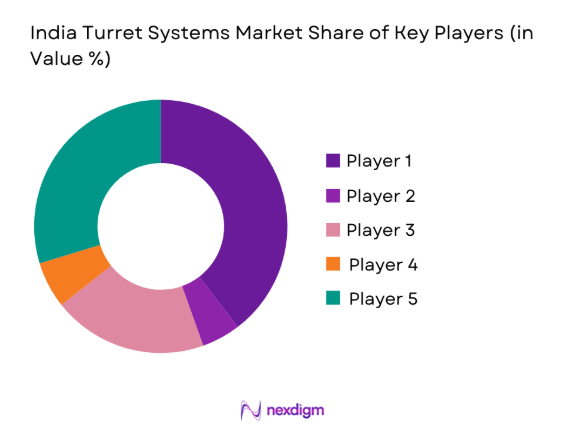
The competitive landscape of the India turret systems market is characterized by a mix of domestic defense manufacturers and international technology providers operating through partnerships and licensed production models. Competition is driven by technology depth, system reliability, compliance with defense procurement norms, and long-term support capabilities.
| Company Name | Establishment Year | Headquarters | Formulation Depth | Distribution Reach | Regulatory Readiness | Service Capability | Channel Strength | Pricing Flexibility |
| Bharat Electronics Limited | 1954 | India | ~ | ~ | ~ | ~ | ~ | ~ |
| Larsen & Toubro Defence | 2011 | India | ~ | ~ | ~ | ~ | ~ | ~ |
| Tata Advanced Systems | 2007 | India | ~ | ~ | ~ | ~ | ~ | ~ |
| Kalyani Strategic Systems | 2017 | India | ~ | ~ | ~ | ~ | ~ | ~ |
| Mahindra Defence Systems | 2001 | India | ~ | ~ | ~ | ~ | ~ | ~ |
India Turret Systems Market Analysis
Growth Drivers
Rising armored vehicle modernization programs
Modernization programs accelerated during 2024 and 2025 as armed forces prioritized upgrading legacy armored platforms. Procurement focus shifted toward enhanced firepower, mobility, and survivability through advanced turret integration. Indigenous development initiatives supported localized manufacturing of turret subsystems and components. Integration of stabilized weapon platforms improved operational readiness across multiple terrains. Increased cross-border security concerns reinforced the demand for advanced turret solutions. Government-backed modernization timelines sustained consistent procurement activity. Enhanced digital fire control systems improved targeting precision under dynamic conditions. System standardization improved logistics and maintenance efficiency. Platform upgrades extended lifecycle usability of existing armored fleets. These factors collectively reinforced sustained market expansion momentum.
Increasing focus on indigenous defense manufacturing
Indigenization policies strengthened domestic turret system production during 2024 and 2025. Local manufacturing reduced dependency on imports and improved supply chain resilience. Technology transfer programs enabled domestic firms to enhance system integration capabilities. Public-private partnerships accelerated design validation and production scalability. Local sourcing mandates encouraged investment in component manufacturing ecosystems. Indigenous development improved lifecycle support and maintenance responsiveness. Domestic testing facilities improved certification timelines. Policy continuity reinforced long-term production planning. Skill development initiatives enhanced engineering capabilities. These developments collectively improved competitiveness of domestically produced turret systems.
Challenges
High development and integration costs
Advanced turret systems require complex integration of sensors, fire control, and stabilization technologies. Development costs increased due to rising material and testing expenses. Integration with existing platforms often requires extensive customization efforts. Long validation cycles delay deployment timelines. Cost overruns remain a concern during prototype development phases. Budget constraints impact large-scale fleet modernization programs. Indigenous component sourcing sometimes increases initial production costs. Testing and certification processes add additional financial burdens. Technology obsolescence risks affect long-term investment planning. These factors collectively restrain rapid market scalability.
Long defense procurement cycles
Procurement timelines remain extended due to multi-stage approval mechanisms. Tender evaluation processes require extensive technical and field validations. Delays in contract finalization impact production planning stability. Changing operational requirements often lead to specification revisions. Budgetary approvals may extend across multiple fiscal periods. Vendor qualification processes are highly stringent. Compliance with offset obligations adds procedural complexity. Decision-making involves multiple defense stakeholders. Slow contracting impacts cash flow predictability for manufacturers. These structural challenges affect overall market momentum.
Opportunities
Make in India and indigenization initiatives
National manufacturing initiatives continue to expand opportunities for domestic turret system suppliers. Local content mandates encourage development of indigenous subsystems. Defense corridors support infrastructure and testing facility development. Export promotion policies open access to emerging defense markets. Collaboration with research institutions enhances technology readiness. Increased funding supports prototype development and trials. Indigenous production improves cost competitiveness over imports. Policy stability encourages long-term investment planning. Domestic demand visibility supports capacity expansion decisions. These factors create sustained growth opportunities.
Upgradation of legacy armored platforms
Large fleets of aging armored vehicles require capability upgrades to remain operationally relevant. Retrofit programs drive demand for modern turret systems. Upgrades focus on firepower, optics, and stabilization improvements. Retrofitting is cost-effective compared to new platform acquisition. Modular turret designs simplify integration with older platforms. Upgrades extend service life and operational utility. Domestic integration capabilities reduce dependency on foreign suppliers. Retrofit demand remains consistent across multiple service branches. This creates recurring revenue opportunities for system providers.
Future Outlook
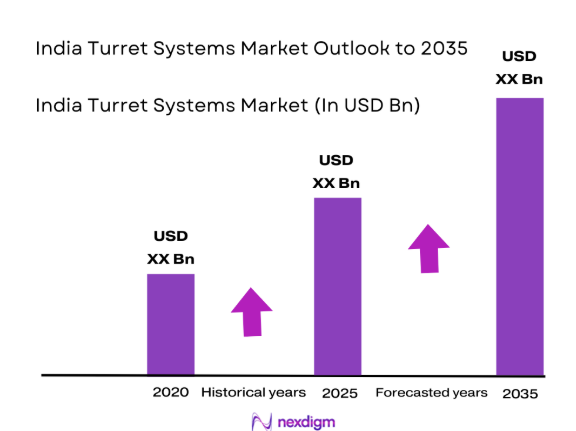
The India turret systems market is expected to maintain steady growth through 2035, supported by defense modernization programs and indigenization priorities. Continued investments in armored platforms, naval assets, and autonomous systems will shape demand trends. Technological advancements in sensors and fire control will further redefine system capabilities across future deployments.
Major Players
- Bharat Electronics Limited
- Larsen & Toubro Defence
- Tata Advanced Systems
- Kalyani Strategic Systems
- Mahindra Defence Systems
- Bharat Dynamics Limited
- Advanced Weapons and Equipment India Limited
- Elbit Systems
- Rafael Advanced Defense Systems
- Saab AB
- Rheinmetall Defence
- KNDS
- Leonardo S.p.A.
- ASELSAN
- John Cockerill Defense
Key Target Audience
- Indian Army procurement divisions
- Indian Navy weapons acquisition units
- Indian Air Force modernization teams
- Ministry of Defence procurement agencies
- Defence public sector undertakings
- Private defense manufacturers
- System integrators and OEM partners
- Investments and venture capital firms
Research Methodology
Step 1: Identification of Key Variables
Market scope, platform categories, technology types, and deployment environments were identified through industry mapping and defense procurement analysis.
Step 2: Market Analysis and Construction
Data was compiled using procurement trends, production patterns, and deployment activity across defense segments to construct market structure.
Step 3: Hypothesis Validation and Expert Consultation
Insights were validated through consultations with defense engineers, system integrators, and former procurement officials.
Step 4: Research Synthesis and Final Output
Findings were consolidated, cross-verified, and structured to reflect market dynamics, risks, and growth opportunities.

- Executive Summary
- Research Methodology (Market Definitions and operational scope of turret systems in Indian defense platforms, segmentation framework by platform and weapon integration, bottom-up market sizing using procurement and induction data, revenue attribution by OEM contracts and retrofit programs, primary validation through defense OEMs and retired armed forces experts, triangulation using MoD budgets and import-export data, assumptions based on indigenization and modernization timelines)

- Definition and Scope
- Market evolution
- Usage and deployment architecture
- Ecosystem structure
- Supply chain and sourcing dynamics
- Regulatory and defense procurement environment

- Growth Drivers
Rising armored vehicle modernization programs
Increased focus on indigenous defense manufacturing
Border security and asymmetric warfare requirements
Naval fleet expansion and weapon upgrades
Adoption of remote and autonomous combat systems - Challenges
High development and integration costs
Long defense procurement cycles
Technology transfer and IP restrictions
Dependence on imported sub-systems
Complex certification and testing processes - Opportunities
Make in India and Atmanirbhar Bharat initiatives
Upgradation of legacy armored platforms
Export potential to emerging defense markets
Integration of AI and electro-optics
Rising demand for remote weapon stations - Trends
Shift toward unmanned and remotely operated turrets
Increased modular turret designs
Integration with battlefield management systems
Lightweight composite materials adoption
Enhanced stabilization and targeting accuracy - Government Regulations
- SWOT Analysis
- Stakeholder and Ecosystem Analysis
- Porter’s Five Forces Analysis
- Competition Intensity and Ecosystem Mapping

- By Value, 2020–2025
- By Volume, 2020–2025
- By Installed Base, 2020–2025
- By Average Selling Price, 2020–2025

- By Fleet Type (in Value %)
Land-based armored platforms
Naval combat vessels
Airborne and special mission platforms - By Application (in Value %)
Main battle tanks
Infantry fighting vehicles
Armored personnel carriers
Naval gun systems
Air defense and counter-UAS systems - By Technology Architecture (in Value %)
Manned turret systems
Remote weapon stations
Unmanned and autonomous turrets
Hybrid stabilization systems - By End-Use Industry (in Value %)
Indian Army
Indian Navy
Indian Air Force
Homeland security and paramilitary forces - By Connectivity Type (in Value %)
Standalone fire control systems
Network-enabled and C4ISR-integrated systems
AI-assisted targeting systems - By Region (in Value %)
North India
South India
West India
East India

- Market structure and competitive positioning
- Market share snapshot of major players
- Cross Comparison Parameters (product portfolio breadth, technology maturity, indigenous content level, contract wins, manufacturing capability, system integration strength, aftersales support, export presence)
- SWOT Analysis of Key Players
- Pricing and Commercial Model Benchmarking
- Detailed Profiles of Major Companies
Tata Advanced Systems
Larsen & Toubro Defence
Mahindra Defence Systems
Kalyani Strategic Systems
Advanced Weapons and Equipment India Limited
Bharat Dynamics Limited
Elbit Systems
Rafael Advanced Defense Systems
Saab AB
Rheinmetall Defence
KNDS (Nexter Systems)
Leonardo S.p.A.
ASELSAN
John Cockerill Defense

- Demand and utilization drivers
- Procurement and tender dynamics
- Buying criteria and vendor selection
- Budget allocation and financing preferences
- Implementation barriers and risk factors
- Post-purchase service expectations

- By Value, 2026–2035
- By Volume, 2026–2035
- By Installed Base, 2026–2035
- By Average Selling Price, 2026–2035


 Request a Sample
 Ask for Customization
 Get a Quote
 Enquire Now