
 Download PDF
Market Overview
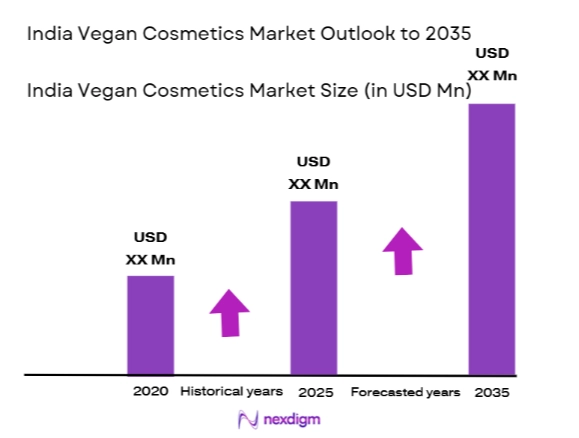
India vegan cosmetics market was valued at USD ~ million in the latest published India-specific estimate for the base year, while the broader Indian beauty and personal care sector was cited at USD ~billion in the immediately preceding year and India’s luxury beauty segment at USD ~ million in that same period. The vegan niche is being pulled forward by cruelty-free preference, plant-based/Ayurveda-led formulations, D2C discovery, and wider online assortment through beauty platforms and marketplaces, which have reduced access barriers for ethical beauty buyers.
Within India, Delhi-NCR, Mumbai, and Bengaluru are the most influential urban demand centers because they combine premium beauty consumption, influencer density, startup concentration, and omnichannel retail infrastructure. Nykaa reported 187 beauty stores across 68 cities in its investor presentation, while its beauty trends reporting referenced 200 stores across 72 cities, including 106 in non-metros, indicating that vegan cosmetics scale first in metros and then diffuse outward through e-commerce and specialty beauty retail.
Market Segmentation
By Product Type
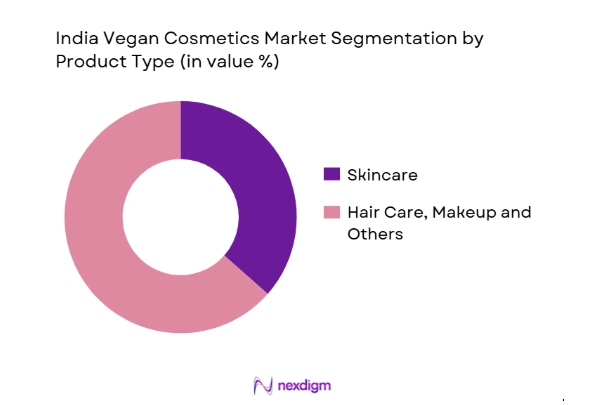
India vegan cosmetics market is segmented by product type into skin care and hair care, makeup, and others. Recently, skin care has held the dominant position under this segmentation because vegan beauty adoption in India has been led by problem-solution categories such as acne care, hydration, brightening, barrier repair, and sun protection. This aligns well with plant-derived actives, ingredient transparency, and Ayurveda-botanical storytelling, which are easier for brands to communicate in serums, moisturizers, cleansers, masks, and treatment-led routines than in pure color cosmetics. Indian D2C brands such as Plum, Earth Rhythm, Juicy Chemistry, Daughter Earth, and Foxtale have built stronger education-led consumer funnels in skincare, and marketplaces such as Nykaa have amplified discovery through ingredient-focused merchandising. The segment also benefits from higher repeat purchase frequency, regimen building, and greater suitability for climate- and skin-type-specific product innovation.
By End User
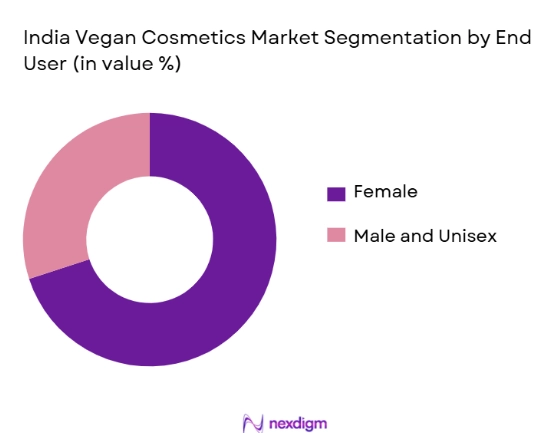
India vegan cosmetics market is segmented by end user into female and male/unisex consumers. Recently, the female sub-segment has maintained a dominant market share because the category is still largely driven by skincare-first and makeup-adjacent purchase behavior, where women remain the primary buyers across routine care, treatment categories, and premium beauty discovery. In India, vegan beauty’s strongest traction has come from urban millennial and Gen Z women who actively evaluate ingredient decks, cruelty-free claims, and sustainability cues before purchase. Social commerce, beauty creators, celebrity-backed labels, and premium marketplace merchandising further reinforce female-led category conversion. At the same time, men’s grooming and unisex wellness-led beauty are expanding, but they remain less developed in SKU depth, influencer education, and routine intensity than female-focused skincare and color categories.
Competitive Landscape
The India vegan cosmetics market remains fragmented but influence-led, with a mix of homegrown digital-first specialists and international ethical beauty brands shaping category standards. Indian players such as Plum, Earth Rhythm, SUGAR Cosmetics, and Mamaearth use D2C marketing, marketplace discovery, ingredient storytelling, and affordable premium pricing to scale. International brands such as The Body Shop continue to influence consumer expectations around certification, vegan formulation integrity, and retail presentation.
| Company | Establishment Year | Headquarters | Vegan / Cruelty-Free Positioning | Core Category Strength | Channel Strength | Price Positioning | Certification / Trust Marker | Market Relevance in India |
| Plum | 2014 | Thane, Maharashtra | ~ | ~ | ~ | ~ | ~ | ~ |
| Mamaearth | 2016 | Gurugram, Haryana | ~ | ~ | ~ | ~ | ~ | ~ |
| SUGAR Cosmetics | 2015 | Mumbai, Maharashtra | ~ | ~ | ~ | ~ | ~ | ~ |
| The Body Shop | 1976 | Brighton, England | ~ | ~ | ~ | ~ | ~ | ~ |
| Earth Rhythm | 2019 | Gurugram, Haryana | ~ | ~ | ~ | ~ | ~ | ~ |
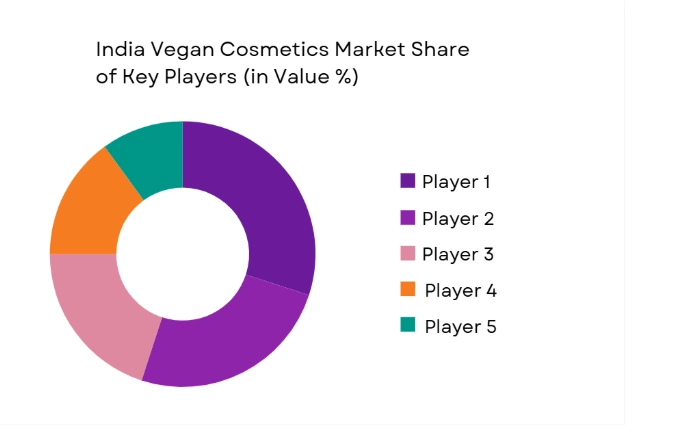
India Vegan Cosmetics Market Analysis
Growth Drivers
Premiumization
Premiumization in India vegan cosmetics is being enabled by a stronger spending base, higher digital product discovery, and a retail environment that can support premium ingredient narratives. India’s GDP reached USD 3.91 trillion in 2024 and GDP per capita reached USD 2,694.7, while the IMF places India’s population at 1,476.626 million in 2026, giving brands a very large addressable consumer base for premium skincare, makeup, and wellness-adjacent beauty. On the demand-conversion side, TRAI reported 969.10 million internet subscribers and 944.12 million broadband subscribers at the end of March 2025, while wireless data usage reached 228,779 petabytes and wireless data revenue rose to Rs. 2,15,078 crore in 2024-25. For vegan cosmetics, that matters because premiumization in this market is not driven only by higher incomes; it is driven by the ability to merchandise ingredient stories, routines, before-after content, dermatologist explanations, and brand values across high-frequency digital touchpoints. A market with this level of online reach can support higher-value vegan serums, treatment moisturizers, lip oils, skin tints, and hybrid derma-beauty lines because consumers can compare formulations, read labels, and transact at scale. In practical terms, premiumization is strongest where disposable spending, broadband access, and digital content consumption come together, which is exactly the structure India now offers to vegan beauty brands trying to move consumers from basic natural products to more performance-led ethical cosmetics.
Ingredient Transparency
Ingredient transparency is a growth driver in India vegan cosmetics because the official compliance environment already pushes cosmetics toward clearer ingredient accountability, and digital infrastructure allows consumers to act on that information. CDSCO states that any imported cosmetic must be registered along with its pack size, variant(s), and manufacturing premises, and it also states that no cosmetic may make a claim that is false or misleading. BIS further notes that the Cosmetics Sectional Committee has published 2 Indian Standards for cosmetic raw materials and ingredients that are widely used by CDSCO and state FDAs. On the consumer-access side, TRAI reported 939.51 million wireless data subscribers and 228,779 petabytes of wireless data usage in 2024-25, while India’s GDP per capita stood at USD 2,694.7 in 2024. This combination is highly relevant for vegan cosmetics because ingredient transparency only becomes commercially powerful when consumers can repeatedly access, verify, and compare labels online. In India, the digital shelf has become the place where shoppers evaluate whether a product is plant-derived, free from animal-derived inputs, and aligned with adjacent claims such as fragrance-free, sulfate-free, silicone-free, or dermatologically tested. For vegan brands, transparency is therefore not a soft branding issue; it is a conversion tool tied to regulatory scrutiny, ingredient disclosure discipline, and digitally enabled label-reading behavior. The more consumers can inspect formulations at scale, the more transparent brands gain an advantage over brands relying on vague naturalness language.
Market Challenges
Certification Confusion
Certification confusion remains a core challenge in India vegan cosmetics because the consumer sees many overlapping trust marks, while the official framework codifies some ethical claims more clearly than others. FSSAI has a formal Vegan Foods Regulations framework and a vegan logo regime for food products, but the current cosmetics framework visible through CDSCO and BIS is centered on registration, safety, ingredient standards, pack size, variants, manufacturing premises, and misleading-claim control rather than a cosmetics-specific statutory vegan certification mark. CDSCO also clarifies that different colour/shade or flavour combinations can be treated as variants, while different pack sizes are recorded separately. In a country with 969.10 million internet subscribers, 944.12 million broadband subscribers, and 228,779 petabytes of wireless data usage in 2024-25, that distinction matters because claims are consumed at very large scale and often through thumbnails, short-form videos, and marketplace badges rather than full regulatory reading. The result is that consumers can easily treat “vegan,” “cruelty-free,” “clean,” and “natural” as interchangeable when the official compliance architecture does not present a single cosmetics-only vegan symbol comparable to the food-side vegan logo. For India vegan cosmetics brands, this raises the cost of education and creates friction at the point of sale, especially when premium products depend on trust. The category therefore grows, but it grows with a structural clarity problem that can slow repeat purchase and weaken the value of legitimate third-party ethical claims.
Claim Overlap with Clean/Natural
Claim overlap with clean and natural positioning is another direct challenge for India vegan cosmetics because the market rewards simple label cues, while regulation addresses safety and misleading communication more directly than marketing semantics. CDSCO states that no cosmetic may purport to convey an idea that is false or misleading, and BIS notes the use of 2 Indian Standards for cosmetic ingredients and raw materials. However, “clean” and “natural” are not presented in the accessible CDSCO/BIS materials as standalone statutory product classes in the same way that FSSAI separately codifies vegan food. This creates a problem for vegan cosmetics: a product may be vegan without being natural, natural without being vegan, clean without being cruelty-free, or all three at once. In India’s digital beauty environment, that ambiguity travels fast. TRAI reported 939.51 million wireless data subscribers, 228,779 petabytes of wireless data usage, and Rs. 2,15,078 crore in wireless data revenue in 2024-25, which shows the scale at which beauty claims can circulate through marketplaces, social commerce, and influencer-led discovery. With India’s GDP at USD 3.91 trillion in 2024 and its population at 1,476.626 million in 2026, even a small degree of label confusion can affect a very large consumer base. For the vegan cosmetics market, this overlap dilutes differentiation, complicates merchandising, and makes it harder for brands to justify a premium based on vegan formulation integrity alone. Brands must therefore spend more on education, content, and proof architecture just to keep the vegan claim from being absorbed into broader clean-beauty language.
Market Opportunities
Vegan Derma Beauty
Vegan derma beauty is one of the clearest opportunities in India because current climatic stress, rising digital health access, and expanding consumer capacity all support performance-led, skin-health-oriented formulations. IMD recorded 2024 as India’s warmest year since 1901, with the annual mean land surface air temperature at 0.65°C above the long-term average. IMD also reported 10 to 18 heatwave days in June 2024 across parts of north, central, and east India, while maximum temperatures in late May reached 48°C to 50.5°C in parts of Rajasthan and adjoining regions. These conditions matter for vegan derma beauty because heat, sun stress, and seasonal skin sensitivity increase consumer interest in barrier repair, calming actives, hydration systems, post-sun care, and clinically legible formulations. The health-access backdrop also supports this shift: PIB reported that eSanjeevani had served over 36 crore patients by April 2025, with 232,291 providers, 131,793 spokes, 17,051 hubs, and 130 specialties on the platform. That scale normalizes doctor-led digital consultation and strengthens the commercial logic for dermatologist-adjacent product claims, provided they remain compliant. At the same time, India’s GDP per capita reached USD 2,694.7 in 2024, indicating greater capacity to trade up from basic herbal products to more sophisticated vegan formulations built around ceramides, peptides, niacinamide, cica, or mineral filters paired with plant-derived systems. The opportunity is therefore not just “more skincare”; it is a move toward vegan products that are clinically understandable, sensitive-skin compatible, and credible in a high-heat, high-exposure environment.
Vegan Sunscreens
Vegan sunscreens represent a strong growth opportunity because India’s current climate profile, digital retail intensity, and premium skincare migration all favor sun-protection formats with cleaner ethical positioning. IMD states that India’s annual mean land surface air temperature in 2024 was 0.65°C above the long-term average, making it the warmest year on record since 1901. It also recorded 10 to 18 heatwave days during June 2024 in multiple northern and central belts, and maximum temperatures of 48°C to 50.5°C in late May over parts of Rajasthan and nearby regions. In commercial terms, these are the kinds of conditions that expand everyday use cases for sunscreen, gel-creams with SPF, tinted protection, lip SPF, and post-sun recovery products. The digital and income infrastructure is also favorable: TRAI reported 969.10 million internet subscribers, 944.12 million broadband subscribers, and 228,779 petabytes of wireless data usage in 2024-25, while the World Bank recorded India’s GDP at USD 3.91 trillion and GDP per capita at USD 2,694.7 in 2024. For vegan cosmetics, this means sunscreen education can now scale through marketplace search, ingredient explainers, UV-awareness content, and repeat-replenishment models. The opportunity is especially relevant because sunscreen sits at the intersection of efficacy, skincare routine building, and ethical beauty positioning. Brands that can combine reliable broad-spectrum performance, cosmetically elegant textures for Indian climates, and a clearly communicated vegan formulation story are better placed to build both frequency and loyalty within the category.
Future Outlook
India vegan cosmetics market is positioned for sustained expansion as ethical beauty moves from a niche claim to a mainstream portfolio architecture across skincare, body care, makeup, and hybrid dermaceutical formats. Growth is likely to be supported by higher ingredient literacy, broader acceptance of cruelty-free and vegan claims, stronger online discovery, and deeper premiumization in metro and Tier 1 cities. Over the medium term, the category should also benefit from localized innovation in botanical actives, refillable or lower-waste packaging, and celebrity- or creator-backed launch pipelines. Public India forecasts point to continued growth, while broader global vegan cosmetics forecasts indicate that the category still has meaningful headroom through the next decade.
Major Players
- Plum
- The Body Shop
- SUGAR Cosmetics
- Kay Beauty
- Mamaearth
- Earth Rhythm
- Disguise Cosmetics
- Ruby’s Organics
- Daughter Earth
- Love Earth
- Dr. Sheth’s
- Foxtale
- Aqualogica
- 82°E
- Iba Cosmetics
Key Target Audience
- Chief Executive Officers, vegan and clean beauty brands
- Chief Marketing Officers, beauty and personal care companies
- Category Heads, beauty marketplaces and specialty retailers
- Product Development Heads, plant-based and ethical cosmetics manufacturers
- E-commerce and Omnichannel Directors, beauty retail platforms
- Investments and venture capitalist firms
- Government and regulatory bodies (CDSCO, Bureau of Indian Standards, Ministry of Commerce and Industry, Department for Promotion of Industry and Internal Trade)
- Private label and contract manufacturing decision-makers in cosmetics
Research Methodology
Step 1: Identification of Key Variables
The first stage maps the India vegan cosmetics ecosystem across brands, marketplaces, offline beauty retail, contract manufacturers, certifiers, and digital influencers. Secondary research is used to define the boundaries of vegan cosmetics against adjacent labels such as cruelty-free, clean beauty, botanical beauty, and toxin-free positioning. The goal is to isolate the variables that materially affect size, growth, and competitive intensity.
Step 2: Market Analysis and Construction
In this phase, publicly available market-size references, company disclosures, retailer expansion signals, and category trend indicators are compiled. A top-down lens is used to position vegan cosmetics within India’s broader beauty and personal care spend, while a bottom-up lens tracks brand portfolios, category emphasis, pricing ladders, and distribution architecture. This helps build a practical view of revenue concentration, growth pockets, and market maturity.
Step 3: Hypothesis Validation and Expert Consultation
Preliminary assumptions are tested against observed channel behavior, certification activity, brand launches, and consumer adoption patterns. Industry interviews with brand operators, formulators, distributors, and category managers are typically used to validate which segments are gaining traction and where consumer willingness to pay is strongest. This step reduces distortion from purely promotional or brand-led narratives.
Step 4: Research Synthesis and Final Output
The final phase integrates quantitative indicators with qualitative interpretation of demand drivers, channel shifts, and brand strategies. Segment priorities, competitor positioning, and future growth themes are cross-checked to ensure internal consistency between market size, segmentation, and outlook. The result is a market report intended for decision-makers evaluating entry, expansion, investment, private label, or channel strategy in India vegan cosmetics.

- Executive Summary
- Research Methodology (Market Definitions and Assumptions, Abbreviations, Scope Boundary for Vegan Cosmetics, Inclusion/Exclusion Criteria for Vegan vs Cruelty-Free vs Clean Beauty, Demand-Side Assessment Framework, Supply-Side Assessment Framework, Bottom-Up Brand Revenue Mapping, Top-Down Beauty Category Allocation, Channel Validation Through Retailer Audit, Pricing Basket Construction, Primary Interviews with Brands/Distributors/Marketplaces/Formulators, Forecasting Framework, Limitations and Future Conclusions)

- Definition and Scope
- Market Genesis and Evolution of Vegan Beauty in India
- India Beauty Regulatory Context and Vegan Claim Environment
- Consumer Purchase Journey and Consideration Funnel
- Value Chain Analysis
- Supply Chain Analysis
- Ecosystem Map of Brands, Marketplaces, Contract Manufacturers, Ingredient Suppliers, Certifiers, and Influencers
- Timeline of Major Vegan/Plant-Based/Cruelty-Free Brand Entries in India

- Growth Drivers (Premiumization, Ingredient Transparency, Animal-Welfare
- Awareness, D2C Discovery, Marketplace Education, K-Beauty/Clean Beauty Spillover)
- Market Challenges (Certification Confusion, Claim Overlap with Clean/Natural, Price Premium, Shade Gaps, Low Offline Visibility, Counterfeit/Unauthorized Sellers)
- Market Opportunities (Vegan Derma Beauty, Vegan Sunscreens, Men’s Vegan Grooming, Premium Makeup, Teen Skincare, Refillable Packaging)
- Market Trends (Skinification of Makeup, Hybrid Actives, Minimalist Routines, Sensitive-Skin Positioning, SPF-Led Expansion, Creator-Led Conversion)
- Regulatory and Compliance Landscape (Cosmetics Rules, BIS Ingredient Compliance, Labelling, Import Registration, Animal-Testing Ban, Claim Substantiation)
- Customer Pain Point Analysis (Efficacy Skepticism, Texture/Climate Fit, Shade Inclusivity, Price-Value Mismatch, Trust Deficit on Claims, Product Availability)
- Demand-Supply Gap Analysis (Assortment Gaps, Regional Reach, Channel Presence, Price Point White Spaces, Hero SKU Concentration)
- Porter’s Five Forces
- SWOT Analysis
- Stakeholder Ecosystem
- Import Dependence vs Domestic Manufacturing Assessment
- White Space Mapping by Category, Price Tier, and Channel

- By Value (2020-2025)
- By Volume (2020-2025)
- By Average Selling Price (2020-2025)
- By Online vs Offline Contribution (2020-2025)
- By Domestic Brands vs International Brands Contribution (2020-2025)

- By Product Category (In Value %)
Face Care
Color Cosmetics
Lip Care and Lip Color
Eye Makeup
Base Makeup
Body Care
Hair Care
Fragrance and Deo
Nail Care - By Consumer Need-State / Benefit Platform (In Value%)
Hydration and Moisture Lock
Brightening and Glow
Acne / Blemish Control
Barrier Repair / Soothing
Sun Protection
Pigmentation / Uneven Tone
Long-Stay / High-Performance Makeup
Sensitive-Skin / Dermatologically Tested Formulations - By Ingredient Platform (In Value%)
Plant Actives and Botanical Extracts
Clinical Actives + Botanical Hybrids
Ayurveda-Inspired Vegan Formulations
Fruit-Based Active Skincare
Mineral / Clean Pigment Makeup
Fragrance-Free / Minimalist Ingredient Decks - By Price Tier (In Value%)
Entry
Mass Premium
Masstige
Premium
Prestige / Luxury Vegan Beauty - By Distribution Channel (In Value%)
Brand-Owned Website / App
Beauty Marketplaces
E-Commerce Marketplaces
Exclusive Brand Outlets
Modern Trade / Large Format Retail
General Trade / Select Pharmacies / Beauty Stores
Social Commerce / Creator-Led Commerce - By Geography (In Value%)
North India
South India
West India
East India
Central India
Metro Cities
Tier 1 Cities
Tier 2 Cities
Tier 3 and Emerging Cities - By Certification / Claim Architecture (In Value%)
Vegan + Clean Beauty
Vegan + Dermatologically Tested
Vegan + Halal
Vegan + Sustainable / Refillable - By Target Consumer Cohort (In Value%)
Men
Gender-Neutral / Universal Care
Gen Z
Millennials
Premium Urban Professionals
Conscious / Ethical Beauty Buyers

- Market Share of Major Players (By Value, By Volume, By Product Category, By Online vs Offline Sales, By Domestic vs International Brands)
- Cross Comparison Parameters (Vegan/Third-Party Certification Depth, Hero SKU and Ingredient Platform, Average Selling Price by Core SKU, Online Marketplace Visibility, D2C Website Conversion Levers, Offline Retail Footprint and Touchpoints, Shade/Variant Depth, New Product Launch Velocity)
- Competitive Positioning Map (Mass vs Premium, Efficacy vs Naturalness, Makeup vs Skincare Focus, D2C vs Omnichannel Strength)
- Pricing Analysis Basis Core SKUs Across Key Categories
- Discounting and Promotion Benchmarking (Bundle Depth, Intro Offers, Marketplace Discounting, Festive Sale Intensity, Subscription Savings)
- Assortment Benchmarking (SKU Count, Hero Product Concentration, Category Coverage, Shade Range, Travel Packs, Gift Sets)
- Consumer Perception Benchmarking (Ratings, Reviews, Creator Mentions, Search Visibility, Community Strength)
- SWOT Analysis of Major Players
- Detailed Profiles of Major Companies
Plum
The Body Shop
SUGAR Cosmetics
Kay Beauty
Mamaearth
Earth Rhythm
Disguise Cosmetics
Ruby’s Organics
Daughter Earth
Love Earth
Dr. Sheth’s
Foxtale
Aqualogica
82°E
Iba Cosmetics

- Consumer Awareness of Vegan vs Cruelty-Free vs Clean Claims
- Purchase Frequency and Basket Mix
- Average Order Value and Wallet Allocation
- Trial vs Repeat Purchase Behavior
- Review, Rating, and Social Proof Dependence
- Creator / Influencer / Dermatologist Impact on Conversion
- Needs, Desires, and Unmet Expectations
- Decision-Making Hierarchy (Certification, Ingredients, Efficacy, Price, Brand Story, Reviews, Availability)
- Climate and Skin-Type Sensitivity Analysis
- Metro vs Non-Metro Consumer Behavior

- By Value (2026-2035)
- By Volume (2026-2035)
- By Average Selling Price (2026-2035)
- By Online vs Offline Contribution (2026-2035)
- By Domestic vs International Brands Contribution (2026-2035)


 Request a Sample
 Ask for Customization
 Get a Quote
 Enquire Now