
 Download PDF
Market Overview
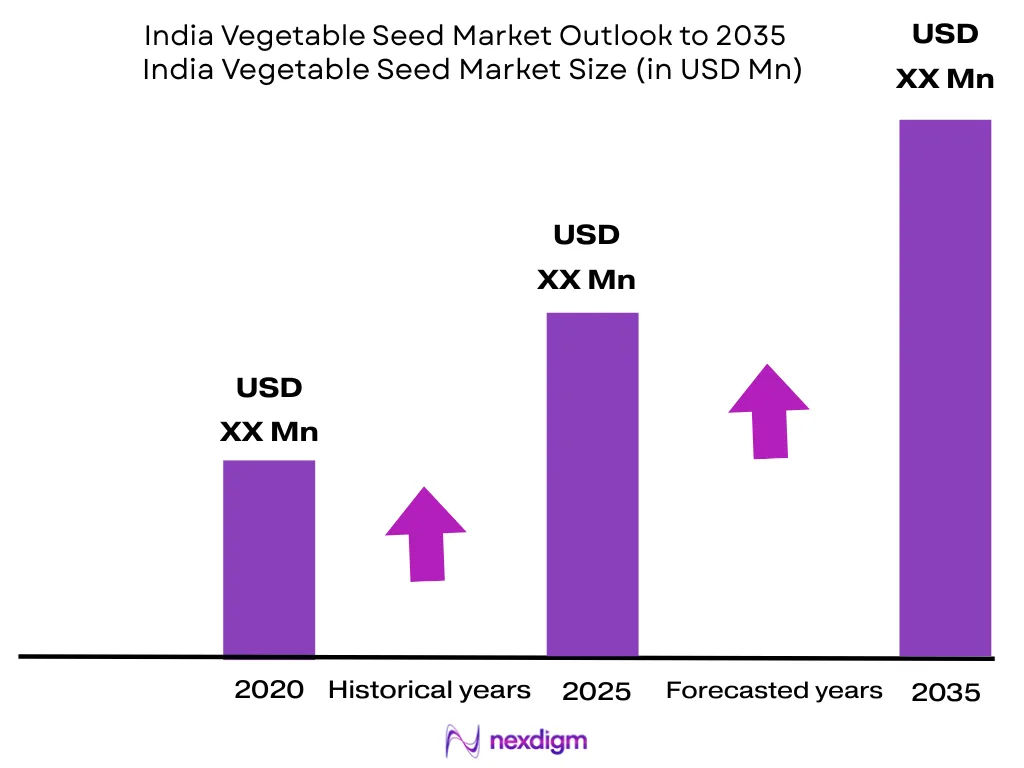
The India Vegetable Seed Market is valued at USD ~ million, based on a five-year historical analysis. Demand is driven by hybrid adoption, short-cycle vegetable cultivation, seed replacement, protected cultivation and commercial horticulture. India’s vegetable production moved from 212.55 million tonnes to around 205.80 million tonnes, while tomato output increased from 204.25 lakh tonnes to 213.20 lakh tonnes, supporting demand for high-yield tomato, chilli, okra, onion, cucurbit and brassica seeds. Uttar Pradesh, West Bengal, Madhya Pradesh, Bihar, Maharashtra, Karnataka, Andhra Pradesh, Gujarat and Tamil Nadu dominate the India Vegetable Seed Market because they combine large vegetable acreage, mandi-linked production, hybrid seed adoption, nurseries and intensive multi-cropping. Uttar Pradesh and West Bengal lead vegetable production; Maharashtra and Karnataka dominate onion, tomato, protected cultivation and seed multiplication; Andhra Pradesh and Telangana are important for chilli and vegetable seed production; Gujarat has strong okra, onion and cucurbit demand.
Market Segmentation
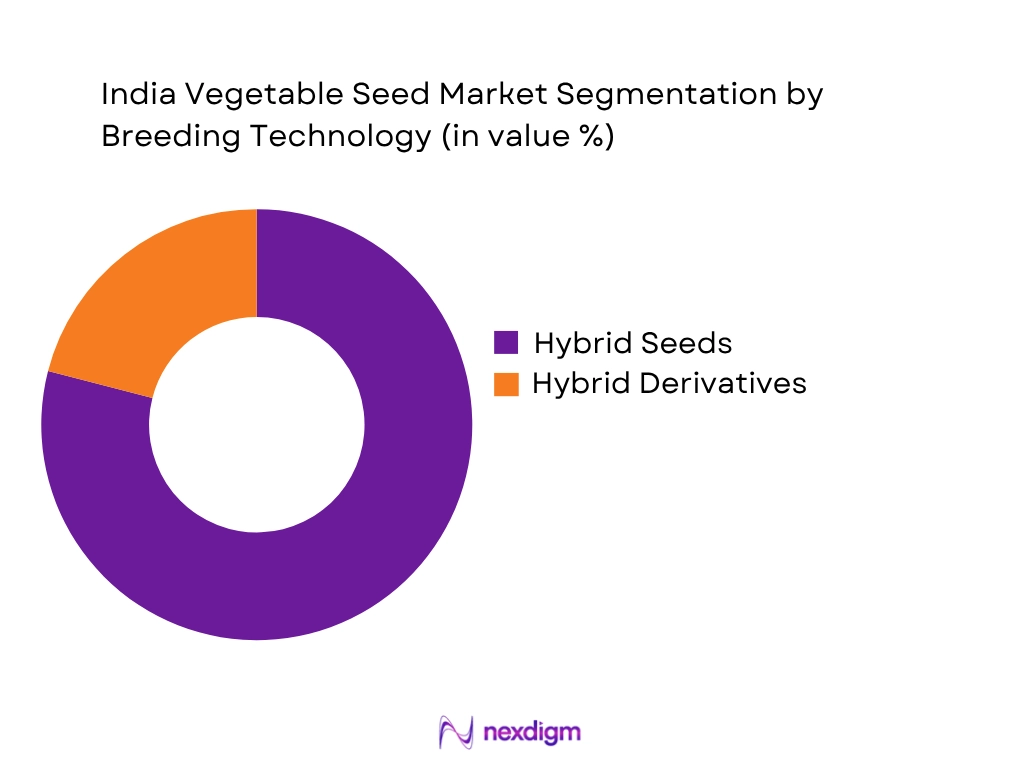
By Breeding Technology
India Vegetable Seed Market is segmented by breeding technology into hybrid seeds and open-pollinated varieties with hybrid derivatives. Recently, hybrid seeds have a dominant market share in India under the breeding technology segmentation due to their superior yield performance, disease resistance, early maturity and better marketable output. Commercial farmers prefer hybrid tomato, chilli, okra, cucumber, watermelon, brinjal, capsicum, cabbage and cauliflower seeds because these crops are highly exposed to pest pressure, viral diseases, heat stress and market price volatility. Hybrid seeds also support uniform fruit size, colour, shelf life and transportability, which are essential for mandi, modern retail, processing and export-oriented supply chains. Open-pollinated seeds remain relevant among smallholders, kitchen gardeners, organic growers and cost-sensitive farmers, but their commercial role is lower because they provide weaker uniformity and limited trait packages compared with F1 hybrids.
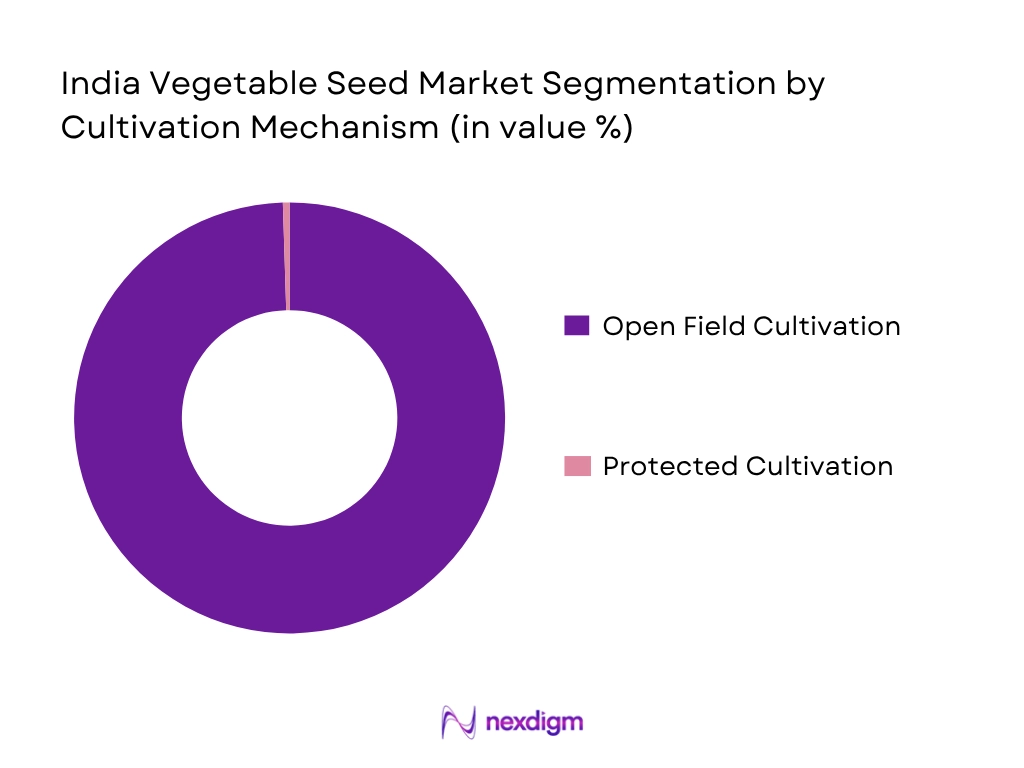
By Cultivation Mechanism
India Vegetable Seed Market is segmented by cultivation mechanism into open field cultivation and protected cultivation. Recently, open field cultivation has a dominant market share in India under the cultivation mechanism segmentation because most vegetable crops are produced by small and medium farmers under open-field systems. Tomato, onion, chilli, okra, brinjal, cabbage, cauliflower, cucurbits, peas, beans and leafy vegetables are grown across diverse agro-climatic zones through seasonal and multi-crop planting cycles. These systems require continuous seed replacement, especially for hybrid crops where farmers purchase seed every season. Protected cultivation is smaller but strategically important, as polyhouse and net-house farmers use premium capsicum, cucumber, tomato, lettuce and cherry tomato seeds. However, its adoption remains limited due to higher infrastructure requirements, technical skill needs and dependence on controlled input management.
Competitive Landscape
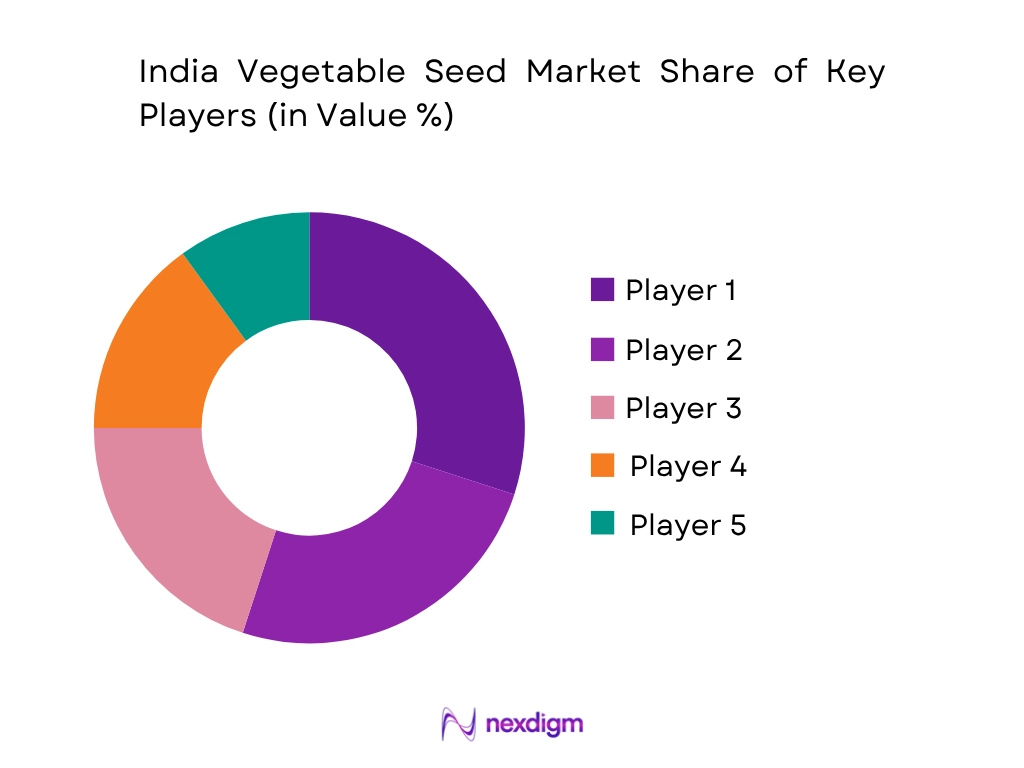
The India Vegetable Seed Market is fragmented, with multinational hybrid seed companies competing against strong domestic seed houses and regional vegetable seed specialists. Syngenta India, Mahyco, UPL Advanta, VNR Seeds and BASF/Nunhems are among the influential players in premium hybrid categories. Domestic companies such as Namdhari Seeds, Indo-American Hybrid Seeds, Rasi Seeds and Nuziveedu Seeds compete through local breeding, dealer reach, smallholder pack sizes and crop-specific adaptation. Competition is shaped by tropical disease resistance, dealer networks, crop portfolios, seed treatment capability, nursery linkages and farmer trust.
| Company | Establishment Year | Headquarters | Key Vegetable Seed Focus | Main Crop Families | Distribution Strength | Protected Cultivation Portfolio | Seed Technology Focus | India Market Positioning |
| Syngenta India | 2000 | Pune, India / Basel, Switzerland | ~ | ~ | ~ | ~ | ~ | ~ |
| Mahyco | 1964 | Jalna, India | ~ | ~ | ~ | ~ | ~ | ~ |
| UPL / Advanta Seeds | 1969 | Mumbai, India | ~ | ~ | ~ | ~ | ~ | ~ |
| VNR Seeds | 1993 | Raipur, India | ~ | ~ | ~ | ~ | ~ | ~ |
| BASF / Nunhems India | 1865 | Ludwigshafen, Germany / India operations | ~ | ~ | ~ | ~ | ~ | ~ |
India Vegetable Seed Market Analysis
Growth Drivers
Large Vegetable Production Base Supports Recurring Demand for Commercial Vegetable Seeds
India Vegetable Seed Market is supported by a large horticulture base where short-duration vegetables require repeated seed purchases across tomato, onion, chilli, okra, brinjal, cucurbits and brassicas. The Ministry of Agriculture reported vegetable production of 2,177.97 lakh tonnes and total horticulture production of 3,707.38 lakh tonnes, while onion production reached 307.67 lakh tonnes and tomato production reached 205.99 lakh tonnes. India’s macro base strengthens this demand: the World Bank reported population of 1.45 billion, GDP of USD 3.91 trillion, and GDP per capita of USD 2,694.7. These figures support continued demand for hybrid, treated and region-specific vegetable seeds.
Expansion in Onion, Chilli, Brassica and Cucurbit Output Raises Hybrid Seed Adoption
India Vegetable Seed Market benefits from crop-wise expansion in high-seed-replacement vegetables. The Ministry of Agriculture reported vegetable production of 2,177.97 lakh tonnes, supported by higher output in onion, green chilli, cauliflower, cabbage, brinjal, okra, peas, pumpkin, bottle gourd, bitter gourd, cucumber, radish and capsicum. Onion area increased from 15.41 lakh hectares to 19.68 lakh hectares, while onion production reached 307.67 lakh tonnes. For seed companies, these crops require seasonal seed replacement, disease tolerance and localized hybrids. The World Bank’s India indicators show GDP of USD 3.91 trillion, population of 1.45 billion, and GDP growth of 6.5, supporting a large domestic food economy and sustained horticulture input demand.
Market Challenges
Climate Variability Affects Germination, Planting Windows and Seed Demand Planning
India Vegetable Seed Market faces climate-linked uncertainty because vegetable crops are sensitive to heat, rainfall timing, nursery mortality and transplant establishment. The India Meteorological Department reported annual rainfall at 104 of the long-period average and noted heatwave conditions over the east coast in April, northwest India in May, and northern and central India in June. The Ministry of Agriculture reported tomato production at 205.99 lakh tonnes, compared with 213.23 lakh tonnes earlier, showing crop-level exposure to weather and production variability. The World Bank recorded GDP of USD 3.91 trillion, population of 1.45 billion, and GDP per capita of USD 2,694.7, indicating large demand but weather-sensitive supply planning.
Spurious Seed Risk and Dealer-Level Compliance Burden Affect Farmer Confidence
India Vegetable Seed Market faces quality-control challenges from spurious and sub-standard seeds, particularly in high-value vegetable hybrids where farmers rely on dealer recommendations. PIB stated that the Seeds Act, 1966, Seed Rules, 1968, and Seeds Control Order, 1983 empower states to appoint seed inspectors, inspect outlets, draw samples, cancel licences, seize stocks, issue stop-sale orders and prosecute violators. The SATHI portal was also launched for end-to-end digital seed traceability. These controls matter in a market supported by 2,177.97 lakh tonnes of vegetable production and 19.68 lakh hectares of onion area. World Bank indicators show India’s population at 1.45 billion and GDP at USD 3.91 trillion, making seed reliability critical for food supply.
Market Opportunities
Protected Cultivation and Nursery-Based Farming Create Demand for Premium Vegetable Seeds
India Vegetable Seed Market has a growth opportunity in protected cultivation, seedling nurseries and high-value vegetable production. PIB reported that under MIDH, 3.07 lakh hectares had been covered under protected cultivation and 872 nurseries had been established for quality planting material. This supports demand for premium seeds in capsicum, cucumber, tomato, lettuce, herbs, cherry tomato and exotic vegetables. Protected cultivation also reduces exposure to pests and unstable weather, making seed traits such as germination uniformity, seedling vigor and disease resistance more valuable. World Bank data shows India’s GDP at USD 3.91 trillion, population at 1.45 billion, and GDP per capita at USD 2,694.7, supporting demand for organized fresh-produce systems.
Organic and Traceable Seed Channels Gain Relevance Through Formal Seed Oversight
India Vegetable Seed Market has an opportunity in traceable, quality-certified, untreated and organic-aligned vegetable seeds as seed regulation becomes more digital. PIB stated that SATHI enables end-to-end traceability across the seed supply chain, while state governments can act under the Seeds Act, 1966, Seed Rules, 1968, and Seeds Control Order, 1983 against spurious and sub-standard seed sales. This improves the business case for branded vegetable seed packs, QR-linked authenticity, certified nurseries and dealer accountability. The opportunity is supported by 2,177.97 lakh tonnes of vegetable production and 3,707.38 lakh tonnes of horticulture production. World Bank data shows India’s population at 1.45 billion, GDP at USD 3.91 trillion, and GDP per capita at USD 2,694.7.
Future Outlook
The India Vegetable Seed Market is expected to grow at around 5.7% CAGR during the long-range forecast period, supported by hybrid seed adoption, vegetable production intensity, protected cultivation, dealer digitization and increasing demand for high-quality produce. Demand will remain strongest in tomato, chilli, okra, onion, cucurbits, cabbage, cauliflower and capsicum. Over the next phase, growth will be supported by tropical disease-resistant hybrids, heat-tolerant vegetable varieties, bio-primed seeds, seedling nursery partnerships and FPO-led bulk procurement. Protected cultivation will create higher-value demand for cucumber, capsicum, tomato, lettuce and exotic vegetables. Open-field cultivation will remain the volume anchor because India’s vegetable production is dominated by smallholder and mandi-linked farming systems. The market will also see stronger differentiation between premium hybrids and economy hybrid seeds. Large growers and protected-crop farmers will prioritize branded F1 seeds, precision seedlings, grafted plants and disease-resistant varieties. Smallholders will continue purchasing affordable packs through village dealers, agri-input shops and regional distributors. Seed companies that combine crop-specific genetics, farmer advisory, dealer financing and counterfeit protection will gain stronger market positions.
Major Players
- Syngenta India
- Bayer CropScience / Seminis / De Ruiter
- East-West Seed India
- Mahyco
- UPL / Advanta Seeds
- Namdhari Seeds
- Rijk Zwaan India
- Enza Zaden India
- BASF Vegetable Seeds / Nunhems India
- Sakata Seed India
- Bejo Sheetal Seeds
- VNR Seeds
- Nuziveedu Seeds
- Indo-American Hybrid Seeds
- Rasi Seeds
Key Target Audience
- Vegetable Seed Manufacturers
- Hybrid Vegetable Seed Breeding Companies
- Commercial Vegetable Growers
- Protected Cultivation and Polyhouse Operators
- Seedling Nurseries and Grafted Plant Producers
- Agri-Input Distributors and Seed Dealers
- Investments and Venture Capitalist Firms
- Government and Regulatory Bodies
Research Methodology
Step 1: Identification of Key Variables
The initial phase involves constructing an ecosystem map encompassing all major stakeholders within the India Vegetable Seed Market. This includes seed breeders, seed producers, distributors, dealers, nurseries, FPOs, protected-crop farmers and regulators. The objective is to identify critical variables such as crop family, hybrid penetration, seed replacement, pack size, dealer reach and regional production clusters.
Step 2: Market Analysis and Construction
In this phase, historical data is compiled and analyzed for vegetable production, seed demand, crop-wise adoption, cultivation mechanism and state-level production concentration. The market is constructed through top-down validation and bottom-up modelling based on crop acreage, seed rate, seed replacement cycle, commercial seed usage and pricing structure across major vegetable categories.
Step 3: Hypothesis Validation and Expert Consultation
Market hypotheses are validated through computer-assisted interviews with seed companies, dealers, nursery operators, FPO representatives and commercial growers. These consultations provide insights into farmer buying behaviour, hybrid adoption, regional seed preferences, protected cultivation demand, counterfeit seed risks and crop-specific performance expectations.
Step 4: Research Synthesis and Final Output
The final phase involves synthesis of secondary data, primary interviews, company portfolio mapping and bottom-up crop-demand modelling. The output is cross-validated across market size, segmentation, competitive landscape, future outlook and regulatory environment. This ensures a business-focused and investor-relevant analysis of the India Vegetable Seed Market.

- Executive Summary
- Research Methodology (Market Definitions and Assumptions, Vegetable Seed Taxonomy, Hybrid/Open-Pollinated/Heirloom/Organic/Untreated Seed Classification, Market Sizing Approach, Top-Down Seed Revenue Validation, Bottom-Up Crop Acreage-to-Seed Requirement Model, Dealer and Distributor Mapping, Primary Interviews with Breeders/Distributors/FPOs/Nurseries/Growers, Seed Certification Validation, Limitations and Future Conclusions)

- Definition and Scope
- Overview Genesis
- Evolution of Vegetable Seed Industry in India
- Timeline of Major Players
- Business Cycle

- Growth Drivers (Hybrid Adoption, Vegetable Production Growth, Seed Replacement, Protected Cultivation, FPO-Led Procurement, Rising Demand for Quality Produce)
- Market Challenges (Spurious Seeds, Price Sensitivity, Climate Variability, Disease Outbreaks, Fragmented Distribution, Farmer Credit Constraints)
- Opportunities (Protected Cultivation Genetics, Domestic Hybrid Breeding, Organic Seeds, Seed Enhancement, Digital Advisory, Export-Oriented Vegetable Seeds)
- Trends (Hybridization, Tropical Disease Resistance, Seed Enhancement, Nursery-Based Production, Protected Cultivation, Digital Distribution)
- SWOT Analysis
- Porter’s Five Forces
- PESTLE Analysis

- By Value (2020-2025)
- By Volume (2020-2025)
- By Average Realization per Kilogram/Thousand Seeds (2020-2025)

- By Crop Family (In Value %)
Tomato Seeds
Chilli and Capsicum Seeds
Okra Seeds
Brinjal Seeds
Cucurbit Seeds - By Distribution Channel (In Value %)
Direct-to-Grower Sales
Seed Dealers and Regional Distributors
Agri-Input Retailers
Cooperatives and FPOs
Online B2B Platforms - By End User (In Value %)
Commercial Vegetable Growers
Smallholder Farmers
Protected-Crop Farmers
Seedling Nurseries
Organic Growers
Contract Farming Companies
- By Region (In Value %)
South India
West India
North India
East India
Central India

- Market Share of Major Players (Commercial Vegetable Seed Revenue, Crop-Family Share, Hybrid Share, Regional Presence)
- Cross Comparison Parameters (Hybrid Vegetable Portfolio Breadth, India-Specific Disease-Resistance Trait Depth, Dealer and Distributor Network Coverage, Protected-Cultivation Variety Portfolio, Seed Treatment and Bio-Priming Capability, Parent Seed and Contract Production Footprint, Regional Trial and Agronomy Support, Smallholder Pack-Size and Affordability Strategy)
- SWOT Analysis of Major Players
- Detailed Profiles of Major Companies
Syngenta India
Bayer CropScience / Seminis / De Ruiter
East-West Seed India
Mahyco
UPL / Advanta Seeds
Namdhari Seeds
Rijk Zwaan India
Enza Zaden India
BASF Vegetable Seeds / Nunhems India
Sakata Seed India
Bejo Sheetal Seeds
VNR Seeds
Nuziveedu Seeds
Indo-American Hybrid Seeds
Rasi Seeds

- Commercial Vegetable Grower Analysis
- Smallholder Farmer Analysis
- Protected-Crop Farmer Analysis
- Seedling Nursery Analysis
- Organic and Natural Farming Grower Analysis

- By Value (2020-2035)
- By Volume (2026-2035)
- By Average Realization per Kilogram/Thousand Seeds (2026-2035)


 Request a Sample
 Ask for Customization
 Get a Quote
 Enquire Now