

 Download PDF
Market Overview
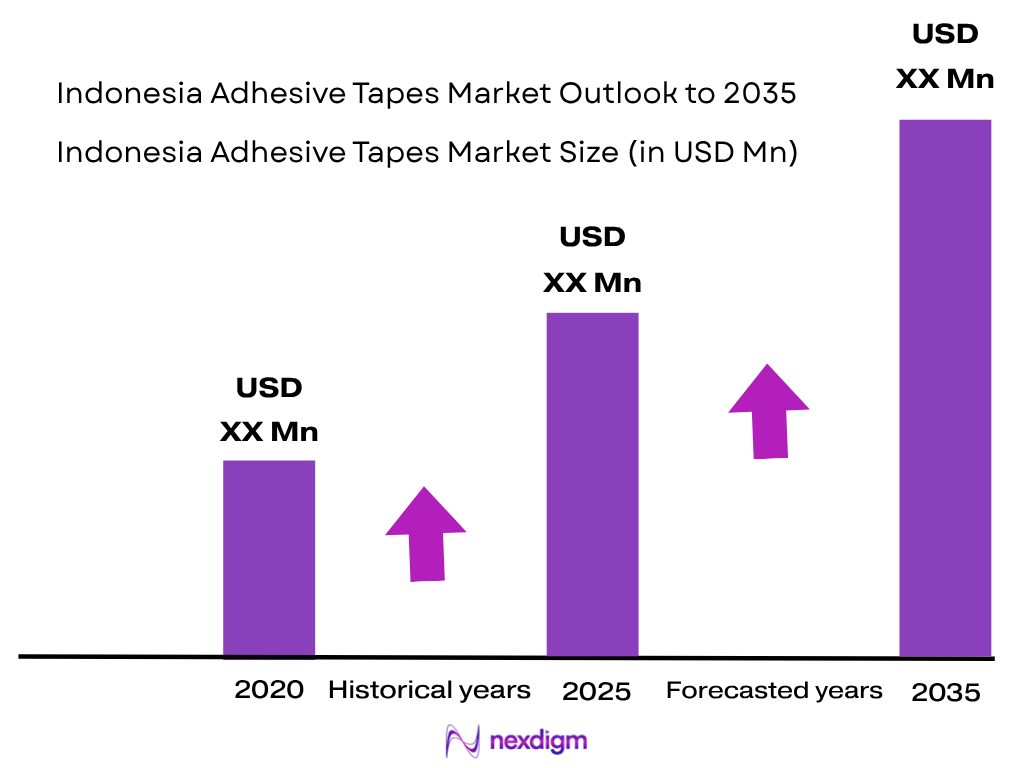
The Indonesia adhesive tapes market is estimated at USD XX million in 2024, with demand anchored by packaging, logistics, manufacturing, construction, automotive, electronics and consumer-goods applications. A current commercial market benchmark places Indonesia at USD 719.6 million in 2025, providing a reference point for the historical sizing framework. The market is supported by the country’s large industrial base and merchandise trade activity: Indonesia recorded US$266.53 billion in exports in the latest full-year trade dataset, compared with US$259.54 billion a year earlier. Adhesive tapes therefore function as both packaging consumables and engineered assembly materials across Indonesia’s expanding industrial supply chains.
Indonesia’s adhesive-tape demand is concentrated around Jakarta, Tangerang, Bekasi, Karawang, Bandung, Surabaya, Semarang and Batam, reflecting the geographic concentration of manufacturing, logistics, electronics, automotive and construction activity. Greater Jakarta and the surrounding West Java industrial corridor are particularly important because they combine major consumer markets with manufacturing and distribution infrastructure. Batam has strategic relevance for electronics and export-oriented manufacturing, while Surabaya provides a major East Java industrial and logistics base. Indonesia’s e-commerce ecosystem further reinforces demand: the country’s digital economy reached US$90 billion in GMV, while e-commerce reached US$65 billion, according to the e-Conomy SEA 2024 country assessment.
Market Segmentation
By Adhesive Technology
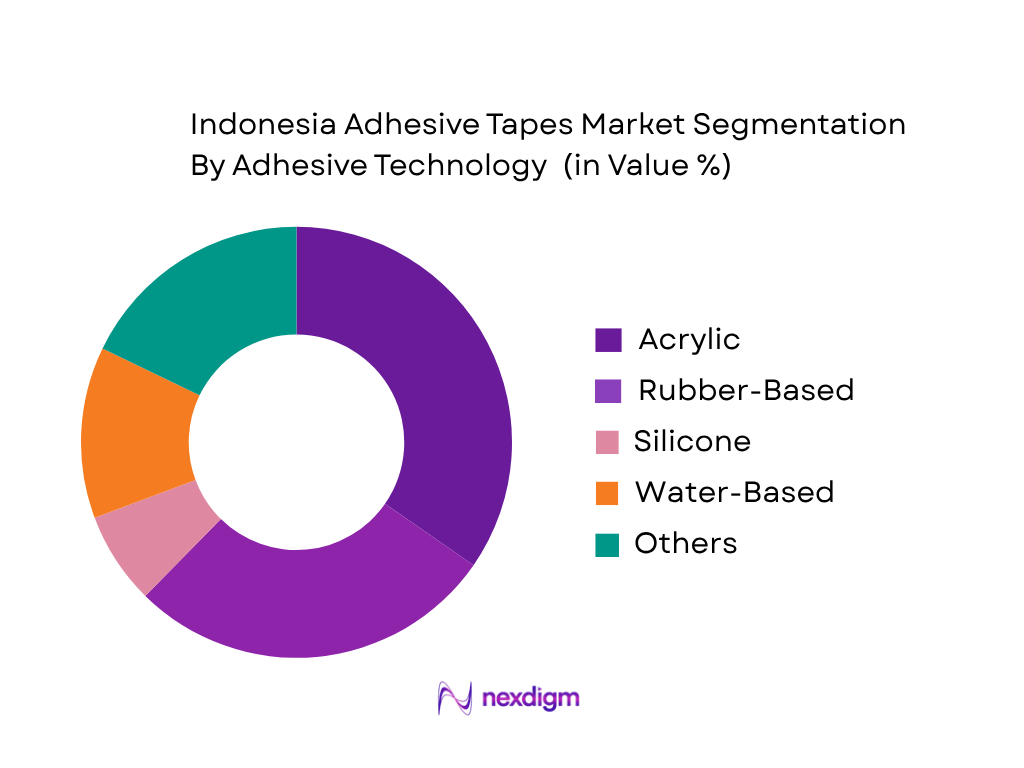
The Indonesia adhesive tapes market is segmented into acrylic, rubber-based, silicone, water-based, solvent-based and hot-melt adhesive technologies. Acrylic is positioned as the leading technology because it combines strong adhesion with weathering, ageing and temperature resistance and can serve multiple substrates used in packaging, automotive, electronics, construction and industrial assembly. Industry-specific Indonesian market research also identifies acrylic as the leading resin category, supported by its broad application range and durability. Rubber-based systems remain important in packaging, mounting and high-tack applications, while silicone tapes occupy higher-performance niches requiring temperature resistance and demanding substrate compatibility. Water-based and hot-melt systems benefit from their relevance to packaging and manufacturing processes, whereas solvent-based formulations continue to serve applications where aggressive adhesion and specific coating characteristics are required. The technology mix is increasingly influenced by automation, substrate diversity, environmental requirements and the replacement of mechanical fastening. For Indonesian converters, the distinction between commodity and specialty adhesive systems is becoming strategically important as automotive, electronics and industrial customers demand tighter performance specifications and consistent bonding under humid tropical conditions.
By End-Use Industry
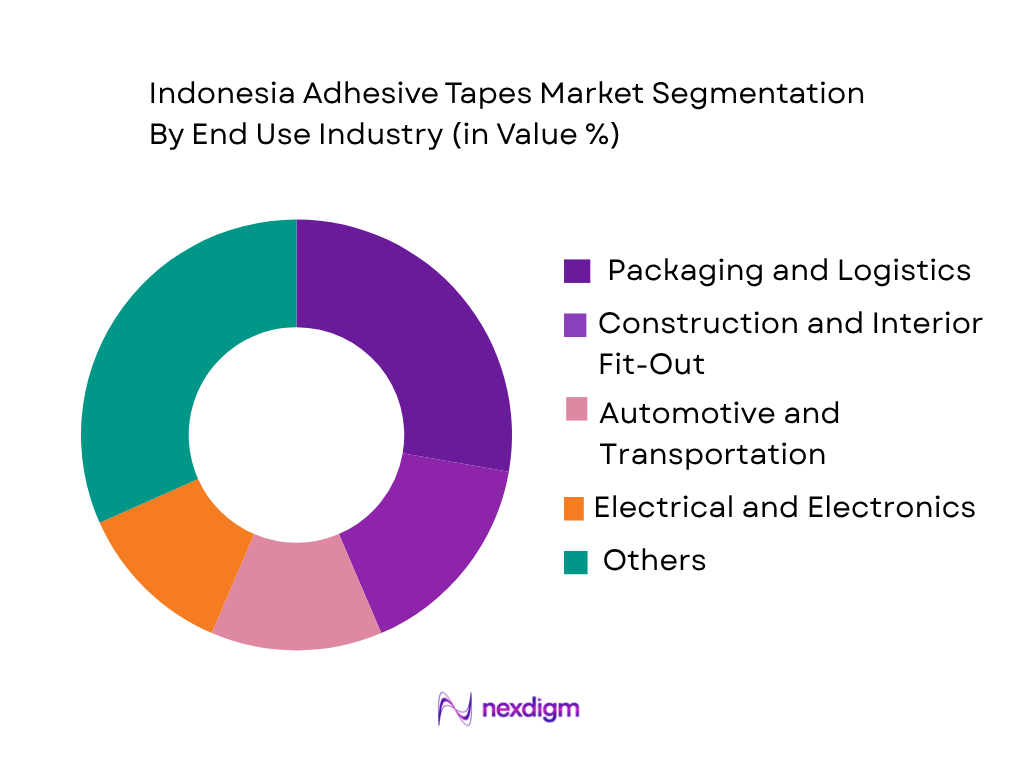
The Indonesia adhesive tapes market is segmented across packaging and logistics, construction and interior fit-out, automotive and transportation, electrical and electronics, HVAC and MEP, healthcare and pharmaceuticals, industrial manufacturing, aerospace and defense, furniture and interiors, food and beverage, and marine and specialty applications. Packaging and logistics represents the leading demand pool because tapes are consumed continuously for carton sealing, bundling, palletizing, parcel handling and secondary packaging. The importance of this segment is reinforced by Indonesia’s e-commerce scale: national e-commerce GMV reached US$65 billion, while the broader digital economy reached US$90 billion. Packaging demand is complemented by manufacturing and construction requirements. Construction accounted for approximately 10.43 of Indonesia’s GDP in the fourth quarter of 2024, according to BPS, illustrating the scale of the built-environment sector that uses mounting, masking, insulation, protective and assembly tapes. Automotive, electronics and industrial manufacturing generate additional specialty-tape demand where acrylic foam, double-sided, electrical, thermal-management and die-cut tapes can replace conventional fastening approaches.
Competitive Landscape
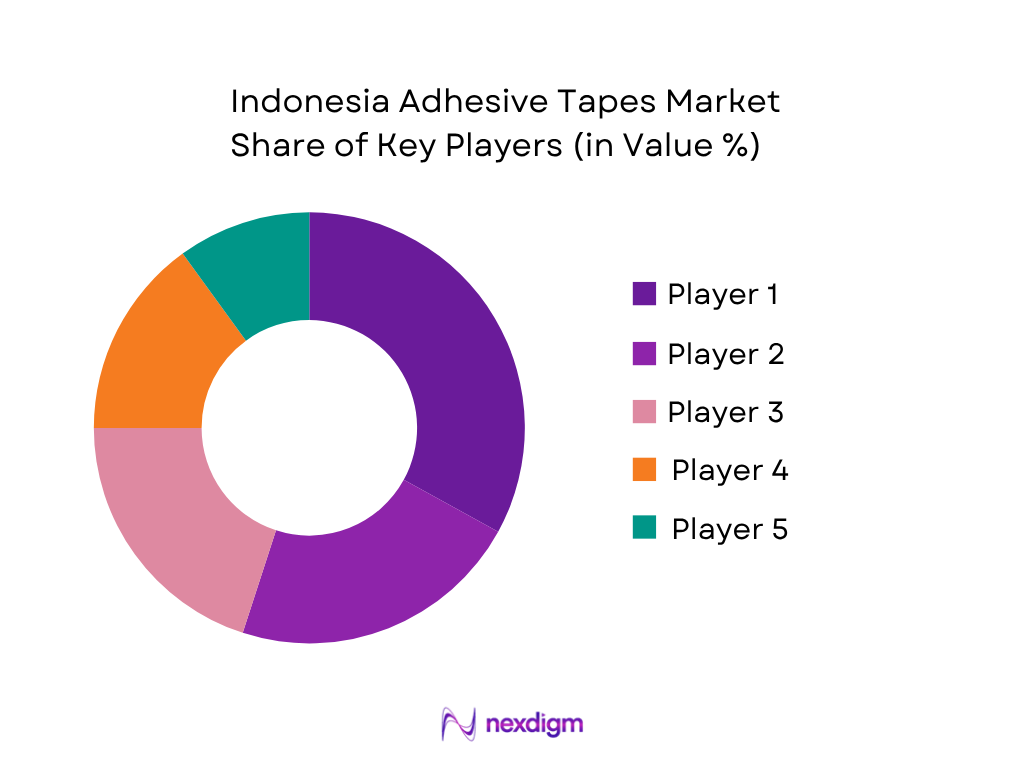
The Indonesia adhesive tapes market combines global adhesive-technology leaders with regional suppliers, local converters and distributors. Competition is shaped not only by brand recognition but also by adhesive chemistry, backing-material availability, local converting capability, application engineering and the ability to satisfy OEM qualification requirements. 3M’s Indonesian portfolio, for example, covers packaging, electrical, filament, foam, foil, specialty, splicing and surface-protection tapes, while tesa identifies automotive, electronics, construction, furniture and printing/paper among its Indonesian-relevant industrial solution areas. Henkel has operated in Indonesia since 1974 and maintains four local facilities/locations, with its Indonesian headquarters in Tangerang, Banten.
| Major Player | Established | Headquarters | Adhesive Technology Focus | Key Tape Portfolio | Major Indonesia End Uses | Application Capability | Indonesia Market Positioning |
| 3M | 1902 | St. Paul, Minnesota, USA | ~ | ~ | ~ | ~ | ~ |
| Nitto Denko | 1918 | Osaka, Japan | ~ | ~ | ~ | ~ | ~ |
| tesa SE | 1941 | Norderstedt, Germany | ~ | ~ | ~ | ~ | ~ |
| Avery Dennison | 1935 | Mentor, Ohio, USA | ~ | ~ | ~ | ~ | ~ |
| Henkel | 1876 | Düsseldorf, Germany | ~ | ~ | ~ | ~ | ~ |
Indonesia Adhesive Tapes Market Analysis
Growth Drivers
Packaging and E-Commerce Fulfilment Expansion
Indonesia’s packaging-oriented adhesive-tape demand is being reinforced by the scale of merchandise movement and rapid digital commerce adoption. Indonesia recorded US$266.53 billion in exports and US$235.20 billion in imports in 2024, creating a large base of cartons, pallets, parcels, export packaging and industrial handling activity requiring carton-sealing, bundling and mounting tapes. Bank Indonesia also reported 34.5 billion digital-payment transactions in 2024, while QRIS transaction volume increased by 175.2% during the year, illustrating the accelerating digital-commerce infrastructure surrounding online purchases and fulfilment. The country’s digital economy generated approximately US$90 billion in GMV, with e-commerce contributing US$65 billion, according to Bank Indonesia/Google’s Indonesia digital-economy assessment. These developments directly support recurring consumption of BOPP carton-sealing tapes, paper tapes, double-sided mounting tapes and specialty packaging tapes across fulfilment centres, warehouses, distributors and manufacturers. The scale of Indonesia’s import structure is equally relevant: BPS recorded US$170.72 billion of imports as raw and auxiliary materials and US$41.75 billion as capital goods, indicating extensive industrial supply-chain activity in which adhesive tapes are used for packaging, component fixation, bundling and process applications.
Electronics, Semiconductor and Industrial Manufacturing Expansion
Indonesia’s industrial investment base is creating a broader addressable market for technically specified adhesive tapes used in assembly, insulation, mounting, thermal management, surface protection and component fixation. Total investment realization reached IDR1,714.2 trillion in 2024 and generated 2,456,130 jobs, while downstream-sector investment reached IDR407.8 trillion. Importantly for adhesive-tape applications, the electric-vehicle battery ecosystem alone attracted IDR8.4 trillion of investment in battery manufacturing. Electronics manufacturing also provides a substantial demand channel: Indonesia recorded US$25.43 billion of electronics imports in 2024 against US$9.23 billion of electronics exports, demonstrating the scale of equipment, components and finished products moving through the domestic electronics ecosystem. Kementerian Perindustrian reported that the metal products, computers, electronics, optical goods and electrical-equipment industry grew 7.29 in the third quarter of 2024, while electronics exports reached US$10.07 billion during the first three quarters. These activities require increasingly specialized tapes, including double-sided acrylic tapes, PET electrical tapes, high-temperature systems, thermal-management tapes and cleanroom-compatible products. The development of EV and battery manufacturing in Karawang is particularly relevant because battery-cell and vehicle assembly processes require controlled bonding, insulation and component fixation. Consequently, Indonesia’s manufacturing expansion is supporting a shift from commodity packaging tapes toward higher-value engineered tape applications.
Market Challenges
Imported Master-Roll Dependency and Exposure to Imported Polymer and Adhesive Feedstocks
Indonesia’s adhesive-tape industry operates within a broader manufacturing economy that remains substantially dependent on imported intermediate materials, creating exposure to international supply disruptions, freight conditions, exchange-rate movements and upstream polymer availability. BPS recorded total Indonesian imports of US$235.20 billion in 2024, including US$198.92 billion of non-oil-and-gas imports. Raw and auxiliary materials represented US$170.72 billion, while capital-goods imports reached US$41.75 billion, illustrating the importance of imported inputs throughout domestic manufacturing. China alone supplied US$73.85 billion of Indonesian imports, while Singapore supplied US$21.53 billion and Japan US$14.98 billion, demonstrating the concentration of important Asian supply routes. Tanjung Priok handled US$86.72 billion of imports, making the port particularly important for imported industrial inputs entering Indonesia. For adhesive-tape producers and converters, dependence on imported master rolls, polymer films, specialty resins, release liners and other components can increase lead-time exposure and complicate inventory management. The challenge becomes more pronounced for technically demanding tapes because substitution between suppliers may require qualification testing, substrate validation and customer approval. Indonesia’s large manufacturing investment base therefore creates demand while simultaneously increasing the importance of supply-chain resilience. Local slitting, coating, lamination and specialty conversion can reduce selected dependencies, but advanced adhesive chemistry and specialized backing materials remain areas where international supply relationships continue to matter. (Badan Pusat Statistik Indonesia)
Tropical Humidity, Adhesive Performance Degradation and Advanced-Tape Qualification Requirements
Indonesia’s tropical operating environment creates demanding conditions for adhesive tapes used in construction, automotive, electronics, logistics, HVAC and outdoor applications. High humidity, moisture exposure and elevated temperatures can influence tack, peel strength, shear performance, dimensional stability and long-term adhesion, making formulation and substrate selection critical. This challenge becomes more significant as Indonesian manufacturing moves toward higher-specification applications. The country’s electronics sector imported US$25.43 billion of electronic products in 2024, while electronics exports reached US$9.23 billion, demonstrating a substantial installed base where bonding materials may need to satisfy tighter application specifications. Automotive production also represents an important technical-use environment: domestic four-wheel vehicle production reached approximately 1.09 million units during January–November 2024, while full-year wholesales reached 865,723 units and retail sales reached 889,680 units. At the same time, Indonesia’s investment realization reached IDR1,714.2 trillion, indicating continued expansion of industrial facilities where specialized mounting, insulation and assembly tapes can be required. These conditions raise qualification requirements because industrial buyers cannot simply substitute a commodity tape for a technically validated product without testing adhesion, temperature resistance, humidity resistance, substrate compatibility and service life. For suppliers, this means technical support and application engineering become important competitive differentiators, while smaller converters may face difficulties developing and validating advanced products.
Market Opportunities
High-Performance Acrylic Foam Tapes, EV and Battery Assembly Tapes, and Semiconductor/Electronics Tapes
Indonesia’s current investment pipeline creates an opportunity to expand from conventional packaging tapes into engineered bonding products. Investment realization reached IDR1,714.2 trillion in 2024, with IDR407.8 trillion directed toward downstream industries and IDR8.4 trillion toward the EV battery manufacturing ecosystem. The Karawang EV and battery project itself represented an investment of US$4.46 billion, covering an integrated ecosystem extending from mining and processing through precursor and battery-cell manufacturing to EV production. These activities create potential applications for acrylic foam tapes, electrically insulating tapes, thermal-management tapes, component-mounting tapes, protective films and die-cut adhesive components. Electronics provides another opportunity: Indonesia recorded US$25.43 billion in electronics imports and US$9.23 billion in electronics exports in 2024, while electronics-product exports had already reached US$10.07 billion through the first three quarters according to Kementerian Perindustrian. Such production and assembly activity requires tapes capable of maintaining adhesion under thermal cycling, vibration, humidity and demanding substrate conditions. Suppliers able to provide application-specific products, technical qualification support and local converting can therefore capture value beyond standard carton-sealing products. The opportunity is particularly strong where adhesive tapes can replace screws, rivets or liquid adhesives while improving assembly speed, appearance, weight and automation compatibility.
Sustainable BOPP Packaging Tapes, Low-VOC Systems, HVAC Foil Tapes and Solar Applications
Indonesia’s expanding industrial, logistics and energy infrastructure creates a pathway for specialty tapes that combine performance with lower environmental impact. The country’s exports reached US$266.53 billion and imports reached US$235.20 billion in 2024, indicating extensive movement of manufactured goods and associated packaging requirements. Construction also remained a major economic activity, contributing 10.43 of GDP in the fourth quarter of 2024, supporting demand for mounting, masking, insulation, sealing and HVAC-related tapes. Renewable-energy deployment provides an additional application opportunity: the Ministry of Energy and Mineral Resources reported 217.73 MW of additional installed renewable-energy capacity during the first half of 2024, with hydropower and solar among the principal contributors. These developments create opportunities for durable tapes used in insulation, foil joining, sealing, mounting and renewable-energy equipment assembly. Sustainable BOPP tapes and lower-VOC adhesive technologies can address customers seeking reduced material intensity and improved workplace or environmental performance without sacrificing packaging efficiency. Local specialty-tape conversion is another strategic opportunity because Indonesia’s large industrial investment base and geographically dispersed demand create requirements for customized widths, lengths, die-cut formats and application-specific constructions. Producers that combine imported high-performance materials with domestic slitting, rewinding, lamination and die-cutting can potentially shorten supply chains while offering localized technical support.
Future Outlook
Over the coming decade, Indonesia’s adhesive tapes market is expected to move progressively from high-volume commodity applications toward a more differentiated mix of engineered and application-specific tapes. Packaging and e-commerce will remain important consumption anchors, while electronics, automotive, EV-related manufacturing, construction, HVAC and industrial automation should increase demand for higher-performance products. Indonesia’s 2024 merchandise exports reached US$266.53 billion, supporting the importance of reliable packaging and industrial supply chains. Meanwhile, BPS manufacturing statistics track production across medium and large manufacturers, providing a broad industrial base for adhesive-tape applications.
Growth opportunities are likely to be strongest in acrylic foam tapes, electronics assembly tapes, electrical insulation tapes, die-cut components, thermal-management tapes, sustainable packaging tapes, HVAC foil tapes and low-VOC systems. Local converting and customization can also become more important as customers seek shorter lead times, application-specific dimensions and reduced dependence on imported finished tapes.
Major Players
- 3M Company
- Nitto Denko Corporation
- tesa SE
- Avery Dennison Corporation
- Henkel AG & Co. KGaA
- LINTEC Corporation
- Saint-Gobain
- Lohmann GmbH & Co. KG
- Essentra plc
- Intertape Polymer Group
- Nichiban Co., Ltd.
- ORAFOL Europe GmbH
- Scapa Group
- Gergonne – The Adhesive Solution
- PT Hasri Anekatama
Key Target Audience
- Adhesive tape manufacturers and industrial adhesive solution providers
- Master-roll producers, coating companies and local tape converters
- Packaging, logistics and e-commerce fulfilment companies
- Automotive, EV and component manufacturers
- Electrical, electronics and semiconductor manufacturers
- Construction, HVAC, MEP and interior-fit-out companies
- Investments and venture capitalist firms (industrial-materials investors, private-equity investors and manufacturing-focused venture capital firms)
- Government and regulatory bodies (Ministry of Industry, Ministry of Trade, Indonesia Investment Authority, Directorate General of Customs and Excise, and Badan Standardisasi Nasional)
Research Methodology
Step 1: Identification of Key Variables
The initial stage establishes the Indonesia adhesive tapes ecosystem across raw-material suppliers, adhesive formulators, backing-material producers, master-roll manufacturers, converters, distributors and end users. Product variables include adhesive chemistry, backing material, construction, tape format and performance specification. Demand variables cover packaging, automotive, electronics, construction, HVAC and industrial applications.
Step 2: Market Analysis and Construction
Historical market data are reconstructed using manufacturer activity, import-export statistics, production indicators, distribution structures and end-user demand. Indonesia’s trade statistics provide product-level customs data in kilograms and US dollars, while BPS manufacturing and construction datasets establish the industrial-demand framework. The methodology separates finished-tape imports from domestic conversion to avoid double counting.
Step 3: Hypothesis Validation and Expert Consultation
Market hypotheses are validated through interviews with adhesive-tape manufacturers, converters, distributors, packaging companies, automotive suppliers, electronics manufacturers and industrial procurement specialists. Discussions focus on adhesive technology selection, substrate compatibility, qualification procedures, imported master-roll dependence, local conversion and application-specific requirements.
Step 4: Research Synthesis and Final Output
The final market model triangulates supply-side production and trade information with bottom-up end-use consumption. Competitive benchmarking evaluates product breadth, technology capabilities, local presence, converting capacity and application engineering. The resulting dataset is structured to support strategic decisions concerning market entry, localization, product development, distribution and investment.

- Executive Summary
- Research Methodology (Market Definition and Scope, Product Classification Framework, Adhesive-Tape Taxonomy, Top-Down Market Sizing, Bottom-Up Market Reconstruction, Volume Conversion, Import-Export Validation, End-Use Demand Mapping, Local Converter Assessment, Distributor Mapping, Primary Industry Interviews, Secondary Data Validation, Data Triangulation, Forecasting Framework, Scenario Analysis, Assumptions and Limitations)

- Definition and Scope
- Evolution of the Indonesian Adhesive Tapes Industry
- Indonesia Adhesive Tapes Industry Ecosystem
- Indonesia Adhesive Tapes Value Chain Analysis
- Raw Material Ecosystem

- Growth Drivers (Packaging and E-Commerce Fulfilment Expansion, Electronics and Semiconductor Manufacturing, Automotive Production, Construction Activity, Industrial Manufacturing, HVAC Installation, Logistics Infrastructure and Lightweight Bonding Adoption)
- Market Challenges (Imported Master-Roll Dependency, Imported Polymer and Adhesive Feedstock Exposure, Tropical Humidity, Adhesive Performance Degradation, Commodity-Tape Competition, Advanced-Tape Qualification Requirements, Technical Application Knowledge and Fragmented Conversion Capacity)
- Market Opportunities (High-Performance Acrylic Foam Tapes, Semiconductor and Electronics Tapes, EV and Battery Assembly Tapes, Sustainable BOPP Packaging Tapes, Low-VOC Adhesive Systems, HVAC Foil Tapes, Solar Applications, Thermal-Management Tapes, Smart Functional Tapes and Local Specialty-Tape Conversion)
- Market Trends (Lightweight Bonding, Mechanical-Fastener Replacement, Premiumization of Specialty Tapes, Low-VOC Chemistry, Sustainable Backings, High-Temperature Adhesives, Electrification, Semiconductor Miniaturization, Die-Cut Components, Automated Assembly and Application-Specific Tape Solutions)
- Government and Regulatory Framework (SNI Standards, Ministry of Industry Requirements, Ministry of Trade Regulations, Chemical Management, Occupational Safety, Environmental Compliance, Product Labelling and Packaging Requirements)
- Porter’s Five Forces Analysis
- PESTLE Analysis
- SWOT Analysis

- By Market Value (2020-2025)
- By Volume Consumption (2020-2025)
- By Average Selling Price (2020-2025)
- By Adhesive Technology (2020-2025)
- By Tape Construction (2020-2025)
- By Backing Material (2020-2025)
- By End-Use Industry (2020-2025)
- By Application (2020-2025)

- By Adhesive Technology (In Value %)
Acrylic Adhesive Tapes
Rubber-Based Adhesive Tapes
Silicone Adhesive Tapes
Water-Based Adhesive Tapes
Solvent-Based Adhesive Tapes
Hot-Melt Adhesive Tapes
Hybrid and Specialty Adhesive Systems - By Tape Construction (In Value %)
Single-Sided Tapes
Double-Sided Tapes
Transfer Tapes
Foam Tapes
Filament and Reinforced Tapes
Masking Tapes
Packaging and Carton-Sealing Tapes
Electrical Insulation Tapes
Protective Surface Tapes
Specialty Industrial Tapes - By Backing Material (In Value %)
BOPP Backing
PET Backing
PVC Backing
Paper and Crepe Paper Backing
PE and Polyolefin Backing
Foam Backing
Aluminum Foil Backing
Nonwoven Backing
Fabric and Cloth Backing
Specialty Film Backings - By End-Use Industry (In Value %)
Packaging and Logistics
E-Commerce Fulfilment
Electrical and Electronics
Semiconductor Manufacturing
Automotive and Transportation
Building and Construction
HVAC and MEP
Healthcare and Pharmaceuticals
Industrial Manufacturing
Furniture and Interiors
Food and Beverage
Marine and Specialty Applications - By Application (In Value %)
Carton Sealing and Case Closing
Parcel Packaging and Fulfilment
Bundling and Palletizing
Mounting and Assembly
Wire Harnessing and Electrical Insulation
Thermal Insulation and HVAC Sealing
Surface Protection
Masking and Paint Application
Splicing and Web Joining
Lamination and Composite Assembly
Component Fixation
Automotive Trim Attachment
Signage and Graphic Mounting
Die-Cut Component Assembly - By Performance Requirement (In Value %)
High-Temperature Resistance
High Shear Strength
High Peel Adhesion
UV Resistance
Humidity and Moisture Resistance
Chemical Resistance
Flame Retardancy
Electrical Insulation
Low-VOC Performance
Outdoor Durability
Clean Removability

- Market Share of Major Players (By Value, Volume, Adhesive Technology, Tape Construction, Backing Material, End-Use Industry, Application and Distribution Channel)
- Cross Comparison Parameters (Product Portfolio Breadth, Local Manufacturing and Conversion Capacity, Adhesive Technology Depth, Specialty-Tape Capability, Electronics and Semiconductor Tape Portfolio, Automotive Tape Portfolio, Die-Cutting and Customization Capability, Distribution and Technical-Service Network)
- Competitive SWOT Assessment Of Major Players
- Detailed Profiles of Major Companies
3M Company
tesa SE
Nitto Denko Corporation
Avery Dennison Corporation
Henkel AG & Co. KGaA
Sika AG
Saint-Gobain
Lohmann GmbH & Co. KG
LINTEC Corporation
Berry Global Group, Inc.
ORAFOL Europe GmbH
Shurtape Technologies, LLC
Intertape Polymer Group
Scapa Group
PT Hasri Anekatama

- Packaging and Logistics End Users
- E-Commerce End Users
- Electrical and Electronics End Users
- Semiconductor End Users
- Automotive End Users
- Construction End Users
- HVAC and MEP End Users
- Industrial Manufacturing End Users

- By Market Value (2026-2035)
- By Volume Consumption (2026-2035)
- By Average Selling Price (2026-2035)
- By Adhesive Technology (2026-2035)
- By Tape Construction (2026-2035)
- By Backing Material (2026-2035)
- By End-Use Industry (2026-2035)
- By Application (2026-2035)


 Request a Sample
 Ask for Customization
 Get a Quote
 Enquire Now